$2$-stratifolds with fundamental group $\mathbb{Z}$
J. C. G\'omez-Larra\~naga, F. Gonz\'alez-Acu\~na, Wolfgang Heil

TL;DR
This paper classifies trivalent 2-stratifolds with fundamental group Z, providing a clear characterization and an efficient algorithm to determine this property from their associated labelled graphs.
Contribution
It offers a classification of trivalent 2-stratifolds with fundamental group Z and introduces an algorithm for identifying this from their labelled graphs.
Findings
Classification of trivalent 2-stratifolds with fundamental group Z
Development of an efficient graph-based decision algorithm
Extension of previous 1-connected case results
Abstract
-stratifolds are a generalization of -manifolds that occur as objects in applications such as in TDA. These spaces can be described by an associated bicoloured labelled graph. In previous papers we obtained a classification of 1-connected trivalent -stratifolds. In this paper we classify trivalent -stratifolds that have fundamental group . This classification implicitly gives an efficient algorithm that applies to a bicoloured labelled graph to decide wether the associated -stratifold has fundamental group .
Click any figure to enlarge with its caption.
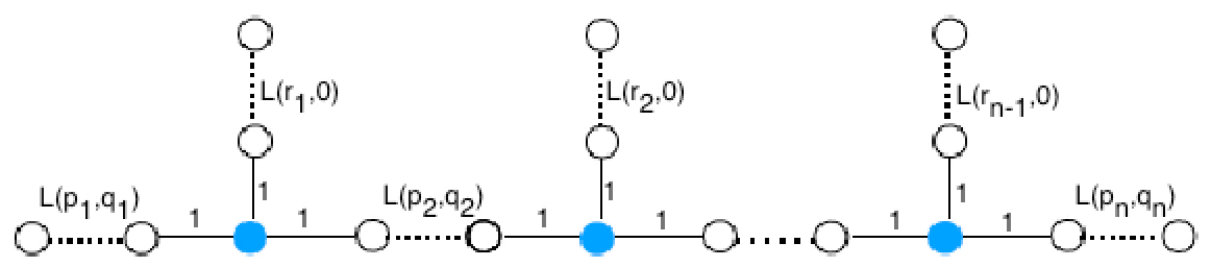 Figure 1
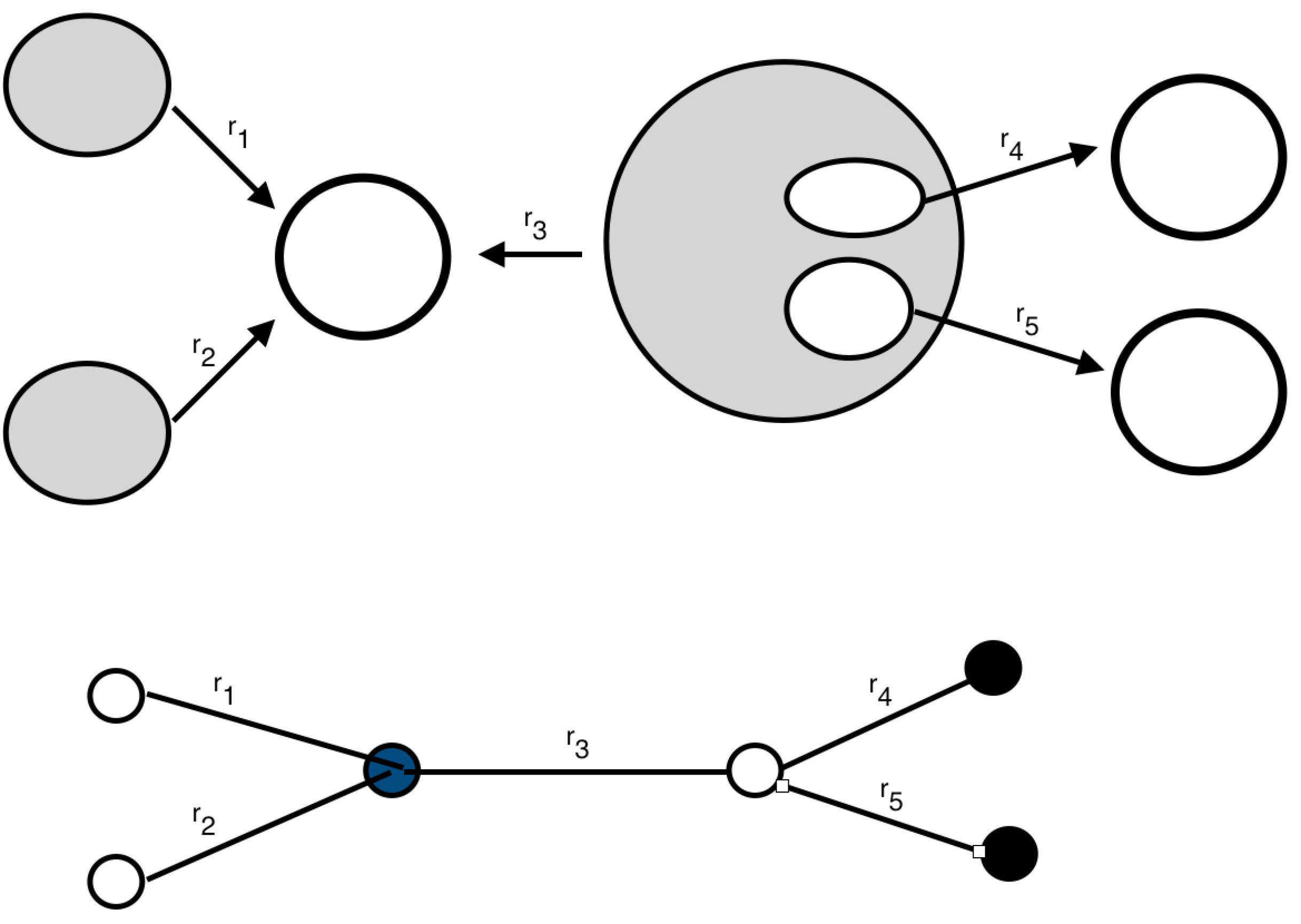 Figure 2
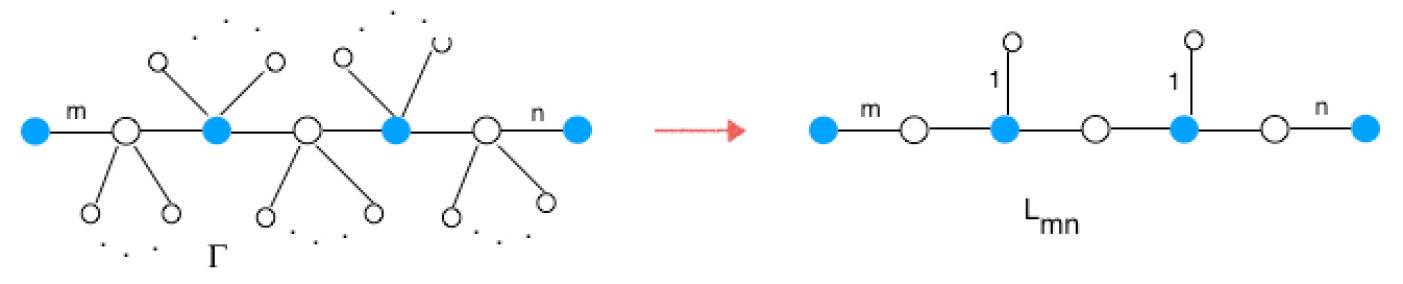 Figure 3
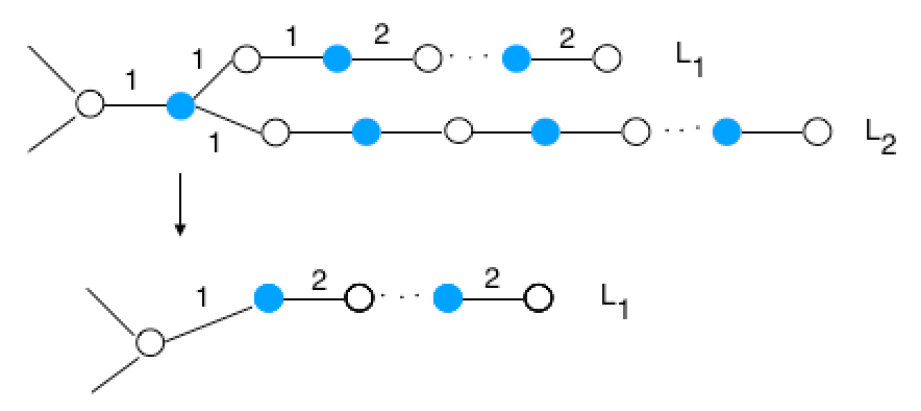 Figure 4
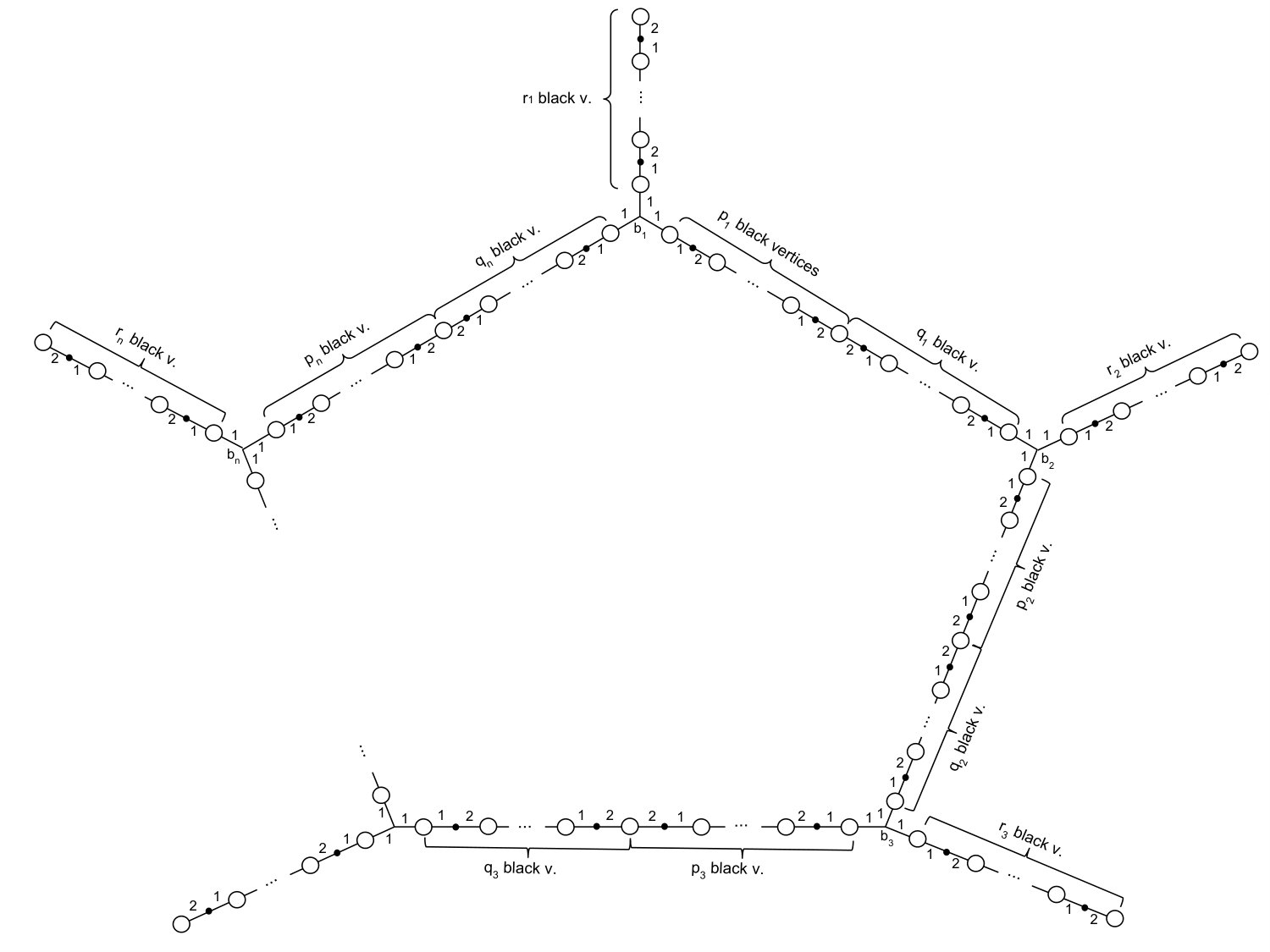 Figure 5
Peer Reviews
No public reviews on file for this paper yet. If you reviewed it on a platform where reviews are public (OpenReview, ICLR, NeurIPS, ICML), you can paste yours below so the community can read it here.
Videos
No videos yet. Explain this paper in a talk, walkthrough, or lecture? Add one.
Taxonomy
TopicsTopological and Geometric Data Analysis · Geometric and Algebraic Topology · Advanced Combinatorial Mathematics
-stratifolds with fundamental group
J. C. Gómez-Larrañaga Centro de Investigación en Matemáticas, A.P. 402, Guanajuato 36000, Gto. México. [email protected]
F. González-Acuña Instituto de Matemáticas, UNAM, 62210 Cuernavaca, Morelos, México and Centro de Investigación en Matemáticas, A.P. 402, Guanajuato 36000, Gto. México. [email protected]
Wolfgang Heil Department of Mathematics, Florida State University, Tallahasee, FL 32306, USA. [email protected]
Abstract
-stratifolds are a generalization of -manifolds that occur as objects in applications such as in TDA. These spaces can be described by an associated bicoloured labelled graph. In previous papers we obtained a classification of 1-connected trivalent -stratifolds. In this paper we classify trivalent -stratifolds that have fundamental group . This classification implicitly gives an efficient algorithm that applies to a bicoloured labelled graph to decide wether the associated -stratifold has fundamental group . 111AMS classification numbers: 57N10, 57M20, 57M05 222Key words and phrases: 2-stratifolds, fundamental group
1 Introduction
A (closed) -stratifold is a compact connected -dimensional cell complex that can be constructed from a disjoint union of compact (connected) -manifolds and a disjoint union of circles by attaching each component of to via a covering map , with for . These -stratifolds form a special class of -dimensional stratified spaces. Matsuzaki and Ozawa [14] defined and studied a slightly more general class of -dimensional stratified spaces, which they call multibranched surfaces, by allowing boundary curves, i.e. considering covering maps , where is a sub collection of the components of . A -stratifold can be described by its bicoloured labelled graph , whose white vertices are the components , the black vertices are the components of , and an edge is a component of , where the label on an edge is the degree of the attaching map .
-stratifolds arise as the nerve of certain Lusternick-Schnirelman type decompositions of -manifolds into pieces where they determine whether the -category of the -manifold is or ([6]). They are related to foams, which include special spines of -dimensional manifolds and which have been studied by Khovanov [11] and Carter [3]. Matsuzaki and Ozawa showed that every -stratifold embeds in , however embeds into some orientable closed -manifold if and only if the singular set satisfies a certain regularity condition. In [9] we showed that very few -stratifolds occur as spines of closed -manifolds.
Graphs can be thought of as being -stratifolds and persistent graphs occur in Topological Data Analysis [12]. The use of -dimensional stratified spaces in TDA has been proposed in the literature [1], with a concrete example given in [2]. It seems likely that -stratifolds will be used in a similar fashion as models for applications. For example they occur in the study of the energy landscape of cyclo-octane [13], and -stratifolds with boundary and foams with and without boundary occur in the study of boundary singularities produced by the motion of soap films [5].
Closed -manifolds are classified in terms of their fundamental groups, but for a given -stratifold there are infinitely many non-homeomorphic -stratifolds with the same fundamental group. Since the group can be computed from the labelled graph one would like to obtain conditions on the type of bicoloured labelled graphs that correspond to a given fundamental group. As a first step in this direction we obtained in [7] conditions on the labelled graph such that the associated -stratifold is -connected and in [8] we give a complete classification of -connected trivalent -stratifolds in terms of their graphs. The term trivalent means that each point of has a neighborhood where three sheets meet. For these -stratifolds we developed an efficient algorithm to decide whether they are simply connected and implemented the algorithm in [10].
The ultimate goal is to obtain a classification of all -stratifolds in terms of their labelled graphs. In particular, with a view towards applications, one would like to have efficient algorithms for deciding whether a given -stratifold is of a certain type. In this paper we consider -stratifolds whose fundamental group is infinite cyclic. In sections 3 and 4 we obtain necessary and sufficient conditions on and the type of the graph such that . However for a general -stratifold graph it is difficult to obtain conditions on the labelling that guarantee that has fundamental group . We are able to do this in section 6 for trivalent -stratifolds, after obtaining a classification for an interesting type of trivalent graphs, the echinus graphs, in section 5. The main Theorem in section 6 provides a complete classification, in terms of conditions that can be read off from the labelled graph, of trivalent -stratifolds with fundamental group .
2 -stratifolds and their graphs
We first review the basic definitions and some results given in [7] and [8]. A -stratifold is a compact, Hausdorff space that contains a closed (possibly disconnected) -manifold as a closed subspace with the following property: Each point has a neighborhood homeomorphic to , where is the open cone on for some (finite) set of cardinality and is a (possibly disconnected) -manifold.
A component of has a regular neighborhood that is homeomorphic to , where is the closed cone on the discrete space and is a homeomorphism whose restriction to is the permutation . The space depends only on the conjugacy class of and therefore is determined by a partition of . A component of corresponds to a summand of the partition determined by . Here the neighborhoods are chosen sufficiently small so that is disjoint from for disjoint components and of .
For a given - stratifold there is an associated bipartite graph embedded in as follows:
The white vertices of the graph are the components of the -manifold where runs over the components of . The black vertices are the ’s. An edge is a component of ; it joins a white vertex with a black vertex if . Note that the number of boundary components of is the number of adjacent edges of .
We label the graph by assigning to a white vertex the genus of and by labelling an edge by , where is the summand of the partition corresponding to the component of . (Here we use Neumann’s [15] convention of assigning negative genus to nonorientable surfaces; for example the genus of the projective plane or the Moebius band is , the genus of the Klein bottle is ). Note that the partition of a black vertex is determined by the labels of the adjacent edges.
In sections 5 and 6 we obtain a classification of trivalent -stratifolds in terms of their labelled graphs. Here a -stratifold and its labeled bicoloured graph are defined to be trivalent, if each black vertex is incident to either three edges each with label or to two edges, one with label , the other with label , or is a terminal vertex with adjacent edge of label . This means that a neighborhood of a point of a component of the -skeleton has sheets; the permutation of the regular neighborhood has partition or or .
Notation. If is a bipartite labelled graph corresponding to the -stratifold we let and . If is of genus [math], we do not label .
Another description of is as a quotient space , where and where is a covering map (and for every ). For a component of the label on the corresponding edge then corresponds to the attaching map . An example is given in the picture below.
If is a tree, then the labeled graph determines uniquely. If is not a tree then we need some additional data for which consists of a cocycle together with a function assigning to each edge of value or such that, for every simple cycle whose edges are , . Here we identify , the cyclic group of order , with under multiplication.
One may assume such an evaluation is constructed as follows: take a maximal tree in , and let if is an edge of and if is in and is the cycle of . With this evaluation, the labelled graph together with a cocycle determines uniquely.
Thus if is homotopy equivalent to there is at most one (arbitrarily chosen) edge in the simple closed cycle of with .
The fundamental group of can be computed from the labelled graph . Generators of are the generators of for each white vertex , one generator for each black vertex (also denoted by ), and one generator for each edge outside a maximal tree of . Relations are those of , , for each edge between and with label , and , for each edge between and with label ().
In [7] we showed the following.
Proposition 1**.**
There is a retraction such that is a singular curve and is a -manifold .
For simplicity, if is a black vertex of , we will sometimes write instead of . Also we will write instead of .
For a given labelled graph we often prune away certain edges and vertices to obtain a subgraph such that there is an epimorphism as follows: For a subgraph of let . This is almost a -stratifold, except that has possibly boundary curves corresponding to edges of , where is the star of in . Let be the quotient of obtained by collapsing the closure of each component of to a point i.e. is obtained from by attaching disks to its boundary curves. Then is a -stratifold, , where is the union of and the labeled edges (with their vertices) of which are adjacent to a black vertex of . Then the quotient map induces surjections of fundamental groups and first homology groups.
Using Proposition 1 and this pruning construction we show in [7] the following
Proposition 2**.**
If is simply connected, then is a tree, all white vertices of have genus [math], and all terminal vertices are white.
3 The homotopy type of the graph
In this section we show that a necessary condition for to be infinite cyclic is that the associated graph is homotopy equivalent to a circle, the labels on all white vertices are [math] and all terminal vertices are white.
In the following Lemma denotes a closed surface of genus .
Lemma 1**.**
*Let be any graph of a -stratifold .
(1) If has (at least) two black terminal vertices then there is an epimorphism for some .
(2) If has a black terminal vertex and contains a white vertex of genus then there is an epimorphism for some .
(3) If contains two white vertices of genera , then there is an epimorphism .*
Proof.
(1) Let be a linear subgraph of with terminal black vertices , and prune at . In the resulting graph construct by deleting all edges (together with their white vertices) from each interior black vertex , then adjoining to one edge with label (together with a white vertex) and finally changing the labels of all white vertices to [math] (see Figure 3). (This has the effect of killing in ). Then there is a surjection .
(2) Let be a linear subgraph of with terminal black vertex and white vertex of genus . Construct a graph as in (1) with terminal vertices and . Then there is a surjection . If is not a one edge graph, then , if is a one edge graph then is a quotient of .
(3) In the proof of (2) replace by a linear subgraph of with a terminal white vertex of genus and a terminal white vertex of genus . ∎
Lemma 2**.**
*Let be a tree of a 2-stratifold .
(1) If has at most one black terminal vertex and all white vertices are of genus [math] then is finite.
(2) If has no black terminal vertices, contains at most one white vertex of genus and all other white vertices are of genus [math], then is finite.*
Proof.
(1)(a) Suppose has no black terminal vertices. The proof is by induction on the number of white vertices. Let be a terminal (white) vertex with edge with label between and a black vertex . If the degree of is then is as in the lemma and by induction is finite. Therefore is finite.
If the degree of is let . Then , where is a non-trivial element of the torsion subgroup (since ). By induction is finite and it follows that is finite.
(1)(b) Now suppose has exactly one black terminal vertex . If has finite order in , let be obtained from by attaching an edge with label , together with a white vertex of genus [math], to . Then is as in (1)(a) and so , is finite.
We claim that does not have infinite order in . To see this let be the double of along (i.e. is obtained from two disjoint copies of by identifying their copies of ). If has infinite order in , then is an infinite cyclic subgroup of amalgamated along . This is a contradiction, since is as in (1)(a).
(2) Let be the trees of where is the white vertex of genus . By (1), is finite (). Now /, where the ’s are the black vertices of and the ’s are the labels of the edges incident to . It follows that and so has finite order in .
∎
Lemma 3**.**
*Let be a graph of a -stratifold that is homotopy equivalent to .
(1) If has a white vertex of genus then there is an epimorphism .
(2) If has a black terminal vertex then there is an epimorphism for some .*
Proof.
(1) If the white vertex of genus is a vertex of the cycle of let be the labelled graph obtained from by adjoining to each black vertex an edge (together with a white vertex) of label and assigning genus [math] to all white vertices of , except for . Then there is an epimorphism .
If the white vertex of genus is not in connect to by a linear graph in such that is a terminal vertex of and is a vertex . Let be as above an let be obtained from by adjoining to each black vertex of an edge (together with a white vertex) of label and assigning genus [math] to all white vertices of , except for . Then there is an epimorphism .
(2) Let be a linear subgraph of connecting the terminal black vertex (and with terminal edge labelled ) to a vertex of and construct as in (1). Then there is an epimorphism . ∎
Proposition 3**.**
If then is homotopy equivalent to , all white vertices of are of genus [math], and all terminals vertices are white.
Proof.
The retraction induces an epimorphism an so is a tree or homotopy equivalent to .
By Lemma 1(1) has at most one black terminal vertex.
If has one black terminal vertex then by Lemma 1(2) all white vertices have genus [math]. Then by Lemma 2(1) is not a tree.
If has no black terminal vertices then by Lemma 1(3) all white vertices have genus [math], except possibly for one of genus . Then by Lemma 2(2) is not a tree.
Hence is homotopy equivalent to and by Lemma 3 all white vertices have genus [math] and all terminal vertices are white. ∎
4 The general case of
In this section we obtain the main result in the case when is any labelled graph satisfying the necessary conditions of Proposition 3. By [8], the requirements in Theorem 1 below that certain stratifolds be 1-connected can be determined from the labelled graphs .
We first obtain a Lemma that applies to any labelled graph :
Lemma 4**.**
Let be a labelled graph and suppose is a black vertex of of degree such that is contractible in . Then where are the components of and is the free group of rank .
Proof.
Let be the space obtained from by collapsing to a point . Then there is an obvious map such that and . Since is contractible, . Now let be the quotient map, where is obtained from by collapsing each component to a point and let be a maximal tree in . Then is homotopy equivalent to the wedge . Since there are edges in it follows that is homotopy equivalent to . ∎
Recall from Proposition 3 that a necessary condition for is that is homotopy equivalent to , all white vertices of are of genus [math], and all terminals vertices are white. The next lemma lists more necessary conditions. By the cycle of we mean the subgraph that is homeomorphic to .
Lemma 5**.**
Assume , then
(a) is not homeomorphic to .
(b) There is at least one black vertex belonging to the cycle of whose degree is .
(c) For each black vertex , is homotopic to 0.
(d) Let be a collection of black vertices containing at least one . Then every component of is 1-connected.
Proof.
We know that is homotopy equivalent to , all white vertices of are of genus [math], and all terminals vertices are white.
(a) We show that if , a cycle, then is infinite but not .
Starting at a white vertex and reading the edges (counterclockwise) as
with edge labels we obtain a presentation
, where , for and . This group is an HNN extension of the nontrivial group (an iterated free product with amalgamation) and and are of infinite order in B. Hence .
(b) If each black vertex of has degree then pruning at each white vertex of yields a graph homeomorphic to . Since is surjective this contradicts (a).
(c) Since is Hopfian, the epimorphism is an isomorphism and since is a point, the circle is nulhomotopic in .
(d) From (c) and Lemma 4 it follows that is 1-connected for every component of . If contains some , then since is contractible in it follows again from Lemma 4 that every component of is 1-connected. Now (d) follows from induction.∎
We remark that in (a) where is a group of order , the determinant of the by matrix representing . If is trivalent (i.e. , ) and then is not and so .
The next proposition gives conditions that are necessary and sufficient.
Proposition 4**.**
Let be a bicoloured labelled graph homotopy equivalent but not homeomorphic to and such that all white vertices have genus [math] and all terminal vertices are white. Let be a collection of black vertices of containing a vertex of and such that is homotopic to [math] in for each . Then if and only all components of are 1-connected.
Proof.
By Lemma 5(c) the condition is necessary. Considering we have by Lemma 4 that , where are the components of . If for some , then again by Lemma 4, splits into a free product. Doing this successively for all we obtain , where the are the components of . By assumption these are 1-connected and therefore ∎
We now state the main Theorem of this section.
Theorem 1**.**
*Let be a bicoloured labelled graph. Then if and only if the following four conditions hold.
(1) is homotopy equivalent but not homeomorphic to .
(2) All white vertices have genus [math] and all terminal vertices are white.
(3) The cycle of has a black vertex of degree and is contractible in .
(4) ( is 1-connected where are the components of .*
Proof.
Proposition 3 and Lemma 5 show that the conditions are necessary. Suppose (1)-(4) hold. Then for a black vertex as in (3) and (4) it follows from Lemma 4 that . ∎
5 Trivalent echinus graphs
In this section we consider bicoloured trivalent graphs that are homotopy equivalent to and such that the closure of each component of is a linear graph, where is the cycle of .
First we list some necessary conditions for .
Lemma 6**.**
Assume and is trivalent, then
(a) If all terminal edges of disjoint from have label , then contains no white branch vertices.
(b) Let be a non-terminal vertex of and let be linear graph that is the closure of a component of and contains a terminal edge of of label . If is a white vertex then is a linear graph. If is a black branch vertex then is a linear graph.
(c) If all terminal edges of have label then contains no white branch vertices.
Proof.
(a) Suppose is a white branch vertex in and , are the closures of the components of , where contains . All terminal edges of have label , and so is not [math]. The retraction shows that contains a -summand and collapsing in the circle to a point we see that has as a quotient, hence .
(b) Let be the set of black vertices of . Then is a component of and is 1-connected by Lemma 5(d). Since all edge labels of are or (and in the second case the first label is ) the claim follows from Theorem 3 of [GGH].
(c) By (a) we know that has no white branch vertices. If a component of contains a black branch vertex let be an outermost such vertex. Then the closures of the two components that do not meet are linear graphs of length with , say. Pruning away as in the figure below does not change the fundamental group. Hence we may assume that the closure of very component of is a linear graph as in (b).
Let be a white vertex of of degree . We will show that .
If is another such white vertex prune away all subgraphs other than that meet . For the resulting graph there is an epimorphism . So may may assume that has exactly one vertex of degree .
If degree, prune away all subgraphs other than that meet , except for one. Again there is an epimorphism . So may may assume that deg.
Note that the closure of each component of is a linear graph as in (2.2). If we may prune away the part after (the effect is killing in ). So may may assume that all . By the same argument, if we may (by pruning at ) assume that .
If there is an edge of with label let be the white vertex incident with and let be the path on , containing with endpoints and . Then if is the union of with the components of whose closure intersects , we have since all the terminal edges of have label . By killing all the loops in we see that has as quotient which is not .
If all edges of have label 1 we compute : Let and be the labels of the edges in adjacent to (the other edge adjacent to has label 1). In one has (where corresponds to a black vertex of ) and . Adjoining the relation (this is only needed if there is no black branch vertex) one obtains as a quotient of the abelian group which is (no matter what and are).∎
A -string (of length ) is an oriented linear graph with all white vertices of genus [math], successive edge labels (starting at ) and with labels of .
A -string is such an oriented linear graph with successive edge labels (starting at ) with labels of .
If is a trivalent linear graph for which is 1-connected, then Theorem 3 of [6] implies that does not contain a linear subgraph consisting of a -string followed by a -string for . Thus we define to be the linear graph consisting of a -string followed by a -string, i.e. is the trivalent linear graph with terminal vertices white and edge labels , but we allow or to be [math].
We say that a -string is a terminal string of if is a terminal (white) vertex of . Deleting from all terminal -strings, except for their initial vertices , does not change the fundamental group of . For the computation of the fundamental group it therefore suffices to to restrict to pruned graphs, that are graphs without terminal -strings for .
If is a trivalent pruned graph such that the closure of each component of is a linear graph and then from Lemma 6(c) we know that contains no white branch vertices and then it follows from Proposition 1 and Theorem 1 that all components of are 1-connected -graphs, where is the set of black branch vertices of . Furthermore, since is pruned, the closure of each component of is a linear graph -graph. We call these graphs echinus-graphs.
Definition**.**
The echinus graph is the trivalent labelled graph with the following properties:
(1) is homotopy equivalent, but not homeomorphic to .
(2) All vertices of are of degree , except for black vertices of the cycle of .
(3) If are the successive black branch vertices for a fixed orientation of and are the successive components of , then is the linear graph , with , .
(4) The component of that does not intersect is the linear graph with , .
The fundamental group of for has a presentation
and , where has a relation matrix as follows:
is the diagonal matrix with the entry in the th row and column ; is the matrix () where if mod and all other ’s are [math].
We first consider echinus graphs that contain no branch vertices that are of distance to a terminal vertex (i.e. all ) and show:
Proposition 5**.**
*Let with for all .
Then if and only if exactly one of , is [math].*
Proof.
Recall that with and presentation matrix the diagonal matrix with the entry in the th row and column. The ’s can be computed using elementary ideals as in [4] (Chapt.VIII Sect.4): is equivalent to and therefore , the subgroup generated by the product if , where () is the greatest common divisor of the determinants of all submatrices of M. Hence and in particular if and only if .
For as above we have and one computes . All the other submatrices contain a row of and therefore their determinants are (either [math] or) divisible by (since by assumption each ), and so if and only if does not divide . This happens if and only if exactly one of , is [math]. ∎
Theorem 2**.**
*Let be an echinus graph with all .
Then the following are equivalent
(a)
(b)
(c) Precisely one of or is 0.*
Proof.
By Proposition 5 it suffices to show that if but then .
We may assume . Then eliminating in the presentation we obtain where .
(*) If , then and so .
If , raising the second relation to the power , we get
.
After a number of these reductions of we obtain
, where , which by (*) is .
∎
We now consider echinus graphs that contain branch vertices of distance to terminal vertices. Note that if all are [math], then .
Let be an echinus graph with cycle and let be the set of black branch vertices in at distance from a terminal vertex. Assume is not empty and let be a component of . If does not consist of a single (white) vertex, is as in the figure below and with obvious notation we write
, .
Proposition 6**.**
*The following are equivalent :
(i) is 1-connected.
(ii) .
(iii) If for some , then for all .*
Proof.
Clearly (i) implies (ii). We show that (ii) implies (iii). If (iii) does not hold, let and for some and let (resp. ) be the white starting vertex (resp. end vertex) of the -string (resp. -string). Consider the subgraph of that is the union of the path in from to and the components of whose closures intersect . Then is a quotient of and since all the terminal edges of have label (recall all ). This contradicts (ii). Now we show that (iii) implies (1). This is clear if all . If then (iii) implies that . Pruning from the left we obtain a subgraph with and then pruning from the right we obtain , a single vertex, with .∎
We now obtain a characterization of 1-connected echinus graphs that contain branch vertices that of distance to terminal vertices.
Theorem 3**.**
Let be an echinus graph with cycle such that the set of black branch vertices in at distance from a terminal vertex is not empty. Then is 1-connected if and only if each component of is a graph of type .
Proof.
This follows from Propositions 4 and 6. ∎
6 Trivalent graphs
In [8] we classified trivalent graphs that are 1-connected in terms of their graphs. We now describe necessary and sufficient conditions for to be that can be read off the graph for any trivalent graph . We assume that satisfies the first three conditions of Theorem 1 which can readily be detected from the graph. Recall that pruning a graph means removing all terminal linear subgraphs with edge labels . This does not change the fundamental group of the associated -stratifolds. Thus we also assume that he graph is pruned i.e. there are no terminal linear subgraphs with edge labels . The To summarize, we assume
(1) is homotopy equivalent but not homeomorphic to .
(2) All white vertices have genus [math] and all terminal vertices are white.
(3) The cycle of has a black vertex of degree .
(4) is pruned.
For convenience we say that a labelled graph is 1-connected if is 1-connected. We now reduce to its core as follows.
If does not contain a black branch vertex of distance to a terminal vertex, we let and say that is core-reduced. If contains a black branch vertex of distance to a terminal vertex we let be the set of all such outermost black branch vertices, i.e. each has distance from a terminal vertex and the component of that does not meet does not contain a black branch vertex of distance to a terminal vertex. If some component is not -connected let . If each is 1-connected let . If is pruned let , otherwise let be the pruned . Note that in this case , since is homotopic to [math] in .
Inductively, if contains an outermost black branch vertex of distance to a terminal vertex we let be the set of all such outermost black branch vertices that each has distance from a terminal vertex and let be the component of . If some is not -connected we let . If each is 1-connected we let be the pruned graph . We define the core-reduced subgraph as follows:
\Gamma_{C}=\begin{cases}\emptyset&\text{if }\Gamma_{n}=\emptyset\text{ for some }n\geq 0,\text{ otherwise}\\ \Gamma_{n}&\text{ for the smallest nsuch that }\Gamma_{n}{-}C\text{ does not contain a black branch vertex}\\ &\text{ of distance1 to a terminal vertex}.\end{cases}
Note that if then .
We can now state our main classification Theorem.
Theorem 4**.**
*Let be a bicoloured pruned trivalent graph. Then if and only if
(a) The underlying graph of is homotopically equivalent, but not homeomorphic, to a circle
(b) All terminal vertices of are white and the genus of any white vertex is 0
(c) The core-subgraph is not the empty set
(d) If is the set of black vertices on the cycle of at distance 1 from a terminal vertex of then either
(d1) is nonempty and is 1-connected for all components of or
(d2) is empty, all branch vertices of are black, any edge of whose distance to (or, equivalently, to a terminal vertex of ) is odd has label 1, and is alternating.*
Here the cycle of is alternating if, ignoring the edges incident to branch vertices, it is a cycle with a positive (even) number of edges.
Proof.
Assume that . Then (a),(b),(c) and (d1) follow from Theorem 1 and Proposition 4. As for (d2) we know from Lemma 6(a) and (b) that all branch vertices are black. If there is an edge at odd distance from with label and is its white endpoint at distance from then, if is the closure of the component of , is not 1-connected because all terminal edges of have label . This is a contradiction since occurs as a component as in Lemma 5(d).
By successively applying a pruning move as in the proof of of Lemma 6(c) (pruning off suitable terminal linear subgraphs that does not change the fundamental group), we may assume that the closures of all components of are disjoint linear subgraphs and, by further pruning, we may assume they have length with edge labels . If the labelled graph is “orientable” (i.e. all labels are positive) then it is an echinus graph with , and by Theorem 2 exactly one of , . This means that is alternating.
If the labelled graph is not orientable then we may assume there is precisely one negative label in the graph and we may assume it is a label of an edge of adjacent to (and “to the left” of ) the black branch vertex . Then is presented by a matrix where is an diagonal matrix with ’s on the diagonal and is an matrix with determinant . Again, as in the proof of Proposition 5, , if and only if exactly one of , is [math], that is, is alternating.
To prove the converse, suppose (a), (b), (c) and (d) of the Theorem hold. If is an outermost black branch vertex of such that the closure of the two components of which do not intersect are linear graphs of lengths respectively with , we prune off to obtain a labelled graph with fewer such branch vertices. If is an outermost black branch vertex of adjacent to a terminal white vertex and is the closure of the component of , delete from . If the resulting subgraph is not pruned, eliminate the terminal linear subgraph with edge labels to get . In either case . Repeating this pruning process we obtain an echinus graph with and such that satisfies (a), (b), (c) and (d) of the Theorem. Now by Theorems 2 and 3. ∎
Acknowledgments: J. C. Gómez-Larrañaga would like to thank INRIA Saclay, Francia and CNRS UMI 2001, Laboratorio Solomon Lefschetz, Mexico, for financial support.
The reference list from the paper itself. Each links out to its DOI / PubMed record.
- 1[1] P. Bendich , B. Wang , S. Mukherjee, Local homology transfer and stratification learning, In Proceedings of the Twenty-Third Annual ACM-SIAM Symposium on Discrete Algorithms, 1355-1370 (2012).
- 2[2] P. Bendich, E. Gasparovicy, C.J. Traliez, J. Harer, Scaffoldings and Spines: Organizing High-Dimensional Data Using Cover Trees, Local Principal Component Analysis, and Persistent Homology, ar Xiv:1602.06245 v 2 [cs.CG] 27 Feb 2016.
- 3[3] J.S. Carter, Reidemeister/Roseman-type moves to embedded foams in 4-dimensional space, Series on Knots and Everything 56, New Ideas in Low Dimensional Topology, 1-30 (2015).
- 4[4] R. Crowell, R. Fox, Introduction to Knot Theory, Dover Publications (2008).
- 5[5] R.E. Goldstein, J. Mc Tavish, H.K. Moffatt, A.I. Pesci, Boundary singularities produced by the motion of soap films, Proc. National Academy Sciences 111 (2014), 8339-8344.
- 6[6] J.C. Gómez-Larrañaga, F. González-Acuña, Wolfgang Heil, Categorical group invariants of 3-manifolds, manuscripta math. 145 (2014), 433-448.
- 7[7] J.C. Gómez-Larrañaga, F. González-Acuña, Wolfgang Heil, 2 2 2 -stratifolds, in “A Mathematical Tribute to José María Montesinos Amilibia”, Universidad Complutense de Madrid, 395-405 (2016).
- 8[8] J.C. Gómez-Larrañaga, F. González-Acuña, Wolfgang Heil, Classification of Simply-connected Trivalent 2 2 2 -dimensional Stratifolds, Top. Proc. (2018)