Direct measurement of the Higgs self-coupling in $e^+e^- \to ZH$
Junya Nakamura, Ambresh Shivaji

TL;DR
This paper proposes a novel method to directly measure the Higgs self-coupling in electron-positron collisions using T-odd asymmetries, providing a unique approach when other methods are infeasible.
Contribution
It introduces a new technique utilizing T-odd asymmetries in $e^+e^- o ZH$ to directly probe the Higgs self-coupling, especially when high-energy $ZHH$ production is not accessible.
Findings
T-odd asymmetries relate to the Higgs self-coupling.
Method requires large data and polarized beams.
Potentially the only direct measurement approach in certain conditions.
Abstract
A new method to measure the trilinear Higgs self-coupling in a single Higgs production process is proposed. Time-reversal-odd (T-odd) asymmetries in the process , are computed from the absorptive part of the electroweak one-loop amplitude. Since the T-odd asymmetries measure the tree-level -channel scattering, they can be direct probes of . The proposed method is quite challenging; a relatively large statistics and polarized beams are demanded. However, this is probably the only approach to directly measure in collisions, when a beam energy above the production threshold is not available.
Click any figure to enlarge with its caption.
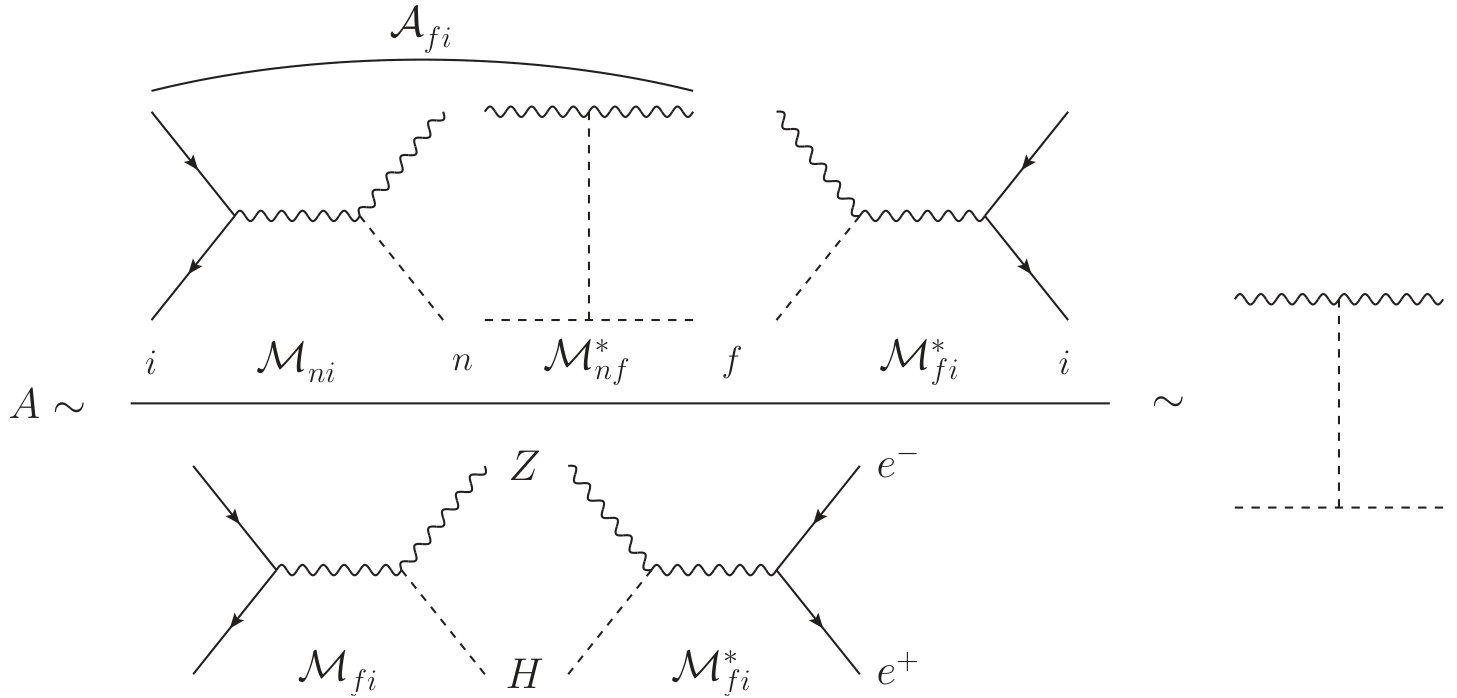 Figure 1
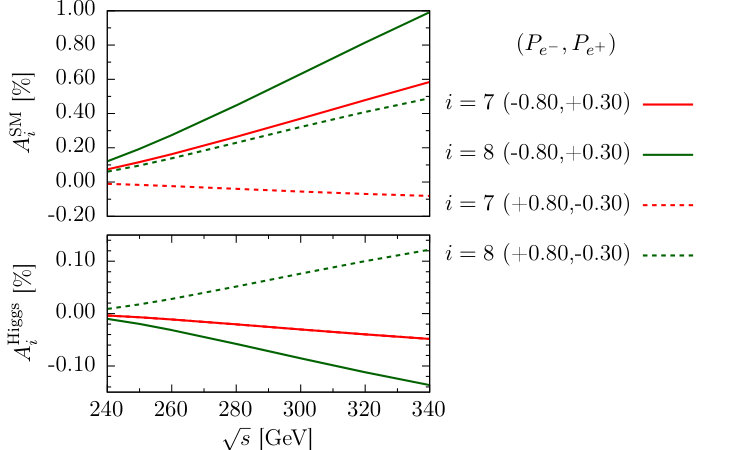 Figure 2
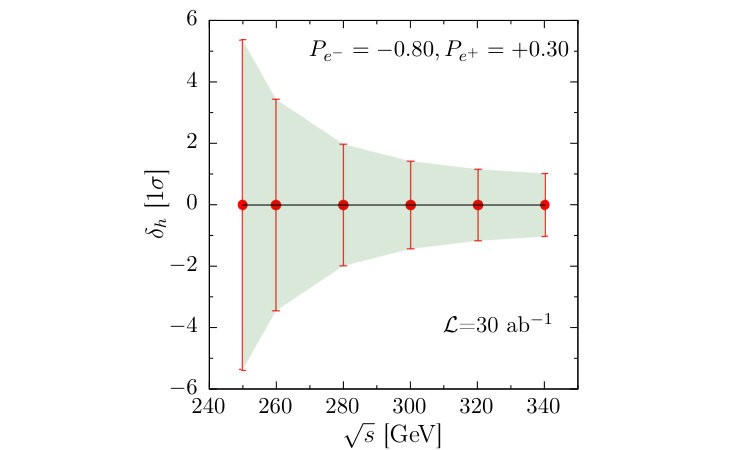 Figure 3
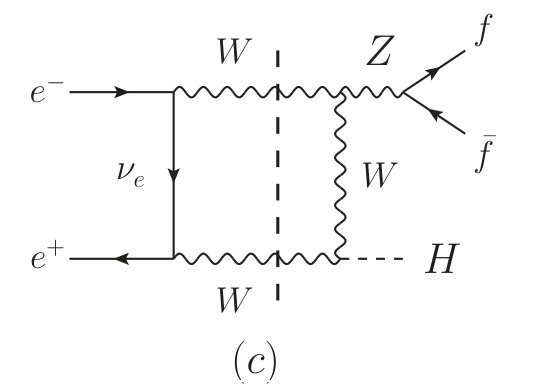 Figure 4
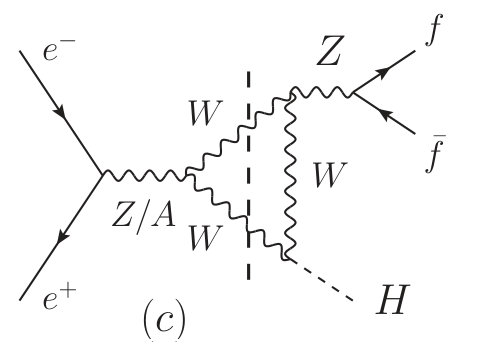 Figure 5
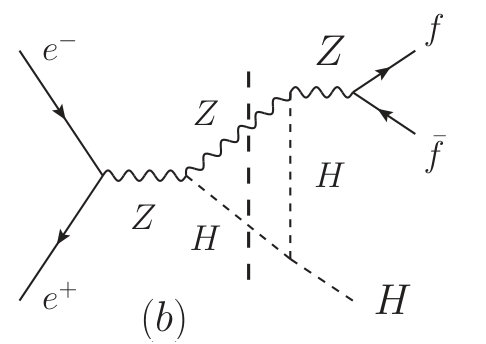 Figure 6
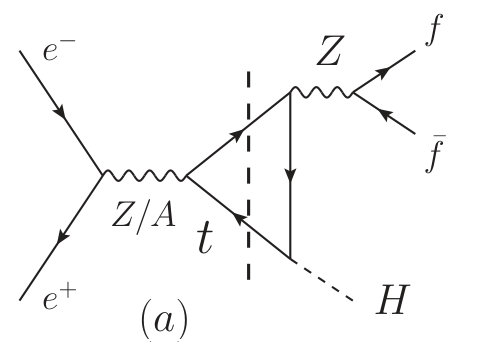 Figure 7
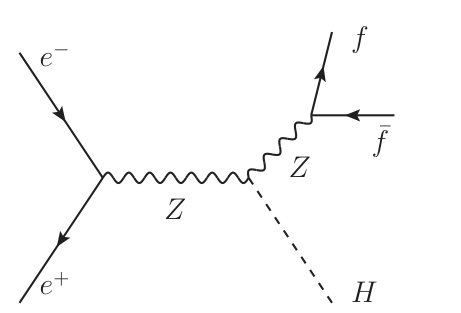 Figure 8
Peer Reviews
No public reviews on file for this paper yet. If you reviewed it on a platform where reviews are public (OpenReview, ICLR, NeurIPS, ICML), you can paste yours below so the community can read it here.
Videos
No videos yet. Explain this paper in a talk, walkthrough, or lecture? Add one.
Direct measurement of the Higgs self-coupling in
Junya Nakamura
Institut für Theoretische Physik, Universität Tübingen, 72076 Tübingen, Germany
Ambresh Shivaji
Centre for Cosmology, Particle Physics and Phenomenology (CP3), Université Catholique de Louvain, B-1348 Louvain-la-Neuve, Belgium
Abstract
A new method to measure the trilinear Higgs self-coupling in a single Higgs production process is proposed. Time-reversal-odd (T-odd) asymmetries in the process , are computed from the absorptive part of the electroweak one-loop amplitude. Since the T-odd asymmetries measure the tree-level -channel scattering, they can be direct probes of . The proposed method is quite challenging; a relatively large statistics and polarized beams are demanded. However, this is probably the only approach to directly measure in collisions, when a beam energy above the production threshold is not available.
††preprint: CP3-18-71
The capabilities of the LHC and future colliders to measure the trilinear Higgs self-coupling have been extensively studied in recent years Baur et al. (2002, 2004); Baur (2009); Dolan et al. (2012); Baglio et al. (2013); Baer et al. (2013); Asner et al. (2013); McCullough (2014); Frederix et al. (2014); Azatov et al. (2015); Shen and Zhu (2015); Gorbahn and Haisch (2016); Degrassi et al. (2016); Bizon et al. (2017); Bishara et al. (2017); Di Vita et al. (2017, 2018); Maltoni et al. (2017); ATL (2017); CMS (2018a); Gonçalves et al. (2018); Maltoni et al. (2018); Rindani and Singh (2018); ATL (2018); Bizoń et al. (2018); Borowka et al. (2018). Unlike the couplings of the Higgs bosons with heavy fermions and gauge bosons, we do not have any meaningful information on and its value can be very different from the one predicted in the standard model (SM). The measurements from the di-Higgs production processes, which are commonly referred as direct measurements, are challenging, because of their very small cross sections both at the LHC Baur et al. (2002, 2004); Dolan et al. (2012); Baglio et al. (2013); Frederix et al. (2014); Azatov et al. (2015); Bishara et al. (2017); Gonçalves et al. (2018) and at colliders Baur (2009); Baer et al. (2013); Asner et al. (2013); Di Vita et al. (2018); Maltoni et al. (2018), at which a relatively high beam energy is required. Current LHC runs are only able to provide exclusion limits for di-Higgs production CMS (2018a); ATL (2018) and, even the projected sensitivity at the HL-LHC is very weak () ATL (2017); Borowka et al. (2018). The information on may be also obtained from measurement of the (differential) cross sections of the single Higgs production processes McCullough (2014); Shen and Zhu (2015); Gorbahn and Haisch (2016); Degrassi et al. (2016); Bizon et al. (2017); Di Vita et al. (2018, 2017); Maltoni et al. (2017, 2018); Rindani and Singh (2018); CMS (2018b). The coupling contributes to the electroweak one-loop correction to single Higgs processes. This approach is commonly called an indirect one due to the fact that the trilinear coupling enters into the loop. Since very precise determination of the cross sections is demanded, the indirect method in single Higgs processes is as challenging as the direct measurement from the di-Higgs productions McCullough (2014); Di Vita et al. (2018, 2017); Maltoni et al. (2018).
In collisions, the aforementioned indirect method in the process has an obvious advantage over the direct approach with the di-Higgs production processes such as ; only a smaller beam energy is needed. However, the indirect measurements highly depend on assumptions about unknown new physics (NP) at high scale that does not modify the coupling itself McCullough (2014) 111It is known that a virtual heavy fermion in the one-loop radiative correction does not decouple from the cross section measured at low energy Fleischer and Jegerlehner (1983a, b); Dawson and Haber (1991); Kniehl (1992).. Direct methods, on the other hand, are less model dependent and, therefore, can provide more reliable bounds on a possible modification of .
In this work, a method of measuring directly the coupling in the single Higgs production process is proposed. The method deals with time-reversal-odd (T-odd) asymmetries in the production process with a subsequent boson decay into a massless fermion pair,
[TABLE]
When CP (or equally T) is conserved, T-odd quantities are generally identical to zero in the tree-level approximation and receive finite contributions only from an absorptive part of loop diagrams De Rujula et al. (1971). The T-odd asymmetries are computed at the lowest order from the absorptive part of the electroweak one-loop amplitude. The absorptive part always includes the tree level -channel re-scattering effect, a part of which is proportional to the coupling . As a result, the T-odd asymmetries are direct probes of . Unknown heavy NP particles, which may affect the indirect measurement via one-loop radiative corrections, do not contribute to the T-odd asymmetries unless the beam energy is large enough to directly produce these NP particles, because the asymmetries arise only from the absorptive part 222It should be noted that the attempt to directly measure a coupling which enters a process at the next-to-leading order by using T-odd observables is not new in particle physics; see e.g. De Rujula et al. (1978); Fabricius et al. (1980); Hagiwara et al. (1981, 1983); Hikasa (1983)..
The kinematics of the process in Eq. (1) can be specified by four independent variables after integration over the azimuthal angle of the : the center-of-mass (c.m.) energy squared , the polar angle () of the from the direction of the momentum in the c.m. frame, the polar and azimuthal angles of the final fermion in the rest frame. We neglect the initial electron mass and the final fermion mass. For given and the electron helicity (), after the summation over the final fermion helicity, the differential cross section using the narrow width approximation for the boson can be expressed as 333 dependence is always implicit throughout the paper.
[TABLE]
where the nine coefficients ( to ) are functions of , and . After integrations over and , only remains in Eq. (2), which corresponds to the differential cross section for the production process.
The first six coefficients are T-even and the last three coefficients are T-odd. The leading contribution to the six T-even coefficients is calculated from the tree diagram shown in Fig. 1. The amplitude for the production process can be in general written as
[TABLE]
where and are the spinors for the electron and the positron, respectively, the polarization vectors, the boson helicity, and , and are the four-momenta of the electron, positron and boson, respectively. The four-vector in the one-loop calculation can be expanded as
[TABLE]
The six coefficients ( to ) are complex numbers, independent of and . In the tree-level calculation, only are non-zero:
[TABLE]
where with being the magnitude of the electron charge, and are the weak mixing factors. We define the coordinate system of the rest frame as follows: the axis is along the original momentum direction and the axis is along the direction of . The tree-level prediction for the angular coefficients in our coordinate system is
[TABLE]
with
[TABLE]
where is the boson energy , is the boson three momentum , is the branching fraction , and are the vector and axial-vector couplings of the to the final fermion , and is the final fermion helicity. At the tree-level, the T-odd coefficients are vanishing as expected. The first non-vanishing contribution comes from the interference between the tree diagram and the absorptive part of the one-loop diagrams 444Here the decay is always the tree level calculation. This is sufficient for our purpose, since the absorptive part of the one-loop diagrams in does not produce the T-odd distribution in the massless fermion limit.:
[TABLE]
Note that the absorptive part in this order is both ultraviolet and infrared finite. We notice that do not contribute to the T-odd coefficients. As a result, we need to calculate the absorptive part of only a limited one-loop diagrams, representatives of which are shown in Fig. 2. We divide the relevant one-loop diagrams into three categories, namely, top loop diagrams, a Higgs loop diagram that depends on the coupling , and gauge boson loop diagrams. These are labeled as (a), (b) and (c), respectively, in Fig. 2. They are separately gauge-independent. The electroweak one-loop diagrams and amplitude are generated with help of FeynArts Hahn (2001) and FormCalc Hahn and Perez-Victoria (1999). The analytic formulas for and have been obtained but they are very long expressions and will be provided elsewhere Nakamura and Shivaji . The numerical values for the one-loop scalar functions are calculated with the LoopTools van Oldenborgh and Vermaseren (1990); Hahn and Perez-Victoria (1999). Phase space integration is performed with BASES Kawabata (1995). Our calculation has been numerically checked in the following two ways. First, CP invariance of the differential cross section Hagiwara and Stong (1994); Hagiwara et al. (2000) has been tested. Second, the T-odd coefficients have been also calculated from the electroweak full one-loop helicity amplitudes using MadGraph5_aMC@NLO Alwall et al. (2014); Frederix et al. (2018). We have found perfect agreement for several phase space points.
The leading order prediction for T-odd asymmetries is of order and can be obtained by dividing the T-odd coefficients in Eq. (8) by the T-even coefficient in Eq. (7) . We define the integrated T-odd asymmetries by
[TABLE]
where and, denotes the degree of longitudinal polarization of the electron (positron) beam. The integration over takes into account the CP invariance of the differential cross section. We have found that the coefficient receives contribution only from the gauge boson loop diagrams (c) in Fig. 2 Nakamura and Shivaji , therefore an asymmetry based on it is not useful for our purpose. In Fig. (3), diagrams contributing to the numerator and denominator in the T-odd asymmetries are described. Here represents the absorptive part of only the Higgs one-loop diagram 555The explicit formula of T-odd quantities in terms of an absorptive part can be found in Refs. De Rujula et al. (1971, 1978); Hagiwara et al. (1983).. It is shown that, because an absorptive part of one-loop amplitude is simply a tree amplitude times a tree amplitude, the tree diagram for drops from the ratio and only the tree diagram for the scattering (-channel) is left. This explains that the T-odd asymmetries measure the tree-level scattering, and because the coupling is no longer a part of the loop, the T-odd asymmetries are direct probes of . The asymmetries depend also on the coupling. However, the coupling can be constrained separately via a precise measurement of the cross section. Therefore, we can use it as input to predict the asymmetries, focusing only on constraining deviation in .
We use the following set of input parameters for the numerical results:
[TABLE]
in units of GeV for the mass parameters. In the following numerical studies, we restrict ourselves to the case , in which case the direct measurement in is not possible. Since the c.m. energy chosen is also below the threshold, i.e. , the top loop diagrams do not contribute to the T-odd asymmetries and we can avoid any ambiguity from a modified top Yukawa coupling due to a high scale NP, which is unavoidable in the indirect method Shen and Zhu (2015). We separate the contribution from the Higgs loop diagram and that from the gauge boson loop diagrams to the SM asymmetries as,
[TABLE]
Observation of requires the charge identification of the final fermion . This requirement is easily met for the decay modes . The charge of a meson containing one or quark can be identified via the decay mode . We assume an efficiency of for identifying the charges of the decaying or hadrons Hagiwara et al. (2000). The asymmetries receive unpleasant suppressions due to the fact that the T-odd coefficients are also parity-odd in case we do not measure the spin of the initial and final states Hagiwara et al. (1983). Techniques to reduce the suppressions are as follows. The asymmetry vanishes if the decay process conserves parity. Since the coupling of the charged lepton to the is almost axial-vector, in the and decay modes has the suppression factor of , which is unavoidable. However, for some fraction of the decay, we can measure the helicity from decay distributions Bullock et al. (1993); Hagiwara et al. (2013) and reduce the suppression factor. We assume an efficiency of for measuring the helicity Hagiwara et al. (2000). Similarly, the asymmetry vanishes if parity is conserved in the production process, namely if for all . Due to the coupling of the incoming electron to the being dominantly axial-vector, the Higgs loop contribution is very suppressed without beam polarization. Fortunately, polarized beams can be available in future colliders Baer et al. (2013).
In Fig. 4, we display the variation of and as functions of the c.m. energy for two practical choices of beam polarizations: , and . We find that the absolute values of the asymmetries are small () and they grow as the beam energy is increased. For both the choices of beam polarizations, are larger than , respectively. This indicates that can play a more important role than in bounding . The Higgs loop contribution to the asymmetries also become larger at higher c.m. energies, implying a higher sensitivity to at a higher beam energy.
We parametrize the NP effect on the trilinear self-coupling in terms of a real parameter as
[TABLE]
where, gives the SM prediction for . Because is proportional to , the asymmetries with nonzero can be described as
[TABLE]
In Fig. 5, we provide direct bound on the SM value of that can be reached at different c.m. energies by measuring the asymmetries . The result is obtained for beam polarization of which provides better sensitivity due to a larger statistics and the larger asymmetry ; see Fig. 4. We have also assumed an integrated luminosity of 30 ab*-1*. By definition, the asymmetries are less sensitive to systematic uncertainties, therefore, in our analysis, we consider only the statistical uncertainty. Despite a decrease in the total cross section with the rise of the beam energy, the constraint on improves and we can reach an accuracy of about 100% below the threshold. We have explicitly verified that the accuracy on does not change appreciably if uncertainty on coupling is less than 10%. Since the asymmetries depend on linearly, the same level of accuracy can be achieved for non-SM values of the parameter as well.
To summarize, a direct measurement of the Higgs self-coupling is possible even in the single Higgs production process by using the T-odd asymmetries. Due to the smallness of the asymmetries (), the method is very challenging and requires a huge statistics. Our analysis with a beam polarization and an integrated luminosity of 30 ab*-1* suggests that using this method we can measure with an accuracy of at GeV. However, the following benefits of the proposed method should be emphasized:
(1) Any ambiguity from a possible modification in the top Yukawa coupling is absent in a measured , when the beam energy is below the threshold.
(2) Since the T-odd asymmetries are independent information from the production cross section, the coupling which also contributes to the asymmetries can be very well constrained through the cross section measurement and, therefore, the asymmetries can be utilized to constrain only.
(3) This is so far the only approach to directly measure in collisions, when a beam energy above the threshold is not available.
Acknowledgements.
The authors wish to thank F. Maltoni and X. Zhao for reading the manuscript. The authors are grateful to J. Baglio, D. Gonçalves, K. Hagiwara, B. Jäger, F. Maltoni, L. D. Ninh and X. Zhao for fruitfull discussions, and V. Hirschi and O. Mattelaer for their help with MadGraph5_aMC@NLO package. J.N. would also like to thank K. Hagiwara for encouragement. J.N. would like to acknowledge the warm hospitality of the KEK Theory Center and CP3 Louvain, where he has carried out a part of the work. J.N. is also grateful for the support from MEXT KAKENHI Grant Number JP16K21730. J.N. very much appreciates the support from the Alexander von Humboldt Foundation. The work of A.S. is supported by MOVE- IN Louvain incoming postdoctoral fellowship co-funded by the Marie Curie Actions of the European Commission.
The reference list from the paper itself. Each links out to its DOI / PubMed record.
- 1Baur et al. (2002) U. Baur, T. Plehn, and D. L. Rainwater, Phys. Rev. Lett. 89 , 151801 (2002) , ar Xiv:hep-ph/0206024 [hep-ph] . · doi ↗
- 2Baur et al. (2004) U. Baur, T. Plehn, and D. L. Rainwater, Phys. Rev. D 69 , 053004 (2004) , ar Xiv:hep-ph/0310056 [hep-ph] . · doi ↗
- 3Baur (2009) U. Baur, Phys. Rev. D 80 , 013012 (2009) , ar Xiv:0906.0028 [hep-ph] . · doi ↗
- 4Dolan et al. (2012) M. J. Dolan, C. Englert, and M. Spannowsky, JHEP 10 , 112 (2012) , ar Xiv:1206.5001 [hep-ph] . · doi ↗
- 5Baglio et al. (2013) J. Baglio, A. Djouadi, R. Gröber, M. M. Mühlleitner, J. Quevillon, and M. Spira, JHEP 04 , 151 (2013) , ar Xiv:1212.5581 [hep-ph] . · doi ↗
- 6Baer et al. (2013) H. Baer, T. Barklow, K. Fujii, Y. Gao, A. Hoang, S. Kanemura, J. List, H. E. Logan, A. Nomerotski, M. Perelstein, et al. , (2013), ar Xiv:1306.6352 [hep-ph] .
- 7Asner et al. (2013) D. M. Asner et al. , in Proceedings, 2013 Community Summer Study on the Future of U.S. Particle Physics: Snowmass on the Mississippi (CSS 2013): Minneapolis, MN, USA, July 29-August 6, 2013 (2013) ar Xiv:1310.0763 [hep-ph] .
- 8Mc Cullough (2014) M. Mc Cullough, Phys. Rev. D 90 , 015001 (2014) , [Erratum: Phys. Rev.D 92,no.3,039903(2015)], ar Xiv:1312.3322 [hep-ph] . · doi ↗