Dipole-dipole interactions between neutrons
Renato Higa, James F. Babb, and Mahir S. Hussein

TL;DR
This paper investigates the dipole-dipole interactions involving neutrons and conducting surfaces using electromagnetic polarizabilities derived from chiral EFT, with implications for ultracold neutron confinement.
Contribution
It provides a detailed analysis of neutron interactions with walls and other neutrons based on chiral EFT data, extending understanding of neutron behavior in confined environments.
Findings
Quantitative interaction potentials between neutrons and conducting walls.
Interaction characteristics between two neutrons at various distances.
Relevance to ultracold neutron confinement physics.
Abstract
In this work we present results of the dipole-dipole interactions between two neutrons, a neutron and a conducting wall, and a neutron between two walls. As input, we use dynamical electromagnetic dipole polarizabilities fitted to chiral EFT results up to the pion production threshold and at the onset of the Delta resonance. Our work can be relevant to the physics of confined ultracold neutrons inside bottles.
Click any figure to enlarge with its caption.
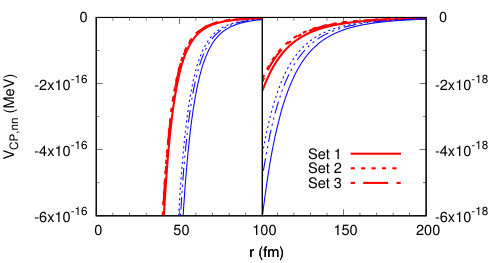 Figure 1
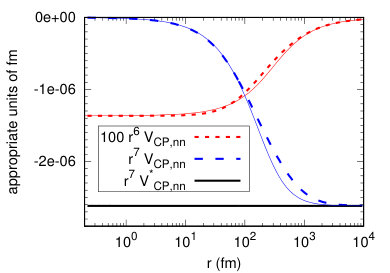 Figure 2
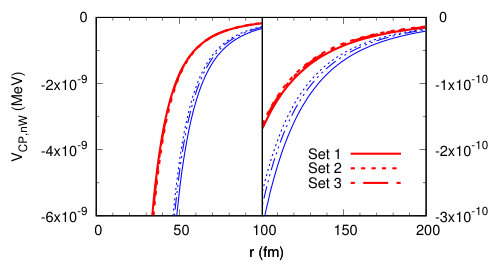 Figure 3
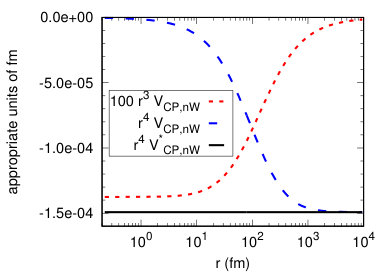 Figure 4
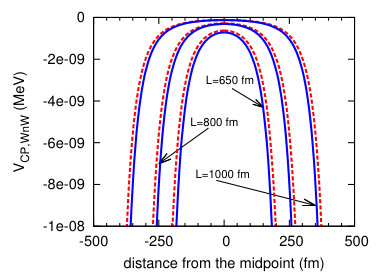 Figure 5
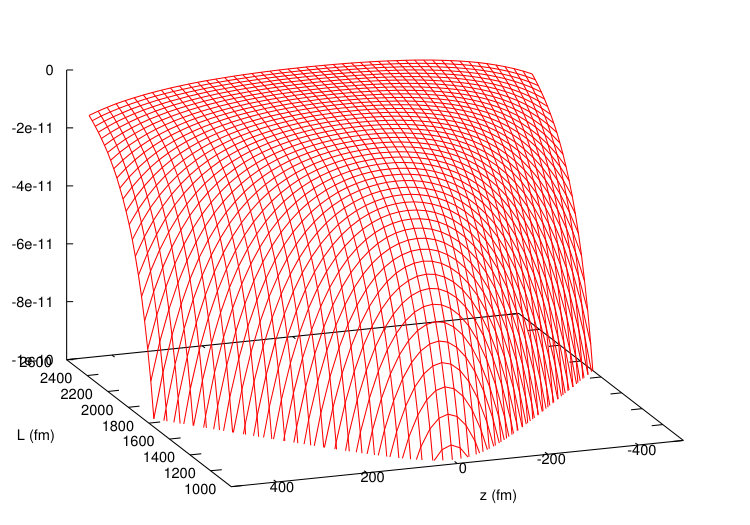 Figure 6
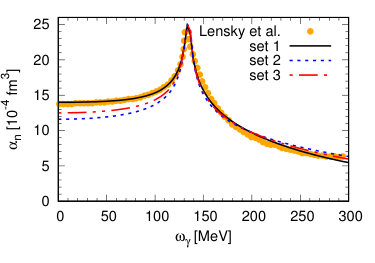 Figure 7
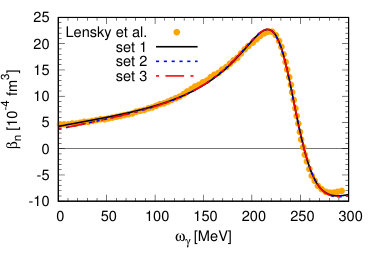 Figure 8
| Set 1 | 13.9968 | 12.2648 | 1621.63 | 4.2612 | 8.33572 | 22.85 | 241.484 | 66.92 65 |
|---|---|---|---|---|---|---|---|---|
| Set 2 | 11.6 | 2.2707 | 2721.47 | 3.7 | 8.67962 | 24.2003 | 241.593 | 68.3009 |
| Set 3 | 12.5 | 5.91153 | 2118.79 | 2.7 | 9.27719 | 26.328 | 241.821 | 70.8674 |
Peer Reviews
No public reviews on file for this paper yet. If you reviewed it on a platform where reviews are public (OpenReview, ICLR, NeurIPS, ICML), you can paste yours below so the community can read it here.
Videos
No videos yet. Explain this paper in a talk, walkthrough, or lecture? Add one.
\tocauthor
Renato Higa, James F. Babb and Mahir S. Hussein 11institutetext: Instituto de Física, Universidade de São Paulo, R. do Matão 1371, 05508-090,
São Paulo, SP, Brazil, 22institutetext: ITAMP, Center for Astrophysics | Harvard & Smithsonian, MS 14, 60 Garden St., Cambridge, MA 02138, USA, 33institutetext: Instituto de Estudos Avançados, Universidade de São Paulo, C. P. 72012, 05508-970 São Paulo-SP, Brazil, 44institutetext: Departamento de Física, Instituto Tecnológico de Aeronáutica, CTA,
São José dos Campos, S.P., Brazil
Dipole-dipole interactions between neutrons
Renato Higa 11
James F. Babb 22
Mahir S. Hussein 331144
Abstract
In this work we present results of the dipole-dipole interactions between two neutrons, a neutron and a conducting wall, and a neutron between two walls. As input, we use dynamical electromagnetic dipole polarizabilities fitted to chiral EFT results up to the pion production threshold and at the onset of the Delta resonance. Our work can be relevant to the physics of confined ultracold neutrons inside bottles.
keywords:
Casimir-Polder forces, effective field theory, ultracold neutrons
1 Introduction
The Casimir effect is a quite popular example of a non-trivial phenomenon arising from quantum fluctuations on the vacuum energy. The Casimir-Polder force was originaly devised to address the mismatch of the van der Waals tail of interatomic interactions and observations of Overbeek on quartz powder in colloid suspension. The correct asymptotic behavior is obtained by taking into account retardation effects due to the finiteness of the speed of light. Shortly after, Casimir related this force to quantum fluctuations of the vacuum between two neutral objects. Such force should appear due to the change in the zero-point electromagnetic energy between two neutral, conducting plates, an experimentally confirmed fact since then (see [1] and references therein).
A huge body of work has been devoted to this subject in atomic physics [2]. Feinberg and Sucher [3] derived the Casimir-Polder (CP) interaction between two neutral spinless particles via the two-photon exchange mechanism and general analytical properties of the related Compton scattering sub-amplitudes. The result is given in terms of atomic dipole polarizabilities reflecting the linear response to an external electromagnetic field. Arnold [4] was the first to calculate the CP interaction between two neutrons, however, at that time only the static, electric dipole polarizability data were available with nowadays outdated values. We extended Arnold’s idea [5, 6] to include dynamic electric and magnetic dipole polarizabilities with updated information from low-energy chiral effective field theory analysis. We also performed calculations of the CP-interaction between a neutron and a wall, and one neutron between two walls. In the following we summarize our main results and present an outlook for future studies.
2 Compton scattering and neutron polarizabilities
Compton scattering on both proton and neutron became a wide subject in hadron physics comprising many theoretical and experimental efforts around the world. See recent review [8] for the current status of this line of research, where one also finds the intricate details on how to extract information on the polarizabilities from the Compton scattering amplitudes. Chiral effective field theory (EFT), the effective theory of the underlying strong interactions (QCD), has being used to make rigorous and systematic predictions to Compton scattering observables at photon energies around and below the -resonance excitation energy. The most recent EFT calculations of Lensky et al. [9] for the electric and magnetic dynamical dipole polarizabilities of the neutron is shown in Fig. 1 together with our low-energy parametrizations
[TABLE]
with the set of parameters from Table 1 (more details in [5]).
3 Casimir-Polder interactions with neutrons
The CP interaction between two neutrons is given by [3, 2, 7, 5]
[TABLE]
where is the electromagnetic fine structure constant.
For the neutron-Wall (nW) CP potential one has [10, 11, 5]
[TABLE]
Finally, for two Walls separated by a distance and one neutron in between, at a distance from the midpoint [10, 11, 5],
[TABLE]
4 Results
Our results are shown in Fig. 2. First row, for as function of the separation distance . In the left panel, the (red) curves with smaller magnitudes stand for dynamical, -dependent polarizabilities while the (blue) ones with higher magnitudes stand for the static limit. On the right panel, the (red/blue) short-dashed/long-dashed curves are multiplied by appropriate factors (/), the (red/blue) solid lines are the arctan parametrization [12] that phenomenologically makes the transition from short-distance van der Waals to the asymptotic Casimir-Polder behavior [4]. Second row, for and shows similar qualitative behavior as . Third row, for as function of and . For ultracold neutrons, these attractive CP forces may compete with repulsive Fermi pseudopotential, e.g., for Ni [5].
The reference list from the paper itself. Each links out to its DOI / PubMed record.
- 1[1] P. W. Milonni and M.-L. Shih, Contemp. Phys. 33 , 313 (1992).
- 2[2] J. F. Babb, in Adv. At. Molec. Opt. Phys. , edited by E. Arimondo, P. R. Berman, and C. C. Lin (Academic Press, San Diego, 2010), Vol. 59, p. 1.
- 3[3] G. Feinberg and J. Sucher, Phys. Rev. A 2 , 2395 (1970).
- 4[4] L. G. Arnold, Phys. Lett. B 44 , 401 (1973).
- 5[5] J. F. Babb, R. Higa, and M. S. Hussein, Eur. Phys. J. A 53 , 126 (2017).
- 6[6] M. S. Hussein, J. Babb and R. Higa, Acta Phys. Polon. B 48 , 1837 (2017).
- 7[7] L. Spruch and E. J. Kelsey, Phys. Rev. A 18 , 845 (1978)
- 8[8] F. Hagelstein et al. , Prog. Part. Nucl. Phys. 88 , 29 (2016).