Nontrivial Triplon Topology and Triplon Liquid in Kitaev-Heisenberg-type Excitonic Magnets
Pavel S. Anisimov, Friedemann Aust, Giniyat Khaliullin, Maria Daghofer

TL;DR
This paper explores topological properties of triplon excitations in Kitaev-Heisenberg-type excitonic magnets, revealing nontrivial band topology and a novel triplon liquid phase in Mott insulators with strong spin-orbit coupling.
Contribution
It introduces the concept of nontrivial triplon band topology and identifies a triplon liquid phase in Kitaev-Heisenberg-like excitonic magnets, expanding understanding of quantum magnetic states.
Findings
Triplons acquire nontrivial band topology in a magnetic field.
Identification of a triplon liquid phase analogous to Kitaev's spin liquid.
Magnetic states include both ordered phases and a novel triplon liquid.
Abstract
The combination of strong spin-orbit coupling and correlations, e.g. in ruthenates and iridates, has been proposed as a means to realize quantum materials with nontrivial topological properties. We discuss here Mott insulators where onsite spin-orbit coupling favors a local singlet ground state. We investigate excitations into a low-lying triplet, triplons, and find them to acquire nontrivial band topology in a magnetic field. We also comment on magnetic states resulting from triplon condensation, where we find, in addition to the same ordered phases known from the Kitaev-Heisenberg model, a triplon liquid taking the parameter space of Kitaev's spin liquid.
Click any figure to enlarge with its caption.
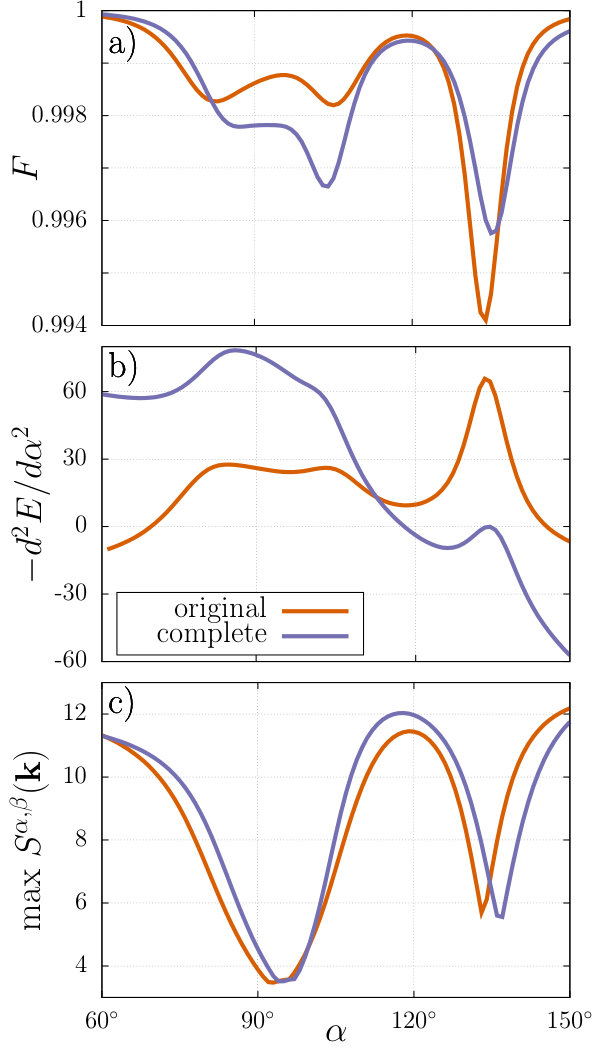 Figure 1
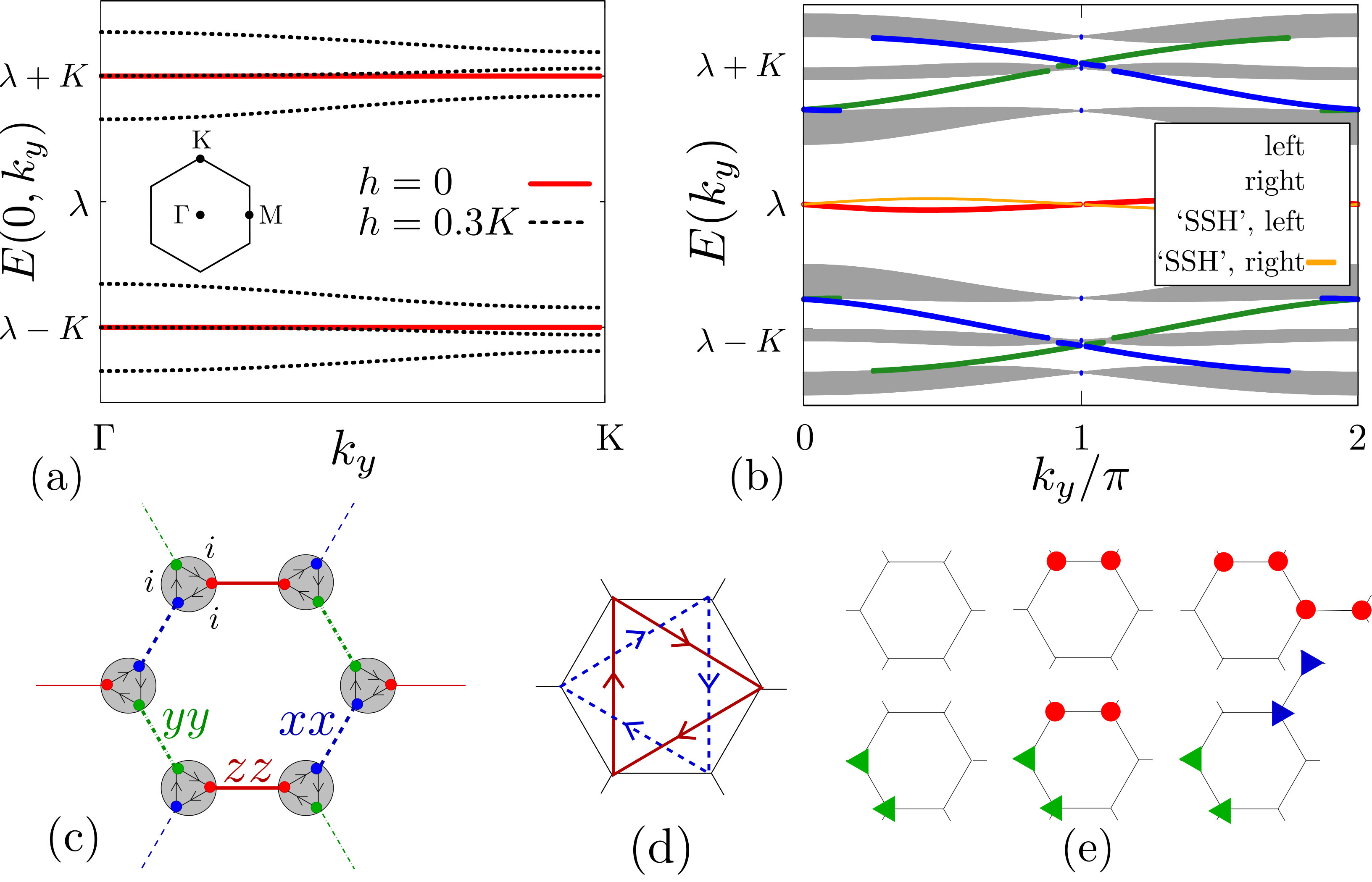 Figure 1
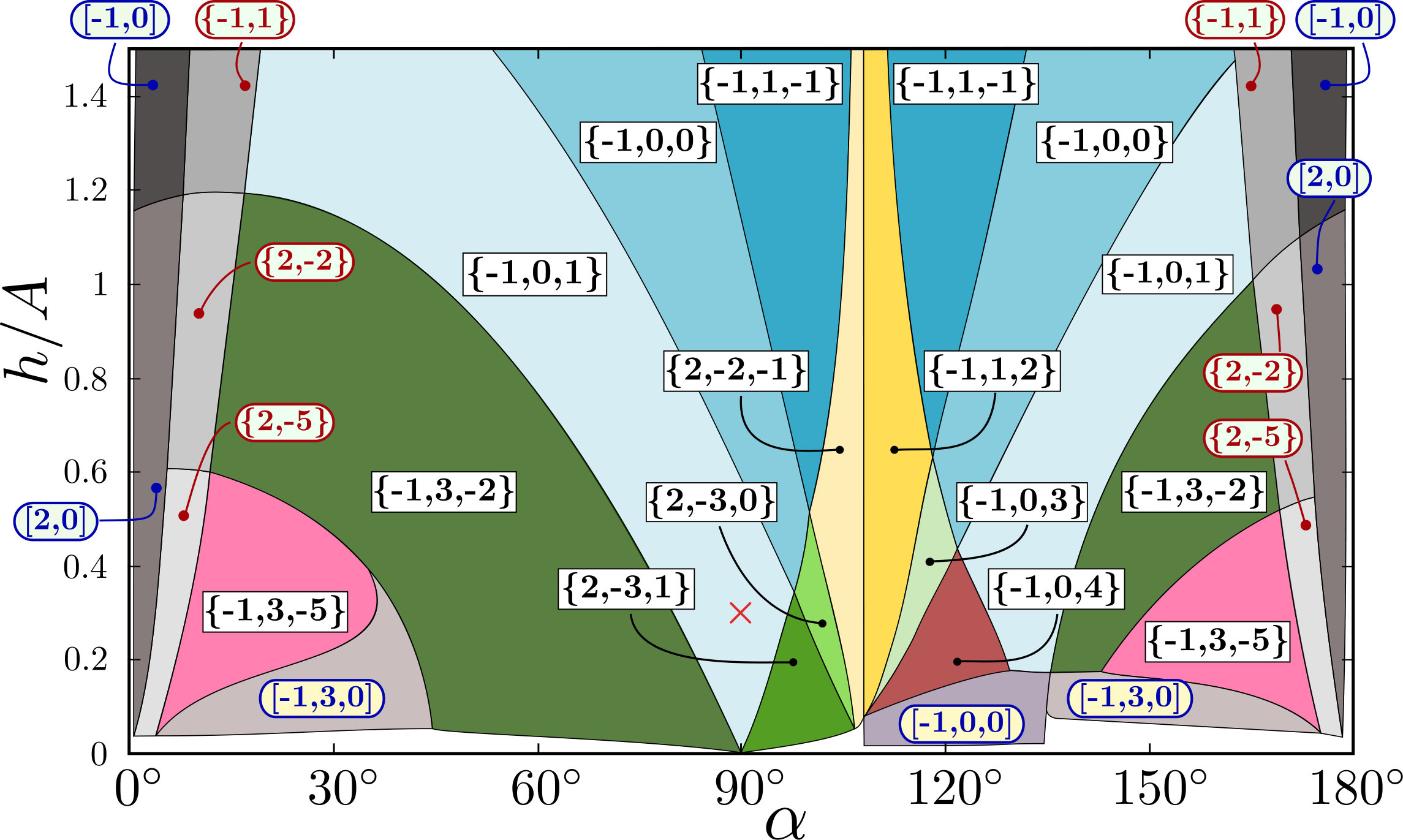 Figure 2
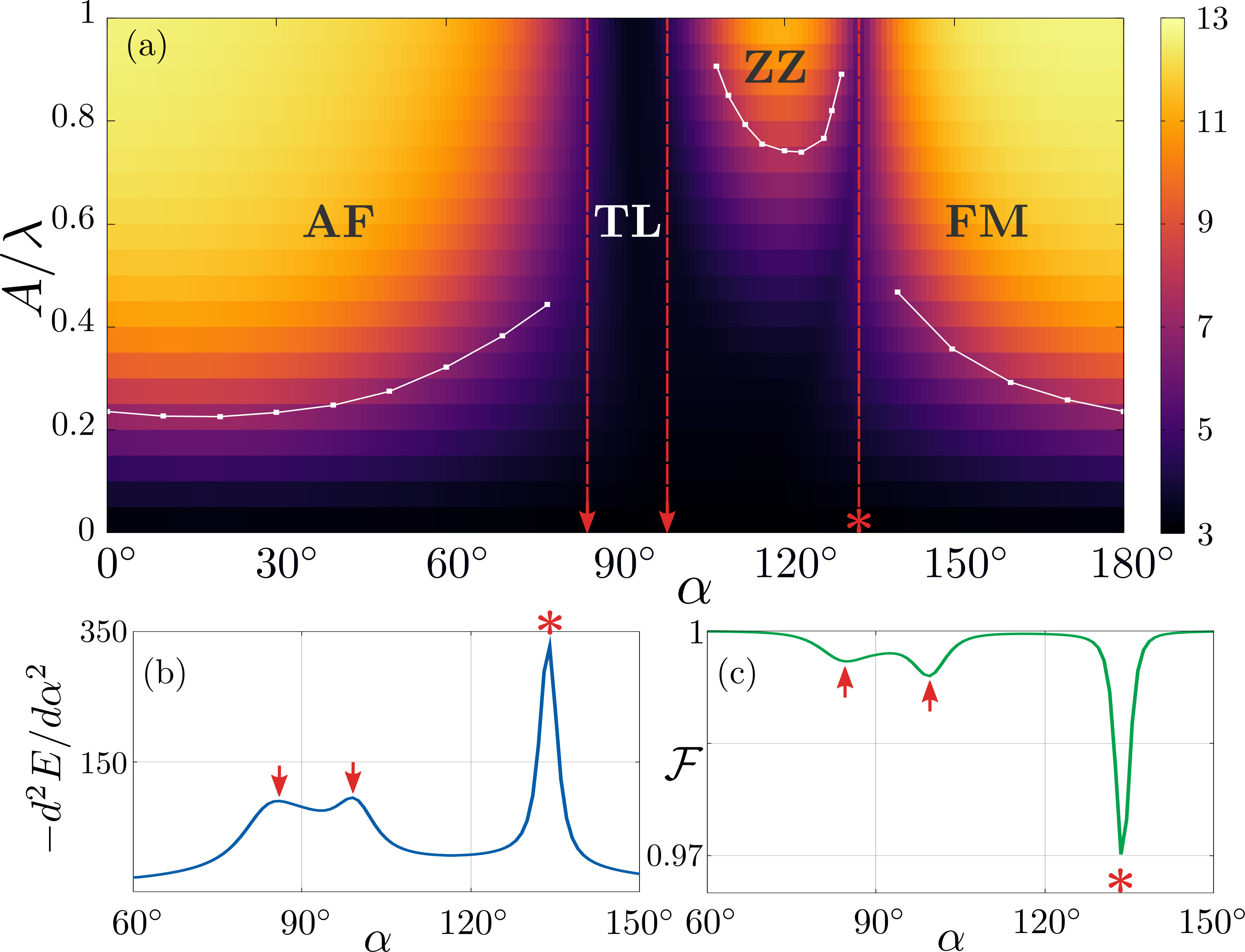 Figure 3
Peer Reviews
No public reviews on file for this paper yet. If you reviewed it on a platform where reviews are public (OpenReview, ICLR, NeurIPS, ICML), you can paste yours below so the community can read it here.
Videos
No videos yet. Explain this paper in a talk, walkthrough, or lecture? Add one.
Nontrivial Triplon Topology and Triplon Liquid in Kitaev-Heisenberg–type Excitonic Magnets
Pavel S. Anisimov
Friedemann Aust
Institute for Functional Matter and Quantum Technologies, University of Stuttgart, Pfaffenwaldring 57, 70550 Stuttgart, Germany
Center for Integrated Quantum Science and Technology, University of Stuttgart, Pfaffenwaldring 57, 70550 Stuttgart, Germany
Giniyat Khaliullin
Max Planck Institute for Solid State Research, Heisenbergstraße 1, 70569 Stuttgart
Maria Daghofer
Institute for Functional Matter and Quantum Technologies, University of Stuttgart, Pfaffenwaldring 57, 70550 Stuttgart, Germany
Center for Integrated Quantum Science and Technology, University of Stuttgart, Pfaffenwaldring 57, 70550 Stuttgart, Germany
Abstract
The combination of strong spin-orbit coupling and correlations, e.g. in ruthenates and iridates, has been proposed as a means to realize quantum materials with nontrivial topological properties. We discuss here Mott insulators where onsite spin-orbit coupling favors a local singlet ground state. We investigate excitations into a low-lying triplet, triplons, and find them to acquire nontrivial band topology in a magnetic field. We also comment on magnetic states resulting from triplon condensation, where we find, in addition to the same ordered phases known from the Kitaev-Heisenberg model, a triplon liquid taking the parameter space of Kitaev’s spin liquid.
Prime candidate systems for the interaction of spin-orbit coupling with substantial electronic correlations are those containing and transition metals, where ’topological Mott insulators’ Pesin and Balents (2010) or topological spin liquids were proposed. A prominent example is the prediction of Kitaev’s spin liquid Kitaev (2006) in materials with a single hole in the levels Jackeli and Khaliullin (2009); Chaloupka et al. (2013). Strong research activity has subsequently focused on honeycomb iridates Winter et al. (2017) and on -RuCl3 Plumb et al. (2014); Kubota et al. (2015). Encouragingly, H3LiIr2O6 does indeed not show magnetic order Kitagawa et al. (2018) and zig-zag order in -RuCl3 can be suppressed by a magnetic field Yadav et al. (2016); Baek et al. (2017). In the latter case, a thermal Hall effect due to the Majorana edge states has been reported Kasahara et al. (2018).
Current interest has similarly been drawn to spin-orbit coupled Mott insulators with two holes in the shell. In addition to total spin , they would have an effective orbital angular momentum , and spin-orbit coupling prefers their opposite orientation into a singlet ground state . On the other hand, magnetic superexchange between two ions involves the excited states with . This superexchange can drive excitonic magnetism via the condensation of bosonic ’triplons’ Khaliullin (2013); Meetei et al. (2015).
While the classical limit of this scenario is governed by the same symmetries – and thus by similar magnetic ordering patterns – as the scenario, the underlying degree of freedom is a superposition of the and states. In addition to opening the route to unconventional collective state like triplet superconductivity Chaloupka and Khaliullin (2016), this has a decisive impact on excitations, e.g. on their dispersion in the Brillouin zone. With the observation of an amplitude ’Higgs’ mode, Ca2RuO4 has been argued to realize such a scenario close to a quantum critical point Jain et al. (2017); Souliou et al. (2017).
Here, we investigate this scenario on the honeycomb lattice, a model that should be appropriate to compounds like Li2RuO3 Miura et al. (2007) and Ag3LiRu2O6 Kimber et al. (2010), and whose low coordination number has been proposed to make it susceptible to states with enhanced quantum fluctuations Khaliullin (2013). We focus first on the regime with dominant character, i.e., where onsite spin-orbit coupling dominates over intersite superexchange, as found for iridates with a double-perovskite lattice Pajskr et al. (2016); Fuchs et al. (2018); Kim et al. (2017). We find that excitations become topologically nontrivial in magnetic fields. This implies features like protected edge states crossing triplon-band gaps, similar to the topological magnon edge states discussed as spin conductors with reduced dissipation Shindou et al. (2013); Mook et al. (2015), and the thermal Hall effect Romhányi et al. (2015); Malki and Schmidt (2017); Mook et al. (2014); Murakami and Okamoto (2017); Onose et al. (2010).
We also present a phase diagram of the magnetic states emerging once the states become more dominant. We find magnetically ordered phases analogous to those of the Kitaev-Heisenberg model, and also a disordered phase taking the place of Kitaev’s spin liquid. This ‘triplon liquid’ realizes a quantum-mechanical order-by-disorder scenario, where quantum fluctuations select a unique gapped ground state from classically degenerate dimer coverings.
Model. Based on Ref. Khaliullin (2013), we model the strongly spin-orbit coupled Mott insulators as
[TABLE]
where () creates (annihilates) a triplon, i.e. a hard-core boson, with flavor at site . These operators are collected into vectors . The honeycomb lattice is built of three bond directions, here likewise labeled by so that the triplon with coupling on a given bond bears the same index as the bond. Energy associated with creating a triplon is given by spin-orbit coupling separating the from the states. Couplings , , and can be estimated from second-order perturbation theory. The constants , , and giving the relative strength of triplon hopping to pair creation terms depend on the microscopic processes involved. However, they are of order 1, and since we have verified that the results presented here do not depend on their precise values, we set here . The full model also features three- and four-triplon terms, but as these only become relevant once the groundstate contains an appreciable number of triplons, their influence on triplon excitations of the state and on its ordering tendencies (before order sets it) are small. They are neglected here, but are shortly discussed in the supplemental material sup .
For bond angles, dominant oxygen-mediated electron hopping and neglecting Hund’s rule, becomes so that every triplon flavor can move on two kinds of bonds along a zig-zag line through the honeycomb lattice Khaliullin (2013). Hopping due to direct overlap between the orbitals leads to ; and if both and are present, becomes active. Further, Hund’s rule coupling promotes FM exchange Meetei et al. (2015), processes via orbitals might also contribute Khaliullin (2005); Chaloupka et al. (2013), and a honeycomb lattice can also arise with bond angles in ’dice-lattice’ bilayer heterostructures Okamoto (2013). Since a large variety of parameter combinations are possible, we treat , and as material-dependent and vary them in the present study.
Nontrivial triplon topology. For , the state determines the ground state, but once a triplon is excited, it can move to another site via the terms of (1). The terms enter in order , and we consequently neglect them in this analysis of excitations deep within the phase, see also Ref. Romhányi et al., 2015.
The bands described by (1) have Chern number , but can nevertheless show edge states. These can be most easily seen for the extreme “Kitaev” limit and , where one finds two groups of threefold degenerate dispersionless bands at energies , see Fig. 1(a). Each corresponds to one triplon flavor and eigenstates are perfectly localized on isolated bonds of the honeycomb lattice, see Fig. 1(c). If a zig-zag edge cuts all bonds along a vertical line, -triplon states on the edge sites have no site to hop to, so that their energy becomes instead of , see Fig. 1(b). Such states can be ascribed a topological origin Joshi and Schnyder (2018) that is related to the Zak phase van Miert et al. (2017) and to the topological end states of a Su-Shrieffer-Heeger (SSH) chain Nawa et al. (2018). Very recently, a model supporting such states has been argued to describe neutron-scattering data for Ba2CuSi2O6Cl2 Nawa et al. (2018).
The ‘SSH’ edge states discussed above do not cross the gap between triplon bands, are localized to isolated sites for , and would thus not be good candidates for transport. Edge states between bands with different Chern numbers, which do cross gaps and support a thermal Hall effect, need broken time-reversal symmetry. One possibility is a magnetic field , which couples to the magnetic moment on site ,
[TABLE]
with Khaliullin (2013). Again, the first term linear in triplon operators is suppressed at large .
The second term in (2), which drives onsite flavor transitions, can as before be discussed most clearly for the extreme “Kitaev” limit and . Starting from the degenerate dispersionless bands of Fig. 1(a), a field [i.e. perpendicular to the honeycomb plane] allows transitions between flavors on each site. Triplons are then no longer localized to a single bond and bands become dispersive, see Fig. 1(a) and (b). As illustrated in the cartoon Fig. 1(c), the system in fact becomes equivalent to a decorated honeycomb lattice, where topologically nontrivial bands can arise Rüegg et al. (2010). As a result of the imaginary phase i, see Eq. (2) and Fig. 1(c), the top and bottom band of each triplet acquires a nontrivial Chern number , and the two bands are connected by protected edge states, see Fig. 1(b).
Figure 2 gives a phase diagram in - parameter space, with topologically nontrivial bands almost everywhere. Gaps between Chern bands can be quite small and energy ranges of bands may in fact overlap with indirect gaps; more robust gaps are generally found for intermediate (i.e. for large ). Allowing significantly affects phase boundaries (not shown), but topological band character persists. In general, finite magnetic fields are needed, but correspond to achievable strengths of a few Tesla for estimated parameters Khaliullin (2013). This implies that honeycomb insulators provide a viable route to the observation of triplon bands with Chern numbers as high as .
Nontrivial triplon topology in coupled intersite-dimer systems arises through DM interactions Romhányi et al. (2015); Malki and Schmidt (2017); Joshi and Schnyder (2017, 2018), which are symmetry-allowed on NNN-bonds and take the form:
[TABLE]
with , i.e. perpendicular to the plane; denotes NNNs and the () sign applies to (anti-) clockwise motion within a hexagon, see Fig. 1(d). The similarity of DM term (Nontrivial Triplon Topology and Triplon Liquid in Kitaev-Heisenberg–type Excitonic Magnets) and magnetization (2) is obvious. We have found DM interactions to support Chern numbers in the absence of a magnetic field, e.g. for , , and . However, the gaps are here rather fragile and nontrivial band topology is lost for finite and of the order of . As NNN DM terms are in general expected to be rather smaller than NN interactions and , this suggests a minor role for the former 111DM interactions can gain in importance if a trigonal crystal field splits the triplon mode off the modes. Anisotropies due to and then average out, and the DM interaction together with yields a perfect analogy to Haldane’s anomalous quantum-Hall-effect model Haldane (1988) with Chern numbers .
Magnetic Phase Diagram and triplon liquid. While a detailed investigation of the model’s magnetic phases is beyond the scope of this work 222An extensive ED study will be presented elsewhere, J. Chaloupka and G. Khaliullin, to be published, we shortly discuss their basic features. The ordering vector expected for a magnetically ordered phase is the one where the triplon excitations first reach zero energy. The terms in the Hamiltonian have to be included here. We have accordingly used a Bogoliubov-de Gennes transformation Gopalan et al. (1994), which neglects the hard-core constraint of the triplons, and exact diagonalization (ED), which is restricted to small clusters. We additionally interpolated between these two approaches using cluster-perturbation theory, which incorporates the hard-core constraint within the directly solved cluster.
For , the phase diagram obtained from ED is given in Fig. 3(a). The dark region in the middle corresponds to the regime, where hardly any triplons are mixed into the ground state and where magnetic structure factors
[TABLE]
are thus small for any . The ground-state fidelity in Fig. 3(b) as well as the second derivative of the ground-state energy in Fig. 3(c) have here a single peak, which indicates a first-order phase transition. The canonical-boson treatment and cluster-perturbation theory agree with these phase boundaries, which furthermore correspond more closely to classical predictions than in the Kitaev-Heisenberg model Gotfryd et al. (2017). As in a classical model, our phase diagram going from 0 to 180∘ (i.e. for ) perfectly repeats itself for the negative- part going from 180∘ to 360∘ (except that FM and AF change places and that zigzag becomes stripy).
Differences between the classical analysis and ED arise near the the ’Kitaev’ limits . The fidelity and second energy derivative obtained from ED, see Figs. 3(b,c), argue here against the single first-order transition of the classical scenario and in favor of an intermediate phase in a narrow but finite parameter regime around the Kitaev points. With a triplon density at large (somewhat below the of the ordered phases), the phase clearly differs from the vacuum with , and we term it a ’triplon liquid’. We have found the phase to be stable against small , its stability range is similar to that of Kitaev’s spin liquid in the corresponding model Rau et al. (2014). The character of the present triplon liquid, however, differs from Kitaev’s spin liquid, as we find here no topological degeneracy.
For , the ground state contains, in addition to the vacuum state, only configurations where - (-, -) bosons sit on both ends of - (-, -) bonds, see Fig. 1(e) for examples. This observation allows us to restrict the Hilbert space to such dimer configurations and to obtain ground states of clusters with up to 30 sites; excitations going beyond this restricted Hilbert space can be obtained for up to 18 sites. Based on the dimer observation, one can moreover see that any structure factors (3) are strictly short range, and we find numerically no indications for bond order either.
Semi-classically, we expect for an infinitely degenerate ground-state manifold of dimer coverings, with each dimer in a superposition of ‘empty’ and ‘occupied’ and an energy of per site for . The triplon liquid has a non-degenerate ground state with markedly lower energy. This quantum-mechanical order-by-disorder mechanism is largely mediated by the vacuum state, which is shared between the dimer coverings and makes them non-orthogonal.
The energy gap between the ground state and the rest of the spectrum allows the triplon liquid to survive small . We have also assessed the impact of three- and four-triplon terms that were left out of the Hamiltonian (1), but are present at sizeable triplon densities Khaliullin (2013). We have found them to leave the scenario of Fig. 3 intact, i.e., the triplon liquid without long-range order remains as an intermediate phase between the zig-zag and Néel AF phases sup .
Conclusions. We analyzed a singlet-triplet model for honeycomb compounds with a strongly correlated and spin-orbit coupled configuration, as e.g. appropriate for materials like Ag3LiRu2O6 Kimber et al. (2010) and Li2RuO3 Miura et al. (2007). The latter might in fact be close to a quantum critical point, because its magnetic state differs between powder Park et al. (2016) and single-crystal samples Wang et al. (2014). This would be consistent with a close competition that is decided by the triplons’s coupling to the lattice. For strong intersite superexchange, we find magnetically ordered states (Néel, stripe and zig-zag AF and FM) as well as a triplon liquid stabilized out of classically degenerate dimer coverings via a quantum order-by-disorder mechanism.
At weaker superexchange, where the ground state is dominated by the state of the ion, excitations are found to be topologically nontrivial as soon as orbital anisotropies become relevant. Topologically nontrivial triplon bands have been proposed Romhányi et al. (2015) and found to agree with neutron scattering data McClarty et al. (2017) for SrCu2(BO3)2, whose ground state consists of singlets on dimers; the discussion has since been extended to other geometries Malki and Schmidt (2017); Joshi and Schnyder (2017, 2018). Topological triplon states in these dimer systems rely on DM interactions, which we found to compete with symmetric anisotropic exchange in the present onsite-singlet systems. Consequently, magnetic fields perpendicular to the plane appear a more promising route towards nontrivial triplon topology when anisotropic couplings can be expected to dominate over DM interactions.
In addition to the regime discussed above, topologically nontrivial excitations are expected to persist into the FM phase, analogous to the nontrivial magnon topology in ferromagnetically polarized states of the Kitaev model Joshi (2018); McClarty et al. (2018). The AF patterns require a more detailed symmetry analysis Lu and Lu (2018), but may also harbor nontrivial magnon bands. Finally, potential topological properties of the triplon liquid present an intriguing question once a magnetic field renders the underlying single-triplon states nontrivial.
Acknowledgements.
We thank G. Jackeli and J. Chaloupka for many fruitful discussions. This research was supported by the Deutsche Forschungsgemeinschaft, via the Emmy-Noether program (DA 1235/1-1) and FOR1807 (DA 1235/5-1).
References
- (1) G. Khaliullin, Phys. Rev. Lett. 111, 197201 (2013).
The reference list from the paper itself. Each links out to its DOI / PubMed record.
- 1Pesin and Balents (2010) D. Pesin and L. Balents, Nat. Phys. 6 , 376 (2010) . · doi ↗
- 2Kitaev (2006) A. Kitaev, Annals of Physics 321 , 2 (2006) . · doi ↗
- 3Jackeli and Khaliullin (2009) G. Jackeli and G. Khaliullin, Phys. Rev. Lett. 102 , 017205 (2009) . · doi ↗
- 4Chaloupka et al. (2013) J. Chaloupka, G. Jackeli, and G. Khaliullin, Phys. Rev. Lett. 110 , 097204 (2013) . · doi ↗
- 5Winter et al. (2017) S. M. Winter, A. A. Tsirlin, M. Daghofer, J. van den Brink, Y. Singh, P. Gegenwart, and R. Valentí, J. Phys. Condens. Matter 29 , 493002 (2017) .
- 6Plumb et al. (2014) K. W. Plumb, J. P. Clancy, L. J. Sandilands, V. V. Shankar, Y. F. Hu, K. S. Burch, H.-Y. Kee, and Y.-J. Kim, Phys. Rev. B 90 , 041112 (2014) . · doi ↗
- 7Kubota et al. (2015) Y. Kubota, H. Tanaka, T. Ono, Y. Narumi, and K. Kindo, Phys. Rev. B 91 , 094422 (2015) . · doi ↗
- 8Kitagawa et al. (2018) K. Kitagawa, T.Takayama, Y. Matsumoto, A. Kato, R. Takano, Y. Kishimoto, S. Bette, R. Dinnebier, G. Jackeli, and H. Takagi, Nature 554 , 341 (2018) . · doi ↗