Sharma-Mittal Quantum Discord
Souma Mazumdar, Supriyo Dutta, Partha Guha

TL;DR
This paper introduces Sharma-Mittal quantum discord, a generalized measure of quantum correlations based on Sharma-Mittal entropy, providing analytic expressions for various quantum states and comparing it with other quantum correlation measures.
Contribution
It presents the first analytic formulation of Sharma-Mittal quantum discord for key quantum states and unifies existing discord measures as special cases.
Findings
Sharma-Mittal quantum discord generalizes R{é}nyi, Tsallis, and von-Neumann discord.
Analytic expressions derived for two-qubit, Werner, isotropic, and pointer states.
Numerical comparison shows differences and similarities among various quantum correlation measures.
Abstract
We demonstrate a generalization of quantum discord using a generalized definition of von-Neumann entropy, which is Sharma-Mittal entropy; and the new definition of discord is called Sharma-Mittal quantum discord. Its analytic expressions are worked out for two qubit quantum states as well as Werner, isotropic, and pointer states as special cases. The R{\'e}nyi, Tsallis, and von-Neumann entropy based quantum discords can be expressed as limiting cases for of Sharma-Mittal quantum discord. We also numerically compare all these discords and entanglement negativity.
Click any figure to enlarge with its caption.
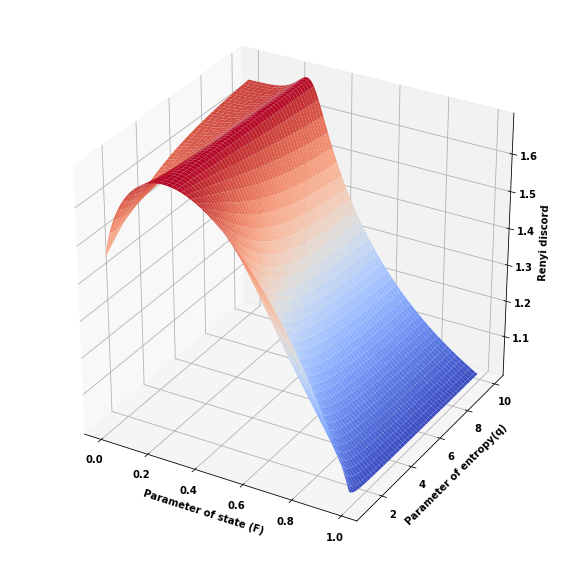 Figure 1
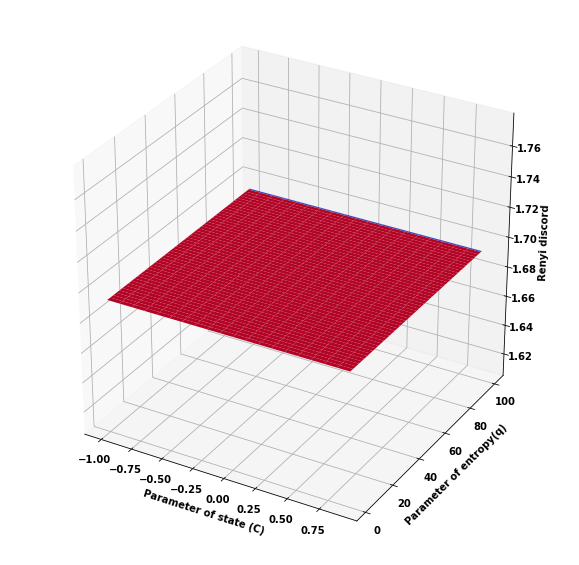 Figure 2
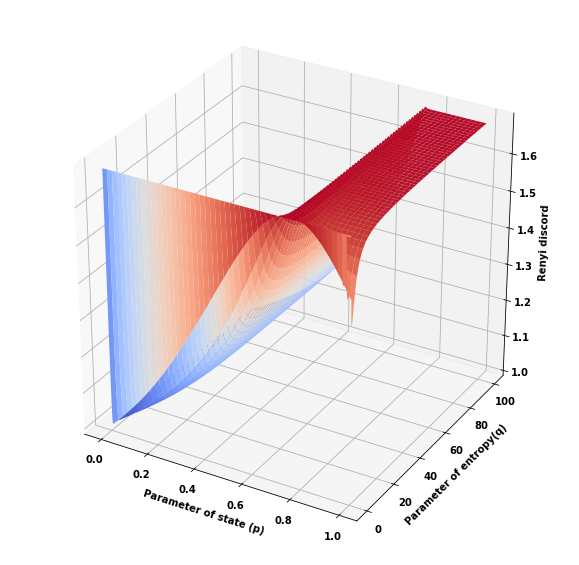 Figure 3
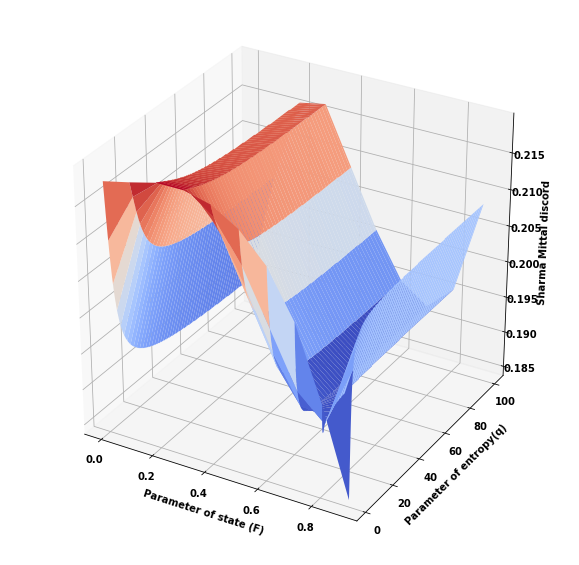 Figure 4
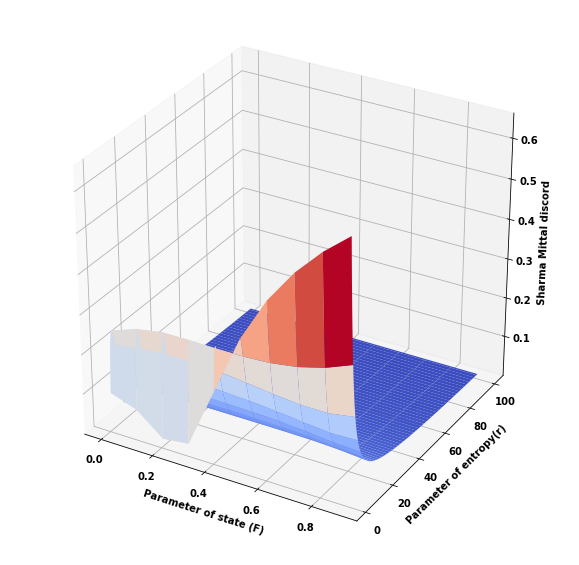 Figure 5
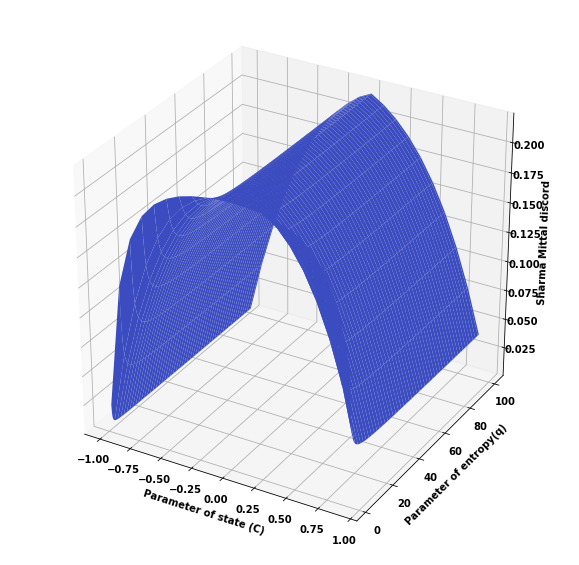 Figure 6
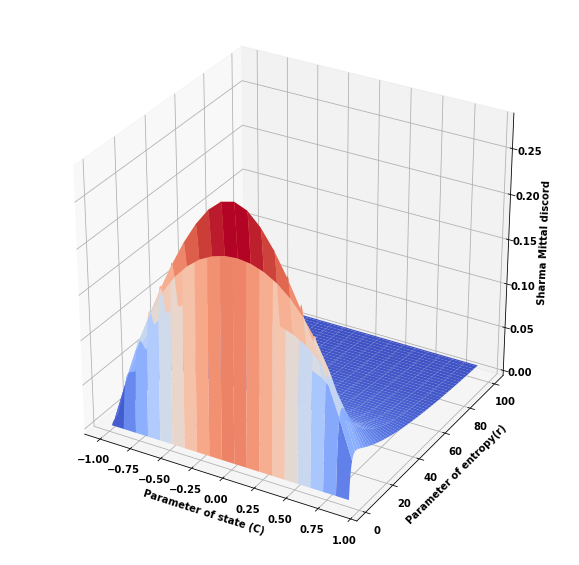 Figure 7
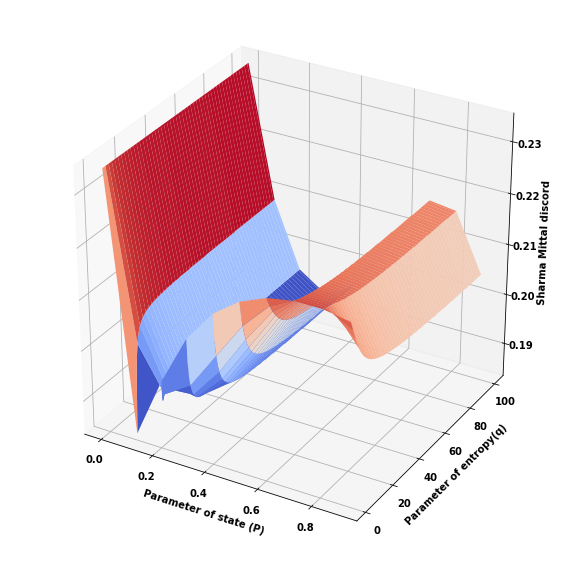 Figure 8
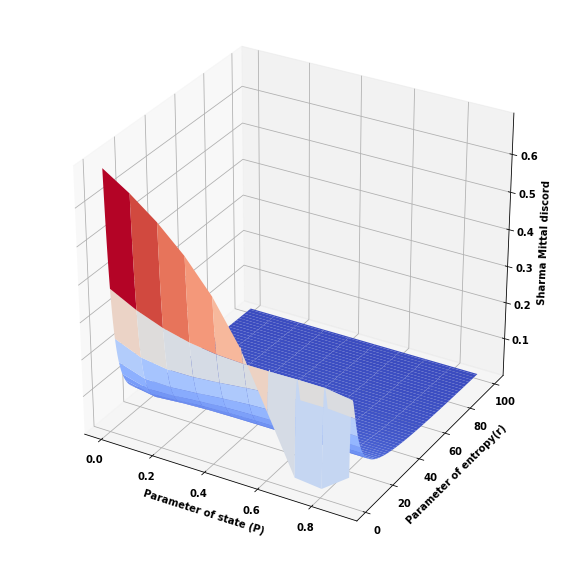 Figure 9
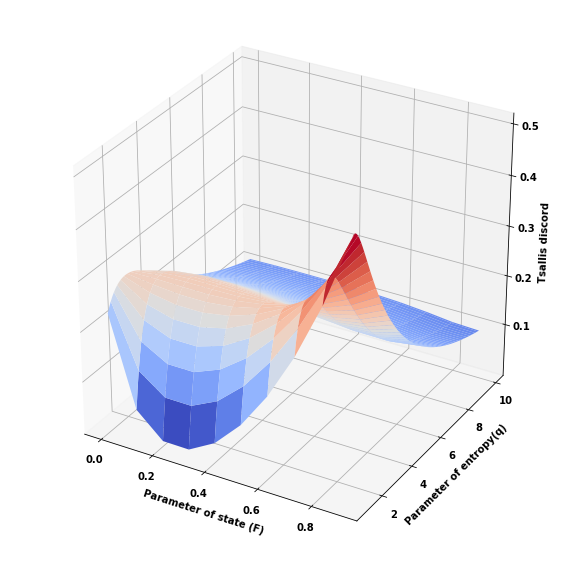 Figure 10
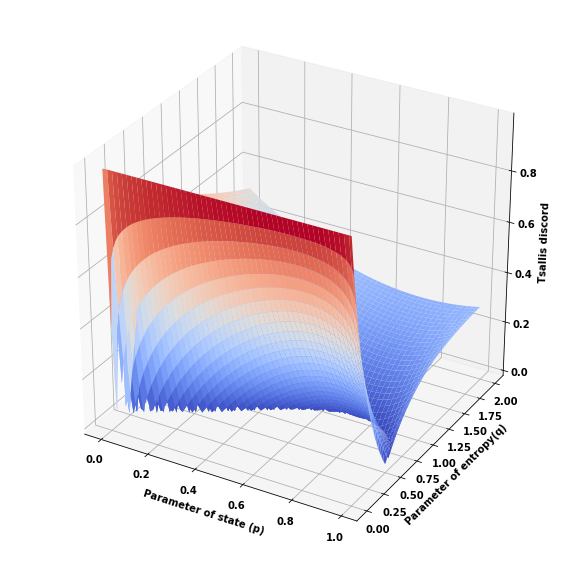 Figure 11
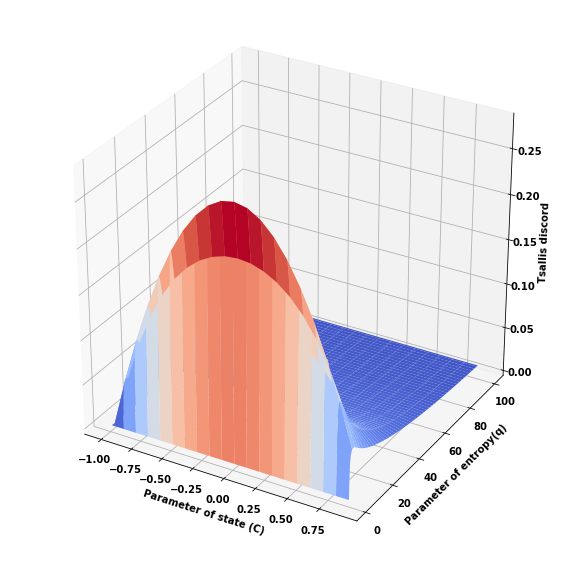 Figure 12
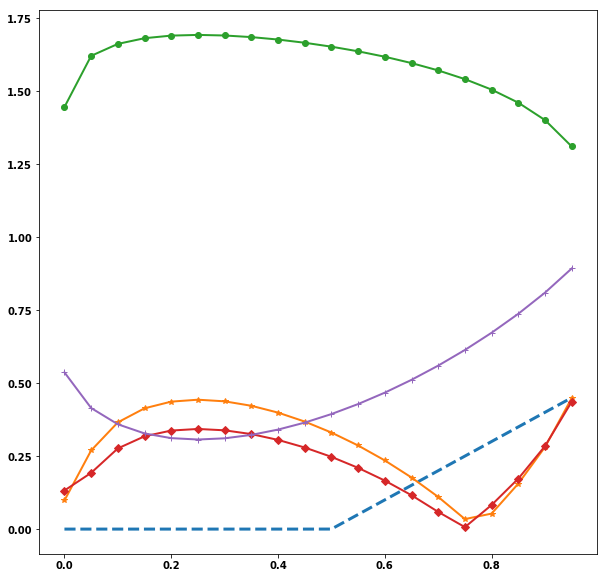 Figure 13
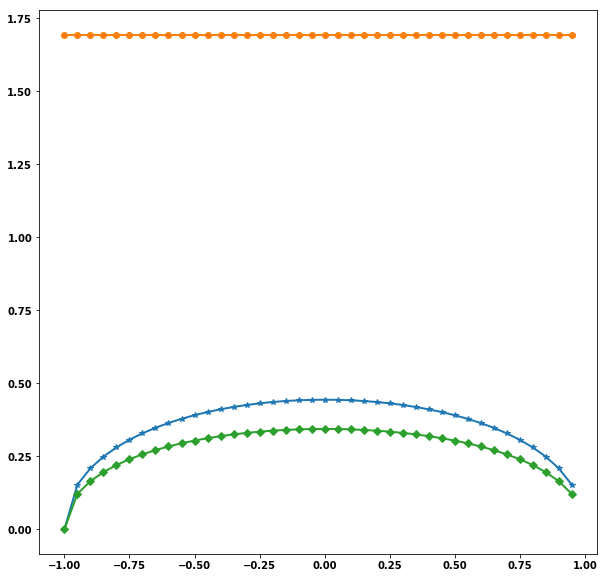 Figure 14
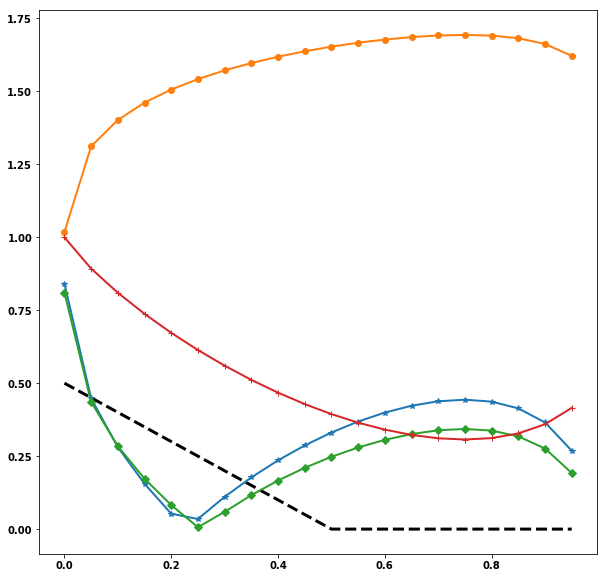 Figure 15
Peer Reviews
No public reviews on file for this paper yet. If you reviewed it on a platform where reviews are public (OpenReview, ICLR, NeurIPS, ICML), you can paste yours below so the community can read it here.
Videos
No videos yet. Explain this paper in a talk, walkthrough, or lecture? Add one.
Sharma-Mittal Quantum Discord
Souma Mazumdar, Supriyo Dutta , Partha Guha
Depertment of Theoretical Sciences
S. N. Bose National Centre for Basic Sciences
Block - JD, Sector - III, Salt Lake City, Kolkata - 700 106 Email: [email protected]: [email protected]: [email protected]
Abstract
We demonstrate a generalization of quantum discord using a generalized definition of von-Neumann entropy, which is Sharma-Mittal entropy; and the new definition of discord is called Sharma-Mittal quantum discord. Its analytic expressions are worked out for two qubit quantum states as well as Werner, isotropic, and pointer states as special cases. The Rényi, Tsallis, and von-Neumann entropy based quantum discords can be expressed as limiting case for of Sharma-Mittal quantum discord. We also numerically compare all these discords and entanglement negativity.
Keywords: Quantum discord, Sharma-Mittal entropy, Rényi entropy, Tsallis entropy, Werner state, isotropic state, pointer state.
1 Introduction
Entropy is a measure of information generated by random variables. In classical information theory [1], we use Shannon entropy as a measure of information. In quantum information theory, the von-Neumann entropy is the generalization of classical Shannon entropy. In resent years, a number of entropies has been proposed to measure information, for instance the Rényi entropy [2], and Tsallis entropy [3], in different contexts. The Rényi entropy is a generalization of the Hartley entropy, the Shannon entropy, the collision entropy and the min-entropy. Also, the Tsallis entropy is a generalization of Boltzmann-Gibbs entropy. The Sharma-Mittal entropy generalizes both Rényi entropy and Tsallis entropy. Further generalizations of entropy functions are also available in the literature [4], [5].
In quantum information and computation [6], quantum discord is a well known quantum correlation, which was first introduced in [7], [8] as a quantum mechanical difference between two classically equivalant definitions of mutual information. In classical information theory, the Shannon entropy of a random varible is defined by , where is the probability function. Given a joint random variable , the mutual information can be expressed by the following equations:
[TABLE]
In quantum information theory, a quantum state is represented by a density matrix which is equivalent to the random variable . Also, the Shannon entropy was generalised by the von-Neumann entropy, given by , where is an eigenvalue of . If represents a bipartite quantum state in , that is a state distributed between two parties and , then the reduced density matrices and are considered as the substitutes of the marginal probability distributions. Then, equation (1) can be generalised as quantum mutual information which is expressed as,
[TABLE]
Also, the equation (2) can be generalised as
[TABLE]
where the maximization runs over all possible projective measurements on , as well as
[TABLE]
The quantum discord is defined by [7]. An analytic expression of quantum discord based on von-Neumann entropy for two qubit states is constructed in [9]. In resent years, the von-Neumann entropy was replaced by the Rényi entropy, and the Tsallis entropy [10], [11], [12]. A recent review on quantum discord and its allies is [13].
In this article, we replace the von-Neumann entropy with the Sharma-Mittal entropy in the definition of quantum discord, first time in literature. Throughout the article, we consider logarithm with respect to the base . The Sharma-Mittal entropy [14], [15] of a random variable is denoted by, , and defined by,
[TABLE]
where and are two real parameters , and [16], [17]. If limit in the above expression, we get the Rényi entropy:
[TABLE]
where and . Similarly, if in the equation (6) we get the Tsallis entropy:
[TABLE]
where and . The Sharma-Mittal entropy reduced to Shannon entropy when both and , which is
[TABLE]
Recall that, a density matrix is a positive semi-definite, Hermitian matrix with unit trace. Hence, all its eigenvalues are non-negative.
Definition 1**.**
Given a density matrix as well as two real numbers and with , the Sharma-Mittal entropy of is defined by,
[TABLE]
where s are eigenvalues of .
The quantum mechanical counterparts of Rényi and Tsallis entropy can also be generalised in a similar fashion. Also, the von-Neumann entropy is the alternative of Shannon entropy in quantum mechanical context.
Definition 2**.**
The Sharma-Mittal quantum discord of a quantum state in , represented by a density matrix is defined by , where
[TABLE]
In the above definition, replacing by , and , we get the Rényi, Tsallis, and von-Neumann quantum discord, which are denoted by , , and , respectively. It is proved that for all density matrices the von-Neumann discord [18], which may not be true for , and . For instance, consider a Werner state given by . We can calculate , and . The idea of negative correlation has been considered in the theory of probability, but not well accepted in the quantum information theoretic community, till date. Therefore, to assure non-negativity we consider the absolute value in the definition 2.
The motivation behind this work is to generalize the idea of quantum discord in an unified fashion. Calculating an analytical expression of discord is a challenging task, as it involves an optimization term [19]. In the next section, we construct the analytic expression of for two qubit states, as well as , , and as its limiting cases. Also, we compare each of them with entanglement negativity, which is a well known measure of entanglement [20]. We also calculate the Sharma-Mittal quantum discord and its specifications for Werner, isotropic, and pointer states. Then, we conclude this article with some open problems.
2 Discord for two qubit states
2.1 Discord in general
Two qubit states which belongs to the Hilbert space , act as the primary building blocks for encoding correlations in quantum information theory. The computational basis of is . Recall that, the Pauli matrices are
[TABLE]
The identity matrix of order is given by . In general, any two qubit state is locally unitary equivalent to:
[TABLE]
For analytical simplicity, and since we are just keen on the correlations in the bipartite states, we consider those states with the maximally mixed marginals, that is, we consider the following states:
[TABLE]
where , and are real numbers. Expanding the tensor products we get,
[TABLE]
Lemma 1**.**
If a matrix represents a density matrix of a quantum state, then for , and .
Proof.
The eigenvalues of in terms of , and are,
[TABLE]
As is a Hermitian matrix, all the eigenvalues are real. Also, is positive semi-definite matrix. Therefore, . As , we have . As we have . In addition, indicate and indicates . Combining we get . Similarly, , and . ∎
Eigenvalues of a density matrix suggest that the Sharma-Mittal entropy of is
[TABLE]
The Rényi entropy of will be obtained by taking which is
[TABLE]
Similarly, the Tsallis entropy will be which is
[TABLE]
Also, the von-Neumann entropy of is
[TABLE]
Theorem 1**.**
The Sharma-Mittal quantum discord of quantum state represented by a density matrix , mentioned in equation (13), is
[TABLE]
where , as well as and are two real numbers, such that .
Proof.
Recall the definition 2 of Sharma-Mittal quantum discord. We can check that the reduced density matrices over the subsystems and are given by , which is a density matrix which eigenvalues . Now, the Sharma-Mittal entropy of is
[TABLE]
The local measurements for the party along the computational basis is . Now, any von-Neumann measurement for the party is given by
[TABLE]
Any unitary operator can be expressed as
[TABLE]
where , and and . After measurement the state will be changed to an ensemble , where
[TABLE]
Simplifying we get,
[TABLE]
where , and . Also, . It can be verified that . Both of the matrices and have two zero eigenvalues, and two non-zero eigenvalues, which are , and . Let . Then the Sharma-Mittal entropies of , and are
[TABLE]
Now, as , we have , which we need to maximize. Considering, , we have which is the maximum value of . Putting it the expression of we have
[TABLE]
Adding equation (20), (26) and (16) we get the result. ∎
Corollary 1**.**
The Rényi quantum discord of a two qubit quantum state given by a density matrix is
[TABLE]
where is given by equation (17).
Proof.
We have seen that the Sharma-Mittal entropy reduces to the Rényi entropy if . From equation (7) we get . Taking , in the equation (26) we get,
[TABLE]
Hence, the result. ∎
Corollary 2**.**
The Tsallis discord of a two qubit quantum state given by a density matrix is
[TABLE]
where is given by equation (18).
Proof.
We know that the Sharma-Mittal entropy reduces to Tsallis entropy if . From equation (8) we get . Taking , in the equation 26 we get,
[TABLE]
Hence, the result. ∎
In the next proof, instead of using the definition of von-Neumann entropy directly, we present the limit operations on , explicitly. It justifies that the conventional idea of quantum discord is a limiting situation of the Sharma-Mittal quantum discord. Our result matches with the expressions derived in [9].
Corollary 3**.**
The von-Neumann discord is given by
[TABLE]
where is the von-Neumann entropy of .
Proof.
We know that the Sharma-Mittal entropy reduces to Shannon entropy if and . Now,
[TABLE]
using the ĹHôpital’s rule. Taking and , in the equation (26) we get,
[TABLE]
Using the ĹHôpital’s rule the above expression,
[TABLE]
Applying these limiting values in , mentioned in the theorem 1 we get the result. ∎
Now, we discuss Sharma-Mittal quantum discord and its specifications for a number of well known two qubit quantum states. For pure states it is simplified to the entropy of a state which is equivalent to the entropy of entanglement.
Corollary 4**.**
The Sharma-Mittal quantum discord of any pure entangled state is nonzero.
Proof.
The density matrix representing a pure state has only one non-zero eigenvalue, which is . Therefore, . A set of measurement operators produce an ensemble of pure states from a given pure state . Therefore, the Sharma-Mittal entropy for all these states are also [math], that is . Now, the definition 2 suggests that . If is an entangled state, is mixed state and . Therefore, . ∎
Similarly, the Rényi and Tsallis discord for pure bipartite entangled state is nonzero and reduces to , and , respectively.
2.2 Werner State
A dimensional Werner state [21] is a mixture of symmetric and antisymmetric projection operators, represented by the density matrix,
[TABLE]
where , , and are the projectors as well as . When , the density matrix representing a Werner state is given by
[TABLE]
Theorem 2**.**
The Sharma-Mittal quantum discord for -qubit Werner state mentioned in equation (31) is
[TABLE]
Proof.
Comparing the density matrix in equation (31) with density matrix considered in the equation (14) we get,
[TABLE]
They indicate . Hence, . Also, the eigenvalues of are , and with multiplicity . Therefore, the Sharma-Mittal entropy for a given isotropic state is
[TABLE]
Also, replacing in equation (26) the maximization term reduces to
[TABLE]
Combining we get the expression of the Sharma-Mittal quantum discord of -qubit Werner state, mentioned in the statement. ∎
The Sharma Mittal discord for Werner state with respect to the state parameter and entropy parameter is plotted in fig 1. Also, the figure 2 shows the Sharma-Mittal discord of Werner state with respect to and keeping unchanged.
Corollary 5**.**
The Rényi discord for -qubit Werner state is given by
[TABLE]
Proof.
The Rényi entropy of two qubit Werner state is
[TABLE]
Also, the maximization term is given by
[TABLE]
Now, combining we get the result from corollary 1. ∎
The Rényi discord is plotted with respect to and in the figure 3.
Corollary 6**.**
The Tsallis discord of -qubit Werner state is given by
[TABLE]
Proof.
The Tsallis entropy of two qubit Werner state is
[TABLE]
Also, the maximization term reduces to
[TABLE]
Hence, the corollary 2 leads us to the proof. ∎
The Tsallis discord of the Werner state with respect to and is plotted in the figure 4.
Corollary 7**.**
The von-Neumann quantum discord for -qubit Werner state is given by
[TABLE]
Proof.
The von-Neumann entropy of two qubit Werner state is
[TABLE]
Using the ĹHôspital’s rule we get
[TABLE]
In addition, the maximization term reduces to
[TABLE]
Hence, the corollary 3 leads us to the proof. ∎
The negativity of entanglement is a well known measure of entanglement. It is the negated sum of negative eigenvalues of the partial transpose of density matrix. The partial transpose of with respect to the subsystem is
[TABLE]
Eigenvalues of this matrix are , and with multiplicity three. The first eigenvalue if negative when . The second one is everywhere positive in . Therefore, entanglement of is
[TABLE]
In the figure 5, we plot negativity, Sharma-Mittal, Renyi, Tsallis and Von Neumann discord for Werner state. Here, we can recognize different behavior of quantum correlations with the state parameter . The quantum entanglement is zero for , were all the discords has non-zero value. The Rényi entropy, marked by a bulleted () line takes higher value in comparison to the other discords. The Sharma-Mittal and Tsallis discords are also non-negative when but they do not follow the entanglement like the von-Neumann discord. It indicates applicability of these quantum discords in different tasks of quantum information with zero discord quantum states. Note that, and are negative for some states.
2.3 Isotropic State
An isotropic state is a bipartite quantum state which is given by
[TABLE]
where and , a maximally entangled state in . In general, a two-qubit isotropic state is
[TABLE]
The density matrices mentioned in equation(44) and equation(47) are centro-symmetric. Entanglement of these quantum states is investigated in [22]. Comparing equation(47) with equation (13) we get,
[TABLE]
which indicate
[TABLE]
Hence, .
Theorem 3**.**
The Sharma-Mittal quantum discord for two qubit isotropic states is
[TABLE]
Proof.
Note that, the eigenvalue of are , and with multiplicity . Hence, the Sharma-Mittal quantum entropy of is
[TABLE]
Considering the maximization terms gets the form
[TABLE]
Now, theorem 1 leads up to the result. ∎
The Sharma-Mittal discord for isotropic state with respect to the state parameter and entropy parameter is plotted in the figure 6. Also, the Sharma-Mittal discord for isotropic state with respect to and is plotted in the figure 7.
Corollary 8**.**
The Réyi quantum discord for -qubit isotropic state is
[TABLE]
Proof.
The Réyi entropy is given by
[TABLE]
and the maximization term reduces to
[TABLE]
Hence, the result follows from corollary 1. ∎
The Rényi discord is for isotropic state plotted in the figure 8.
Corollary 9**.**
The Tsallis quantum discord for two qubit isotropic state is
[TABLE]
Proof.
The Tsallis entropy is given by
[TABLE]
and the maximization term reduces to
[TABLE]
Hence, the result follows from Corollary 2 . ∎
The Tsallis discord is for isotropic state plotted in the figure 9.
Corollary 10**.**
The von-Neumann quantum discord for two qubit isotropic state, given by a density matrix , is
[TABLE]
Proof.
The von-Neumann entropy is given by
[TABLE]
and the maximization term reduces to
[TABLE]
Hence, the results follows from Corollary 3. ∎
The eigenvalues of the partial transpose of the density matrix are , and with multiplicity . The first eigenvalues is negative when and the second one is always positive in the range of . Therefore, the negativity of entanglement for Werner state is
[TABLE]
In the figure 10, we plot negativity, Sharma-Mittal, Renyi, Tsallis and Von Neumann discord of isotropic state. Different quantum correlations of the isotropic state also show similar characteristics as the Werner state. These graphs may vary over the entropy parameters and .
2.4 Pointer State
The pointer state [23], which are also called classical quantum state, is well know in the literature of quantum discord as the von-Neumann discord of pointer states are zero. It is proved that the blocks of zero discord quantum states forms a family of commuting normal matrices [24]. Consider the density matrix mentioned in equation (14). Partitioning it into four blocks we get , and . Recall that a matrix is normal if . Also, two matrices and are commutative if . Therefore, all , and are normal, as well as any two of them commute. It generates a system of ten matrix equations, among which four are originated by normality and remainings are originated by commutativity conditions. Expanding these equations, one can observe that all these equations are satisfied if any two of , and are zero.
Theorem 4**.**
The Sharma-Mittal quantum discord for pointer state is given by,
[TABLE]
where is the non-zero member of , and .
Proof.
If any two of , and are zeros, the equation (15) suggests that the eigenvalues of are with multiplicity , and with multiplicity . Therefore, the Sharma-Mittal entropy of is
[TABLE]
Also, as any two of is [math] the maximum of them is the norzero term which is equal to . Therefore, the maximization term reduces to . Then we find the result from theorem 1. ∎
The Sharma-Mittal discord for pointer state with respect to the state parameter and entropy parameter is plotted in the figure 11. Also, the Sharma-Mittal discord for pointer state with respect to and is plotted in the figure 12.
Corollary 11**.**
The Réyi discord for two qubit pointer state is
[TABLE]
Proof.
The Rényi entropy for pointer state is
[TABLE]
Also, the maximization term reduces to . Now from corollary 1 we get the result. ∎
The Rényi discord is for pointer state with respect to the parameter is plotted in the figure 13.
Corollary 12**.**
The Tsallish quantum discord for two qubit pointer state is
[TABLE]
Proof.
The Tsallish entropy for two qubit pointer state is
[TABLE]
As the maximization term reduces to . Now the result follows from corollary 2. ∎
The Tsallis discord is for pointer state plotted with respect to the parameter , in the figure 14.
The next result is well-know in the literature of quantum discord. Here, we calculate the von-Neumann discord as a limit of Sharma-Mittal discord, and it matches with the existing idea.
Corollary 13**.**
The von-Neumann discord for -qubit pointer state is [math].
Proof.
The von-Neumann entropy for two qubit pointer state is given by
[TABLE]
The maximization term is obtained by taking limits in the expression for . Therefore, the maximization term reduces to . From the corollary 3 the von-Neumann discord is given by
[TABLE]
∎
The above result suggests that the new definition of discord matches with the existing idea of discord. In the figure 15, we plot negativity, Sharma-Mittal, Renyi, and Tsallis discord for pointer state.
3 Conclusion and problems in future
In this article, we have generalized the idea of quantum discord in terms of the Sharma-Mittal entropy. The Rényi, Tsallis, and von-Neumann quantum discords are limiting cases of the Sharma-Mittal quantum discord. Analytic expressions of these discords are built up, for well-known -qubit states. These new quantum correlations may be non-zero for zero entanglement states. In future, the following problems may be attempted.
The von-Neumann quantum discord has been widely applied in quantum information theoretic tasks, for instance the remote state preparation [25], device independent quantum cryptography [26], and many others. The new discords may have better efficiency than the von-Neumann discord in these kind of works. For instance, the von-Neumann discord of pointer states is zero. Depending on the parameter values, the pointer states have non-zero Sharma-Mittal and other quantum discords. Hence, these new discords makes the pointer state applicable in quantum information theoretic tasks where the quantum correlation is an essential.
The pointer state has zero von-Neumann quantum discord. But, we have observed that the Sharma-Mittal, Rényi, and Tsallis discords of the pointer state may not be zero. Given any of these definitions, there exist mixed states with zero discord. For instance, consider the Tsallis discord of a Werner state depending on the parameter . Note that, is a continuous function of . We can numerically verify that . Therefore, there is a with for which . Similarly, the Sharma-Mittal entropy , where is a Werner state given by a parameter such that . Now, classification of these zero discord states for different discords may also be an interesting task.
The combinatorial aspects of von-Neumann discord is studied in [27], [28], where a combinatorial graph represents a quantum state and the discord can be expressed in terms of graph theoretic parameters. A combinatorial study on Sharma-Mittal, Rényi, and Tsallis discord in this direction will be very welcome.
It would be an interesting problem to formulate the Sharma-Mittal quantum discord for multipartite quantum states. In [29] and [30] the von-Neumann discord has been investigated for tripartite and multipartite quantum states respectively. Interested reader may generalize these approaches for the Sharma-Mittal discord.
The generalization of von-Neumann quantum discord to Sharma-Mittal quantum discord introduces the idea of negative quantum correlation. This article contains examples of quantum states for which . Therefore, it demands further investigations on their applicability in the quantum information theoretic tasks, as well as a revision of the fundamental concepts of quantum correlation, such as non-negativity.
Acknowledgment
SM and SD have equal contribution in this work. This article is similar to the one published in Quantum Information Processing 18 (6), 169. The final authenticated version is available online at https://link.springer.com/article/10.1007/s11128-019-2289-3.
The reference list from the paper itself. Each links out to its DOI / PubMed record.
- 1[1] Thomas M Cover and Joy A Thomas. Elements of information theory . John Wiley & Sons, 2012.
- 2[2] Alfréd Rényi. On measures of entropy and information. Proceedings of the fourth Berkeley Symposium on Mathematics, Statistics and Probability , pages 547 – 561, 1960.
- 3[3] Constantino Tsallis. Possible generalization of boltzmann-gibbs statistics. Journal of statistical physics , 52(1-2):479–487, 1988.
- 4[4] Piergiulio Tempesta. A theorem on the existence of trace-form generalized entropies. Proc. R. Soc. A , 471(2183):20150165, 2015.
- 5[5] Piergiulio Tempesta. Beyond the shannon–khinchin formulation: the composability axiom and the universal-group entropy. Annals of Physics , 365:180–197, 2016.
- 6[6] David Mc Mahon. Quantum computing explained . John Wiley & Sons, 2007.
- 7[7] Harold Ollivier and Wojciech H Zurek. Quantum discord: a measure of the quantumness of correlations. Physical review letters , 88(1):017901, 2001.
- 8[8] Leah Henderson and Vlatko Vedral. Classical, quantum and total correlations. Journal of physics A: mathematical and general , 34(35):6899, 2001.