The kernel of chromatic quasisymmetric functions on graphs and hypergraphic polytopes
Raul Penaguiao

TL;DR
This paper characterizes the kernel of chromatic quasisymmetric functions on graphs and hypergraphic polytopes, revealing modular relations and proposing new graph invariants to address the tree conjecture.
Contribution
It generalizes the kernel description from graphs to hypergraphic polytopes and introduces new invariants for tackling the tree conjecture.
Findings
Kernel of chromatic symmetric function spanned by modular relations
Generalization to hypergraphic polytopes
Identification of new graph invariants
Abstract
We study the chromatic symmetric function on graphs, and show that its kernel is spanned by the modular relations. We generalize this result to the chromatic quasisymmetric function on hypergraphic polytopes, a family of generalized permutahedra. We use this description of the kernel of the chromatic symmetric function to find other graph invariants that may help us tackle the tree conjecture.
Click any figure to enlarge with its caption.
 Figure 1
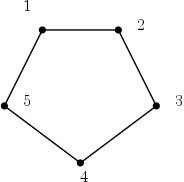 Figure 2
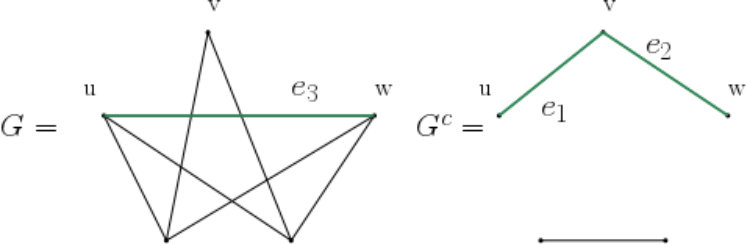 Figure 3
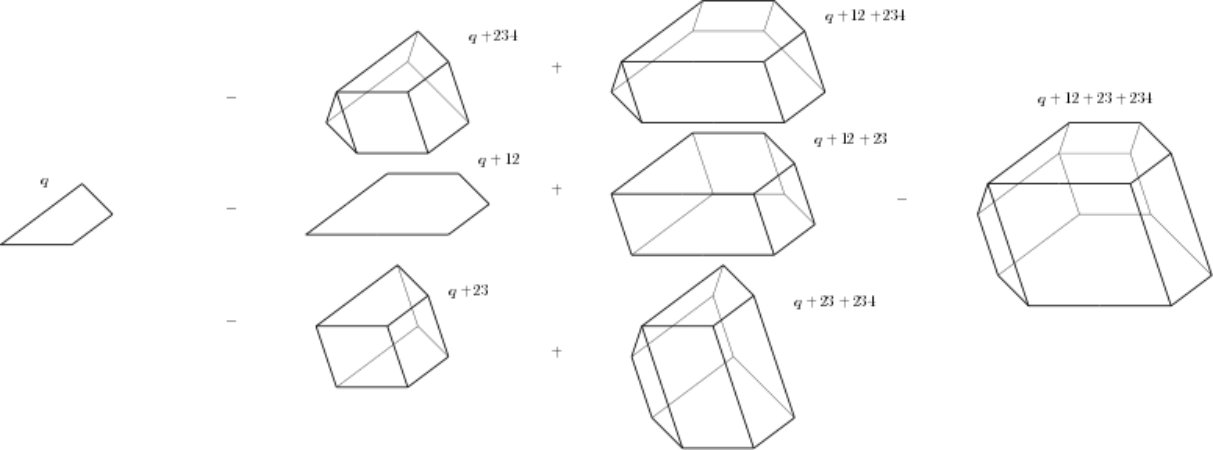 Figure 4
 Figure 5
| n | IBSC | Equivalent classes under |
|---|---|---|
| 0 | ||
| 1 | ||
| 2 | ||
| 3 | ||
| n | 0 | 1 | 2 | 3 | 4 | 5 | 6 | 7 | 8 | 9 |
|---|---|---|---|---|---|---|---|---|---|---|
| 1 | 1 | 2 | 8 | 40 | 242 | 1784 | 15374 | 151008 | 1669010 | |
| 1 | 1 | 3 | 13 | 75 | 541 | 4683 | 47293 | 545835 | 7087261 |
Peer Reviews
No public reviews on file for this paper yet. If you reviewed it on a platform where reviews are public (OpenReview, ICLR, NeurIPS, ICML), you can paste yours below so the community can read it here.
Videos
No videos yet. Explain this paper in a talk, walkthrough, or lecture? Add one.
The kernel of chromatic quasisymmetric functions on graphs and hypergraphic polytopes
Raul Penaguiao111e-mail:[email protected]\blfootnoteInstitute of Mathematics, University of Zurich, Winterthurerstrasse 190, Zurich, CH - 8057.\blfootnoteKeywords: generalized permutahedra, Hopf monoids, chromatic symmetric function\blfootnote2010 AMS Mathematics Subject Classification 2010: 05E05
(March 27, 2020)
Abstract
The chromatic symmetric function on graphs is a celebrated graph invariant. Analogous chromatic maps can be defined on other objects, as presented by Aguiar, Bergeron and Sottile. The problem of identifying the kernel of some of these maps was addressed by Féray, for the Gessel quasisymmetric function on posets.
On graphs, we show that the modular relations and isomorphism relations span the kernel of the chromatic symmetric function. This helps us to construct a new invariant on graphs, which may be helpful in the context of the tree conjecture. We also address the kernel problem in the Hopf algebra of generalized permutahedra, introduced by Aguiar and Ardila. We present a solution to the kernel problem on the Hopf algebra spanned by hypergraphic polytopes, which is a subfamily of generalized permutahedra that contains a number of polytope families.
Finally, we consider the non-commutative analogues of these quasisymmetric invariants, and establish that the word quasisymmetric functions, also called non-commutative quasisymmetric functions, form the terminal object in the category of combinatorial Hopf monoids. As a corollary, we show that there is no combinatorial Hopf monoid morphism between the combinatorial Hopf monoid of posets and that of hypergraphic polytopes.
1 Introduction
Chromatic function on graphs
For a graph with vertex set , a coloring of the graph is a function . A coloring is proper in if no edge is monochromatic.
We denote by the graph Hopf algebra, which is a vector space freely generated by the graphs whose vertex sets are of the form for some . This can be endowed with a Hopf algebra structure, as described by Schmitt in [Sch94, Chapter 12], and also presented below in Section 2.2.
Stanley defines in [Sta95] the chromatic symmetric function of in commuting variables as
[TABLE]
where we write , and the sum runs over proper colorings of . Note that is in the ring Sym of symmetric functions. The ring is a Hopf subalgebra of , the ring of quasisymmetric functions introduced by Gessel in [Ges84]. A long standing conjecture in this subject, commonly referred to as the tree conjecture, is that if two trees are not isomorphic, then .
When , the natural ordering on the vertices allows us to consider a non-commutative analogue of , as done by Gebhard and Sagan in [GS01]. They define the chromatic symmetric function on non-commutative variables as
[TABLE]
where we write , and we sum over the proper colorings of .
Note that is homogeneous and symmetric in the variables . Such power series are called word symmetric functions. The ring of word symmetric functions, WSym for short, was introduced in [RS06], and is sometimes called the ring of symmetric functions in non-commutative variables, or NCSym, for instance in [BZ09]. Here we adopt the former name to avoid confusion with the ring of non-commutative symmetric functions.
In this paper we describe generators for and . A similar problem was already considered for posets. In [Fér15], Féray studies , the Gessel quasisymmetric function defined on the poset Hopf algebra, and describes a set of generators of its kernel.
Some elements of the kernel of have already been constructed in [GP13] by Guay-Paquet and independently in [OS14] by Orellana and Scott. These relations, called modular relations, extend naturally to the non-commutative case. We introduce them now.
Given a graph and an edge set that is disjoint from , let denote the graph with the edges in added. If we have edges and such that forms a triangle, then we also have
[TABLE]
We call the formal sum in a modular relation on graphs. An example is given in Fig. 1. Our first result is that these modular relations span the kernel of the chromatic symmetric function in non-commuting variables. The structure of the proof also allows us to compute the image of the map.
Theorem 1** (Kernel and image of ).**
The modular relations span . The image of is WSym.
Two graphs are said to be isomorphic if there is a bijection between the vertices that preserves edges. For the commutative version of the chromatic symmetric function, if two isomorphic graphs are given, it holds that and are the same. The formal sum in given by is called an isomorphism relation on graphs.
Theorem 2** (Kernel and image of ).**
The modular relations and the isomorphism relations generate the kernel of the commutative chromatic symmetric function . The image of is Sym.
It was already noticed that is surjective. For instance, in [CvW15], several bases of are constructed, which are the chromatic symmetric function of graphs, namely are of the form for suitable graphs on vertices. Here we present a new such family of graphs.
At the end of Section 3 we introduce a new graph invariant , called the augmented chromatic invariant. We observe that modular relations on graphs are in the kernel of the augmented chromatic invariant. It follows from Theorem 2 that . This reduces the tree conjecture in to a similar conjecture on this new invariant , which contains seemingly more information.
Generalized Permutahedra
Another goal of this paper is to look at other kernel problems of chromatic flavor. In particular, we establish similar results to Theorems 1 and 2 in the combinatorial Hopf algebra of hypergraphic polytopes, which is a Hopf subalgebra of generalized permutahedra.
Generalized permutahedra form a family of polytopes that include permutahedra, associahedra and graph zonotopes. This family has been studied, for instance, in [PRW08], and we introduce it now.
The Minkowski sum of two polytopes is set as . The Minkowski difference is only sometimes defined: it is the unique polytope that satisfies , if it exists. We denote as the Minkowski sum of several polytopes.
If we let be the canonical basis of , a simplex is a polytope of the form for non-empty . A generalized permutahedron in is a polytope given by real numbers as follows: Let and . Then, the corresponding generalized permutahedron is
[TABLE]
if the Minkowski difference exists. We identify a generalized permutahedron with the list . Note that not every list of real numbers will give us a generalized permutahedron, since the Minkowski difference is not always defined.
In [Pos09], generalized permutahedra are introduced in a different manner. A polytope is said to be a generalized permutahedron if it can be described as
[TABLE]
for reals .
A third definition of generalized permutahedra is present in [AA17]. Here, a generalized permutahedron is a polytope whose normal fan coarsens the one of the permutahedron. These three definitions are equivalent, and a discussion regarding this can be seen in Section 2.4.
A hypergraphic polytope is a generalized permutahedron where the coefficients in (3) are non-negative. For a hypergraphic polytope , we denote by the family of sets such that . A fundamental hypergraphic polytope on is a hypergraphic polytope such that . Finally, for a set , we write for the hypergraphic polytopes . Note that a fundamental hypergraphic polytope is of the form for some family .
One can easily note that the hypergraphic polytope and are, in general, distinct, so some care will come with this notation. However, the face structure is the same, and we give an explicit combinatorial equivalence in Proposition 29. If is a hypergraphic polytope such that is a building set, then is called a nestohedron, see [Pil17] and [AA17]. Hypergraphic polytopes and its subfamilies are studied in [AA17, Part 4], where they are also called -positive generalized permutahedra.
In [AA17], Aguiar and Ardila define GP, a Hopf algebra structure on the linear space generated by generalized permutahedra in for . The Hopf subalgebra HGP is the linear subspace generated by hypergraphic polytopes. We warn the reader of the use of the same notation for Minkowski operations (Minkowski sum and dilations) and for algebraic operations in GP. However, the distinction should be clear from the context. In [Dok11], generalized permutahedra are also debated.
In [Gru16], Grujić introduced a quasisymmetric map in generalized permutahedra that was extended to a weighted version in [GPS19]. For a polytope , Grujić defines a function to be -generic if the face of that minimizes , denoted , is a point. Equivalently, is -generic if it lies in the interior of the normal cone of some vertex of . Then, Grujić defines for a set of commutative variables, the quasisymmetric function:
[TABLE]
This quasisymmetric function is called the chromatic quasisymmetric function on generalized permutahedra, or simply chromatic quasisymmetric function.
We discuss now a non-commutative version of , where we establish an analogue of Theorem 1 for hypergraphic polytopes. For that, consider the Hopf algebra of word quasisymmetric functions WQSym, an analogue of in non-commutative variables introduced in [NT06] that is also called non-commutative quasisymmetric functions, or NCQSym, for instance in [BZ09]. For a generalized permutahedron and non-commutative variables , let and define
[TABLE]
We see from Proposition 15 that is a word quasisymmetric function. Moreover, a straightforward computation shows that defines a Hopf algebra morphism between GP and WQSym. Let us call and the restrictions of and to HGP, respectively.
Our next theorems describe the kernel of the maps and , using two types of relations:
- •
the simple relations, which are presented in Proposition 29, and convey that only depends on which coefficients are positive;
- •
the modular relations, which are exhibited in Theorem 30. We note for future reference that these generalize the ones for graphs: some of the modular relations on hypergraphic polytopes are the image of modular relations on graphs by a suitable embedding map , introduced below.
Theorem 3** (Kernel and image of of ).**
The space is generated by the simple relations and the modular relations on hypergraphic polytopes. The image of is , a proper subspace of WQSym introduced in 24 below.
Let us denote by the linear space of homogeneous word quasisymmetric functions of degree , and let . A monomial basis for SC is presented in 24. An asymptotic for the dimension of is computed in Proposition 34, where in particular it is shown that it is exponentially smaller than the dimension of .
Two generalized permutahedra are isomorphic if can be obtained from by rearranging the coordinates of the points in . If are isomorphic, the chromatic quasisymmetric functions and are the same. We say that is an isomorphism relation on hypergraphic polytopes.
Theorem 4** (Kernel and image of ).**
The linear space is generated by the simple relations, the modular relations and the isomorphism relations. The image of is .
In [AA17], Aguiar and Ardila define the graph zonotope, a Hopf algebra embeddimg discussed above. Remarkably, we have that . They also define other polytopal embeddings from other combinatorial Hopf algebras , like matroids, to GP. One associates a universal morphism to these Hopf algebras that also satisfy . These universal morphisms are discussed below.
In particular, we can see that . This relation between and is the main motivation to describe , and indicates that is the kernel problem that deserves most attention. In this paper, we leave the description of as an open problem.
Most of the combinatorial objects embedded in GP are also embedded in HGP, such as graphs and matroids, so a description of is already interesting.
We remark that a description of the generators of or does not entail a description of the generators of a generic . For that reason, the kernel problem on matroids and on simplicial complexes is still open, despite these Hopf algebras being realized as Hopf subalgebras of .
On Section 4.4, the computation of the image in Theorem 3 is extended to the Hopf algebra of generalized permutahedra. Specifically, there it is seen that the image of is also .
Universal morphisms
For a Hopf algebra , a character of is a linear map that preserves the multiplicative structure and the unit of . We define a combinatorial Hopf algebra as a pair where is a Hopf algebra and a character of . For instance, consider the ring of quasisymmetric functions introduced in [Ges84] with its monomial basis , indexed by compositions. Then, has a combinatorial Hopf algebra structure , by setting whenever has one or zero parts.
In [ABS06], Aguiar, Bergeron, and Sottile showed that any combinatorial Hopf algebra has a unique combinatorial Hopf algebra morphism , i.e. a Hopf algebra morphism that satisfies . In other words, is a terminal object in the category of combinatorial Hopf algebras. The construction of is given in [ABS06] and also presented below in Section 2. We will refer to these maps as the universal maps to .
The commutative invariants previously shown on graphs , on posets and on generalized permutahedra can be obtained as universal maps to . If we take the character on the graphs Hopf algebra, the unique combinatorial Hopf algebra morphism is exactly the map . With the Hopf algebra structure imposed on in [AA17], if we consider the character , then is the universal map from to . On posets, the Hopf algebra structure considered is the one presented in [GR14] and the character that is considered is .
To see the maps and as universal maps, we need a parallel of the universal property of in the non-commutative world. The fitting property is better described in the context of Hopf monoids in vector species. Consider the Hopf monoid , which is presented in [AM10] as the Hopf monoid of faces. It is seen that there is a unique Hopf monoid morphism between a connected Hopf monoid and . In the last chapter we establish another proof of this fact, using resources from character theory, and expand on that showing that instead of a connected Hopf monoid we can take any combinatorial Hopf monoid, for a suitable notion of combinatoric Hopf monoid.
The relationship between Hopf algebras and Hopf monoids is very well captured with the so called Fock functors, mapping Hopf monoids to Hopf algbras, and Hopf monoid morphisms to Hopf algebra morphism. In particular, the full Fock functor satisfies . Then, the universal property of gives us a Hopf algebra morphism from to . The maps arise precisely in this way, when applying to the unique combinatorial Hopf monoid morphism from the Hopf monoid on graphs and of generalized permutahedra to . In particular, we observe that and . If we consider the poset Hopf monoid , the universal property of the combinatorial Hopf monoid gives us a non-commutative analogue of the Gessel invariant, which coincides with the one presented in [Fér15]. In particual, . We will refer to these Hopf algebra morphisms as the universal maps to .
Finally, our previous results have an interesting consequence. We show that, because is not surjective, there is no combinatorial Hopf monoid morphism from the Hopf monoid on posets to the Hopf monoid on hypergraphic polytopes. However, in [AA17] a Hopf monoid morphism from posets to extended generalized permutahedra is constructed. With this result we obtain that this map cannot be restricted from extended generalized permutahedra to generalized permutahedra.
Note: for sake of clarity, we have been using boldface for non-commutative Hopf algebras, their elements, and the associated combinatorial objects, like word symmetric functions and set compositions. We try and maintain that notational convention throughout the paper.
This paper is organized as follows: In Section 2 we address the preliminaries, where the reader can find the linear algebra tools that we use, the introduction to the main Hopf algebras of interest, and the proof that the several definitions of a generalized permutahedra are equivalent. In Section 3 we prove Theorems 1 and 2, and we study the augmented chromatic invariant. In Section 4 we prove Theorems 3 and 4, and we present asymptotics for the dimension of the graded Hopf algebra SC. In Section 5 we present the universal property of . In Appendix A we find some relations between the coefficients of the augmented chromatic symmetric function and the coefficients of the original chromatic symmetric function on graphs.
2 Preliminaries
There are natural maps and by allowing the variables to commute. We denote these maps by .
For an equivalence relation on a set , we write for the equivalence class of in , and write when is clear from context. We write both and for the set of equivalence classes of . All the vector spaces and algebras are over a generic field of characteristic zero.
2.1 Linear algebra preliminaries
The following linear algebra lemmas will be useful to compute generators of the kernels and the images of and . These lemmas describe a sufficient condition for a set to span the kernel of a linear map .
Lemma 5**.**
Let be a finite dimensional vector space with basis , be a linear map, and be a family of relations.
Assume that there exists such that:
- •
the family is linearly independent in ,
- •
for we have for some and some scalars ;
Then spans . Additionally, we have that is a basis of the image of .
The following lemma will help us dealing with the composition : we give a sufficient condition for a natural enlargement of the set to generate , given that already generates .
Lemma 6**.**
We will use the same notation as in Lemma 5. Additionally, consider linear map and write . Take the equivalence relation in that satisfies whenever . Let and write with no ambiguity.
[TABLE]
Assume the hypotheses in Lemma 5 and, additionally, suppose that the family is linearly independent in .
Then, is generated by . Furthermore, is a basis of .
Proof of Lemma 5.
Suppose, for sake of contradiction, that there is some element . In particular . Write
[TABLE]
and note that if for every , then
[TABLE]
which, by linear independence of , implies that for every , contradicting . Therefore, we have for whenever .
Consider the smallest index such that is non-zero. Consider that maximizes .
Thus, we can write
[TABLE]
By hypotheses, because , there is some such that:
[TABLE]
So applying this to (7) gives us:
[TABLE]
Note that which contradicts the maximality of . From this we conclude that there are no elements in .
To show that the family is a basis of , we just need to establish that this is a generating set. Naturally, is a generating set because it is the image of a basis of . We show by induction that is a generating set for any non-negative . This concludes the proof, since the original claim is this for .
Indeed, if is a generating set of , then we note for some , so
[TABLE]
This concludes the induction step. ∎
Proof of Lemma 6.
Define . Note that for every there is such that . Indeed it is enough to choose with , to write .
So, the set satisfies both that:
- •
We have by hypothesis that is linearly independent in ;
- •
For we can write for some and some scalars .
Now applying Lemma 5 to instead of , to instead of and to instead of tells us that generates , and that spans the image of , as desired. ∎
2.2 Hopf algebras and associated combinatorial objects
In the following, all the Hopf algebras have a grading, denoted by .
An integer composition, or simply a composition, of , is a list of positive integers whose sum is . We write . We denote the length of the list by and we denote the set of compositions of size by .
An integer partition, or simply a partition, of , is a non-increasing list of positive integers whose sum is . We write . We denote the length of the list by and we denote the set of partitions of size by . By disregarding the order of the parts on a composition we obtain a partition .
A set partition of a set is a collection of non-empty disjoint subsets of , called blocks, that cover . We write . We denote the number of parts of the set partition by , and call it its length. We denote the family of set partitions of by , or simply by if . By counting the elements on each block of , we obtain an integer partition denoted by . We identify a set partition with an equivalence relation on , where if are on the same block of .
A set composition of is a list of non-empty disjoint subsets of that cover , which we call blocks. We write . We denote the size of the set composition by . We write for the family of set compositions of , or simply if . By disregarding the order of a set composition , we obtain a set partition . By counting the elements on each block of , we obtain a composition denoted by . A set composition is naturally identified with a total preorder on , where if for .
Permutations act on set compositions and set partitions: for a set composition , a set partition on , and a permutation , we define the set composition and the set partition .
A coloring of the set is a function . The set composition type of a coloring is the set composition obtained after deleting the empty sets of . This notation is extended to function .
In partitions and in set partitions, we use the classical coarsening orders with the same notation, where we say that (resp. ) if is obtained from by adding some parts of the original parts together (resp. if is obtained from by merging some blocks).
These objects relate to the Hopf algebras , , and . The homogeneous component (resp. , and ) of the Hopf algebra (resp. , , ) has a monomial basis indexed by partitions (resp. compositions, set partitions, set compositions), which we denote by (resp. , and ).
2.3 Hopf algebras on graphs and posets
Of interest are the Hopf algebras on graphs and on posets , which are graded and connected, and whose homogeneous components , resp. , are the linear span of the graphs with vertex set , resp. partial orders in the set .
In these graded vector spaces, define the products and coproducts in the basis elements. For that, when are sets of integers with the same cardinality, we let be the canonical relabelling of combinatorial objects on to combinatorial objects on that preserves the order of the labels.
Recall that the disjoint union of graphs , where , is , and the restriction of a graph is . Denote as usual, and for . Given two graphs with vertices labeled in respectively, the product is the relabeled disjoint union
[TABLE]
For the coproduct, let be a graph labeled in , then
[TABLE]
To define a Hopf algebra on posets, consider two posets , where represents the set of pairs such that in the respective poset. The disjoint union of posets is written and defined as , and the restriction of a poset is written and defined as . Recall that is an ideal of if whenever and , then . Define the product between partial orders in the sets , respectively, as
[TABLE]
and the coproduct for a partial order in .
[TABLE]
These operations define a Hopf algebra structure in and , as described in [GR14].
Recall from the introduction that, for graphs, Gebhard and Sagan defined in [GS01] the non-commutative chromatic morphism. The following expression is given:
Lemma 7** ([GS01, Proposition 3.2]).**
For a graph we say that a set partition of is proper if no block of contains an edge. Then have that
[TABLE]
where the sum runs over all proper set partitions of .
2.4 Faces and a Hopf algebra structure of generalized permutahedra
In the following we identify with . For a set composition on , recall that is a partial order on . For a non-empty set , define the set , where is the smallest index with . A coloring on is a map . A real coloring on is a map , and we identify the real coloring with the linear function .
[TABLE]
In the space , we define the simplices for each . Recall that a generalized permutahedron is a Minkowski sum and difference of the form
[TABLE]
for reals that can be either positive, negative or zero.
Recall as well that a hypergraphic polytope is a generalized permutahedron of the form
[TABLE]
for non-negative reals .
For a polytope and a real coloring on , we denote by the subset of on which is minimized, that is
[TABLE]
A face of is the solution to such a linear optimization problem on . A real coloring is said to be -generic if the corresponding face is a point.
Example 8*.*
Consider the hypergraphic polytope in . If we take the coloring of given by and , then . If we consider the coloring and , then is a point, so is - generic.
In particular, note that if , then is a face of . Incidentally, whenever is a coloring that is minimal exactly in , we have that . In fact, for a real coloring the face corresponding to of a simplex is another simplex, specifically it we can directly compute that
[TABLE]
The following fact describes faces of the Minkowski sums and differences:
Lemma 9**.**
Let be a real coloring and two polytopes. Then and, if the difference is well defined, .
Proof.
Suppose that are the minima of in the polytopes . Let . So for some .
Then . We have equality if and only if we have , that is when .
Now follows because by the above. ∎
Definition 10* (Normal fan of a polytope).*
A cone is a subset of an -vector space that is closed for addition and multiplication by positive scalars. For a polytope and one of its faces, we define its normal cone
[TABLE]
This is a cone in the dual space of . Moreover, the normal cones of all the faces of partition into cones . This is the normal fan of .
Example 11* (The normal fan of the -permutahedron - The braid fan).*
The faces of the permutahedron are indexed by . In particular, the corresponding normal cone of the face , corresponding to , is
[TABLE]
In the introduction we referred two other definitions of generalized permutahedra that are present in the literature. We recover them here, and justify their equivalence:
Lemma 12** (Definition 1 of generalized permutahedra, see [AA17]).**
A polytope is a generalized permutahedron in the sense of (3) if and only if its normal fan coarsens the one of the permutahedron. Specifically, for any two real colorings , if then .
Define the polytope in the plane given by the inequalities
[TABLE]
for some real numbers .
Lemma 13** (Definition 2 of generalized permutahedra, see [Pos09]).**
A polytope is a generalized permutahedron if it can be expressed as for real numbers such that
[TABLE]
for all non-empty sets that are not disjoint.
In [AA17, Theorem 12.3], is it shown that these two last notions of generalized permutahedra are equivalent. That is, a polytope is of the form for real numbers if and only if its normal fan coarsens the one from the permutahedron.
In [ABD10, Proposition 2.4], Ardila, Benedetti and Doker show that any generalized permutahedron has an expression of the from given by Eq. 3. The main feature in that proof is the following: for real numbers such that , if we choose reals such that , then Eq. 3 gives us a well defined polytope and in fact defines the same polytope as .
In the following we establish that the normal fan of a polytope of the form Eq. 3 coarsens the one of the -permutahedron, concluding with the above that the three definitions of generalized permutahedra presented are equivalent.
Proposition 14**.**
Let be a polytope of the form
[TABLE]
for reals that can be either positive, negative or zero, and and . Then its normal fan coarsens the one of the permutahedron.
Proof.
Let be a real coloring of . As a consequence of 11 and as discussed in the end of Lemma 12, it is enough to establish that if satisfy then . In fact, from Lemma 9 and (9), we have
[TABLE]
which clearly only depend on the set composition type of the real coloring . ∎
Denote by the face on that is the solution to any linear optimization problem on for a real coloring with composition type , so that
[TABLE]
The following is a consequence of Lemma 12:
Proposition 15**.**
If is a generalized permutahedron, then
[TABLE]
We now turn away from the face structure of generalized permutahedra and debate its Hopf algebra structure, introduced in [AA17]. As usual, consider a generalized permutahedron given by (3). If is a set composition of , then can be written as a Minkowski sum of polytopes
[TABLE]
where is a generalized permutahedron in and is a generalized permutahedron on . Note that so the dependence of and on is implicit.
We can obtain explicit expressions for and :
[TABLE]
We have now all the material to endow the space of generalized permutahedra with a Hopf algebra structure according to [AA17]: let , where is the free linear space on generalized permutahedra in .
The linear space has the following product, when are generalized permutahedra in respectively:
[TABLE]
The linear space has the following coproduct, when is a generalized permutahedron in :
[TABLE]
Remark 16*.*
Note that the span of the fundamental hypergraphic polytopes does not form a Hopf algebra, as it is not stable for the coproduct.
3 Main theorems on graphs
In this section we prove Theorems 1 and 2, which follow from Lemmas 5 and 6. We also discuss an application of Theorem 2 on the tree conjecture, by constructing a new graph invariant that satisfies the modular relations.
For a set partition , we define the graph where if . This graph is the disjoint union of the complete graphs on the blocks of . We denote the complement of as . Note that a set partition is proper in if and only if in the coarsening order on set partitions. Hence, as a consequence of Lemma 7,
[TABLE]
We now show that the kernel of is spanned by the modular relations.
Proof of Theorem 1. Recall that is spanned by graphs with vertex set . We choose an order in this family of graphs in a way that the number of edges is non-decreasing.
From (12), we know that the transition matrix of over the monomial basis of WSym is upper triangular, hence forms a basis set of . In particular, .
In order to apply Lemma 5 to the set of modular relations on graphs, it suffices to show the following: if a graph is not of the form , then we can find a formal sum that is a modular relation. Indeed, is the graph with least edges in that expression, so it is the smallest in the order . It follows from Lemma 5 that the modular relations generate the space .
To find the desired modular relation, it is enough to find a triangle such that and . Consider , the set partition given by the connected components of , so that . By hypothesis, , so there are vertices in the same block of that are not neighbors in . Without loss of generality we can take such that are at distance 2 in , so they have a common neighbor in (see example in Fig. 2).
The edges , and form the desired triangle, concluding the proof. ∎
Proof of Theorem 2.
It is clear that is surjective, since is surjective. Now, our goal is to apply Lemma 6 to the map and the equivalence relation corresponding to graph isomorphism. First, note that if then and are isomorphic graphs. Define without ambiguity .
From the proof of Theorem 1, the hypotheses of Lemma 5 are satisfied. Therefore, to apply Lemma 6 it is enough to establish that the family is linearly independent. Indeed, it would follow that is generated by the modular relations and the isomorphism relations, and is a basis of concluding the proof.
Recall that for set partitions