Beating the Rayleigh Limit Using Two-Photon Interference
Micha{\l} Parniak, Sebastian Bor\'owka, Kajetan Boroszko, Wojciech, Wasilewski, Konrad Banaszek, Rafa{\l} Demkowicz-Dobrza\'nski

TL;DR
This paper demonstrates that two-photon Hong-Ou-Mandel interference combined with spatial detection can surpass the Rayleigh limit by simultaneously estimating the separation and centroid of two point sources, both theoretically and experimentally.
Contribution
It introduces a novel measurement scheme using two-photon interference to improve multiparameter imaging beyond classical limits.
Findings
Achieved super-resolution in estimating source separation and centroid.
Validated the method through experimental implementation.
Surpassed traditional Rayleigh limit constraints.
Abstract
Multiparameter estimation theory offers a general framework to explore imaging techniques beyond the Rayleigh limit. While optimal measurements of single parameters characterizing a composite light source are now well understood, simultaneous determination of multiple parameters poses a much greater challenge that in general requires implementation of collective measurements. Here we show, theoretically and experimentally, that Hong-Ou-Mandel interference followed by spatially resolved detection of photons provides precise information on both the separation and the centroid for a pair of point emitters, avoiding trade-offs inherent to single-photon measurements.
Click any figure to enlarge with its caption.
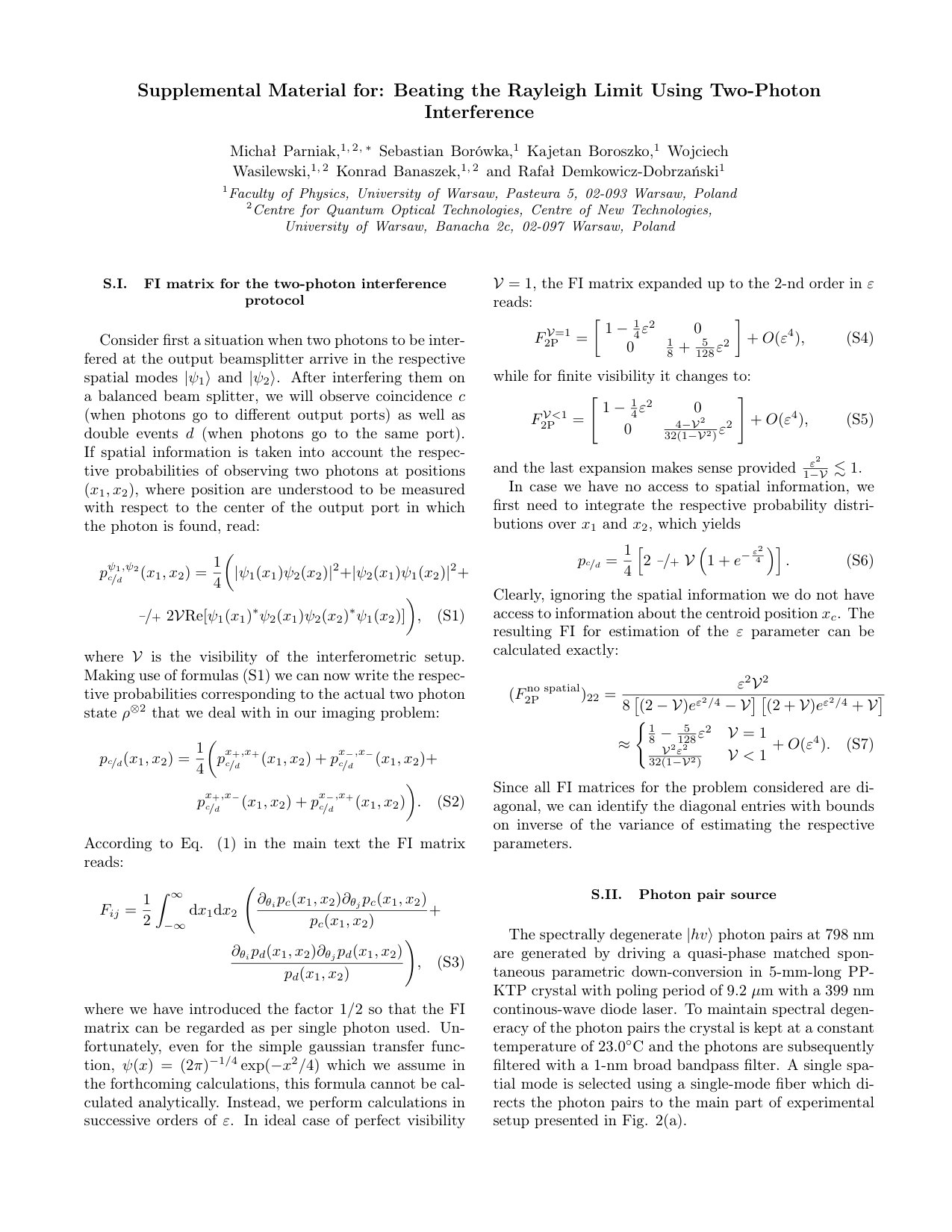 Figure 1
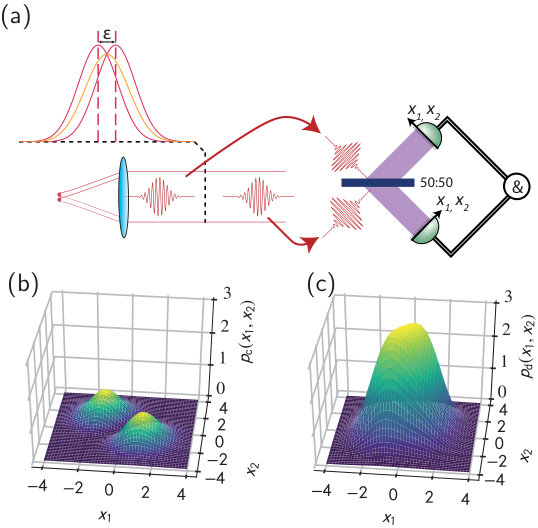 Figure 1
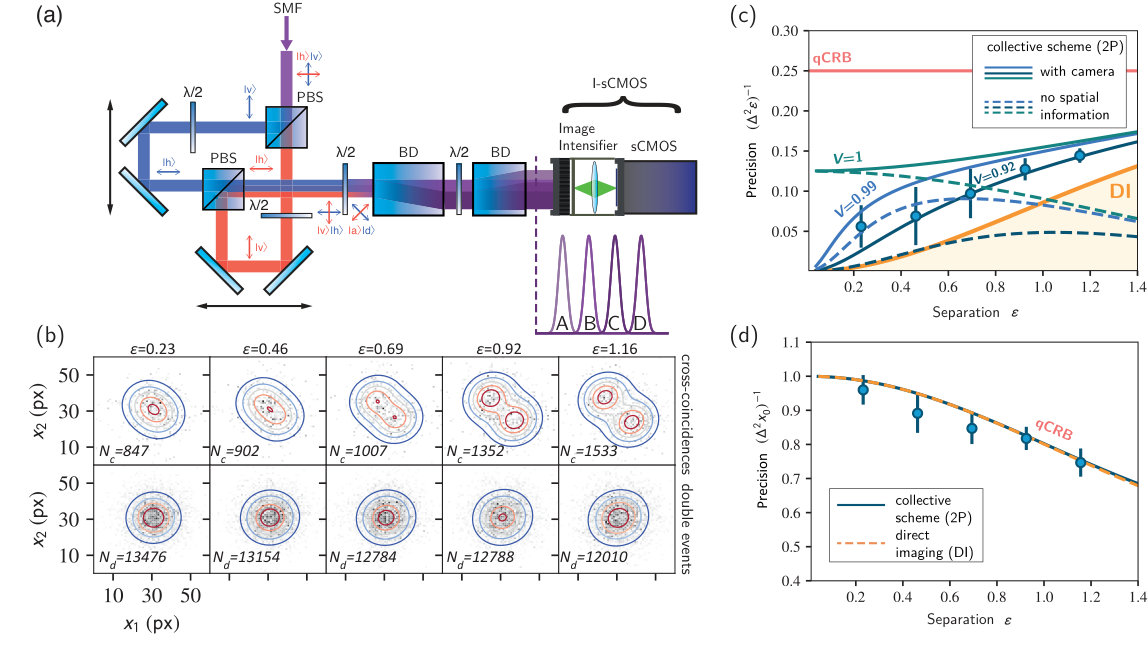 Figure 2
Peer Reviews
No public reviews on file for this paper yet. If you reviewed it on a platform where reviews are public (OpenReview, ICLR, NeurIPS, ICML), you can paste yours below so the community can read it here.
Videos
No videos yet. Explain this paper in a talk, walkthrough, or lecture? Add one.
Beating the Rayleigh limit using two-photon interference
Michał Parniak
Faculty of Physics, University of Warsaw, Pasteura 5, 02-093 Warsaw, Poland
Centre for Quantum Optical Technologies, Centre of New Technologies, University of Warsaw, Banacha 2c, 02-097 Warsaw, Poland
Sebastian Borówka
Faculty of Physics, University of Warsaw, Pasteura 5, 02-093 Warsaw, Poland
Kajetan Boroszko
Faculty of Physics, University of Warsaw, Pasteura 5, 02-093 Warsaw, Poland
Wojciech Wasilewski
Faculty of Physics, University of Warsaw, Pasteura 5, 02-093 Warsaw, Poland
Centre for Quantum Optical Technologies, Centre of New Technologies, University of Warsaw, Banacha 2c, 02-097 Warsaw, Poland
Konrad Banaszek
Faculty of Physics, University of Warsaw, Pasteura 5, 02-093 Warsaw, Poland
Centre for Quantum Optical Technologies, Centre of New Technologies, University of Warsaw, Banacha 2c, 02-097 Warsaw, Poland
Rafał Demkowicz-Dobrzański
Faculty of Physics, University of Warsaw, Pasteura 5, 02-093 Warsaw, Poland
Abstract
Multiparameter estimation theory offers a general framework to explore imaging techniques beyond the Rayleigh limit. While optimal measurements of single parameters characterizing a composite light source are now well understood, simultaneous determination of multiple parameters poses a much greater challenge that in general requires implementation of collective measurements. Here we show, theoretically and experimentally, that Hong-Ou-Mandel interference followed by spatially resolved detection of individual photons provides precise information on both the separation and the centroid for a pair of point emitters, avoiding trade-offs inherent to single-photon measurements.
Multiparameter quantum estimation emerges as a general framework to optimize information retrieval in a variety of experimental scenarios. The problem of imaging can be viewed as an important example of such a scenario, where the properties of an image, for example locations and intensities of point emitters or the moments of the image intensity distribution are the parameters to be estimated Řehaček et al. (2017); Paúr et al. (2016); Yang et al. (2016); Chrostowski et al. (2017); Ragy et al. (2016); Napoli et al. (2018); Zhou and Jiang (2018). A recently introduced family of superresolution imaging schemes Tsang (2009, 2015); Tsang et al. (2016); Tsang (2017); Kerviche et al. (2017); Dutton et al. (2018) based on spatial demultiplexing enable one to determine the separation of two nearby point sources below the Rayleigh limit, but require in principle perfect knowledge of the centroid Chrostowski et al. (2017). Moreover, at the single photon level they are fundamentally incompatible with the measurement needed to estimate the centroid itself. Nonetheless, the effort to extract optimally information carried in light emitted naturally by a source Puschmann and Kneer (2005); Tang et al. (2016); Nair and Tsang (2016, 2015); Lupo and Pirandola (2016); Dutton et al. (2018); Tham et al. (2017) may open up new applications compared to established approaches that require manipulations of the sample to be imaged Moerner (2015).
A deeper insight rooted in the multiparameter estimation theory reveals a possible solution of the above incompatibility problem. Interestingly, in the strong subdiffraction regime where images of the sources overlap significantly, the problem can modelled as simultaneous estimation of the length and the rotation angle of a qubit Bloch vector Chrostowski et al. (2017). From the theory of multiparameter estimation it then follows that, provided collective measurement on the photons (or qubits) are allowed, the incompatibility between the optimal individual measurements to estimate the centroid and the sources separation ceases to be an issue Bagan et al. (2006); Vidrighin et al. (2014). The question is how to realize such a collective measurement in practice.
In this Letter we exploit the advantages offered by the multiphoton interference approach, demonstrating a two-photon protocol for imaging of two point sources, where the centroid estimation is performed in the optimal way, and at the same time the sources separation parameter is estimated with a superresolution precision. The idea relies on the effect of two-photon interference and does not require pre-estimation of the centroid or fine-tuning of the measurement basis inherent to spatial mode demultiplexing schemes Tsang (2009, 2015); Tsang et al. (2016); Tsang (2017); Kerviche et al. (2017); Dutton et al. (2018), where any systematic error in centroid estimation propagates to separation estimation and significantly degrades the imaging protocol.
In Fig. 1(a) we depict a scenario where two photons emitted by a composite source arrive simultaneously at the input ports of the beamsplitter. The proposed protocol exploits both cross-coincidences between the output ports and double events in each port, detected with spatial resolution Jachura et al. (2016). The number of cross-coincidences grows with the distinguishability of the two photons and therefore carries information about the separation between point sources. Most importantly, the proposed interferometric scheme does not require prior selection of the measurement basis or the axis of symmetry, as the two photons serve as a reference for each other. Furthermore, thanks to spatially-resolved detection this strategy will be shown to be robust against residual spectral distinguishability. Let us note that previous approaches to collective measurements relied on the fundamental advantage of using photonic entanglement Rozema et al. (2014), also for superresolution photolithography Liao et al. (2010); Boyd et al. (2012); D’Angelo et al. (2001); Boto et al. (2000), which is essentially different from our technique of simply utilizing the bosonic nature of photons.
The somewhat non-trivial demand of interfering two photons from a realistic classical (thermal) composite source on a beamsplitter could be realized by a photon number quantum nondemolition (QND) measuring device that preserve spatial properties of light, and upon registering single photons delays and redirects them so that they arrive together at the two beamsplitter input ports. Recent advances in storing and controlling single photons in quantum nonlinear media such as Rydberg atoms Firstenberg et al. (2013) as well as spatially-multimode quantum memories Parniak et al. (2017) with processing capabilities Parniak et al. (2018) could provide a viable way to realize the scheme. In particular, a phase shift induced by a single photon has already been achieved Tiarks et al. (2016) and current experiments already explore the Rydberg interactions in the trasverse spatial domain Busche et al. (2017). The combination of a multimode quantum memory with the spatially-resolving QND measurement could follow the steps of experiments demonstrating optical storage in Rydberg media Distante et al. (2017); Li and Kuzmich (2016), use alternative proposals such as nonlinearities induced by ac-Stark shifts Everett et al. (2016) or utilize novel solid-state systems with similar capabilities yet broader spectral bandwidths Yang et al. (2018); Walther et al. (2018).
To support the intuitions behind the discussed scheme let us compare the two-photon imaging scheme with direct imaging (DI) by modeling a problem of resolving a 1D image formed by two point sources. Let be a 1D wave function representing the amplitude transfer function of a single source in the image plane centered at point . We assume that this function is determined by well characterized properties of the imaging setup. In what follows we denote the corresponding single photon state characterized by as .
Consider a situation where the image is produced as a result of an incoherent overlap of images of two point sources separated by a distance , located at and . We may then write the spatial density matrix of a photon emitted from the system as .
In the DI scheme the probability distribution for the position of the detected photon is given by , where represents the dependence on the estimated parameters. For any locally unbiased estimator, the covariance matrix for the estimated parameters can be lower bounded using the Cramér-Rao inequality Kay (1993):
[TABLE]
where is the Fisher information (FI) matrix per single photon, while represents the total number of photons registered. The bound is asymptotically saturable using e.g. max-likelihood estimator, hence . As the FI matrix is diagonal for the given problem, we can easily calculate the variances , the respective variances of the estimated parameters per single photon used. In case of DI the FI matrix yields the following precision for estimation in the leading order in :
[TABLE]
where for concreteness we have assumed a Gaussian-shaped transfer function , yielding intensity profile with standard deviation which can be regarded as a natural unit of distance in the problem. The above expansion is valid for small when source point images are separated by a distance smaller than the transfer function spread, and clearly shows impossibility of precise estimation of in the limit.
Crucially, as observed in Tsang et al. (2016), a more fundamental bound based on the quantum FI matrix Helstrom (1976), which does not assume any particular measurement strategy and is based solely on the properties of the quantum state to be measured reads:
[TABLE]
indicating a potential spectacular robustness of estimation as the is constant irrespectively of how small is. While the bound (1) with being replaced by is saturable for the problem considered, it requires collective measurements on many copies of Vidrighin et al. (2014); Řehaček et al. (2017); Chrostowski et al. (2017); Ragy et al. (2016).
We are now ready to quantify the precision of estimating and in the two-photon (2P) interferometric scheme and contrast it with the above-mentioned strategies. Given at the input ports of the beam-splitter, we calculate spatially-resolved propabilities for coincidences as well as double events , from which the information about and is drawn. Furthermore, we assume a known two-photon visibility resulting from the operation of the non-demolition photon routing device before the beamsplitter. The resulting precision of estimation per single photon used, see Supplementary Material, expanded up to the second order in reads:
[TABLE]
while the expansion in case of imperfect visibility is valid in the regime where . In case of perfect interference, we see that while keeping the optimality of estimation, we additionally obtain estimation with precision reduced by approximately a factor of compared to the fundamental bound given in (5). This shows superiority of 2P over DI, with the added advantage that the measurement setting is fixed and does not require adjusting the measurement for depending on preestimation of . Here we would like to stress the importance of spatial information that is available in the experiment: if only the ratio of coincidence and double events was available, there would be no information on parameter at all, while the precision of estimation shows a small reduction for finite compared with Eq. 7 and reads: when the visibility is equal to one.
The role of spatial information becomes more pronounced for finite visibilities , for which the spatial information always provides an advantage for all values of compared to the case when we consider only the ratio of cross-coincidences and double-event where the precision reads . This is achieved as coincidences that arise due to finite visibility are characterized by a different spatial distribution than coincidences that are due to spatial separation. In both cases we recover the -scaling and thus for small the advantage of the collective schemes over DI takes the form of a constant factor rather than favorable scaling. Nonetheless, as this factor scales as the enhancement can be significant.
For a proof-of-principle experimental demonstration, we generated families of states for a set of separations (see Fig. 2(a) and Supplementary Material for details of the interferometric setup). In Fig. 2(c) and 2(d) we plot the final precision of estimation divided by the total number of photons used as a function of (see Supplementary Material for details of data analysis). The proposed theory (for ) accurately predicts the estimation precision for the given experimental parameters demonstrating a significant, over twofold enhancement over the DI scheme. The spatial resolution provides an advantage over the whole range of parameters, as it allows us to distinguish effects of finite visibility versus the reduced mode overlap due to source separation.
In Figure 2(c),(d) we additionally plot the theoretical predictions for and perfect interference i.e. . The precision approaches a constant value for only for , but offers significant enhancement for realistic visibilities. Note that if information is drawn only from the number of coincidences to double events with no spatial resolution, we can still beat the DI scheme over a broad range of parameters, especially for small . This highlights the possibility to perform precise imaging with only single-pixel detectors.
Let us now provide a simple argument for the observed degree of precision enhancement. The approximately two-fold reduction of precision for estimation for in the 2P protocol compared to the fundamental bound is due to the fact that the protocol performs collective measurement on two photons only. The essence of the collective measurement is effective projection of on symmetric and antisymmetric subspaces thanks to the properties of the Hong-Ou-Mandel interference. Such a measurement commutes with joint unitary rotation of the state which represents the shift of the centroid in our model, and hence does not collide with the measurement optimal for extracting information on . Theoretically, if collective measurements on arbitrary number of copies were possible, one could project state on subspaces corresponding to different irreducible representation of the permutation group which provides optimal information about the parameter in the limit and does not interfere with the optimal measurement of Bagan et al. (2006). Thus, through harnessing more than two photons one would be able to approach and even saturate the quantum Cramér-Rao bound (4).
Interestingly, in a slightly modified imaging scenario, the two-photon measurements may actually saturate the limit discussed above. Consider a different variant of the two-photon state impinging on the beamsplitter
[TABLE]
which represents a situation where the photons from the two sources always enter at different input ports of the beamsplitter. Such a two-photon state could be obtained from a pair of single-photon emitters excited simultaneously, where we would never observe two photons emitted from the same source. In this case, analogous calculations to the ones presented in Ref. Řehaček et al. (2017) for the state, lead to the quantum FI matrix which in the leading order in remains unchanged, whereas the two photon experiment described above saturates the bound exactly:
[TABLE]
Finally, it is insightful to juxtapose the presented scheme with the celebrated Hanbury Brown–Twiss (HBT) interferometry Hanbury Brown and Twiss (1954, 1956, 1957, 1958); Fano (1961). The essential difference is that in our approach photon positions are measured in the image plane, while in the HBT scenario spatially resolved detection is implemented in the Fourier plane conjugate to the source. For photons arriving from point sources located at angular positions specified by wave vectors and and detectors placed at and , HBT interference produces fringes whose spatial variation is proportional to the expression Scully and Zubairy (1997). If the maximum distance , which can be viewed as the aperture of the measuring system, is fixed, an attempt to retrieve the angular separation between the sources from HBT fringes will suffer from the Rayleigh curse in the limit . This is because for vanishing one will observe only a small fraction of the HBT fringe in the vicinity of its maximum.
In the case of the two-photon scheme presented here, we should emphasize the role of the prior QND measurement if superresolution is to be achieved with classical thermal light sources. While HBT interferometry works also with classical light sources, albeit with reduced visibility, the enhancement offered by our scheme stems from realizing two-photon interferometry sufficiently close to the dark fringe, i.e. with high visibility . In fact, since classical light sources can attain at most visibility of Hong-Ou-Mandel interference, formulas (6) indicate that no significant improvement is possible over the DI scheme: for we get vs. in case of direct imaging.
In conclusion, we have demonstrated both theoretically and experimentally an imaging protocol that circumvents the difficulties in a multi-parameter estimation problem by use of a collective measurement. The presented experimental results conclusively confirm the possibility to exploit the inherent indistinguishability of photons to perform quantum-enhanced simultaneous estimation of source separation and centroid. With this proof-of-principle experiment we have also proposed a set of realistic schemes in which our protocol could be readily applied, even to gain additional information along the traditional single-photon DI scenario or other superresolution techniques. The general theory of super-resolved imaging Řehaček et al. (2017); Chrostowski et al. (2017); Zhou and Jiang (2018) implies that the same protocol might be directly applied in case of a more general light source distribution provided one would be interested in estimating its first and second moments.
Acknowledgements.
This work has been funded by the National Science Centre (Poland) Projects No. 2017/25/N/ST2/01163, 2016/22/E/ST2/00559 and by the project “Quantum Optical Communication Systems” carried out within the TEAM programme of the Foundation for Polish Science co-financed by the European Union under the European Regional Development Fund. M.P. thanks M. Jachura for know-how transfer on the photon-pair source and M. Mazelanik for insightful discussions.
The reference list from the paper itself. Each links out to its DOI / PubMed record.
- 1Řehaček et al. (2017) J. Řehaček, Z. Hradil, B. Stoklasa, M. Paúr, J. Grover, A. Krzic, and L. L. Sánchez-Soto, Phys. Rev. A 96 , 062107 (2017) . · doi ↗
- 2Paúr et al. (2016) M. Paúr, B. Stoklasa, Z. Hradil, L. L. Sánchez-Soto, and J. Rehacek, Optica 3 , 1144 (2016).
- 3Yang et al. (2016) F. Yang, A. Taschilina, E. S. Moiseev, C. Simon, and A. I. Lvovsky, 3 (2016), 1606.02662 .
- 4Chrostowski et al. (2017) A. Chrostowski, R. Demkowicz-Dobrzański, M. Jarzyna, and K. Banaszek, Int. J. Quantum Inf. 15 , 1740005 (2017).
- 5Ragy et al. (2016) S. Ragy, M. Jarzyna, and R. Demkowicz-Dobrzański, Phys. Rev. A 94 , 052108 (2016).
- 6Napoli et al. (2018) C. Napoli, T. Tufarelli, S. Piano, R. K. Leach, and G. Adesso, ar Xiv:1805.04116 (2018).
- 7Zhou and Jiang (2018) S. Zhou and L. Jiang, ar Xiv:1801.02917 (2018).
- 8Tsang (2009) M. Tsang, Phys. Rev. Lett. 102 , 253601 (2009).