The tree of numerical semigroups with low multiplicity
P. A. Garc\'ia-S\'anchez, D. Mar\'in-Arag\'on, A. M. Robles-P\'erez

TL;DR
This paper investigates the growth of the number of numerical semigroups with fixed low multiplicity and genus, utilizing the Kunz polytope and partition problems to establish increasing trends.
Contribution
It demonstrates that the count of numerical semigroups with multiplicity three, four, or five increases with genus, and provides explicit enumeration for multiplicity four using partition conditions.
Findings
Number of semigroups increases with genus for multiplicities 3, 4, 5.
Explicit partition-based formula for multiplicity four semigroups.
Use of Kunz polytope to relate semigroup counting to integer partitions.
Abstract
We show that the number of numerical semigroups with multiplicity three, four or five and fixed genus is increasing as a function in the genus. To this end we use the Kunz polytope for these multiplicities. Counting numerical semigroups with fixed multiplicity and genus is then an integer partition problem with some extra conditions (those of membership to the Kunz polytope). For the particular case of multiplicity four, we are able to prove that the number of numerical semigroups with multiplicity four and genus is the number of partitions with , , and .
Click any figure to enlarge with its caption.
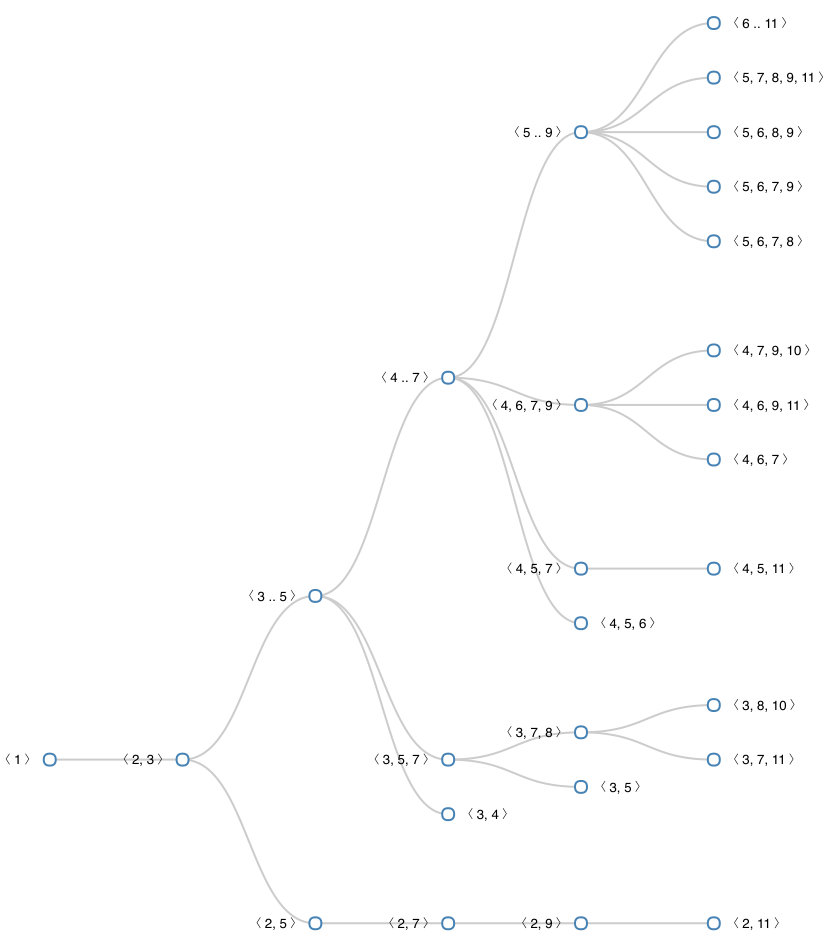 Figure 1
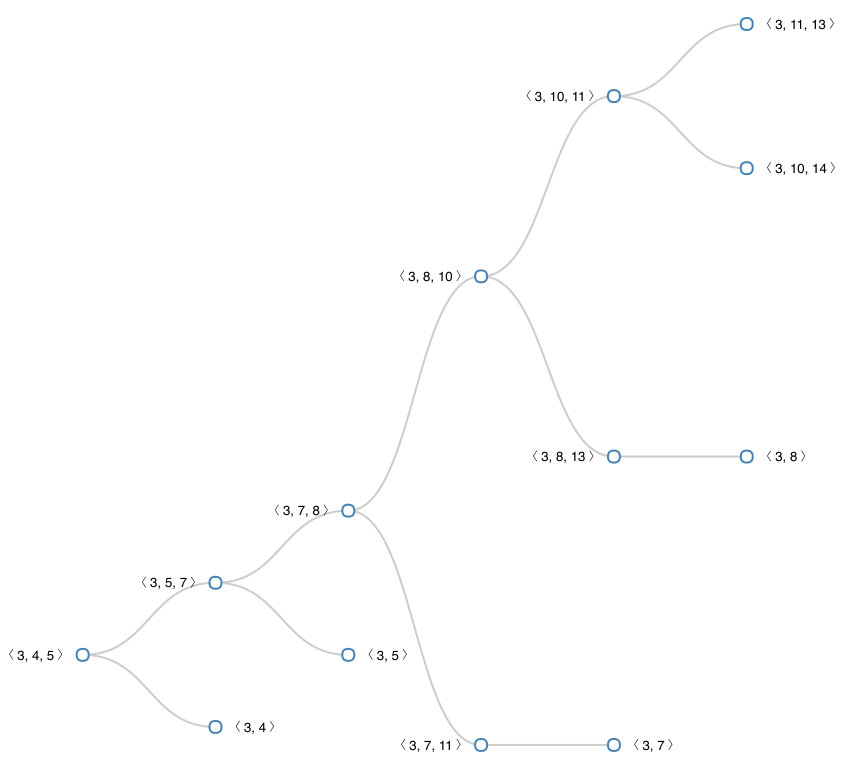 Figure 2
Peer Reviews
No public reviews on file for this paper yet. If you reviewed it on a platform where reviews are public (OpenReview, ICLR, NeurIPS, ICML), you can paste yours below so the community can read it here.
Videos
No videos yet. Explain this paper in a talk, walkthrough, or lecture? Add one.
Taxonomy
TopicsCommutative Algebra and Its Applications · Polynomial and algebraic computation · Graph theory and applications