How to sheafify an elliptic quantum group
Yaping Yang, Gufang Zhao

TL;DR
This paper surveys the construction of a sheafified elliptic quantum group linked to symmetric Kac-Moody Lie algebras, using equivariant elliptic cohomology of moduli spaces, and explores its actions and relations to affine Grassmannians.
Contribution
It introduces a sheafified elliptic quantum group via elliptic cohomology, connecting it to Nakajima quiver varieties and the global affine Grassmannian.
Findings
Sheafification obtained through equivariant elliptic cohomology.
Elliptic quantum group acts on equivariant elliptic cohomology of quiver varieties.
Relation established between the sheafified elliptic quantum group and the affine Grassmannian.
Abstract
We give an introductory survey of the results in arXiv: 1708.01418. We discuss a sheafified elliptic quantum group associated to any symmetric Kac-Moody Lie algebra. The sheafification is obtained by applying the equivariant elliptic cohomological theory to the moduli space of representations of a preprojective algebra. By construction, the elliptic quantum group naturally acts on the equivariant elliptic cohomology of Nakajima quiver varieties. As an application, we obtain a relation between the sheafified elliptic quantum group and the global affine Grassmannian over an elliptic curve.
Click any figure to enlarge with its caption.
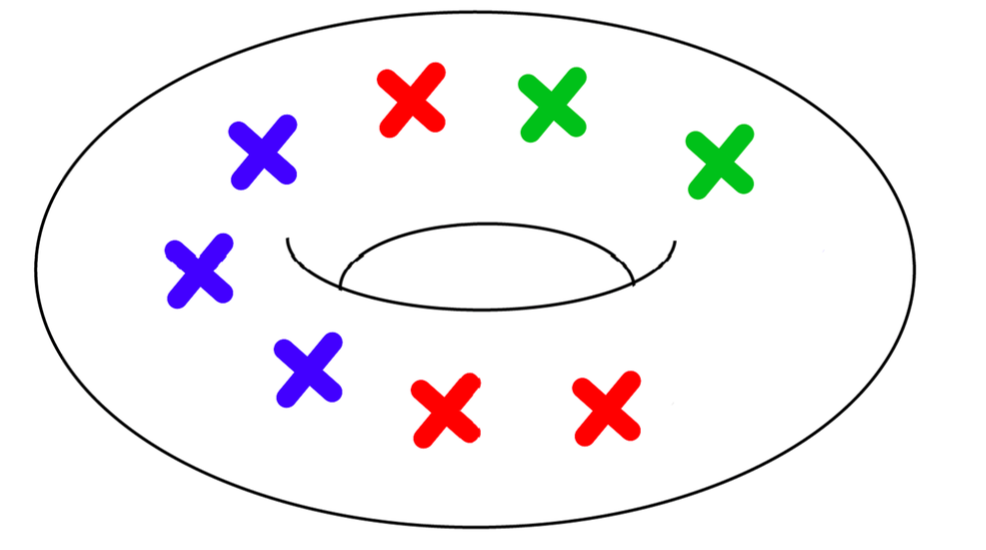 Figure 1
Peer Reviews
No public reviews on file for this paper yet. If you reviewed it on a platform where reviews are public (OpenReview, ICLR, NeurIPS, ICML), you can paste yours below so the community can read it here.
Videos
No videos yet. Explain this paper in a talk, walkthrough, or lecture? Add one.
Taxonomy
TopicsAlgebraic structures and combinatorial models · Advanced Algebra and Geometry · Homotopy and Cohomology in Algebraic Topology
How to sheafify an elliptic quantum group
Yaping Yang
School of Mathematics and Statistics, The University of Melbourne, 813 Swanston Street, Parkville VIC 3010, Australia
and
Gufang Zhao
Institute of Science and Technology Austria, Am Campus, 1, Klosterneuburg 3400, Austria
Abstract.
These lecture notes are based on Yang’s talk at the MATRIX program Geometric R-Matrices: from Geometry to Probability, at the University of Melbourne, Dec.18-22, 2017, and Zhao’s talk at Perimeter Institute for Theoretical Physics in January 2018. We give an introductory survey of the results in [29]. We discuss a sheafified elliptic quantum group associated to any symmetric Kac-Moody Lie algebra. The sheafification is obtained by applying the equivariant elliptic cohomological theory to the moduli space of representations of a preprojective algebra. By construction, the elliptic quantum group naturally acts on the equivariant elliptic cohomology of Nakajima quiver varieties. As an application, we obtain a relation between the sheafified elliptic quantum group and the global affine Grassmannian over an elliptic curve.
1. Motivation
The parallelism of the following three different kinds of mathematical objects was observed in [10] by Ginzburg-Kapranov-Vasserot.
[TABLE]
Here, the correspondence (i)(iii) is well known in algebraic topology, goes back to the work of Quillen, Hirzebruch, et al. Similar correspondence also exists in algebraic geometry thanks to the oriented cohomology theories (OCT) of Levine and Morel [15]. The algebraic OCT associated to and are, respectively, the intersection theory (Chow groups) CH, the algebraic K-theory and the algebraic elliptic cohomology .
The correspondence (i)(ii) was introduced to the mathematical community by Drinfeld [6]. Roughly speaking, the quantum group in (ii) quantizes of the Lie algebra of maps from the algebraic group in (i) to a Lie algebra . The quantization is obtained from the solutions to the quantum Yang-Baxter equation
[TABLE]
The Yangian , quantum loop algebra , and elliptic quantum group are respectively obtained from the rational, trigonometric and elliptic solutions of the QYBE. There is a dynamical elliptic quantum group associated to a general symmetrizable Kac-Moody Lie algebra, which is obtained from solutions to the dynamical Yang-Baxter equation.
The correspondence (ii)(iii) is the main subject of this note, and is originated from the work of Nakajima [22], Varagnolo [25], Maulik-Okounkov [17], and many others. Without going to the details, the quantum group in (ii) acts on the corresponding oriented cohomology of the Nakajima quiver varieties recalled below.
Let be a quiver, with being the set of vertices, and being the set of arrows. Let be the framed quiver, schematically illustrated below. For any dimension vector of , we have the Nakajima quiver variety .
[TABLE]
Denote . We follow the terminologies and notations in [22] on quiver varieties, hence refer the readers to loc. cit. for the details. Nevertheless, we illustrate by the following examples, and fix some conventions in § 2.
Example 1.1**.**
- (1)
Let be the quiver with one vertex, no arrows. Let , with . Then, , the cotangent bundle of the Grassmannian. 2. (2)
Let be the Jordan quiver with one vertex, and one self-loop. Let , with . Then, , the Hilbert scheme of -points on .
[TABLE]
When has no edge-loops, Nakajima in [22] constructed an action of on the equivariant K-theory of , with being the symmetric Kac-Moody Lie algebra associated to . Varagnolo in [25] constructed an action of on the equivariant cohomology of the Nakajima quiver varieties. For a general quiver , Maulik-Okounkov in [17] constructed a bigger Yangian acting on the equivariant cohomology of using a geometric R-matrix formalism. See [23, 5] for the geometric R-matrix construction in the trigonometric (K-theoretic stable envelope), and elliptic case (elliptic stable envelope).
The goal of the present notes is to explain a direct construction of the correspondence from (iii) to (ii) above, using cohomological Hall algebra (CoHA) following [26]. Most of the constructions are direct generalizations of Schiffmann and Vasserot [24]. Closely related is the CoHA of Kontsevich-Soibelman [14], defined to be the critical cohomology (cohomology valued in a vanishing cycle) of the moduli space of representations of a quiver with potential. A relation between the CoHA in the present note and the CoHA from [14] is explained in [27].
This approach of studying quantum groups has the following advantages.
- •
The construction works for any oriented cohomology theory, beyond . One interesting example is the Morava K-theory. The new quantum groups obtained via this construction are expected to be related the Lusztig’s character formulas [26, §6].
- •
In the case of , the construction gives a sheafified elliptic quantum group, as well as an action of on the equivariant elliptic cohomology of Nakajima quiver varieties, as will be explained in §3.
2. Construction of the cohomological Hall algebras
For illustration purpose, in this section we take the OCT to be the intersection theory . Most statements have counterparts in an arbitrary oriented cohomology theory.
2.1. The theorem
Let be an arbitrary quiver. Denote by the corresponding symmetric Kac-Moody Lie algebra associated to . The preprojective algebra, denoted by , is the quotient of the path algebra by the ideal generated by the relation , where is the reversed arrow of . Fix a dimension vector , let be the affine space parametrizing representations of the path algebra of dimension , and let be the affine algebraic variety parametrizing representations of of dimension , with an action of . Here . Let be the quotient stack.
Example 2.1**.**
Let be the Jordan quiver: \textstyle{{\bigcirc}\ignorespaces\ignorespaces\ignorespaces\ignorespaces\ignorespaces\ignorespaces\ignorespaces}$$\scriptstyle{x} . The preprojective algebra is the free polynomial ring in two variables. We have
[TABLE]
Consider the graded vector space
[TABLE]
The torus acts on the same way as in [22, (2.7.1) and (2.7.2)]. More explicitly, let be the number of arrows in from vertex to ; We enumerate these arrows as . The corresponding reversed arrows in are enumerated as . We define an action of on in the following way. For and with , we define
[TABLE]
Theorem A**.**
- (1)
The vector space is naturally endowed with a product and a coproduct , making it a bialgebra. 2. (2)
On , there is a bialgebra structure obtained as a Drinfeld double of . For any , the algebra acts on . 3. (3)
Assume has no edge loops. There is a certain spherical subalgebra , such that
[TABLE]
Furthermore, the induced Yangian action from (2) is compatible with the action constructed by Varagnolo in [25], and, in the case when is of type, the action of Maulik-Okounkov in [17].
Remark 2.2**.**
The construction of the Drinfeld double involves adding a Cartan subalgebra and defining a bialgebra pairing, as can be found in detail in [28, §3]. The Cartan subalgebra can alternatively be replaced by a symmetric monoidal structure as in [29, §5]. The definition of the spherical subalgebra can be found in [28, §3.2].
2.2. Constructions
The Hall multiplication of is defined using the following correspondence.
[TABLE]
where is the moduli space of extensions . The map is smooth, and is proper. The Hall multiplication is defined to be
[TABLE]
Here the stacks for are endowed with obstruction theories obtained from the embeddings , and has a similar obstruction theory described in detail in [26, §4.1]. Similar for the construction of the action below.
Now we explain the action in Theorem A (2). Let be the moduli space of framed representations of with dimension vector , which is constructed as a quotient stack . Imposing a suitable semistability condition, explained in detail in [22], we get an open subset . There is an isomorphism
[TABLE]
We have the following general correspondence [26, §4.1]:
[TABLE]
The action in Theorem A (2) is defined as by taking , and imposing a suitable semistability condition on the correspondence (2).
2.3. Shuffle algebra
Notations as before, let be a quiver. Following the proof of [26, Proposition 3.4], we have the following shuffle description of in (2).
Let be an -graded -algebra. As a -module, we have
[TABLE]
here is the product of symmetric groups, and naturally acts on the variables by permutation. For any and , we consider as a subalgebra of \mathbb{C}[t_{1},t_{2}][\lambda^{i}_{s},z^{j}_{t}]_{\big{\{}\begin{smallmatrix}i\in I,s=1,\dots,({v_{1}^{i}}+{v_{2}^{i}}),\\ j\in I,t=1,\dots,({w_{1}^{j}}+{w_{2}^{j}})\end{smallmatrix}\big{\}}} by sending to , and to .
We define the shuffle product ,
[TABLE]
with specified as follows.
Let
[TABLE]
Let be a function, which for each provides two integers and . We define the torus action on according to the function , satisfying some technical conditions spelled out in [28, Assumption 1.1]. The -equivariant variables are denoted by . Define
[TABLE]
Let
[TABLE]
Proposition 2.3**.**
Under the identification
[TABLE]
the map is equal to the multiplication (3) of the shuffle algebra .
Proof.
The proof follows from the same proof as [26, Proposition 3.4] replacing the quiver by the framed quiver . ∎
Remark 2.4**.**
- (1)
For an arbitrary cohomology theory, Proposition 2.3 is still true when is replaced by in the formula (6) of , where is the formal group law associated to this cohomology theory. 2. (2)
Restricting to the open subset of induces a surjective map , for . The surjectivity follows from [18]. This map is compatible with the shuffle product of the left hand side, and the multiplication on the right hand side induced from (2).
2.4. Drinfeld currents
Let be the dimension vector valued 1 at vertex and zero otherwise. Then, . Let , , be the natural monomial basis of . One can form the Drinfeld currents
[TABLE]
By Theorem A, the generating series satisfy the relations of [26, § 7].
3. Sheafified elliptic quantum groups
In this section, we applying the equivariant elliptic cohomology to the construction in §2. It gives a sheafified elliptic quantum group, as well as its action on .
3.1. Equivariant elliptic cohomology
There is a sheaf-theoretic definition of the equivariant elliptic cohomology theory in [10] by Ginzburg-Kapranov-Vasserot. It was investigated by many others later on, including Ando [1, 2], Chen [4], Gepner[9], Goerss-Hopkins [11], Lurie [16].
Let be the moduli scheme of semisimple semistable degree 0 -bundles over an elliptic curve. For a -variety , the -equivariant elliptic cohomology of is a quasi-coherent sheaf of -module, satisfying certain axioms. In particular, .
Example 3.1**.**
- (1)
Let , then is a coherent sheaf on . This fact leads to the following patten.
- •
is a module over .
- •
is a module over .
- •
is a module over . 2. (2)
Let , then is a coherent sheaf over .
There is a subtlety for pushforward in the equivariant elliptic cohomology theory. Let be a proper, -equivariant homomorphism. The pushforward is the following map
[TABLE]
where , depending on the Thom bundle of the relative tangent bundle of , is a rank 1 locally free module over . The appearance of this twist can be illustrated in the following simple example. The general case is discussed in detail in [10, § 2] and [29, § 2].
Example 3.2**.**
Let be the inclusion. The torus acts on by scalar multiplication. Denote by the disc around [math]. We have the Thom space . There is an exact sequence
[TABLE]
As , since is contractible, and is the skyscraper sheaf at [math], we have the isomorphism .
3.2. The sheafified elliptic quantum group
Recall the elliptic cohomological Hall algebra (see (1)) is defined as
[TABLE]
By the discussion in §3.1, is a sheaf on
[TABLE]
where comes from the -action, and is the moduli space of -colored points on .
Due to the subtlety of pushing-forward in the elliptic cohomology, there is no product on in the usual sense. We illustrate the structure of the Hall multiplication of in the following example.
Example 3.3**.**
Let be the quiver with one vertex, no arrows. In this case, we have . The elliptic CoHA associated to the Lie algebra consists of:
- •
A coherent sheaf on .
- •
For any , a morphism of sheaves on :
[TABLE]
where the symmetrization map , and is some fixed line bundle on , depending on the parameter .
- •
The above morphisms are associative in the obvious sense.
Let be the category of coherent sheaves on . Motivated by the Hall multiplication of , we define a tensor structure on : for , is defined as
[TABLE]
Theorem B**.**
[29, Yang-Zhao]
- (1)
The category is a symmetric monoidal category, with the braiding given by [29, Theorem 3.3]. 2. (2)
The elliptic CoHA , endowed with the Hall multiplication , and coproduct , is a bialgebra object in . 3. (3)
The Drinfeld double of acts on , for any . 4. (4)
After taking a certain space of meromorphic sections , the bialgebra becomes the elliptic quantum group given by the dynamical elliptic R-matrix of Felder [7], Gautam-Toledano Laredo [12].
Remark 3.4**.**
- (1)
In Theorem B(4), a version of the sheafified elliptic quantum group with dynamical twist is needed in order to recover the R-matrix of Felder-Gautam-Toledano Laredo. This twist is explained in detail in [29, § 10.2]. Below we illustrate the flavour of this dynamical twist in § 3.4.
In particular, the abelian category of representations of and are both well-defined (see [29, § 9] for the details). Furthermore, it is proved in loc. cit. that these two representation categories are equivalent as abelian categories. 2. (2)
The details of the space of meromorphic sections are explained in [29, § 6]. 3. (3)
Based on the above theorem, we define the sheafified elliptic quantum group to be the Drinfeld double of .
3.3. The shuffle formulas
The shuffle formula of the elliptic quantum group is given by (3), with the factor replaced by . The shuffle formula gives an explicit description of the elliptic quantum group, as well as its action on the Nakajima quiver varieties. In this section, we illustrate the shuffle description of the elliptic quantum group . Furthermore, we show (3) applied to special cases coincides with the shuffle formulas in [8, Proposition 3.6] and [13, Definition 5.9].
When , the corresponding quiver is , with one vertex, no arrows. Let . For any local sections , by (3) and (6), we have
[TABLE]
where and consists of -shuffles, i.e., permutations of that preserve the relative order of and . The elliptic quantum group is a subalgebra of .
In the following examples we consider with general .
Example 3.5**.**
Assume the quiver is , with one vertex, no arrows. Let , , and , . Choose , and . Applying the formula (6) to this case, we have
[TABLE]
where is the odd Jacobi theta function, normalized such that . This is exactly the same formula as [8, Proposition 3.6].
Example 3.6**.**
When , the corresponding quiver is
\textstyle{\bigcirc\ignorespaces\ignorespaces\ignorespaces\ignorespaces}$$\textstyle{\bigcirc\ignorespaces\ignorespaces\ignorespaces\ignorespaces}$$\textstyle{\cdots\ignorespaces\ignorespaces\ignorespaces\ignorespaces}$$\textstyle{\bigcirc} , with vertices, and arrows. Consider the framed quiver
[TABLE]
Label the vertices of by . Let , be a pair of dimension vectors, and take the framing to be , . To simplify the notations, let , , and denote the variables by , and by . Applying the formula (6) to this case, we then have
[TABLE]
Following [13, §5 (5.3)], we denote by the following element
[TABLE]
Define . We have
[TABLE]
Divide by , we obtain
[TABLE]
This coincides with the formula in [13, Definition 5.9] when .
In other words, consider the map
[TABLE]
It intertwines the shuffle product (3) (with theta-functions), and the shuffle product of [13, Definition 5.9].
Remark 3.7**.**
- (1)
In the work of [8] in the case, and [13] in the case, the shuffle formulas are used to obtain an inductive formula for the elliptic weight functions. Proposition 2.3 provides a way to define the elliptic weight functions associated to a general symmetric Kac-Moody Lie algebra . 2. (2)
In the above cases for and the special framing, the elliptic weight functions are expected to be related to the elliptic stable basis in [5] (see also [8, 13]). Therefore, it is reasonable to expect an expression of the elliptic stable basis in terms of the shuffle product (3) (with theta-functions) for general quiver varieties.
3.4. Drinfeld currents
We now explain the Drinfeld currents in the elliptic case. The choice of an elliptic curve gives rise to the dynamical elliptic quantum group.
Let be the open moduli space of 2 pointed genus 1 curves. We write a point in as , where , and gives a line bundle . Let be the universal curve on . There is a Poincare line bundle on , which has a natural rational section
[TABLE]
where is the coordinate of , and is the Jacobi odd theta function, normalized such that .
We can twist the equivariant elliptic cohomology by the Poincare line bundle . For each simple root , after twisting, we have . A basis of the meromorphic sections consists of .
Consider , and let
[TABLE]
Similarly, we define series , . The series , , and satisfy the relations of the elliptic quantum group of Gautam-Toledano Laredo [12].
4. Relation with the affine Grassmannian
In this section, we explain one unexpected feature of the sheafified elliptic quantum group, namely, its relation with the global loop Grassmannians over an elliptic curve . We assume the quiver =(I, H) is of type ADE in this section.
We collect some facts from [19, 20]. Let be a curve. An -colored local space over , defined in [19, Section 2], see also [20, Section 4.1], is a space over the -colored Hilbert scheme of points of , together with a consistent system of isomorphisms
[TABLE]
Similarly, for a coherent sheaf on , a locality structure of on is a compatible system of identifications
[TABLE]
An example of local spaces is the zastava space , recollected in detail in [19, Section 3] and [20, Section 4.2.3]. Here is a smooth curve. In [21], a modular description of is given along the lines of Drinfeld’s compactification. Let be the semisimple simply-connected group associated to , with the choice of opposite Borel subgroups and with the joint Cartan subgroup . Consider the Drinfeld’s compactification of a point:
[TABLE]
The zastava space for is defined as the moduli of generic maps from to . Gluing the zastava spaces, one get a loop Grassmannian as a local space over , which is a refined version of the Beilinson-Drinfeld Grassmannian, see [19, Section 3], [20, Section 4.2.3].
Fix a point , and a dimension vector , let be the special divisor supported on . The fiber is the Mirković-Vilonen scheme associated to the root vector , i.e., the intersection of closures of certain semi-infinite orbits in [19, Section 3].
The maximal torus acts on . There is a certain component in a torus-fixed loci , which gives a section . We denote this component by . The tautological line bundle has a natural locality structure, and is described in [19, Theorem 3.1].
We now take the curve to be the elliptic curve . Let be the global loop Grassmannian over . The following theorem relies on the description of the local line bundle on in [19], [20, Section 4.2.1].
Theorem C** ([29] Yang-Zhao).**
- (1)
The classical limit is isomorphic to as sheaves on . 2. (2)
The Hall multiplication on is equivalent to the locality structure on .
Remark 4.1**.**
- (1)
Theorem C is true when the curve is replaced by (and ), while the corresponding cohomological Hall algebra is modified to (and respectively). The sheaf deforms the local line bundle . In the classification of local line bundles in [19], is characterized by certain diagonal divisor of [20, Section 4.2.1]. As a consequence of Theorem C, the shuffle formula of gives the -shifting of the diagonal divisor of that appears in . 2. (2)
When the base is , and cohomology theory is the Borel-Moore homology , Theorem C (1) has a similar flavour as [3, Theorem 3.1]. Here, we only consider and as sheaves of abelian groups. By Theorem A, is isomorphic to the positive part of the Yangian, which is in turn related to by Theorem C.
Acknowledgement
Y.Y. would like to thank the organizers of the MATRIX program Geometric R-Matrices: from Geometry to Probability for their kind invitation, and many participants of the program for useful discussions, including Vassily Gorbounov, Andrei Okounkov, Allen Knutson, Hitoshi Konno, Paul Zinn-Justin. Proposition 2.3 and Section 3.3 are new, for which we thank Hitoshi Konno for interesting discussions and communications. These notes were written when both authors were visiting the Perimeter Institute for Theoretical Physics (PI). We are grateful to PI for the hospitality.
The reference list from the paper itself. Each links out to its DOI / PubMed record.
- 1[1] M. Ando, Power operations in elliptic cohomology and representaions of loop groups . Trans. Amer. Math. Soc., 352(12), (2000), 5619–5666. MR 1637129
- 2[2] M. Ando, The Sigma-orientation for circle-equivariant elliptic cohomology , Geom. Topol., 7 , (2003), 91–153. MR 1988282
- 3[3] A. Braverman, M. Finkelberg, H. Nakajima, Coulomb branches of 3 d , 𝒩 = 4 3 𝑑 𝒩 4 3d,\mathcal{N}=4 quiver gauge theories and slices in the affine Grassmannian (with appendices by Alexander Braverman, Michael Finkelberg, Joel Kamnitzer, Ryosuke Kodera, Hiraku Nakajima, Ben Webster, and Alex Weekes). ar Xiv:1604.03625
- 4[4] H.-Y. Chen, Torus equivariant elliptic cohomology and sigma orientation . Ph.D. Thesis, University of Illinois at Urbana-Champaign, 109 pp, (2010). MR 2873496
- 5[5] M. Aganagic, A. Okounkov, Elliptic stable envelopes , preprint, (2016). ar Xiv:1604.00423 .
- 6[6] V. Drinfeld, Quasi-Hopf algebras . Algebra i Analiz 1 (1989), no. 6, 114–148. MR 1047964
- 7[7] G. Felder, Elliptic quantum groups , X Ith International Congress of Mathematical Physics (Paris, 1994), 211–218, Int. Press, Cambridge, MA, (1995). MR 1370676
- 8[8] G. Felder, R. Rimanyi, and A. Varchenko, Elliptic dynamical quantum groups and equivariant elliptic cohomology , preprint, (2017). ar Xiv:1702.08060