Neutral pion and $\eta$ meson production at mid-rapidity in Pb-Pb collisions at $\sqrt{s_{NN}}$ = 2.76 TeV
ALICE Collaboration

TL;DR
This paper reports measurements of neutral pion and eta meson production at mid-rapidity in Pb-Pb collisions at 2.76 TeV, extending the transverse momentum range and providing new insights into suppression patterns and hadronization at the LHC.
Contribution
First measurement of eta meson production in heavy-ion collisions at the LHC and extension of neutral pion measurements to higher transverse momentum.
Findings
Similar eta/pi0 ratio at different centralities with a high-$p_{T}$ plateau.
Observed suppression of meson production in Pb-Pb relative to scaled pp collisions.
Stronger suppression at high energies compared to lower-energy experiments.
Abstract
Neutral pion and meson production in the transverse momentum range 1 < < 20 GeV/ have been measured at mid-rapidity by the ALICE experiment at the Large Hadron Collider (LHC) in central and semi-central Pb-Pb collisions at = 2.76 TeV. These results were obtained using the photon conversion method as well as the PHOS and EMCal detectors. The results extend the upper reach of the previous ALICE measurements from 12 GeV/ to 20 GeV/ and present the first measurement of meson production in heavy-ion collisions at the LHC. The ratio is similar for the two centralities and reaches at high a plateau value of 0.457 0.013 0.018. A suppression of similar magnitude for and meson production is observed in Pb-Pb collisions with respect to their production in pp…
Click any figure to enlarge with its caption.
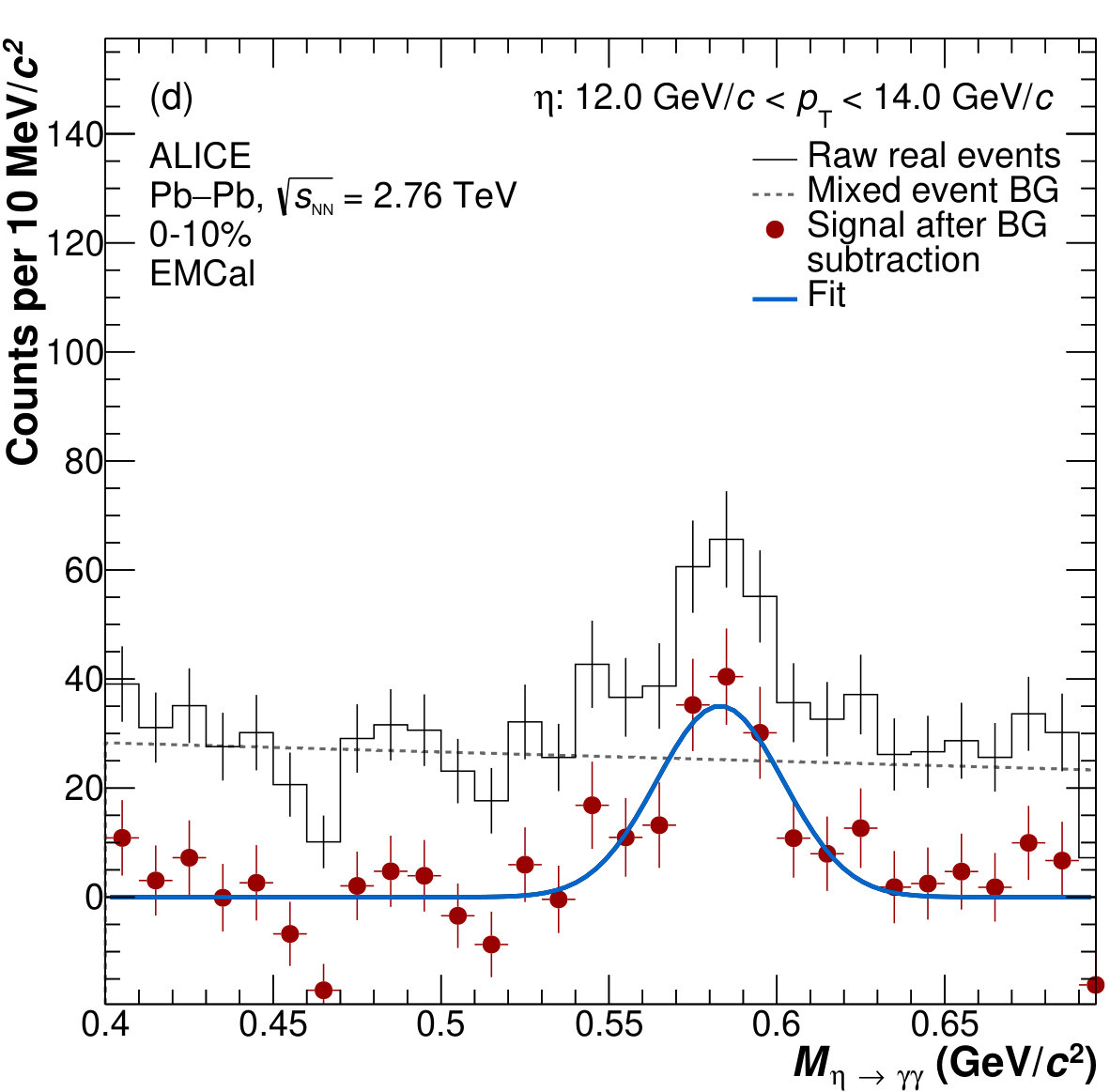 Figure 1
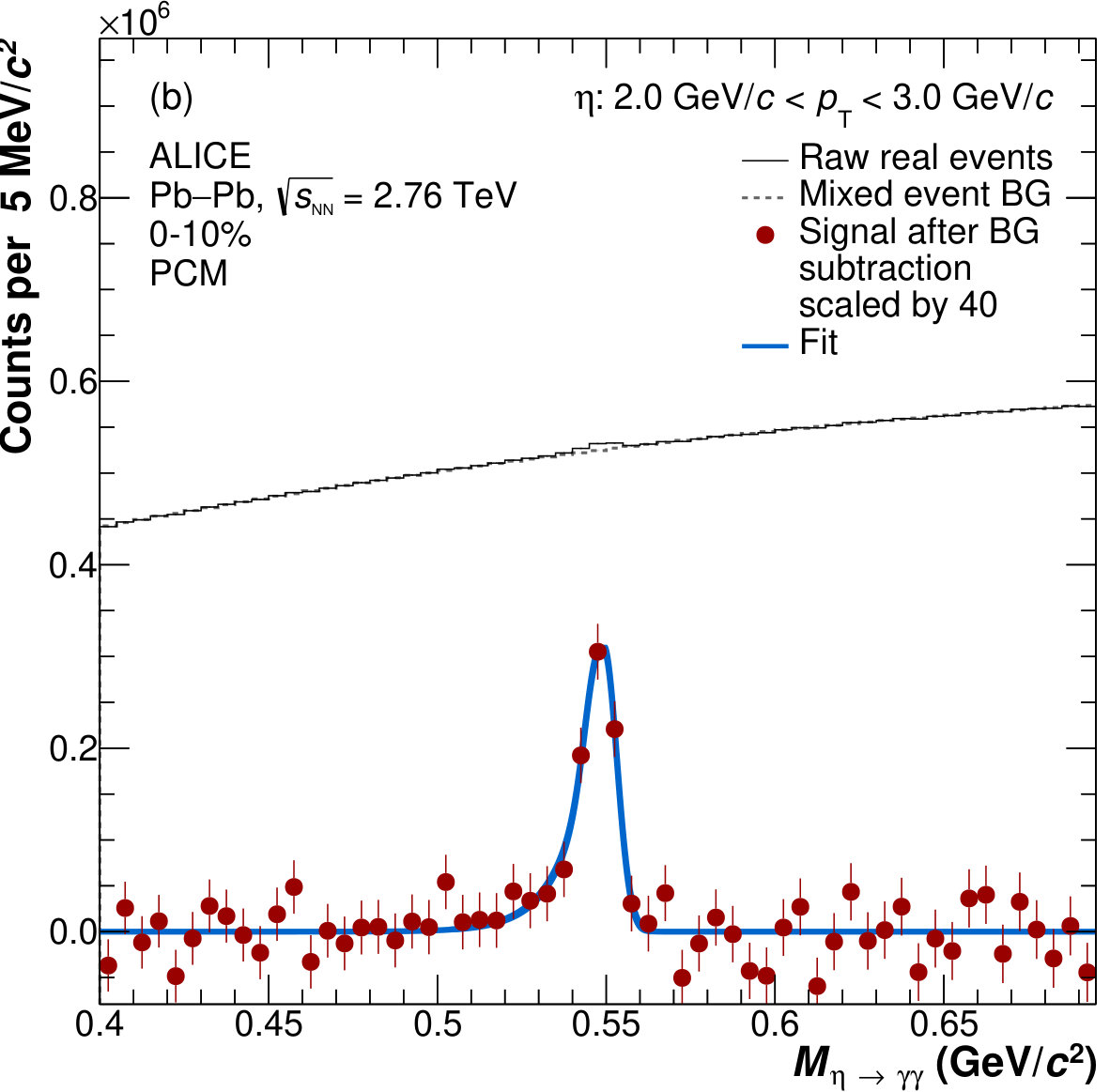 Figure 2
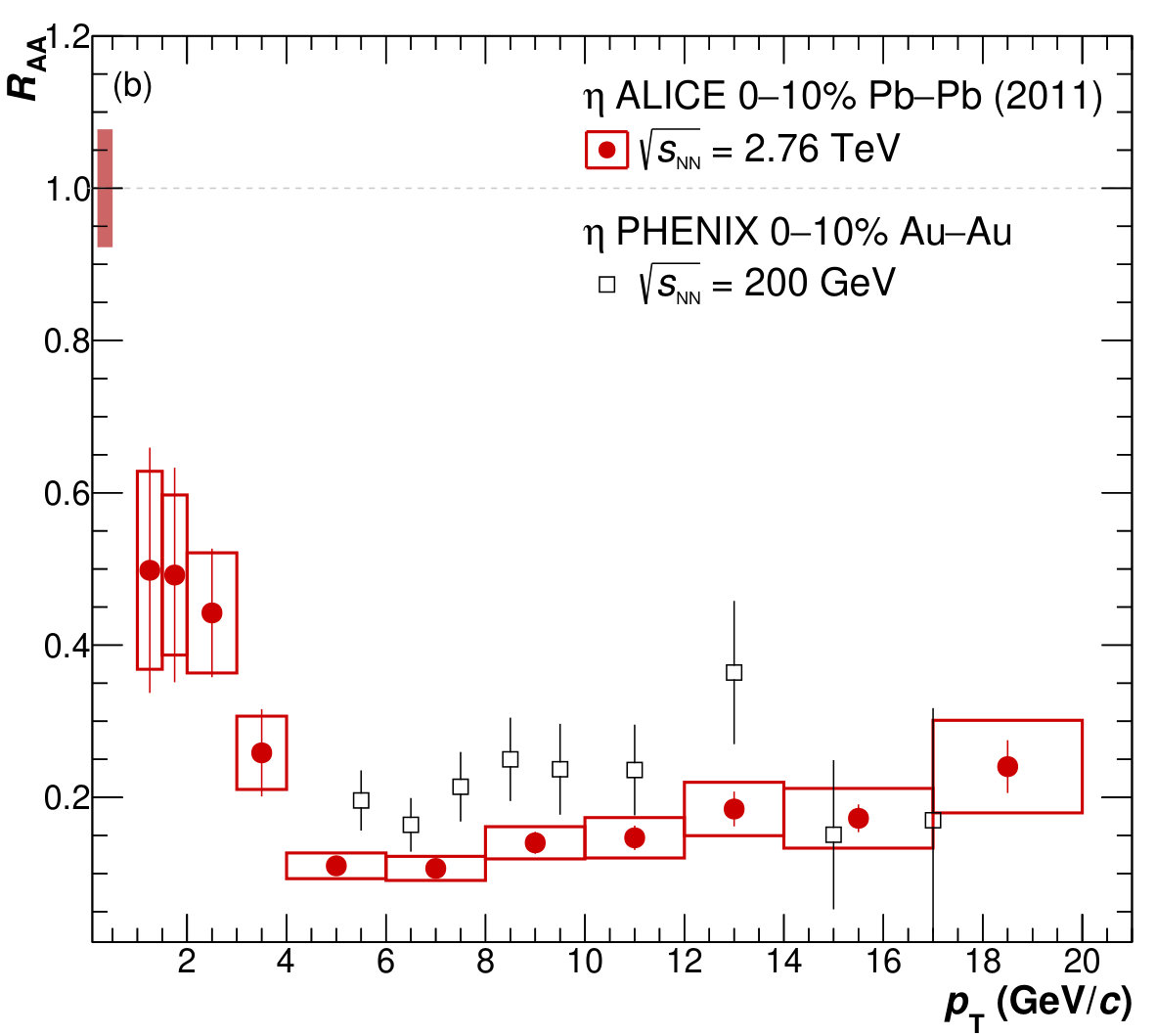 Figure 3
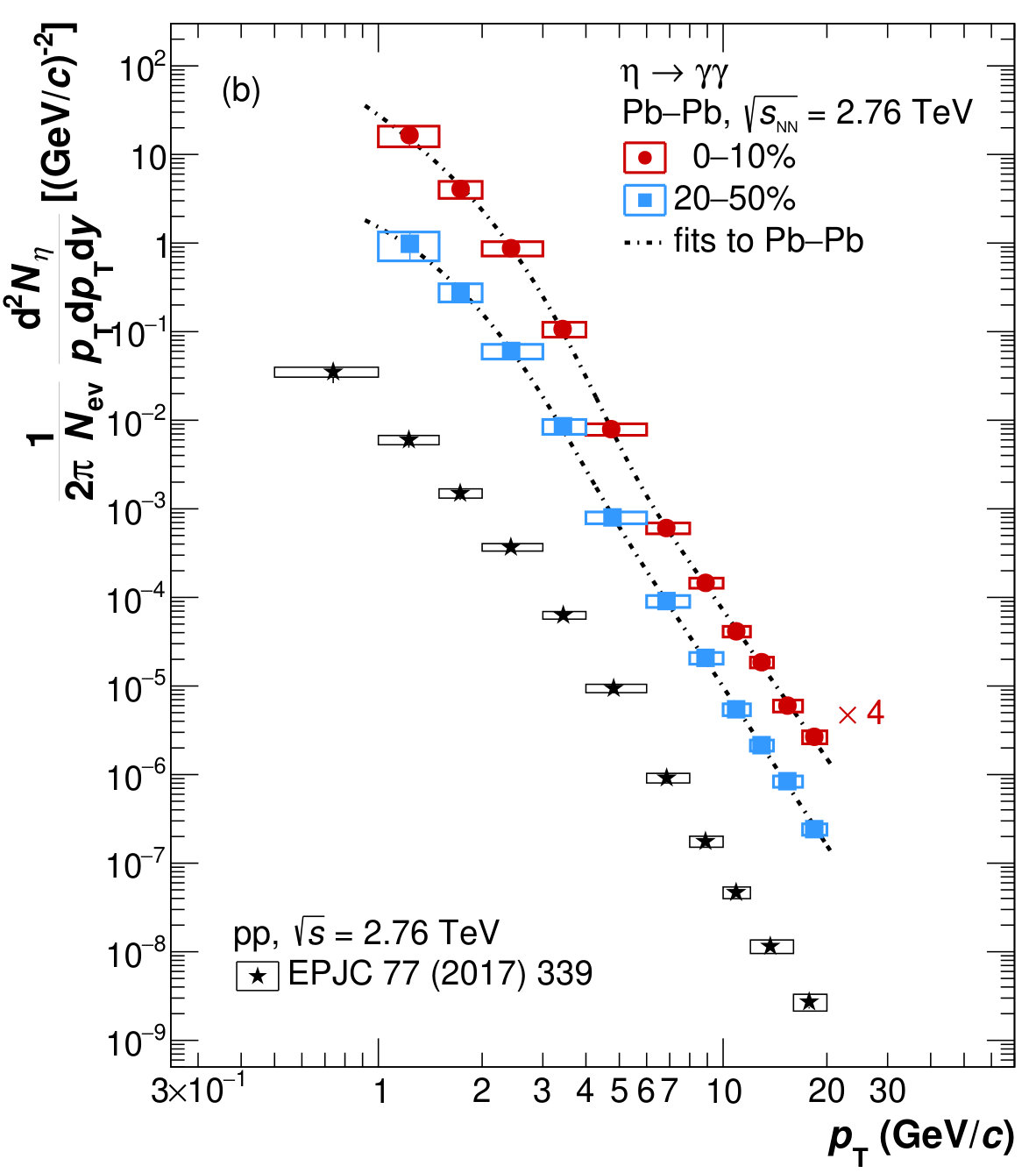 Figure 4
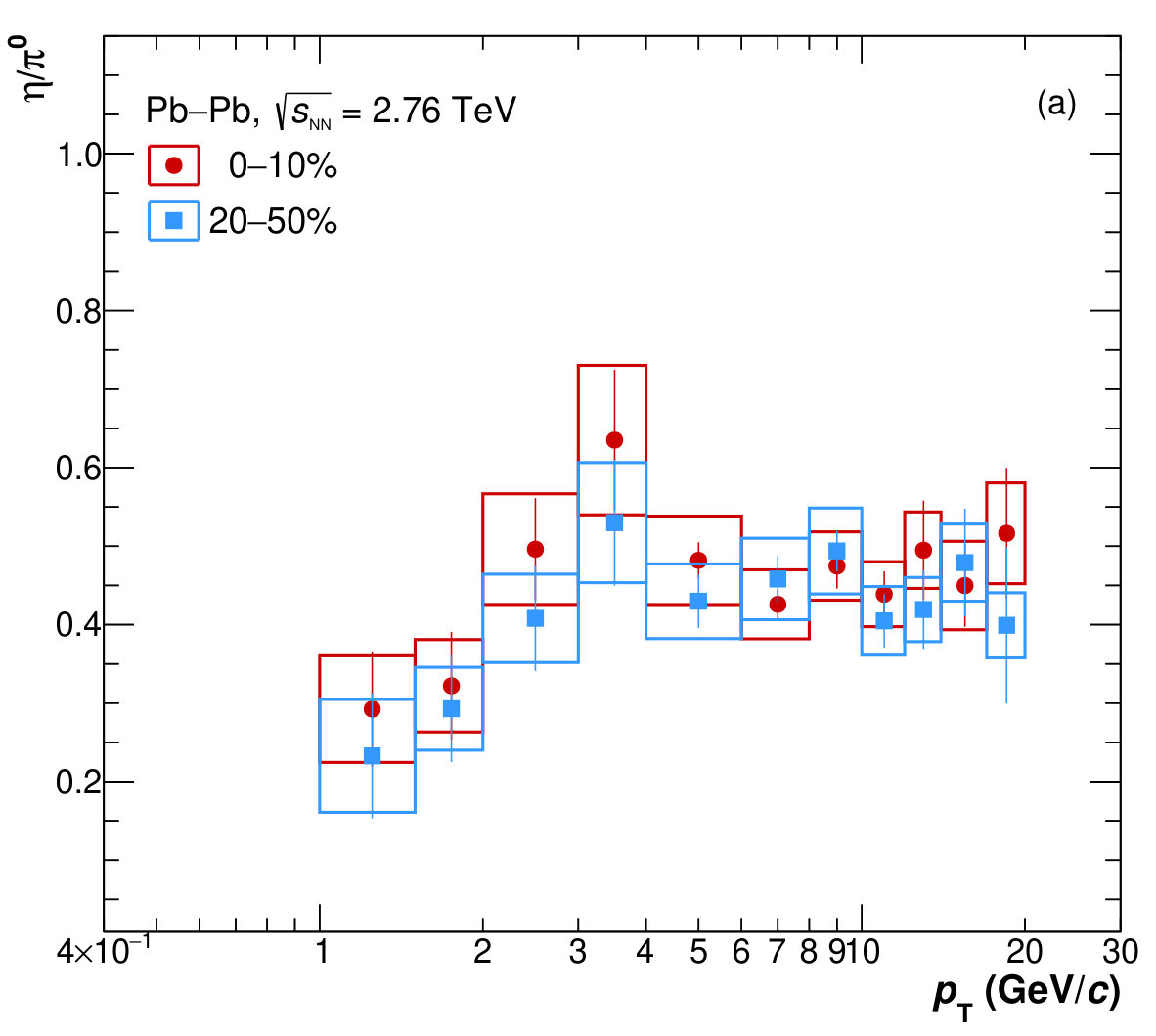 Figure 5
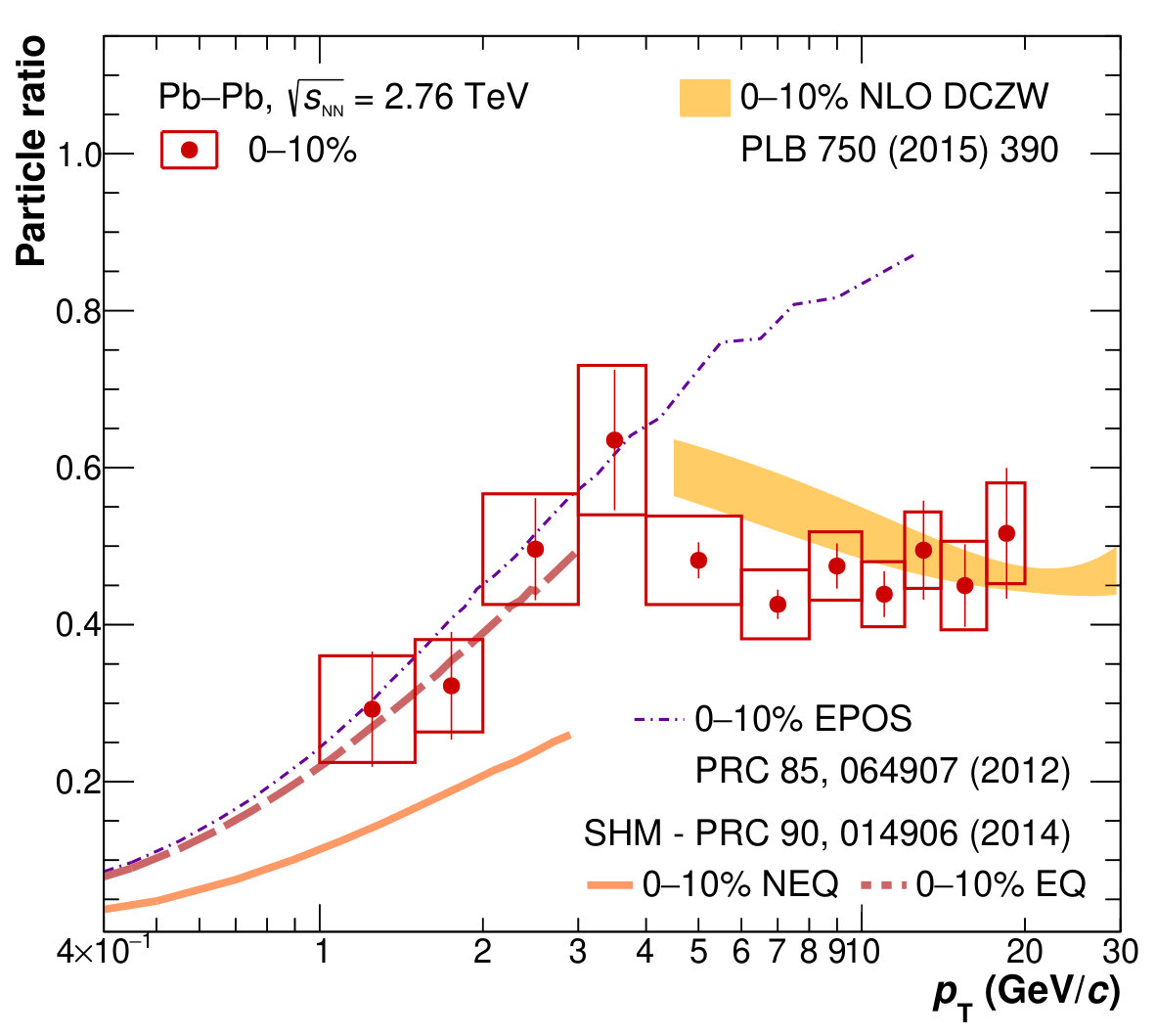 Figure 6
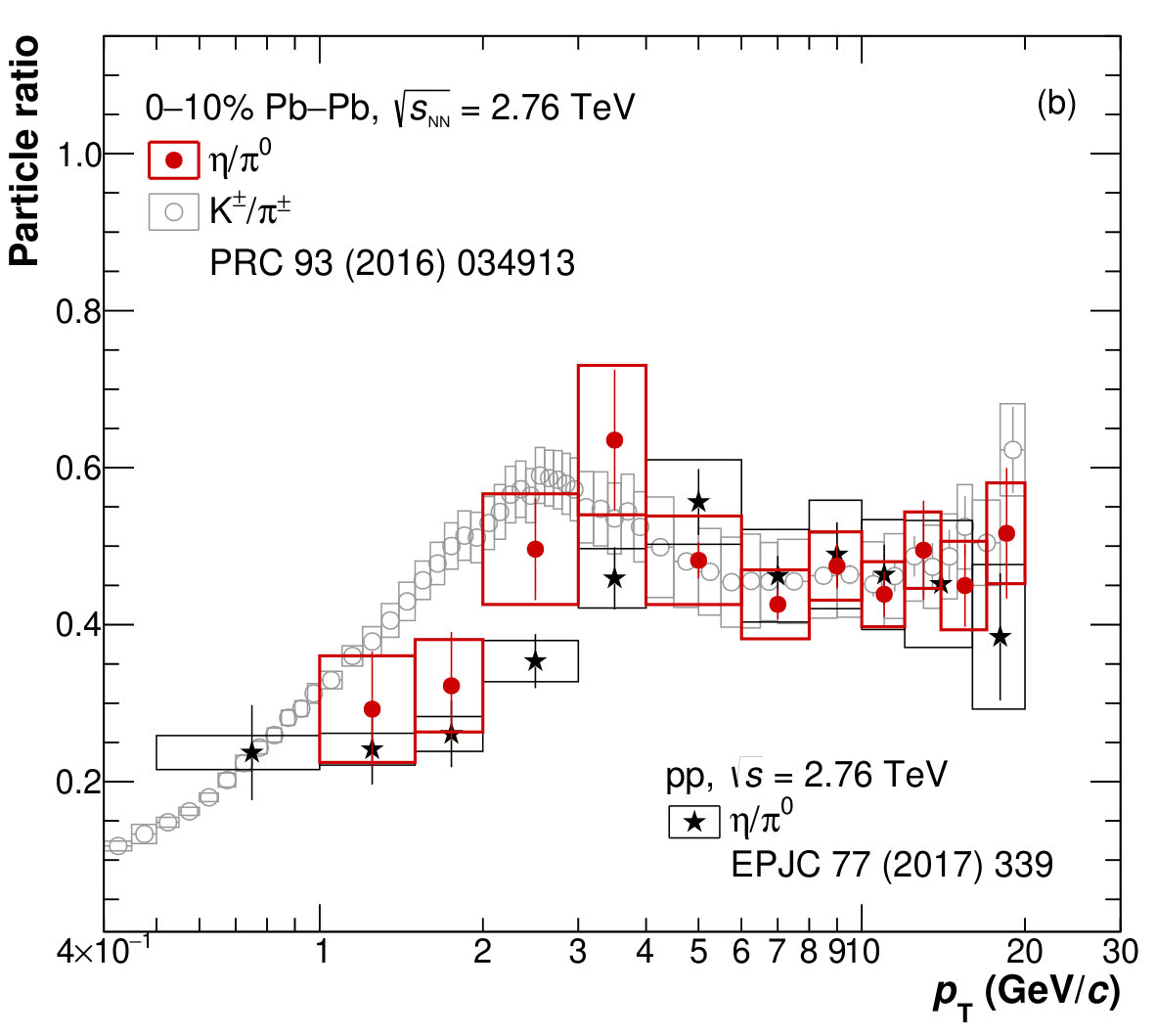 Figure 7
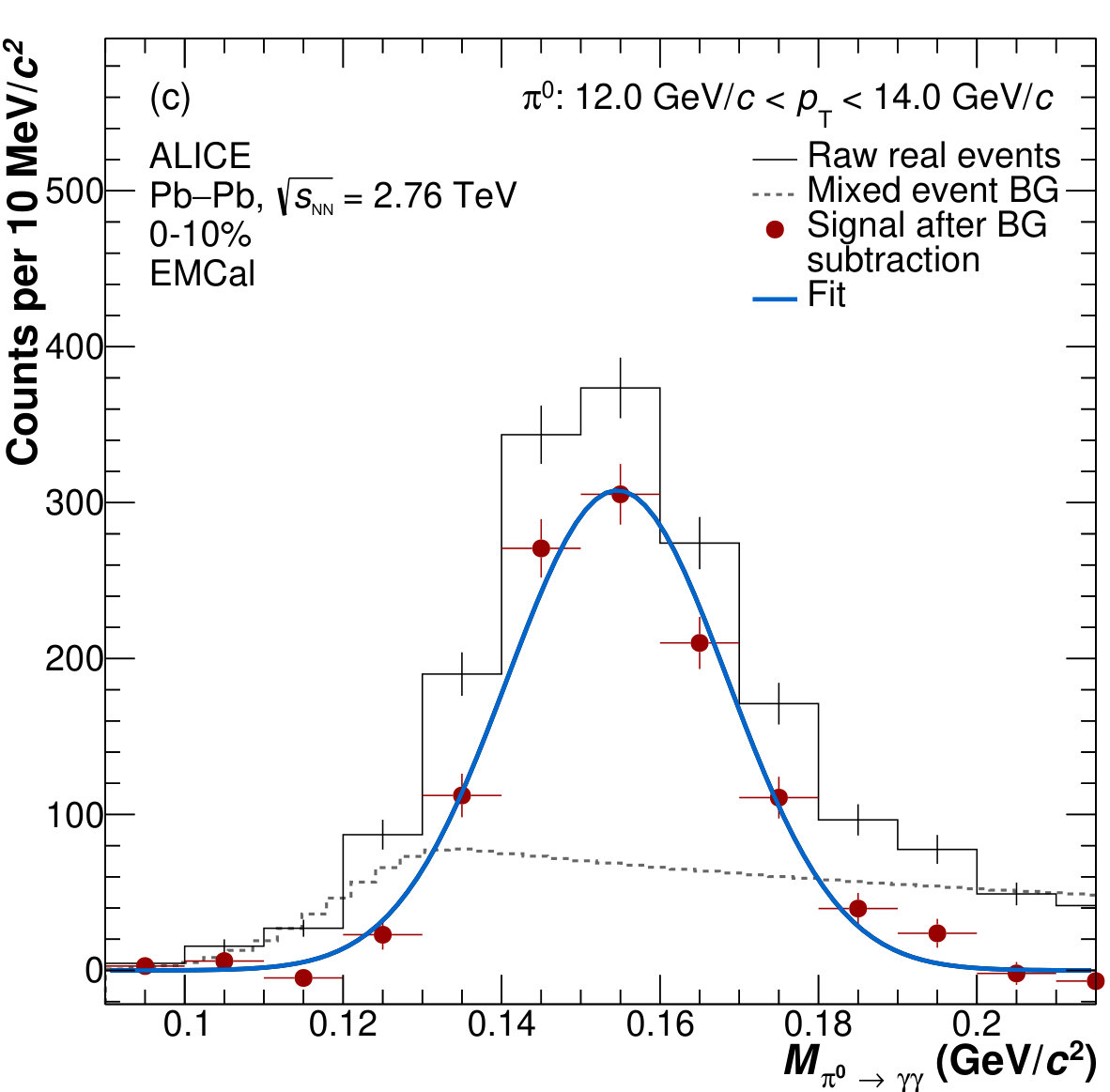 Figure 8
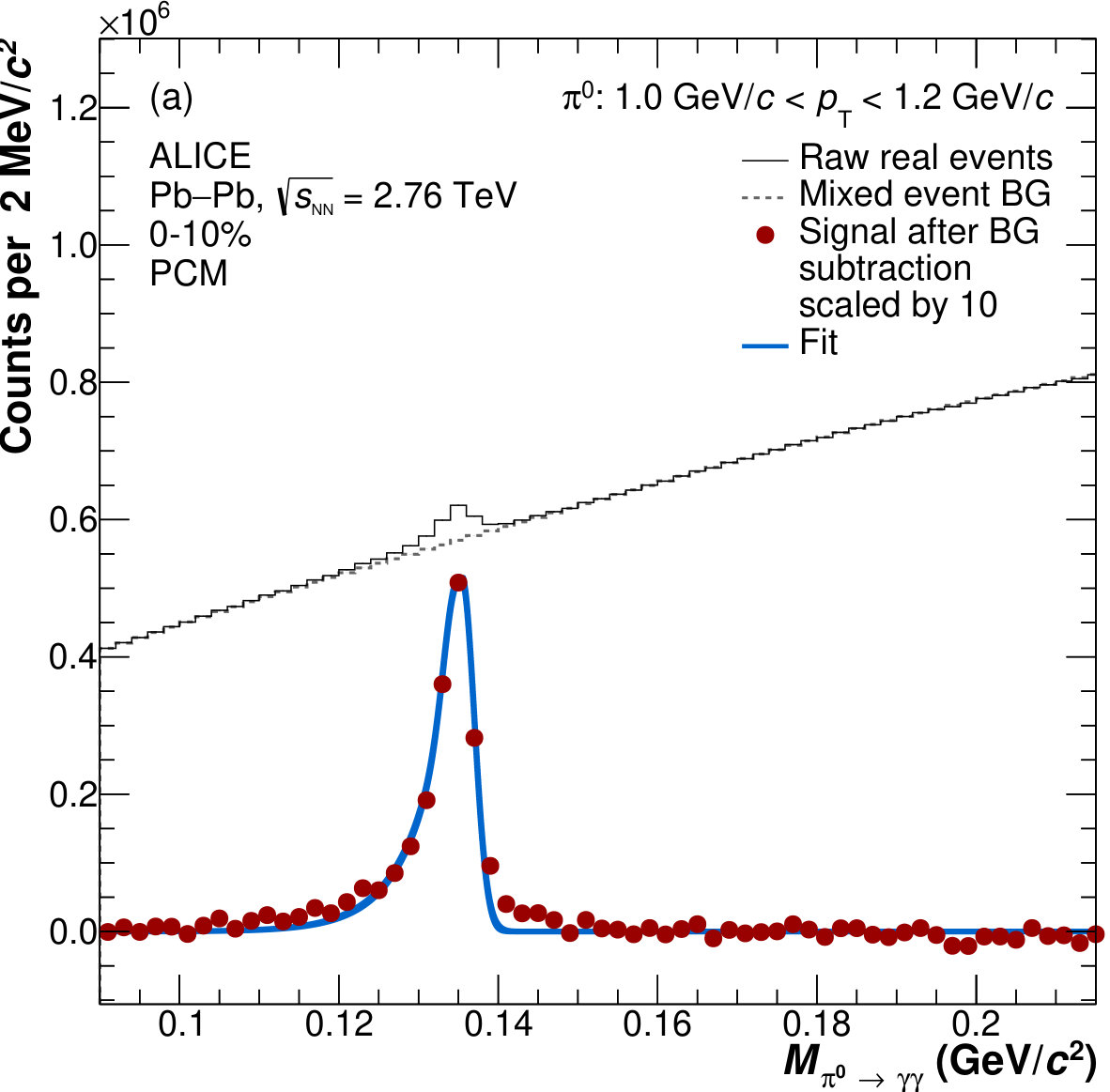 Figure 9
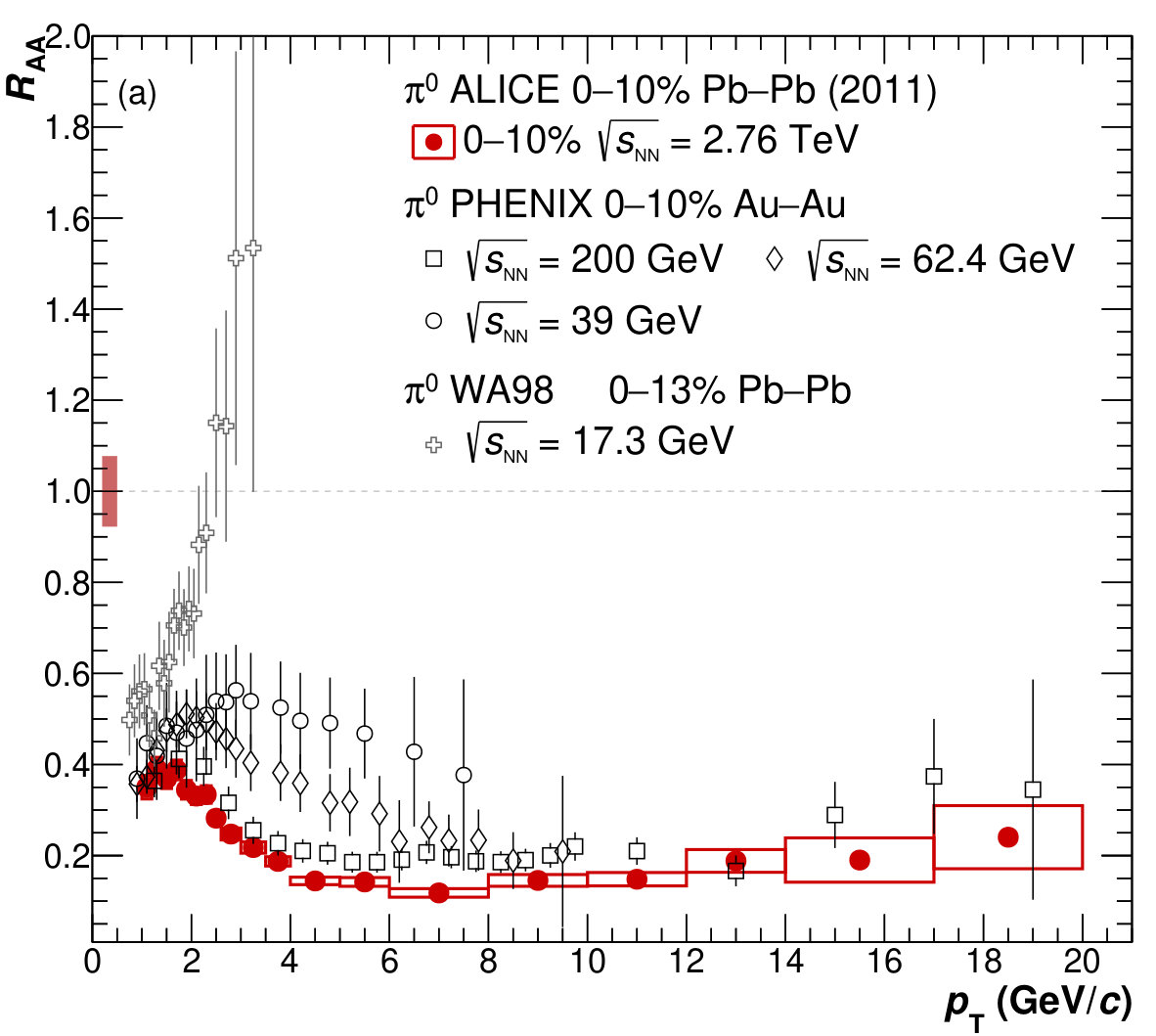 Figure 10
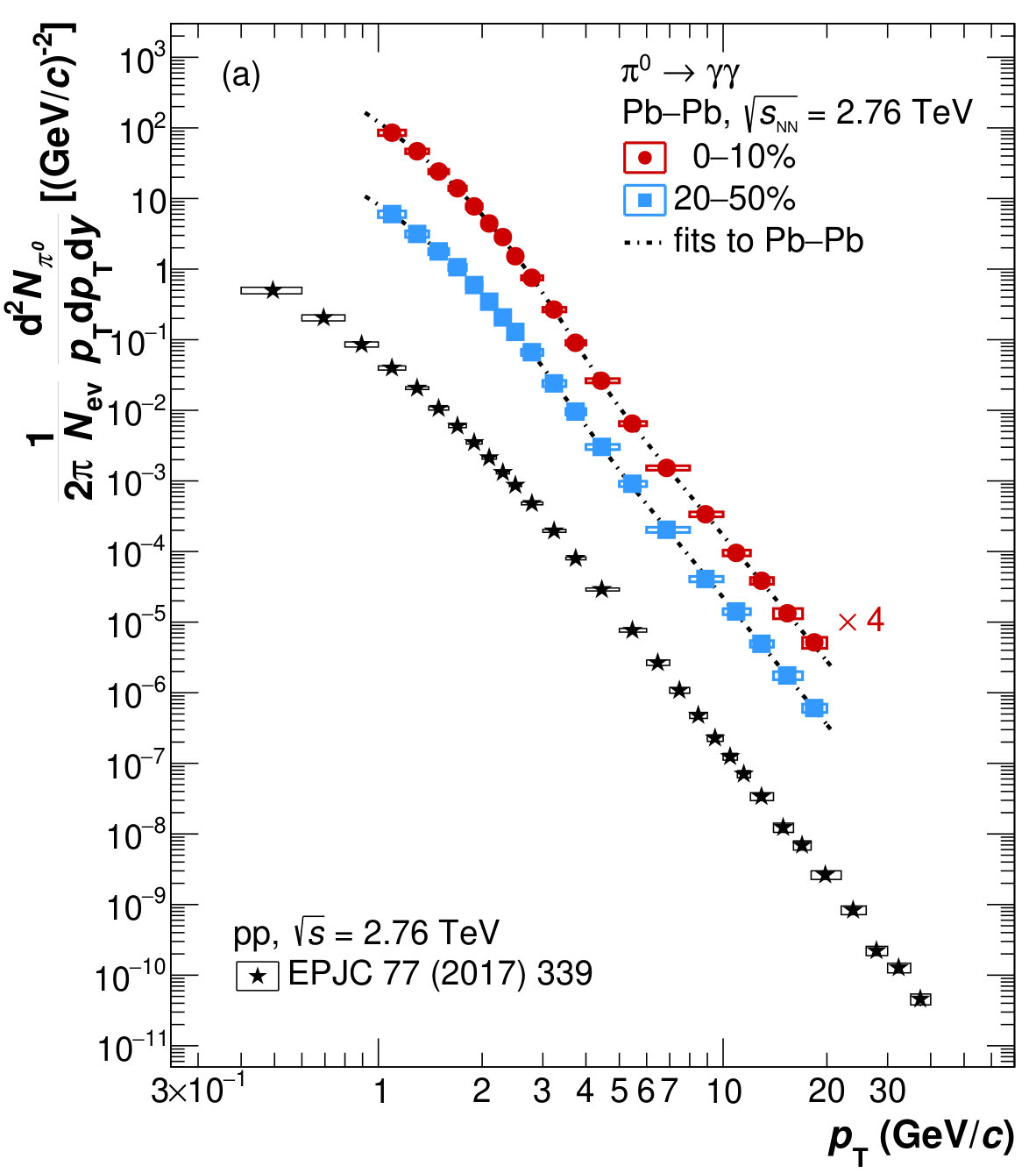 Figure 11
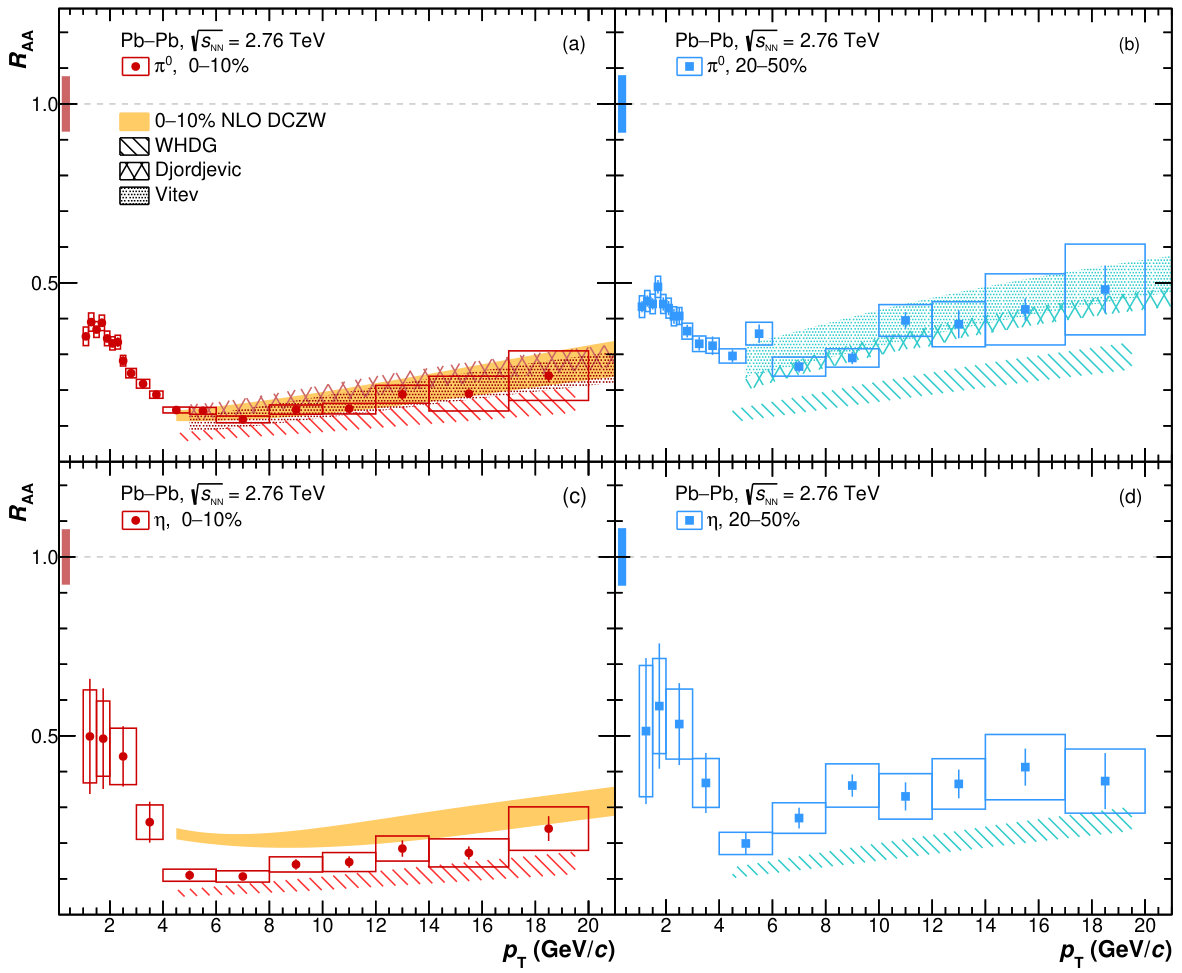 Figure 12
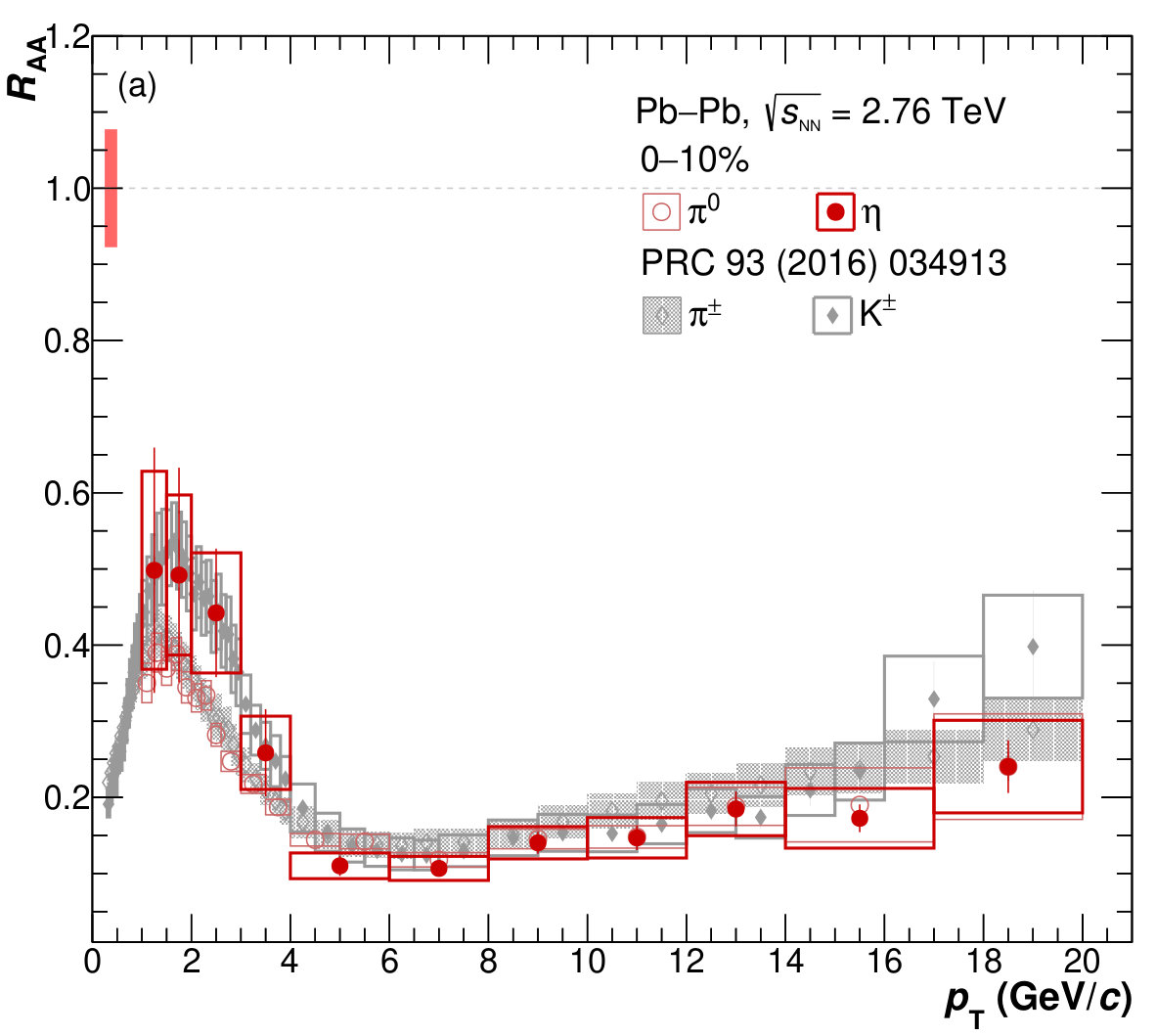 Figure 13
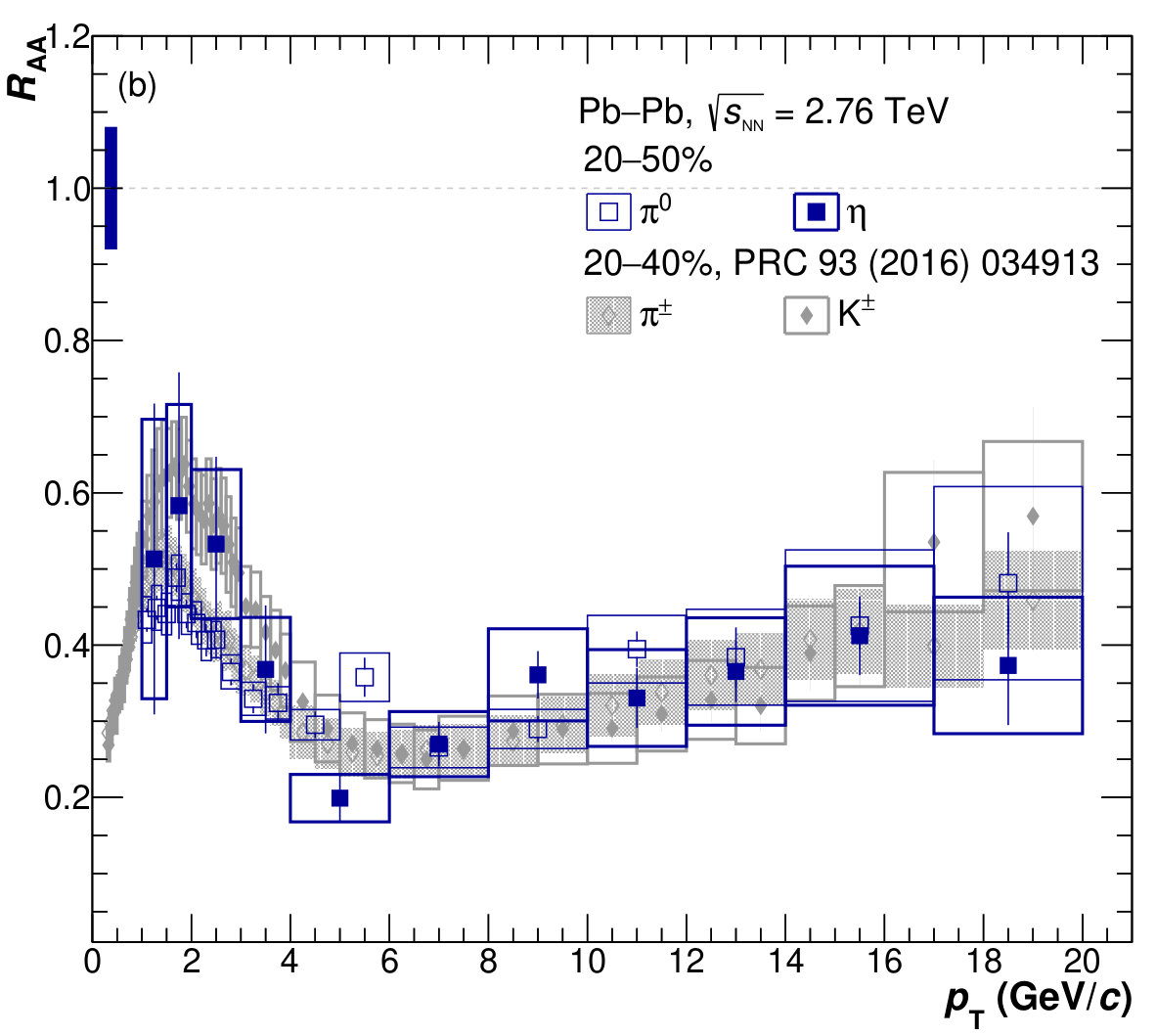 Figure 14
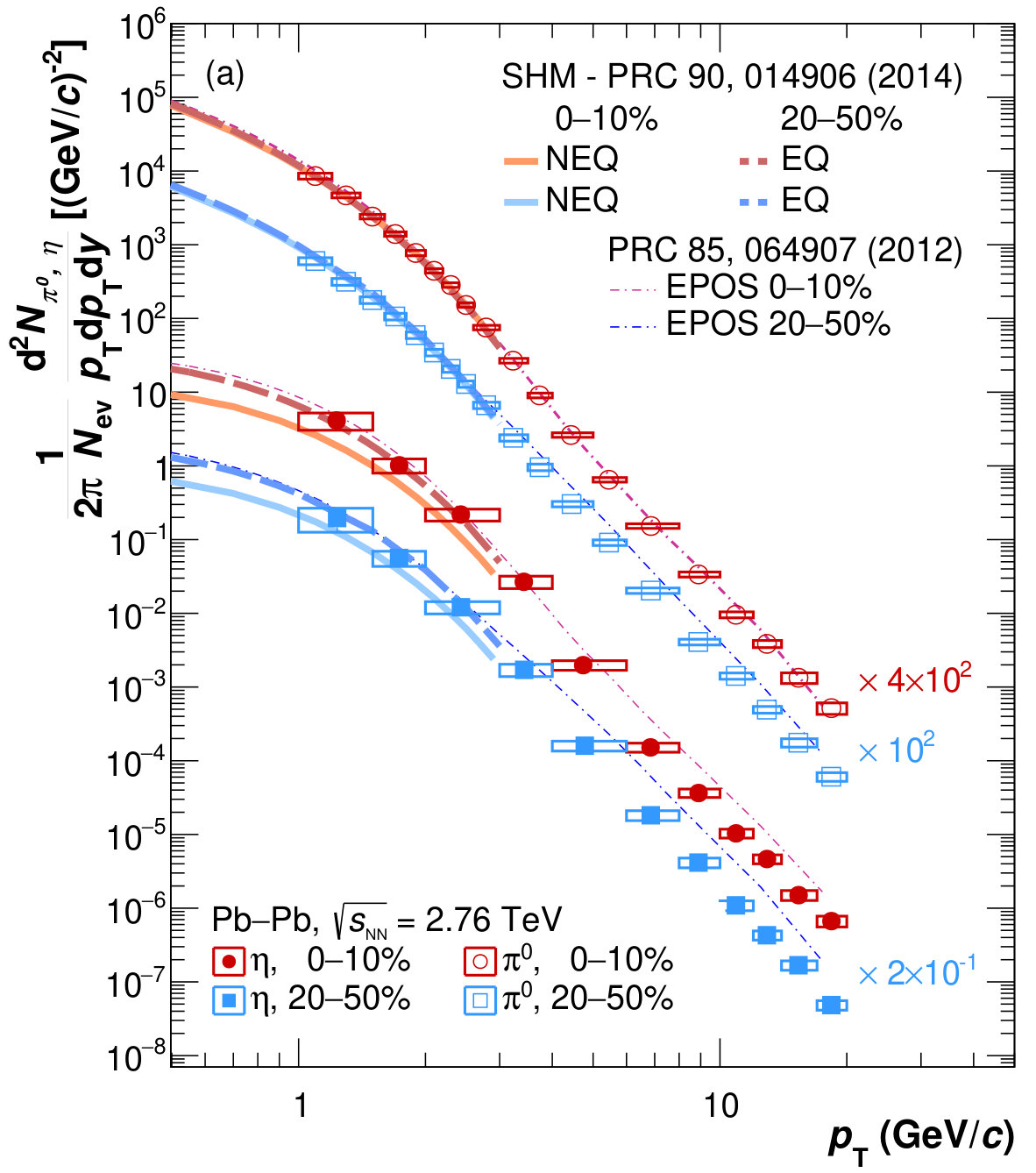 Figure 15
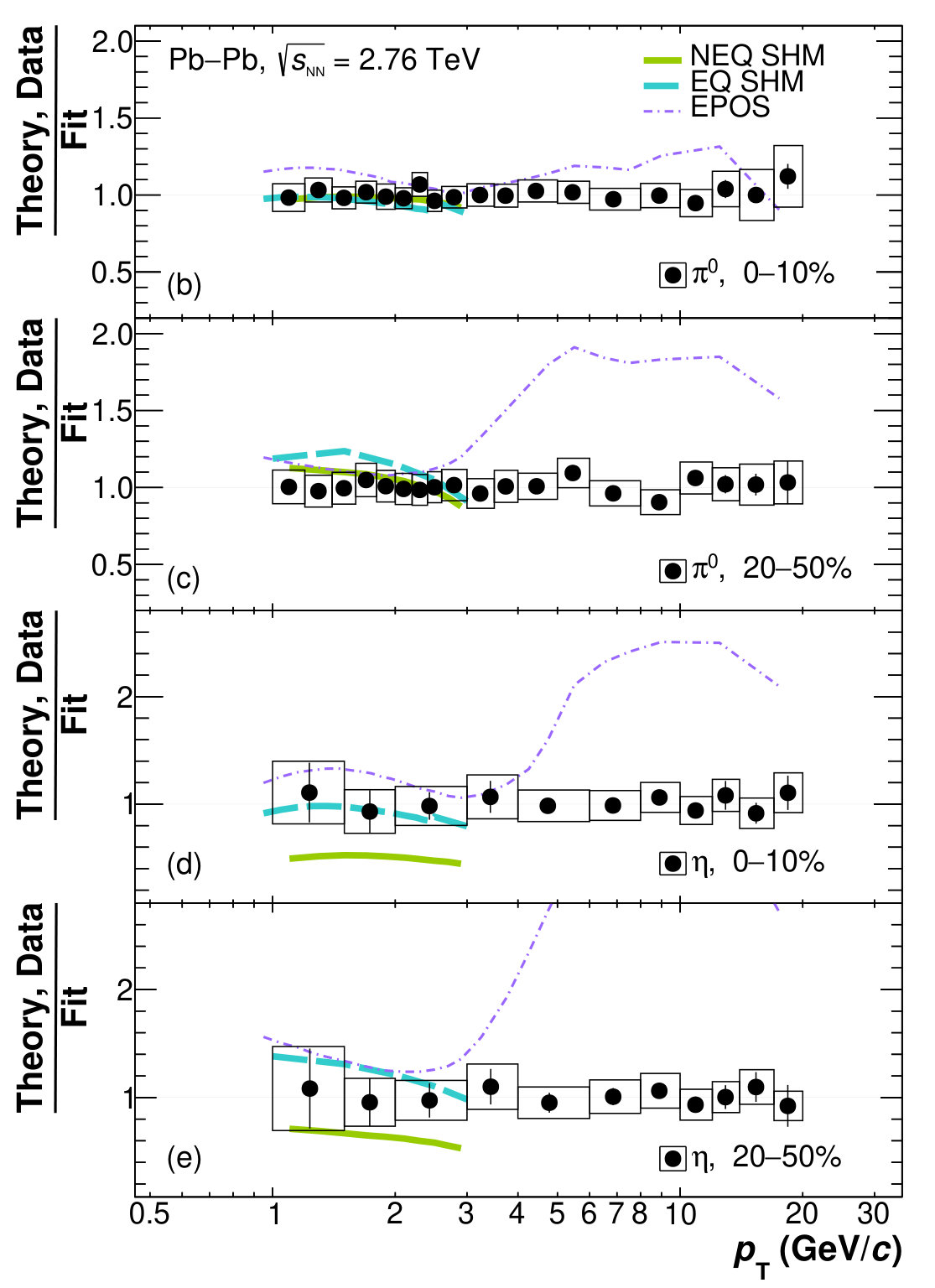 Figure 16
 Figure 17
 Figure 18
| PCM | EMCal | PHOS | PCM | EMCal | |
|---|---|---|---|---|---|
| 0–10% | 1 – 14 GeV/ | 4 – 20 GeV/ | 1 – 12 GeV/ | 1 – 10 GeV/ | 4 – 20 GeV/ |
| 20–50% | 1 – 14 GeV/ | 4 – 20 GeV/ | – | 1 – 10 GeV/ | 4 – 20 GeV/ |
| PCM | ||||||||
| 0–10% | 20–50% | |||||||
| 1.1 GeV/ | 5.5 GeV/ | 2.5 GeV/ | 5.0 GeV/ | 1.1 GeV/ | 5.5 GeV/ | 2.5 GeV/ | 5.0 GeV/ | |
| Material budget | 9.0 | 9.0 | 9.0 | 9.0 | 9.0 | 9.0 | 9.0 | 9.0 |
| Track reconstruction | 2.3 | 2.6 | 6.0 | 6.2 | 1.4 | 2.3 | 7.0 | 9.0 |
| Yield extraction | 1.5 | 2.1 | 6.4 | 7.0 | 2.5 | 2.8 | 10.0 | 11.0 |
| identification | 1.7 | 2.5 | 6.0 | 6.1 | 1.4 | 2.4 | 5.5 | 9.3 |
| Photon reconstruction | 3.7 | 2.1 | 13.7 | 13.6 | 2.1 | 2.2 | 8.0 | 8.6 |
| EMCal | ||||||||
| 0–10% | 20–50% | |||||||
| 7.0 GeV/ | 18.5 GeV/ | 7.0 GeV/ | 18.5 GeV/ | 7.0 GeV/ | 18.5 GeV/ | 7.0 GeV/ | 18.5 GeV/ | |
| Signal extraction | 2.9 | 5.1 | 4.2 | 5.5 | 7.5 | 5.8 | 6.0 | 7.1 |
| Photon identification | 9.5 | 8.0 | 4.6 | 6.0 | 7.5 | 4.5 | 14.1 | 5.0 |
| Energy response | 8.6 | 8.6 | 8.6 | 8.6 | 8.6 | 8.6 | 8.6 | 8.6 |
| Material budget | 5.0 | 5.0 | 5.0 | 5.0 | 5.0 | 5.0 | 5.0 | 5.0 |
| Hijing simulation | 8.6 | 10.0 | 8.6 | 10.0 | 2.0 | 5.3 | 2.0 | 5.3 |
| Monte Carlo input | 2.0 | 3.0 | 1 | 1.5 | 1 | 1 | 1 | 1 |
| Higher mass decays | 4.0 | 2.0 | - | - | 3.2 | 2.0 | - | - |
| 0–10% | 20–50% | 0–10% | 20–50% | |
|---|---|---|---|---|
| (GeV/c)-2 | 162 20 | 30 7 | 15 6 | 4.2 2.5 |
| (GeV/) | 0.37 0.01 | 0.38 0.02 | 0.44 0.03 | 0.42 0.06 |
| (GeV/c)-2 | 840 | 80 | 100 | 2 |
| (GeV/) | 0.34 0.01 | 0.50 0.02 | 0.38 0.03 | 0.76 0.05 |
| 3.00 0.05 | 3.00 0.05 | 3.0 0.1 | 3.0 0.1 | |
| 0.18 | 0.20 | 0.22 | 0.14 | |
Peer Reviews
No public reviews on file for this paper yet. If you reviewed it on a platform where reviews are public (OpenReview, ICLR, NeurIPS, ICML), you can paste yours below so the community can read it here.
Videos
No videos yet. Explain this paper in a talk, walkthrough, or lecture? Add one.
\PHyear2018 \PHnumber040 \PHdate14 March
\ShortTitleNeutral pion and meson production at ALICE
\CollaborationALICE Collaboration††thanks: See Appendix A for the list of collaboration members \ShortAuthorALICE Collaboration
Neutral pion and meson production in the transverse momentum range 1 20 GeV/ have been measured at mid-rapidity by the ALICE experiment at the Large Hadron Collider (LHC) in central and semi-central Pb–Pb collisions at = 2.76 TeV. These results were obtained using the photon conversion method as well as the Photon Spectrometer (PHOS) and Electromagnetic Calorimeter (EMCal) detectors. The results extend the upper reach of the previous ALICE measurements from 12 GeV/ to 20 GeV/ and present the first measurement of meson production in heavy-ion collisions at the LHC. The ratio is similar for the two centralities and reaches at high a plateau value of 0.457 0.013stat 0.018syst. A suppression of similar magnitude for and meson production is observed in Pb–Pb collisions with respect to their production in pp collisions scaled by the number of binary nucleon-nucleon collisions. We discuss the results in terms of Next to Leading Order pQCD predictions and hydrodynamic models. The measurements show a stronger suppression than observed at lower center-of-mass energies in the range 6 10 GeV/. For 3 GeV/, hadronization models describe the results while for the some tension is observed.
1 Introduction
Quantum Chromodynamics (QCD) [1], the fundamental theory of strong interactions, predicts that, above a certain critical energy density, hadrons melt into a Quark-Gluon Plasma (QGP) [2, 3]. Such a state of matter is believed to have existed a few microseconds after the Big Bang [4]. One of the goals of lattice QCD calculations is the understanding of the properties of strongly interacting matter and the nature of the phase transition that depends on the values of the quark masses and number of flavors. For vanishing baryon chemical potential () and for quark masses above a critical quark mass, a deconfinement transition associated with chiral restoration takes place through a smooth crossover [5, 6, 7, 8]. The study and characterization of the QGP gives information on the crossover transition as well as insights on the equation of state of deconfined matter [9, 10]. These transitions are expected to have occurred in the early universe and therefore their study is also of relevance to cosmology [4].
Heavy-ion collisions at relativistic energies offer the possibility of studying the QGP by creating systems of dense matter at very high temperatures. Of the many observables that probe the QGP, measurements of and meson production over a large transverse momentum () range and in different colliding systems are of particular interest. At low ( 3 GeV/), light meson production in heavy-ion collisions gives insights about hadronization and collectivity in the evolution of the QGP. At high- ( 5 GeV/), it helps quantify parton energy loss mechanisms [11, 12]. High- particle suppression in heavy-ion collisions with respect to pp collisions may be modified by cold nuclear matter effects, such as nuclear parton distribution function (nPDF) modifications with respect to the vacuum. Measurements in pA collisions are thus needed to disentangle cold nuclear effects from the observed high- particle suppression in AA collisions.
Other interesting probes of the QGP that can benefit from neutral meson measurements are studies of direct photon and heavy-flavor production measurements [13, 14]. The and mesons are the two most abundant sources of decay photons (and electrons); as a consequence, they generate the primary background for these rare probes. The first measurement of direct photons at the LHC [15] employed -scaling and the K reference measurement to estimate the contribution to decay photons. Forthcoming direct photon and heavy-flavor measurements at the LHC will be able to use the measurement directly.
Measurements of pion spectra at RHIC [16, 17] at low transverse momentum were observed to be well described by thermal models that assume a hydrodynamic expansion of a system in local equilibrium [18]. The comparison of these models to data suggested the presence of a thermalized system of quarks and gluons formed in the early stages of the collision. At LHC energies, the thermal models that describe the RHIC data also describe the ALICE charged pion spectrum [19] for 0.5 GeV/. Modern versions of these models fold in their calculations hydrodynamic expansion, which accounts for transverse flow effects, simultaneous chemical and thermal freeze-out and inclusion of high mass resonance decays from the PDG [1]. Among the many models that aim at explaining low- particle production, the equilibrium and chemical non-equilibrium statistical hadronization models (EQ SHM and NEQ SHM, respectively) have had their validity tested against LHC data from 0.1 GeV/. The physics picture behind the NEQ SHM is a sudden hadronization of the QGP, that leads to the apperance of additional non-equlibrium chemical potentials for light and strange quarks. The low pion enhancement predicted by the NEQ relative to the EQ SHM can be interpreted as the onset of pion condensation in ultra-relativistic heavy-ion collisions at the LHC energies [20, 21, 22, 23, 24]. Both predictions can be further tested by measuring and production at LHC energies.
In the early RHIC program, a suppression of high- production was observed in heavy-ion collisions when compared to scaled pp data [25]. This suppression was interpreted as a consequence of the energy loss of the scattered partons in the QGP generated in the collisions. From these observations, it was deduced that the dense QGP medium is opaque to energetic (hard) colored probes. Regarding high- particle production at the LHC, it must be considered that the energy density of the plasma is higher than measured at RHIC. This increase in energy density leads to a larger energy loss of high- partons with respect to those at both lower ( 3 GeV/) and lower energy [26, 27]. Moreover, it has been observed that baryons and strange mesons exhibit similar suppression as that of pions above 10 GeV/. The measurement of another light meson, the meson, provides additional information about mechanisms of particle production and energy loss, while the measurement of both mesons at higher will give insight about the dependence of the suppression in this region.
The suppression due to the QGP can also be studied with the ratio. In heavy-ion collisions, gluons are expected to experience larger energy loss in the medium than quarks, due to gluons having a larger vertex coupling factor. The energy reduction due to the presence of the medium (jet quenching effect) [28] may alter gluon and quark fragmentation differently with respect to what is observed in pp collisions. These differences between gluon and quark energy loss may introduce a modification in the suppression patterns observed for and mesons, due to a larger gluon component in the meson (note that the meson, unlike , has a two-gluon component) [29]. An intermediate enhancement of the ratio in AA collisions relative to pp collisions would be an indication of the plasma induced color dependence suppression [30, 31, 32]. The magnitude of this enhancement is sensitive to the initial values of the jet transport parameters and thus could be used to quantify the suppression.
In this paper, we present and meson production measurements from the ALICE experiment in the range 1 20 GeV/ in Pb-Pb collisions at center-of-mass energy = 2.76 TeV in two centrality classes, 0–10% and 20–50%. The results are measured at midrapidity using two complementary detection methods: the photon conversion method (PCM) and use of the Electromagnetic Calorimeter (EMCal) [33]. The results in the 0–10% centrality class have been combined with the previously published result measured with the PHOS calorimeter [27]. The new measurement is updated with ten times more statistics than the previous ALICE measurement [27], and extends the reach from 12 GeV/ to 20 GeV/. The measurement is the first measurement of its kind at the LHC and has a wider reach than what was previously measured at RHIC [34].
The paper is organized as follows: a brief description of the detectors used and of the data sample is given in Section 2. The analysis procedure is described in Section 3. The results and the comparison to other experimental measurements and to theoretical predictions are presented in Section 4 and 5, respectively.
2 Detector description and data sample
The ALICE experiment and its performance are described in detail in [35, 36]. The main detectors used for the reconstruction of and mesons are located in the central barrel, operated inside a solenoidal magnetic field of 0.5 T directed along the beam axis.
The Inner Tracking System (ITS) is a high granularity and precision detector that measures the position of the primary collision vertex and the impact parameter of the tracks [37]. The ITS is composed of six cylindrical layers of silicon detectors positioned at radial distances from 4 to 43 cm. The two innermost layers of the ITS are Silicon Pixel Detectors (SPD) that cover the pseudorapidity regions 2 and 1.4. The next two layers are Silicon Drift Detectors (SDD) covering 1, while the two outer layers are Silicon Strip Detectors (SSD) covering 0.9.
The Time Projection Chamber (TPC) [38] is the main charged particle tracking and identification detector in the ALICE central barrel. It is a cylindrical drift detector filled with a Ne-CO2 (90%-10%) gas mixture. This detector surrounds the ITS and is centered around the Interaction Point (IP) at a radial distance from 85 to 250 cm. The TPC has full azimuthal coverage and covers 0.9 for the full track length. Particles are identified through the measurement of their specific energy loss () in the detector with a 6.5% resolution in the 0–5% most central Pb–Pb [36, 38]. The track’s transverse momentum resolution is = 0.8% at 1 GeV/ and 1.7% at 10 GeV/ in central Pb–Pb collisions [36, 39].
The EMCal [33] is a sampling calorimeter composed of 77 alternating layers of 1.4 mm lead and 1.7 mm polystyrene scintillators. The EMCal is a fairly high granularity detector. It has a cell area of = 0.0143 0.0143 rad and an energy resolution of [40]. In year 2011, it covered 0.7 and = 100 degrees.
The main detectors used for triggering and characterization of the collision are the V0 [41] and the Zero Degree Calorimeters (ZDC) [42]. The V0 consists of two scintillator arrays located on opposite sides of the Interaction Point (IP) at 340 and 90 cm covering 2.8 5.1 and 3.7 1.7, respectively. The ZDC detectors are located at a distance of 114 m on both sides of the IP and detect spectator nucleons.
The Pb–Pb data sample used for this analysis was collected in the 2011 LHC run. During that period, about 358 ion bunches circulated in each LHC beam, with collisions delivering a peak luminosity of 4.6 10b*-1s-1*, corresponding to an average of about 10*-3* hadronic interactions per bunch crossing. The minimum bias (MB) trigger was defined by the coincidence of signals in the two V0 arrays synchronized with a bunch crossing. An online selection based on the measured V0 amplitudes was employed to enhance central (0–10%) and semi-central (0–50%) events [36]. The ZDC and the V0 were also used for the rejection of pile-up and beam-gas interactions. The centrality class definition was based on the V0 amplitude distributions. The number of binary collisions (Ncoll) for a given value of the centrality was extracted with the help of a Glauber model [43] as detailed in [39, 44]. Only events with a reconstructed primary vertex within 10 cm of the nominal interaction vertex along the beam direction were accepted. The data are analyzed in two centrality classes: 0–10% and 20–50%, containing 1.9 (1.6) 107 and 1.3 (1.1) 107 events for PCM (EMCal), respectively. The minimum bias trigger cross section, = (7.640.22(syst.)) b [44], was determined using van der Meer scans [45]. The integrated luminosity, corresponding to the number of analyzed events normalized by in each centrality percentile, is 20.1 b*-1* and 4.8 b*-1* for 0–10% and for 20–50%, respectively.
3 Analysis methods
The and mesons are reconstructed using the two-photon decay channel, and , with a branching ratio of (98.823 0.034)% and (39.41 0.20)% [1], respectively. With the photon conversion method, photons that convert in the detector material are measured by reconstructing the electron-positron pairs in the central rapidity detectors using a secondary vertex (V0) finding algorithm [36]. This method produces a V0 candidate sample on which the analysis quality selection criteria were applied, as done in [46, 27]. Electrons, positrons and photons are required to have 0.9. To ensure track quality, a minimum track momentum of 50 MeV/ and a fraction of TPC clusters over findable clusters (the number of geometrically possible clusters which can be assigned to a track) above 0.6 have been required. Moreover, a maximum conversion radius of 180 cm delimits the TPC fiducial volume for good track reconstruction, while a minimum of 5 cm rejects Dalitz decays of the type (). The specific energy loss should be within the interval [3 , 5] from the expected electron Bethe-Bloch parametrization value, where is the standard deviation of the energy loss measurement. Pions are rejected by a selection of 3 above the pion hypothesis in the range 0.4 2 GeV/ and of 1 for 2 GeV/. The smaller rejection with respect to the previous Pb–Pb measurement translates into a larger efficiency at high- for the and mesons. To further reject K, and from the V0 candidates, a selection is applied on the components of the momenta relative to the V0, using the asymmetry of the longitudinal momentum of the V0 daughters (), and on the transverse momentum of the electron with respect to the V0 momentum (q_{\mbox{\tiny T}}=p_{e}\times\sin{\theta_{\mbox{\tiny V{}^{0},e}}}). V0 candidates are selected with a two-dimensional elliptic selection criterion of 1, with = 0.95 and = 0.05 GeV/, in order to increase the purity while optimizing efficiency of the photon sample. As conversion electrons have a preferred decay orientation, a selection on , the angle between the plane perpendicular to the magnetic field and the plane containing the electron and positron tracks, together with a cut on the photon of the Kalman filter [47], further suppresses the contamination from non-photonic V0 candidates. This cut, described in [48], is applied requiring = 20 and = 0.1. To improve the signal significance, a -dependent cut on the energy asymmetry of the photons 0.65\cdot\tanh({1.8\mbox{(GeV/c{}^{-1}}\cdot\it{p}_{\text{T}}}) (where , in GeV/) is applied.
For the measurement with the EMCal, photons stemming from meson decays are measured directly. Photon-like hits in the detector are identified by energy deposits in the neighboring cells, which are grouped into clusters with a minimum size of 2 cells. A minimum energy per cell of 50 MeV is required. The cluster finding algorithm employs a seed energy of = 0.3 GeV, which is slightly above the minimum ionizing particle threshold [36]. EMCal clusters that coincide within a window of 0.025 and 0.05 radians of a charged particle reconstructed in the TPC and projected to the EMCal surface are rejected. Each selected EMCal cluster is then required to have a total energy of at least 1.5 GeV to remove low energy pairs consisting of predominantly combinatorial background and particle conversions in the material. A loose photon-like electromagnetic shower shape selection is applied to the clusters by looking at the eccentricity of the cluster via the weighted RMS of the shower energy along the major ellipse axis according to
[TABLE]
where are the covariance matrix elements, are cell indices in or axes, and , are the second and the first moments of the cluster cells weighted with the cell energy logarithm [49, 50, 36, 51]. The purpose of this loose shower shape selection 0.1 0.5 (photons sit in a narrow peak centered at 0.25) is to remove noisy and very deformed or asymmetric cluster shapes which result from the merging of different particle showers produced nearby in the calorimeter.
For the PCM and EMCal analyses, the reconstructed two-photon invariant mass is measured in bins of in the rapidity range 0.85 and 0.7, respectively. The ranges in which the separate methods contribute are reported in Table 1. In addition, a minimum photon pair opening angle of 5 mrad is used to reject background in the PCM analysis.
The background under the neutral meson signal contains combinatorial and correlated contributions. The combinatorial background is estimated with the event mixing method by mixing photons from different events but with similar photon multiplicity and topological (vertex location on the axis, and in the particular case of the PCM analysis the event plane angle) characteristics. The mixed event background is normalized to the reconstructed two-photon invariant mass in a region at higher mass with respect to the meson peak and subtracted. Additionally, various fitting functions for the total background are also used in order to obtain the number of mesons and to evaluate the corresponding systematic uncertainty (EMCal). The resulting invariant mass distributions are fit with either a Gaussian combined with a low mass exponential tail [52] (PCM, to account for electron bremsstrahlung) on top of a linear function (PCM, to account for residual background) or with a Crystal Ball distribution [53] (EMCal) in order to obtain the position and width of the peak [36]. After subtracting the total background, the yields are extracted for each bin by integrating the invariant mass distributions over a range that depends on the peak position and resolution. Fig. 1 shows the invariant mass distribution for the and mesons reconstructed with PCM and EMCal.
Corrections for geometrical acceptance, reconstruction efficiency, secondary from weak decays (the measured spectra of the relevant particles [54] are taken as input) and hadronic interactions and occupancy effects due to cluster overlaps (for EMCal) were estimated with a Monte Carlo simulation using HIJING [55] as the event generator. The simulated particles are propagated through the apparatus via GEANT3 [56], where a realistic detector response based on experimental conditions is applied in order to reproduce the performance of the ALICE detector during data taking. The simulated events are then analyzed with the same reconstruction and analysis selection criteria applied to the experimental data.
It was verified that the detector resolutions were well reproduced by the Monte Carlo simulations [36]. The mass peak positions and widths measured in the data for each centrality interval for the PCM (EMCal) analysis were reproduced within 0.5 (1.5) or better, and the remaining discrepancies have been taken into account in the systematic uncertainties associated with the difference of the energy scale and position of the calorimeter between data and Monte Carlo.
In the PCM analysis, the pile-up contribution is estimated by analyzing the distance of closest approach distribution for the photon candidates, as done in [27]. The effect of pile-up in the EMCal analysis was verified to be negligible since the EMCal cell timing resolution is an order of magnitude better than the bunch crossing spacing of 200 ns used in the 2011 Pb–Pb run.
For both methods, the systematic uncertainties were studied by varying the selection criteria used in the two analyses and by studying the resulting variations of the fully corrected spectra in individual bins. The largest contribution to the systematic uncertainties for the PCM analysis comes from the uncertainty in the material budget [36], and amounts to 9%. Other sources of systematic uncertainties include the yield extraction, track reconstruction, electron identification and photon reconstruction (mainly for the meson). The details of the PCM systematic uncertainties are listed in Table 2.
The main source of systematic uncertainties for the neutral meson detection with the EMCal is associated with the particle identification criteria used to select photon pairs (PID).
The uncertainties due to the signal extraction in a given interval are taken as the mean of the uncertainties obtained in all signal and background parametrizations. Variations on the values used for the meson identification selection criteria are also included and the root mean square (RMS) of these values is used as a systematic uncertainty.
The EMCal detector energy response was determined by analyzing test beam data [40]. Comparisons of the mass peak position and the energy-to-momentum ratios of electron tracks [57] in data and Monte Carlo simulations quantify the overall systematic uncertainty due to the Monte Carlo description of the energy response and position of the calorimeter. This uncertainty amounts to 8.6% of the invariant yield measurements.
Other sources of systematic uncertainties are the material budget, the distribution of the simulations used for the extraction of efficiencies and the contribution from higher mass decays. The details of the EMCal systematic uncertainties are listed in Table 2.
When computing the ratio and the nuclear modification factor, fully and partially correlated errors, such as material budget and energy scale (EMCal only), are taken into account.
4 Results
4.1 Invariant yields of the and meson
The invariant differential yields for and mesons have been calculated employing
[TABLE]
where is the number of events in the centrality class considered, is the branching ratio [1] for the process , A are the corresponding acceptance and efficiency corrections and corresponds to the reconstructed raw yield within the rapidity range and the transverse momentum bin . The horizontal location of the data points is shifted towards lower from the bin center by a few MeV and illustrates the value where the differential cross section is equal to the measured integral of the cross section over the corresponding bin [58]. For the / ratio and the bin-shift correction is done in y-coordinates. The ranges in which the measurements were performed are reported in Table 1. In the overlap region a weighted average of the two results (or three when applicable) is performed using the inverse of the quadratic sum of the uncertainties (statistical and systematic) that are uncorrelated between the methods as weights [59, 60, 61].
Fig. 2 shows the invariant differential yields of (a) and (b) meson measured in pp [51] and Pb–Pb collisions in the two centrality bins under study. The meson measurements are in agreement with the previously published ALICE spectra [27] and extend the transverse momentum reach from 12 to 20 GeV/. For the meson, the results presented here are the first measurement of its kind in heavy-ion collisions at the LHC and the first measurement of this meson to reach down to of 1 GeV/ in a collider experiment [34, 62].
Both meson spectra have been parametrized over the full range by the function proposed in [63, 64] that combines a Boltzmann factor at low- with a power law at high-
[TABLE]
where is the meson mass (in GeV/), , , , and are free parameters of the fit. The parameters resulting from the fits to the meson invariant yields in both centrality classes are reported in Table 3. All parameters are free except for the amplitude . The values are chosen after a systematic study of the two separate components of the Bylinkin–Rostovtsev function and of the parameter limits variation.
4.2 Particle ratios
The ratio measured in the two centrality classes is shown in Fig. 3 (a). In Fig. 3 (b), the measurement in the 0–10% centrality class is compared to the same ratio measured in pp collisions at = 2.76 TeV [51], as well as to the ratio in the same centrality class and in the same collision system and energy [19], measured by ALICE. The ratio is of interest as the relative mass differences between these particles is similar to the one for the and mesons. At 2 GeV/, the and the ratios in Pb–Pb are in agreement within uncertainties. At 2 4 GeV/, due to the large uncertainties in the ratio in Pb–Pb, no conclusion can be made on the significance of the difference between the ratio in pp or the ratio in Pb–Pb. At 4 GeV/, the value for all ratios is of similar magnitude. Moreover, a constant fit from 3 to 20 GeV/ gives a plateau value for the ratio of 0.457 0.013stat 0.018syst, in agreement with the value quoted in lower center-of-mass energy measurements [34].
4.3 The nuclear modification factor
The nuclear modification factor can be used to quantify particle production suppression in heavy-ion collisions with respect to pp collisions. It is defined as
[TABLE]
where the nuclear overlap function is related to the average number of inelastic collisions by and is the total inelastic cross-section determined using van der Meer scans [65].
The mean number of collisions is 1501 165 for the centrality class 0–10% and 349 34 for the centrality class 20–50% [44]. The and meson spectra measured in pp collisions at the same center-of-mass energy are obtained from [51].
The measured is presented in Fig. 4 for the and the mesons. A and centrality dependent suppression is clearly observed. For the most central collisions, the has a maximum around 1.5 GeV/ and a minimum for 7 GeV/, after which it increases. The increase at high- could be due to the variation of the relative gluon and quark contributions to meson production as a function of , with gluons being expected to suffer a stronger suppression than quarks due to a larger Casimir factor [66].
The suppression observed at high- is consistent with recent ATLAS results [67], and may indicate a larger quark than gluon relative contribution for high- jet production in heavy-ion collisions at the LHC. A similar behavior is observed for semi-central events, though with a smaller suppression over the full transverse momentum range. The magnitude and pattern of the suppression is the same for the and mesons for 4 GeV/ despite the difference in mass. At lower , the present accuracy is not enough to determine if the suppression is different for the two mesons.
The values for both centrality classes are also compared to the ALICE charged kaon [68] measured at the same center-of-mass energy and collision system (Fig. 4), and is of interest given the similar masses of kaons and mesons. This comparison indicates similar suppression patterns for and across the whole range and similar suppression between all particles for 4 GeV/. This result is consistent with previous baryon and strange meson results [68, 69] indicating that the energy loss in the medium is likely a purely partonic effect.
4.4 Comparisons to lower energy measurements
The nuclear modification factor in the 0–10% centrality class is compared to previous measurements reported by the WA98 [70] and PHENIX collaborations [71, 25] (Fig. 5, (a)) for center-of-mass energies per binary collision ranging from GeV (WA89) to GeV (PHENIX).
Our results confirm a dependence of the suppression on the center-of-mass energy and indicate a larger suppression for increasing collision energy. At 11 GeV/, the relative difference in suppression between the PHENIX and ALICE data is inconclusive due to the large uncertainties.
The meson is compared to the corresponding PHENIX measurement [34] at = 200 GeV (Fig. 5, (b)). Similarly to the case, the ALICE measurement shows a larger suppression compared to the PHENIX data in the region 5 14 GeV/.
5 Comparisons to models
The and invariant -differential yields are compared to predictions using a statistical hadronization model (SHM) [20, 18] and the EPOS2 [72] event generator. Results from two versions of the SHM are presented here, an equilibrium (EQ) and non-equilibrium (NEQ) prediction. In the NEQ SHM, the mean particle multiplicities are described with the use of four thermodynamic parameters: temperature , volume , and two parameters to account for the non-equilibrium conditions – and . The EQ SHM can be treated as a particular case of the NEQ when = = 1. The parameters of the model are determined by fits to the measured charged pion and kaon spectra [20]. While only these two particles are considered in the fits, the resulting parameters are used to make predictions for other particles [73], e.g. the meson, the meson and the proton. The EPOS generator addresses both low- and high- phenomena, where the particle spectra include effects (low-) associated to hydrodynamic flow as discussed in [19]. At higher , the focus is shifted towards energy loss of high- strings where strings are the byproduct of hard scatterings.
Fig. 6 (a) shows the comparison to models for the 0–10% and 20–50% centrality classes while Fig. 6 (be) shows the ratio of data and theory calculations to the fit of the and invariant yields.
The EQ and NEQ SHM predictions (bold lines in Fig. 6, (b) and (c)) describe the shape of the measurement within the uncertainties for both centralities. For the meson, in (d) and (e), the EQ model also describes the data within uncertainties. Conversely, the NEQ model predicts about half as many mesons than actually measured in central collisions. The difference observed between the NEQ SHM and the data may point towards a different flow profile of the two mesons with a larger flow for the than the [74]. Significant differences between the EQ and NEQ predictions are also observed for the , (1385), (1520) and (1530) [75, 73].
The and mesons are only partially described by EPOS (dashed lines in Fig. 6, (be)). While the comparison is reasonably close to the data points for the measurement in 0–10% (b), the model only describes the low part of the (c) semicentral and (d, e) measurements. No theoretical uncertainties for the EPOS calculations are available at the time of writing.
The ratio for the centrality class 0–10% is compared to the NLO pQCD calculation by DCZW (Dai, Chen, Zhang, and Wang) [30], to the ratio from the EQ and NEQ SHM [20] predictions and the EPOS [72] generator in Fig. 7. The DCZW model is based on a higher twist approach to jet quenching [76] where parton fragmentation functions are modified as a consequence of the parton energy loss. A generalized QCD factorization of twist-4 processes is used to calculate the scattering. The effective parton fragmentation functions AKK (Albino, Kniehl, Kramer) [77] and AESS (Aidala, Ellinghaus, Seele, Stratmann) [78]) are then incorporated into a NLO pQCD framework to describe the particle production
suppression. Data and the DCZW prediction are in agreement within uncertainties. The EQ SHM prediction describes the ratio, while in comparison to the NEQ SHM prediction the ratio is underestimated as shown in Fig. 6 (d, e). The EPOS curves describe the ratio up to 4 GeV/, as expected since the disagreement with the meson measurement is larger at higher .
The measurements of for both mesons are compared to four NLO pQCD based models in Fig. 8: DCZW [30] (described above), WHDG(Wicks, Horowitz, Djordjevic and Gyulassy) [79, 80, 81], Djordevic et al. [82] ( only) and Vitev et al. [83, 84, 85, 86] ( only). In the first three models, it is assumed that a fast moving parton passing through hot partonic matter will lose its energy via induced radiation due to multiple parton scattering. The WHDG calculation models collisional and radiative energy loss processes in a Bjorken-expanding medium. It assumes that the color charge density of the medium is proportional to the number of participating nucleons obtained from a Glauber model. Hard parton-parton scatterings are then proportional to the number of binary nucleon-nucleon collisions. The Djordevic et al. model also includes effects due to the finite size of the QCD medium, the finite magnetic mass and the running of the coupling [87, 88, 89, 82]. The model of Vitev et al. is an application of the soft-collinear effective theory with Glauber gluons (SCETG) to study inclusive hadron suppression in nucleus-nucleus collisions. In this model, medium-evolved fragmentation functions are combined with all initial-state cold nuclear matter (CNM) effects (dynamical nuclear shadowing, Cronin effect and initial-state parton energy loss). The authors demonstrate that traditional parton energy loss calculations can be regarded as a special soft-gluon emission limit of the general QCD evolution framework.
In the most central event class, the meson is described for 4 GeV/ by the DCZW, Djordevic et al. and Vitev et al. models and for 6 GeV/ by WHDG (Fig. 8, (a)). For the DCZW predictions, the meson is described within uncertainties from 8 GeV/; below this momentum, the DCZW model overstimates the result (Fig. 8, (c)). The latter may indicate that the relative quark and gluon contributions to the meson production is overestimated at intermediate (4 8 GeV/). On the other hand, the WHDG model predicts larger suppression than observed in the data for the meson in the centrality class 0–10% and for both mesons in the centrality class 20–50%. The Djordevic et al. and Vitev et al. models describe the meson suppression in both centrality classes within uncertainties.
6 Summary
We have presented measurements of the and meson production at mid-rapidity in Pb–Pb collisions at = 2.76 TeV measured with the ALICE detector. Independent and complementary techniques are used: photon detection with electromagnetic calorimetry and photon reconstruction through conversions using the tracking system. The combination of these methods allowed measurements in a large transverse momentum range, from 1 to 20 GeV/.
The results represent the first measurement of meson production in heavy-ion collisions at the LHC. The measurements are performed using data that corresponds to a factor 10 increase in integrated luminosity with respect to the previous ALICE publication [27]. The higher statistics allowed for an improved measurement that probes the region up to 20 GeV/.
The ratio is compared to NLO pQCD calculations, corresponding ALICE measurements in pp collisions and to the ratio measured in Pb–Pb collisions at the same energy. For 4 GeV/, these results indicate that the ratio in Pb–Pb is similar to the vacuum expectation, assuming this to be the pp measurement. The ratio is also consistent with predictions from pQCD-based calculations within experimental uncertainties. No effects beyond one related to the strange quark content, mass hierarchy between particles or contributions from higher mass resonance decays that may lead to discernible differences between and were observed.
The invariant yields of both mesons as well as the ratio are compared to predictions including a hydrodynamic approach focusing on low- phenomena. These comparisons show different levels of agreement for and . EPOS slightly overestimates the production rates of the two mesons at low-, but shows a much larger deviation above 3–4 GeV/. Both the EQ and NEQ SHM predictions describe the measured production rates. The data favors the EQ model description which agrees with the measurement. The NEQ model is disfavored by the data as it underestimates the results by a factor of two.
The RAA results show an increasing trend at high which may be explained by a larger quark to gluon contribution in the production of neutral mesons. The measurements, when compared to world data, confirm the center-of-mass energy dependence of the observed suppression when going from low (SPS) to higher (RHIC, ALICE) collision energies. Results of for mesons are currently available only at two center-of-mass energies from the LHC and RHIC with sizable uncertainties. Due to the lack of precise world data, it is difficult to conclude on an energy dependence of the suppression.
The results are additionally compared to NLO pQCD calculations. The WHDG model describes the suppression observed for the meson in the 0–10 centrality class within theoretical and experimental uncertainties. For the measurement, the model predicts a larger suppression than observed. In the 20–50% centrality class the predictions are in disagreement by several sigma with the ALICE data for both mesons. The DCZW model describes within uncertainties the measurement and the meson above 8 GeV/. Below this , the model predicts less suppression than observed. The Djordevic et al. and Vitev et al. calculations describe well the production rates in both centrality classes. The disagreement observed between the measurements and the models may point to a overestimation (DCZW) or underestimation (WHDG) of the gluon to quark contributions to the meson production in heavy-ion collisions at LHC energies.
The presented results, when compared to models, highlight the lack of a full theoretical description of neutral meson production. The measurements presented in this paper will be essential to further constrain theoretical models and improve our understanding of the experimental results.
Acknowledgements
We would like to thank Viktor Begun, Wei Dai, Magdalena Djordevic, William Horowitz, Marco Stratmann, Ivan Vitev and Klaus Werner for useful discussions and clarifications, and for providing the predictions shown in this paper.
The ALICE Collaboration would like to thank all its engineers and technicians for their invaluable contributions to the construction of the experiment and the CERN accelerator teams for the outstanding performance of the LHC complex. The ALICE Collaboration gratefully acknowledges the resources and support provided by all Grid centres and the Worldwide LHC Computing Grid (WLCG) collaboration. The ALICE Collaboration acknowledges the following funding agencies for their support in building and running the ALICE detector: A. I. Alikhanyan National Science Laboratory (Yerevan Physics Institute) Foundation (ANSL), State Committee of Science and World Federation of Scientists (WFS), Armenia; Austrian Academy of Sciences and Nationalstiftung für Forschung, Technologie und Entwicklung, Austria; Ministry of Communications and High Technologies, National Nuclear Research Center, Azerbaijan; Conselho Nacional de Desenvolvimento Científico e Tecnológico (CNPq), Universidade Federal do Rio Grande do Sul (UFRGS), Financiadora de Estudos e Projetos (Finep) and Fundação de Amparo à Pesquisa do Estado de São Paulo (FAPESP), Brazil; Ministry of Science & Technology of China (MSTC), National Natural Science Foundation of China (NSFC) and Ministry of Education of China (MOEC) , China; Ministry of Science, Education and Sport and Croatian Science Foundation, Croatia; Ministry of Education, Youth and Sports of the Czech Republic, Czech Republic; The Danish Council for Independent Research — Natural Sciences, the Carlsberg Foundation and Danish National Research Foundation (DNRF), Denmark; Helsinki Institute of Physics (HIP), Finland; Commissariat à l’Energie Atomique (CEA) and Institut National de Physique Nucléaire et de Physique des Particules (IN2P3) and Centre National de la Recherche Scientifique (CNRS), France; Bundesministerium für Bildung, Wissenschaft, Forschung und Technologie (BMBF) and GSI Helmholtzzentrum für Schwerionenforschung GmbH, Germany; General Secretariat for Research and Technology, Ministry of Education, Research and Religions, Greece; National Research, Development and Innovation Office, Hungary; Department of Atomic Energy Government of India (DAE), Department of Science and Technology, Government of India (DST), University Grants Commission, Government of India (UGC) and Council of Scientific and Industrial Research (CSIR), India; Indonesian Institute of Science, Indonesia; Centro Fermi - Museo Storico della Fisica e Centro Studi e Ricerche Enrico Fermi and Istituto Nazionale di Fisica Nucleare (INFN), Italy; Institute for Innovative Science and Technology , Nagasaki Institute of Applied Science (IIST), Japan Society for the Promotion of Science (JSPS) KAKENHI and Japanese Ministry of Education, Culture, Sports, Science and Technology (MEXT), Japan; Consejo Nacional de Ciencia (CONACYT) y Tecnología, through Fondo de Cooperación Internacional en Ciencia y Tecnología (FONCICYT) and Dirección General de Asuntos del Personal Academico (DGAPA), Mexico; Nederlandse Organisatie voor Wetenschappelijk Onderzoek (NWO), Netherlands; The Research Council of Norway, Norway; Commission on Science and Technology for Sustainable Development in the South (COMSATS), Pakistan; Pontificia Universidad Católica del Perú, Peru; Ministry of Science and Higher Education and National Science Centre, Poland; Korea Institute of Science and Technology Information and National Research Foundation of Korea (NRF), Republic of Korea; Ministry of Education and Scientific Research, Institute of Atomic Physics and Romanian National Agency for Science, Technology and Innovation, Romania; Joint Institute for Nuclear Research (JINR), Ministry of Education and Science of the Russian Federation and National Research Centre Kurchatov Institute, Russia; Ministry of Education, Science, Research and Sport of the Slovak Republic, Slovakia; National Research Foundation of South Africa, South Africa; Swedish Research Council (VR) and Knut & Alice Wallenberg Foundation (KAW), Sweden; European Organization for Nuclear Research, Switzerland; National Science and Technology Development Agency (NSDTA), Suranaree University of Technology (SUT) and Office of the Higher Education Commission under NRU project of Thailand, Thailand; Turkish Atomic Energy Agency (TAEK), Turkey; National Academy of Sciences of Ukraine, Ukraine; Science and Technology Facilities Council (STFC), United Kingdom; National Science Foundation of the United States of America (NSF) and United States Department of Energy, Office of Nuclear Physics (DOE NP), United States of America.
Appendix A The ALICE Collaboration
S. Acharya\Irefnorg138&F.T.-. Acosta\Irefnorg22&D. Adamová\Irefnorg94&J. Adolfsson\Irefnorg81&M.M. Aggarwal\Irefnorg98&G. Aglieri Rinella\Irefnorg36&M. Agnello\Irefnorg33&N. Agrawal\Irefnorg48&Z. Ahammed\Irefnorg138&S.U. Ahn\Irefnorg77&S. Aiola\Irefnorg143&A. Akindinov\Irefnorg64&M. Al-Turany\Irefnorg104&S.N. Alam\Irefnorg138&D.S.D. Albuquerque\Irefnorg119&D. Aleksandrov\Irefnorg88&B. Alessandro\Irefnorg58&R. Alfaro Molina\Irefnorg72&Y. Ali\Irefnorg16&A. Alici\Irefnorg29,\Irefnorg11,\Irefnorg53&A. Alkin\Irefnorg3&J. Alme\Irefnorg24&T. Alt\Irefnorg69&L. Altenkamper\Irefnorg24&I. Altsybeev\Irefnorg137&C. Andrei\Irefnorg47&D. Andreou\Irefnorg36&H.A. Andrews\Irefnorg108&A. Andronic\Irefnorg104&M. Angeletti\Irefnorg36&V. Anguelov\Irefnorg102&C. Anson\Irefnorg17&T. Antičić\Irefnorg105&F. Antinori\Irefnorg56&P. Antonioli\Irefnorg53&N. Apadula\Irefnorg80&L. Aphecetche\Irefnorg111&H. Appelshäuser\Irefnorg69&S. Arcelli\Irefnorg29&R. Arnaldi\Irefnorg58&O.W. Arnold\Irefnorg103,\Irefnorg114&I.C. Arsene\Irefnorg23&M. Arslandok\Irefnorg102&B. Audurier\Irefnorg111&A. Augustinus\Irefnorg36&R. Averbeck\Irefnorg104&M.D. Azmi\Irefnorg18&A. Badalà\Irefnorg55&Y.W. Baek\Irefnorg60,\Irefnorg76&S. Bagnasco\Irefnorg58&R. Bailhache\Irefnorg69&R. Bala\Irefnorg99&A. Baldisseri\Irefnorg134&M. Ball\Irefnorg43&R.C. Baral\Irefnorg66,\Irefnorg86&A.M. Barbano\Irefnorg28&R. Barbera\Irefnorg30&F. Barile\Irefnorg35&L. Barioglio\Irefnorg28&G.G. Barnaföldi\Irefnorg142&L.S. Barnby\Irefnorg93&V. Barret\Irefnorg131&P. Bartalini\Irefnorg7&K. Barth\Irefnorg36&E. Bartsch\Irefnorg69&N. Bastid\Irefnorg131&S. Basu\Irefnorg140&G. Batigne\Irefnorg111&B. Batyunya\Irefnorg75&P.C. Batzing\Irefnorg23&J.L. Bazo Alba\Irefnorg109&I.G. Bearden\Irefnorg89&H. Beck\Irefnorg102&C. Bedda\Irefnorg63&N.K. Behera\Irefnorg60&I. Belikov\Irefnorg133&F. Bellini\Irefnorg36,\Irefnorg29&H. Bello Martinez\Irefnorg2&R. Bellwied\Irefnorg123&L.G.E. Beltran\Irefnorg117&V. Belyaev\Irefnorg92&G. Bencedi\Irefnorg142&S. Beole\Irefnorg28&A. Bercuci\Irefnorg47&Y. Berdnikov\Irefnorg96&D. Berenyi\Irefnorg142&R.A. Bertens\Irefnorg127&D. Berzano\Irefnorg58,\Irefnorg36&L. Betev\Irefnorg36&P.P. Bhaduri\Irefnorg138&A. Bhasin\Irefnorg99&I.R. Bhat\Irefnorg99&B. Bhattacharjee\Irefnorg42&J. Bhom\Irefnorg115&A. Bianchi\Irefnorg28&L. Bianchi\Irefnorg123&N. Bianchi\Irefnorg51&C. Bianchin\Irefnorg140&J. Bielčík\Irefnorg38&J. Bielčíková\Irefnorg94&A. Bilandzic\Irefnorg114,\Irefnorg103&G. Biro\Irefnorg142&R. Biswas\Irefnorg4&S. Biswas\Irefnorg4&J.T. Blair\Irefnorg116&D. Blau\Irefnorg88&C. Blume\Irefnorg69&G. Boca\Irefnorg135&F. Bock\Irefnorg36&A. Bogdanov\Irefnorg92&L. Boldizsár\Irefnorg142&M. Bombara\Irefnorg39&G. Bonomi\Irefnorg136&M. Bonora\Irefnorg36&H. Borel\Irefnorg134&A. Borissov\Irefnorg102,\Irefnorg20&M. Borri\Irefnorg125&E. Botta\Irefnorg28&C. Bourjau\Irefnorg89&L. Bratrud\Irefnorg69&P. Braun-Munzinger\Irefnorg104&M. Bregant\Irefnorg118&T.A. Broker\Irefnorg69&M. Broz\Irefnorg38&E.J. Brucken\Irefnorg44&E. Bruna\Irefnorg58&G.E. Bruno\Irefnorg36,\Irefnorg35&D. Budnikov\Irefnorg106&H. Buesching\Irefnorg69&S. Bufalino\Irefnorg33&P. Buhler\Irefnorg110&P. Buncic\Irefnorg36&O. Busch\Irefnorg130&Z. Buthelezi\Irefnorg73&J.B. Butt\Irefnorg16&J.T. Buxton\Irefnorg19&J. Cabala\Irefnorg113&D. Caffarri\Irefnorg36,\Irefnorg90&H. Caines\Irefnorg143&A. Caliva\Irefnorg63,\Irefnorg104&E. Calvo Villar\Irefnorg109&R.S. Camacho\Irefnorg2&P. Camerini\Irefnorg27&A.A. Capon\Irefnorg110&F. Carena\Irefnorg36&W. Carena\Irefnorg36&F. Carnesecchi\Irefnorg11,\Irefnorg29&J. Castillo Castellanos\Irefnorg134&A.J. Castro\Irefnorg127&E.A.R. Casula\Irefnorg54&C. Ceballos Sanchez\Irefnorg9&S. Chandra\Irefnorg138&B. Chang\Irefnorg124&W. Chang\Irefnorg7&S. Chapeland\Irefnorg36&M. Chartier\Irefnorg125&S. Chattopadhyay\Irefnorg138&S. Chattopadhyay\Irefnorg107&A. Chauvin\Irefnorg114,\Irefnorg103&C. Cheshkov\Irefnorg132&B. Cheynis\Irefnorg132&V. Chibante Barroso\Irefnorg36&D.D. Chinellato\Irefnorg119&S. Cho\Irefnorg60&P. Chochula\Irefnorg36&M. Chojnacki\Irefnorg89&S. Choudhury\Irefnorg138&T. Chowdhury\Irefnorg131&P. Christakoglou\Irefnorg90&C.H. Christensen\Irefnorg89&P. Christiansen\Irefnorg81&T. Chujo\Irefnorg130&S.U. Chung\Irefnorg20&C. Cicalo\Irefnorg54&L. Cifarelli\Irefnorg11,\Irefnorg29&F. Cindolo\Irefnorg53&J. Cleymans\Irefnorg122&F. Colamaria\Irefnorg52,\Irefnorg35&D. Colella\Irefnorg36,\Irefnorg52,\Irefnorg65&A. Collu\Irefnorg80&M. Colocci\Irefnorg29&M. Concas\Irefnorg58\AreforgI&G. Conesa Balbastre\Irefnorg79&Z. Conesa del Valle\Irefnorg61&J.G. Contreras\Irefnorg38&T.M. Cormier\Irefnorg95&Y. Corrales Morales\Irefnorg58&I. Cortés Maldonado\Irefnorg2&P. Cortese\Irefnorg34&M.R. Cosentino\Irefnorg120&F. Costa\Irefnorg36&S. Costanza\Irefnorg135&J. Crkovská\Irefnorg61&P. Crochet\Irefnorg131&E. Cuautle\Irefnorg70&L. Cunqueiro\Irefnorg95,\Irefnorg141&T. Dahms\Irefnorg103,\Irefnorg114&A. Dainese\Irefnorg56&M.C. Danisch\Irefnorg102&A. Danu\Irefnorg68&D. Das\Irefnorg107&I. Das\Irefnorg107&S. Das\Irefnorg4&A. Dash\Irefnorg86&S. Dash\Irefnorg48&S. De\Irefnorg49&A. De Caro\Irefnorg32&G. de Cataldo\Irefnorg52&C. de Conti\Irefnorg118&J. de Cuveland\Irefnorg40&A. De Falco\Irefnorg26&D. De Gruttola\Irefnorg32,\Irefnorg11&N. De Marco\Irefnorg58&S. De Pasquale\Irefnorg32&R.D. De Souza\Irefnorg119&H.F. Degenhardt\Irefnorg118&A. Deisting\Irefnorg104,\Irefnorg102&A. Deloff\Irefnorg85&S. Delsanto\Irefnorg28&C. Deplano\Irefnorg90&P. Dhankher\Irefnorg48&D. Di Bari\Irefnorg35&A. Di Mauro\Irefnorg36&P. Di Nezza\Irefnorg51&B. Di Ruzza\Irefnorg56&R.A. Diaz\Irefnorg9&T. Dietel\Irefnorg122&P. Dillenseger\Irefnorg69&Y. Ding\Irefnorg7&R. Divià\Irefnorg36&Ø. Djuvsland\Irefnorg24&A. Dobrin\Irefnorg36&D. Domenicis Gimenez\Irefnorg118&B. Dönigus\Irefnorg69&O. Dordic\Irefnorg23&L.V.R. Doremalen\Irefnorg63&A.K. Dubey\Irefnorg138&A. Dubla\Irefnorg104&L. Ducroux\Irefnorg132&S. Dudi\Irefnorg98&A.K. Duggal\Irefnorg98&M. Dukhishyam\Irefnorg86&P. Dupieux\Irefnorg131&R.J. Ehlers\Irefnorg143&D. Elia\Irefnorg52&E. Endress\Irefnorg109&H. Engel\Irefnorg74&E. Epple\Irefnorg143&B. Erazmus\Irefnorg111&F. Erhardt\Irefnorg97&B. Espagnon\Irefnorg61&G. Eulisse\Irefnorg36&J. Eum\Irefnorg20&D. Evans\Irefnorg108&S. Evdokimov\Irefnorg91&L. Fabbietti\Irefnorg103,\Irefnorg114&M. Faggin\Irefnorg31&J. Faivre\Irefnorg79&A. Fantoni\Irefnorg51&M. Fasel\Irefnorg95&L. Feldkamp\Irefnorg141&A. Feliciello\Irefnorg58&G. Feofilov\Irefnorg137&A. Fernández Téllez\Irefnorg2&A. Ferretti\Irefnorg28&A. Festanti\Irefnorg31,\Irefnorg36&V.J.G. Feuillard\Irefnorg134,\Irefnorg131&J. Figiel\Irefnorg115&M.A.S. Figueredo\Irefnorg118&S. Filchagin\Irefnorg106&D. Finogeev\Irefnorg62&F.M. Fionda\Irefnorg24,\Irefnorg26&M. Floris\Irefnorg36&S. Foertsch\Irefnorg73&P. Foka\Irefnorg104&S. Fokin\Irefnorg88&E. Fragiacomo\Irefnorg59&A. Francescon\Irefnorg36&A. Francisco\Irefnorg111&U. Frankenfeld\Irefnorg104&G.G. Fronze\Irefnorg28&U. Fuchs\Irefnorg36&C. Furget\Irefnorg79&A. Furs\Irefnorg62&M. Fusco Girard\Irefnorg32&J.J. Gaardhøje\Irefnorg89&M. Gagliardi\Irefnorg28&A.M. Gago\Irefnorg109&K. Gajdosova\Irefnorg89&M. Gallio\Irefnorg28&C.D. Galvan\Irefnorg117&P. Ganoti\Irefnorg84&C. Garabatos\Irefnorg104&E. Garcia-Solis\Irefnorg12&K. Garg\Irefnorg30&C. Gargiulo\Irefnorg36&P. Gasik\Irefnorg114,\Irefnorg103&E.F. Gauger\Irefnorg116&M.B. Gay Ducati\Irefnorg71&M. Germain\Irefnorg111&J. Ghosh\Irefnorg107&P. Ghosh\Irefnorg138&S.K. Ghosh\Irefnorg4&P. Gianotti\Irefnorg51&P. Giubellino\Irefnorg58,\Irefnorg104,\Irefnorg36&P. Giubilato\Irefnorg31&E. Gladysz-Dziadus\Irefnorg115&P. Glässel\Irefnorg102&D.M. Goméz Coral\Irefnorg72&A. Gomez Ramirez\Irefnorg74&A.S. Gonzalez\Irefnorg36&P. González-Zamora\Irefnorg2&S. Gorbunov\Irefnorg40&L. Görlich\Irefnorg115&S. Gotovac\Irefnorg126&V. Grabski\Irefnorg72&L.K. Graczykowski\Irefnorg139&K.L. Graham\Irefnorg108&L. Greiner\Irefnorg80&A. Grelli\Irefnorg63&C. Grigoras\Irefnorg36&V. Grigoriev\Irefnorg92&A. Grigoryan\Irefnorg1&S. Grigoryan\Irefnorg75&J.M. Gronefeld\Irefnorg104&F. Grosa\Irefnorg33&J.F. Grosse-Oetringhaus\Irefnorg36&R. Grosso\Irefnorg104&F. Guber\Irefnorg62&R. Guernane\Irefnorg79&B. Guerzoni\Irefnorg29&M. Guittiere\Irefnorg111&K. Gulbrandsen\Irefnorg89&T. Gunji\Irefnorg129&A. Gupta\Irefnorg99&R. Gupta\Irefnorg99&I.B. Guzman\Irefnorg2&R. Haake\Irefnorg36&M.K. Habib\Irefnorg104&C. Hadjidakis\Irefnorg61&H. Hamagaki\Irefnorg82&G. Hamar\Irefnorg142&J.C. Hamon\Irefnorg133&M.R. Haque\Irefnorg63&J.W. Harris\Irefnorg143&A. Harton\Irefnorg12&H. Hassan\Irefnorg79&D. Hatzifotiadou\Irefnorg53,\Irefnorg11&S. Hayashi\Irefnorg129&S.T. Heckel\Irefnorg69&E. Hellbär\Irefnorg69&H. Helstrup\Irefnorg37&A. Herghelegiu\Irefnorg47&E.G. Hernandez\Irefnorg2&G. Herrera Corral\Irefnorg10&F. Herrmann\Irefnorg141&B.A. Hess\Irefnorg101&K.F. Hetland\Irefnorg37&H. Hillemanns\Irefnorg36&C. Hills\Irefnorg125&B. Hippolyte\Irefnorg133&B. Hohlweger\Irefnorg103&D. Horak\Irefnorg38&S. Hornung\Irefnorg104&R. Hosokawa\Irefnorg130,\Irefnorg79&P. Hristov\Irefnorg36&C. Hughes\Irefnorg127&P. Huhn\Irefnorg69&T.J. Humanic\Irefnorg19&H. Hushnud\Irefnorg107&N. Hussain\Irefnorg42&T. Hussain\Irefnorg18&D. Hutter\Irefnorg40&D.S. Hwang\Irefnorg21&J.P. Iddon\Irefnorg125&S.A. Iga Buitron\Irefnorg70&R. Ilkaev\Irefnorg106&M. Inaba\Irefnorg130&M. Ippolitov\Irefnorg92,\Irefnorg88&M.S. Islam\Irefnorg107&M. Ivanov\Irefnorg104&V. Ivanov\Irefnorg96&V. Izucheev\Irefnorg91&B. Jacak\Irefnorg80&N. Jacazio\Irefnorg29&P.M. Jacobs\Irefnorg80&M.B. Jadhav\Irefnorg48&S. Jadlovska\Irefnorg113&J. Jadlovsky\Irefnorg113&S. Jaelani\Irefnorg63&C. Jahnke\Irefnorg118,\Irefnorg114&M.J. Jakubowska\Irefnorg139&M.A. Janik\Irefnorg139&P.H.S.Y. Jayarathna\Irefnorg123&C. Jena\Irefnorg86&M. Jercic\Irefnorg97&R.T. Jimenez Bustamante\Irefnorg104&P.G. Jones\Irefnorg108&A. Jusko\Irefnorg108&P. Kalinak\Irefnorg65&A. Kalweit\Irefnorg36&J.H. Kang\Irefnorg144&V. Kaplin\Irefnorg92&S. Kar\Irefnorg138&A. Karasu Uysal\Irefnorg78&O. Karavichev\Irefnorg62&T. Karavicheva\Irefnorg62&L. Karayan\Irefnorg104,\Irefnorg102&P. Karczmarczyk\Irefnorg36&E. Karpechev\Irefnorg62&U. Kebschull\Irefnorg74&R. Keidel\Irefnorg46&D.L.D. Keijdener\Irefnorg63&M. Keil\Irefnorg36&B. Ketzer\Irefnorg43&Z. Khabanova\Irefnorg90&S. Khan\Irefnorg18&S.A. Khan\Irefnorg138&A. Khanzadeev\Irefnorg96&Y. Kharlov\Irefnorg91&A. Khatun\Irefnorg18&A. Khuntia\Irefnorg49&M.M. Kielbowicz\Irefnorg115&B. Kileng\Irefnorg37&B. Kim\Irefnorg130&D. Kim\Irefnorg144&D.J. Kim\Irefnorg124&E.J. Kim\Irefnorg14&H. Kim\Irefnorg144&J.S. Kim\Irefnorg41&J. Kim\Irefnorg102&M. Kim\Irefnorg60&S. Kim\Irefnorg21&T. Kim\Irefnorg144&S. Kirsch\Irefnorg40&I. Kisel\Irefnorg40&S. Kiselev\Irefnorg64&A. Kisiel\Irefnorg139&G. Kiss\Irefnorg142&J.L. Klay\Irefnorg6&C. Klein\Irefnorg69&J. Klein\Irefnorg36&C. Klein-Bösing\Irefnorg141&S. Klewin\Irefnorg102&A. Kluge\Irefnorg36&M.L. Knichel\Irefnorg102,\Irefnorg36&A.G. Knospe\Irefnorg123&C. Kobdaj\Irefnorg112&M. Kofarago\Irefnorg142&M.K. Köhler\Irefnorg102&T. Kollegger\Irefnorg104&V. Kondratiev\Irefnorg137&N. Kondratyeva\Irefnorg92&E. Kondratyuk\Irefnorg91&A. Konevskikh\Irefnorg62&M. Konyushikhin\Irefnorg140&M. Kopcik\Irefnorg113&C. Kouzinopoulos\Irefnorg36&O. Kovalenko\Irefnorg85&V. Kovalenko\Irefnorg137&M. Kowalski\Irefnorg115&I. Králik\Irefnorg65&A. Kravčáková\Irefnorg39&L. Kreis\Irefnorg104&M. Krivda\Irefnorg108,\Irefnorg65&F. Krizek\Irefnorg94&M. Krüger\Irefnorg69&E. Kryshen\Irefnorg96&M. Krzewicki\Irefnorg40&A.M. Kubera\Irefnorg19&V. Kučera\Irefnorg94&C. Kuhn\Irefnorg133&P.G. Kuijer\Irefnorg90&J. Kumar\Irefnorg48&L. Kumar\Irefnorg98&S. Kumar\Irefnorg48&S. Kundu\Irefnorg86&P. Kurashvili\Irefnorg85&A. Kurepin\Irefnorg62&A.B. Kurepin\Irefnorg62&A. Kuryakin\Irefnorg106&S. Kushpil\Irefnorg94&M.J. Kweon\Irefnorg60&Y. Kwon\Irefnorg144&S.L. La Pointe\Irefnorg40&P. La Rocca\Irefnorg30&C. Lagana Fernandes\Irefnorg118&Y.S. Lai\Irefnorg80&I. Lakomov\Irefnorg36&R. Langoy\Irefnorg121&K. Lapidus\Irefnorg143&C. Lara\Irefnorg74&A. Lardeux\Irefnorg23&P. Larionov\Irefnorg51&A. Lattuca\Irefnorg28&E. Laudi\Irefnorg36&R. Lavicka\Irefnorg38&R. Lea\Irefnorg27&L. Leardini\Irefnorg102&S. Lee\Irefnorg144&F. Lehas\Irefnorg90&S. Lehner\Irefnorg110&J. Lehrbach\Irefnorg40&R.C. Lemmon\Irefnorg93&E. Leogrande\Irefnorg63&I. León Monzón\Irefnorg117&P. Lévai\Irefnorg142&X. Li\Irefnorg13&X.L. Li\Irefnorg7&J. Lien\Irefnorg121&R. Lietava\Irefnorg108&B. Lim\Irefnorg20&S. Lindal\Irefnorg23&V. Lindenstruth\Irefnorg40&S.W. Lindsay\Irefnorg125&C. Lippmann\Irefnorg104&M.A. Lisa\Irefnorg19&V. Litichevskyi\Irefnorg44&A. Liu\Irefnorg80&H.M. Ljunggren\Irefnorg81&W.J. Llope\Irefnorg140&D.F. Lodato\Irefnorg63&P.I. Loenne\Irefnorg24&V. Loginov\Irefnorg92&C. Loizides\Irefnorg95,\Irefnorg80&P. Loncar\Irefnorg126&X. Lopez\Irefnorg131&E. López Torres\Irefnorg9&A. Lowe\Irefnorg142&P. Luettig\Irefnorg69&J.R. Luhder\Irefnorg141&M. Lunardon\Irefnorg31&G. Luparello\Irefnorg59,\Irefnorg27&M. Lupi\Irefnorg36&A. Maevskaya\Irefnorg62&M. Mager\Irefnorg36&S.M. Mahmood\Irefnorg23&A. Maire\Irefnorg133&R.D. Majka\Irefnorg143&M. Malaev\Irefnorg96&L. Malinina\Irefnorg75\AreforgII&D. Mal’Kevich\Irefnorg64&P. Malzacher\Irefnorg104&A. Mamonov\Irefnorg106&V. Manko\Irefnorg88&F. Manso\Irefnorg131&V. Manzari\Irefnorg52&Y. Mao\Irefnorg7&M. Marchisone\Irefnorg73,\Irefnorg128,\Irefnorg132&J. Mareš\Irefnorg67&G.V. Margagliotti\Irefnorg27&A. Margotti\Irefnorg53&J. Margutti\Irefnorg63&A. Marín\Irefnorg104&C. Markert\Irefnorg116&M. Marquard\Irefnorg69&N.A. Martin\Irefnorg104&P. Martinengo\Irefnorg36&J.A.L. Martinez\Irefnorg74&M.I. Martínez\Irefnorg2&G. Martínez García\Irefnorg111&M. Martinez Pedreira\Irefnorg36&S. Masciocchi\Irefnorg104&M. Masera\Irefnorg28&A. Masoni\Irefnorg54&L. Massacrier\Irefnorg61&E. Masson\Irefnorg111&A. Mastroserio\Irefnorg52&A.M. Mathis\Irefnorg103,\Irefnorg114&P.F.T. Matuoka\Irefnorg118&A. Matyja\Irefnorg127&C. Mayer\Irefnorg115&J. Mazer\Irefnorg127&M. Mazzilli\Irefnorg35&M.A. Mazzoni\Irefnorg57&F. Meddi\Irefnorg25&Y. Melikyan\Irefnorg92&A. Menchaca-Rocha\Irefnorg72&E. Meninno\Irefnorg32&J. Mercado Pérez\Irefnorg102&M. Meres\Irefnorg15&S. Mhlanga\Irefnorg122&Y. Miake\Irefnorg130&L. Micheletti\Irefnorg28&M.M. Mieskolainen\Irefnorg44&D.L. Mihaylov\Irefnorg103&K. Mikhaylov\Irefnorg64,\Irefnorg75&A. Mischke\Irefnorg63&D. Miśkowiec\Irefnorg104&J. Mitra\Irefnorg138&C.M. Mitu\Irefnorg68&N. Mohammadi\Irefnorg36,\Irefnorg63&A.P. Mohanty\Irefnorg63&B. Mohanty\Irefnorg86&M. Mohisin Khan\Irefnorg18\AreforgIII&D.A. Moreira De Godoy\Irefnorg141&L.A.P. Moreno\Irefnorg2&S. Moretto\Irefnorg31&A. Morreale\Irefnorg111&A. Morsch\Irefnorg36&V. Muccifora\Irefnorg51&E. Mudnic\Irefnorg126&D. Mühlheim\Irefnorg141&S. Muhuri\Irefnorg138&M. Mukherjee\Irefnorg4&J.D. Mulligan\Irefnorg143&M.G. Munhoz\Irefnorg118&K. Münning\Irefnorg43&M.I.A. Munoz\Irefnorg80&R.H. Munzer\Irefnorg69&H. Murakami\Irefnorg129&S. Murray\Irefnorg73&L. Musa\Irefnorg36&J. Musinsky\Irefnorg65&C.J. Myers\Irefnorg123&J.W. Myrcha\Irefnorg139&B. Naik\Irefnorg48&R. Nair\Irefnorg85&B.K. Nandi\Irefnorg48&R. Nania\Irefnorg11,\Irefnorg53&E. Nappi\Irefnorg52&A. Narayan\Irefnorg48&M.U. Naru\Irefnorg16&H. Natal da Luz\Irefnorg118&C. Nattrass\Irefnorg127&S.R. Navarro\Irefnorg2&K. Nayak\Irefnorg86&R. Nayak\Irefnorg48&T.K. Nayak\Irefnorg138&S. Nazarenko\Irefnorg106&R.A. Negrao De Oliveira\Irefnorg36,\Irefnorg69&L. Nellen\Irefnorg70&S.V. Nesbo\Irefnorg37&G. Neskovic\Irefnorg40&F. Ng\Irefnorg123&M. Nicassio\Irefnorg104&M. Niculescu\Irefnorg68&J. Niedziela\Irefnorg139,\Irefnorg36&B.S. Nielsen\Irefnorg89&S. Nikolaev\Irefnorg88&S. Nikulin\Irefnorg88&V. Nikulin\Irefnorg96&A. Nobuhiro\Irefnorg45&F. Noferini\Irefnorg11,\Irefnorg53&P. Nomokonov\Irefnorg75&G. Nooren\Irefnorg63&J.C.C. Noris\Irefnorg2&J. Norman\Irefnorg79,\Irefnorg125&A. Nyanin\Irefnorg88&J. Nystrand\Irefnorg24&H. Oeschler\Irefnorg20,\Irefnorg102\Areforg*&H. Oh\Irefnorg144&A. Ohlson\Irefnorg102&L. Olah\Irefnorg142&J. Oleniacz\Irefnorg139&A.C. Oliveira Da Silva\Irefnorg118&M.H. Oliver\Irefnorg143&J. Onderwaater\Irefnorg104&C. Oppedisano\Irefnorg58&R. Orava\Irefnorg44&M. Oravec\Irefnorg113&A. Ortiz Velasquez\Irefnorg70&A. Oskarsson\Irefnorg81&J. Otwinowski\Irefnorg115&K. Oyama\Irefnorg82&Y. Pachmayer\Irefnorg102&V. Pacik\Irefnorg89&D. Pagano\Irefnorg136&G. Paić\Irefnorg70&P. Palni\Irefnorg7&J. Pan\Irefnorg140&A.K. Pandey\Irefnorg48&S. Panebianco\Irefnorg134&V. Papikyan\Irefnorg1&P. Pareek\Irefnorg49&J. Park\Irefnorg60&S. Parmar\Irefnorg98&A. Passfeld\Irefnorg141&S.P. Pathak\Irefnorg123&R.N. Patra\Irefnorg138&B. Paul\Irefnorg58&H. Pei\Irefnorg7&T. Peitzmann\Irefnorg63&X. Peng\Irefnorg7&L.G. Pereira\Irefnorg71&H. Pereira Da Costa\Irefnorg134&D. Peresunko\Irefnorg92,\Irefnorg88&E. Perez Lezama\Irefnorg69&V. Peskov\Irefnorg69&Y. Pestov\Irefnorg5&V. Petráček\Irefnorg38&M. Petrovici\Irefnorg47&C. Petta\Irefnorg30&R.P. Pezzi\Irefnorg71&S. Piano\Irefnorg59&M. Pikna\Irefnorg15&P. Pillot\Irefnorg111&L.O.D.L. Pimentel\Irefnorg89&O. Pinazza\Irefnorg53,\Irefnorg36&L. Pinsky\Irefnorg123&S. Pisano\Irefnorg51&D.B. Piyarathna\Irefnorg123&M. Płoskoń\Irefnorg80&M. Planinic\Irefnorg97&F. Pliquett\Irefnorg69&J. Pluta\Irefnorg139&S. Pochybova\Irefnorg142&P.L.M. Podesta-Lerma\Irefnorg117&M.G. Poghosyan\Irefnorg95&B. Polichtchouk\Irefnorg91&N. Poljak\Irefnorg97&W. Poonsawat\Irefnorg112&A. Pop\Irefnorg47&H. Poppenborg\Irefnorg141&S. Porteboeuf-Houssais\Irefnorg131&V. Pozdniakov\Irefnorg75&S.K. Prasad\Irefnorg4&R. Preghenella\Irefnorg53&F. Prino\Irefnorg58&C.A. Pruneau\Irefnorg140&I. Pshenichnov\Irefnorg62&M. Puccio\Irefnorg28&V. Punin\Irefnorg106&J. Putschke\Irefnorg140&S. Raha\Irefnorg4&S. Rajput\Irefnorg99&J. Rak\Irefnorg124&A. Rakotozafindrabe\Irefnorg134&L. Ramello\Irefnorg34&F. Rami\Irefnorg133&D.B. Rana\Irefnorg123&R. Raniwala\Irefnorg100&S. Raniwala\Irefnorg100&S.S. Räsänen\Irefnorg44&B.T. Rascanu\Irefnorg69&D. Rathee\Irefnorg98&V. Ratza\Irefnorg43&I. Ravasenga\Irefnorg33&K.F. Read\Irefnorg127,\Irefnorg95&K. Redlich\Irefnorg85\AreforgIV&A. Rehman\Irefnorg24&P. Reichelt\Irefnorg69&F. Reidt\Irefnorg36&X. Ren\Irefnorg7&R. Renfordt\Irefnorg69&A. Reshetin\Irefnorg62&K. Reygers\Irefnorg102&V. Riabov\Irefnorg96&T. Richert\Irefnorg63,\Irefnorg81&M. Richter\Irefnorg23&P. Riedler\Irefnorg36&W. Riegler\Irefnorg36&F. Riggi\Irefnorg30&C. Ristea\Irefnorg68&M. Rodríguez Cahuantzi\Irefnorg2&K. Røed\Irefnorg23&R. Rogalev\Irefnorg91&E. Rogochaya\Irefnorg75&D. Rohr\Irefnorg36,\Irefnorg40&D. Röhrich\Irefnorg24&P.S. Rokita\Irefnorg139&F. Ronchetti\Irefnorg51&E.D. Rosas\Irefnorg70&K. Roslon\Irefnorg139&P. Rosnet\Irefnorg131&A. Rossi\Irefnorg31,\Irefnorg56&A. Rotondi\Irefnorg135&F. Roukoutakis\Irefnorg84&C. Roy\Irefnorg133&P. Roy\Irefnorg107&O.V. Rueda\Irefnorg70&R. Rui\Irefnorg27&B. Rumyantsev\Irefnorg75&A. Rustamov\Irefnorg87&E. Ryabinkin\Irefnorg88&Y. Ryabov\Irefnorg96&A. Rybicki\Irefnorg115&S. Saarinen\Irefnorg44&S. Sadhu\Irefnorg138&S. Sadovsky\Irefnorg91&K. Šafařík\Irefnorg36&S.K. Saha\Irefnorg138&B. Sahoo\Irefnorg48&P. Sahoo\Irefnorg49&R. Sahoo\Irefnorg49&S. Sahoo\Irefnorg66&P.K. Sahu\Irefnorg66&J. Saini\Irefnorg138&S. Sakai\Irefnorg130&M.A. Saleh\Irefnorg140&J. Salzwedel\Irefnorg19&S. Sambyal\Irefnorg99&V. Samsonov\Irefnorg96,\Irefnorg92&A. Sandoval\Irefnorg72&A. Sarkar\Irefnorg73&D. Sarkar\Irefnorg138&N. Sarkar\Irefnorg138&P. Sarma\Irefnorg42&M.H.P. Sas\Irefnorg63&E. Scapparone\Irefnorg53&F. Scarlassara\Irefnorg31&B. Schaefer\Irefnorg95&H.S. Scheid\Irefnorg69&C. Schiaua\Irefnorg47&R. Schicker\Irefnorg102&C. Schmidt\Irefnorg104&H.R. Schmidt\Irefnorg101&M.O. Schmidt\Irefnorg102&M. Schmidt\Irefnorg101&N.V. Schmidt\Irefnorg69,\Irefnorg95&J. Schukraft\Irefnorg36&Y. Schutz\Irefnorg36,\Irefnorg133&K. Schwarz\Irefnorg104&K. Schweda\Irefnorg104&G. Scioli\Irefnorg29&E. Scomparin\Irefnorg58&M. Šefčík\Irefnorg39&J.E. Seger\Irefnorg17&Y. Sekiguchi\Irefnorg129&D. Sekihata\Irefnorg45&I. Selyuzhenkov\Irefnorg92,\Irefnorg104&K. Senosi\Irefnorg73&S. Senyukov\Irefnorg133&E. Serradilla\Irefnorg72&P. Sett\Irefnorg48&A. Sevcenco\Irefnorg68&A. Shabanov\Irefnorg62&A. Shabetai\Irefnorg111&R. Shahoyan\Irefnorg36&W. Shaikh\Irefnorg107&A. Shangaraev\Irefnorg91&A. Sharma\Irefnorg98&A. Sharma\Irefnorg99&N. Sharma\Irefnorg98&A.I. Sheikh\Irefnorg138&K. Shigaki\Irefnorg45&M. Shimomura\Irefnorg83&S. Shirinkin\Irefnorg64&Q. Shou\Irefnorg7&K. Shtejer\Irefnorg9,\Irefnorg28&Y. Sibiriak\Irefnorg88&S. Siddhanta\Irefnorg54&K.M. Sielewicz\Irefnorg36&T. Siemiarczuk\Irefnorg85&S. Silaeva\Irefnorg88&D. Silvermyr\Irefnorg81&G. Simatovic\Irefnorg90,\Irefnorg97&G. Simonetti\Irefnorg36,\Irefnorg103&R. Singaraju\Irefnorg138&R. Singh\Irefnorg86&V. Singhal\Irefnorg138&T. Sinha\Irefnorg107&B. Sitar\Irefnorg15&M. Sitta\Irefnorg34&T.B. Skaali\Irefnorg23&M. Slupecki\Irefnorg124&N. Smirnov\Irefnorg143&R.J.M. Snellings\Irefnorg63&T.W. Snellman\Irefnorg124&J. Song\Irefnorg20&F. Soramel\Irefnorg31&S. Sorensen\Irefnorg127&F. Sozzi\Irefnorg104&I. Sputowska\Irefnorg115&J. Stachel\Irefnorg102&I. Stan\Irefnorg68&P. Stankus\Irefnorg95&E. Stenlund\Irefnorg81&D. Stocco\Irefnorg111&M.M. Storetvedt\Irefnorg37&P. Strmen\Irefnorg15&A.A.P. Suaide\Irefnorg118&T. Sugitate\Irefnorg45&C. Suire\Irefnorg61&M. Suleymanov\Irefnorg16&M. Suljic\Irefnorg27&R. Sultanov\Irefnorg64&M. Šumbera\Irefnorg94&S. Sumowidagdo\Irefnorg50&K. Suzuki\Irefnorg110&S. Swain\Irefnorg66&A. Szabo\Irefnorg15&I. Szarka\Irefnorg15&U. Tabassam\Irefnorg16&J. Takahashi\Irefnorg119&G.J. Tambave\Irefnorg24&N. Tanaka\Irefnorg130&M. Tarhini\Irefnorg111,\Irefnorg61&M. Tariq\Irefnorg18&M.G. Tarzila\Irefnorg47&A. Tauro\Irefnorg36&G. Tejeda Muñoz\Irefnorg2&A. Telesca\Irefnorg36&K. Terasaki\Irefnorg129&C. Terrevoli\Irefnorg31&B. Teyssier\Irefnorg132&D. Thakur\Irefnorg49&S. Thakur\Irefnorg138&D. Thomas\Irefnorg116&F. Thoresen\Irefnorg89&R. Tieulent\Irefnorg132&A. Tikhonov\Irefnorg62&A.R. Timmins\Irefnorg123&A. Toia\Irefnorg69&M. Toppi\Irefnorg51&S.R. Torres\Irefnorg117&S. Tripathy\Irefnorg49&S. Trogolo\Irefnorg28&G. Trombetta\Irefnorg35&L. Tropp\Irefnorg39&V. Trubnikov\Irefnorg3&W.H. Trzaska\Irefnorg124&T.P. Trzcinski\Irefnorg139&B.A. Trzeciak\Irefnorg63&T. Tsuji\Irefnorg129&A. Tumkin\Irefnorg106&R. Turrisi\Irefnorg56&T.S. Tveter\Irefnorg23&K. Ullaland\Irefnorg24&E.N. Umaka\Irefnorg123&A. Uras\Irefnorg132&G.L. Usai\Irefnorg26&A. Utrobicic\Irefnorg97&M. Vala\Irefnorg113&J. Van Der Maarel\Irefnorg63&J.W. Van Hoorne\Irefnorg36&M. van Leeuwen\Irefnorg63&T. Vanat\Irefnorg94&P. Vande Vyvre\Irefnorg36&D. Varga\Irefnorg142&A. Vargas\Irefnorg2&M. Vargyas\Irefnorg124&R. Varma\Irefnorg48&M. Vasileiou\Irefnorg84&A. Vasiliev\Irefnorg88&A. Vauthier\Irefnorg79&O. Vázquez Doce\Irefnorg103,\Irefnorg114&V. Vechernin\Irefnorg137&A.M. Veen\Irefnorg63&A. Velure\Irefnorg24&E. Vercellin\Irefnorg28&S. Vergara Limón\Irefnorg2&L. Vermunt\Irefnorg63&R. Vernet\Irefnorg8&R. Vértesi\Irefnorg142&L. Vickovic\Irefnorg126&J. Viinikainen\Irefnorg124&Z. Vilakazi\Irefnorg128&O. Villalobos Baillie\Irefnorg108&A. Villatoro Tello\Irefnorg2&A. Vinogradov\Irefnorg88&L. Vinogradov\Irefnorg137&T. Virgili\Irefnorg32&V. Vislavicius\Irefnorg81&A. Vodopyanov\Irefnorg75&M.A. Völkl\Irefnorg101&K. Voloshin\Irefnorg64&S.A. Voloshin\Irefnorg140&G. Volpe\Irefnorg35&B. von Haller\Irefnorg36&I. Vorobyev\Irefnorg103,\Irefnorg114&D. Voscek\Irefnorg113&D. Vranic\Irefnorg36,\Irefnorg104&J. Vrláková\Irefnorg39&B. Wagner\Irefnorg24&H. Wang\Irefnorg63&M. Wang\Irefnorg7&Y. Watanabe\Irefnorg129,\Irefnorg130&M. Weber\Irefnorg110&S.G. Weber\Irefnorg104&A. Wegrzynek\Irefnorg36&D.F. Weiser\Irefnorg102&S.C. Wenzel\Irefnorg36&J.P. Wessels\Irefnorg141&U. Westerhoff\Irefnorg141&A.M. Whitehead\Irefnorg122&J. Wiechula\Irefnorg69&J. Wikne\Irefnorg23&G. Wilk\Irefnorg85&J. Wilkinson\Irefnorg53&G.A. Willems\Irefnorg36,\Irefnorg141&M.C.S. Williams\Irefnorg53&E. Willsher\Irefnorg108&B. Windelband\Irefnorg102&W.E. Witt\Irefnorg127&R. Xu\Irefnorg7&S. Yalcin\Irefnorg78&K. Yamakawa\Irefnorg45&P. Yang\Irefnorg7&S. Yano\Irefnorg45&Z. Yin\Irefnorg7&H. Yokoyama\Irefnorg79,\Irefnorg130&I.-K. Yoo\Irefnorg20&J.H. Yoon\Irefnorg60&E. Yun\Irefnorg20&V. Yurchenko\Irefnorg3&V. Zaccolo\Irefnorg58&A. Zaman\Irefnorg16&C. Zampolli\Irefnorg36&H.J.C. Zanoli\Irefnorg118&N. Zardoshti\Irefnorg108&A. Zarochentsev\Irefnorg137&P. Závada\Irefnorg67&N. Zaviyalov\Irefnorg106&H. Zbroszczyk\Irefnorg139&M. Zhalov\Irefnorg96&H. Zhang\Irefnorg24,\Irefnorg7&X. Zhang\Irefnorg7&Y. Zhang\Irefnorg7&C. Zhang\Irefnorg63&Z. Zhang\Irefnorg7,\Irefnorg131&C. Zhao\Irefnorg23&N. Zhigareva\Irefnorg64&D. Zhou\Irefnorg7&Y. Zhou\Irefnorg89&Z. Zhou\Irefnorg24&H. Zhu\Irefnorg7,\Irefnorg24&J. Zhu\Irefnorg7&Y. Zhu\Irefnorg7&A. Zichichi\Irefnorg29,\Irefnorg11&M.B. Zimmermann\Irefnorg36&G. Zinovjev\Irefnorg3&J. Zmeskal\Irefnorg110&S. Zou\Irefnorg7&
Affiliation notes
{Authlist}
\Adef
org*Deceased
\Adef
orgIDipartimento DET del Politecnico di Torino, Turin, Italy
\Adef
orgIIM.V. Lomonosov Moscow State University, D.V. Skobeltsyn Institute of Nuclear, Physics, Moscow, Russia
\Adef
orgIIIDepartment of Applied Physics, Aligarh Muslim University, Aligarh, India
\Adef
orgIVInstitute of Theoretical Physics, University of Wroclaw, Poland
Collaboration Institutes
{Authlist}
\Idef
org1A.I. Alikhanyan National Science Laboratory (Yerevan Physics Institute) Foundation, Yerevan, Armenia
\Idef
org2Benemérita Universidad Autónoma de Puebla, Puebla, Mexico
\Idef
org3Bogolyubov Institute for Theoretical Physics, National Academy of Sciences of Ukraine, Kiev, Ukraine
\Idef
org4Bose Institute, Department of Physics and Centre for Astroparticle Physics and Space Science (CAPSS), Kolkata, India
\Idef
org5Budker Institute for Nuclear Physics, Novosibirsk, Russia
\Idef
org6California Polytechnic State University, San Luis Obispo, California, United States
\Idef
org7Central China Normal University, Wuhan, China
\Idef
org8Centre de Calcul de l’IN2P3, Villeurbanne, Lyon, France
\Idef
org9Centro de Aplicaciones Tecnológicas y Desarrollo Nuclear (CEADEN), Havana, Cuba
\Idef
org10Centro de Investigación y de Estudios Avanzados (CINVESTAV), Mexico City and Mérida, Mexico
\Idef
org11Centro Fermi - Museo Storico della Fisica e Centro Studi e Ricerche “Enrico Fermi’, Rome, Italy
\Idef
org12Chicago State University, Chicago, Illinois, United States
\Idef
org13China Institute of Atomic Energy, Beijing, China
\Idef
org14Chonbuk National University, Jeonju, Republic of Korea
\Idef
org15Comenius University Bratislava, Faculty of Mathematics, Physics and Informatics, Bratislava, Slovakia
\Idef
org16COMSATS Institute of Information Technology (CIIT), Islamabad, Pakistan
\Idef
org17Creighton University, Omaha, Nebraska, United States
\Idef
org18Department of Physics, Aligarh Muslim University, Aligarh, India
\Idef
org19Department of Physics, Ohio State University, Columbus, Ohio, United States
\Idef
org20Department of Physics, Pusan National University, Pusan, Republic of Korea
\Idef
org21Department of Physics, Sejong University, Seoul, Republic of Korea
\Idef
org22Department of Physics, University of California, Berkeley, California, United States
\Idef
org23Department of Physics, University of Oslo, Oslo, Norway
\Idef
org24Department of Physics and Technology, University of Bergen, Bergen, Norway
\Idef
org25Dipartimento di Fisica dell’Università ’La Sapienza’ and Sezione INFN, Rome, Italy
\Idef
org26Dipartimento di Fisica dell’Università and Sezione INFN, Cagliari, Italy
\Idef
org27Dipartimento di Fisica dell’Università and Sezione INFN, Trieste, Italy
\Idef
org28Dipartimento di Fisica dell’Università and Sezione INFN, Turin, Italy
\Idef
org29Dipartimento di Fisica e Astronomia dell’Università and Sezione INFN, Bologna, Italy
\Idef
org30Dipartimento di Fisica e Astronomia dell’Università and Sezione INFN, Catania, Italy
\Idef
org31Dipartimento di Fisica e Astronomia dell’Università and Sezione INFN, Padova, Italy
\Idef
org32Dipartimento di Fisica ‘E.R. Caianiello’ dell’Università and Gruppo Collegato INFN, Salerno, Italy
\Idef
org33Dipartimento DISAT del Politecnico and Sezione INFN, Turin, Italy
\Idef
org34Dipartimento di Scienze e Innovazione Tecnologica dell’Università del Piemonte Orientale and INFN Sezione di Torino, Alessandria, Italy
\Idef
org35Dipartimento Interateneo di Fisica ‘M. Merlin’ and Sezione INFN, Bari, Italy
\Idef
org36European Organization for Nuclear Research (CERN), Geneva, Switzerland
\Idef
org37Faculty of Engineering and Business Administration, Western Norway University of Applied Sciences, Bergen, Norway
\Idef
org38Faculty of Nuclear Sciences and Physical Engineering, Czech Technical University in Prague, Prague, Czech Republic
\Idef
org39Faculty of Science, P.J. Šafárik University, Košice, Slovakia
\Idef
org40Frankfurt Institute for Advanced Studies, Johann Wolfgang Goethe-Universität Frankfurt, Frankfurt, Germany
\Idef
org41Gangneung-Wonju National University, Gangneung, Republic of Korea
\Idef
org42Gauhati University, Department of Physics, Guwahati, India
\Idef
org43Helmholtz-Institut für Strahlen- und Kernphysik, Rheinische Friedrich-Wilhelms-Universität Bonn, Bonn, Germany
\Idef
org44Helsinki Institute of Physics (HIP), Helsinki, Finland
\Idef
org45Hiroshima University, Hiroshima, Japan
\Idef
org46Hochschule Worms, Zentrum für Technologietransfer und Telekommunikation (ZTT), Worms, Germany
\Idef
org47Horia Hulubei National Institute of Physics and Nuclear Engineering, Bucharest, Romania
\Idef
org48Indian Institute of Technology Bombay (IIT), Mumbai, India
\Idef
org49Indian Institute of Technology Indore, Indore, India
\Idef
org50Indonesian Institute of Sciences, Jakarta, Indonesia
\Idef
org51INFN, Laboratori Nazionali di Frascati, Frascati, Italy
\Idef
org52INFN, Sezione di Bari, Bari, Italy
\Idef
org53INFN, Sezione di Bologna, Bologna, Italy
\Idef
org54INFN, Sezione di Cagliari, Cagliari, Italy
\Idef
org55INFN, Sezione di Catania, Catania, Italy
\Idef
org56INFN, Sezione di Padova, Padova, Italy
\Idef
org57INFN, Sezione di Roma, Rome, Italy
\Idef
org58INFN, Sezione di Torino, Turin, Italy
\Idef
org59INFN, Sezione di Trieste, Trieste, Italy
\Idef
org60Inha University, Incheon, Republic of Korea
\Idef
org61Institut de Physique Nucléaire d’Orsay (IPNO), Institut National de Physique Nucléaire et de Physique des Particules (IN2P3/CNRS), Université de Paris-Sud, Université Paris-Saclay, Orsay, France
\Idef
org62Institute for Nuclear Research, Academy of Sciences, Moscow, Russia
\Idef
org63Institute for Subatomic Physics of Utrecht University, Utrecht, Netherlands
\Idef
org64Institute for Theoretical and Experimental Physics, Moscow, Russia
\Idef
org65Institute of Experimental Physics, Slovak Academy of Sciences, Košice, Slovakia
\Idef
org66Institute of Physics, Bhubaneswar, India
\Idef
org67Institute of Physics of the Czech Academy of Sciences, Prague, Czech Republic
\Idef
org68Institute of Space Science (ISS), Bucharest, Romania
\Idef
org69Institut für Kernphysik, Johann Wolfgang Goethe-Universität Frankfurt, Frankfurt, Germany
\Idef
org70Instituto de Ciencias Nucleares, Universidad Nacional Autónoma de México, Mexico City, Mexico
\Idef
org71Instituto de Física, Universidade Federal do Rio Grande do Sul (UFRGS), Porto Alegre, Brazil
\Idef
org72Instituto de Física, Universidad Nacional Autónoma de México, Mexico City, Mexico
\Idef
org73iThemba LABS, National Research Foundation, Somerset West, South Africa
\Idef
org74Johann-Wolfgang-Goethe Universität Frankfurt Institut für Informatik, Fachbereich Informatik und Mathematik, Frankfurt, Germany
\Idef
org75Joint Institute for Nuclear Research (JINR), Dubna, Russia
\Idef
org76Konkuk University, Seoul, Republic of Korea
\Idef
org77Korea Institute of Science and Technology Information, Daejeon, Republic of Korea
\Idef
org78KTO Karatay University, Konya, Turkey
\Idef
org79Laboratoire de Physique Subatomique et de Cosmologie, Université Grenoble-Alpes, CNRS-IN2P3, Grenoble, France
\Idef
org80Lawrence Berkeley National Laboratory, Berkeley, California, United States
\Idef
org81Lund University Department of Physics, Division of Particle Physics, Lund, Sweden
\Idef
org82Nagasaki Institute of Applied Science, Nagasaki, Japan
\Idef
org83Nara Women’s University (NWU), Nara, Japan
\Idef
org84National and Kapodistrian University of Athens, School of Science, Department of Physics , Athens, Greece
\Idef
org85National Centre for Nuclear Research, Warsaw, Poland
\Idef
org86National Institute of Science Education and Research, HBNI, Jatni, India
\Idef
org87National Nuclear Research Center, Baku, Azerbaijan
\Idef
org88National Research Centre Kurchatov Institute, Moscow, Russia
\Idef
org89Niels Bohr Institute, University of Copenhagen, Copenhagen, Denmark
\Idef
org90Nikhef, National institute for subatomic physics, Amsterdam, Netherlands
\Idef
org91NRC ¿Kurchatov Institute¿ ¿ IHEP , Protvino, Russia
\Idef
org92NRNU Moscow Engineering Physics Institute, Moscow, Russia
\Idef
org93Nuclear Physics Group, STFC Daresbury Laboratory, Daresbury, United Kingdom
\Idef
org94Nuclear Physics Institute of the Czech Academy of Sciences, Řež u Prahy, Czech Republic
\Idef
org95Oak Ridge National Laboratory, Oak Ridge, Tennessee, United States
\Idef
org96Petersburg Nuclear Physics Institute, Gatchina, Russia
\Idef
org97Physics department, Faculty of science, University of Zagreb, Zagreb, Croatia
\Idef
org98Physics Department, Panjab University, Chandigarh, India
\Idef
org99Physics Department, University of Jammu, Jammu, India
\Idef
org100Physics Department, University of Rajasthan, Jaipur, India
\Idef
org101Physikalisches Institut, Eberhard-Karls-Universität Tübingen, Tübingen, Germany
\Idef
org102Physikalisches Institut, Ruprecht-Karls-Universität Heidelberg, Heidelberg, Germany
\Idef
org103Physik Department, Technische Universität München, Munich, Germany
\Idef
org104Research Division and ExtreMe Matter Institute EMMI, GSI Helmholtzzentrum für Schwerionenforschung GmbH, Darmstadt, Germany
\Idef
org105Rudjer Bošković Institute, Zagreb, Croatia
\Idef
org106Russian Federal Nuclear Center (VNIIEF), Sarov, Russia
\Idef
org107Saha Institute of Nuclear Physics, Kolkata, India
\Idef
org108School of Physics and Astronomy, University of Birmingham, Birmingham, United Kingdom
\Idef
org109Sección Física, Departamento de Ciencias, Pontificia Universidad Católica del Perú, Lima, Peru
\Idef
org110Stefan Meyer Institut für Subatomare Physik (SMI), Vienna, Austria
\Idef
org111SUBATECH, IMT Atlantique, Université de Nantes, CNRS-IN2P3, Nantes, France
\Idef
org112Suranaree University of Technology, Nakhon Ratchasima, Thailand
\Idef
org113Technical University of Košice, Košice, Slovakia
\Idef
org114Technische Universität München, Excellence Cluster ’Universe’, Munich, Germany
\Idef
org115The Henryk Niewodniczanski Institute of Nuclear Physics, Polish Academy of Sciences, Cracow, Poland
\Idef
org116The University of Texas at Austin, Austin, Texas, United States
\Idef
org117Universidad Autónoma de Sinaloa, Culiacán, Mexico
\Idef
org118Universidade de São Paulo (USP), São Paulo, Brazil
\Idef
org119Universidade Estadual de Campinas (UNICAMP), Campinas, Brazil
\Idef
org120Universidade Federal do ABC, Santo Andre, Brazil
\Idef
org121University College of Southeast Norway, Tonsberg, Norway
\Idef
org122University of Cape Town, Cape Town, South Africa
\Idef
org123University of Houston, Houston, Texas, United States
\Idef
org124University of Jyväskylä, Jyväskylä, Finland
\Idef
org125University of Liverpool, Liverpool, United Kingdom
\Idef
org126University of Split, Faculty of Electrical Engineering, Mechanical Engineering and Naval Architecture, Split, Croatia
\Idef
org127University of Tennessee, Knoxville, Tennessee, United States
\Idef
org128University of the Witwatersrand, Johannesburg, South Africa
\Idef
org129University of Tokyo, Tokyo, Japan
\Idef
org130University of Tsukuba, Tsukuba, Japan
\Idef
org131Université Clermont Auvergne, CNRS/IN2P3, LPC, Clermont-Ferrand, France
\Idef
org132Université de Lyon, Université Lyon 1, CNRS/IN2P3, IPN-Lyon, Villeurbanne, Lyon, France
\Idef
org133Université de Strasbourg, CNRS, IPHC UMR 7178, F-67000 Strasbourg, France, Strasbourg, France
\Idef
org134 Université Paris-Saclay Centre d¿Études de Saclay (CEA), IRFU, Department de Physique Nucléaire (DPhN), Saclay, France
\Idef
org135Università degli Studi di Pavia, Pavia, Italy
\Idef
org136Università di Brescia, Brescia, Italy
\Idef
org137V. Fock Institute for Physics, St. Petersburg State University, St. Petersburg, Russia
\Idef
org138Variable Energy Cyclotron Centre, Kolkata, India
\Idef
org139Warsaw University of Technology, Warsaw, Poland
\Idef
org140Wayne State University, Detroit, Michigan, United States
\Idef
org141Westfälische Wilhelms-Universität Münster, Institut für Kernphysik, Münster, Germany
\Idef
org142Wigner Research Centre for Physics, Hungarian Academy of Sciences, Budapest, Hungary
\Idef
org143Yale University, New Haven, Connecticut, United States
\Idef
org144Yonsei University, Seoul, Republic of Korea
The reference list from the paper itself. Each links out to its DOI / PubMed record.
- 1[1] Particle Data Group Collaboration, C. Patrignani et al. , “Review of Particle Physics,” Chin. Phys. C 40 no. 10, (2016) 100001 . · doi ↗
- 2[2] H.-T. Ding, F. Karsch, and S. Mukherjee, “Thermodynamics of strong-interaction matter from Lattice QCD,” Int. J. Mod. Phys. E 24 no. 10, (2015) 1530007 , ar Xiv:1504.05274 [hep-lat] . · doi ↗
- 3[3] P. Braun-Munzinger, V. Koch, T. Schaefer, and J. Stachel, “Properties of hot and dense matter from relativistic heavy ion collisions,” Phys. Rept. 621 (2016) 76–126 , ar Xiv:1510.00442 [nucl-th] . · doi ↗
- 4[4] D. Boyanovsky, H. J. de Vega, and D. J. Schwarz, “Phase transitions in the early and the present universe,” Ann. Rev. Nucl. Part. Sci. 56 (2006) 441–500 , ar Xiv:hep-ph/0602002 [hep-ph] . · doi ↗
- 5[5] Y. Aoki, G. Endrodi, Z. Fodor, S. D. Katz, and K. K. Szabo, “The order of the quantum chromodynamics transition predicted by the standard model of particle physics,” Nature 443 (2006) 675–678 , ar Xiv:hep-lat/0611014 [hep-lat] . · doi ↗
- 6[6] Hot QCD Collaboration, A. Bazavov et al. , “Equation of state in (2 + 1)-flavor QCD,” Phys. Rev. D 90 (2014) 094503 , ar Xiv:1407.6387 [hep-lat] . · doi ↗
- 7[7] R. A. Soltz, C. De Tar, F. Karsch, S. Mukherjee, and P. Vranas, “Lattice QCD thermodynamics with physical quark masses,” Ann. Rev. Nucl. Part. Sci. 65 (2015) 379–402 , ar Xiv:1502.02296 [hep-lat] . · doi ↗
- 8[8] A. Bazavov, H. T. Ding, P. Hegde, F. Karsch, E. Laermann, S. Mukherjee, P. Petreczky, and C. Schmidt, “Chiral phase structure of three flavor QCD at vanishing baryon number density,” Phys. Rev. D 95 no. 7, (2017) 074505 , ar Xiv:1701.03548 [hep-lat] . · doi ↗