Proof of the absence of local conserved quantities in the XYZ chain with a magnetic field
Naoto Shiraishi

TL;DR
This paper rigorously proves that the spin-1/2 XYZ chain with a magnetic field lacks local conserved quantities, showing that all conserved operators are nonlocal and supported on large contiguous regions.
Contribution
It provides a rigorous proof that the XYZ chain with magnetic field has no local conserved quantities, clarifying the nature of conserved operators in this model.
Findings
No local conserved quantities in the XYZ chain with magnetic field
Any conserved quantity is supported on at least half of the system
The absence of local conserved quantities is rigorously established
Abstract
We rigorously prove that the spin-1/2 XYZ chain with a magnetic field has no local conserved quantity. Any nontrivial conserved quantity of this model is shown to be a sum of operators supported by contiguous sites with at least half of the entire system. We establish that the absence of local conserved quantity in concrete models is provable in a rigorous form.
Click any figure to enlarge with its caption.
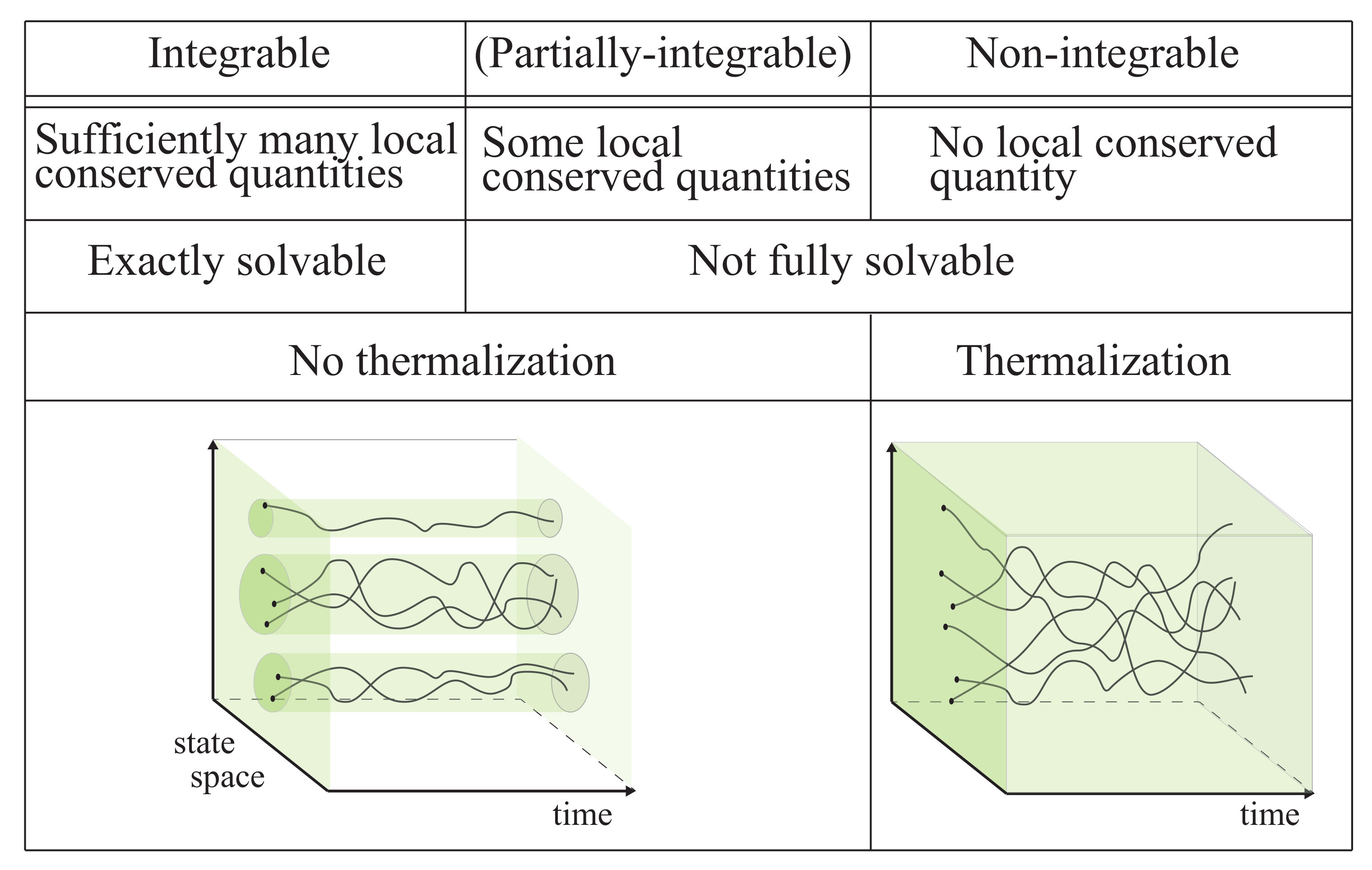 Figure 1
Peer Reviews
No public reviews on file for this paper yet. If you reviewed it on a platform where reviews are public (OpenReview, ICLR, NeurIPS, ICML), you can paste yours below so the community can read it here.
Videos
No videos yet. Explain this paper in a talk, walkthrough, or lecture? Add one.
11institutetext: Department of Physics, Gakushuin University, 1-5-1 Mejiro, Toshima-ku, Tokyo, 171-8588, Japan
Quantum statistical mechanics Spin chain models Heisenberg model
Proof of the absence of local conserved quantities in the XYZ chain with a magnetic field
Naoto Shiraishi
Abstract
We rigorously prove that the spin-1/2 XYZ chain with a magnetic field has no local conserved quantity. Any nontrivial conserved quantity of this model is shown to be a sum of operators supported by contiguous sites with at least half of the entire system. We establish that the absence of local conserved quantity in concrete models is provable in a rigorous form.
pacs:
05.30.-d
pacs:
75.10.Pq
pacs:
75.10.Jm
1 Introduction
Integrable many-body systems have played momentous roles in various research fields, including statistical mechanics [1, 2, 3], strongly-correlated systems [4, 5, 6, 7], quantum computation [8, 9, 10], and high-energy physics [11, 12, 13]. Although there is no established definition of quantum integrability unlike classical integrability [14, 16, 15, 17], for locally-interacting many-body spin systems the integrability is roughly equivalent to the existence of infinitely-many local conserved quantities, which guarantees exact solutions of these systems [2, 3, 18, 19, 20, 21, 22]. The presence or absence of local conserved quantities is relevant to various aspects of many-body systems. For example, systems with local conserved quantities do not thermalize to the standard equilibrium state [23, 24, 25, 26], while systems without local conserved quantities appear to thermalize [27, 28, 17, 29, 30, 31]. Another example is the energy level statistics, which obeys the Poisson distribution in integrable systems and obeys the Wigner-Dyson distribution in chaotic systems [32]. The Bethe ansatz and the quantum inverse scattering method are useful to find out energy eigenstates and many local conserved quantities in integrable systems [2, 33, 22]. Now various integrable models, including the Heisenberg spin-1/2 chain, the XYZ chain, the IRF model, and many other more complicated models, have been discovered, and their classification and characterization have been investigated [34, 35, 36, 16].
Although vast literature is devoted to integrability, very few studies have addressed non-integrability of specific models in spite of its necessity. Here, we used the word non-integrable in the sense that the model has no local conserved quantity. Non-integrability is of course relevant to the research field of chaos and thermalization, but it is also relevant to much more broad research fields. Non-integrability is strongly related to the presence of thermalization, and thus if one wants to avoid anomalous non-thermalizing phenomena, they should ensure the non-integrability of the system in consideration (see also Fig. 1). For instance, a kind of ergodic property is employed in the derivation of the Kubo formula [37, 38, 39], and some integrable systems obey a modified version of the Kubo formula [40]. In many other situations from local equilibration in hydrodynamic description [41] to scrambling in black holes [42, 43, 44, 45], non-integrability of systems in consideration is explicitly or implicitly assumed. Furthermore, transport properties are also affected by the integrability of systems in consideration [46]. These facts confirm that proving non-integrability of concrete models in a rigorous form is relevant to broad research fields. However, as stated above, very few theoretical works have tackled to show the non-integrability of a certain model. A notable exception is Ref. [47], which tries to argue non-integrability of certain specific models by putting some hypotheses. However, this attempt only draws a heuristic road map, and a rigorous proof of non-integrability has been completely elusive. Some researchers even have a pessimistic view that non-integrability of a specific model is out of the scope of analytical approach, and it can only be presumed with numerical simulations.
To break this pessimistic view, in this Letter, we provide the first rigorous proof of the absence of local conserved quantities in a specific model, the one-dimensional XYZ spin systems with a magnetic field. We show that any nontrivial conserved quantity is a sum of operators supported by contiguous sites with at least half of the system, which means non-locality of this conserved quantity. Our strategy is straightforward. We first write down a formal expansion of a candidate of local conserved quantities consisting of products of at most neighboring spin operators, and demonstrate that if it conserves, then all of the coefficients in this expansion must be zero. The case with , which is treated in detail, already contains the essence for general . Our approach to proving non-integrability can extend to other spin systems. This result opens a novel research direction where non-integrability is investigated in a mathematically rigorous form.
2 Setup and main claim
We consider the standard XYZ spin chain with sites under a magnetic field with the periodic boundary condition:
[TABLE]
where , , represents the Pauli matrices , , , and we set all the coupling constants , , nonzero. Since the Hamiltonian is translationally invariant, we can write any conserved quantities in a translationally invariant form (see [48]). We introduce a symbol , which is a sequence of operators starting from the site to the site . The first and the last operators and take one of the Pauli operators (, , or ), and other operators take one of the Pauli operators or the identity operator . Using this symbol, we write a candidate of local conserved quantities as
[TABLE]
with coefficients . The sum of runs over all possible sequences from to . Since the Pauli matrices and the identity span the space of Hermitian matrices, we find that the above form covers all possible translationally invariant quantities. We call an -support operator. For example, there are possible 3-support operators. If one of is nonzero and all with are zero, we call as a -support conserved quantity. For example, the Hamiltonian itself is a 2-support conserved quantity, and the projection operator onto an energy eigenstate is usually an -support conserved quantity. The claim of this Letter is that the spin chain (2) has no -support conserved quantity with as long as and . In other words, all nontrivial conserved quantities are highly nonlocal.
3 Strategy
Take a -support operator in the form (1). We consider the commutator of and :
[TABLE]
which is an at most -support operator because is a -support operator and is a 2-support operator. The conservation of reads for any , which results in a system of linear relations on by comparing both sides of Eq. (2). We shall show that these linear relations do not have nontrivial solutions except that with all zero. To prove this, we narrow the range of possible coefficients which may take nonzero values step by step, and finally ensure that no coefficient can take nonzero value with keeping all relations consistent.
Our proof consists of two steps.
- a.
In the first step, we exploit the condition for all , and show that (i) the coefficients of except those in a specific form are zero, (ii) all the remaining coefficients of are in the linear relation. 2. b.
In the second step, we exploit the condition for all , and show that one of the remaining coefficient of is zero.
Owing to the linear relation shown in a-(ii), this completes the proof of absence of -support conserved quantities.
Since the case with captures the essential idea of the proof for general , in the following we describe the proof for the case with in detail, and then outline the proof for general .
4 Case of : Step 1
We consider a 3-support conserved quantity in this and next section. In the first step, we focus on 4-support operators in . In this letter, if a commutator with an operator and results in another operator , we say that the operator is generated by the commutator with and . In case of , a 4-support operator in is generated by commutators between a 3-support operator in and a 2-support operator in . For example, the 4-support operator in is generated by the following two commutators:
[TABLE]
In case without confusion, we drop the summation of and subscripts for visibility. We express these two relations as
[TABLE]
where the horizontal bar represents a commutator (including the imaginary number ), and the horizontal positions correspond to the positions of spin operators. With noting that the operator in is generated only by the above two commutators, the condition implies
[TABLE]
Notably, some 4-support operators are generated only by a single commutator. An example is , which is generated only by
[TABLE]
This fact directly means
[TABLE]
In addition, by considering commutators
[TABLE]
we have
[TABLE]
In a similar manner, we arrive at the fact that if two of , , are the same. Moreover, we have for any , , which follows from
[TABLE]
and similar relations.
In summary, the analysis of 4-support operators in yields
[TABLE]
and coefficients of other 3-support operators in turn out to be zero.
5 Case of : Step 2
We next focus on 3-support operators in . First, is generated by the following four commutators;
[TABLE]
which reads
[TABLE]
Next, considering
[TABLE]
and
[TABLE]
both of which are generated by three commutators, we further have
[TABLE]
Combining Eqs. (24), (25), and (26) to erase and , along with relations and shown in Eq. (9), we arrive at
[TABLE]
Hence, holds as long as and . Due to Eq. (9), suffices to prove the absence of 3-support conserved quantities in the XYZ chain with a magnetic field.
6 General case: Step 1
We proceed to analyses on -support conserved quantities with general [49]. We shall show that such a does not exist.
In the first step, we focus on -support operators in . To explain our findings, we introduce a useful expression of operators such as
[TABLE]
where takes one of to make its coefficient 1. The symbol , which we call doubling product, represents the exchange interaction of , and the neighboring symbol has its support with single-site shift. The coefficient leads to the rule of the coefficientless product of the Pauli operators: , , . We require that the same symbols cannot be neighboring (e.g., is not allowed). If an operator can be expressed in the above form, we call this operator as doubling-product operator.
We now claim that the condition for all leads to the following two facts:
- (i)
All -support operators in which are not doubling-product have zero coefficients, 2. (ii)
Any two coefficients of doubling-product -support operators in have a linear relation as Eq. (9).
In case of , there are six 3-support operators which are doubling-product; , , , , , , and they are the six operators appearing in Eq. (9). The aforementioned claims ares their generalization.
The latter fact (ii) is ensured as follows: Take the case of () as an example. Two commutators
[TABLE]
imply that and have a linear relation. The reason why and have a relation is that becomes by adding from right and removing the leftmost . In general, if an operator is obtained from another operator by removing the leftmost (rightmost) doubling operator and adding a doubling operator from right (left), then the coefficients of these two operators have a linear relation. This observation directly leads to the latter fact (ii).
The former fact (i) is ensured in a similar line to above. If an operator is not doubling-product, this operator has at least one inconsistency in the doubling-product representation. Consider as an example. By removing the leftmost and adding from right as in the above paragraph, the obtained operator obviously has zero coefficient for the same reason as Eq. (6). In a similar manner to above, all non-doubling-product operator can be shown to be zero.
7 General case: Step 2
From the facts (i) and (ii), it suffices to prove one of the coefficient of a doubling-product -support operators in zero, which is accomplished by considering -support operators in . Similar to the case with , a -support operator in is generally generated by four commutators; two commutators between a -support operator in and a magnetic field in , and two commutators between a -support operator in and the exchange interaction in . For example, is generated by the following four commutators:
[TABLE]
However, in some cases, a -support operator in is generated only by three commutators. This happens when the two leftmost or rightmost operators of the -support operator are the same, which we have already seen in case with (Eqs. (25) and (26)).
To describe commutators as above in the doubling-product representation, we introduce some symbols. First, we introduce a symbol “”, which represents a commutator with at this position. For example, represents the commutator . Here, the magnetic field settles at the site because and the overlap of and , which is referred by the upward arrow, is at the site . Using this symbol, the two commutators in (43) are expressed as
[TABLE]
Next, we introduce a symbol “”, which represents multiplication of at this position with setting coefficient 1. Examples are and . We note that the expression with is not unique (e.g., ). We finally introduce two symbols “” and “”, which mean commutators with the exchange interaction in at the rightmost and leftmost site, respectively. Then, the two commutators in (50) are expressed as
[TABLE]
We now construct a sequence of sets of commutators for even , which is presented in the next page. (In case of odd , we replace in the sequence to . The cases of and are treated separately in a similar manner [50].).
{widetext}
[TABLE]
Here, is the abbreviation of the alternation of and . Each horizontal row of the sequence consists of three or four commutators generating the same -support operator in , which yields a relation of coefficients. For example, the first and second rows yield
[TABLE]
Remarkably, any -support operators in this sequence appears twice [51]. By summing up corresponding relations with multiplying proper coefficients to cancel all the coefficients of -support operators and using the linear relation for doubling-product operators obtained in the previous section, we arrive at
[TABLE]
This directly implies that all the coefficients of -support operators are zero as long as and .
8 Discussion
We have rigorously shown that there is no -support conserved quantity in the XYZ chain with a magnetic field for . This result breaks the widespread pessimistic belief that non-integrability is out of the scope of analytical investigation and is only presumed with numerical supports. Now a novel research direction to proving non-integrability in concrete many-body systems has opened. The proposed techniques and ideas extend to other one-dimensional spin-1/2 systems such as those with next-nearest interaction, including the Majumdar-Ghosh model [52] and the Shastry-Sutherland model [53]. The extension to spin-1 systems such as the AKLT model [55] looks not straightforward since the rule of the product of spin-1 operators is more complicated than the case of spin-1/2. Extensions to frustration-free systems as explained above is especially important because recent studies have revealed that some frustration-free or frustration-free-like systems [56, 57, 58, 59, 60] have solvable nonthermal excited states in spite of its nonintegrability. To highlight their significance, the proof of the non-integrability of these models is desirable.
Another challenging extension is to quasi-local conserved quantities [61], whose importance has recently been discovered in some translationally invariant integrable systems, the Heisenberg chain and the XXZ chain [62, 63, 64, 65, 66, 67]. Although the presence of quasi-local conserved quantities without local ones seems to be unlikely, our proof does not exclude the possibility of the presence of quasi-local ones in a rigorous sense. Since we have not yet fully understood the nature of quasi-local conserved quantities, the investigation for the absence of quasi-local conserved quantity is, unfortunately, out of reach at present. After arriving at the full understanding, the extension to quasi-local conserved quantities will merit future investigation.
In closing this article, we comment on the relation to some previous results on integrable systems. The local conserved quantities of the XYZ chain without a magnetic field has been obtained through the quantum inverse scattering method, and the explicit form of these local conserved quantities are calculated in Refs. [20, 21]. These local conserved quantities indeed satisfies the obtained relation (9) and its generalizations for general . The quantum inverse scattering method provides a systematic way to construct local quantities consistent with the commutative condition with the Hamiltonian. Algebraic structures including the Hopf algebra and the Virasoro algebra lie behind this construction [1]. Our result employs a complementary approach to this, where we demonstrate that no local quantity is consistent with the commutative condition with a certain class of Hamiltonian. This fact, the absence of local conserved quantities, may also have algebraic characterizations, which will shed light on the general principle for presence and absence of local conserved quantities.
Acknowledgement.— The author is grateful to Atsuo Kuniba for fruitful discussion. The author thanks Sriram Shastry and Fabian Essler for informing some related works. The author also thanks Hosho Katsura, Chihiro Matsui, Takashi Mori, Tomoyuki Obuchi, Akira Shimizu and Hal Tasaki for helpful comments. This work was supported by Grant-in-Aid for JSPS Fellows JP17J00393.
The reference list from the paper itself. Each links out to its DOI / PubMed record.
- 1[1] M. Jimbo and T. Miwa, Algebraic Analysis of Solvable Lattice Models . Amer Mathematical Society (1995).
- 2[2] R. J. Baxter, Exactly Solved Models in Statistical Mechanics . Dover (2008).
- 3[3] M. Takahashi, Thermodynamics of One-Dimensional Solvable Models . Cambridge University Press (2005).
- 4[4] Elliott H. Lieb and F. Y. Wu, Absence of Mott Transition in an Exact Solution of the Short-Range, One-Band Model in One Dimension . Phys. Rev. Lett. 20 , 1445 (1968).
- 5[5] N. Andrei, Diagonalization of the Kondo Hamiltonian . Phys. Rev. Lett. 45 , 379 (1980).
- 6[6] P. B. Wiegmann, Exact solution of the s-d exchange model (Kondo problem) . J. Phys. C: Solid State Phys. 14 , 1463 (1981).
- 7[7] H. Katsura and I. Maruyama, Derivation of the matrix product ansatz for the Heisenberg chain from the algebraic Bethe ansatz . J. Phys. A: Math. Theor. 43 , 175003 (2010).
- 8[8] L. G. Valiant, Quantum Circuits That Can Be Simulated Classically in Polynomial Time . SIAM J. Comput., 31 , 1229 (2002).