Connection between zero-energy Yu-Shiba-Rusinov states and 0-$\pi$ transitions in magnetic Josephson junctions
Andreas Costa, Jaroslav Fabian, Denis Kochan

TL;DR
This paper investigates the relationship between zero-energy Yu-Shiba-Rusinov states and 0-$ ext{pi}$ transitions in ballistic superconductor/ferromagnetic insulator/superconductor Josephson junctions, revealing their spectral features and robustness.
Contribution
It uncovers the connection between zero-energy YSR states and quantum phase transitions in magnetic Josephson junctions, including effects of spin-orbit coupling.
Findings
Zero-energy YSR states are more robust than Andreev states against scalar tunneling.
Zero-energy YSR states indicate a transition from 0 to $ ext{pi}$ phase in the junction.
The phase transition correlates with a reversal of Josephson current flow.
Abstract
We study the bound state spectrum and 0- transitions in ballistic quasi-1D superconductor/ferromagnetic insulator/superconductor (S/FI/S) Josephson junctions. In addition to the Andreev bound states, stemming from the phase coherence, the magnetic barrier gives rise to qualitatively different Yu-Shiba-Rusinov (YSR) bound states with genuine spectral features and spin characteristics. We show that zero-energy YSR states are much more robust against scalar tunneling than their Andreev counterparts and also fingerprint a quantum phase transition from the junctions' 0 into the phase, connected to a measurable reversal of the Josephson current flow; this coincidence persists also in the presence of Rashba spin-orbit coupling.
Click any figure to enlarge with its caption.
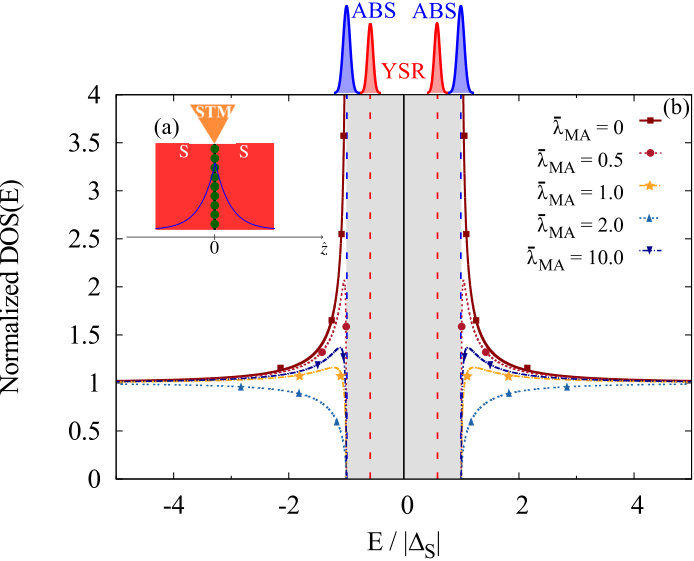 Figure 1
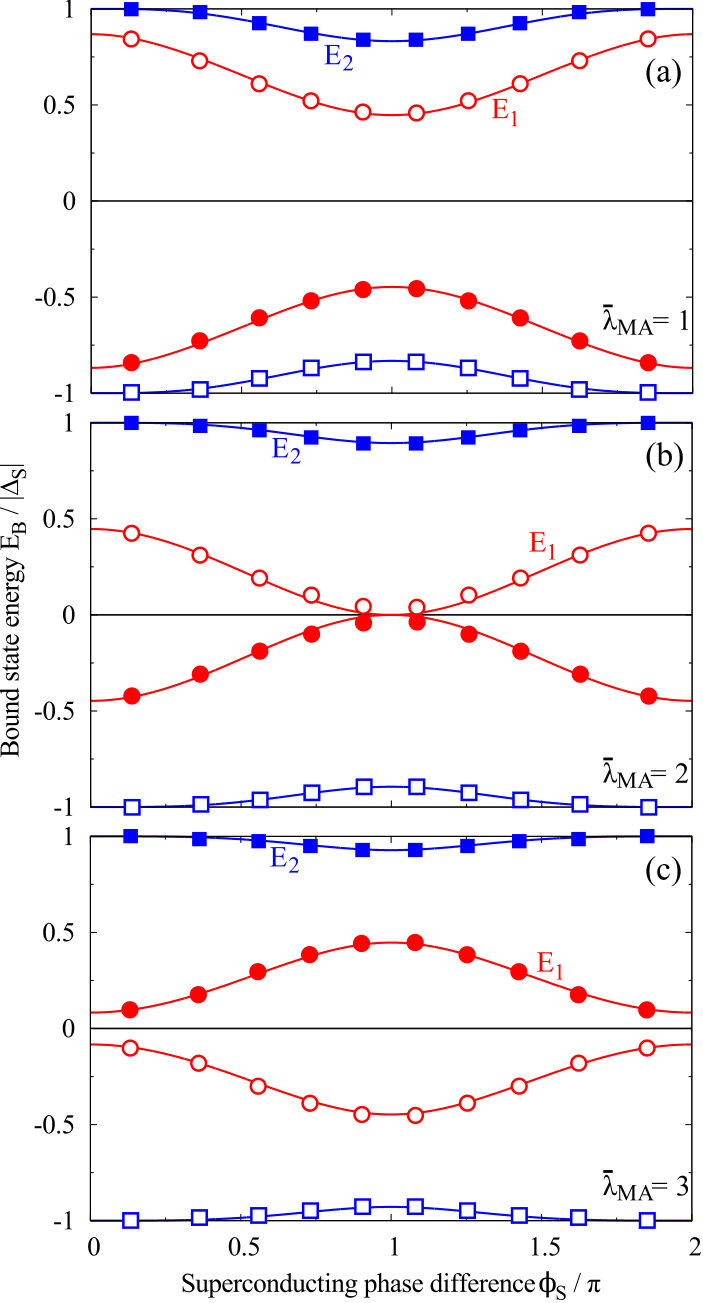 Figure 2
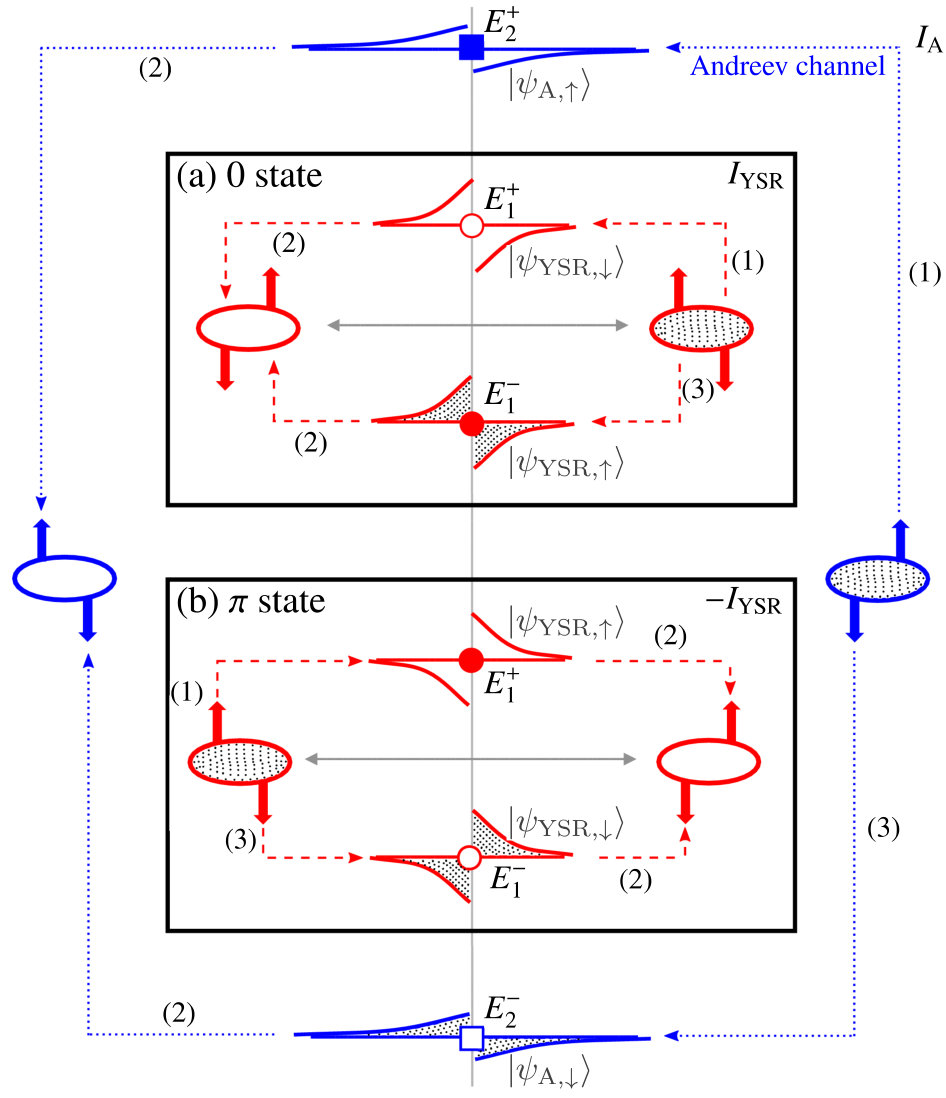 Figure 3
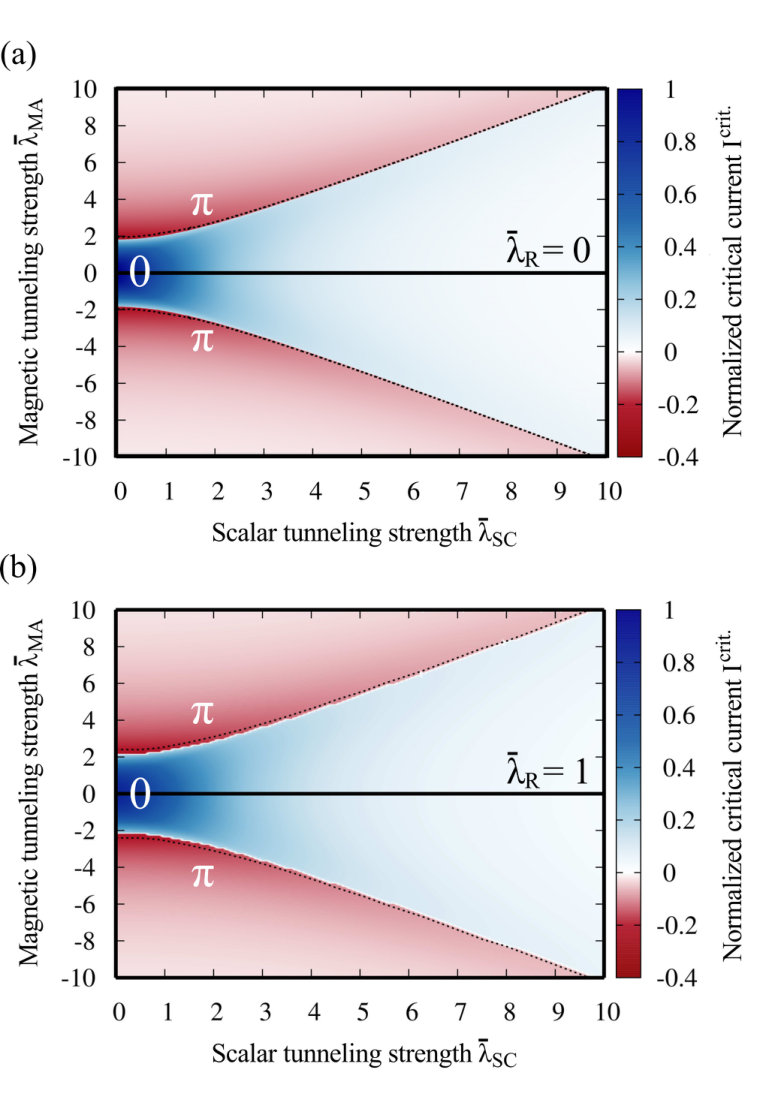 Figure 4
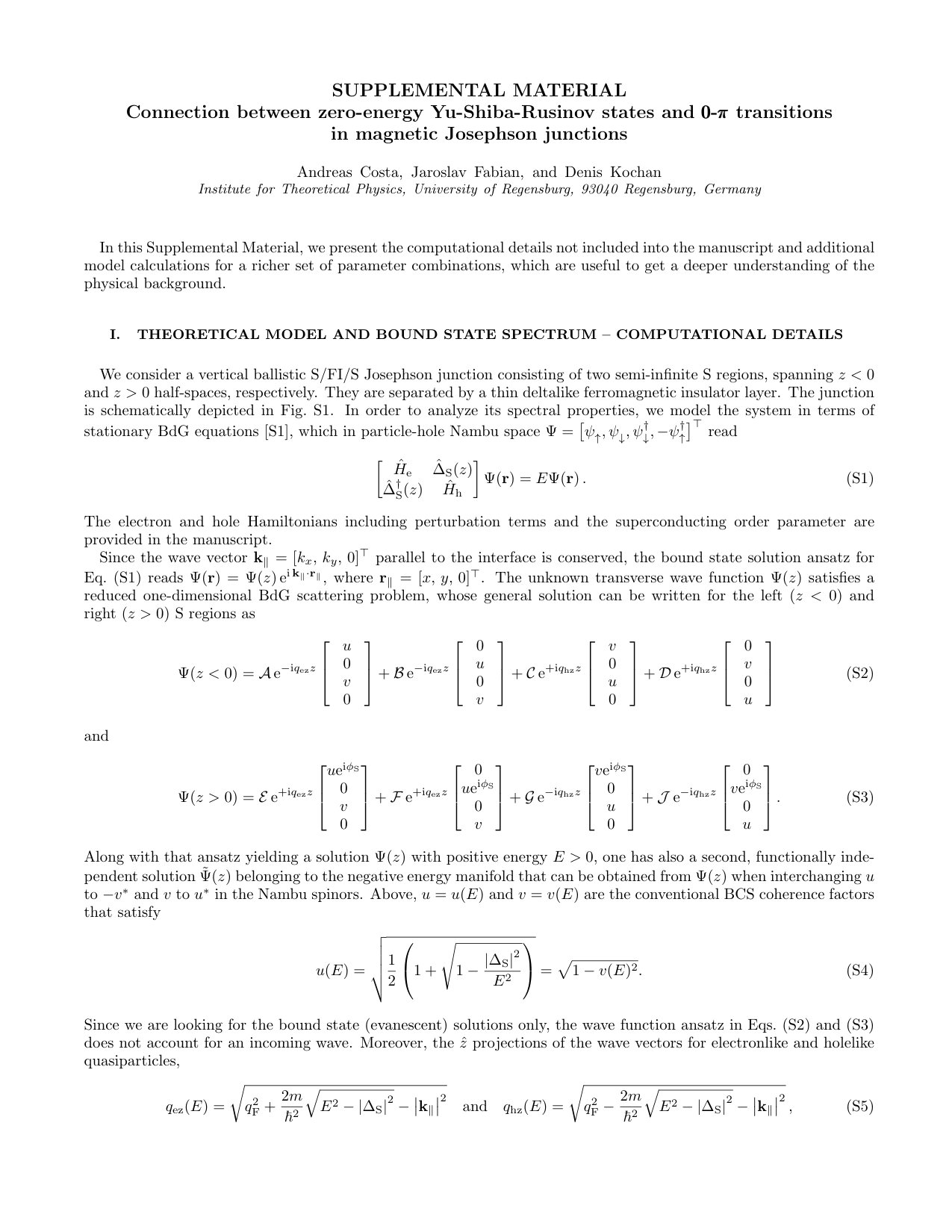 Figure 5
Peer Reviews
No public reviews on file for this paper yet. If you reviewed it on a platform where reviews are public (OpenReview, ICLR, NeurIPS, ICML), you can paste yours below so the community can read it here.
Videos
No videos yet. Explain this paper in a talk, walkthrough, or lecture? Add one.
Connection between zero-energy Yu-Shiba-Rusinov states and - transitions in magnetic Josephson junctions
Andreas Costa
Institute for Theoretical Physics, University of Regensburg, 93040 Regensburg, Germany
Jaroslav Fabian
Institute for Theoretical Physics, University of Regensburg, 93040 Regensburg, Germany
Denis Kochan
Institute for Theoretical Physics, University of Regensburg, 93040 Regensburg, Germany
(March 3, 2024)
Abstract
We study theoretically the bound state spectrum and [math]- transitions in ballistic quasi-one-dimensional superconductor/ferromagnetic insulator/superconductor Josephson junctions. In addition to the Andreev bound states, stemming from the phase coherence, the magnetic barrier gives rise to qualitatively different Yu-Shiba-Rusinov (YSR) bound states with genuine spectral features and spin characteristics. We show that zero-energy YSR states are much more robust against the presence of scalar tunneling than their Andreev counterparts and also fingerprint a quantum phase transition from the junctions’ [math] into the phase, connected to a measurable reversal of the Josephson current; this evidence persists also in the presence of Rashba spin-orbit coupling.
I Introduction
Since its discovery, superconductivity evolved into a most influential area in fundamental science and technology. While the exchange interaction in metals favors parallel spins Stoner (1939), the -wave pairing in superconductors promotes the formation of Cooper pairs with antiparallel spin alignments Bardeen et al. (1957a, b). The competition of those two antagonistic interactions within one system leads to interesting physical phenomena Eschrig (2011); Linder and Robinson (2015); Gingrich et al. (2016). Prominent examples are S/F/S Josephson junctions Bulaevskii et al. (1977a); *Bulaevskii1977alt; Buzdin et al. (1982a); *Buzdin1982alt; Andreev et al. (1991); Demler et al. (1997); Golubov et al. (2004); Buzdin (2005); Bergeret et al. (2005); Annunziata et al. (2011); Costa et al. (2017), in which a leakage of Cooper pairs from the superconducting (S) electrodes introduces a nontrivial pairing in the proximitized ferromagnet (F). In response to the spin-selective exchange splitting in the F, the induced order parameter oscillates with a characteristic spatial length Andreev et al. (1991); Demler et al. (1997); depending on the thickness of the F, the phase difference between the two S electrodes can accumulate an intrinsic shift. That is responsible for the reversal of the Josephson current direction in such a state junction regime as compared to its (usual) [math] state counterpart.
Another realization of Josephson junctions relies on the coupling of S electrodes via interacting quantum dots (QDs). Several theoretical works Glazman and Matveev (1989a); *Glazman1989alt; Clerk and Ambegaokar (2000); Vecino et al. (2003); Choi et al. (2004); Siano and Egger (2004); *Siano2004alt; Bauer et al. (2007); Karrasch et al. (2008); Meng et al. (2009); Luitz and Assaad (2010); Martín-Rodero and Yeyati (2011); Luitz et al. (2012); Kiršanskas et al. (2015) showed that the junction regimes can be controlled by the strength of the lead-QD coupling and the QD charging energy. Experimental observations of [math]- transitions in S/F/S Ryazanov et al. (2001); Kontos et al. (2002); Robinson et al. (2006); Feofanov et al. (2010) and S/QD/S Buitelaar et al. (2002); Jørgensen et al. (2007); Eichler et al. (2009); Deacon et al. (2010); Pillet et al. (2010); Franke et al. (2011); Lee et al. (2012); Maurand et al. (2012a); *Maurand2012alt; Chang et al. (2013); Kim et al. (2013); Pillet et al. (2013); Kumar et al. (2014); Lee et al. (2014); Delagrange et al. (2015); Gingrich et al. (2016); Assouline et al. (2017); Li et al. (2017); van Woerkom et al. (2017) Josephson junctions boosted hopes for their engineering and designed technological applications, counting qubits Yamashita et al. (2005), quantum computing Ioffe et al. (1999); Mooij et al. (1999); Devoret and Schoelkopf (2013), and spintronics Eschrig (2011); Žutić et al. (2004); Fabian et al. (2007).
An unambiguous spectroscopic fingerprint of Josephson junctions is the formation of subgap Andreev bound states (ABSs) Andreev (1964a); *Andreev1964alt; Andreev (1966a); *Andreev1966alt, which have been studied in single Lee et al. (2014); Delagrange et al. (2015); Li et al. (2017); van Woerkom et al. (2017) and double Su et al. (2017) QD-coupled Josephson junctions. In the latter case, the ABSs hybridized to novel Andreev molecular states, which can eventually launch a platform for realizing Majorana physics Fu and Kane (2008); Oreg et al. (2010); Duckheim and Brouwer (2011); Mourik et al. (2012); Rokhinson et al. (2012); Nadj-Perge et al. (2014). However, understanding the spectral features of Josephson junctions in magnetic systems becomes more intricate since the magnetism breaks Cooper pairs and allows a creation of additional subgap bound states, commonly known as Yu-Shiba-Rusinov (YSR) states Yu (1965); Shiba (1968); Shiba and Soda (1969); Rusinov (1968); *Rusinov1968alt. YSR states have been intensively studied in various systems, e.g., in S substrates hosting magnetic adatoms Satori et al. (1992); Simonin and Allub (1995); Salkola et al. (1997); Balatsky et al. (2006); Tsai et al. (2009); Ruby et al. (2016); Kaladzhyan et al. (2017); Körber et al. (2018) or nanowires connecting normal/superconductor junctions Žitko et al. (2015); Jellinggaard et al. (2016).
In this paper, we investigate the subgap bound states in ballistic S/FI/S Josephson junctions with ultrathin barriers containing ferromagnetic insulators (FIs). The subgap states possess unique spectral Vecino et al. (2003); Kawabata et al. (2012) and spin characteristics that are tunable by tunneling strengths or the S phase difference. Moreover, magnetic tunneling causes an interesting interplay between ABSs and YSR states, modifying, for example, the quasiparticle density of states (DOS) Kiršanskas et al. (2015); Lee et al. (2012). We pay special attention to zero-energy YSR states which can signal topological superconductivity Sau and Demler (2013); Pientka et al. (2015); Hatter et al. (2015) and ground state phase transitions Sakurai (1970). We clearly distinguish the [math] and phases of the ballistic S/FI/S Josephson junctions Andersen et al. (2006); Kawabata et al. (2010, 2012) and unravel the [math]- transition mechanism on the microscopic level: the reversal of the tunneling of Cooper pairs in the YSR channel near zero energy stems from the ground state phase transition. Therefore, besides the two conventional mechanisms explaining [math]- transitions—(1) proximity-induced effects in S/F/S and (2) the interplay between the Fermi statistics and strong correlations in S/QD/S junctions—we concentrate on the third one: pair tunneling via the spectrally distinct YSR states at the interface of the magnetic FI barrier. To demonstrate the universality and the robustness of our mechanism, we also investigate [math]- transitions in S/FI/S Josephson junctions in the presence of Rashba spin-orbit coupling (SOC) Bychkov and Rashba (1984); Fabian et al. (2007) in the S leads, eventually showing the same qualitative behavior. Our findings offer a comprehensive understanding of [math]- transitions in Josephson junctions.
The paper is organized in the following way. In Sec. II, we introduce our theoretical model and study the bound state spectra for some important limiting cases. Section III briefly comments on the states’ impact on the quasiparticle DOS. The main part of the paper is the analysis of the connection between the bound state spectrum and the Josephson current reversing [math]- transitions, which can be found in Secs. IV–VI.
II Theoretical model and bound state spectrum
We consider a vertical ballistic S/FI/S Josephson junction, consisting of two semi-infinite S regions that are separated by a thin deltalike tunnel barrier, simulating scalar and magnetic tunneling; see Fig. 1(a).
To analyze its spectral properties, we model the junction in terms of the stationary Bogoljubov–de Gennes Hamiltonian De Gennes (1989),
[TABLE]
Here, represents the single-electron Hamiltonian and its hole counterpart. Scalar and magnetic tunneling at the interface are modeled by deltalike potentials de Jong and Beenakker (1995); Žutić and Valls (1999, 2000) with effective coupling strengths and , respectively, while accounts for Rashba SOC in the right lead, realized by a semiconducting electrode with proximity-induced superconductivity Zhi-Hong et al. (2012). Spin matrices and stand for the two-by-two identity and the th Pauli matrix. For the sake of simplicity, we assume a symmetric S/FI/S junction with equal quasiparticle masses , the same chemical potential , and the transverse -dependent S order parameter , where is the phase difference.
The general procedure for finding the eigencharacteristics of the Hamiltonian , given by Eq. (1), is outlined in the Supplemental Material (SM) 111See attached Supplemental Material, including Refs. De Gennes (1989); McMillan (1968); Beenakker (1991); Golubov et al. (2004); Oreg et al. (2010); Duckheim and Brouwer (2011); Mourik et al. (2012); Rokhinson et al. (2012); Nadj-Perge et al. (2014); Fu and Kane (2008); Yu (1965); Shiba (1968); Rusinov (1968); *Rusinov1968alt; Costa et al. (2017); Carbotte (1990); Andreev et al. (1991); Demler et al. (1997); Fulde and Ferrell (1964); Larkin and Ovchinnikov (1964); *Larkin1964alt; Ryazanov et al. (2001); Brinkman and Golubov (2000); Kawabata et al. (2010), for more details.. In what follows, we focus on quasi-one-dimensional (quasi-1D) junctions for which the thickness in the transverse and directions is much shorter than in the longitudinal direction (higher-dimensional junctions bring no new features; see SM Note (1)). The particle-hole symmetric subgap eigenspectrum () in the absence of SOC reads
[TABLE]
where and represent effective tunneling strengths with respect to the Fermi level (chemical potential ); stands for the corresponding Fermi momentum.
Let us briefly examine the main spectral characteristics of such Josephson junctions. Taking , we recover the Andreev limit Beenakker (1991); Golubov et al. (2004),
[TABLE]
Letting and , the spectrum complementary yields the celebrated YSR states Yu (1965); Shiba (1968); Rusinov (1968); *Rusinov1968alt
[TABLE]
and two remaining states at , which coincide with the ABS at ; see Eq. (3). For that reason, we will refer to as the YSR and to as the Andreev branch.
Figure 2 shows a generic spin-resolved spectrum as a function of for various . Generally, the Andreev branch is always closer to the gap edges than the YSR branch, serving as a spectroscopic fingerprint for distinguishing those states. While the Andreev states, given by Eq. (3), cross zero energy only for a transparent interface and phase differences Beenakker (1991), Eq. (2) suggests that additional magnetic tunneling supports zero-energy YSR states in a wide range of parameters. Analyzing Eq. (2), one sees that for , there always exists a for which the YSR branch crosses zero energy; see Fig. 2. The corresponding comes as a solution of
[TABLE]
III Modulation of quasiparticle DOS
The subgap states strongly impact the quasiparticle DOS. Figure 1(b) shows the DOS for and different ’s at zero phase difference (for methodology, see SM Note (1)). Without magnetic tunneling, the spectrum only consists of ABS and the quasiparticle spectrum shows the standard BCS-like DOS. Gradually growing , the spectrum also contains YSR states that move to the gap center. As a consequence, a part of spectral weight is taken into the gap and the quasiparticle coherence peaks modify. A similar peak structure was identified in quantum-dot experiments Kumar et al. (2014); Li et al. (2017). Raising , the quasiparticle spectral peaks become unprecedentedly suppressed and disappear when the YSR states cross zero energy. A further increase of shifts the bound states back towards the gap edges and, simultaneously, the quasiparticle DOS rises again.
IV Qualitative analysis—ground state phase transition
We see from Fig. 2 that the ABSs do not change spins with evolving , whereas the YSR states effectively ‘flip’ spins when crossing zero energy. The states’ spin ordering reflects important ground state properties, which we briefly discuss. Without the deltalike terms in and , absent SOC, and for , the BdG Hamiltonian , given by Eq. (1), can be easily diagonalized. Denoting by () the creation (annihilation) operators for the BdG eigenmodes with positive energies and by () the corresponding operators for negative energies, the BCS ground state is a Slater product over the occupied and unoccupied eigenmodes,
[TABLE]
where represents the Fermi vacuum.
What happens to when adding a deltalike exchange interaction, parameterized by ? For simplicity, let us start with zero and . Assuming a small positive , spin up states have higher energy than their spin down counterparts. This means that initially degenerate quasiparticle eigenmodes spin split and form spatially (quasi)localized impurity subgap states. Anticipating the results of Eq. (2) for and , we denote the localized states with positive energies as and , and states with negative energies as and ; see Fig. 3. Generally, the states and are shifted more towards the center of the gap than and for , and hence become spatially more localized around the impurity. With a further increase of , the energy of continuously lowers, while that of rises. Before reaching the critical value ( is the BCS coherence length), remains unoccupied and occupied; see Fig. 3(a). Denoting the corresponding creation (annihilation) operators for and by () and (), respectively, we expect the ground state below to be in the form
[TABLE]
The tilde operators have the same meaning as before—quasiparticle eigenmodes (now perturbed) with energies above and below the gap 222Since momentum is not a good quantum number, we rather use a general index that labels perturbed eigenmodes above and below the S gap.. Increasing over the critical , the energy of becomes smaller than that of and, therefore, the relative occupations of both states interchange; see Fig. 3(b). The ground state wave function above is now expected to be
[TABLE]
The former ground state has a modified spin content inside the gap when compared to , so both are in distinct quantum states, which we correspondingly call the [math] and phases. Turning on and , the bound state energies evolve in a complex way—see Eq. (2) for and —nevertheless, crossings at zero energy again indicate changes in the spin ordering of the ground states. Thus, reversals of the Josephson current at [math]- transitions in ballistic S/FI/S Josephson junctions are interpreted in terms of a change of the ground state spin order.
V 0- transitions in Josephson current
Knowing the phase dependence of the bound state spectrum, we can obtain the Josephson current Kulik (1969); *Kulik1969alt ; stands for the (positive) elementary charge and is Boltzmann’s constant. From the experimental point of view, it is common to measure the critical Josephson current and the corresponding critical S phase . By tuning to its critical value and performing scanning tunneling spectroscopy/scanning tunneling microscopy (STS/STM) in the vicinity of the interface, one could explore the spectral properties of the subgap states. Figure 4(a) displays the dependence of on the tunneling strengths. For each , one finds a at which the Josephson current’s direction reverses, indicating transitions from [math] to regimes. The maximal current in the [math] state is twice as large as in the state; moreover, as expected, the [math]- transition lines coincide with the contours signifying the formation of zero-energy YSR states. In Fig. 4(b), we show similar, fully numerical calculations in the presence of moderate Rashba SOC in the right electrode. Modulating the Rashba SOC by electrical gating Nitta et al. (1997); Koga et al. (2002) can efficiently tune [math]- transitions. Nevertheless, there is still a clear coincidence between the [math]- transition lines and the zero-energy YSR states, although SOC inevitably introduces an intrinsic shift to the current-phase relation. This causes slight deviations at weak tunnelings.
VI Zero-energy YSR states & reversal of Josephson current
To connect the zero-energy YSR states with the reversal of the Josephson current, one needs the bound state wave functions. The full calculation is rather technical; see SM Note (1). Here, we qualitatively illustrate the main mechanism. Figure 3 schematically shows the Andreev (blue dotted lines) and YSR (red dashed lines) channels, transporting Cooper pairs across the barrier. To understand the transport direction of one Cooper pair, we split each occupied and unoccupied bound state into its electronlike and holelike component and read out the corresponding electron-hole density difference. This is qualitatively illustrated by the sketched evanescent tails in Fig. 3 for the corresponding and states; upward (downward) tails indicate electron (hole) dominance. For the ABS, there is always an electronlike excess in the left and a holelike excess in the right S. This means that the electrons forming a Cooper pair are transferred via the Andreev channel from the right into the left superconductor by the individual steps (1)–(3). In (1), a spin up electron tunnels to an empty state at positive energy . In (2), this electron pairs with a spin down electron residing in the occupied state at energy , creating a spin-singlet Cooper pair in the left superconductor; finally, the remaining electron from the initial Cooper pair fills the vacant state at . The situation for the YSR channel is different. In the [math] state, shown by Fig. 3(a), the YSR states also show electronlike excess on the left side and holelike excess on the right side of the barrier. Hence, the previous mechanism still holds and Cooper pairs are also transferred from right to left. In total, both current contributions add together, . Contrarily, in the phase, the spin-resolved electron and hole content of the YSR states spatially change and, therefore, the YSR states now drive Cooper pairs from left to right, i.e., against the direction of the Andreev channel. The total current is then . Since the transition probabilities of the activation step (1) are proportional to and , the YSR contribution is generally dominant and therefore, a reversal of also reverses the total Josephson current. This qualitative explanation is fully consistent with our presented calculations.
VII Summary
We analyzed spectral and transport characteristics associated with Andreev and YSR states in magnetic Josephson junctions in terms of experimentally tunable parameters and showed that certain combinations of these parameters lead to zero-energy YSR states. Such states serve as a clear fingerprint of quantum phase transitions in the junctions’ ground state. Particularly, we demonstrated that this phase transition coincides with the Josephson current reversing [math]- transitions. This coincidence between zero-energy YSR states and [math]- transitions persists also in the presence of Rashba SOC in one electrode.
Acknowledgements.
This work was supported by DFG SFB Grant No. 689 and DFG SFB Grant No. 1277 (B07). This project has received funding from the European Union’s Horizon 2020 research and innovation programme under Grant Agreement No. 696656 and the International Doctorate Program Topological Insulators of the Elite Network of Bavaria.
The reference list from the paper itself. Each links out to its DOI / PubMed record.
- 1Stoner (1939) E. C. Stoner, Proc. R. Soc. London A: Math. Phys. Engineer. Sci. 169 , 339 (1939) . · doi ↗
- 2Bardeen et al. (1957 a) J. Bardeen, L. N. Cooper, and J. R. Schrieffer, Phys. Rev. 106 , 162 (1957 a) . · doi ↗
- 3Bardeen et al. (1957 b) J. Bardeen, L. N. Cooper, and J. R. Schrieffer, Phys. Rev. 108 , 1175 (1957 b) . · doi ↗
- 4Eschrig (2011) M. Eschrig, Phys. Today 64 , 43 (2011) .
- 5Linder and Robinson (2015) J. Linder and J. W. A. Robinson, Nature Phys. 11 , 307 (2015) .
- 6Gingrich et al. (2016) E. C. Gingrich, B. M. Niedzielski, J. A. Glick, Y. Wang, D. L. Miller, R. Loloee, W. P. Pratt Jr, and N. O. Birge, Nat. Phys. 12 , 564 (2016) . · doi ↗
- 7Bulaevskii et al. (1977 a) L. N. Bulaevskii, V. V. Kuzii, and A. A. Sobyanin, Pis’ma Zh. Eksp. Teor. Fiz. 25 , 314 (1977 a).
- 8Bulaevskii et al. (1977 b) L. N. Bulaevskii, V. V. Kuzii, and A. A. Sobyanin, JETP Lett. 25 , 290 (1977 b) .