New Proofs of Triangle Inequalities
Norihiro Someyama, Mark Lyndon Adamas Borongan

TL;DR
This paper introduces three novel proofs of the triangle inequality in Euclidean Geometry, utilizing circles and ellipses instead of traditional triangle properties, aiming for simplicity.
Contribution
It provides new proofs of the triangle inequality based on circle and ellipse properties, diverging from the conventional triangle-based proofs.
Findings
Three new proofs of the triangle inequality are presented.
The proofs avoid using traditional triangle properties.
The methods involve circle and ellipse properties.
Abstract
We give three new proofs of the triangle inequality in Euclidean Geometry. There seems to be only one known proof at the moment. It is due to properties of triangles, but our proofs are due to circles or ellipses. We aim to prove the triangle inequality as simple as possible without using properties of triangles.
Click any figure to enlarge with its caption.
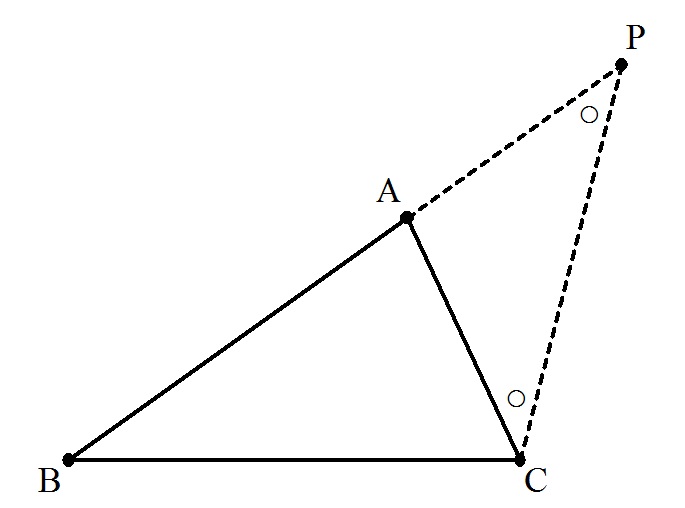 Figure 1
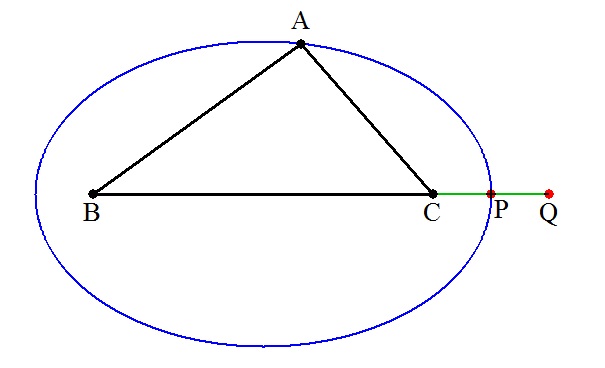 Figure 2
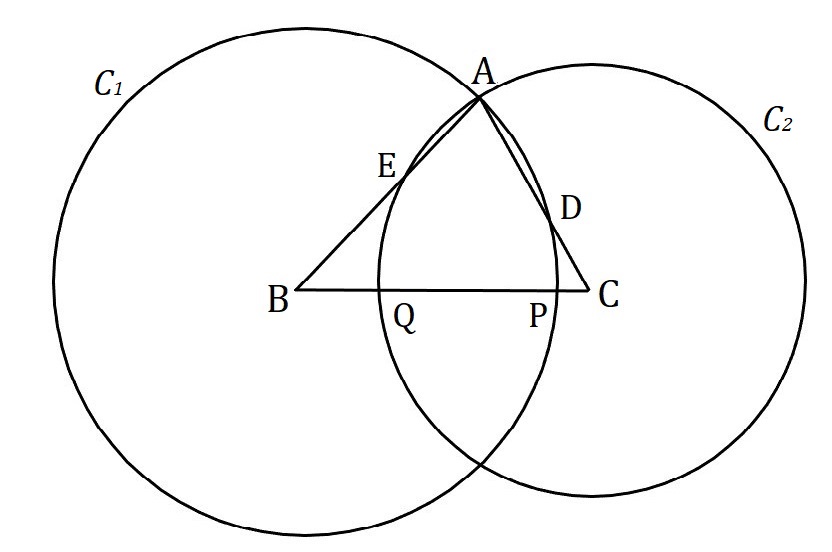 Figure 3
Peer Reviews
No public reviews on file for this paper yet. If you reviewed it on a platform where reviews are public (OpenReview, ICLR, NeurIPS, ICML), you can paste yours below so the community can read it here.
Videos
No videos yet. Explain this paper in a talk, walkthrough, or lecture? Add one.
Taxonomy
TopicsMathematics and Applications · Robotic Mechanisms and Dynamics · History and Theory of Mathematics
New Proofs of Triangle Inequalities
Norihiro Someyama111Shin-yo-ji Temple, 5-44-4 Minamisenju, Arakawa-ku, Tokyo 116-0003 Japan / e-mail: [email protected] Mark Lyndon Adamas Borongan222Mathematics Department, Silliman University, 1 Hibbard Avenue, Dumaguete City, Negros Oriental, 6200 Philippines / e-mail: [email protected]
Abstract
We give three new proofs of the triangle inequality in Euclidean Geometry. There seems to be only one known proof at the moment. It is due to properties of triangles, but our proofs are due to circles or ellipses. We aim to prove the triangle inequality as simple as possible without using properties of triangles.
**Keywords and Phrases: triangle inequality, circle, ellipse, focci of ellipse **
1 Introduction
We consider triangle inequalities for triangles in Euclidean space. For convenience, let the dimension of the space be . We write for the triangle with three vertices . Hereafter, denotes the segment from a point to a point , and the angle made by segments . Moreover, stands for the length of the segment in .
The triangle inequality asserts that the sum of any two sides of a triangle is strictly bigger than the remaining third side. This geometric inequality is well known as one of the most fundamental and classical theorems in Euclidean geometry:
Theorem 1.1** **(Triangle Inequalities).
For any triangle , an inequality
[TABLE]
holds (regardless of the dimension of the space).
This was probably proved by the ancient Greeks for the first time, but the proof is still considered important. See Subsection 1.1 for details of ‘the first proof’. However, we want to give new and more natural proofs in this article. Furthermore, it is also well known that we can prove the triangle inequality in the broad sence, i.e. the ‘’-version of (1.1), by algebraic argument. It is not exactly the triangle inequality in the sense of Euclidean geometry, because the point is on the segment in case . For details of them, Subsection 1.2 (in particular Remark 1.3) will mention.
Throughout this article, we always assume the following:
Assumption 1.1**.**
is the longest side among three sides of . That is,
[TABLE]
1.1 The best known Proof by Euclidean Geometrical Method
We consider a triangle with Assumption 1.1 and plot a point , obeying
[TABLE]
on an extension of the segment . (See Figure 1.) Then,
[TABLE]
Hence, satisfies
[TABLE]
from (1.3) and (1.4). This completes the proof.
Remark 1.1**.**
The above proof also applies to obtuse angled triangles, but there is another short proof for obtuse angled triangles. In fact, if is the maximum angle,
[TABLE]
holds, so we obviously gain (1.1).
1.2 Proofs of Algebraic Triangle Inequalities
The names ‘triangle inequalities’ often appear in some fields such as linear algebra and functional analysis. These ‘triangle inequalities’ are able to argue by algebraic method.
1.2.1 Triangle Inequalities for Absolute Values of Vectors
We consider three vectors
[TABLE]
Then, since , it is sufficient to prove
[TABLE]
so as to obtain (1.1), where is an Euclidean norm:
[TABLE]
Note that, of course, . To see (1.5), we consider the following equation:
[TABLE]
where ‘’ is the inner product. The inner product defines by
[TABLE]
where . Thus,
[TABLE]
since . Hence, (1.5) is proved from (1.6) and (1.7).
Remark 1.2**.**
It follows in more general that
[TABLE]
Let us call this the algebraic triangle inequality. To see (1.8), we consider (1.6) and the Cauchy-Schwarz-Bunyakovsky’s inequality
[TABLE]
They immediately derive (1.8).
1.2.2 Algebraic Triangle Inequalities for Complex Numbers
(1.5) can be shown by using complex values. We write
[TABLE]
for two real vectors in Subsection 1.2.1. Since the mapping is isomorphic: , let correspond to two complex numbers
[TABLE]
respectively. Here and . Note that . Then, we should prove
[TABLE]
to obtain (1.5). We can see (1.9) as follows:
[TABLE]
We here use that . Hence, this completes the proof.
Remark 1.3**.**
More generally, we have
[TABLE]
This corresponds to (1.8). The condition for (1.8) (resp. (1.10)) to become an equation is what and are parallel (resp. that for any ). Geometrically, triangles are of course not made if these conditions are satisfied, so the algebraic triangle inequalities such as (1.5) and are triangle inequalities in the broad sence.
2 New Proofs by Circles
Let us present our proofs of triangle inequalities from this section. This section gives us two proofs of (1.1) by circles.
2.1 New Proof 1 by Circles
We consider two circles, one is a circle whose center is the point and whose radius is the segment , and the other is a circle whose center is the point and whose radius is the segment . (See Figure 2.) If
[TABLE]
then and come in contact with each other or become separated from each other. In either case, segments , and never make a triangle. Hence, (1.1) must hold.
2.2 New Proof 2 by Circles
If and come in contact with each other, the point is on the segment . So, it is sufficient to argue only the case that intersects at two points. Then, is one of two points of intersection of and . (See Figure 2.) Remark that the point (resp. ) is outside (resp. ) from (1.2). We write for a point of intersection of and . Similarly, we write for a point of intersection of and . Then,
[TABLE]
because . So it is sufficient to prove
[TABLE]
but, since intersects , we obviously obtain (2.1) as follows:
[TABLE]
Hence, this completes the proof.
Remark 2.1**.**
A proof for obtuse angled triangles is known and is similar to the above proof. (See [2] for example.) That is, if is the maximum angle, we consider a circle whose center is and whose radius is . We leave the details to the reader.
3 New Proof by Ellipses and Properties of
We first give a partial proof of the triangle inequality by ellipses in Section 3.1. We next complement the proof by certain property of real numbers in Section 3.2. That complementary proof is however only an appendix.
3.1 Proof for Special Triangles
We consider an ellipse
[TABLE]
and set that vertices and of are focci of given by
[TABLE]
Then, if the vertex of is any point on , we gain
[TABLE]
by definition of an ellipse. If , it satisfies that
[TABLE]
from (3.1). We plot a point , on an extension of the segment , obeying
[TABLE]
(See Figure 3.) Hence, by (3.2) and (3.3),
[TABLE]
From the above, we can also see that (1.1) holds if
[TABLE]
Thus, we obtain the following result:
Proposition 3.1**.**
Let be the semi-major axis of . If
[TABLE]
then (1.1) holds.
Remark 3.1**.**
The above proof of Proposition 3.1 is the argument by analytic geometry, but we can also prove by the algebraic argument as follows:
[TABLE]
- 2)
The above proof is acceptable wheather is acute or not.
3.2 Appendix: Completion of the Proof
As we saw in Section 3.1, it was easy to see (1.1) if
[TABLE]
This is a partial proof of (1.1). In order to complete the proof of (1.1), it is necessary to prove the following statement.
Proposition 3.2**.**
Let be the semi-major axis of . If
[TABLE]
then (1.1) holds.
To see this, we use the following property for real numbers.
Lemma 3.3** (e.g. [1], p.42).**
Let . If for any such that , then .
Remark 3.2**.**
Lemma 3.3 is a statement which paraphrases the following well-known proposition used frequently in measure theory:
‘Let . If for any , then .’
To see Lemma 3.3 directly, we use reductio ad absurdum. In fact, we should assume and set .
Actually, we can immediately prove Proposition 3.2 by putting
[TABLE]
in Lemma 3.3.
Hence, by virtue of Proposition 3.1 and Proposition 3.2, this completes the proof of (1.1).
Acknowledgement
The authors NS and MLAB thank Honorary Prof. Shigeru Nakamura of Tokyo University of Marine Science and Technology, Dr. Millard R. Mamhot of Silliman University and other doctors, for accurate advice and suggestion.
The reference list from the paper itself. Each links out to its DOI / PubMed record.
- 1[1] Burk, F., Lebesgue Measure and Integration, WILEY INTERSCIENCE (1998).
- 2[2] Dillon, M. I., Geometry Through History, Springer (2018).
- 3[3] Euclidis, Elementa [trans.: K. Nakamura, H. Terasaka, S. Ito and M. Ikeda, Euclid’s Elements (Pocket Edition) , Kyoritsu-shuppan (in Japanese)] (2005).