Quantum enhanced optomechanical magnetometry
Bei-Bei Li, Jan Bilek, Ulrich B. Hoff, Lars S. Madsen, Stefan, Forstner, Varun Prakash, Clemens Sch\"afermeier, Tobias Gehring, Warwick P., Bowen, and Ulrik L. Andersen

TL;DR
This paper demonstrates that quantum correlated light, specifically phase squeezed light, can enhance the sensitivity and bandwidth of chip-scale optomechanical magnetometers, achieving significant improvements over classical approaches.
Contribution
The work introduces a silicon-chip based cavity optomechanical magnetometer utilizing phase squeezed light to suppress shot noise and expand bandwidth, a novel integration of quantum optics with sensor technology.
Findings
20% improvement in magnetic field sensitivity
Bandwidth increased by 50% due to quantum squeezing
First demonstration of quantum enhancement in chip-scale magnetometry
Abstract
The resonant enhancement of both mechanical and optical response in microcavity optomechanical devices allows exquisitely sensitive measurements of stimuli such as acceleration, mass and magnetic fields. In this work, we show that quantum correlated light can improve the performance of such sensors, increasing both their sensitivity and their bandwidth. Specifically, we develop a silicon-chip based cavity optomechanical magnetometer that incorporates phase squeezed light to suppress optical shot noise. At frequencies where shot noise is the dominant noise source this allows a 20% improvement in magnetic field sensitivity. Furthermore, squeezed light broadens the range of frequencies at which thermal noise dominates, which has the effect of increasing the overall sensor bandwidth by 50%. These proof-of-principle results open the door to apply quantum correlated light more broadly in…
Click any figure to enlarge with its caption.
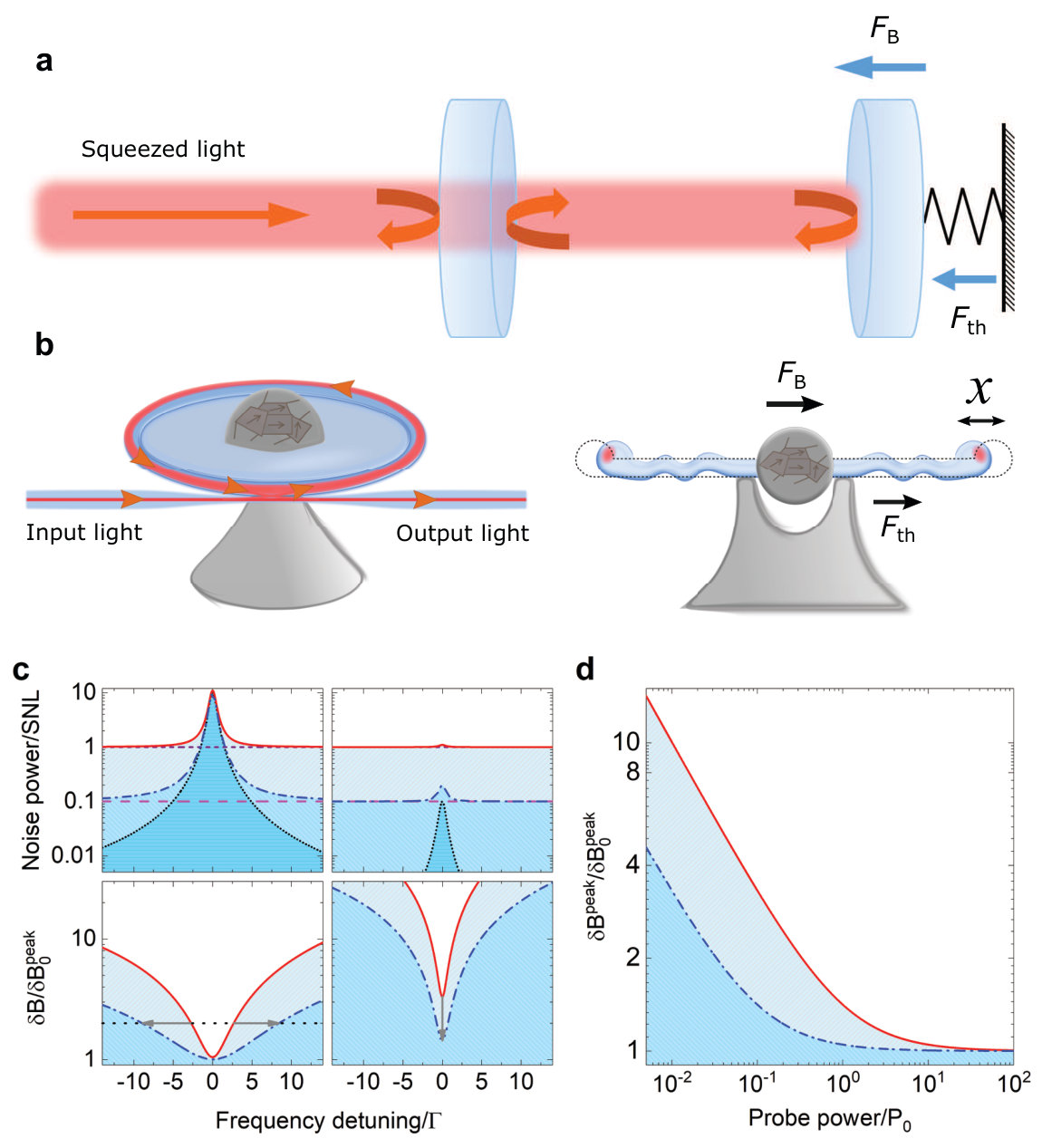 Figure 1
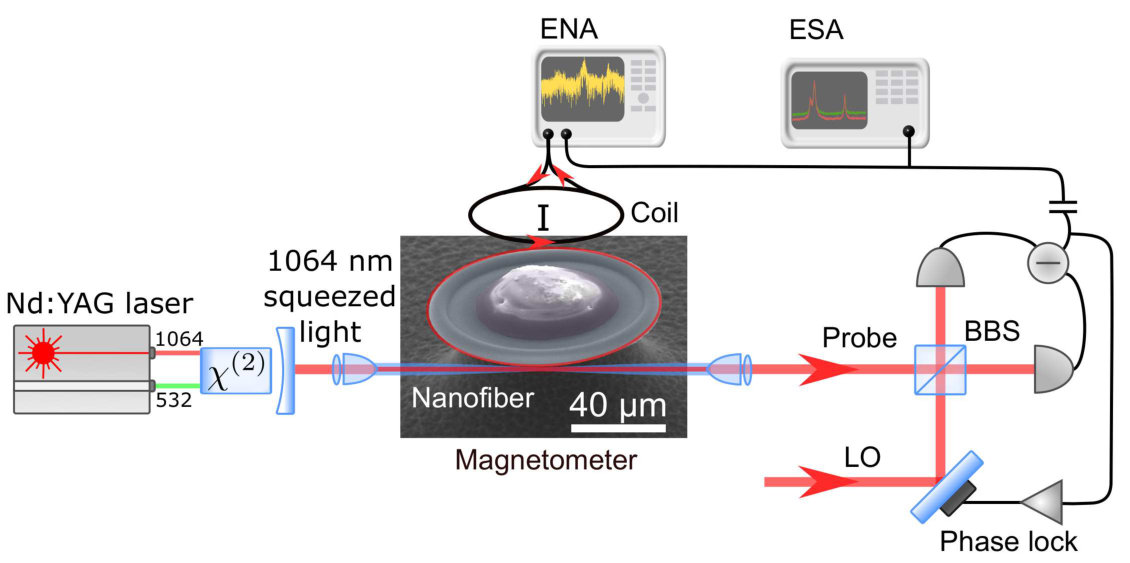 Figure 2
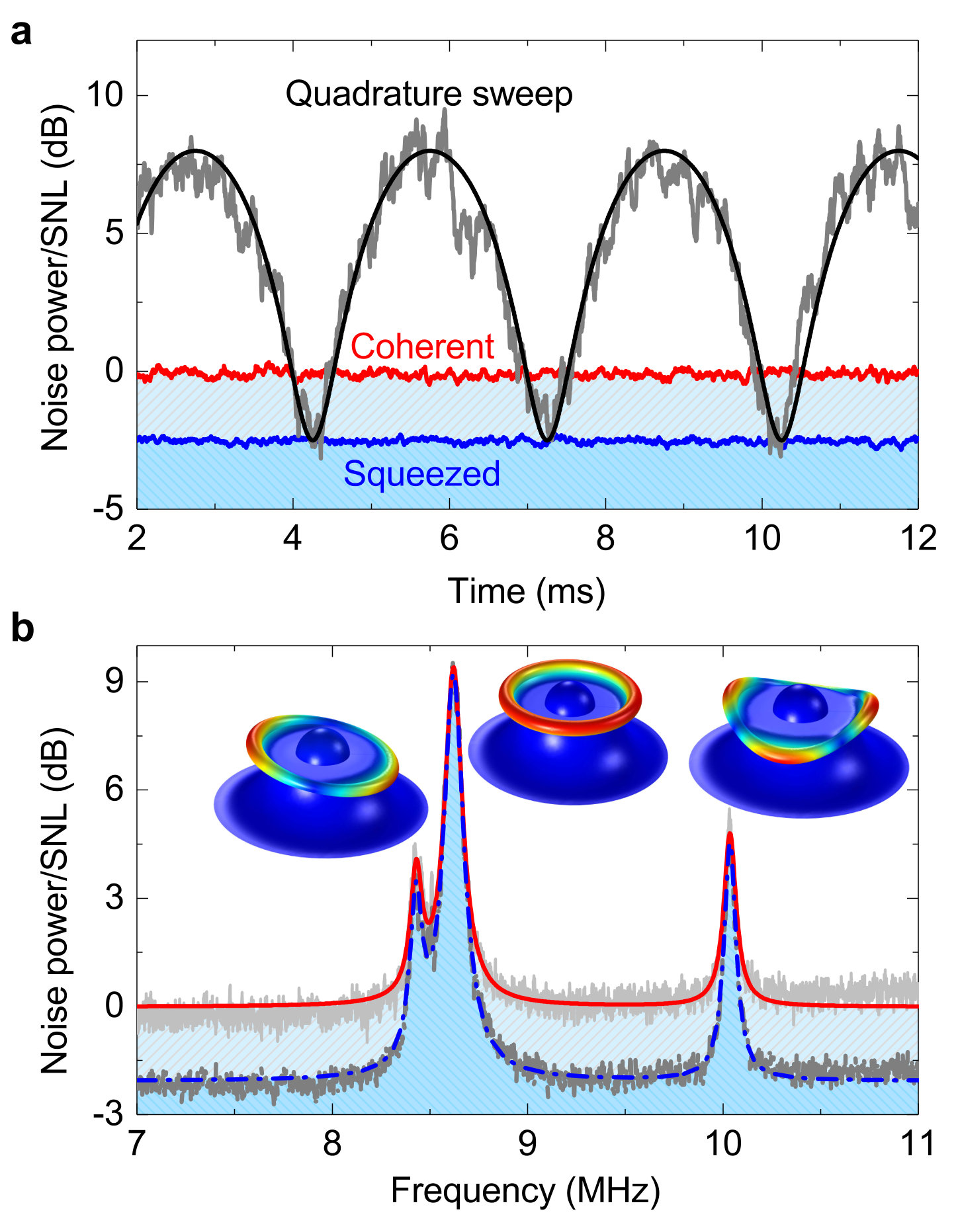 Figure 3
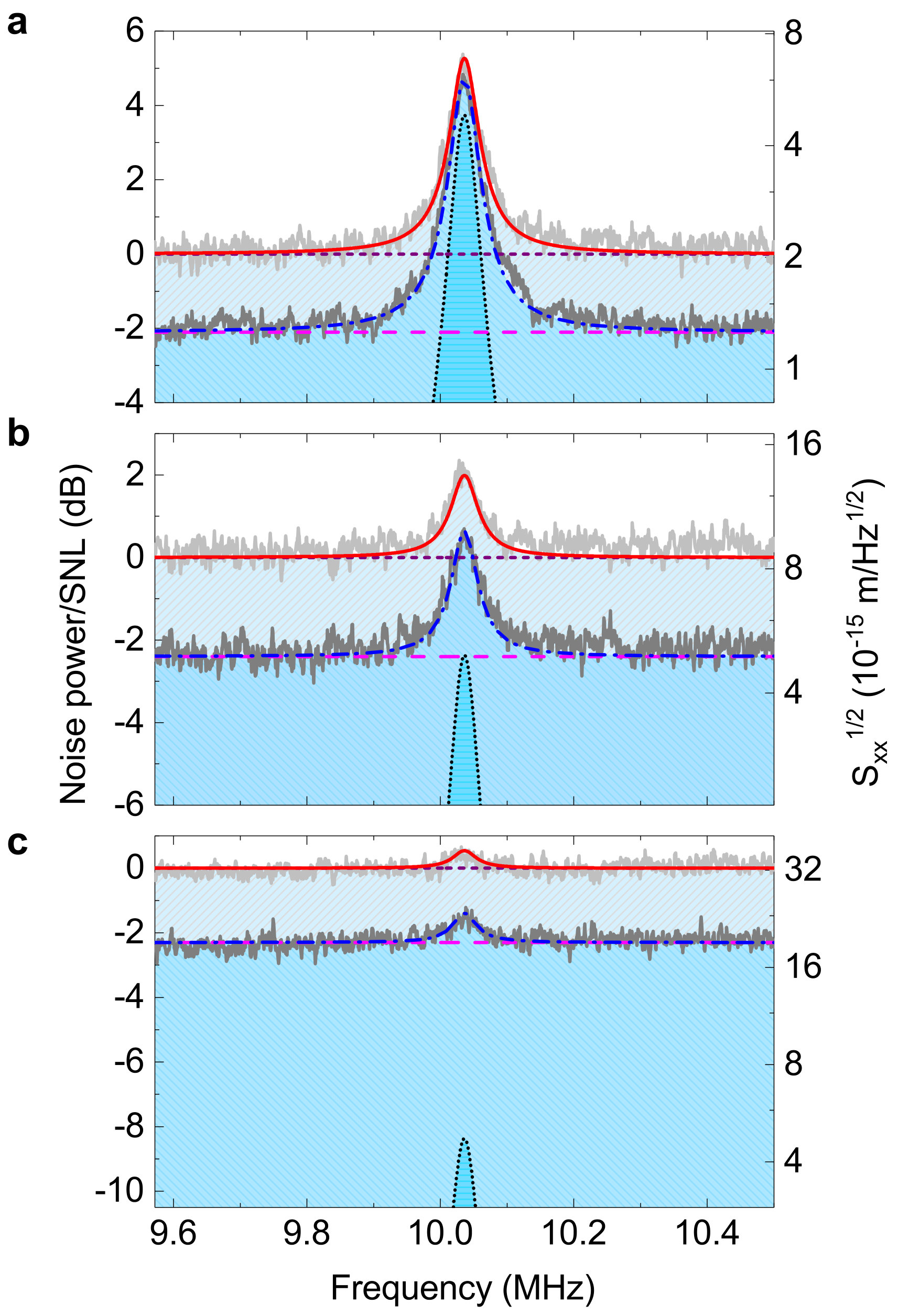 Figure 4
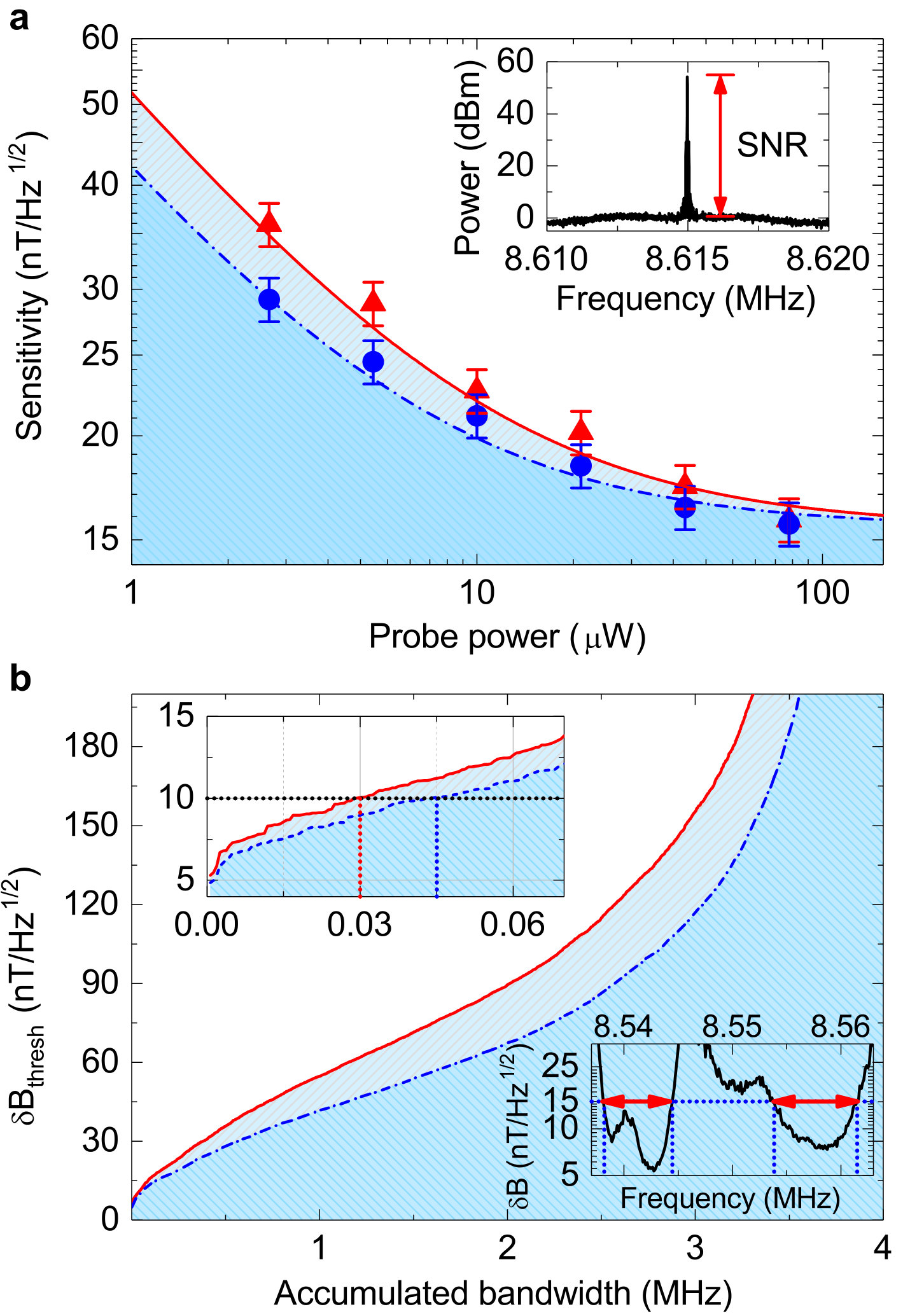 Figure 5
Peer Reviews
No public reviews on file for this paper yet. If you reviewed it on a platform where reviews are public (OpenReview, ICLR, NeurIPS, ICML), you can paste yours below so the community can read it here.
Videos
No videos yet. Explain this paper in a talk, walkthrough, or lecture? Add one.
Taxonomy
TopicsMechanical and Optical Resonators · Advanced MEMS and NEMS Technologies · Geophysics and Sensor Technology
Quantum enhanced optomechanical magnetometry
Bei-Bei Li
School of Mathematics and Physics, The University of Queensland, St Lucia, Queensland 4072, Australia.
Qian Xuesen Laboratory of Space Technology, Beijing 100094, P. R. China.
Jan Bilek
Department of Physics, Technical University of Denmark, Fysikvej 309, 2800 Kgs. Lyngby, Denmark.
Ulrich B. Hoff
Department of Physics, Technical University of Denmark, Fysikvej 309, 2800 Kgs. Lyngby, Denmark.
Lars S. Madsen
School of Mathematics and Physics, The University of Queensland, St Lucia, Queensland 4072, Australia.
Stefan Forstner
School of Mathematics and Physics, The University of Queensland, St Lucia, Queensland 4072, Australia.
Varun Prakash
School of Mathematics and Physics, The University of Queensland, St Lucia, Queensland 4072, Australia.
Clemens Schäfermeier
Department of Physics, Technical University of Denmark, Fysikvej 309, 2800 Kgs. Lyngby, Denmark.
Tobias Gehring
Department of Physics, Technical University of Denmark, Fysikvej 309, 2800 Kgs. Lyngby, Denmark.
Warwick P. Bowen
School of Mathematics and Physics, The University of Queensland, St Lucia, Queensland 4072, Australia.
Ulrik L. Andersen
Department of Physics, Technical University of Denmark, Fysikvej 309, 2800 Kgs. Lyngby, Denmark.
Abstract
The resonant enhancement of both mechanical and optical response in microcavity optomechanical devices allows exquisitely sensitive measurements of stimuli such as acceleration, mass and magnetic fields. In this work, we show that quantum correlated light can improve the performance of such sensors, increasing both their sensitivity and their bandwidth. Specifically, we develop a silicon-chip based cavity optomechanical magnetometer that incorporates phase squeezed light to suppress optical shot noise. At frequencies where shot noise is the dominant noise source this allows a 20% improvement in magnetic field sensitivity. Furthermore, squeezed light broadens the range of frequencies at which thermal noise dominates, which has the effect of increasing the overall sensor bandwidth by 50%. These proof-of-principle results open the door to apply quantum correlated light more broadly in chip-scale sensors and devices.
Cavity optomechanics 2008Science ; 2014RMP ; Warwick book has attracted increasing research interest for both fundamental studies and practical applications. Strong radiation pressure coupling between high quality mechanical and optical resonances has enabled the demonstration of a range of interesting quantum behaviours, such as ground state cooling of macroscopic mechanical oscillators cooling1 ; cooling2 ; cooling3 ; cooling4 , quantum squeezing of mechanical motion SqeezMotion1 ; SqeezMotion2 ; SqeezMotion3 ; SqeezMotion4 , and the production of squeezed light SquezLightProd1 ; SquezLightProd2 ; While the combination of resonance-enhanced mechanical and optical response 2008NJP has enabled precision sensors 2014APR ranging from kilometer-sized laser interferometer gravitational wave detectors LIGO ; GW , to micro/nano scale silicon chip based force force , mass mass , acceleration acceleration1 ; acceleration2 , and magnetic field magnetic1 ; magnetic2 ; magnetic3 ; magnetic4 sensors.
The precision of cavity optomechanical sensors is generally constrained by three fundamental noise sources: thermal noise from the environment, shot noise from the photon number fluctuations of the light used to probe the system, and quantum backaction noise arising from the radiation pressure of the probe light. With increasing laser power, the shot noise contribution decreases and backaction increases. An optimal sensitivity is reached when they are equal, termed the standard quantum limit (SQL) 2008Science . The noise floor can be engineered using quantum correlated light. For instance, squeezed light squeezing1 ; squeezing2 ; 30years allows the shot noise to be suppressed Caves , thereby improving the sensitivity if the shot noise is dominant. Squeezed light has been used, for example, to improve the precision of gravitational wave interferometry in both LIGO and GEO GW1 ; GW2 ; GW3 , of nanoscale measurements of biological systems biology , and of magnetic field measurement using atomic magnetometers atomic1 ; atomic2 . In cavity optomechanics, it has been used to enhance measurements of thermal noise toroid , to improve both feedback feedback cooling and sideband cooling sideband cooling , and to study the backaction from the radiation pressure force strong radiation . However, it has not previously been used to improve cavity optomechanical sensors of external stimuli. Here, we demonstrate the first application of squeezed light in such a sensor, specifically, in a cavity optomechanical magnetometer magnetic1 ; magnetic2 . At frequencies where shot noise is dominant, squeezed light suppresses the noise floor, improving the magnetic field sensitivity. Moreover, by increasing the range of frequencies over which thermal noise is dominant, the sensor bandwidth is also increased. Squeezed light enhanced sensor bandwidth bandwidth is of importance in applications which need good sensitivity in a broadband range, e.g., in magnetic resonance imaging.
Theoretical analysis
Figure 1a shows a conceptual schematic of a cavity optomechanical magnetometer, comprised of an optical cavity, coupled to a mechanical oscillator. The mechanical oscillator is driven by a force induced by a magnetic field via the magnetostrictive effect magnetic1 , along with thermal and backaction noise forces. The mechanical motion of the oscillator changes the cavity length and thus the optical resonance. This modulates the phase of an injected squeezed probe field, and can therefore be read out via an optical phase measurement. In our case, the optical cavity is a microtoroid, whose circumference is modified by mechanical motion, as illustrated in Fig. 1b. Our experiments operate in the unresolved sideband regime where the optical decay rate is much larger than the mechanical resonance frequency . In this regime, the thermal force noise dominates the backaction noise when Warwick book , where is the thermal phonon occupancy of the mechanical oscillator, and is the optomechanical cooperativity, which quantifies the strength of radiation pressure optomechanical coupling relative to the mechanical and optical dissipation rates and is proportional to the probe laser power. For the few megahertz frequencies we use, at room temperature; while with the optical and mechanical properties of our optomechanical microresonator, and for the maximum optical power we use, . Consequently, the mechanical force noise is dominated by thermal noise, and we neglect backaction noise henceforth.
The displacement of the mechanical oscillator in response to an external force is quantified in the frequency domain by the mechanical susceptibility . To illustrate the physics, we consider the simple case of a single mechanical resonance, for which , where is the effective mass of the mechanical oscillator, and is its damping rate, enhancing the mechanical response to near resonant forces (see top left and top right of Fig. 1c). Quite generally in cavity optomechanical sensors, away from resonance, optical shot noise is dominant, allowing squeezed-light enhanced sensitivity; while for a single-sided cavity in the unresolved sideband regime, thermal noise dominates shot noise at resonance if , where is the optical detection efficiency.
A magnetic field is resolvable when the signal it induces is larger than the total noise floor. Neglecting backaction noise, this leads to a minimum detectable force
[TABLE]
for a cavity without internal losses and with a perfect optical detection efficiency . and are the Boltzmann constant and the temperature, respectively. The first term in the bracket on the right hand side represents the thermal noise, while the second term represents the optical noise, with the squeezed quadrature variance of the squeezed light. Introducing an actuation constant which characterizes how well the magnetic field is converted into an applied force on the mechanical oscillator magnetic1 , the magnetic field sensitivity is .
From Eq. 1 we see that the peak sensitivity occurs on mechanical resonance. In the case where thermal noise is dominant at mechanical resonance frequency (), squeezed light does not significantly change the peak sensitivity, instead extending the frequency range over which thermal noise dominates, and therefore the sensor bandwidth (bottom left of Fig. 1c); while in the case where optical noise is dominant on resonance (), both the peak sensitivity and bandwidth are improved by squeezed light (bottom right of Fig. 1c). The saturation of sensitivity to the optimal (thermal noise limited) sensitivity as probe powers increase is shown in Fig. 1d. It can be seen that squeezed light reduces the probe power required to reach the optimal sensitivity.
Results
Measurement of the optomechanical system. The optomechanical magnetometer is a microtoroid cavity with a grain of magnetostrictive material (terfenol-D) magnetic1 ; magnetic2 , as sketched in Fig.1b. In such magnetometers, the magnetic field deforms the microcavity via the magnetostrictive expansion and shifts the optical resonance. In the case of an alternating current (AC) magnetic field, the magnetostrictive material exerts a periodic force on the mechanical oscillator, which can drive the mechanical motion of the toroid. When the microcavity is excited on optical resonance, the mechanical motion translates into a pure phase modulation of the transmitted light at the mechanical frequency, which is read out with a homodyne detector and recorded using a spectrum analyzer.
The measurement setup for squeezed light enhanced magnetometry is shown in Fig. 2. A Nd:YAG laser is used to produce squeezed light at a wavelength of 1064 nm. The light is coupled into the microtoroid evanescently through an optical nanofiber with a diameter of about 700 nm. The optical resonance of the cavity is thermally tuned to match the wavelength of the laser. The cavity phase is actively locked using a feedback system PDH . A coil is used to produce an AC magnetic field to test the magnetic field response of the magnetometer. The mechanical motion of the toroid is measured by performing homodyne detection (see Methods for more details). An electronic spectrum analyzer (ESA) is used to record the noise power spectrum. In order to measure the response of the magnetometer to magnetic fields at different frequencies, we drive the coil with the output of an electric network analyzer (ENA) and measure the magnetic field response at each frequency with the same ENA.
Characterization of the squeezed light. To characterize the squeezed state transmitted through the fiber, we decouple the microtoroid from the nanofiber and measure the homodyne detection signal of the field quadratures by linearly sweeping the LO phase . As shown in the dark grey curve in Fig. 3a, when is swept continuously, the noise power changes periodically, following the equation , with being the anti-squeezed quadrature variance. The black solid curve is the fitted result based on this equation, yielding , and . Ideally, the product , satisfying the Heisenberg uncertainty limit, but in reality this limit is not reached, due to loss of the squeezed light during propagation in the setup. The noise power reaches its minimum when locked at the phase quadrature, and we lock to that quadrature henceforth. The red and blue curves in Fig. 3a show the noise power for phase quadrature measurement of coherent and squeezed probes, respectively.
Magnetic field measurement with a coherent or squeezed probe. The squeezed field is coupled into the microcavity through the nanofiber. We keep the fiber-cavity coupling in the undercoupled regime, in which case most of the squeezing is preserved. The noise power with both coherent and squeezed probes in the frequency range of 7-11 MHz is measured, as shown in the light grey (for coherent probe) and grey (for squeezed probe) curves in Fig. 3b. With a probe power of 80 µW, three peaks appear in this frequency range of the noise spectrum, corresponding to three thermally excited mechanical resonance modes. We use COMSOL Multiphysics simulations to identify these three modes as tilting mode, flapping mode, and crown mode, with the corresponding mode profiles shown in the inset. It can be seen that over the frequency ranges where the optical noise dominates, the noise floor is suppressed by up to 2.2 dB by squeezed light, while it is left essentially unchanged when thermal noise dominates.
In order to carefully study the effect of the probe power on the noise spectrum, in the following we focus on the crown mode with mechanical resonance frequency of MHz. Figure 4a shows the noise (normalized to the shot noise level) in the vicinity of the crown mode with probe power =80 µW. As expected, in this case the noise level remains unchanged by squeezing near the resonance frequency where thermal noise is dominant, and is suppressed away from resonance. As the probe power gradually decreases, the thermal noise drops relative to the shot noise. As shown in Figs. 4b and c, the shot noise is dominant in the whole frequency range, for probe powers of 20 µW and 5 µW. At these power levels, squeezing allows the noise floor to be suppressed over the entire frequency ranges. These results are consistent with the predictions in Fig. 1c.
The magnetic field sensitivity of the magnetometer is then characterized (see Methods for more details). We first characterize the absolute sensitivity at a single frequency =8.615 MHz. The inset of Fig. 5a shows the power spectrum at , when the magnetometer is driven with a magnetic field with known strength . The sensitivity at this frequency can be derived from the signal-to-noise ratio (SNR) and , magnetic1 , with RBW being the measurement resolution bandwidth. Figure 5a plots the sensitivity at this frequency as a function of the probe power. The red triangles and the blue circles represent the measured result for coherent and squeezed probes, respectively, with the error bars obtained by taking into account the fluctuation of about dB in the measured noise spectrum. As expected, the sensitivity is improved by squeezing at low probe power where the shot noise is dominant and reaches the same optimal sensitivity at high probe power where the thermal noise is dominant, in good agreement with theoretical fits. For instance, the sensitivity at 2.5 µW probe power is improved from 35.9 nT/ to 29.2 nT/, and thermal noise limited sensitivity is about 15.7 nT/ for both coherent and squeezed probes. The sensitivity at can be used along with network analysis to calibrate the sensitivity over the whole frequency range (see Methods). This allows the effect of squeezing on bandwidth to be analyzed, as discussed in the following. For a probe power of 80 µW, the peak sensitivity in the whole frequency range is found to be about 5 nT/ at 8.543 MHz for both coherent and squeezed probes, at the power of 80 µW.
The sensitivity is found to vary significantly over frequency ranges of around 10 kHz, due to resonances in the response of terfenol-D, as shown in the sensitivity spectrum in the bottom-right inset of Fig. 5b, and consistent with previous observations magnetic1 . This precludes comparison of the magnetometer bandwidth as a function of squeezing to a simple theory. Instead here we analyze the squeezing dependence of the accumulated bandwidth, defined as the total frequency range over which the sensitivity is better than a certain threshold value (see bottom-right inset). In Fig. 5b, we plot the accumulated bandwidth for coherent (red solid curve) and squeezed (blue dash-dotted curve) probes, at a probe power of 80 µW. It can be seen that, for each , the accumulated bandwidth for the squeezed probe is greater than that for the coherent probe. The upper-left inset of Fig. 5b shows the accumulated bandwidth over the smaller frequency range of 0-70 kHz. Squeezed light expands the 3 dB bandwidth (corresponding to nT/) by 50%, from 30 kHz (for coherent probe) to 45 kHz (for squeezed probe).
Conclusions
In summary, we have demonstrated the first application of quantum light in a microcavity optomechanical sensor. By probing a cavity optomechanical magnetometer with phase squeezed light, the noise floor is suppressed by about 40%, allowing improved sensitivity by about 20% in the shot noise dominated regime, and a 50% enhancement in accumulated bandwidth from 30 kHz to 45 kHz. Squeezed light, further, reduces the optical power required to reach the optimal sensitivity.
Our approach provides a way to improve the sensitivity of the cavity optomechanical magnetometer over a broad frequency range, and also opens up possibilities for improving other optomechanical sensors, e.g., inertial sensors acceleration1 ; acceleration2 . While a 20% improvement in sensitivity is relatively modest, recent advances in squeezing technologies squeezing6dB ; squeezing9dB ; squeezing12.7dB ; squeezing15dB hold promise for more substantial improvements. For instance, with squeezing of 15 dB recently reported squeezing15dB , a sensitivity improvement of a factor of 5.6 could potentially be realized. Moreover, squeezed light could be generated on the same silicon chip as the sensor itself, using either radiation pressure induced optomechanical effects SquezLightProd1 ; SquezLightProd2 or nonlinear waveguides Nonlinear waveguide . Further improvements may be possible by optimizing the magnetometer design itself, with sensitivities on the order of 100 pT/ reported in previous cavity optomechanical magnetometers magnetic2 . Sensitivities in this range make cavity optomechanical magnetometers a promising candidate for a range of applications such as on-chip microfluidic nuclear magnetic resonance for medical diagnosis NMR and magnetoencephalography MEG , without the requirement for cryogenic systems, necessary for other precision magnetometers, such as superconducting quantum interference device (SQUID) based magnetometers SQUID1 ; SQUID2 .
Methods
Generation of squeezed light. Phase-squeezed light is generated through a parametric down conversion process in a 10mm PPKTP crystal enclosed in a linear cavity feedback cooling . As shown in Fig. 2, both the 532 nm light (the pump light) and 1064 nm light (the seed light) are injected to the cavity. To generate phase squeezed light, the pump phase is locked to the seed beam amplification.
Homodyne detection. The balanced homodyne detector combines two inputs: a relatively weak probe which couples with the microcavity and a relatively strong local oscillator (LO) which comes from the same laser but without going through the microcavity. The homodyne detection signal is proportional to the product of the probe power and local oscillator power . In our experiment, we keep mW, and vary the probe power from 1 to 100 µW.
Measurement of the magnetic field sensitivity. The magnetometer is fabricated by embedding a grain of magnetostrictive material (terfenol-D) into the microtoroid magnetic2 . In order to obtain the sensitivity over the whole frequency range, we first measure the sensitivity at one reference frequency , and use it to calibrate the sensitivity over the whole spectrum . The inset of Fig. 5a shows the power spectrum when the magnetometer is driven with a magnetic field with known strength at the reference frequency 8.615 MHz, from which the sensitivity at this frequency is derived. We then sweep the frequency of the magnetic field and measure the response in the whole frequency range, . Then the sensitivity over the whole frequency range, , is derived from , and (the noise spectrum), . The magnetic field signal at each frequency is the same for coherent and squeezed probes, as it only depends on the probe power and the properties associated with the magnetometer itself (including the magnetostrictive coefficient, coupling between the motion of the terfenol-D and the toroid, mechanical quality factor, optical quality factor, and the optomechanical coupling strength). Therefore, the sensitivity, which is inversely proportional to SNR, gets improved for a lower noise level.
The reference list from the paper itself. Each links out to its DOI / PubMed record.
- 1(1) References
- 2(2) Kippenberg, T. J. & Vahala, K. J. Cavity Optomechanics: Back-Action at the Mesoscale. Science 321 , 1172-1176 (2008).
- 3(3) Aspelmeyer, M., Kippenberg, T. J. & Marquardt, F. Cavity optomechanics. Rev. Mod. Phys. 86 , 1391-1452 (2014).
- 4(4) Bowen, W. P. & Milburn, G. Quantum Optomechanics (CRC Press, Boca Raton, 2016).
- 5(5) O ′ ′ {}^{{}^{\prime}} Connell, A. D. et al. Quantum ground state and single-phonon control of a mechanical resonator. Nature 464 , 697-703 (2010).
- 6(6) Chan, J. et al. Laser cooling of a nanomechanical oscillator into its quantum ground state. Nature 478 , 89-92 (2011).
- 7(7) Teufel, J. D. et al. Sideband cooling of micromechanical motion to the quantum ground state. Nature 475 , 359-363 (2011).
- 8(8) Wilson, D. J. et al. Measurement-Based Control of a Mechanical Oscillator at Its Thermal Decoherence Rate. Nature 524 , 325-329 (2015).