Quantum complementarity of clocks in the context of general relativity
Zhifan Zhou, Yair Margalit, Daniel Rohrlich, Yonathan Japha, and Ron, Folman

TL;DR
This paper explores the interplay between quantum clocks and general relativity by deriving and testing a complementarity relation influenced by gravitational time lag, advancing understanding of quantum effects in curved spacetime.
Contribution
It introduces a new complementarity relation for quantum clocks affected by gravity, supported by theoretical derivation and experimental validation.
Findings
Derived a complementarity relation for quantum clocks in gravitational fields.
Experimentally tested the relation using clock-interferometry.
Discussed implications for various quantum clock types.
Abstract
Clocks play a special role at the interface of general relativity and quantum mechanics. We analyze a clock-interferometry thought experiment and go on to theoretically derive and experimentally test a complementarity relation for quantum clocks in the context of the gravitational time lag. We study this relation in detail and discuss its application to various types of quantum clocks.
Click any figure to enlarge with its caption.
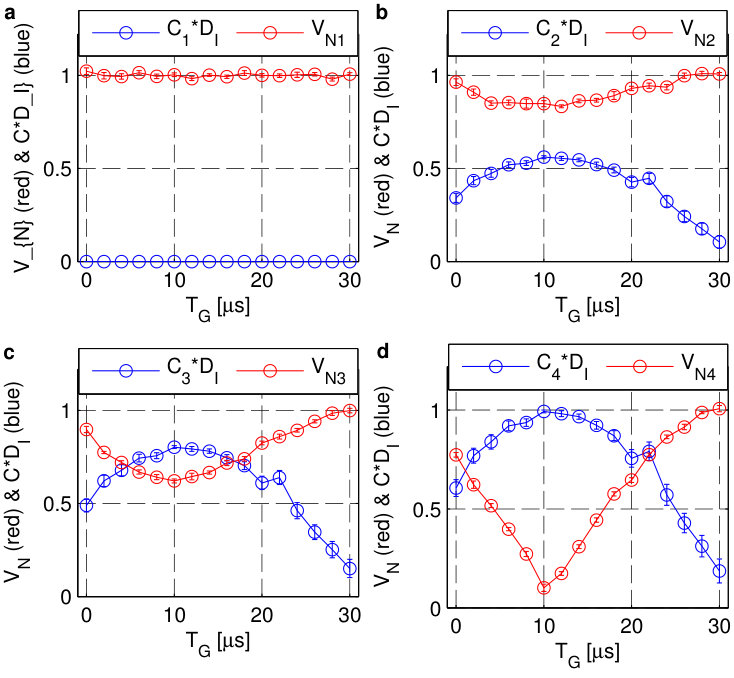 Figure 1
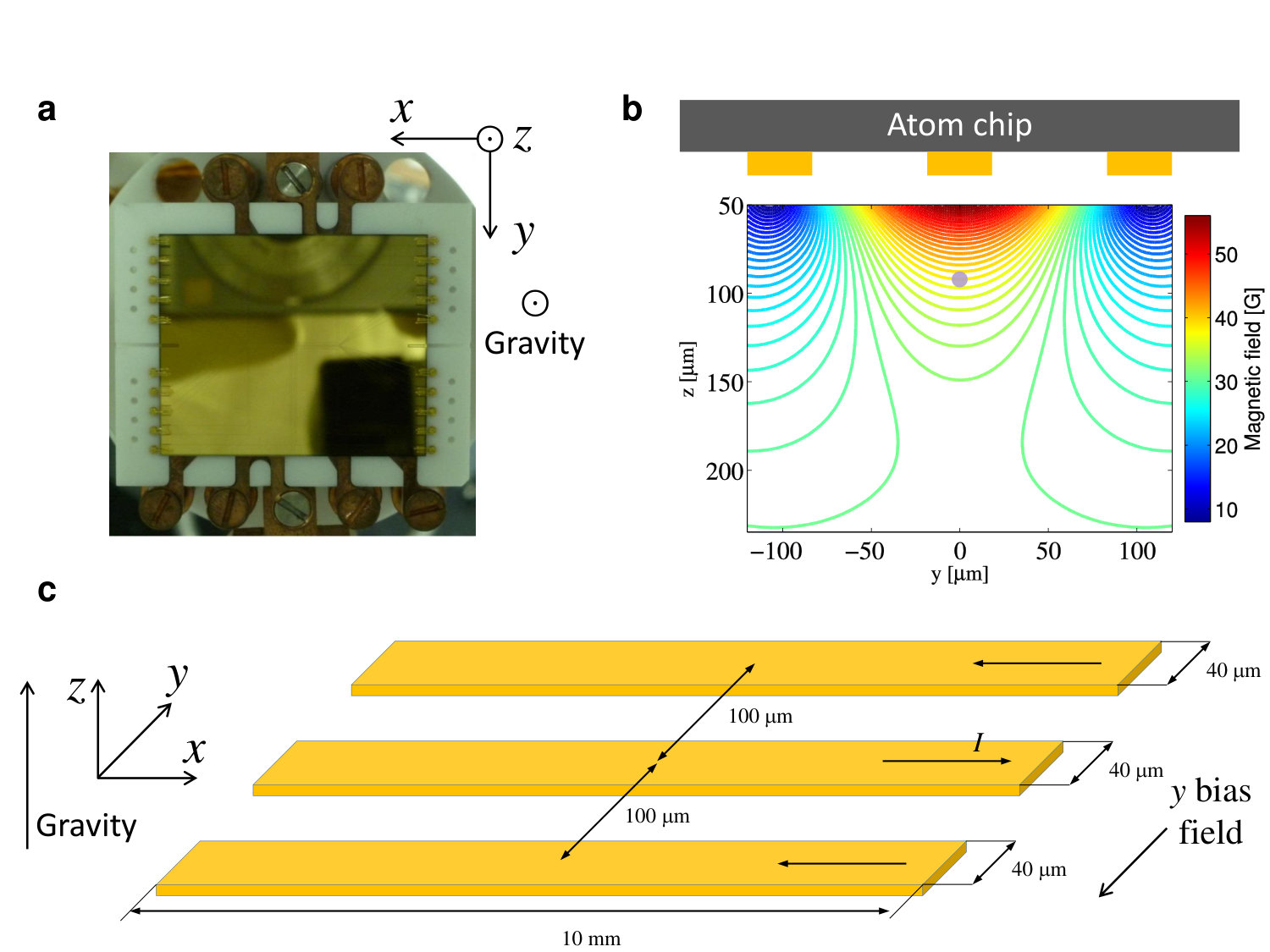 Figure 2
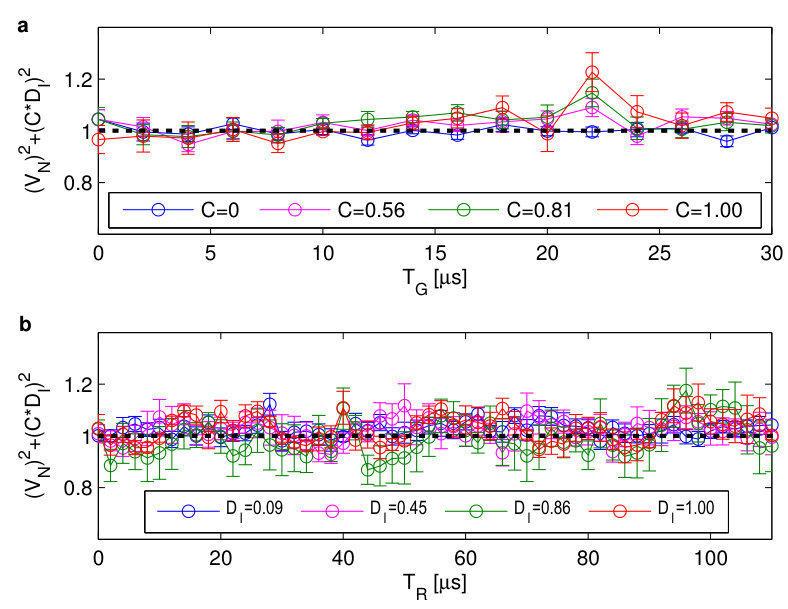 Figure 2
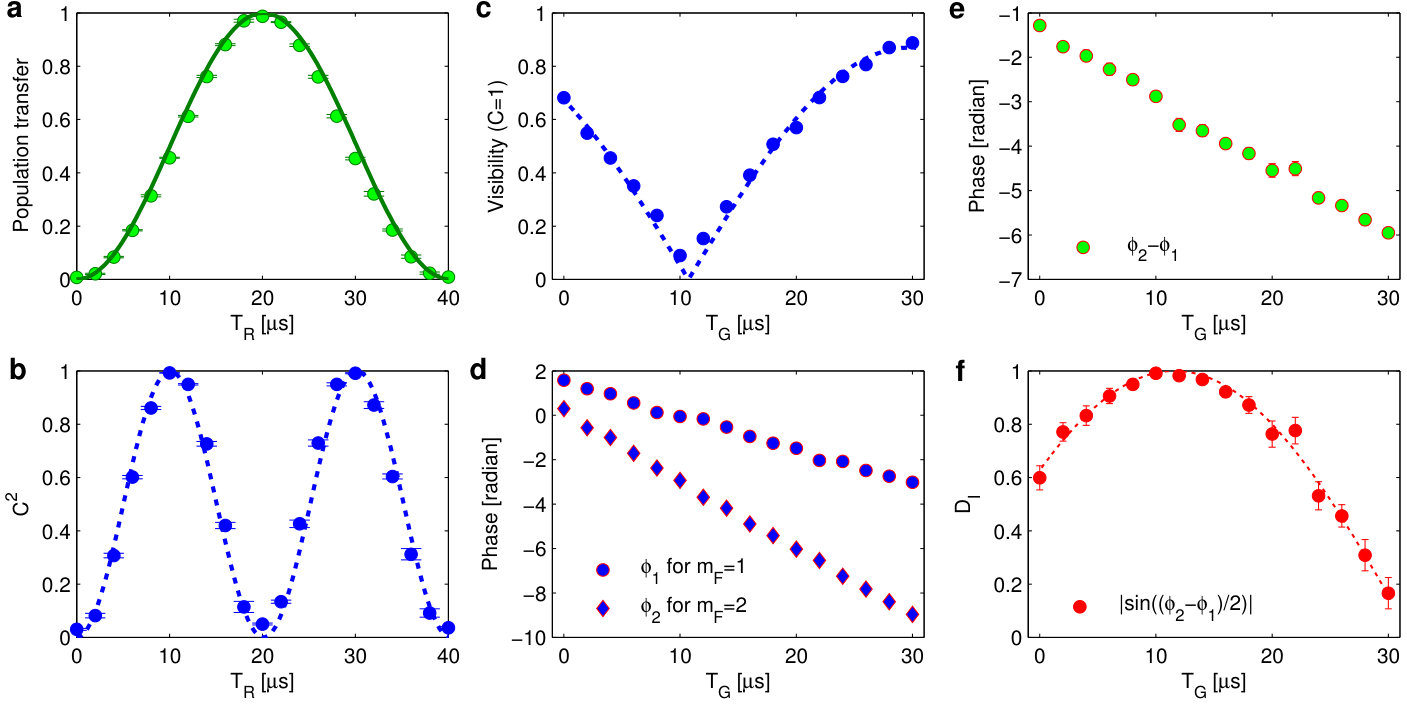 Figure 2
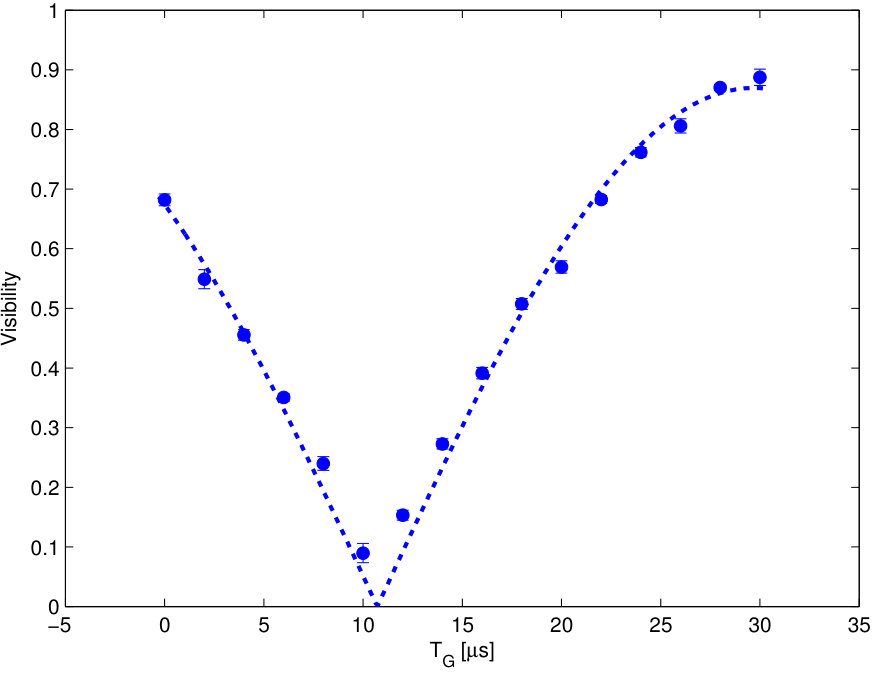 Figure 5
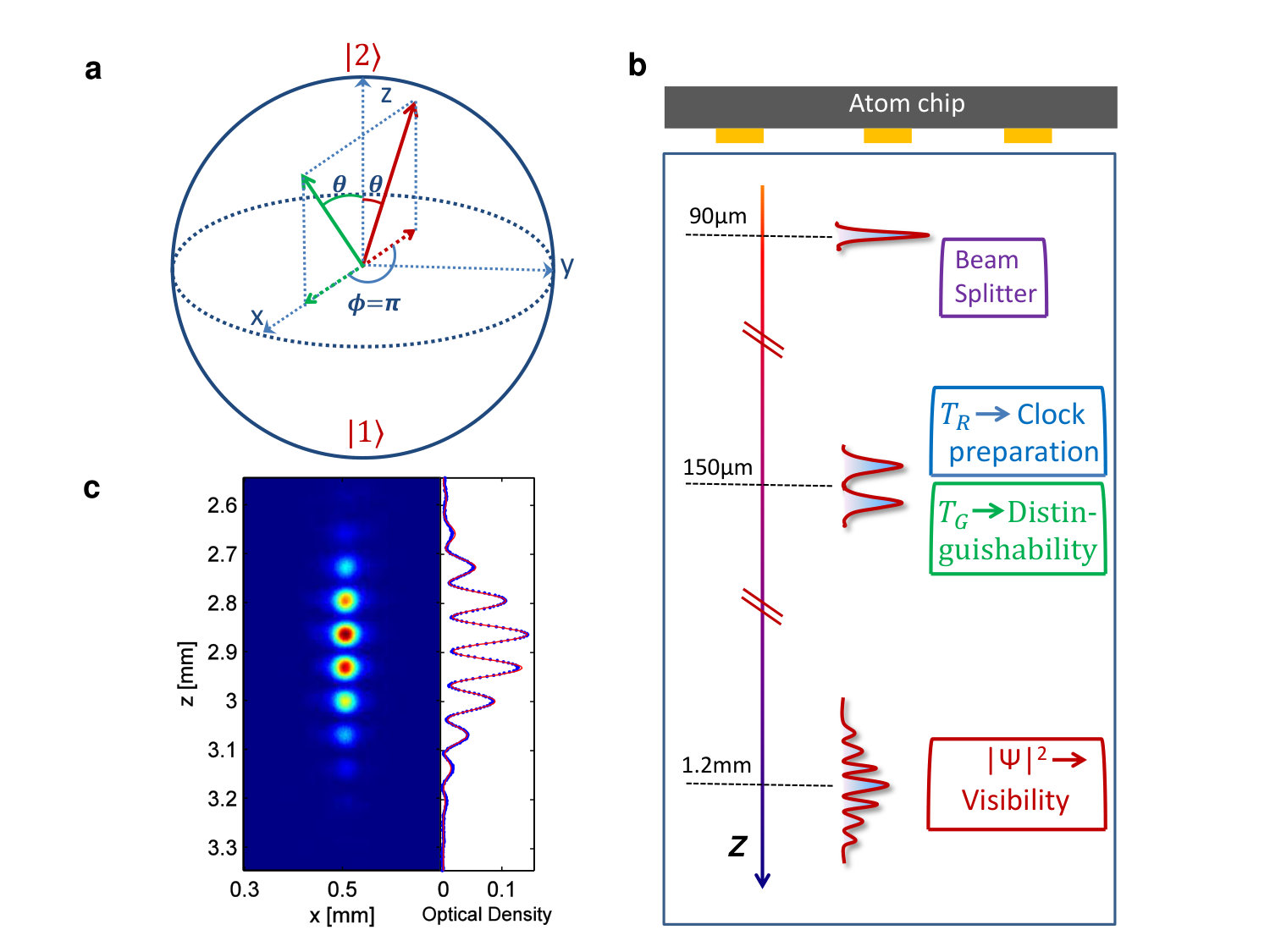 Figure 1
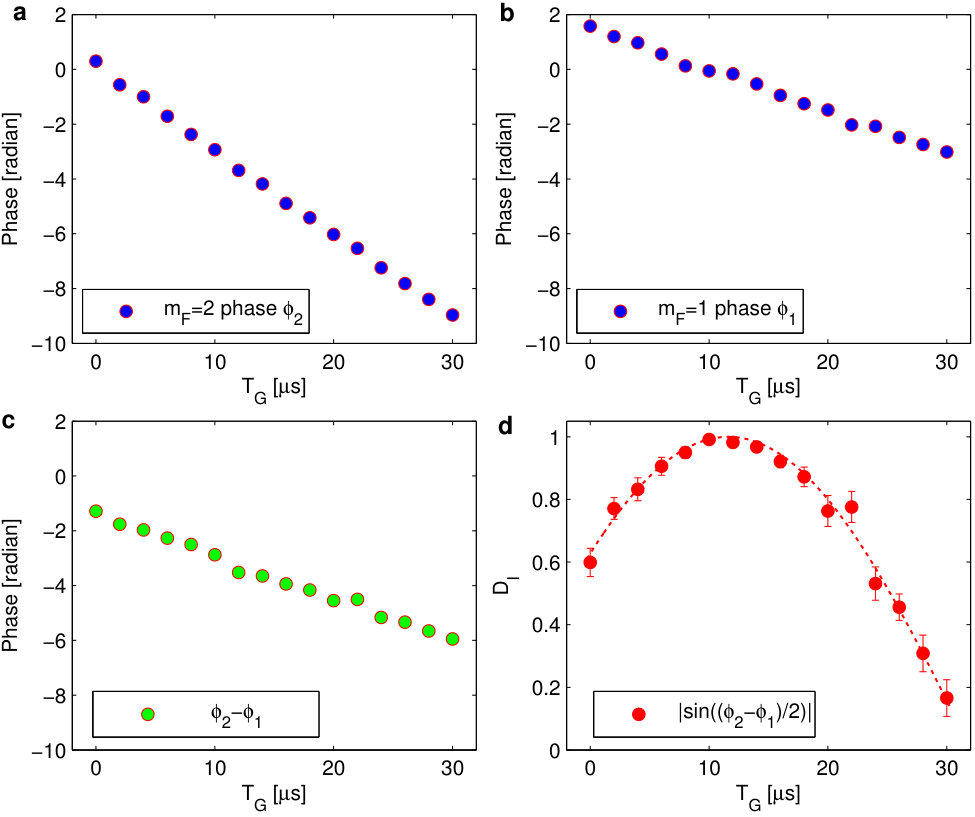 Figure 7
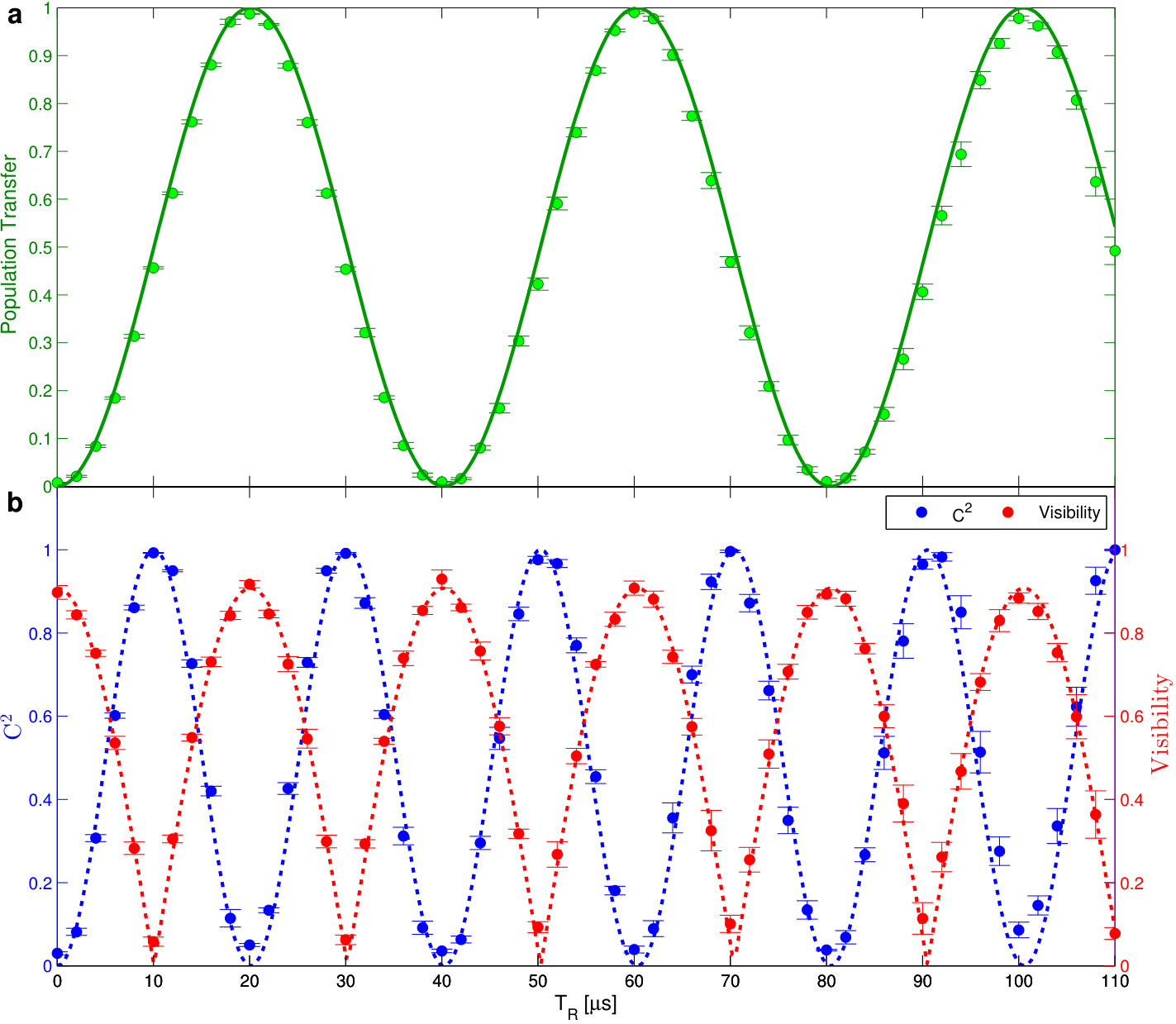 Figure 8
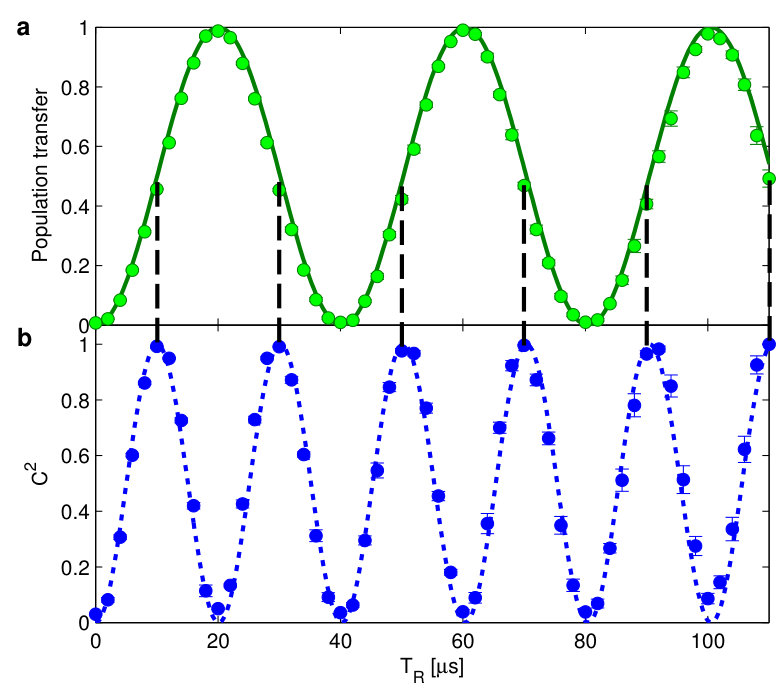 Figure 9
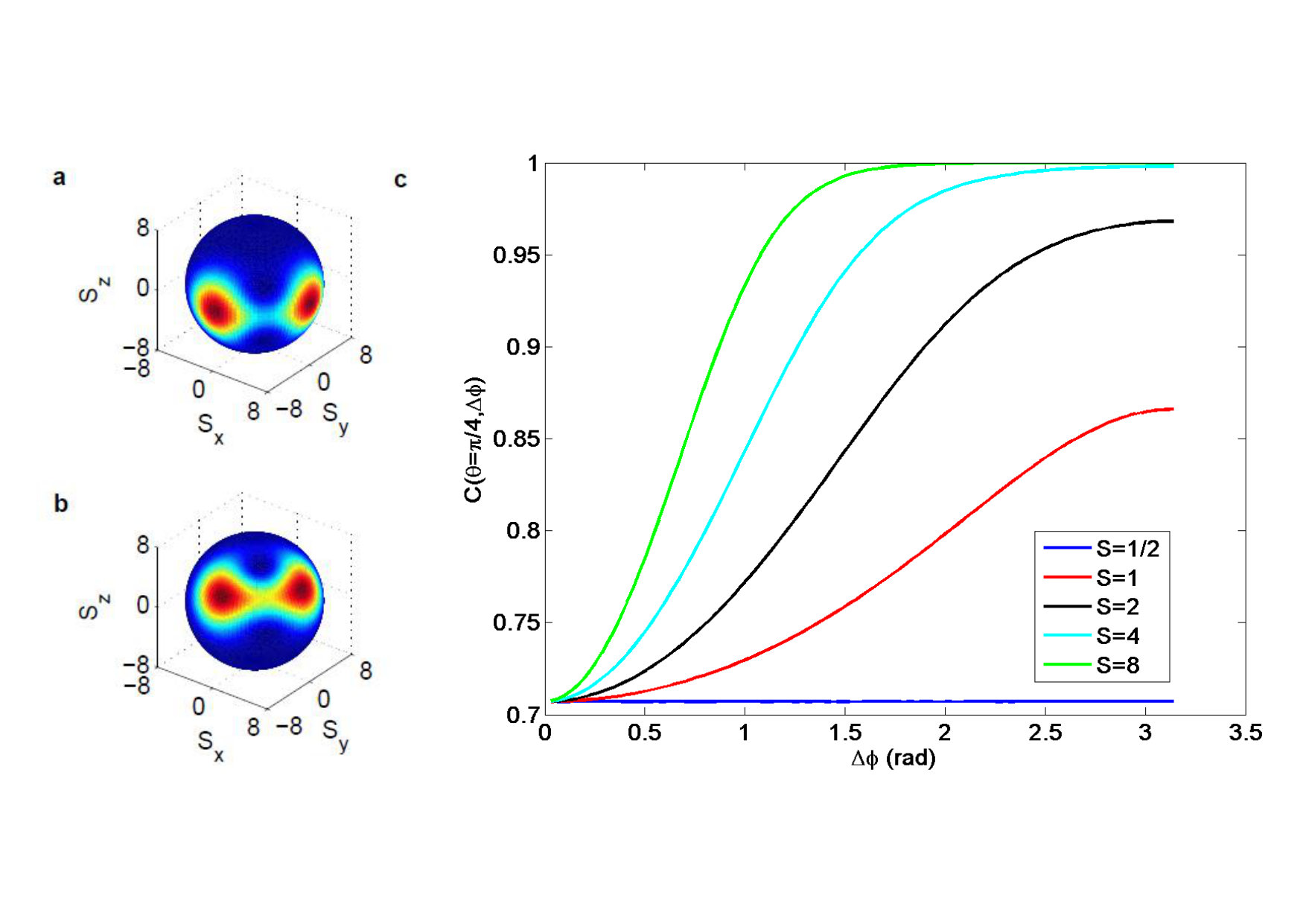 Figure 5
Peer Reviews
No public reviews on file for this paper yet. If you reviewed it on a platform where reviews are public (OpenReview, ICLR, NeurIPS, ICML), you can paste yours below so the community can read it here.
Videos
No videos yet. Explain this paper in a talk, walkthrough, or lecture? Add one.
††thanks: corresponding author
Quantum complementarity of clocks
in the context of general relativity
Zhifan Zhou
Department of Physics, Ben-Gurion University of the Negev, Be’er Sheva 84105, Israel
Yair Margalit
Department of Physics, Ben-Gurion University of the Negev, Be’er Sheva 84105, Israel
Daniel Rohrlich
Department of Physics, Ben-Gurion University of the Negev, Be’er Sheva 84105, Israel
Yonathan Japha
Department of Physics, Ben-Gurion University of the Negev, Be’er Sheva 84105, Israel
Ron Folman
Department of Physics, Ben-Gurion University of the Negev, Be’er Sheva 84105, Israel
Department of Physics, Ben-Gurion University of the Negev, Be’er Sheva 84105, Israel
Department of Physics, Ben-Gurion University of the Negev, Be’er Sheva 84105, Israel
Department of Physics, Ben-Gurion University of the Negev, Be’er Sheva 84105, Israel
Department of Physics, Ben-Gurion University of the Negev, Be’er Sheva 84105, Israel
Department of Physics, Ben-Gurion University of the Negev, Be’er Sheva 84105, Israel
Abstract
Clocks play a special role at the interface of general relativity and quantum mechanics. We analyze a clock-interferometry thought experiment and go on to theoretically derive and experimentally test a complementarity relation for quantum clocks in the context of the gravitational time lag. We study this relation in detail and discuss its application to various types of quantum clocks.
I Introduction
The interface between quantum mechanics (QM) and general relativity (GR) is an ongoing fundamental challenge. While cosmology and high-energy physics offer tools used for probing this interface and seeking hints for a highly sought-after unification, here our tools are table-top spatial atomic interferometry and atomic clocks. Indeed, progress in matter-wave interferometry Kasevich ; Tower ; muller and atomic clocks JunYe has provided a promising platform for new experiments. To unambiguously test the GR notion of proper time in the context of QM, a self-interfering clock has been suggested Zych ; Bushev . Such a scheme has recently been realized in a proof-of-principle experiment Us . Quantum complementarity Bohr plays a special role at this QM–GR interface, as we show below.
Our present understanding of complementarity Englert ; Greenberg ; Jaeger ; Mandel ; Zurek for a two-path interferometer is summarized by the fundamental inequality , where is interference pattern visibility and is distinguishability of the two paths of the interfering particle. This law has been verified in numerous experiments Rauch ; Aspect ; Rempe ; MandelExp ; Haroche2 ; Electron ; Pfau ; Chapman and elaborated theoretically Bergou ; NCinternal . In the framework of GR, there is speculation Zych that the inequality may be broken such that . As clock interferometry sensitive to gravitational red shifts may soon be feasible JunYe ; Wineland ; Campbell ; Huntemann ; Chen ; Ludlow , formulating an account of clock complementarity is timely. Here we analyze in detail, and test experimentally, a clock complementarity rule for spatial interferometers with internal Hilbert spaces. See also brukner for a closely related analysis. We begin with a clock-interferometry thought experiment, suggesting a clock complementarity rule in the context of proper time. We obtain it theoretically for an atomic clock with two or more internal levels, and verify it empirically in a clock interferometry experiment that includes a simulated gravitational red shift.
II Theory
In the thought experiment, a clock is prepared in a spatial superposition where one wave packet is closer to a gravitational source and thus suffers from a stronger time lag (or red shift) Zych ; Us . We note that it has been theoretically shown that spatial interferometers which are sensitive to a proper time lag between the paths are possible Wolfgang1 . Now, on the one hand, if the “ticking” rate of the clock depends on its path, then clock time provides which-path information and the inequality , developed in the framework of non-relativistic QM, must apply. Yet, on the other hand, gravitational time lags do not arise in non-relativistic quantum mechanics, which is not covariant and therefore not consistent with the equivalence principle Lugli . Hence our treatment of the clock superposition is a semiclassical extension of quantum mechanics to include gravitational red shifts.
As a historical precedent, we note that at the sixth Solvay conference in 1930, Einstein tried to defeat the uncertainty principle for time and energy by using a clock to measure the precise time a photon is released, and a spring scale to weigh the change in energy (via ) of the whole apparatus. Bohr then applied gravitational time dilation to show that Einstein’s suggestion could not succeed BE . Indeed, Bohr’s reply to Einstein already contains the idea for our thought experiment, if we transform the uncertain height of the clock in the gravitational potential (during the weighing) into a superposition of the clock at different heights. Yet Bohr’s refutation seems, at first sight, mysterious. How could Bohr have applied something outside of quantum mechanics to refute a quantum-mechanical argument? Isn’t quantum mechanics by itself, without general relativity, a self-consistent theory? The explanation AR is simple: Einstein suggested measuring the energy of a photon by it; he thus equated the mass (in the formula for energy) with the mass (in the weight of the photon). But this equation — the equivalence principle — implies the red shift! In this work we reverse the logical implication: since we impose a red shift, we must also impose the equivalence principle.
According to the equivalence principle, two wave packets traversing an interferometer in a gravitational field can equivalently be described as two wave packets traversing the interferometer and accelerating feynman lectures . That is, we can map the experiment with its gravitational field to an equivalent experiment with no gravitational field, but with acceleration; and relativistic quantum mechanics fully describes the latter experiment. It follows that the two experiments are equivalent; for otherwise, quantum mechanics could distinguish between them, contradicting the equivalence principle. It likewise follows that complementarity, which is expected to hold also for relativistic QM, should also apply to wave packets that acquire different red shifts.
An atomic clock accumulates a quantum phase between two or more internal levels. It is convenient to represent clock states as vectors in the Bloch sphere. In Fig. 1(a) we show two such vectors corresponding to two interfering clock wave packets. The angle corresponds to the clock preparation (and is common to both wave packets) while the angle describes the effect of the proper time lapse between the two clock wave packets, when the clock precesses at rate Zych ; Us . We consider the case where the distinguishability arises solely from . Because of imperfect clock preparation, may not increase the distinguishability to 1 (and correspondingly would not reduce the visibility to zero), and it is useful to characterize the actual distinguishability allowed by the clock by comparing it to the distinguishability made possible by a clock with an ideal preparation, where full distinguishability is achieved for , where and denote the upper and lower paths of the interferometer, respectively. We do this by introducing a re-scaling factor that accounts for such imperfection, taking .
Let us consider a clock that is initially prepared as a superposition of the two clock energy eigenstates and . This clock state corresponds to a Bloch vector , which is ideally at on the equator of the Bloch sphere, representing an equal superposition of the two energy eigenstates. After propagation along the two paths, the two clock wave packets acquire an angular difference due to the proper time lag. The visibility of the clock interferometer is equal to the overlap between the two states and of the clock wave packets, which have rotated angles and , respectively, during free propagation at different heights in the gravitational field. The angular difference between the two states and makes them distinguishable; the interference visibility is reduced to zero if the overlap between the two states is zero, and the distinguishability grows to 1, implying full “which-path” information. In the case of an ideal preparation, where , the angular separation between the two Bloch vectors and is and the overlap is . In general, we can choose two vectors and on the Bloch sphere, corresponding to two quantum states and , with an angle of separation between them in the plane that they define. Their overlap is likewise . It follows that the distinguishability is
[TABLE]
In our case, where the latitude of the clock states does not change over time, the (real) scalar product of the two Bloch vectors and is . We use the trigonometric equality and note that is the distinguishability of two states in an ideal clock prepared with the Bloch vector pointing to the equator, namely with equal populations. Upon substituting for in Eq. (1) we obtain
[TABLE]
namely, the distinguishability of the states of the two clock wave packets is a product of the distinguishability of two states created by perfect preparation of the clock and propagation through the interferometer, scaled by a factor , which varies from for an ideal clock to for a non-clock prepared in a given energy eigenstate (at the north or south pole of the Bloch sphere). While perfect clock preparation () gives rise to the possibility of perfect distinguishability (full orthogonality of the clock states) for a given proper time lag , in the case of imperfect preparation () the angle between the Bloch vectors of the two wave packets is always smaller than and the maximum possible distinguishability is . ( may be thought of as the clock preparation quality or “clockness”.) In the context of a clock interferometer Zych ; Us , where the distinguishability of clock states determines the visibility, the complementarity relation can now be written as
[TABLE]
This is the clock complementarity relation, where is the ideal clock distinguishability, determined solely by the proper time lag (in the thought experiment).
The complementarity relation in Eq. (3) was derived here for a typical atomic clock based on a two-level system. In this case the ideal distinguishability is and the clock preparation quality is , where and are the populations (occupation probabilities) of the two energy eigenstates of the clock. In the more general case — for example, a clock based on an -level system [spin ] — we show in Sect. V that Eq. (3) leads to interesting results in which and may not be disentangled when defining .
In the next section we demonstrate experimentally the complementarity relation of Eq. (3) with a system of two Zeeman levels of an atom in a magnetic field. A vertical magnetic field gradient takes the place of the gravitational field. The accumulated angular difference between the two clock wave packets centered at heights and is , where is the gradient pulse duration and , is the Bohr magneton and the Landé factor of the hyperfine level . This clock shift mimics a shift for a clock in two positions in the gravitational field, where and is the time (in the lab frame) during which the two wave packet centers are separated along the axis of gravity.
III Experimental scheme
We experimentally verify to a high level of likelihood that a two-level clock obeys the generalized clock complementarity rule, with a magnetic gradient simulating a gravitational red shift. The setup used for this study is described in Ref. Us , while numerous improvements have resulted in a much higher in the raw data: Fig. 1(c) shows very high visibility without any normalization (90% as compared with 60% in Ref. Us ). The experimental scheme is depicted in Fig. 1(b); it applies the previously demonstrated Stern-Gerlach (SG) matter-wave interferometer on an atom chip FGBS in the following experimental sequence. (For more details, see the Supplementary Material.) After a BEC of about 87Rb atoms in the state has been released from a magnetic trap located 90 m below the chip surface, the SG beam splitter acts on it.
It creates a coherent spatial superposition of two wave packets in the same spin state (). A stopping pulse then adjusts the relative velocity of the two wave packets so that they have the same momentum. Clocks are prepared by an RF pulse of duration , which creates a superposition of and states. The pulses are applied under a strong homogeneous magnetic field (36.7 G) in order to push the transition to out of resonance via the nonlinear Zeeman effect, thus forming a pure two-level system. As the Rabi frequency is constant, varying will effectively change the Bloch vector’s polar angle in the Bloch sphere [Fig. 1(a)], e.g. when s, there is no rotation and the Bloch vector stays at the north pole, and when s, the Bloch vector is rotated onto the equator and a proper clock is prepared in the state . Then an additional magnetic gradient pulse of duration is applied in order to change the relative “tick” rate of the superposed clock wave packets, thus determining a relative rotation on the equator of Bloch sphere [Fig. 1(a)]. This synthetic red shift introduces a posteriori which-path information (WPI) by creating entanglement between the path and a WPI marker, in contrast to the a priori WPI, which involves the preparation of an unbalanced interferometer such that the particle flux along the two paths differs.
Let us note that it is not enough to experimentally simulate the thought experiment by placing a clock in a spatial superposition, and creating a synthetic red shift with some force field. To faithfully simulate the thought experiment one must make sure that there is no breakup of the clock due to the applied force field. This may be viewed as a mere technical condition for the operation of a clock, but in fact the “no clock breakup” is a fundamental feature of the thought experiment that must be imitated by any experimental simulation. Specifically, there is no breakup of a clock wave packet in the gravitational field. Consider a single wave packet centered at a point and let be a proper time lapse there. While two clock levels are indeed accelerated in the gravitational field to different momenta (where the mass difference is due to the difference in their energies), the corresponding velocities do not depend on the specific clock level. The Galilean law of falling masses, stating that gravitational acceleration is independent of mass, holds in general relativity and insures that clock breakup will not occur in a gravitational field. Similarly, the clock breakup effect in our experiment is negligible relative to the difference of the clock angle between the two clock wave packets. A clock wave packet in a magnetic field gradient undergoes not only a rotation of the clock , where and are the magnetic potentials for the two levels at , but also a differential momentum. While the differential clock rotation is shown to span a large range of clock angles allowing the two clock states to be fully distinguishable (), the momentum separation between the two states of the same clock, which is given by , is much smaller than the momentum distribution of each wave packet (allowing the observation of many spatial fringes Us ). These conditions are automatically fulfilled in our experiment when the separation between the two wave packets is larger than the wave packet width. It follows that our demonstration of the effect of gravitational red shift on clock distinguishability is valid.
IV Verifying clock complementarity
Each clock is a superposition of two Zeeman sublevels, with coefficients that depend on and . The RF pulse (duration ) controls the value of , while the magnetic gradient pulse (duration ) controls the value of . The latter creates an effective red shift, namely a differential clock “tick” rate, by inducing a differential Zeeman splitting such that . Finally is measured from the spatial interference pattern [Fig. 1(c)]. We measure independently in a separate experiment by measuring after the clock is initialized, and we evaluate independently by measuring the relative phases in two single-state interferometers, one for each of the two clock states. The independent measurements of , and are presented in Fig. 2.
As noted, , and in order to establish the value of we need to measure the population transfer from the state to the state. In Fig. 2(a) we show the population transfer measured by Stern-Gerlach splitting of the different spin states and atom counting, and Fig. 2(b) shows the resulting value of . As expected, oscillates between 0 and 1, corresponding to the population transfer. In Fig. 2(c), we scan and measure the optimal clock () interference visibility. The result is fitted with , where represents the clock relative rotation. In Figs. 2(d-f) is measured by two single-state interferometers ( and ). The difference in phase between these two interferometric fringe patterns is equivalent to the relative rotation between the upper and lower clock wave packets, from which is directly calculated as . The measured relations among the population transfer , the parameter and the visibility appear in greater detail in Fig. 3, for the case of equal to 1.
In Fig. 4(a) we present the clock complementarity relation for four values of when is scanned. Fig. 4(b) presents the clock complementarity for four values of when is scanned. With , and measured independently, Fig. 4 demonstrates that the clock complementarity rule is sound.
V Multilevel clocks
To achieve an atomic clock with a better time precision it is possible to choose a pair of energy eigenstates with a larger energy spacing . In the context of our Zeeman level clock it is possible, for example, to prepare the system as a superposition of the two extreme Zeeman levels of the manifold and use this system as a two-level clock with rotation frequency . (See Lovecchio2016 for a possible realization.) The discussion in Sect. II is valid for this system exactly in the same way.
An example of a multilevel clock where a few or many levels are occupied simultaneously during the clock evolution provides a model for examining the transition to the classical clock limit where the clock hand moves over a continuum of distinguishable times. So far, a two-level clock was prepared by using a Rabi rotation that places the Bloch vector at an angle from the axis of the Bloch sphere. Let us consider an system prepared in a similar way. (For an example of such a preparation see Petrovic2013 ; for a possible realization of a very large see Budker .) Figs. 5(a,b) show an clock interferometer on the Bloch sphere. In a spin- system (with levels and equal energy spacing), one may rotate the state along the direction while free evolution rotates the state along the direction. As in the spin- system, the overlap between two states and , representing two coherent states obtained by such rotations starting from the extreme energy eigenstate , is determined by the angle between the two Bloch vectors and corresponding to the two quantum states. For example, consider the overlap between the two states (the extreme energy eigenstate on the north pole) and obtained by a Rabi rotation of the state with an angle . This state has the form
[TABLE]
where are the spin eigenstates and \left(\begin{array}[]{c}2S\\ S+m\end{array}\right) are binomial coefficients for choosing out of . It follows that the overlap integral is given by . As rotations around the Bloch sphere are unitary operations and do not change the overlap between two states transformed under the same operation, and as can be verified directly from the above equation, we can generalize this result to any two coherent states on the Bloch sphere, such that
[TABLE]
where is the angle between the two Bloch vectors such that . By using some trigonometric equations we conclude that for two Bloch vectors prepared at the same latitude the distinguishability is
[TABLE]
For this leads to the same expression as in Eqs. (1) and (2). The ideal distinguishability is (conforming to the two-level system result for ). This implies that the “clockness” should be
[TABLE]
In the limit of a very short time lag , the “clockness” becomes , the same as for spin- and independent of the spin. However, for general proper time lags of the two clocks, becomes dependent both on the spin and the angle difference . The value of as a function of is shown in Fig. 5(c). For large values of the spin and large proper time differences, the distinguishability is no longer sensitive to the clock preparation angle, as the clock states are represented by a narrow distribution of angles on the Bloch sphere and therefore two states with large are well separated even if the preparation angle is not ideal.
Finally, we can apply the clock complementarity relation in Eq. (3) to a single-state spatial interferometer, e.g. the Compton clock for which ; Muller4 ; CCT2 ; Wolfgang2 ; Peil ; but does not correspond to a clock in the usual sense of an internal state space. What is unique to clock interferometry is the reduced due to different clock readings along the paths, rendering the paths distinguishable Zych ; Us . An additional implication of Eqs. (1-2) is that Zych requires either or new rules for scalar products in quantum mechanics.
VI Conclusion
In summary, we have theoretically obtained and experimentally confirmed a clock complementarity relation, , for clock wave packets superposed on two paths through an interferometer. Here is the visibility of their interference pattern, is a measure of the “preparation quality” of the clock, and is the distinguishability of an ideally prepared clock. We emphasize that our experiment measures , , independently. While this relation is specific to clock complementarity, it is unusual in linking non-relativistic quantum mechanics with general relativity. A direct test of this complementarity relation will come when reflects the gravitational red shift between two paths which traverse different heights.
Acknowledgments
We gratefully acknowledge discussions with Wolfgang Schleich and Albert Roura. We thank Zina Binstock for the electronics and the BGU nano-fabrication facility for providing the high-quality chip. This work is funded in part by the Israel Science Foundation (grant no. 1381/13), the EC Matter–Wave consortium (FP7–ICT–601180), and the German-Israeli DIP project (Hybrid devices: FO 703/2–1) supported by the DFG. We also acknowledge support from the Israeli Council for Higher Education and from the Ministry of Immigrant Absorption (Israel). D. R. thanks the John Templeton Foundation (Project ID 43297) and the Israel Science Foundation (grant no. 1190/13) for support. The opinions expressed in this publication do not necessarily reflect the views of the John Templeton Foundation.
References
- (1) Bohr, N. Discussions with Einstein on epistemological problems in atomic physics, in Albert Einstein: Philosopher–Scientist, ed. Paul A. Schilpp (New York: Tudor Pub. Co.), 201-41 (1951).
- (2) Sinha, S. & Samuel, J. Quantum limit on time measurement in a gravitational field. Class. Quantum Grav. 32, 015018 (2015).
- (3) Kovachy, T. et al. Quantum superposition at the half-metre scale. Nature 528, 530-533 (2015).
- (4) Muntinga, H. et al. Interferometry with Bose-Einstein condensates in microgravity. Phys. Rev. Lett 110, 093602 (2013).
- (5) Yu, C., Estey, B., Zhong, W., Parker, R. H. & Müller, H. Improved accuracy of atom interferometry using bragg diffraction, in Proceedings of the Seventh Meeting on CPT and Lorentz Symmetry (CPT’16), Indiana University, Bloomington (2016).
- (6) Nicholson, T. L. et al. Systematic evaluation of an atomic clock at 2 total uncertainty. Nat. Commun. 6, 6896 (2015).
- (7) Zych, M., Costa, F., Pikovski, I. & Brukner, C. Quantum interferometric visibility as a witness of general relativistic proper time. Nat. Commun. 2, 505 (2011).
- (8) Margalit, Y. et al. A self-interfering clock as a “ which path” witness. Science 349, 1205 (2015).
- (9) Bohr, N. Das Quantenpostulat und die neuere Entwicklung der Atomistik. Naturwissenschaften 16, 245 (1928).
- (10) Englert, B.-G. Fringe visibility and which-way information: an inequality. Phys. Rev. Lett.. 77, 2154 (1996).
- (11) Greenberger, D. M. & Yasin, A. Simulteneous wave and particle knowledge in a neutron interferometer. Phys. Lett. A 128, 391 (1988).
- (12) Jaeger, G., Shimony, A. & Vaidman, L. Two interferometric complementarities. Phys. Rev. A 51, 54 (1995).
- (13) Mandel, L. Coherence and indistinguishability. Opt. Lett. 16, 1882 (1991).
- (14) Wootters, W. K. & Zurek, W. H. Complementarity in the double-slit experiment: quantum nonseparability and a quantitative statement of Bohr’s principle. Phys. Rev. D 19, 473 (1979).
- (15) Jacques, V. et al. Delayed-choice test of quantum complementarity with interfering single photons. Phys. Rev. Lett. 100, 220402 (2008).
- (16) Durr, S., Nonn, T. & Rempe, G. Fringe visibility and which-way information in an atom interferometer. Phys. Rev. Lett. 81, 5705 (1998).
- (17) Summhammer, J., Badurek, G., Rauch, H., Kischko, U. & Zeilinger, A. Direct observation of fermion spin superposition by neutron interferometry. Phys. Rev. A 27, 2523 (1983).
- (18) Zou, X. Y., Wang, L. J. & Mandel, L. Induced coherence and indistinguishability in optical interference. Phys. Rev. Lett. 67, 318 (1991).
- (19) Bertet, P. et al. A complementarity experiment with an interferometer at the quantum-classical boundary. Nature 411, 166 (2001).
- (20) Buks, E., Schuster, R., Heiblum, M., Mahalu, D. & Umansky, V. Dephasing in electron interference by a ‘which-path’ detector. Nature 391, 871 (1998).
- (21) Pfau, T., Spalter, S., Kurtsiefer, C., Ekstrom, C. R. & Mlynek, J. Loss of spatial coherence by a single spontaneous emission. Phys. Rev. Lett. 73, 1223 (1994).
- (22) Chapman, M. S. et al. Photon scattering from atoms in an atom interferometer: coherence lost and regained. Phys. Rev. Lett. 75, 3783 (1995).
- (23) Englert, B.-G. & Bergou, J. Quantitative quantum erasure. Opt. Commun. 179, 337 (2000).
- (24) Banaszek, K., Horodechi, P., Karpinski, M. & Radzewicz, C. Quantum mechanical which-way experiment with an internal degree of freedom. Nat. Commun. 4, 2594 (2013).
- (25) Lan, S.-Y. et al. A Clock Directly Linking Time to a Particle’s Mass. Science 339, 554 (2013).
- (26) Wolf, P. et al. Does an atom interferometer test the gravitational redshift at the Compton frequency? Class. Quantum Grav. 28, 145017 (2011).
- (27) Schleich, W. P., Greenberger, D. M. & Rasel, E. M. Redshift controversy in atom interferometry: representation dependence of the origin of phase shift. Phys. Rev. Lett. 110, 010401 (2013).
- (28) Peil, S. & Ekstrom, C. R. Analysis of atom-interferometer clocks. Phys. Rev. A 89, 014101 (2014).
- (29) Pikovski, I., Zych, M., Costa, F. & Brukner, C. Time dilation in quantum systems and decoherence. New J. Phys. 19, 025011 (2017).
- (30) Greenberger, D. M., Schleich, W. P. & Rasel, E. M. Relativistic effects in atom and neutron interferometry and the differences between them. Phys. Rev. A 86, 063622 (2012).
- (31) Lovecchio, C. et al. Optimal preparation of quantum states on an atom-chip device. Phys. Rev. A 93, 010304(R) 2016.
- (32) Petrovic, J., Herrera, I., Lombardi, P., Schaefer, F. & Cataliotti, F. S. A multi-state interferometer on an atom chip. New Journal of Physics 15, 043002 (2013).
- (33) Derek, F., Kimball, J., Sushkov, A. O. & Budker, D. Precessing ferromagnetic needle magnetometer. Phys. Rev. Lett. 116, 190801 (2016).
- (34) Machluf, S., Japha, Y. & Folman, R. Coherent Stern–-Gerlach momentum splitting on an atom chip. Nat. Commun. 4, 2424 (2013).
- (35) Li, R. B., et al. Rabi-oscillation-induced π phase flip in an unbalanced Ramsey atom interferometer. Phys. Rev. A 94, 033613 (2016).
- (36) Takahashi, A., Imai, H., Numazaki, K. & Morinaga, A. Phase shift of an adiabatic rotating magnetic field in Ramsey atom interferometry for m=0 sodium-atom spin states. Phys. Rev. A 80, 050102**(R)** (2009).
- (37) Usami, K. & Kozuma, M. Observation of a Topological and Parity-Dependent Phase of m=0 Spin States. Phys. Rev. Lett. 99, 140404 (2007).
- (38) Schleich, W. P., Greenberger, D. M. & Rasel, E. M. A representation-free description of the Kasevich–Chu interferometer: a resolution of the redshift controversy. New. J. Phys. 15, 013007 (2013).
- (39) Giese, E. et al. The interface of gravity and quantum mechanics illuminated by Wigner phase space. Proceedings of the International School of Physics “Enrico Fermi” Course 188 “Atom Interferometry”, edited by G. M. Tino and M. A. Kasevich (IOS, Amsterdam; SIF, Bologna) 2014.
- (40) Oppenheim, J. & Wehner, S. The Uncertainty Principle Determines the Nonlocality of Quantum Mechanics. Science 330, 1072 (2010).
- (41) Kocsis, S. et al. Observing the average trajectories of single photons in a two-slit interferometer. Science 332, 1170 (2011).
- (42) Barrett, J. Information processing in generalized probabilistic theories. Phy. Rev. A 75, 032304 (2007).
- (43) Rohrlich, D. PR-Box Correlations Have No Classical Limit. in Quantum Theory: A Two-Time Success Story, 205, Struppa, D.C. & Tollaksen, J.M. (eds.), Springer-Verlag Italia (2014); arXiv:1407.8530.
- (44) See, for example, Eq. (2.14) in Aharonov, Y. & Rohrlich, D. Quantum Paradoxes: Quantum Theory for the Perplexed (Weinheim: Wiley-VCH), 2005.
- (45) An example of an external variable as a measure of time appears in Aharonov, Y. & Rohrlich, D. op. cit. Sect. 8.5.
The reference list from the paper itself. Each links out to its DOI / PubMed record.
- 1(1) Kovachy, T. et al. Quantum superposition at the half-metre scale. Nature 528, 530-533 (2015).
- 2(2) Muntinga, H. et al. Interferometry with Bose-Einstein condensates in microgravity. Phys. Rev. Lett 110, 093602 (2013).
- 3(3) Yu, C., Estey, B., Zhong, W., Parker, R. H. & Müller, H. Improved accuracy of atom interferometry using Bragg diffraction, in Proceedings of the Seventh Meeting on CPT and Lorentz Symmetry (CPT 16), Indiana University, Bloomington (2016).
- 4(4) Nicholson, T. L. et al. Systematic evaluation of an atomic clock at 2 × 10 − 18 absent superscript 10 18 \times 10^{-18} total uncertainty. Nat. Commun. 6, 6896 (2015).
- 5(5) Zych, M., Costa, F., Pikovski, I. & Brukner, Č. Quantum interferometric visibility as a witness of general relativistic proper time. Nat. Commun. 2, 505 (2011).
- 6(6) Bushev, P. A., Cole, J. H., Sholokhov, D., Kukharchyk, N., & Zych, M., Single electron relativistic clock interferometer. New J. Phys. 18 , 093050 (2016).
- 7(7) Margalit, Y. et al. A self-interfering clock as a “ which path” witness. Science 349, 1205 (2015).
- 8(8) Bohr, N. Das Quantenpostulat und die neuere Entwicklung der Atomistik. Naturwissenschaften 16, 245 (1928).