Pr-magnetism in the quasi-skutterudite compound PrFe$_2$Al$_8$
Harikrishnan S. Nair, Micheal O. Ogunbunmi, C. M. N. Kumar, D. T., Adroja, P. Manuel, D. Fortes, J. Taylor, A. M. Strydom

TL;DR
This study investigates the magnetic properties of PrFe₂Al₈ using neutron scattering, revealing long-range Pr magnetic order below 4.5 K, a specific magnetic structure, and crystal field effects, with implications for exchange mechanisms.
Contribution
It provides the first detailed neutron diffraction and inelastic scattering analysis of PrFe₂Al₈, elucidating its magnetic ground state and crystal field effects, highlighting unconventional magnetic ordering mechanisms.
Findings
Pr orders magnetically below 4.5 K with a propagation vector (1/2, 0, 1/2).
The Pr magnetic moment is 2.5 μ_B along the c-axis.
Inelastic neutron scattering reveals a 19 meV crystal field excitation linked to Pr.
Abstract
The intermetallic compound \PFA\ that possesses a three-dimensional network structure of Al polyhedra centered at the transition metal element Fe and the rare earth Pr is investigated through neutron powder diffraction and inelastic neutron scattering in order to elucidate the magnetic ground state of Pr and Fe and the crystal field effects of Pr. Our neutron diffraction study confirms long-range magnetic order of Pr below = 4.5~K in this compound. Subsequent magnetic structure estimation reveals a magnetic propagation vector = (~0~) with a magnetic moment value of 2.5~/Pr along the orthorhombic -axis and evidence the lack of ordering in the Fe sublattice. The inelastic neutron scattering study reveals one crystalline electric field excitation near 19~meV at 5~K in \PFA. The energy-integrated intensity of the 19~meV excitation as a…
Click any figure to enlarge with its caption.
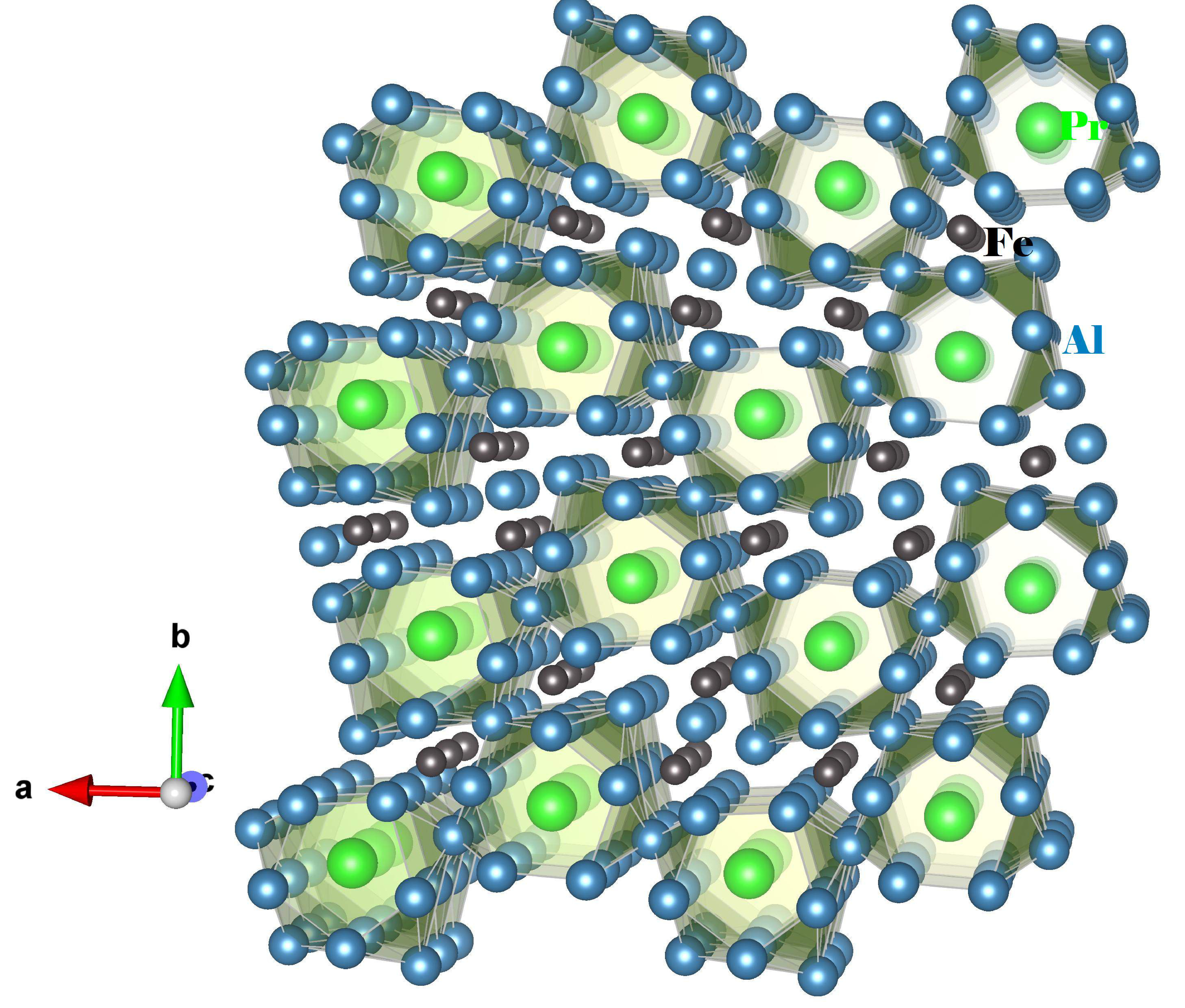 Figure 1
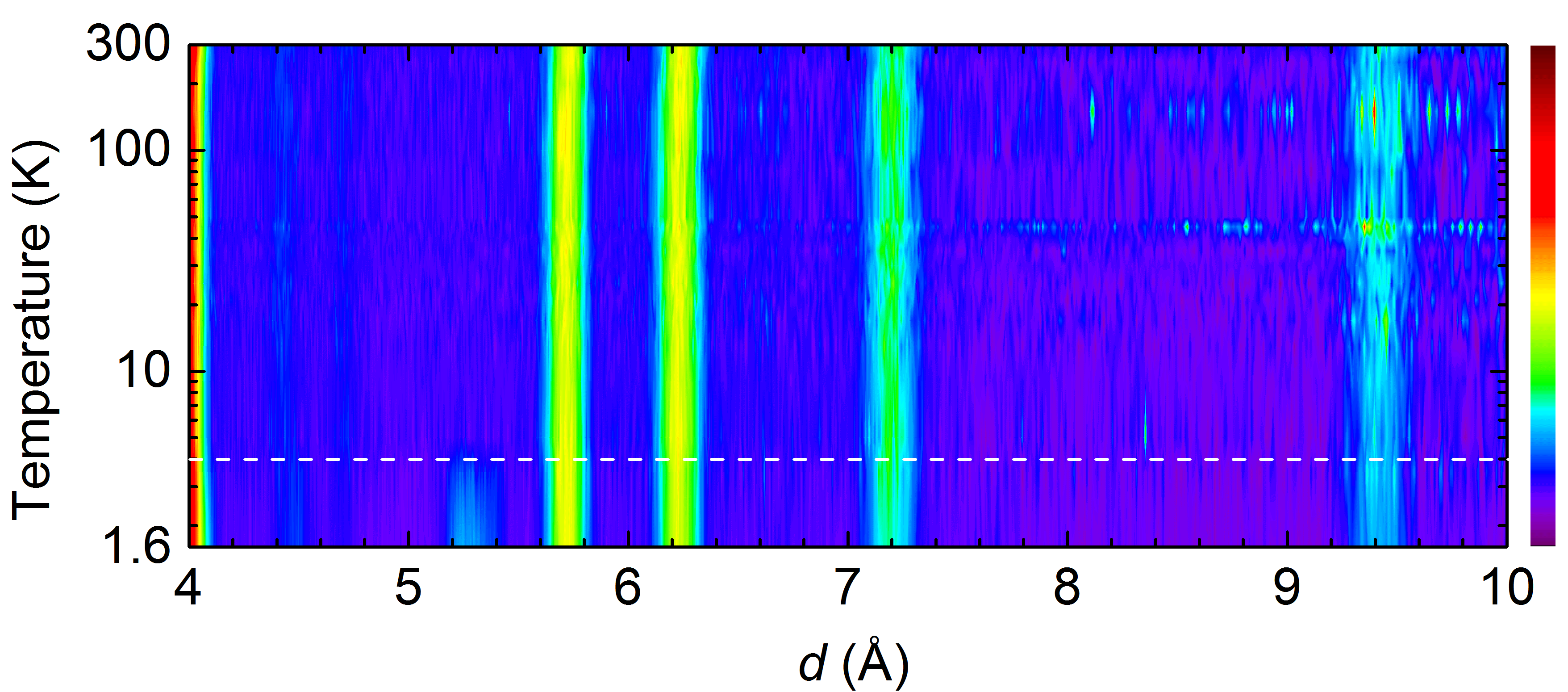 Figure 2
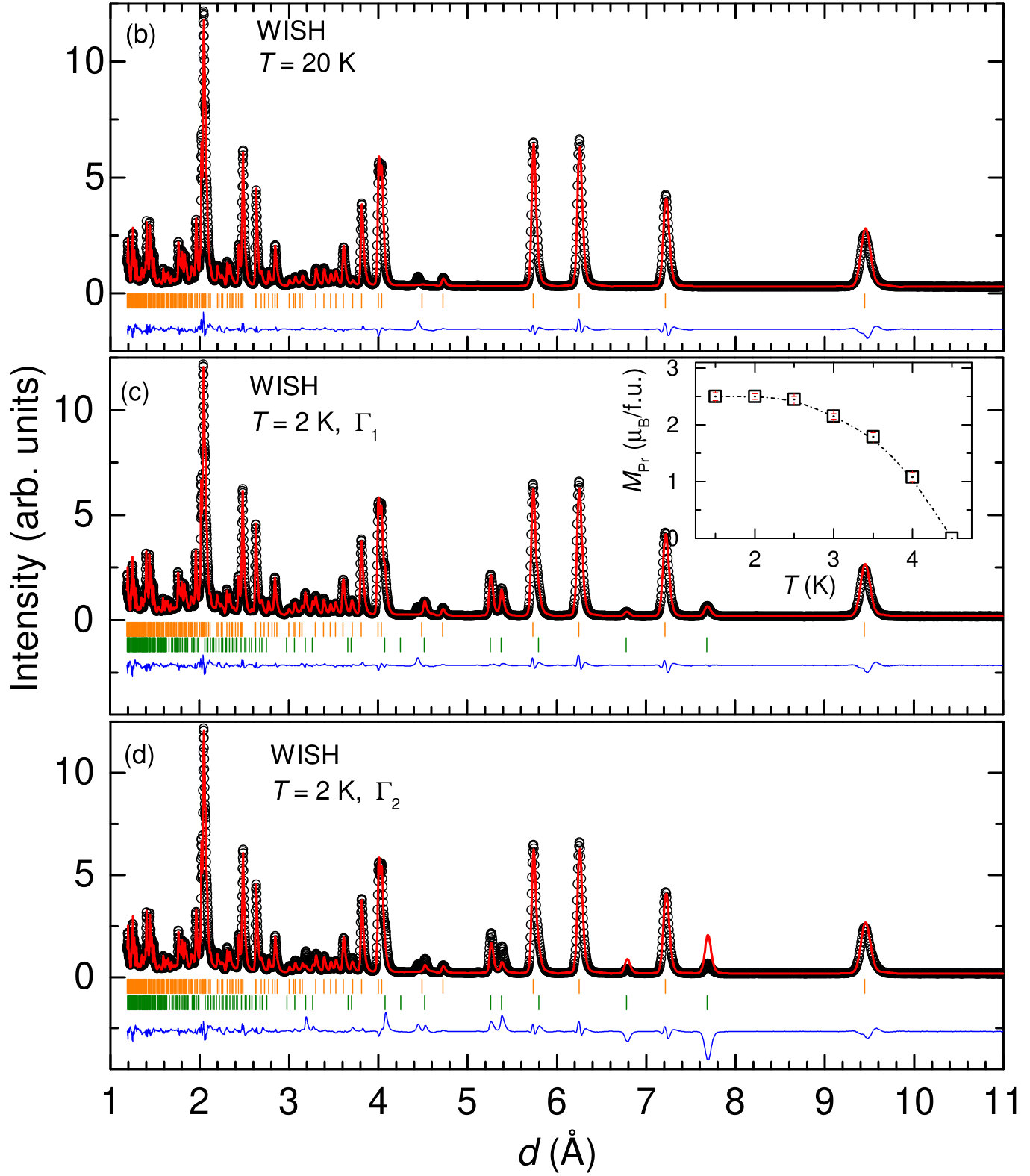 Figure 3
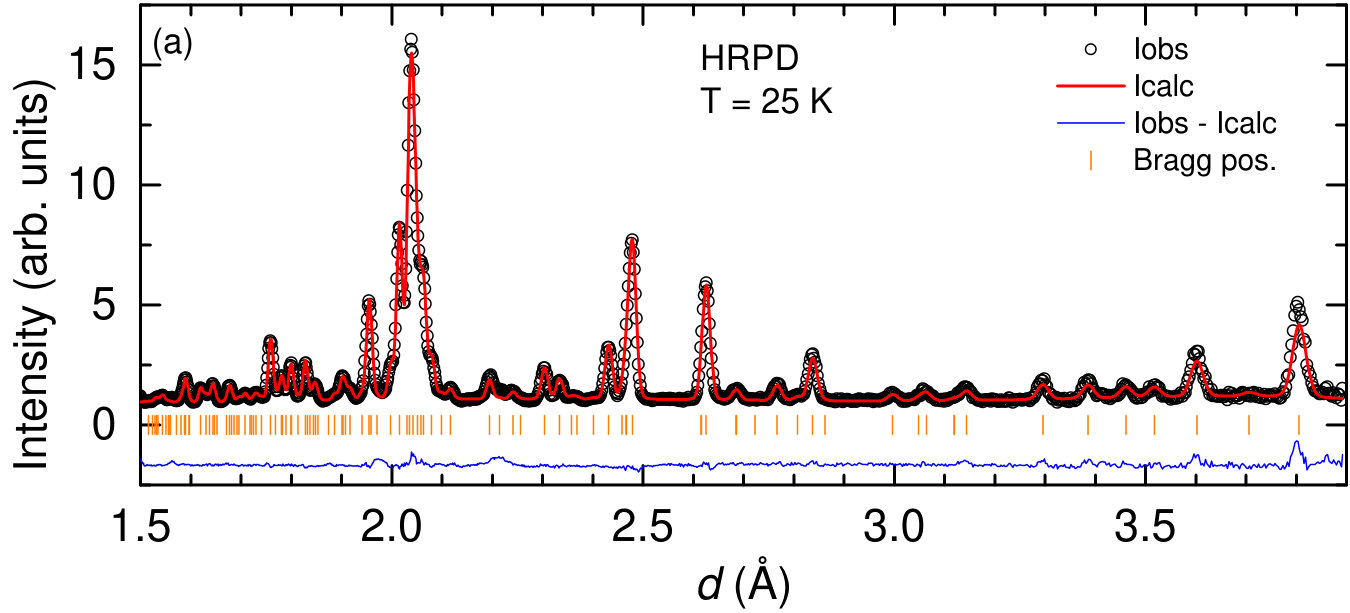 Figure 3
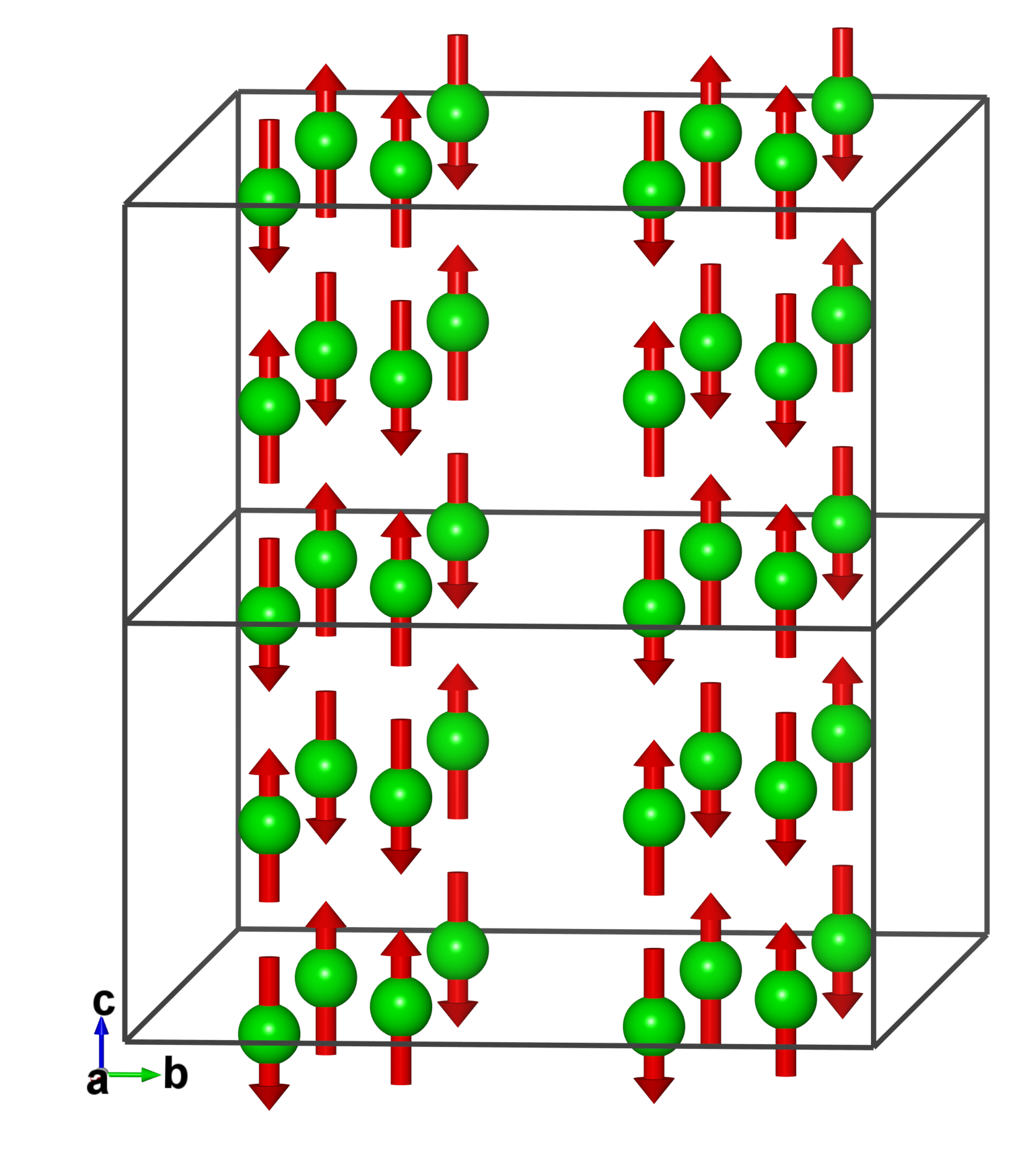 Figure 4
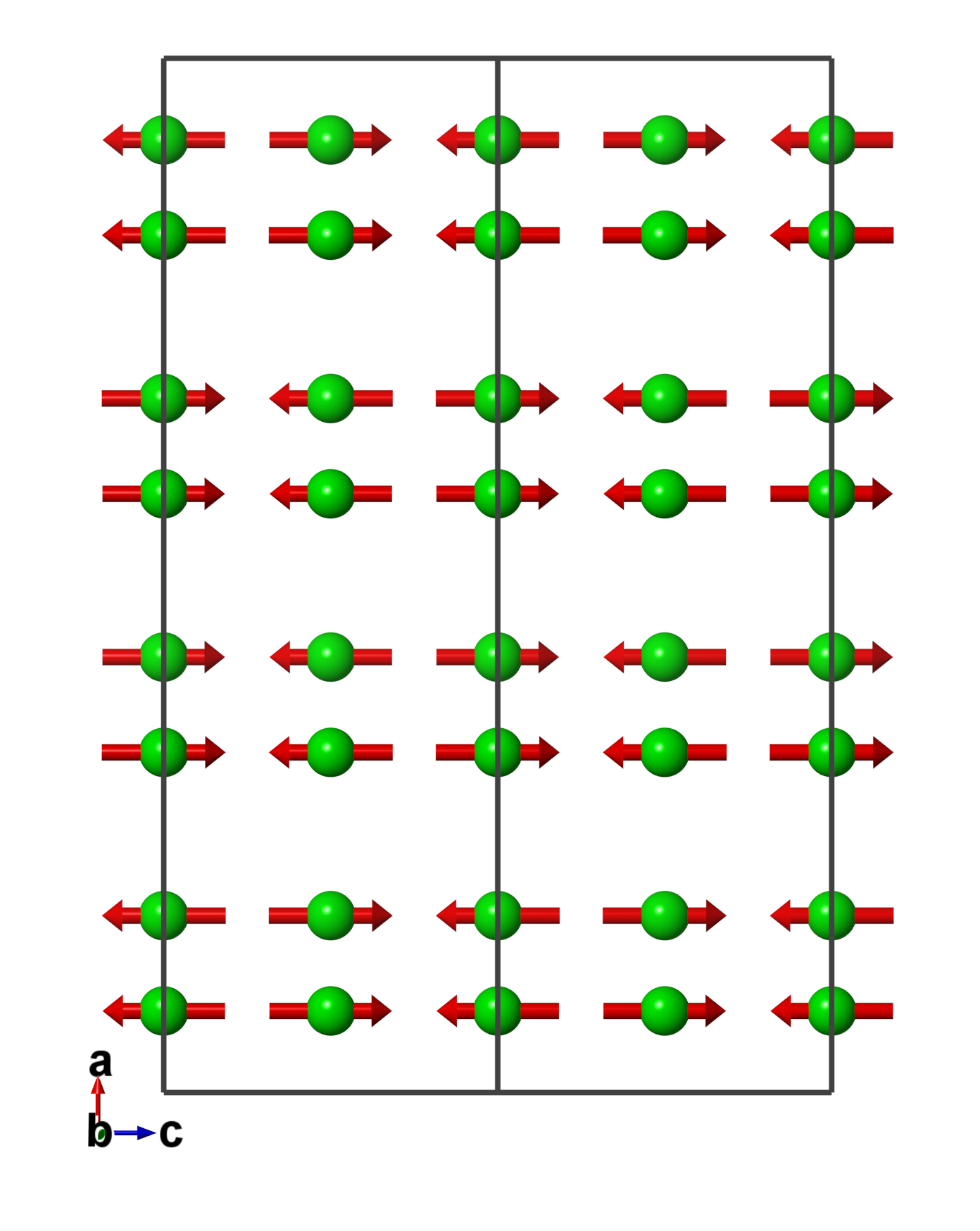 Figure 4
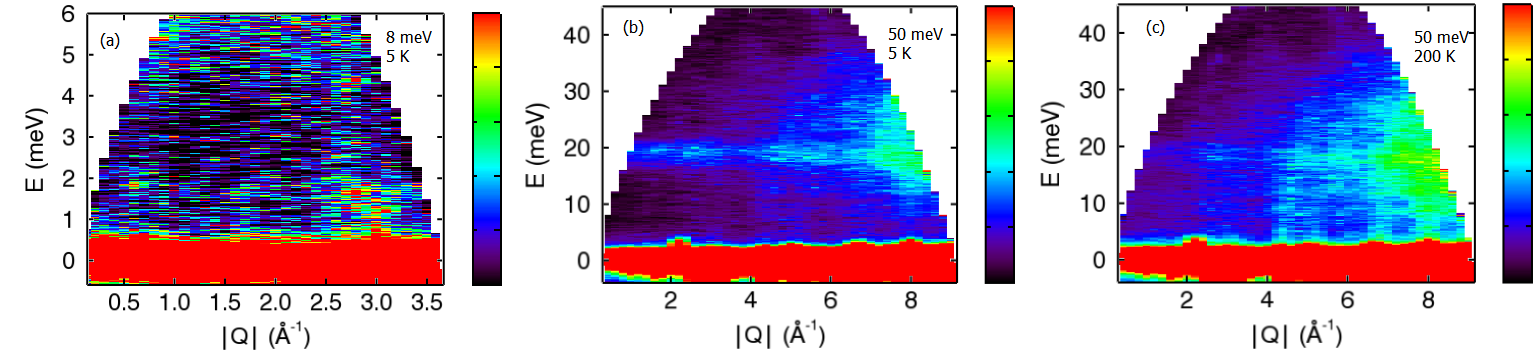 Figure 5
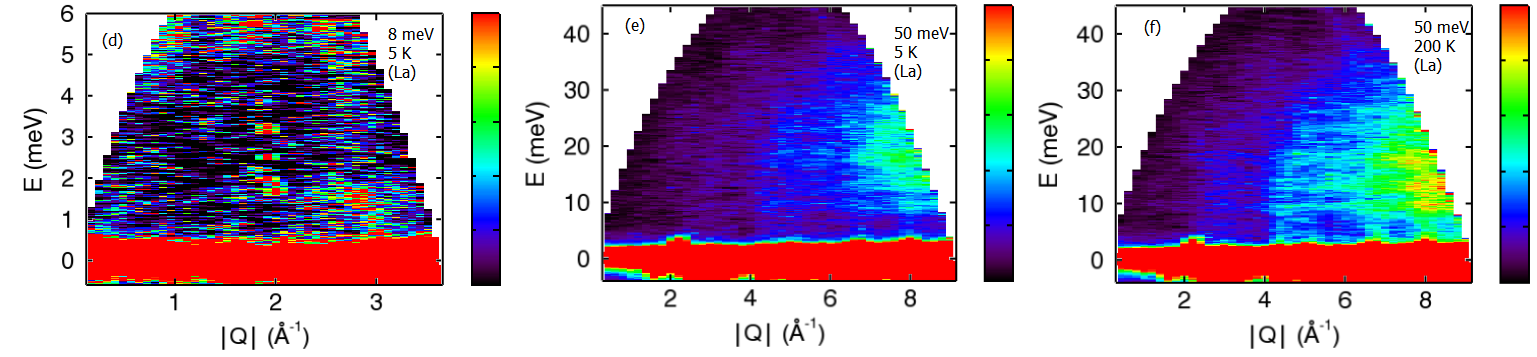 Figure 5
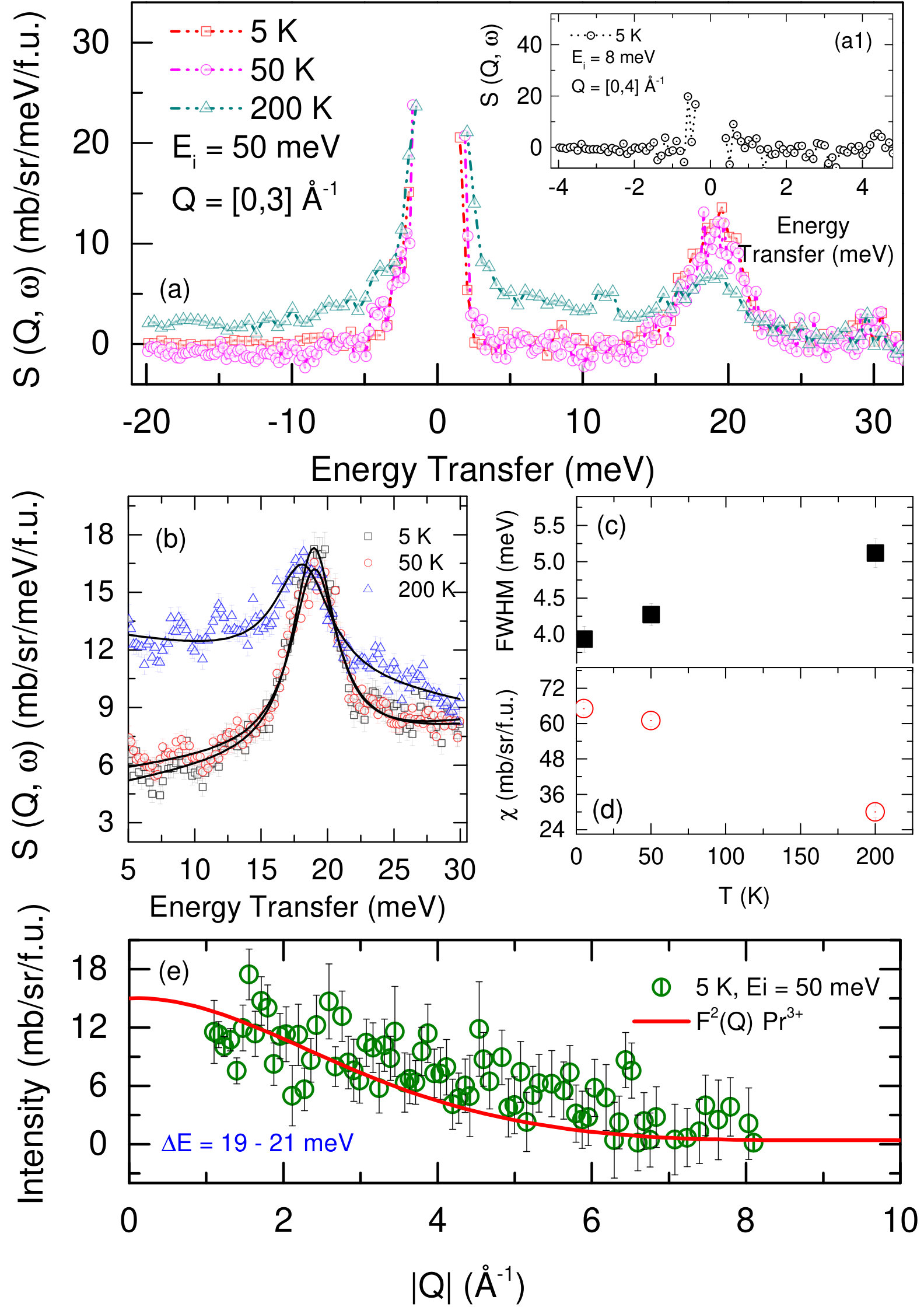 Figure 6
| 300 K | 150 K | 25 K | |
|---|---|---|---|
| (Å) | 12.5101(3) | 12.4871(5) | 12.4799(4) |
| (Å) | 14.4383(3) | 14.4168(6) | 14.4081(8) |
| (Å) | 4.0411(1) | 4.0332(8) | 4.0297(2) |
| 300 K | 150 K | 25 K | 1.6 K | |
| Pr-Pr () | 4.0411(9) Å | 4.0334(6) Å | 4.0297(2) Å | 4.0297(2) Å |
| Pr-Pr () | 6.572(9) Å | 6.562(11) Å | 6.559(11) Å | 6.554(13) Å |
| Pr-Pr () | 7.563(7) Å | 7.554(7) Å | 7.551(9) Å | 7.560(9) Å |
| Fe-Fe () | 4.0411(2) Å | 4.0335(6) Å | 4.0297(6) Å | 4.0297(8) Å |
| Fe-Fe () | 4.818(14) Å | 4.815(4) Å | 4.816(5) Å | 4.817(6) Å |
| Fe-Fe () | 2.754(4) Å | 2.748(5) Å | 2.757(5) Å | 2.762(7) Å |
| Pr () | 144.23(8)∘ | 144.12(7)∘ | 144.12(7)∘ | 144.36(9)∘ |
| Pr () | 145.32(9)∘ | 145.19(11)∘ | 145.15(10)∘ | 145.68(11)∘ |
Peer Reviews
No public reviews on file for this paper yet. If you reviewed it on a platform where reviews are public (OpenReview, ICLR, NeurIPS, ICML), you can paste yours below so the community can read it here.
Videos
No videos yet. Explain this paper in a talk, walkthrough, or lecture? Add one.
Pr-magnetism in the quasi-skutterudite compound PrFe2Al8
Harikrishnan S. Nair
[email protected], [email protected]
Highly Correlated Matter Research Group, Physics Department, P. O. Box 524, University of Johannesburg, Auckland Park 2006, South Africa
Department of Physics, Colorado State University, 200 W. Lake St., Fort Collins, CO 80523-1875, USA
Michael O. Ogunbunmi
Highly Correlated Matter Research Group, Physics Department, P. O. Box 524, University of Johannesburg, Auckland Park 2006, South Africa
C. M. N. Kumar
Laboratoire National des Champs Magnétiques Intenses, CNRS-INSA-UJF-UPS, 143 Avenue de Rangueil, F-31400 Toulouse, France
D. T. Adroja
ISIS Facility, STFC, Rutherford Appleton Laboratory, Chilton, Didcot, Oxfordshire OX11 0QX, United Kingdom
P. Manuel
ISIS Facility, STFC, Rutherford Appleton Laboratory, Chilton, Didcot, Oxfordshire OX11 0QX, United Kingdom
D. Fortes
ISIS Facility, STFC, Rutherford Appleton Laboratory, Chilton, Didcot, Oxfordshire OX11 0QX, United Kingdom
J. Taylor
ISIS Facility, STFC, Rutherford Appleton Laboratory, Chilton, Didcot, Oxfordshire OX11 0QX, United Kingdom
André M. Strydom
Highly Correlated Matter Research Group, Physics Department, P. O. Box 524, University of Johannesburg, Auckland Park 2006, South Africa
Abstract
The intermetallic compound PrFe2Al8 that possesses a three-dimensional network structure of Al polyhedra centered at the transition metal element Fe and the rare earth Pr is investigated through neutron powder diffraction and inelastic neutron scattering in order to elucidate the magnetic ground state of Pr and Fe and the crystal field effects of Pr. Our neutron diffraction study confirms long-range magnetic order of Pr below = 4.5 K in this compound. Subsequent magnetic structure estimation reveals a magnetic propagation vector = ( 0 ) with a magnetic moment value of 2.5 /Pr along the orthorhombic -axis and evidence the lack of ordering in the Fe sublattice. The inelastic neutron scattering study reveals one crystalline electric field excitation near 19 meV at 5 K in PrFe2Al8. The energy-integrated intensity of the 19 meV excitation as a function of follows the square of the magnetic form factor of Pr3+ thereby confirming that the inelastic excitation belongs to the Pr sublattice. The second sum rule applied to the dynamic structure factor indicates only 1.6(2) evolving at the 19 meV peak compared to the 3.58 for free Pr3+, indicating that the crystal field ground state is magnetic and the missing moment is associated with the resolution limited quasi-elastic line. The magnetic order occurring in Pr in PrFe2Al8 is counter-intuitive to the symmetry-allowed crystal field level scheme, hence, is suggestive of exchange-mediated mechanisms of ordering stemming from the magnetic ground state of the crystal field levels.
I Introduction
Intermetallic compounds possessing a cage-like crystal structure comprising of polyhedra that contain rare earth or transition metal atoms in their voids have been interesting compounds from the perspective of thermoelectric properties, however, the magnetism of rare earth that is placed in the cages is a relatively less-explored topic. The filled-skutterudites where = rare earth, = transition metal and = pnictogen, is a well-explored class of compounds sales_filled_1996 ; nolas_skutterudites:_1999 with the potential of making thermoelectric applications guo_development_2012 . The original binary skutterudite formula can be written as which, with the existence of voids in the original structure, may adopt a general formula or . The cubic Al20, known as the Frank Kasper compounds, provide another example of the caged-structure compounds similar to the filled-skutterudites, and have a large coordination number of atoms constructing the cage around the atomfrank_complex_1958 . They crystallize in the space group (227) with the ion surrounded by neighboring 16 atoms and the site is of a cubic point symmetry. A related caged-structure compound is the Al10 which has orthorhombic crystal structure with the space group (63) tursina_ceru2al10_2005 ; adroja_muon-spin-relaxation_2013 . In this caged system the atoms are 20-fold coordinated and are located inside Al cages. It is interesting to look at the magnetism of these caged-network compounds with Pr occupying the void inside the cage. For example, the filled-skutterudite PrRu4Sb12 shows a Van Vleck paramagnetic behaviour for most of the temperature range before entering a superconducting phase below 1.04 Ktakeda_superconducting_2000 ; adroja_probing_2005 . In the case of PrTi2Al20, a non-magnetic order parameter was identified below the magnetic transition at 2 Kito_sr_2011 . This was correlated with the ferroquadrupole ordering scenario. In the case of PrRu2Al10, which displayed metallic behaviour, no magnetic phase transition was recorded down to low temperaturesakoda_single_2012 .
These studies focusing on the rare earth magnetism in the caged-network points towards the interesting magnetic ordering or the lack of it, that may have a strong influence from the ligand field around the rare earth. The crystal field ground state of the ion in the cages play an important role in the magnetic ordering phenomena in these compounds. While many studies focused on the magnetism of the element in the cages, it must be noted that the magnetism of the element and the correlation between the two is an emergent theme in similar compounds. For example, ab-initio calculations in the Ce compounds have shown indication of correlation between the and the wave functionsslebarski2015study . Unexpected localization of Fe moments were experimentally observed in another caged compound Yb2Fe2Al10 where it was observed that the long-range ordering of the moments were avoided down to 0.4 Kkhuntia2014contiguous . These studies point to case of caged intermetallics where the rare earth and transition metal display cooperative phenomena in concert or as separate. With this background, we take a look at a rather less-studied caged-network intermetallic compound, PrFe2Al8 that belongs to the family of ( = Al, Ga).
The compounds crystallize in cubic space group. Figure 1 shows the projection of the crystal structure on -plane displaying the network of Al and the chain-like formation of Pr and Fe along the -axis. These structural peculiarities certainly have a bearing on the magnetism of this class of compounds, notably, a strong influence from crystal field effects. Depending on whether the crystal field levels are comparable in energy scales with other interactions (especially, magnetic exchange), a non-magnetic singlet or doublet crystal field ground state can result. To cite an example, the point charge model calculations that take in to account the local symmetry for the Pr site in PrSi predicts a splitting of = 4 Pr3+ ground state in to 9 singlets which renders spontaneous magnetic order impossible. However, an anomalous ferromagnetic ground state (with an ordering temperature of 55 K) was experimentally unraveled in PrSisnyman2012anomalous . Similarly, the point symmetry of the Pr-site in PrFe2Al8 is () which predicts 9 distinct singlets from a 9-fold degenerate state which consequentially presupposes a non-magnetic ground state. Our previous studies on PrFe2Al8 had revealed long-range magnetic order through macroscopic magnetization measurements which was assumed to have originated from the Pr magnetic sublatticenair2016magnetic . The Fe sublattice was deduced to be non-magnetic or as having only short-range spin correlations. In the present work, we investigate the magnetic ground state of PrFe2Al8 through neutron diffraction experiments and confirm that only Pr orders magnetically long-range while Fe is not. In addition, our study sheds light on the magnetic excitations and crystal field effects through inelastic neutron scattering.
II Experimental details
About 10 g of polycrystalline powder of PrFe2Al8 and LaFe2Al8 were prepared following the procedure outlined in Ref.nair2016magnetic . The powder samples were initially characterized using laboratory x-rays to check for purity of the chemical phase and using magnetometry to identify the magnetic phase transition. These preliminary checks confirmed the findings of Ref.nair2016magnetic . Time-of-flight (TOF) neutron powder diffraction experiments were carried out at the instrument HRPD at ISIS facility of the Rutherford Appleton Laboratory, UK mainly to characterize the temperature evolution of the crystal structure. Diffraction patterns covering a -spacing range 0.75 - 4 Å were obtained at 19 temperature points in the interval of 300 K to 1.6 K. Additionally, experiments were also performed using the TOF diffractometer WISH on TS2 at ISIS facility especially covering the higher -spacing range of 1.2 - 11 Å in order to unambiguously determine the magnetic structure of PrFe2Al8. Inelastic neutron scattering experiments were performed on 10 g of PrFe2Al8 powder sample using the TOF chopper spectrometer MARI at ISIS facility. PrFe2Al8 powder from the same batch was used in all the three experiments. Incident neutron energies = 8 meV, 50 meV and 150 meV were selected for the experiment. The chopper frequencies were set at 150 Hz, 250 Hz, and 400 Hz, respectively. Data were collected mainly at 5 K, 50 K, 200 K and at 300 K. As a non-magnetic reference, the inelastic response of LaFe2Al8 was also recorded to serve as a phonon estimate for PrFe2Al8. The inelastic neutron data was analyzed using the software DAVEdave . Rietveld refinementrietveld of the diffraction data were carried out using FULLPROF software fullprof . The software SARAsarah was used for the representation analysis of magnetic structure from diffraction data.
III Results
III.1 Neutron Diffraction
A 2D contour plot of the diffracted intensity from PrFe2Al8 obtained from the diffraction data of bank-3 of HRPD, is shown in figure 2 as a function of temperature and -spacing. Diffracted intensity due to Bragg scattering from the nuclear structure is present at 4 Å, 5.5 Å, 6.2 Å, 7.2 Å and 9.5 Å. It is observed that additional magnetic intensity develops only below 4 K, at the -spacing 5.3 Å, which is indicated in figure 2 by a horizontal white dashed-line. Note that the temperature-axis is plotted in log-scale for clarity. According to our previous investigation on PrFe2Al8 nair2016magnetic , long-range magnetic order sets in only below 4 K. The experimental evidence in figure 2 supports this assignment of magnetic phase transition temperature 4 K for Pr. In our previous work signatures akin to short-range spin fluctuations in the Fe lattice were observed in magnetic susceptibility at 34 K. No magnetic scattered intensity is developed at around 34 K in the present diffraction data thereby ruling out the presence of magnetic ordering on the Fe lattice in this compound. More concretely, in a later subsection of the present paper, it is shown through inelastic neutron data that the energy-integrated intensity as a function of follows the magnetic form factor of Pr3+ there by confirming that only Pr orders magnetically in PrFe2Al8.
The neutron powder diffraction intensity pattern of PrFe2Al8 at 25 K obtained from HRPD, is plotted in figure 3 (a) (black circles) as a function of -spacing. The red solid line in the figure is the result of a Rietveld fit to the data using space group. From the magnetization measurements we know that at 25 K PrFe2Al8 is not magnetically ordered and hence the diffraction data was modeled using only the nuclear structure in the space group model as has been used in our previous work nair2016magnetic . The diffracted intensity at 300 K (not shown) is similar to that at 25 K as presented in figure 3 (a) and no signature of any structural phase transition is observed in this temperature interval of 300 - 25 K. The lattice parameters , and show a gradual decrease with temperature as can be seen from the values at 300 K, 150 K and 25 K collected in Table (1). Also presented in Table (1) are the atomic parameters of PrFe2Al8 at 300 K. The crystal structure of PrFe2Al8 in space group has Pr occupying a single Wyckoff position tougait_jssc_2005prco . The crystal structure is a close-packed arrangement of three dimensional Al polyhedra which are packed face-sharing to form chains of Pr and Fe along the -axis separated from each other by the Fe-Al network (see figure 1). The shortest Pr-Pr and Fe-Fe distances are parallel to the -axis. As a function of temperature, the Pr-Pr and the Fe-Fe nearest-neighbour distances undergo only slight variation. A slight decrease in the nearest-neighbour distances is observed in all the directions , and . The bond angles between the nearest Pr atoms also do not vary significantly down till 1.6 K. Along and directions, they remain close to the values 144∘ and 145∘ respectively. The bond parameters as a function of temperature are collected in Table (2).
One of the important questions about the magnetism of PrFe2Al8 is whether Pr and Fe in this compound order in a magnetically long-range fashion, either individually or jointly, or not. In our previous studynair2016magnetic , magnetic anomalies at 34 K and 4 K were observed in the magnetization measurements. The anomaly at was attributed to short-range order in the Fe lattice or due to minute amount of magnetic impurity; whereas was attributed to long-range order in the Pr magnetic lattice. Hence, one of the major aims of our neutron diffraction experiments was to determine the microscopic nature of the magnetic phase transitions pertaining to Fe or Pr in PrFe2Al8. Since, through the low angle bank of HRPD, the development of long-range magnetic order in the Pr sublattice was observed to occur below 4 K, we performed a detailed low temperature neutron diffraction measurements using the WISH diffractometer in the temperature range 2 K to 50 K covering a larger -spacing up to 11 Å. The diffracted intensity at 50 K was identical to that of 20 K. No additional magnetic Bragg peaks or short range magnetic diffuse scattering were observed at 20 K. Also, there was no enhancement of diffracted intensity at low temperatures suggesting ferromagnetic contributions at nuclear Bragg positions. These results confirm that the 34 K transition observed previouslynair2016magnetic in the magnetic susceptibility is not from the bulk of the sample.
The neutron diffraction patterns at 20 K and 2 K obtained from WISH along with the Rietveld refinement results are presented in figure 3 (b), (c) and (d). It can be readily observed that additional scattered intensity has developed at 2 K as compared to the intensity profiles at high temperatures. Especially, new peaks at 5.25 Å, 5.37 Å, 6.78 Å and 7.68 Å emerge. The nuclear structure below 4 K conforms to , which is the crystal structure at 300 K. Hence, any structural phase transformation in the temperature range 300 - 4 K is ruled out. In order to ascertain the ordering is from Pr or Fe or from both in PrFe2Al8 first, a determination of the magnetic propagation vector was undertaken. Using the -search utility in the FULLPROF suite of programs, the most probable propagation vector was determined as to be used for the representation analysis of magnetic structure. According to the symmetry analysis for the orthorhombic space group, two magnetic representations and - both antiferromagnetic - were found as acceptable solutions for the magnetic structure of Pr3+ in PrFe2Al8. Hence, Rietveld refinement of diffracted intensity at 2 K was performed by assuming the nuclear space group as and the magnetic representation as or . The magnetic -factor for the refinements with or were 3.4 and 80 respectively, indicating that is the best fit. In this representation, Pr moments order antiferromagnetically with moment direction along the orthorhombic -axis.
In the panel (d) of Figure 3, the Rietveld refinement of 2 K data of PrFe2Al8 is shown, with the fits using representation (lower tick marks). Noticeably, the intensities are not correctly accounted for in this model (near 5.5 Åand 7.7 Å). A refinement model that allows for long-range magnetic order in both Pr and Fe lattices did not lead to an improved fit and hence was discarded. The experimental data did not fit to a model that considers only the Fe moment ordering, either. Moreover, from our previous experimental studynair2016magnetic it was understood that the magnetic anomaly tentatively attributed to Fe at was very broad suggesting short-range correlations to be present rather than a conventional paramagnet-to-antiferromagnet phase transition. A value of 2.5 /Pr is obtained at 2 K for the neutron-derived ordered moment of Pr. A gradual decrease of the ordered magnetic moment was observed until = 4.5 K. The temperature-evolution of the ordered moment of Pr, , is presented in the inset of figure 3 (c). The dashed line in the inset serves as a guide to eye. The antiferromagnetic magnetic structure adopted by Pr3+ moments in PrFe2Al8 is pictured in figure 4.
III.2 Inelastic Neutron Scattering
Once we determined the magnetic structure of PrFe2Al8 we now proceed to study the magnetic excitations and the crystal field effects using inelastic neutron scattering methods. The inelastic neutron scattering intensity of PrFe2Al8 at different incident neutron energies and temperatures are presented in figure 5 (a) through (f) where color maps of energy transfer (in meV) versus momentum transfer ( in ) are shown. Specifically, (a) = 8 meV, = 5 K, (b) = 50 meV, = 5 K and (c) = 50 meV, = 200 K for PrFe2Al8 are shown. The inelastic intensity of the non-magnetic reference compound LaFe2Al8 are shown in (d) = 8 meV, = 5 K, (e) = 50 meV, = 5 K and (f) = 50 meV, = 200 K. The intensity pattern at 5 K and at 200 K are essentially identical, suggesting that there is no magnetic low lying excitations in the energy range approximatley up to 10 meV. The absence of any excited state transition at 200 K suggests that there are no CEF levels below 15 meV, which have non-zero matrix elements. At low energy transfer, for example with = 8 meV (shown in (a)), no magnetic inelastic excitations are observed in PrFe2Al8. This result indicates that the quasi-elastic linewidth is very small and not able to detect within the resolution of MARI ( = 0.19 meV for = 8 meV, 150 Hz). In figure 5, only one inelastic excitation is seen present at all the temperatures, viz., at 19 meV which arises from the crystal field excitation of the Pr3+ crystal field levels, as can be seen from the panel (b) with incoming energy, = 50 meV at 5 K. The inelastic spectra shown in figure 5 also suggest the absence of magnetic ordering down to 5 K, as one would expect spin wave excitations in an ordered state. Further the -dependent cuts (not shown) obtained by binning the energy from -2 meV to 2 meV (from (a) and (b)) did not reveal any magnetic Bragg peaks at 5 K. From panels (d, e) that represent the inelastic scattered intensity of LaFe2Al8 at 5 K, it is clear that no magnetic intensity is present in the non-magnetic analogue compound, which indicates that the Fe atoms do not have ordered magnetic moments in LaFe2Al8 or PrFe2Al8. An versus plot of PrFe2Al8 obtained using = 150 meV (not shown here) also did not provide any evidence of other CEF excitations between 20 meV and 145 meV. The high intensity observed in (d) towards the high- originates from the phonon contribution. The inelastic intensity of PrFe2Al8 at 200 K (in (c)) is compared with that of LaFe2Al8 in the panels (e) and (f), which further confirmed that high- intensity is mainly dominated by the phonon scattering as its intensity shows an increase with increasing temperature.
The -integrated (0 to 3 ) dynamic structure factor, , for PrFe2Al8 as a function of energy transfer at = 50 meV is presented in figure 6 (a) for 5 K, 50 K and 200 K. The location in the graph where energy transfer equals zero corresponds to the elastic line. The inelastic signal arising from the crystal field effect is observed at 19 meV which diminishes in intensity as temperature is raised. The dependence on energy transfer with = 8 meV is shown in the inset (a1), which shows the absence of any excitations in the energy range accessed. The dynamic structure factor for inelastic neutron scattering of unpolarized neutrons is given by the equationholland1982anomalous ,
[TABLE]
where is the magnetic form factor of the magnetic ion, is the static magnetic susceptibility and is a spectral function. The first term on the right-hand-side is the Bose factor for the thermal occupation of levels. Curve fits to the 19 meV excitation according to Equation (1) is shown in Figure 6 (b) for 5 K, 50 K and 200 K. The FWHM of the peaks as well as the area under the peak which corresponds to the local susceptibility were extracted from these fits and presented respectively in panels (c) and (d) of Figure 6. A gradual broadening of the peaks with increasing temperature is observed, suggested by the increasing FWHM and decreasing susceptibility. A peak is observed at 12 meV for the 200 K data (in the main panel of (a)) which, in fact, is narrower than the resolution and hence is judged as a spurious peak.
The -dependence of integrated intensity at 5 K, binned in the interval of 19 - 21 meV is shown in the panel (e) plotted together with the square of the magnetic form factor, for Pr3+. The integrated intensity follows the for Pr3+ closely, suggesting that the inelastic excitation in PrFe2Al8 results from single ion effects of Pr3+. In order to estimate the magnetic moment from the inelastic signal at 19 meV, use was made of the second sum rule:
[TABLE]
where is the dynamic structure factor, is the magnetic form factor, = 48.6 mb/sr/ is a constantholland1982anomalous and is the effective magnetic moment. From the integrated intensity at the 19 meV peak of PrFe2Al8 the effective moment value was estimated as = 1.6(2) which is almost half of the spin-orbit coupled magnetic moment = 3.58 of Pr3+, = 4. The low value of the moment associated with 19 meV excitation along with the heat capacity results, which suggest a doublet CEF ground state, indicates that the missing Pr moment is associated with a narrow resolution limited quasi-elastic scattering from the ground state.
IV Discussion
The specific heat of PrFe2Al8 showed a clear indication of a peak at 4 K where the Pr begins to order magneticallynair2016magnetic . The magnetic contribution to the specific heat was obtained by subtracting the non-magnetic specific heat of LaFe2Al8. The estimate of crystal field levels were obtained by modeling the Schottky peak using a 9-level model for the crystal field levels. The first excited crystal field level was calculated at 10 K and from the behaviour of magnetic entropy as a function of temperature, a full occupation of the 9 levels was found to happen at 200 K where the entropy reaches ln(9). From the inelastic neutron scattering data, a single excitation is discernible at 19 meV which corresponds to 200 K. The first excited level near 10 K ( 0.8 meV) is not observed in the inelastic data with either = 8 meV or 50 meV, which could be due to the zero matrix element between these wave functions - the intensity of CEF excitation vary as a square of this matrix element. However, since only one excitation is revealed in the inelastic scattering experiment, a full crystal field analysis to estimate all the 9 crystal field levels is not possible in the present case. Considering orthorhombic point symmetry () of Pr ion in PrFe2Al8 there will be nine non-zero crystal field parameters in the Hamiltonian and hence a single observed CEF excitation is not sufficient to fit the CEF model. The temperature dependence of the inelastic excitation peak at 19 meV shown in figure 6 (a) indicates that the peak position does not shift with temperature, confirming the origin of the excitation to be crystal field effect. Moreover, the integrated intensity at 19 meV as a function of follows the square of form factor of Pr3+ confirming that the magnetism in PrFe2Al8 is purely from Pr3+. Though the previous magnetization study of PrFe2Al8 indicated short-range magnetic order due to Fe, the neutron scattering results (figure 2) do not show any indication of this. The diffraction results only indicate that the long-range magnetic ordering in PrFe2Al8 at 4.5 K pertains only to the Pr sublattice where the moments order antiferromagnetically. The crystal field level scheme for = 4, Pr3+ in the local symmetry of predicts a singlet ground state. The 2 + 1 = 9 fold multiplet of Pr3+ splits so that a crystal field singlet is always present for all type of crystallographic symmetrywalter_treating_1984 . Pr-based intermetallics often display singlet ground states however, also have been found to lead to exotic behaviour such as the observation of heavy fermion superconductivitybauer_superconductivity_2002 ; goremychkin_crystal_2004 . Not only that, in certain Pr based systems like PrAu2Si2-related compounds, frustration effects on the magnetic ground state were argued to be introduced by crystal field effectsgoremychkin2008spin . In fact, a competition between the crystal field interaction and the magnetic exchange energy strengths were observed in these compounds, eventually, resulting in a novel spin glass ground state. Magnetic long range order also happens in several systems despite the crystal field level scheme warranting otherwise. PrIrSi3 is one such system where Pr displays long range magnetic orderanand2014investigations . However a large separation of about 90 K is observed between the first excited crystal field levels of PrIrSi3. Induced moment magnetic ordering in this compound would require very high internal exchange energy to achieve ordering. In some other Pr-based compounds like PrRu2Si2 and PrNi2Si2, relatively smaller crystal field separations are (of 2.25 meV and 3.3 meV, respectively) mulders_prru2si2_1997 ; blanco_specific_1992 . In the present case of PrFe2Al8 the knowledge of the first excited crystal field level first originated from a simulation of the Schottky specific heat, which predicts the first level at around 10 K. An estimation of the exchange constant is in general possible through the relation, = where is the Curie-Weiss temperature and is the exchange constant. However, in the case of PrFe2Al8 it was found that the inverse magnetic susceptibility did not follow a linear trend due to the presence of Fe short-range fluctuations and hence a mean-field estimate of was not possible. Comparing the ground state energy scale in PrFe2Al8 with other compounds like PrIrSi3 or with PrRu2Si2 and PrNi2Si2, it seems more plausible that an exchange-generated admixture of low lying crystal field energy levels is possible in the case of PrFe2Al8.
V Conclusions
In conclusion, through neutron powder diffraction and inelastic scattering experiments we determined the magnetism of the quasi-skutterudite compound PrFe2Al8Ṫhrough the analysis of the neutron diffraction data, it is found that only Pr develops long-range magnetic order in this compound with a = 4.5 K. The Pr3+ moments adopt antiferromagnetic arrangement with moments along the -axis and a propagation vector . Only one magnetic excitation at 19 meV is observed in the inelastic neutron scattering data of PrFe2Al8 corresponding to the crystal field excitation from Pr3+ levels. The presence of only one excitation detected in our experiments has rendered the estimation of the full crystal field level scheme of Pr3+ in PrFe2Al8 impossible as there are nine free crystal field parameters to be determined from the one excitation. However, from the -dependence of integrated magnetic intensity it is confirmed that the magnetism in PrFe2Al8 is solely governed by Pr while the Fe sublattice remains magnetically inactive down to 2 K.
Acknowledgements
HSN acknowledges FRC/URC for a postdoctoral fellowship. AMS thanks the SA-NRF (93549) and the FRC/URC of UJ for financial assistance. DTA thanks CMPC-STFC grant number CMPC-09108 for the funding. We would like to thank A. Bhattacharyya for his help on MARI experiment.
The reference list from the paper itself. Each links out to its DOI / PubMed record.
- 1(1) Sales B C, Mandrus D and Williams R K 1996 Science 272 1325
- 2(2) Nolas G S, Morelli D T and Tritt T M 1999 Ann. Rev. Mater. Sci. 29 89–116
- 3(3) Guo J Q, Geng H Y, Ochi T, Suzuki S, Kikuchi M, Yamaguchi Y and Ito S 2012 J. Elec. Mater. 41 1036–1042
- 4(4) Frank F C and Kasper J S 1958 Acta Crystallogr. 11 184–190
- 5(5) Tursina A I, Nesterenko S N, Murashova E V, Chernyshev I V, Noël H and Seropegin Y D 2005 Acta Crystallogr. E 61 i 12–i 14
- 6(6) Adroja D T, Hillier A D, Muro Y, Takabatake T, Strydom A M, Bhattacharyya A, Daoud-Aladin A and Taylor J W 2013 Physica Scripta 88 068505
- 7(7) Takeda N and Ishikawa M 2000 J. Phys. Soc. Jpn. 69 868–873
- 8(8) Adroja D T, Hillier A D, Park J G, Goremychkin E A, Mc Ewen K A, Takeda N, Osborn R, Rainford B D and Ibberson R M 2005 Physical Review B 72 184503