
TL;DR
This paper analyzes neural network robustness by providing tight bounds on neuron failures without retraining, leveraging Lipschitz continuity, and distinguishing failure types, with implications for memory efficiency and cost-accuracy trade-offs.
Contribution
It introduces a novel bound on error propagation due to neuron failures, applicable to various failure models, and connects robustness with memory and learning costs.
Findings
Bound on neuron failure tolerance without harming computation
Extension of bounds to synapse failures and Byzantine neurons
Implications for memory cost reduction and robustness trade-offs
Abstract
We view a neural network as a distributed system of which neurons can fail independently, and we evaluate its robustness in the absence of any (recovery) learning phase. We give tight bounds on the number of neurons that can fail without harming the result of a computation. To determine our bounds, we leverage the fact that neural activation functions are Lipschitz-continuous. Our bound is on a quantity, we call the \textit{Forward Error Propagation}, capturing how much error is propagated by a neural network when a given number of components is failing, computing this quantity only requires looking at the topology of the network, while experimentally assessing the robustness of a network requires the costly experiment of looking at all the possible inputs and testing all the possible configurations of the network corresponding to different failure situations, facing a discouraging…
Click any figure to enlarge with its caption.
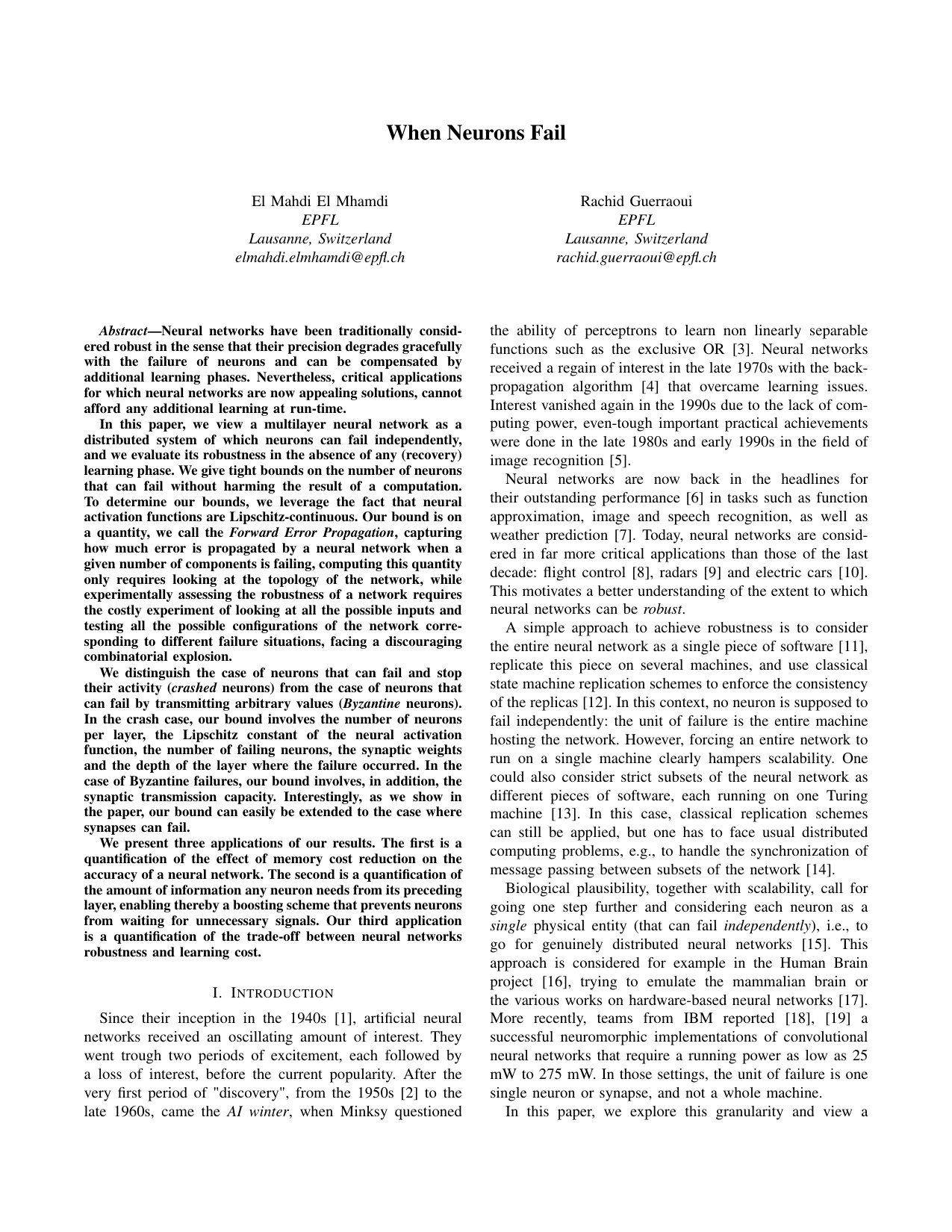 Figure 1
Peer Reviews
No public reviews on file for this paper yet. If you reviewed it on a platform where reviews are public (OpenReview, ICLR, NeurIPS, ICML), you can paste yours below so the community can read it here.
Videos
No videos yet. Explain this paper in a talk, walkthrough, or lecture? Add one.
See pages 1-last of IPDPS_2017_IEEE_camera_ready.pdf