Dyakonov Waves in Biaxial Anisotropic Crystals
Evgenii Narimanov

TL;DR
This paper develops a comprehensive analytical framework for Dyakonov surface waves at the interface of biaxial anisotropic and isotropic media, revealing distinct classes and explicit dispersion relations.
Contribution
It introduces a general analytical theory for Dyakonov waves in biaxial crystals, classifying different wave types and deriving their dispersion characteristics.
Findings
Dyakonov waves can be divided into two distinct classes with different spatial behaviors.
Explicit expressions for dispersion relations of Dyakonov waves are derived.
Parameter ranges for the existence of these waves are identified.
Abstract
We present the general analytical theory for Dyakonov surface waves at the interface of a biaxial anisotropic dielectric with an isotropic medium. We demonstrate that these surface waves can be divided into todo distinct classes, with qualitatively different spatial behavior. We obtain explicit expressions for the Dyakonov waves dispersion and the parameter range for their existence.
Click any figure to enlarge with its caption.
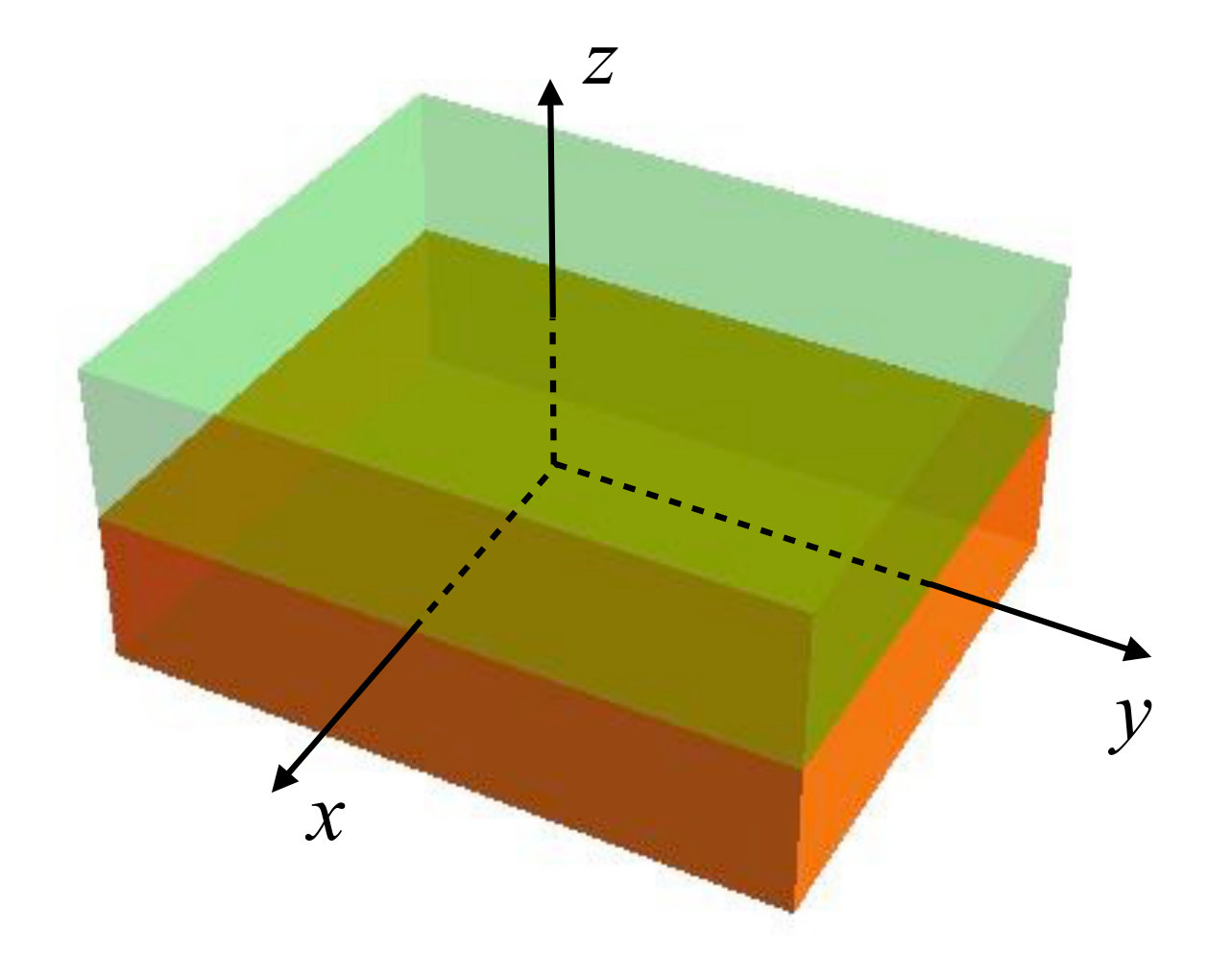 Figure 0
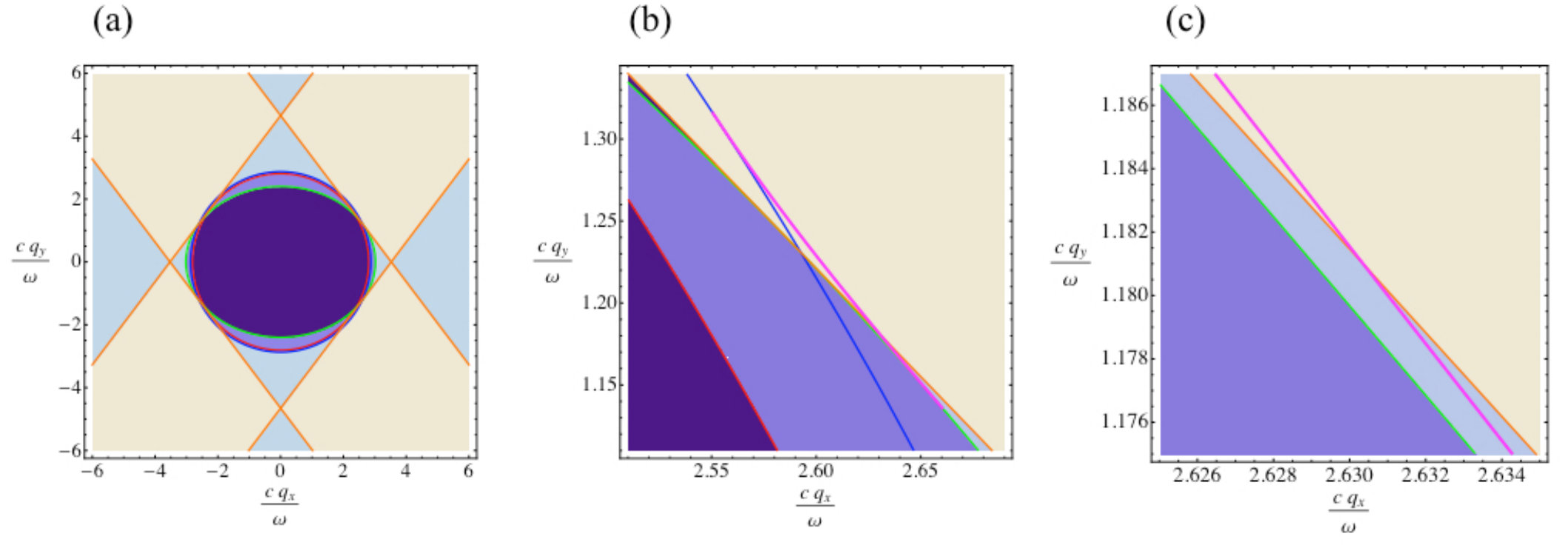 Figure 101
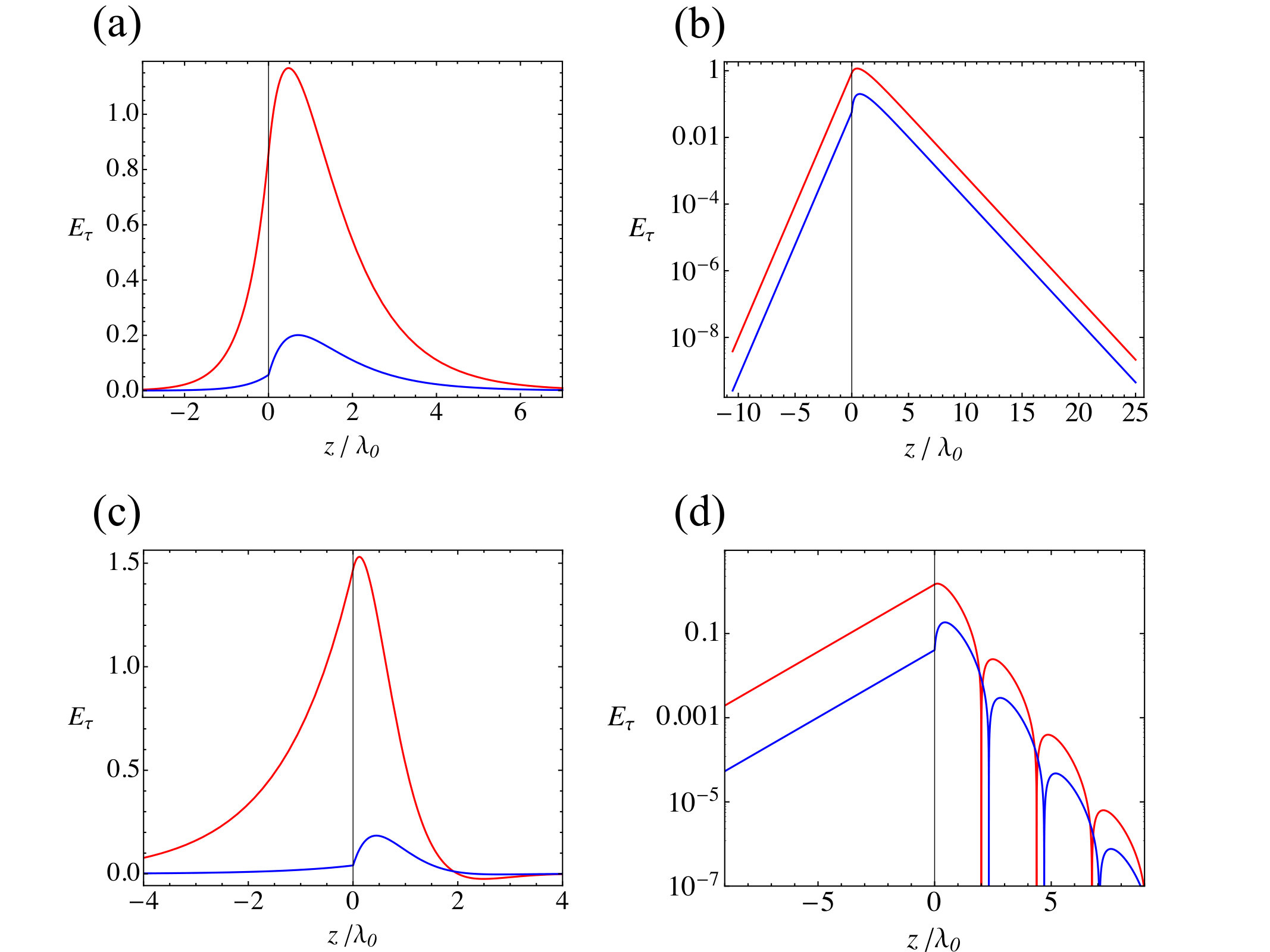 Figure 111
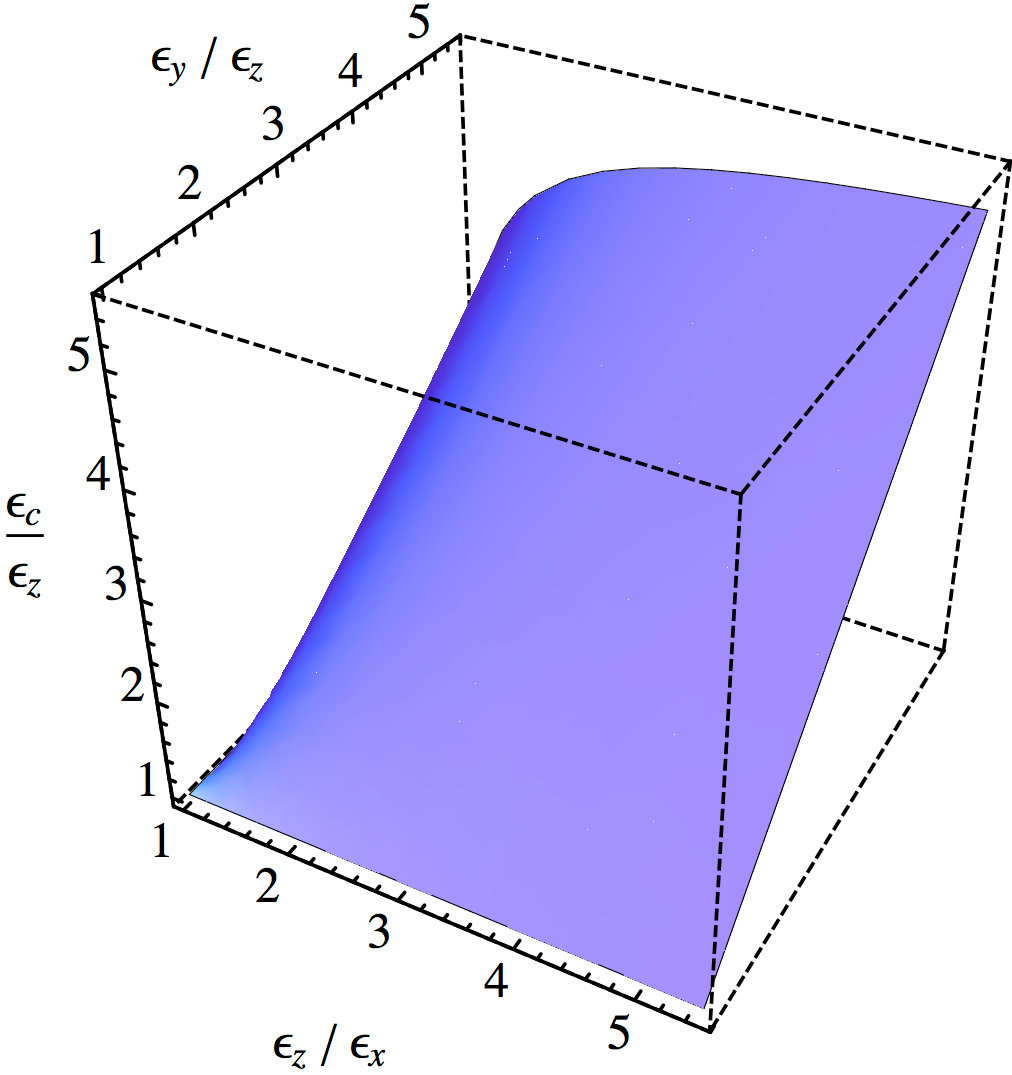 Figure 122
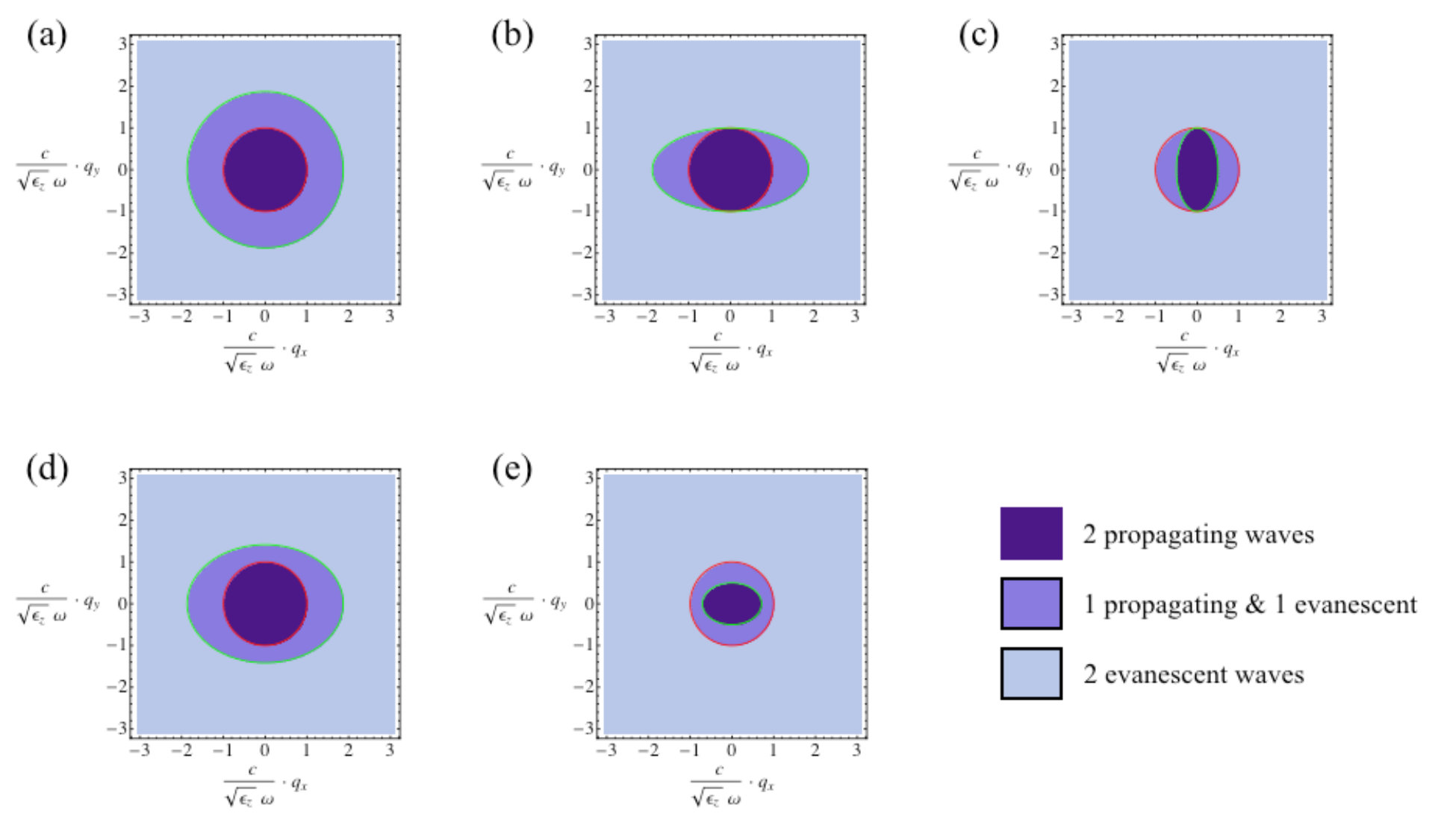 Figure 41
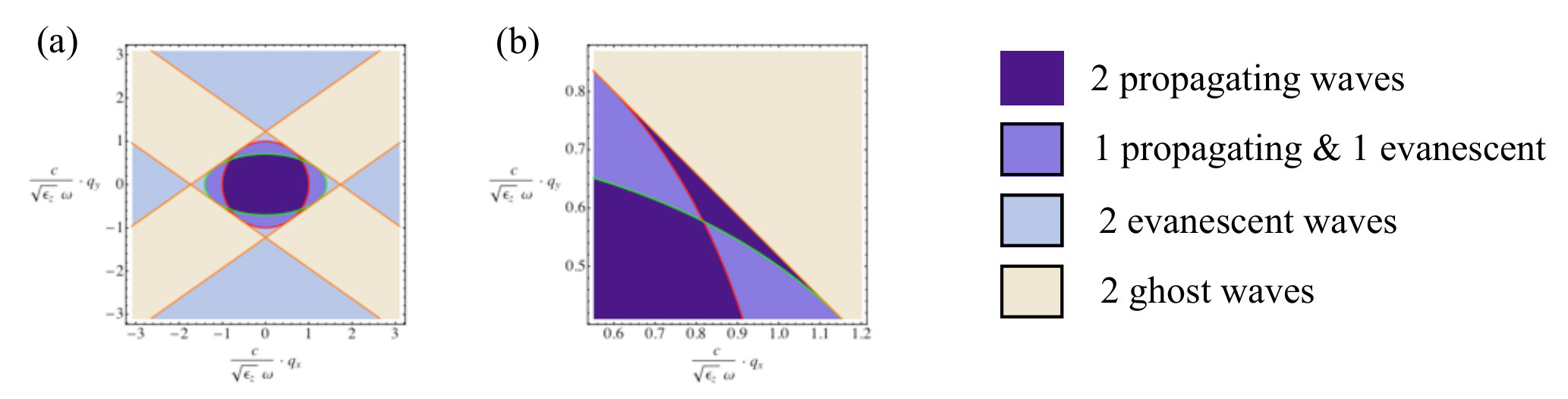 Figure 52
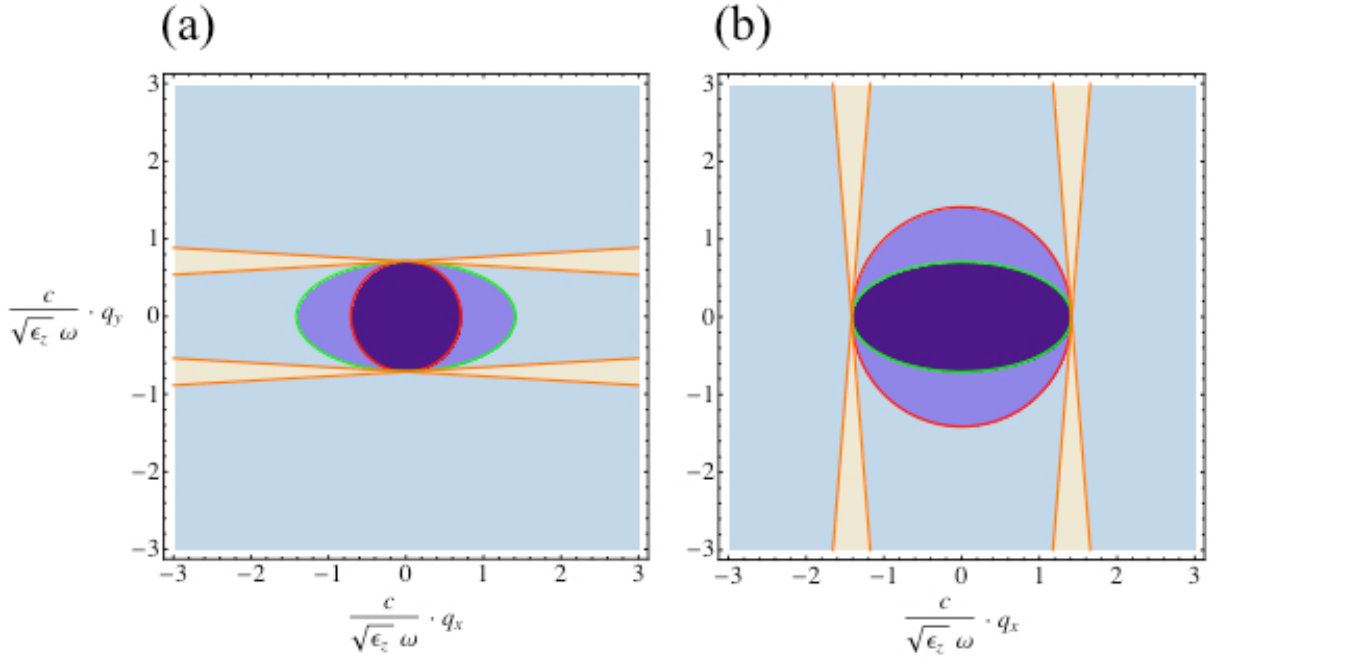 Figure 61
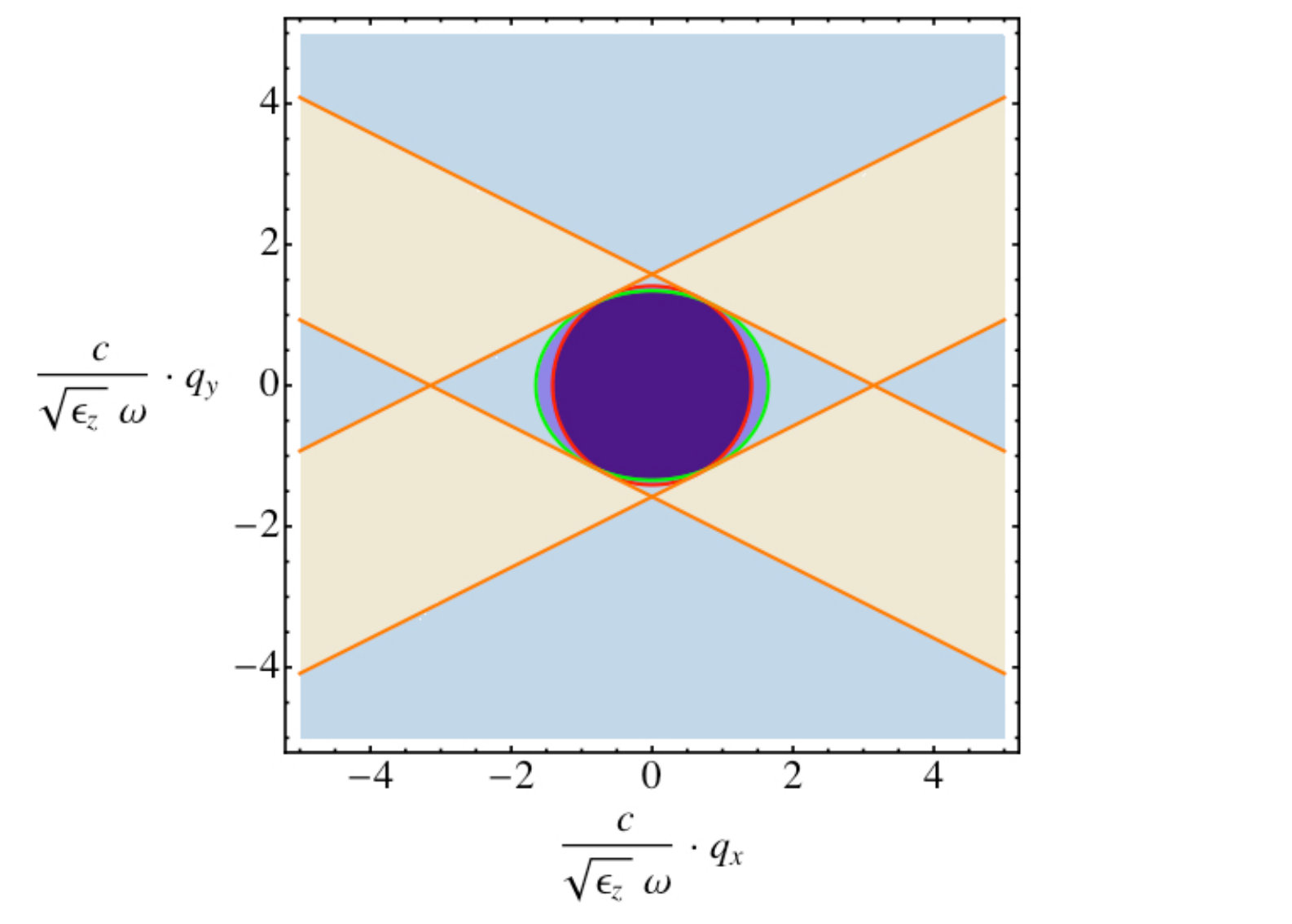 Figure 72
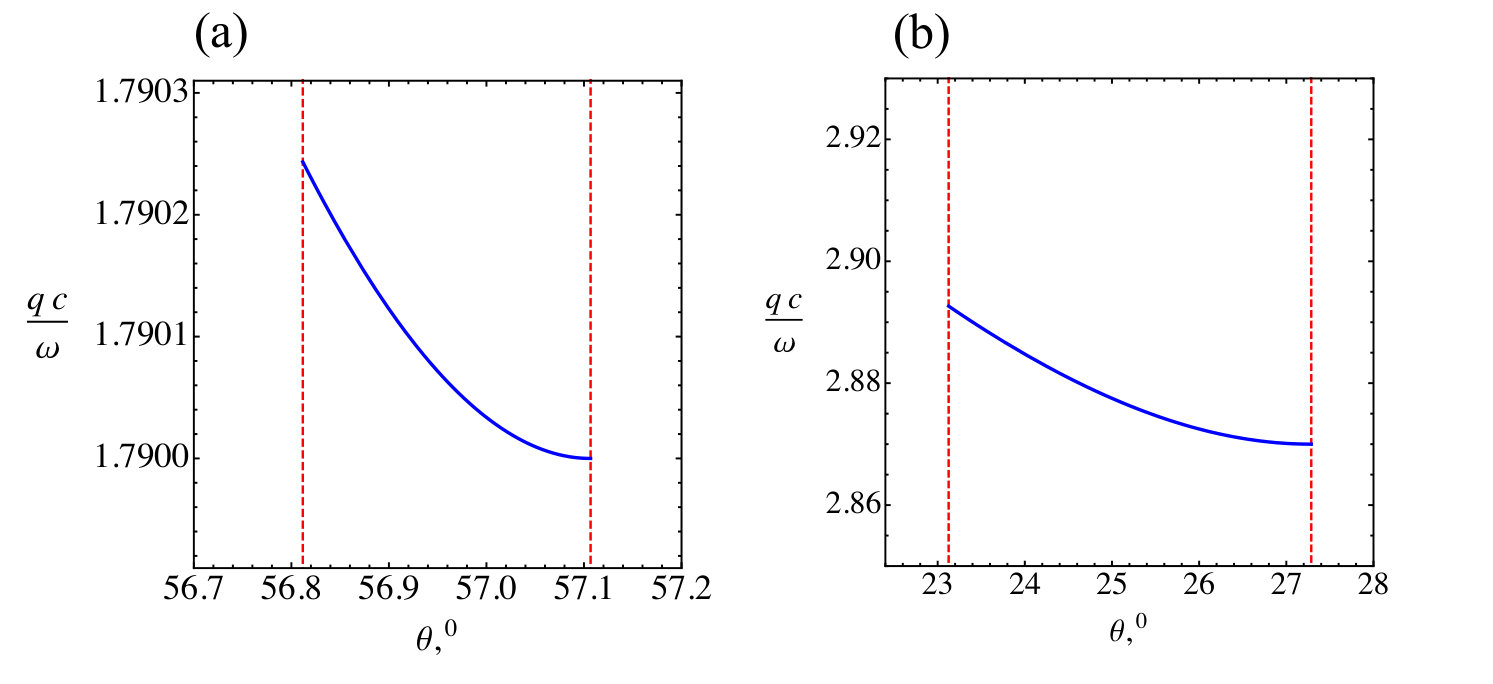 Figure 84
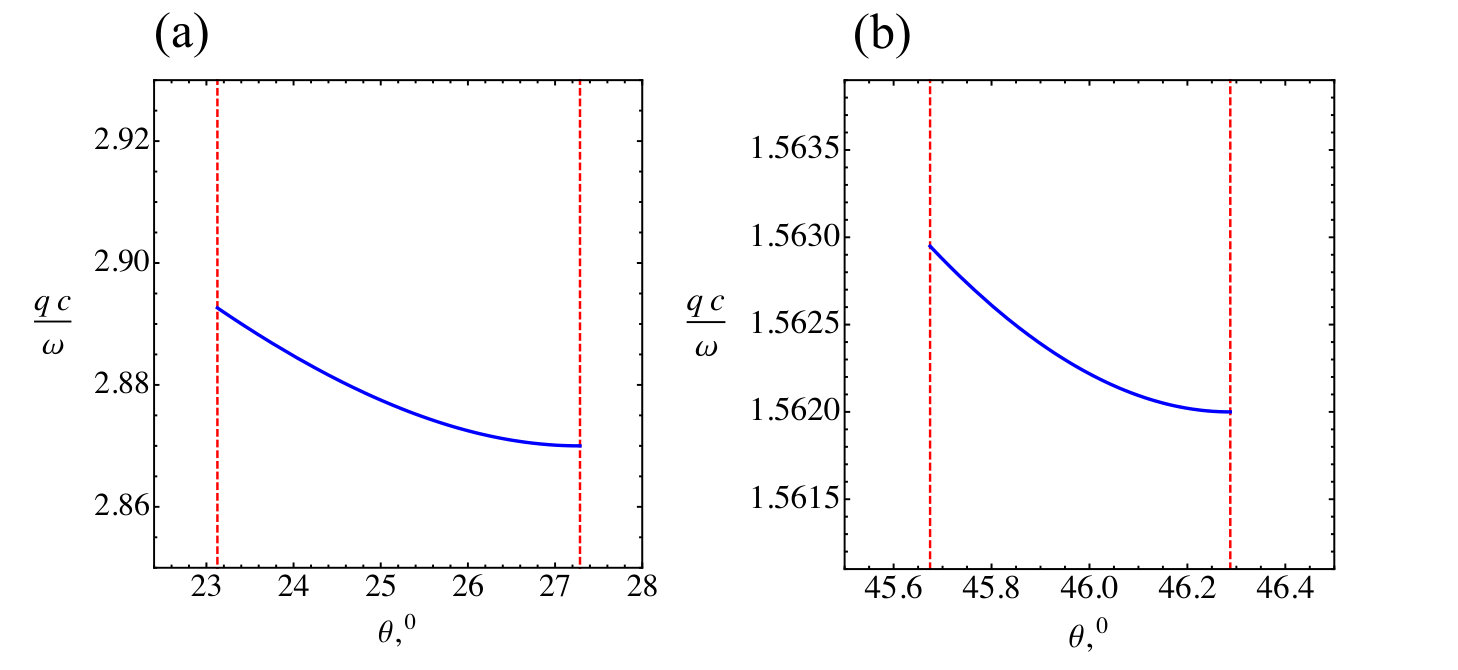 Figure 92
Peer Reviews
No public reviews on file for this paper yet. If you reviewed it on a platform where reviews are public (OpenReview, ICLR, NeurIPS, ICML), you can paste yours below so the community can read it here.
Videos
No videos yet. Explain this paper in a talk, walkthrough, or lecture? Add one.
Dyakonov Waves in Biaxial Anisotropic Crystals
Evgenii E. Narimanov
School of Electrical and Computer Engineering and Birck Nanotechnology Center,
Purdue University, West Lafayette, IN 47907, USA
Abstract
We present the general analytical theory for Dyakonov surface waves at the interface of a biaxial anisotropic dielectric with an isotropic medium. We demonstrate that these surface waves can be divided into todo distinct classes, with qualitatively different spatial behavior. We obtain explicit expressions for the Dyakonov waves dispersion and the parameter range for their existence.
pacs:
42.25.Bs,42.25.Lc,43.35.Pt.
Electromagnetic surface waves, strongly localized near the interface of two different media, pay an important role in many areas of science and technology – from optical microscopy SW_microscopy and biosensing SW_biosensing to nano-optical tweezing SW_tweezing to photonic integrated circuits. SW_circuits Electomagnetic surface waves are responsible for such phenomena as superlensing,Pendry2000 ; Haldane_arxiv enhanced Raman scattering SW_Raman1 ; SW_Raman2 and extraordinary light transmission through subwavelength holes. Ebbesen While there exists a number of different kinds of surface electormagnetic waves, such as e.g. surface plasmons at the interface of a metal and a dielectric, plasmonics or Tamm-Shockeley states Tamm ; Shockley ; Yeh1978 at the boundary of a photonic crystal, Yablonovich ; SJohn ; Joannopoulos_book a new class of surface electromagnetic modes has recently gained considerable attention. Marchevskii ; Dyakonov1 ; Dyakonov2 ; Dyakonov3 ; SW_good_paper ; SW_review ; Dyakonov_experiment_PRL These Dyakonov surface waves exist at the interface of an isotropic and anisotropic dielectric media. They can be supported by transparent optical materials, and thus do not suffer from the metallic absorption that plagues surface plasmons. ref:figure-of-merit Compared to the Tamm-Shockley state, Dyakonov wave does not require any period patterning of the material forming the system, with the resulting light scattering due to the inevitable disorder as a result of an imperfect fabrication of such lattice.
The presence of Dyakonov waves at the isotopic-anisotropic interface has been firmly established in the experiment, Dyakonov_experiment_PRL and a number of adequate theoretical methods exists for their quantitative description. Dyakonov1 ; Dyakonov2 ; SW_good_paper However, due to the inevitable complexity of the boundary conditions at the interface of a fully-anisotropic dielectric the resulting theoretical description generally leads to a system of nonlinear equations that must be solved numerically. While this may be considered a straightforward task, Dyakonov waves are usually extended over many wavelengths, SW_good_paper and are therefore close to the propagation wave threshold – which makes the numerical solution more challenging. What is even more important, with the theoretical “toolbox” limited to numerical methods, the root-finding algorithm may even miss an entire class of possible solutions.
In this work, we present a complete analytical solution for the Dyakonov surface waves at the interface of an isotropic and a biaxial dielectric medium. We show that, depending on the magnitudes of the dielectric permittivity components in the system, the interface can simultaneously support two different classes of surface waves, with qualitatively different spatial behavior.
I The model
We consider the interface of an isotopic dielectric with the permittivity , with a biaxial anisotropic medium, with the permittivity tensor
[TABLE]
We furthermore assume that one of the symmetry directions of the anisotropic crystal (which will be referred to as the axis in our coordinate system – see Fig. 1) is normal to the interface, as this is generally the case for a high-quality interface. While a non-orthogonal orientation of with respect to the plane of surface is possible, this would lead to a relatively high density of surface defects – thus making the theory for surface waves at a idea planar interface irrelevant for most practical application. For convenience, the coordinate system origin is chosen at the plane of the interface – see Fig. 1.
In this work, we focus on guided surface waves with the in-plane momenttum ,
[TABLE]
where
[TABLE]
II Electromagnetic waves in a biaxial medium
For an evanescent wave that decays away from the interface, we have
[TABLE]
Note that for a complex , the expressions (8), (9) also describe the propagating waves in the medium.
Substituting (5),(6) with (8), (9) into Maxwell’s equations, we obtain
[TABLE]
and
[TABLE]
where
[TABLE]
and
[TABLE]
From (16) we find the electrical field components in terms of the amplitude
[TABLE]
which together with (10)-(12) define the entire electromagnetic field (e, b) in (8), (9).
Also, from Eqn. (16) we obtain
[TABLE]
which yields
[TABLE]
Eqn. (28) is a quadratic equation for , with the straightforward solution
[TABLE]
where the Discriminant
[TABLE]
When the Discriminant is positive, there are three distinct possibilities for the nature of the waves supported by the anisotropic dielectric. If the right-hand side of Eqn. (29) is positive for and , both waves with the “in-plane” momentum are evanescent. In the opposite case, when the right-hand side of Eqn. (29) is negative in both cases, the corresponding two waves are propagating. Finally, when it’s positive for one choice of the sign in (29) and negative for the other, we find that for the given in-plane momentum the dielectric interface supports one propagating and one evanescent wave.
As follows from Eqn. (30), the Discriminant is positive-definite (for any ) in each of the following cases:
- •
any uniaxial dielectric
( or or ),
- •
,
- •
.
The boundaries that separate different portions of the phase space that respectively support only the propagating waves, or only the evanescent fields, or a mixture of evanescent and propagating waves, are given by
[TABLE]
and
[TABLE]
This behavior is illustrated in Fig. 2.
However, if
[TABLE]
the Discriminant in Eqn. (30) can, and does, for certain ranges of the values of and , become negative. In this case, is complex, with nonzero values for both its real and imaginary parts. These “ghost waves”, recently described in Ref. EN_ghosts , combine the oscillatory behavior of the propagating waves with the exponential decay characteristic of the evanescent fields, and represent the third class of the waves that can be supported by a transparent dielectric medium.
When the inequality (33) is satisfied, the boundaries of the portion of the phase space of the ghost modes are defined by the four equations
[TABLE]
Fig. 3 shows the phase space of a biaxial anisotropic dielectric that supports ghosts waves. Note its nontrivial structure near the point corresponding to the intersection of the boundaries described by Eqns. (31) and (32) in the magnified view of its panel (b).
When the permittivity in the normal-to-the-interface direction approaches the value of one of the in-plane permittivities or , the ghost regions in the phase space collapse to increasingly narrow strips parallel to either the (when ) or (for ) axis. This “collapse” is however relatively slow, and substantial ghost regions are still present even when the permittivity is within 1% of the critical value, as seen in Fig. 4.
Most importantly, ghost regions show substantial presence in actual biaxial anisotropic crystals. This is illustrated in Fig. 5, where we show the phase space for the sodium nitrite , with the dielectric permittivity tensor components moti , and .
While Eqns. (10) - (26) adequately describe the general case of a dielectric crystal with arbitrary degree of anisotropy, the isotropic limit is singular, as here both and are identical,
[TABLE]
with
[TABLE]
and direct substitution of (35),(36) into (24), (25), (26) and (10), (11), (12) yields
[TABLE]
with . This uncertainty can be removed if we explicitly introduce and polarizations, correspondingly with and :
[TABLE]
and
[TABLE]
Here
[TABLE]
while and are the scaled amplitudes of the and polarized waves respectively.
III Dyakonov Wave
Assuming that the interface at separates transparent isotropic medium with the permittivity at from biaxial anisotropic dielectric with the permittivity tensor (4), for the guided surface wave with the in-plane momentum we obtain
[TABLE]
and
[TABLE]
where (note the sign change from (38) - (49) to (57) - (60) as the evanescent field for behaves as )
[TABLE]
and
[TABLE]
With non-magnetic () dielectric materials at both sized of the interface, at we have the continuity of all three components of the magnetic field , and the continuity of , and . However, as follows from (12), the continuity of both tangential components of the electric field immediately implies the continuity of Furthermore, since
[TABLE]
the continuity of is a direct consequence of the continuity of the tangential magnetic field. Therefore, out of six boundary conditions here only four are actually independent, consistent with the four independent amplitudes m , and .
Imposing the continuity of , , and , we obtain:
[TABLE]
where the matrix is defined as
[TABLE]
with
[TABLE]
Introducing the new variable coresponding to the -components of the amplitudes of the electric field in the anisotropic material and ,
[TABLE]
[TABLE]
where the matrix is defined by
[TABLE]
and
[TABLE]
The dispersion of the surface wave is then given by
[TABLE]
which yields
[TABLE]
Eqn. (53) uniquely defines the dispersion relation of the Dyakonov surface wave , and is the primary result of this section.
For a guided surface wave, all its components, in both the isotropic and anisotropic sides of the interface, must decay away from the boundary. For , this implies that
[TABLE]
At the same time, in the anisotopic medium the waves with the in-plane momentum, can belong to either the evanescent or ghost sub-classes – see Section II. From Eqns. (31) and (32) we therefore obtain
[TABLE]
and
[TABLE]
Eqns. (87), (88) and (89) substantially reduce the range of the momentum and frequency that needs to be explored in the numerical solution of Eqn. (86). Furthermore, as shown in Ref. SW_good_paper (see also Appendix A), the Dyakonov surface wave only exists when
[TABLE]
While the numerical solution of Eqn. (53) is generally straightforward, for small - to - moderate anisotropy, the surface waves are known SW_review ; SW_good_paper to be relatively weakly guided,
[TABLE]
which turns numerical root-finding into a challenging numerical problem SW_good_paper . In the next section we will therefore develop the method for the analytical solution of Eqn. (86).
IV Analytical Solution for the surface wave dispersion
Despite its relative complexity, Eqn. (86) is not transcendental, but only contains algebraic functions. As a result, it can be reduced to a polynomial equation. Furthermore, as we show in the present section, the resulting polynomial equation is of the 4th order, and therefore allows a complete analytical solution.
Choosing the -direction at the one corresponding to the largest permittivity in the plane of the interface,
[TABLE]
we introduce the new variable
[TABLE]
Note that, as follows from (89), . Then
[TABLE]
and
[TABLE]
We can then express Eqn. (86) as
[TABLE]
where
[TABLE]
and
[TABLE]
We then square both sides of Eqn. (105), which yields
[TABLE]
where
[TABLE]
and
[TABLE]
with
[TABLE]
and
[TABLE]
Note that, in addition to the solutions of the original equation (86), the new Eqn. (99) contains spurious roots corresponding to . We therefore need to constrain the solutions of (99) with the inequality
[TABLE]
Together, Eqns. (99) and (105) are equivalent to the original equation (86).
Since and (see Eqns. (31),(32) and (93)), from Eqn. (94) we find
[TABLE]
where
[TABLE]
Substituting (106) into (99), we obtain
[TABLE]
Introducing the new dimensionless variable
[TABLE]
we can express Eqn. (108) in the form
[TABLE]
where
[TABLE]
and
[TABLE]
The expression (110) is a quartic equation for , and allows an immediate analytical solution via the Ferrari formula, Ferrari so that
[TABLE]
Then, introducing the polar angle that defines the direction of the in-plane momentum ,
[TABLE]
[TABLE]
which parametrically defines the function .
In general, a quartic equation like (110) has four distinct roots. However, in our case should satisfy a number of additional constraints. Aside from being a positive real quantity, it must also exceed the value of ,
[TABLE]
since decay of the surface wave away from the interface implies
[TABLE]
As we prove in Appendix B, Eqn. (110) only has no more than a single real positive solution that satisfies (122), so there is no ambiguity of choosing the correct root. We therefore obtain
[TABLE]
where
[TABLE]
While the choice of and in Eqn. (131) that leads to a positive real root that satisfies Eqn. (122), is unique, such a solution only exist in a limited range of angles . Furthremore, the resulting solution must be tested against the inequality (105) to remove the spurious roots. As a result, for the angular range of that supports the Dyakonov surface wave, we obtain (see Appendix C) :
[TABLE]
where, assuming ,
[TABLE]
and
[TABLE]
Here, and correspond to and respectively. At the same time, corresponds to the boundary of the inequality (89), while represents the “edge” of the inequality (105) – see Appendix C. Within the angle range (132) for any direction and the frequency , there is one and only one surface wave, described by the parametric equations (120), (121) with the function from Eqn. (124), while for any angle outside this range, there is no surface wave.
In Fig. 6 we plot the surface wave dispersion for the interface of potassium titanyl phosphate (KTP) and aluminium oxynitride (AlON) (panel (a)), and arsenic trisulfide with aluminum arsenide (panel (b)). The results of the present work can also be applied to uniaxial materials, as illustrated in Fig. 7 for calcite and (panel (a)), and lithium niobate () and (panel (b)).
Following Ref. SW_good_paper , it is also instructive to project the surface wave dispersion onto the wavevector space that we studied in Section II. In Fig. 8 we show this projection for the surface wave at the interface of isotropic aluminum arsenide and biaxial arsenic trisulfide. As expected, the magenta curve that represents the Dyakonov surface wave, terminates at the boundaries corresponding to (blue line) and (green line). Note that, depending on the wavevector of the surface wave, it could be observed both in the “evanescent” and “ghost” portions of the phase space (see panel (c)).
V Two classes of Dyakonov surface waves
Near the boundary of an isotropic medium with a uniaxial dielectric, the Dyakonov surface wave is formed by evanescent waves on both sides of the interface. However, for a biaxial dielectric that supports both the evanescent and the ghost waves (see Section II), the localized surface wave can be formed from either the evanescent or from ghost waves, depending on its in-plane momentum. As a result, for the interface of a isotropic medium with a biaxial medium, we can have two different types of the Dyakonov surface wave. A “conventional” Dyakonov surface, as originally described by M. Dyakonov in 1988 Dyakonov1 wave monotonically decays on both sides of the interface, while the ghost surface wave, together with the exponential decay also shows oscillatory behavior in the anisotropic medium – see Fig. 9.
Note that, depending on the magnitude of the permittivity of the isotropic medium (), at a single frequency the isotropic - biaxial interface can either support both the “conventional” and the “ghosts” mode patterns, or only the ”conventional” modes. The corresponding critical value of the permittivity is given by the equation (see Appendix D)
[TABLE]
which for always has a single solution in the interval .
In scaled variables , , the solution of Eqn. (135) can be expressed as
[TABLE]
We plot this function in Fig. 10.
For , the Dyakonov surface waves that are supported by the interface of isotropic and biaxial dielectric media, belong to the “conventional” class for all allowed propagation angles. However, if , for the propagation angle in the range and we find “conventional” Dyakonov waves, while for and the surface modes belong to the “ghost” class – see Fig. 8(c). Here, the angle only depends on the dielectric permittivies of the media forming the interface, and is defined as the solution of the system of equations (86) and (34), where the latter taken with the positive signs.
VI Discussion
The key feature of the Dyakonov surface waves that makes them an ideal platform for experiments on nonlinear optics and strong coupling, is their inherent “lossless“ nature. While the residual linear absorption in the dielectric as well as light scattering due to surface roughness can never be completely avoided, the corresponding contributions to the effective mode loss can be dramatically reduced, as demonstrated in Mie resonance experiments with the measured -factors on the order of . Ilchenko
As a result, with an evanescent coupling (from e.g. a high-index prism) to the isotropic-biaxial interface, one can observe an enormous increase of the field intensity at this boundary, only limited by the effective loss due to system imperfections (surface and builk disorder, etc.) and ultimately by the non-locality of the dielectric response LL_media (corresponding to the variations of the dielectric permittivity on the order of , where is on the order of the atomic size and is the wavelength).
For the applications to nonlinear optics however, the effective “selection rules” such as the phase-matching conditions NLO_book are defined by the spatial variation of the corresponding optical modes. The qualitative difference between the “ghost” and the ‘conventional” surface waves, respectively with- and without oscillations away from the interface, that can be simultanenouls supported by the same isotropic-biaxial interface at the same frequency, will therefore have dramatic effect on the nonlinear-optical phenomena in this system. EN_ghosts
VII Conclusions
In summary, we have developed a complete analytical theory of Dyakonov surface waves at the interface of an isotropic medium with a biaxial anisotropic dielectric. As opposed to earlier work on this subject, our approach does not require any numerical root-finding, and offers substantial advantage in the description of the surface waves near the propagation threshold. We have also presented a detailed description of the ghost waves that combine the properties of propagating and evanescent solutions, and of the corresponding surface modes supported by these ghost waves.
VIII Acknowledgements
This work was partially supported by the Army Research Office (grant W911NF-14-1-0639), National Science Foundation (grants DMR-1120923 and DMR-1629276), and Gordon and Betty Moore Foundation.
Appendix A
Some of the necessary conditions for the existence of the Dyakonov wave in (90) can be immediately obtained from the general structure of Eqn. (86) and its constituents. Eqn. (89) immediately implies that both the first and the last terms in the curly brackets in Eqn. (86) are negative-definite, therefore
[TABLE]
Since
[TABLE]
[TABLE]
which implies that
[TABLE]
Similarly, from (88), (137) and (138)
[TABLE]
or
[TABLE]
Appendix B
First, we consider the number of real positive solutions of Eqn. (110). Since
[TABLE]
since with our choice of (see (92)) the requirement (90) reduces to
[TABLE]
and therefore
[TABLE]
Similarly, since ,
[TABLE]
and
[TABLE]
Therefore, regardless of the sign of , the number of sign changes of the polynomial is equal to one if and to two if . According to the Descartes’ rule of signs, Descartes Eqn. (110) has no more than one positive real root in the former case and no more than two positive real roots in the latter. So, in general Eqn. (110) has no more than two positive real roots.
However, the solution of Eqn. (110) must also satisfy the inequality (122). Introducing the new variable
[TABLE]
to satisfy (122) we need . From (110) we obtain
[TABLE]
where
[TABLE]
[TABLE]
For we obtain
[TABLE]
If either , , or , , or , , then the number of sign changes of the polynomial is equal to one, and therefore Eqn. (149) has no more than one real positive root. It is if and only if , that Eqn. (149) can in principle have two positive real roots.
For , , from Eqns. (151), (152) we obtain
[TABLE]
Then
[TABLE]
and
[TABLE]
which yields
[TABLE]
With , and , and (see (90)), the left-hand side of (160) is negative, while the right-hand size is positive. The system of the inequalities (156),(157) is therefore inconsistent, and the case , cannot be realized. Therefore, Eqn. (149) cannot have more than one positive real root, and Eqn. (110) cannot have more than one real solution with .
Appendix C
We define as the propagation angle that corresponds to the limiting case of the inequality (89). In terms of our parameter defined by Eqns. (93) and (116), the bound (89) corresponds to
[TABLE]
which together with (94) implies that
[TABLE]
Since
[TABLE]
we obtain
[TABLE]
Substituting (161) into (121), we obtain
[TABLE]
leading to our definition of in Eqn. (133).
Since we defined the - and - directions with , the inequality (89) then implies
[TABLE]
or
[TABLE]
The angle is defined as the propagation direction of the surface wave corresponding to the limiting case of (105) when the latter turns into the exact equality
[TABLE]
Substituting (168) into (96), we find that either
[TABLE]
or
[TABLE]
Since for in the range defined by Eqns. (166),(167) we find , and Eqn. (170) therefore cannot be satisfied – so that (169) is the only option. Then, substituting (169) into Eqn. (86), we obtain
[TABLE]
From (94) we obtain
[TABLE]
Substituting (172) into (171), we find
[TABLE]
[TABLE]
Substituting (173) into (174) and using (104), we find
[TABLE]
To satisfy Eqn. (105), we therefore need
[TABLE]
or
[TABLE]
Together, (166), (167) and (176), (177) are equivalent to (132).
Appendix D
The critical angle corresponds to the point where the iso-frequency curve corresponding to the Dyakonov surface wave in the space terminates at the line (32). We can show that the ghost boundary in the first quadrant,
[TABLE]
can never cross this point. An assumption that such intersection point , that satisfies both (32) and (178), may exist, leads to the equation
[TABLE]
which cannot be satisfied for any . As a result, in the first quadrant (, ) the ghost boundary is either always above or always below the curve of Eqn. (32). The ellipse of Eqn. (32) intersects the positive half of the -axis at the point of , while for the ghost boundary (178) the corresponding crossing point is at . In the first quadrant of the space the ghost boundary is therefore always above the elliptical curve of Eqn. (32). As a result, this boundary, and thus the “edge” of the iso-frequency curve of the Dyakonov surface wave, is always in the “conventional” regime, with the field characterized by the exponential decay on both sides of the interface.
As a result, for the system to support the “ghost” surface waves, the ghost boundary (178) must cross the iso-frequency curve of the Dyakonov waves, Eqn. (86). The onset of the ghost regime then corresponds to the case when the ghost boundary intersects the iso-frequency curve precisely at its end at the angle .
As follows from Eqn. (169), the critical angle corresponds to the point where the iso-frequency line of the Dyakonov surface wave in the space terminates at the circle
[TABLE]
For the intersection point of (180) with the ghost boundary (178) in the first quadrant we obtain
[TABLE]
Substituting (181),(182) into (86) and using (94), we obtain
[TABLE]
which defines the values of the dielectric permittivity of the dielectric media corresponding to the onset of ghost surface waves in the system phase space.
The reference list from the paper itself. Each links out to its DOI / PubMed record.
- 1(1) M. Specht, J. D. Pedarnig, W. M. Heckl, and T. W. Hänsch, “Scanning plasmon near-field microscope,” Phys. Rev. Lett. 68 , 476 (1992).
- 2(2) D. A. Schultz, “Plasmon resonant particles for biological detection,” Current Opinion in Biotechnology 14 (1), 13 - 22 (2003).
- 3(3) M. L. Juan, M. Righini and R. Quidant, “Plasmon nano-optical tweezers,” Nature Photonics 5 , 349 - 356 (2011).
- 4(4) T. W. Ebbesen, C. Genet, S. I. Bozhevolnyi, ”Surface-plasmon circuitry”,Physics Today Physics Today 61 , 44 - 50, (2008).
- 5(5) J. B. Pendry, “Negative Refraction Makes a Perfect Lens,” Phys. Rev. Lett. 85 , 3966 (2000)
- 6(6) F. D. M. Haldane, “Electromagnetic surface modes at interface with negative refractive index make a “not-quite-perfect” lens,” preprint ar Xiv:cond-mat/0206420 V 3 (2002).
- 7(7) S. M. Nie and S. R. Emery, “Probing Single Molecules and Single Nanoparticles by Surface-Enhanced Raman Scattering,” Science 275 , 1102 - 1106 (1997).
- 8(8) K. Kneipp, Y. Wang, H. Kneipp, L. T. Perelman, I. Itzkan, R. R.Dasari, and M. S.Feld, “Single Molecule Detection Using Surface-Enhanced Raman Scattering (SERS),” Phys. Rev. Lett. 78 , 1667 (1997).