Thermalization in small system of hadron gas and high-multiplicity pp events
Nachiketa Sarkar, Premomoy Ghosh

TL;DR
This paper investigates how the degree of thermalization, measured by the Knudsen number, varies with system size in hadron gases, supporting the use of hydrodynamics in interpreting high-multiplicity proton-proton collision events.
Contribution
It provides a comparative analysis of Knudsen numbers in heavy-ion and proton-proton collisions, extending thermalization studies to small systems.
Findings
Hydrodynamics is applicable to high-multiplicity pp events.
Knudsen numbers in small systems are similar to those in heavy-ion collisions.
Supports thermalization in small hadron systems.
Abstract
We study the system-size dependence of Knudsen number, a measure of degree of thermalization, for hadron resonance gas that follows the Lattice-QCD equation of state at zero chemical potential. A comparison between Knudsen numbers for the AuAu collisions at RHIC and the hadron gas of size similar to the size of high-multiplicity pp events at LHC, reassures the applicability of hydrodynamics in interpreting the features of particle production in high-multiplicity pp events.
Click any figure to enlarge with its caption.
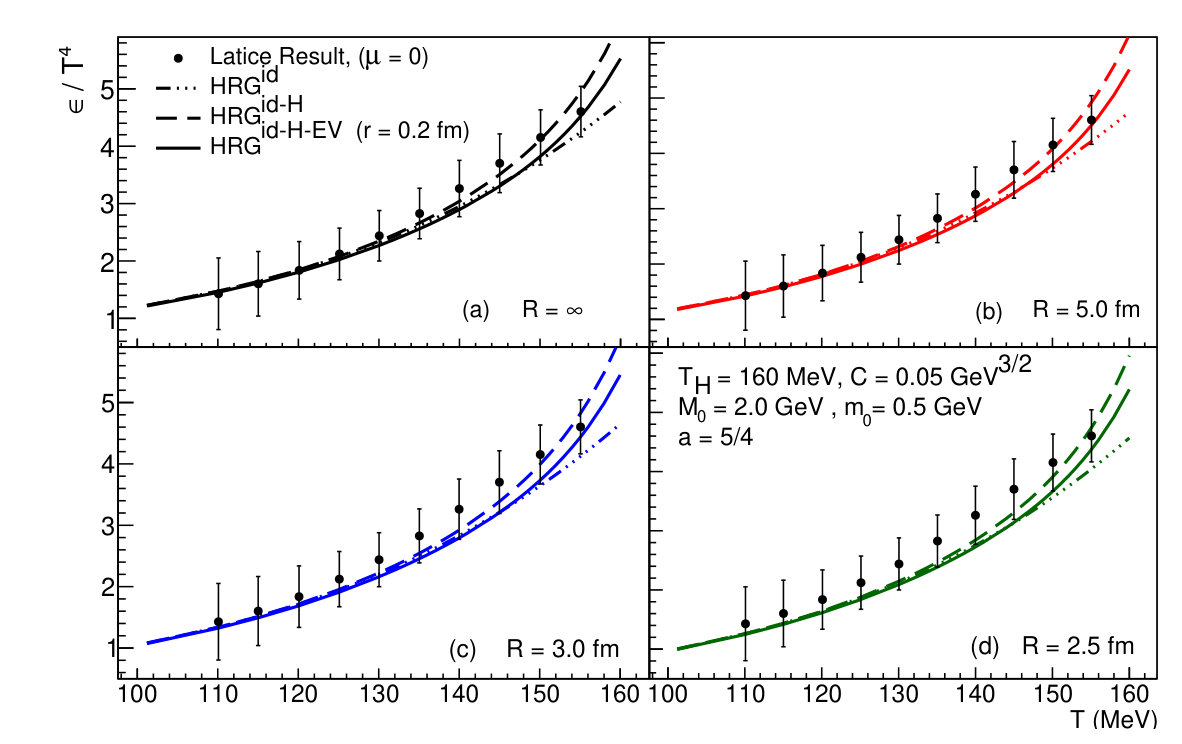 Figure 1
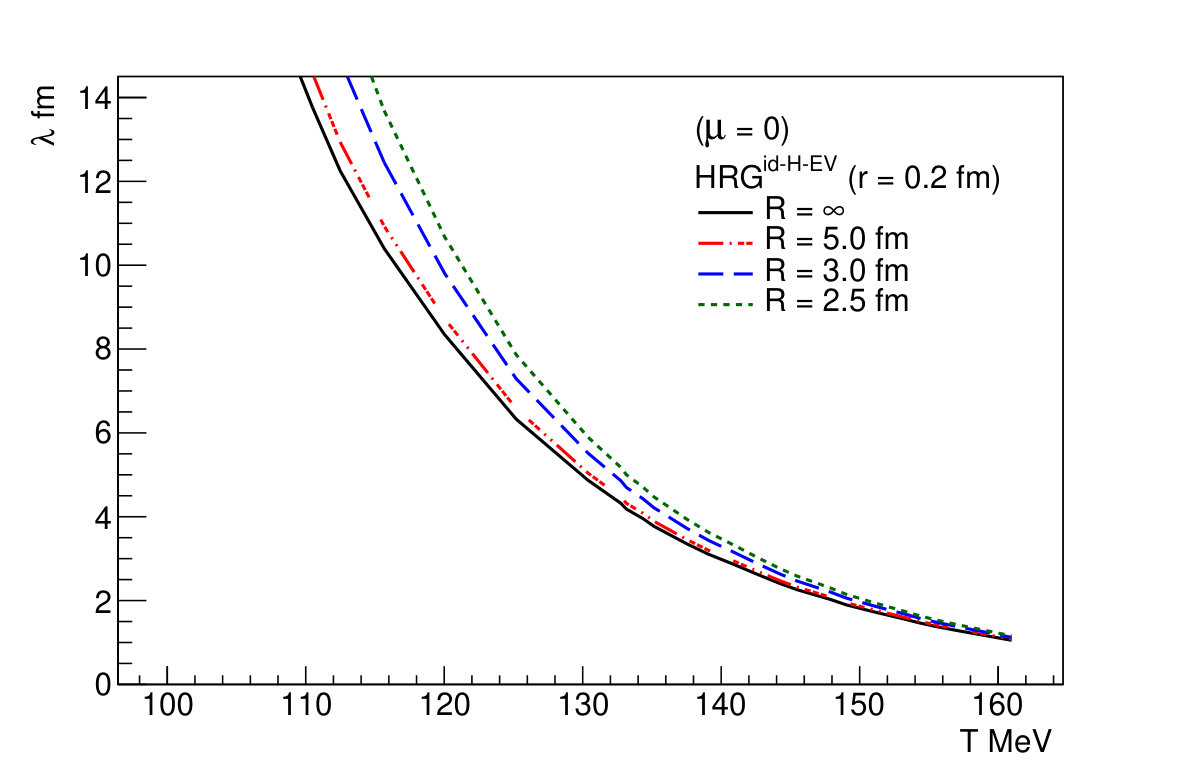 Figure 2
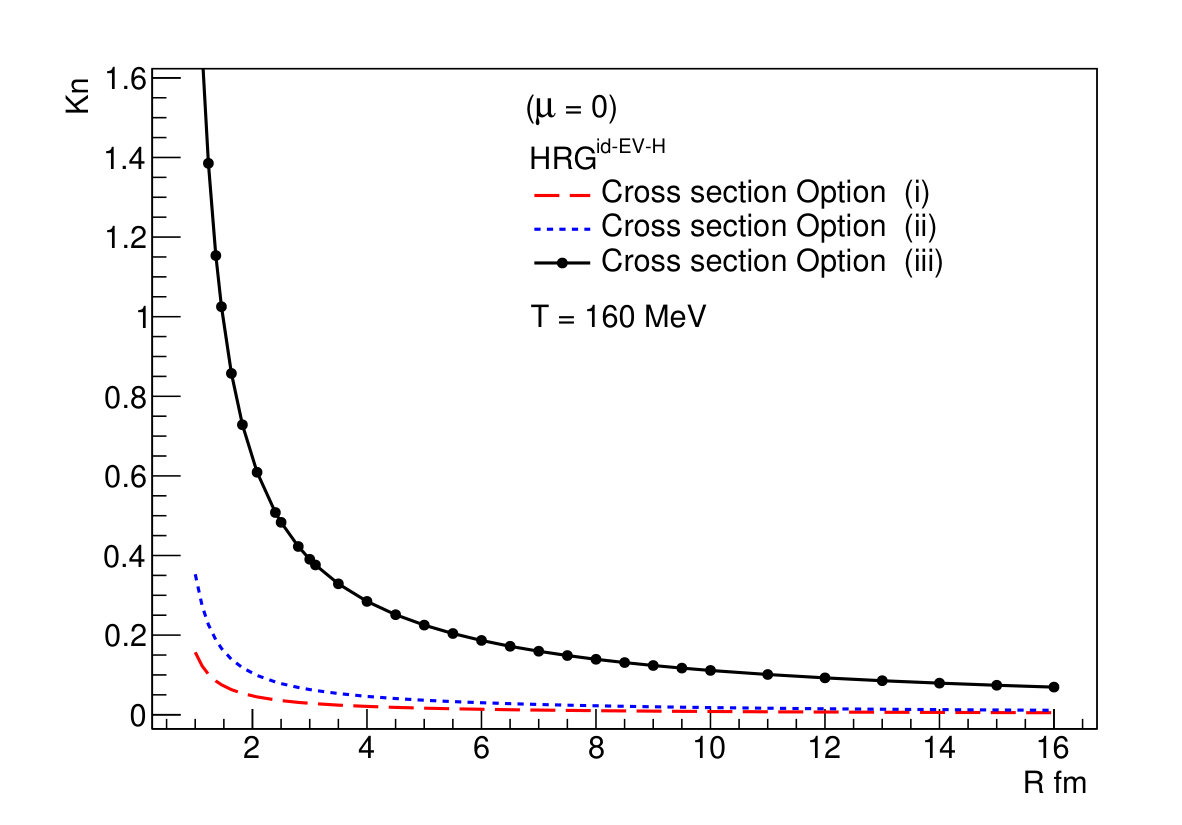 Figure 3
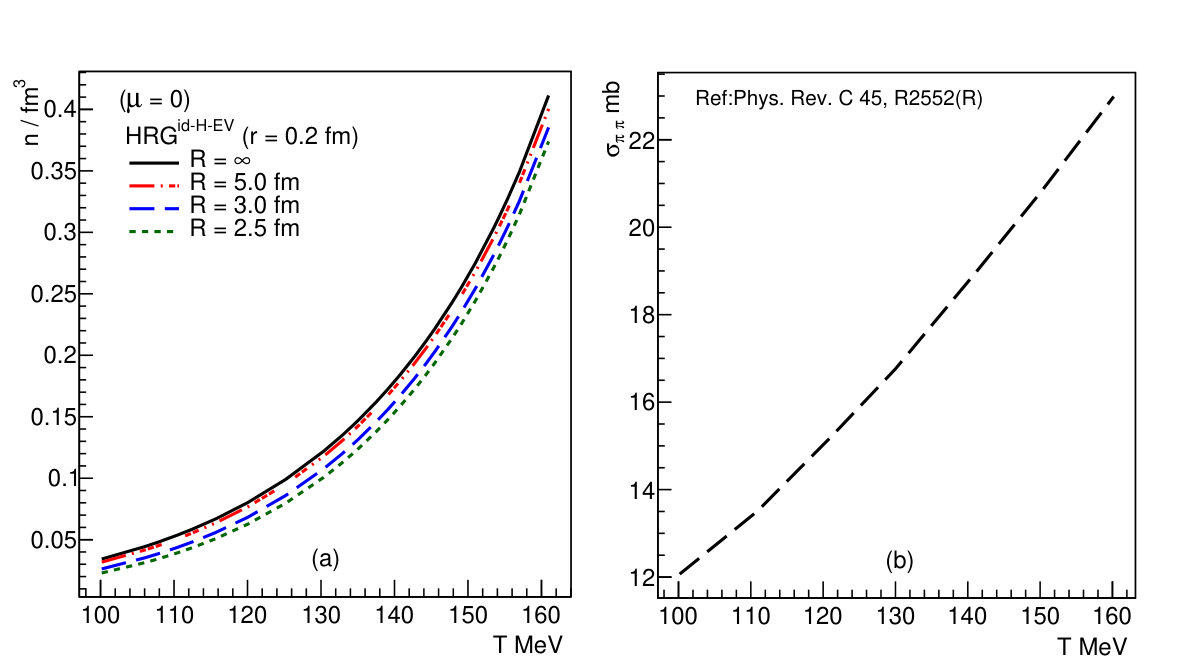 Figure 4
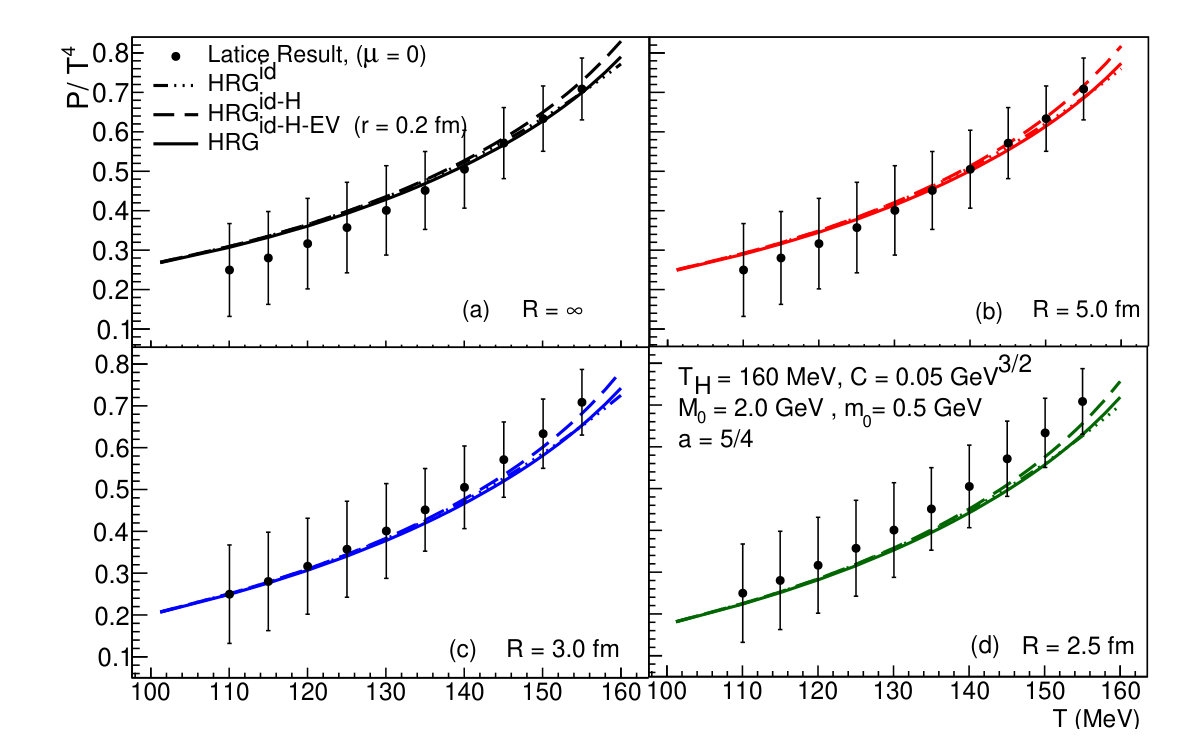 Figure 5
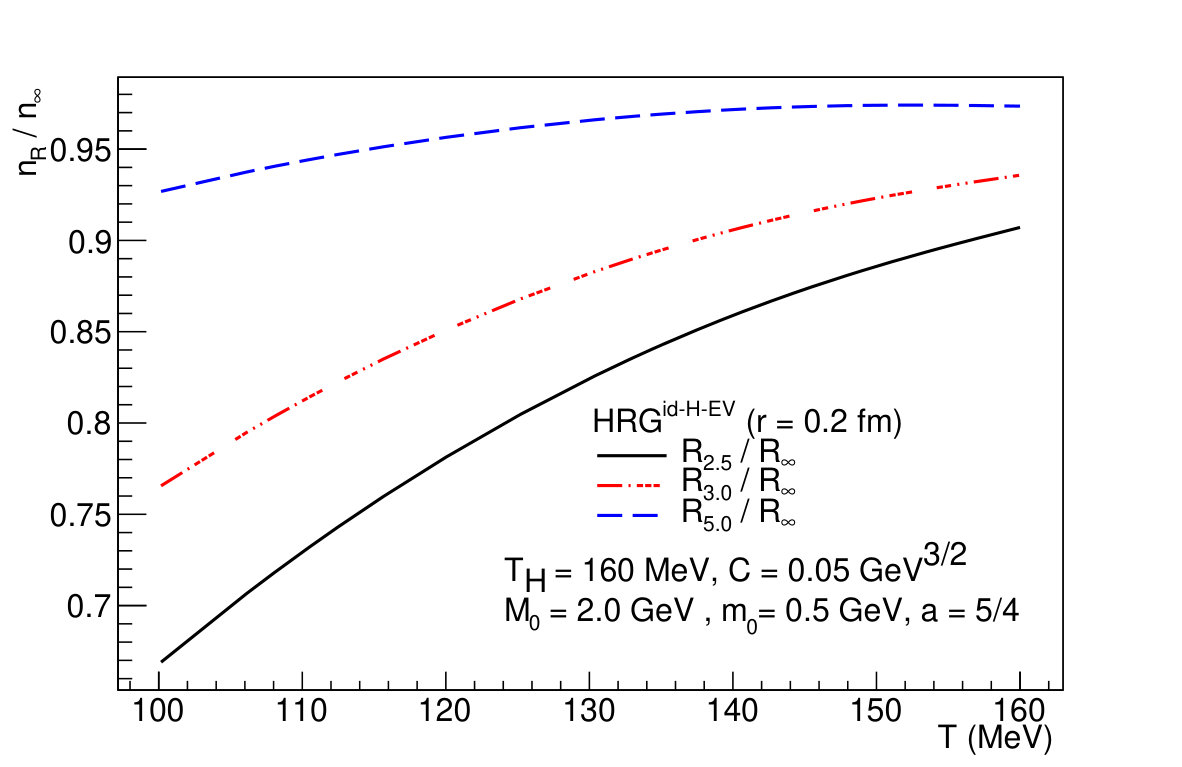 Figure 6
Peer Reviews
No public reviews on file for this paper yet. If you reviewed it on a platform where reviews are public (OpenReview, ICLR, NeurIPS, ICML), you can paste yours below so the community can read it here.
Videos
No videos yet. Explain this paper in a talk, walkthrough, or lecture? Add one.
Thermalization in small system of hadron gas
and high-multiplicity events
Nachiketa Sarkar
Premomoy Ghosh
Variable Energy Cyclotron Centre, HBNI, 1/AF Bidhan Nagar, Kolkata 700 064, India
Abstract
We study the system-size dependence of Knudsen number, a measure of degree of thermalization, for hadron resonance gas that follows the Lattice-QCD equation of state at zero chemical potential. A comparison between Knudsen numbers for the collisions at RHIC and the hadron gas of size similar to the size of high-multiplicity events at LHC, reassures the applicability of hydrodynamics in interpreting the features of particle production in high-multiplicity events.
pacs:
13.85.Hd, 25.75-q
I Introduction
The Quark-Gluon Plasma (QGP), a thermalized partonic matter predicted in quantum chromodynamics (QCD), got the experimental endorsement ref01 ; ref02 ; ref03 ; ref04 from the ultra-relativistic collisions at the RHIC, where the collisions served the role of the base-line in finding the signals for the collective medium. The experiments at the LHC have raised the significance of the study of multiparticle production in collisions by extracting long-range two-particle angular correlations and obtaining the characteristic flow parameters in high-multiplicity events of collisions at = 7 and 13 TeV ref05 ; ref06 ; ref07 .
In spite of the strong experimental signatures, the collectivity in collisions is disputed on the issue of thermalization in a small system of short lifetime that may be formed in the events. At this stage, it is pertinent to assess the degree of thermalization of the system formed in high-multiplicity events and compare it with that of the medium formed in relativistic heavy-ion collisions where the local thermodynamic equilibrium is undisputedly established through satisfactory descriptions of data by relativistic hydrodynamics ref08 .
The study of the bulk thermodynamic properties of the strongly interacting matter in the QCD framework has been made possible by the formulation of the Lattice QCD (LQCD) ref09 . Recent LQCD simulations at finite temperature reveal existence of a de-confined partonic phase at high temperature and a confined hadronic phase at low temperature. The hadronic phase of the QCD medium is successfully addressed also by the Hadron Resonance Gas (HRG) Model ref10 ; ref11 ; ref12 , in statistical thermodynamic framework. An ideal HRG, formulated with discrete mass spectrum of identified hadrons and resonances, has been reinforced with the ab-initio confirmation ref13 ; ref14 ; ref15 ; ref16 from the LQCD. Also, as yet unmeasured higher-mass hadron states, provided by the exponentially growing continuum mass spectrum, proposed ref17 by R. Hagedorn, have important contribution to the equation of state (EoS) ref18 ; ref19 ; ref20 below the critical temperature () for the QCD change of phase.
In this article, to address the cardinal question on the degree of thermalization in small system of high-multiplicity events, we consider HRG with the Hagedorn mass spectrum. The excluded volume effect ref21 ; ref22 is implemented in the HRG by considering hard core radius of the constituents of the system. Finally, we study the system-size dependence of the Knudsen number for finite-size hadron gas, complying with the LQCD EoS, to access the degree of thermalization in hadron gas that may be formed in the final stage of high-multiplicity events.
II Hadron Resonance Gas Model
The partition function of particle in a grand canonical ensemble of ideal HRG can be written as ref11 :
[TABLE]
where and . The symbols carry their usual meaning. The and sign corresponds to fermions and bosons respectively. The pressure , energy density and the number density for ideal hadron resonance gas, at = 0, can be written as :
[TABLE]
[TABLE]
[TABLE]
The Hagedorn mass spectrum is given by ref23 :
[TABLE]
where is the Hagedorn temperature that determines the slope of the exponential part of the mass spectrum. The effect of repulsive interactions at the short distances, particularly significant for density related observables, are incorporated in a thermodynamically consistent manner, through the Van der Waals Excluded Volume (EV) method ref22 . The volume of the system is substituted with an effective volume obtained by excluding the sum of volume, = 16/3 of the constituent hadrons of hard core radius, . The inclusion of the Hagedorn states in the system of hadrons and resonances naturally leads one to adopt the Boltzmann approximation. The thermodynamic variables for such a system with the excluded volume effect can be written as ref19 :
[TABLE]
where (<1) is the excluded volume suppression factor, given by and
[TABLE]
III Results
To implement the finite size effect in hadron resonance gas, we start with infinite (in thermodynamic sense) system-size of hadron gas, incorporated with the Hagedorn states and excluded volume effect, where the LQCD EoS is contrasted satisfactorily. We optimize the values of the corresponding parameters, from the ranges as suggested in Ref. ref19 , for the simultaneous consideration of Hagedorn states and the excluded volume effect. The finite size effect on volume and number of particles, considered infinite in the thermodynamic limit, can be implemented ref24 ; ref25 by cutting off the low momentum regions in the integral over momentum space. We introduce the finite size effect ref25 , using the lower limit of momentum, = 197 , where is the characteristic system-size. We consider the mass table of the PDG in Ref. ref26 and compare our calculations with the LQCD results of Ref. ref16 . The temperature dependence of pressure and energy-density of hadron gas for infinite as well as for a few representative finite sizes, = 2.5, 3 and 5 fm, for different options, 1) Ideal HRG, 2) Ideal HRG + Hagedorn States and 3) Ideal HRG + Hagedorn States + EV effect are presented in Figures 1 and 2, respectively. It is clear from the figures that a system of hadrons, resonances and Hagedorn states up to the finite system-size of = 2.5 fm (corresponding to the 250 MeV), can be described by the LQCD EoS at zero chemical potential.
To calculate the mean free path, of the constituents in the thermalized gas of hadrons, resonances and Hagedorn states, one needs to rely on approximations only, as the cross-sections for all the involved interactions are not available. Considering the fact that the pions are the most abundant constituents in an equilibrated hadron gas, for the present study, we approximate the temperature dependent number density () given by equation 8 and depicted in the Figure 3(a) as representing the pion-density and compare the temperature dependent mean free path of pions in thermalized hadron gas of different system-size. The temperature dependent pion-pion cross-sections in thermalized pion gas, used for the temperature dependent mean free path calculations, has been obtained from the Ref.ref27 and presented in Figure 3(b). Figure 3 shows that the number density varies with the system-size of the hadron gas all through the considered temperature range. Further study in terms of the ratio of number density of finite ( = 5, 3 and 2.5 fm) and the infinite system-size of hadron resonance gas, reveals ( Figure 4) that the variation in the number density with the system-size decreases with increasing temperature. This feature of the number density for hadron gas of different sizes approaching closer value at high temperature is consistent with the observation ref25 on the temperature dependence of thermodynamical variables for the similar finite system-sizes of hadron gas. As has been pointed out in the Ref. ref25 , the variation with the system-size at high temperature disappears due to the dominant population of higher mass resonances, including the Hagedorn States, which, unlike the low mass resonances, are not affected on implementation of finite size effect. As can be seen in the Figure 5, though the mean free path of pions for the hadron gas of different sizes, constrained with the LQCD EoS, is different in the lower region of the temperature scale, it asymptotically approaches the same value of 1 fm at 160 MeV. The mean free path for hadron gas of different sizes approaching the same value at high temperature can be attributed to the cumulative effect of reducing differences of the system-size-dependent number density and the system-size independent large interaction cross-sections at high temperature.
By comparing the mean free path and the system-size, one can ideally assess the possibility of thermalization. However, for a quantitative comparison between the degree of thermalization of the system formed in high-multiplicity pp events and that of the medium formed in relativistic heavy-ion collisions, we calculate the degree of thermalization in terms of the dimensionless Knudsen number, , a ratio between the mean free path and the typical size of the system. A small value of , tending to zero, implies high degree of thermalization approaching the perfect fluid limit, while a large indicates a system far from thermodynamic equilibrium and not suitable for application of fluid dynamics. We calculate as a function of the system size of the considered hadron gas at = 160 MeV, with the calculated from different approximations on , like (i) all hadrons of radius 1 fm leading to the total cross section ref28 , (ii) = 4/9 x (), = 2/3 x () while ref28 (obviously for the discrete masses only) and iii) pion gas ref27 , as depicted in Figure 3(b). From the Figure 6, it is clear that among the considered approximations, the cross-section option - (iii) gives the most conservative estimates on the system-size dependence of the Knudsen number for the hadron gas and we, therefore consider the for this option only for further study / discussions. As can be seen from the Figure 6, there is a rapid variation in values of in between the system-size 4 ( 0.28) and 2.5 ( 0.48) fm.
The Knudsen number for collisions at = 200 GeV have been estimated by hydrodynamic and transport models. In hydrodynamical approach, the centrality dependent elliptic flow suggest ref29 ; ref30 0.3 and 0.5 for the central and a semi-central events, respectively. A good agreement between the Boltzmann equation for dilute system and the relativistic dissipative fluid dynamics, the main tool to study the space-time evolution of the bulk matter formed in the relativistic heavy-ion collisions at RHIC, is established ref31 ; ref32 ; ref33 for 0.5.
To estimate the degree of thermalization in high multiplicity events, we compare the sizes of considered hadron gas and the events with average charged particle multiplicity, 136 and higher, which exhibit collective properties in terms of the near-side long-range two-particle angular correlations ref05 and also give -dependence of the elliptic flow harmonic ref07 , at = 7 TeV. The effective emission radius, , obtained ref34 from the Bose-Einstein Correlations between pairs of identical bosons of the hadronizing system near the kinetic freeze-out, has been parameterized for the collisions, as a function of , as , where fm for collisions at = 7 TeV. So, the high-multiplicity event sample of = 136, corresponding to the average effective emission radius, equals 3.1 fm, may be represented by a system of hadron gas following the LQCD EoS and having the Knudsen number 0.36. These high-multiplicity events, satisfying the Knudsen number criterion, lie well within the limit of applicability of the fluid dynamics.
IV Summary
In summary, we have studied grand canonical ensemble of hadrons, resonances and Hagedorn states in finite system size, complying with the LQCD equation of state. We find, for any finite system-size of HRG that follows the LQCD EoS, the mean free path of pions asymptotically approaches the same value of 1 fm at 160 MeV. The estimated degree of thermalization of hadron gas of size comparable to the size of high-multiplicity events appears consistent with that for the collisions at the RHIC. The study concurs the applicability of hydrodynamics in interpreting the features ref05 ; ref06 ; ref07 of the multiparticle production in high-multiplicity events at the LHC.
V Acknowledgements
PG acknowledges useful discussions with Jan-s Alam, Partha Pratim Bhaduri and Abhijit Bhattacharyya.
The reference list from the paper itself. Each links out to its DOI / PubMed record.
- 1(1) I. Arsene et al., BRAHMS Collaboration, Nucl. Phys. A 757 , 1 (2005).
- 2(2) B. B. Back et al., PHOBOS Collaboration, Nucl. Phys. A 757 , 28 (2005).
- 3(3) J. Adams et al., STAR Collaboration, Nucl. Phys. A 757 , 102 (2005).
- 4(4) K. Adcox et al., PHENIX Collaboration, Nucl. Phys. A 757 , 184 (2005).
- 5(5) V. Khachatryan et al., CMS Collaboration, J. High Energy Phys. JHEP 09, 091 (2010).
- 6(6) G. Aad et al., ATLAS Collaboration, Phys. Rev. Lett. 116 , 172301 (2016).
- 7(7) V. Khachatryan et al., CMS Collaboration, Phys. Lett. B 765 , 193 (2017).
- 8(8) S. Z. Belenkij and L. D. Landau, Nuovo. Cim. Suppl. 3 S 10 , 15 (1956).