$B$ decay anomalies from nonabelian local horizontal symmetry
James M. Cline, Jorge Martin Camalich

TL;DR
This paper proposes a nonabelian gauge symmetry framework to explain B decay anomalies, connecting them to the origin of flavor and predicting new Z' bosons with specific experimental signatures.
Contribution
It introduces a chiral SU(3)_L×SU(3)_R flavor symmetry model that links B decay anomalies to the origin of fermion masses and predicts new gauge bosons within experimental reach.
Findings
The model is highly constrained by LHC and flavor physics data.
Predicted anomalies in B decays to lighter mesons with specific lepton flavor patterns.
Lightest Z' boson mass is less than about 6 TeV for gauge coupling ≤ 1.
Abstract
Recent anomalies in meson decays are consistent with exchange of a heavy vector boson. Here we try to connect such new physics to understanding the origin of flavor, by gauging generation number. Phenomenological and theoretical considerations suggest that the smallest viable flavor symmetry (not including any extra U(1) factors) is chiral , which acts only on generation indices and does not distinguish between quarks and leptons. Spontaneous breaking of the symmetry gives rise to the standard model Yukawa matrices, and masses for the 16 -like gauge bosons, one of which is presumed to be light enough to explain the anomalies. We perform a bottom-up study of this framework, showing that it is highly constrained by LHC dilepton searches, meson mixing, decays and CKM unitarity. Similar anomalies…
Click any figure to enlarge with its caption.
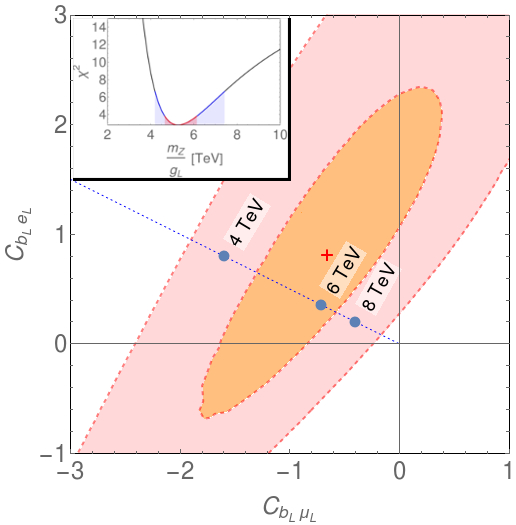 Figure 1
 Figure 2
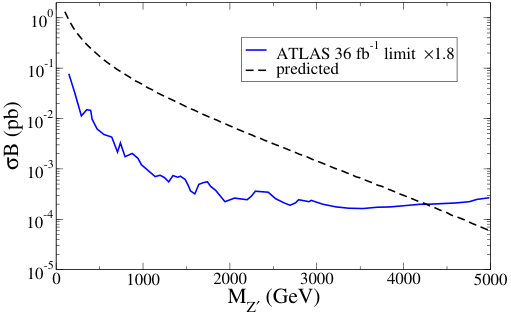 Figure 3
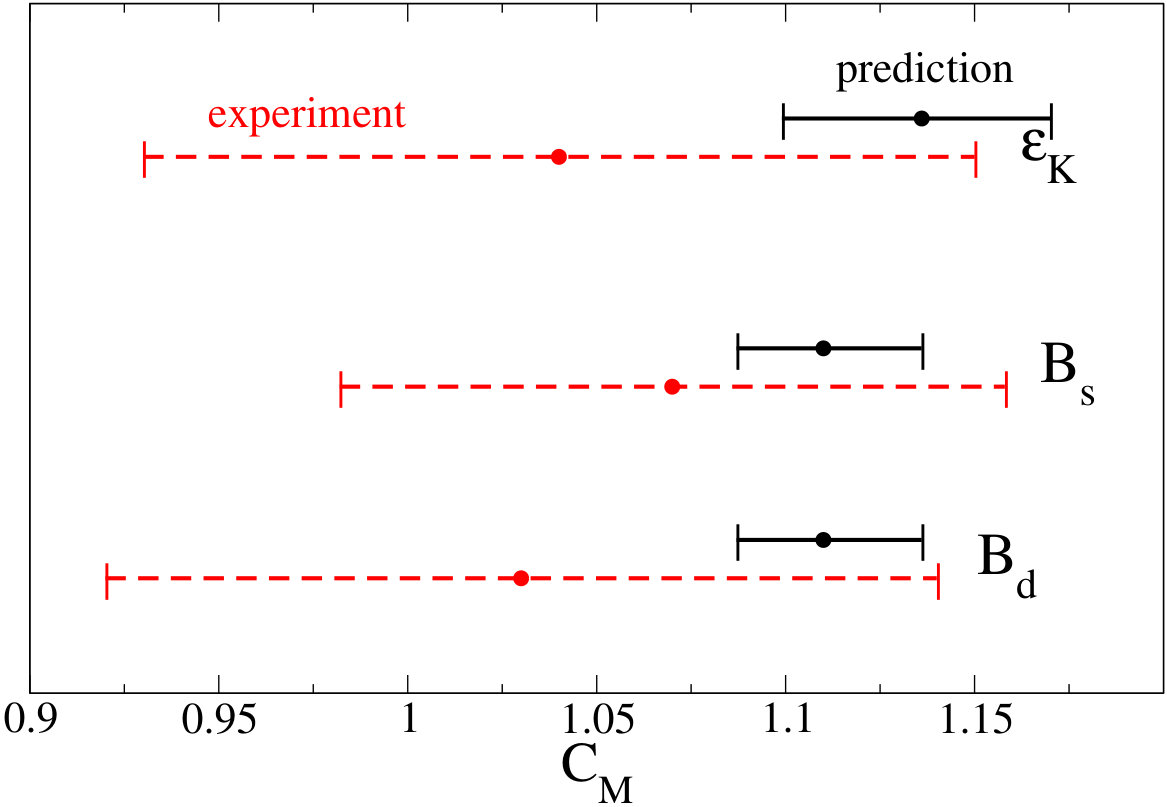 Figure 4
| Field | U(1)y | SU(2)L | SU(3)c | SU(3)L | SU(3)R | |
|---|---|---|---|---|---|---|
| , | ||||||
Peer Reviews
No public reviews on file for this paper yet. If you reviewed it on a platform where reviews are public (OpenReview, ICLR, NeurIPS, ICML), you can paste yours below so the community can read it here.
Videos
No videos yet. Explain this paper in a talk, walkthrough, or lecture? Add one.
decay anomalies from nonabelian local horizontal symmetry
James M. Cline
CERN Theoretical Physics Department and McGill University, Department of Physics
Jorge Martin Camalich
CERN Theoretical Physics Department, Geneva, Switzerland
Abstract
Recent anomalies in meson decays are consistent with exchange of a heavy vector boson. Here we try to connect such new physics to understanding the origin of flavor, by gauging generation number. Phenomenological and theoretical considerations suggest that the smallest viable flavor symmetry (not including any extra U(1) factors) is chiral SU(3)SU(3)R, which acts only on generation indices and does not distinguish between quarks and leptons. Spontaneous breaking of the symmetry gives rise to the standard model Yukawa matrices, and masses for the 16 -like gauge bosons, one of which is presumed to be light enough to explain the anomalies. We perform a bottom-up study of this framework, showing that it is highly constrained by LHC dilepton searches, meson mixing, decays and CKM unitarity. Similar anomalies are predicted for semileptonic decays of to lighter mesons, with excesses in the channels and deficits in , but no deviation in . The lightest mass is TeV if the gauge coupling is .
††preprint: CERN-TH-2017-136
I Introduction
Particle physicists have long been waiting for some definitive sign of a breakdown in the Standard Model (SM), which generally works so well as to recall Lord Kelvin’s famous statement, “There is nothing new to be discovered in physics now. All that remains is more and more precise measurement.” But it has also been anticipated that precision measurements, in the context of flavor, could be the most likely harbinger of new physics (NP), since flavor changing neutral currents (FCNCs) are so highly suppressed in the SM Glashow:1976nt ; Glashow:1970gm . The natural progression of such a signal would be a gradual accumulation of tension in some flavor observables. In recent years, tensions have been mounting in semileptonic decays, which have been measured with increasing accuracy at the LHC Aaij:2014ora ; Aaij:2015esa ; Aaij:2015oid ; Aaij:2015yra ; Aaij:2017vbb ; ATLAS:2017dlm and factories Lees:2012xj ; Lees:2013uzd ; Huschle:2015rga ; Abdesselam:2016xqt ; Wehle:2016yoi and point to new sources of lepton-universality violation (LUV) in nature.
In particular for the FCNC transitions, LHCb has found compelling discrepancies in the ratios
[TABLE]
for decays into , which are predicted to be very close to 1 in the SM Hiller:2003js ; Bordone:2016gaq ; Geng:2017svp . The measured values are Aaij:2014ora , below the SM prediction, and (low ), , where is the invariant mass of the lepton pair Aaij:2017vbb . The significance of the discrepancy in each bin is -. Moreover an angular analysis of Aaij:2015oid suggests a discrepancy.
The quantity is particularly interesting because hadronic uncertainties in the decay rate cancel to a high degree in the ratio, making this a “clean” observable (see e.g. Geng:2017svp ). Other measurements such as branching fractions and the angular observables mentioned above are not so theoretically clean, but it is interesting that their inclusion tends to reinforce the evidence from clean observables only Geng:2017svp ; DAmico:2017mtc ; Altmannshofer:2017yso ; Capdevila:2017bsm ; Ciuchini:2017mik ; Bardhan:2017xcc ; Neshatpour:2017qvi ; Alok:2017jaf ; Alok:2017su, a further indication that the effect could be real. The best fits are provided by NP contributions involving the effective operators
[TABLE]
where and the SM contributions are , Bobeth:2003at . Since , it is possible to fit the data well with NP contributions to the left-handed leptonic operators alone.
The anomalies have inspired many model-building efforts, with the most popular proposals involving exchange of heavy vector bosons Gauld:2013qba ; Gauld:2013qja ; Buras:2013dea ; Altmannshofer:2014cfa ; Crivellin:2015lwa ; Sierra:2015fma ; Crivellin:2015era ; Celis:2015ara ; Carmona:2015ena ; Fuyuto:2015gmk ; Chiang:2016qov ; Kim:2016bdu ; Cheung:2016exp ; Crivellin:2016ejn ; GarciaGarcia:2016nvr ; Datta:2017pfz ; Ko:2017lzd ; Alonso:2017bff ; Bonilla:2017lsq ; Alonso:2017uky ; Ellis:2017nrp ; Tang:2017gkz ; Chiang:2017hlj ; Chivukula:2017qsi ; King:2017anf , leptoquarks Hiller:2014yaa ; Gripaios:2014tna ; Allanach:2015ria ; Alonso:2015sja ; Bauer:2015knc ; Sahoo:2015pzk ; Kumar:2016omp ; Das:2016vkr ; Li:2016vvp ; Chen:2016dip ; Becirevic:2016yqi ; Becirevic:2016oho ; Mileo:2016zeo ; Hiller:2016kry ; Sahoo:2016pet ; Popov:2016fzr ; Barbieri:2016las ; Chen:2017hir ; Crivellin:2017zlb ; Hiller:2017bzc ; Cai:2017wry ; Becirevic:2017jtw ; Chauhan:2017ndd or loop-induced transitions Gripaios:2015gra ; Bauer:2015knc ; Arnan:2016cpy ; Kamenik:2017tnu ; Das:2017kfo ; He:2017osj . The data can be well fit in simplified models that are designed to address only , but one naturally hopes that the complete picture would shed greater light on one of the biggest puzzles of the SM, the origin of flavor. If flavor symmetry is local and spontaneously broken, then heavy gauge bosons would inevitably arise, possibly having couplings with the right flavor structure for explaining the anomalies Altmannshofer:2014cfa ; Crivellin:2015lwa ; Alonso:2017bff ; Alonso:2017uky . This is the approach we take, with the goal of adopting the smallest nonabelian flavor symmetry group that seems to be consistent with the observations, while fully accounting for the structure of the SM Yukawa matrices.
The simplest possibility for a generational symmetry as the origin of flavor would be to couple all SM fermions vectorially to a single SU(3)H generation group. Although global fits to decays disfavor purely vectorial currents to the quarks, it was noted in ref. Alonso:2017bff that chiral currents can arise for the flavor-changing transitions if only left-handed quarks need to be rotated when diagonalizing the quark masses; the full flavor symmetry group must include a U(1)B-L factor to account for neutrino masses in this model.
Here we consider a different possibility, by assuming the larger chiral group SU(3)SU(3)R with no U(1) factor. In addition, we attempt to give a detailed account of the origin of the SM fermion masses within the same framework, as explained in section II. It turns out to be highly constrained, with phenomenological requirements restricting the model-building choices at almost every step. We make a number of predictions for collider searches and precision studies that are imminently testable, as explained in section III. Further consequences of the model, focusing on physics above the scale needed to explain , are discussed in section IV. We summarize the distinctive features of our model and its differences with previous proposals in section V. Appendix A presents the constraints on possible lepton flavor violation that may be present in the model, while appendix B explains why a simpler related model, with vectorial SU(3)H flavor group and no U(1) factor, is not viable.
II Model
In order to generate the SM fermion masses and to cancel anomalies, we add a set of fermions , , , and scalar fields , , , that transform as shown in in table 1,
[TABLE]
The new fermions play a double role, by cancelling the anomalies of SU(3)SU(3)R, and by generating the SM Yukawa couplings. A symmetry under which the right-handed SM fermions and are charged prevents direct flavor-universal mass terms such as . The scalars , , are present to spontaneously break this symmetry and to dynamically generate the flavor structure of the SM, as we now show.
For simplicity, we take to get VEVs proportional to the unit matrix
[TABLE]
while may be more complicated. We further assume that , with the possible exception of because of the large top quark mass. On the other hand is much greater than the other VEVs, so that the right-handed neutrinos are very heavy.
Integrating out the heavy fields gives rise to the dimension-5 and 7 operators
[TABLE]
that become the fermion mass matrices. The mass scales in the denominators are given by , except possibly for where we use the more exact expression
[TABLE]
Below, we will assume that is a diagonal matrix, and only the element will be large enough to matter in this more exact expression.
II.1 Fermion and gauge boson masses
After the scalars and the Higgs field get VEVs, the SM fermions get Dirac masses
[TABLE]
(with taken to be a matrix as explained above) while the neutrinos get the Majorana mass matrix
[TABLE]
with playing the role of the Dirac mass matrix in the seesaw formula.
The large VEV breaks SU(3)SU(3)SU(3)L at a high scale, so we henceforth ignore the heavy gauge bosons associated with SU(3)R.111 In general the mass eigenstates are mixtures of and , but if as assumed, then the lightest 8 of the 16 gauge bosons will be mostly , with a very small admixture of . For simplicity we will henceforth consider to be decoupled and ignore this small mixing. The terms that give masses to the SU(3)L gauge bosons are
[TABLE]
where with generators of the fundamental representation, and is the SU(3)L gauge coupling. We will show that the decay anomalies motivate us to further break SU(3) U(1)8, the U(1) subgroup whose gauge boson couples to the diagonal generator . This is the reason for including the octet scalars. It suffices to have VEVs of the form , , with to give large masses to all components of except as desired.
The identification of as a special direction in the space of generators implies a choice of basis for the fermion flavors. We are assuming that in this basis, the mass matrices of the quarks and charged leptons are diagonal, in the limit where CKM mixing is neglected. To include CKM mixing, we will make the simplifying assumption that the up-like mass matrix is diagonal, and all the mixing comes from . This choice is particularly convenient for revealing that our model enjoys the properties of minimal flavor violation (MFV) Chivukula:1987py ; DAmbrosio:2002vsn ; all the FCNCs that arise from exchange explicitly have the same CKM structure as in the SM.
We emphasize that the assumption of being diagonal is not crucial to the more general framework presented here. It would also be consistent to have off-diagonal contributions to similar in relative size to those in . For example, suppose that the fermion masses are diagonalized as usual by unitary transformations , , such that , where . Then the predictions we present in the following would be similar to those in the simpler case where , . The flavor-changing couplings of to down-type quarks would be approximately half as large, this amount being shifted into those of the up-like quark sector. Detailed predictions would change but the overall picture, including MFV structure, would be preserved. We defer the study of such generalizations for possible future work.
II.2 Currents
Diagonalizing the gauge boson mass matrix determines the mass eigenstates as where is an orthogonal matrix. Our model is such that is the lightest gauge boson, whose exchange is the origin of anomalous decays. In general, a that has only flavor-diagonal couplings could couple to the linear combination of generators
[TABLE]
(which must be traceless since they belong to SU(3)). It turns out that, to avoid large FCNC’s affecting - mixing, must be negligibly small. Such operators, with complex coefficients, are directly induced by exchange of the gauge bosons coupling to , which constrains their masses to be at the scale TeV. Diagonalization of the gauge boson mass matrix then reveals that , since is at the TeV scale. We therefore ignore in the following.
The fermion masses are diagonalized as usual by unitary transformations , . Then couplings of to fermions in the mass basis are given by the left-handed currents,
[TABLE]
where by our simplifying assumption and the CKM mixing is entirely due to .
Then as discussed in section II.1, flavor mixing in the down-quark sector has a structure resembling the MFV hypothesis. The diagonal couplings to (left-handed) quarks are given by
[TABLE]
while the off-diagonal ones are
[TABLE]
For the left-handed leptons, we require that is nearly diagonal, to avoid tree-level lepton flavor changing neutral currents. Moreover the diagonal elements must violate flavor universality to explain the anomalies. We assume that
[TABLE]
which preserves the eigenvalues of (10) for . Hence is approximately of the form
[TABLE]
which is just a permutation, and has determinant . This is the unique SU(3) transformation that takes the generator into a diagonal form in which muons couple more strongly than electrons, as indicated by the anomaly (and having the right sign, as will be established below), hence (15) is forced upon us. The right-handed rotation is still unconstrained, while the transformation is now determined in terms of the PMNS neutrino mixing matrix , as . For simplicity we will impose lepton flavor conservation by taking in the remainder. If one relaxes this assumption, the experimental constraints on lepton flavor violation require that , , as shown in appendix A.
It is worth emphasizing that, while there is considerable freedom in choosing VEVs of the fields to obtain the flavor structure of the quark and lepton currents, there is also an important restriction: the generators are traceless, forcing to couple with similar strength to all quarks and leptons, in addition to the phenomenologically motivated coupling. This leads to interesting constraints and predictions as we now explore.
III Constraints and predictions
Having defined the model, there is only one combination of parameters, , that is left to fit the anomalies. Once this is done, a number of predictions for related FCNC semileptonic meson decays, neutral meson oscillations, -decays, and violation of unitarity of the CKM matrix follow. In addition a level of dilepton pair production at the LHC is predicted that is close to current constraints. We discuss these issues in the following.
III.1 Explaining the anomalies
The contributions to processes from purely semileptonic operators in the SM are contained in eq. (I), where the Wilson coefficients are independent of the lepton flavor. Global fits to point to new lepton flavor nonuniversal contributions to these operators and including other data suggests that part of this NP appears in the muonic operators. Contributions to other operators, such as those involving or different Lorentz structures, are disfavored as discussed in refs. Geng:2017svp ; DAmico:2017mtc ; Alonso:2014csa .
From (13) and (14) it follows that our model produces lepton-specific contributions precisely to ,
[TABLE]
The CKM coefficient of this contribution has factored out with the SM normalization in eq. (I), which is a consequence of the MFV-like structure of the couplings to the quarks.
In fig. 1 we show the trajectory of our model as a function of in the (, ) plane compared to the best fit point to , and of ref. Geng:2017svp . In the lower-left corner we also show the projection of the along . As one can see, our model gives an excellent fit to the data, with a for 3 degrees of freedom, which represents a 4.22 improvement over the SM. The best fit point and 1 error interval is
[TABLE]
We have checked that adding the angular observables of in a global fit slightly narrows the constraint on but does not have a significant impact on the best solution or improvement with respect to the SM.222In ref. DAmico:2017mtc at fit was performed for models that are similar to ours, which gives a significantly stronger bound on . This stems from their inclusion of two data points whose respective preferred solutions for the minimum of are regions of parameter space with small overlap; these are inclusive and . We do not include these observables in our fit (17); doing so we find that the improvement in is comparable and the best fit value is shifted to TeV. We thank Guido D’Amico and Marco Nardecchia for discussions clarifying this point.
Eq. (16) predicts excesses for the branching ratios of , , which are approximately half the deficit in . A further consequence of the MFV couplings to the quarks is that similar effects should be measured in , where is a zero-strangeness meson. In particular we predict
[TABLE]
for the decay channels with pions and mesons.333 Large differences in form factors between the channels could in principle modify this prediction, but such differences are disfavored by approximate SU-flavor symmetry in the light-quark sector of QCD, and by explicit calculations Straub:2015ica .
III.2 decays
Along with the charged leptons, our couples to neutrinos and hence contributes to rare decays such as and . Interestingly, the former will be searched by Belle II and the latter will be better measured by the NA62 experiment in the coming year. In the SM the decays are induced by the low-energy operator
[TABLE]
where Brod:2010hi . The contributions of the are
[TABLE]
Even though large deviations are predicted for decays into individual neutrino flavors, what the experiments observe are the “invisible” and rates, in which the absolute contributions from the neutrino flavors are summed over. An important consequence of the tracelessness of the current, eq. (12), together with the fact that the matrix element contributing to this process is the same for all neutrino flavors, is that the net interference of the and SM contributions vanishes. The NP contribution to the branching fraction is thus given by the quadratic terms,
[TABLE]
an effect that will be hardly detectable in forthcoming experiments.
III.3 transitions
Neutral-meson mixing receives tree-level contributions from -exchange in our model, yielding
[TABLE]
which has the same operator structure and combination of CKM matrix elements as the box diagram of the top quark in the SM. Parametrizing the deviation from the SM of the parameter in - mixing by Bona:2007vi
[TABLE]
we obtain using eq. (17), while the current experimental constraint is at 1 Bona:2007vi ; the latter sets the lower bound TeV, which is quite close to our best fit value (17). In the case of - mixing the SM contribution is dominated by the top-loop diagram and its weak phase is aligned with that of the . Thus only the mass differences are constraining, which can be parametrized by
[TABLE]
We obtain which is within the experimental limits and Bona:2007vi and gives the slightly weaker bound TeV. The predictions for and the experimental constraints are summarized in fig. 2.
There is a potentially dangerous contribution to - mixing from the loop diagram 3 from exchange of the heavy and particles. In the limit where all the states of the octet are degenerate, the contribution to the amplitude is proportional to the product of SU(3) generators,
[TABLE]
However if there are mass splittings, then FCNCs get generated. For example if which couples to has mass-squared splitting , we find that the operator relevant to - mixing is
[TABLE]
Since the coefficient is real, it is constrained at the level of Bona:2007vi . We do not predict the masses or splittings here; it would require constructing the full potential of the scalars which is beyond the scope of this work. Nothing ostensibly precludes choosing to be sufficiently small.
III.4 Collider searches for resonant and nonresonant
dileptons
A crucial test comes from the search for resonant production of that decays to and ATLAS:2017wce . In our model, production occurs from all flavors of quarks in the proton (but is dominated by the contributions), according to the couplings (12). The branching ratio for decays into muons (electrons) is , from (12) and (14). Using MadGraph Alwall:2014hca to predict the resulting production cross section at 13 TeV center of mass energy, with QCD correction of , and eq. (17) to determine , we find the product versus shown in fig. 4.
The published ATLAS limit applies to models in which equal numbers of electrons and muons are produced. In our model, since primarily muons are produced, and the efficiency for detecting electrons is greater than for muons, the limit is relaxed. In the most interesting mass bin for our purposes, 3-6 TeV, the relative efficiency for electron versus muon detection is . The bound on is then relaxed by the factor Moenig , using This leads to the limit TeV, which when combined with (17) implies a gauge coupling . Thus another prediction of this model is that the should appear soon in searches for resonant dimuons, if the gauge coupling is not much greater than .
Recently a complementary recasting of dilepton constraints was done in ref. Greljo:2017vvb , pointing out that they could also limit the size of effective 4-fermion operators induced by integrating out a heavy , even if its mass is beyond the reach of resonant production at LHC. Coefficients of the operators involving first generation left-handed quarks and contributing to and are bounded using the resonant dilepton searches. The dimensionless coefficients are identified in our model and constrained as
[TABLE]
where the allowed ranges are given. There is some tension at the level of in the channel, where the range is asymmetric because of a deficit of background events in some invariant mass bins. This analysis reinforces the conclusion that dilepton searches could soon reveal evidence for our model, or exclude it.
Interestingly, an independent constraint on the Wilson coefficient arises from parity-violating observables in atomic and electron-proton scattering experiments: Falkowski:2017pss , which is consistent with the bound in eq. (27). There is no analogous constraint on , but the muonic coupling of the can be tested using neutrino trident production Altmannshofer:2014pba , which in our case leads to the lower limit GeV.
III.5 and couplings to fermions
As we dicuss in detail below, in order to have a with a mass of TeV, at least some of the exotic fermions , , and must be in the multi-TeV range. Although such masses are still out of reach for direct searches at the LHC, they can affect low-energy observables like the couplings of weak bosons to the SM fermions. By integrating out all the heavy states in eq. (3), at the electroweak scale they produce the effective operators
[TABLE]
where \raisebox{5.69054pt}{{}^{\leftrightarrow}}D_{\mu}=D_{\mu}-\raisebox{5.69054pt}{{}^{\leftarrow}}D_{\mu} and \raisebox{5.69054pt}{{}^{\leftrightarrow}}D_{\mu}^{I}=\tau^{I}D_{\mu}-\raisebox{5.69054pt}{{}^{\leftarrow}}D_{\mu}\tau^{I}, both of which act trivially in generation space. 444We have omitted the contributions to operators of the type , …which are also generated by integrating out the heavy fermions but that are only weakly constrained by Higgs-couplings measurements. These can readily be converted into modifications of the and couplings of the SM left-handed fields,
[TABLE]
The couplings to the fermions have been measured very precisely at LEP. The strongest constraint is on the coupling to the leptons, which leads to the bound TeV at 95% C.L. Falkowski:2017pss . The invisible width of the leads to the bound or TeV at 95% C.L. Similarly, for the couplings to the up- and down-type quarks we get TeV and TeV at 95% C.L.
Generally these bounds can be satisfied even if is not very large by taking sufficiently small. The exact formula for the heavy fermion masses, eq. (6), implies that (since ), where is the mass of the heaviest SM fermion of type . Thus for down-type quarks, the decay bound can be satisfied even if GeV. However for the up-type quarks we have , hence TeV. These constraints can be expressed in terms of the couplings , by using eqs. (9) and (17) (see the discussion around eqs. (32) and (33)), resulting in upper limits shown in table 2.
In the case of the charged currents, the strongest bound stems from the first-row unitarity test of the CKM matrix Gonzalez-Alonso:2016etj ,
[TABLE]
where in the second line we have used the corrections in eq. (III.5). The experimental bound is , while the contributions to (III.5) from the charged leptons can be as large as , from the -decay constraint. If the other contributions are no larger (even though the decay bounds would allow them to be so), the constraint is satisfied without any need for tuning of parameters. This is the case if , which is consistent with the decay limits in table 2.
IV UV implications
The discussion so far has been focused on explaining the anomalies while satisfying other flavor-changing constraints on the low-energy limit of the theory. Here we return to the higher-energy regime to explore how this relates to the masses of the heavier gauge bosons, and the mechanism of fermion mass generation.
IV.1 Hierarchy of scales
We require the octet scalars to get VEVs proportional to the generators in order to give large masses to all the that couple to generators other than . Supposing that , and no other VEVs are present, the gauge boson mass matrix is
[TABLE]
where . Separate contributions from two octet fields are required to avoid a second vanishing eigenvalue, that would lead to large FCNC’s amongst light quarks, The first two of the states in (31) couple to , which mediate transitions. Constraints from - mixing require that TeV, since their exchange generally produces with a coefficient whose imaginary part is not suppressed. (Rotation to the quark mass basis does not affect this conclusion).
Since commutes with , only the second term in (7) contributes to the mass. Recalling the simplifying assumption that the VEV is proportional to the unit matrix, we have
[TABLE]
Then using (17) the heavy fermion masses are given by
[TABLE]
Assuming the couplings , this implies that all the heavy fermions are within the reach of the LHC. Current limits on vectorlike quark masses are still close to 1 TeV Sirunyan:2017usq ; Aaboud:2017qpr .
IV.2 ,
It is interesting to ask whether the present framework could also accommodate the anomalies observed in the decays . It would require the presence of a heavy boson in addition to the . In principle this could be accomplished by extending the gauge symmetry to SU(6)SU(3)R, where SU(6)L contains the SM gauge group SU(2)L. The additional gauge bosons then arise from the breaking of SU(6) SU(2)SU(3)L. CKM-like mixing would produce the generation-changing interaction
[TABLE]
Although such an operator can provide a good fit to , there are two problems in the present framework. First, eq. (14) also predicts the operator with coefficient times that in (34), which does not fit the observations Glattauer:2015teq ; Abdesselam:2017kjf . Secondly, as shown in ref. Freytsis:2015qca , the required mass for to fit is too small to satisfy LHC constraints, given that the couples to light quarks through the generator (10).
IV.3 Asymptotic freedom
With the particle content listed in table 1, the and couplings remain asymptotically free. The contributions to the functions are
[TABLE]
from the gauge bosons, fermions, bifundamental scalars, and octets (plus sextet in (36)), respectively. We have assumed that the component fields are real, so that the matrices and hence the SM Yukawa matrices are Hermitian, which is phenomenologically allowed Evans:2011wj .
The beta function (35) is only valid above the scale TeV at which SU(3)L is restored. Between this scale and , we should consider the evolution of as the gauge coupling of the U(1) associated with . Its beta function is given by
[TABLE]
where the respective contributions from the fermions and bosons are shown. Using the initial condition at TeV, which would saturate the current bound from ATLAS dilepton searches, this would lead to a Landau pole at scale TeV. However asymptotic freedom takes over well before, at TeV, so the theory has good UV behavior.
IV.4 Neutrino masses
A further consequence of the structure of the currents is that we are forced to take the transformation that diagonalizes the lepton mass matrix to be close to the permutation (15). This means that the lepton masses have to be in an unusual order in the original basis, diag(). As mentioned above, this fixes the left-handed neutrino rotation in terms of the PMNS matrix to be
[TABLE]
From this one can infer the form of the seesaw neutrino mass matrix in the original basis, before diagonalization:
[TABLE]
depending upon whether the mass hierachy is normal or inverted. We assumed that .
V Discussion
Our model has similarities to that of ref. Alonso:2017bff , in which the gauged flavor symmetry is SU(3)U(1)B-L acting vectorially on the SM fermions. The horizontal symmetry is the same as we have considered except for the fact that it is not chiral and it includes an extra U(1) factor. This leads to a number of important phenomenological differences between the models. First, right-handed currents are present in ref. Alonso:2017bff (though they are taken to be flavor-diagonal), while they are presumed to be negligible in ours. Second, the flavor generators in Alonso:2017bff are not traceless like in eqs. (10) and (14). Third, since is opposite for quarks and leptons, the currents for quarks and leptons are different linear combinations of and in Alonso:2017bff , whereas they are the same in our model. The presence of the U(1)B-L factor in Alonso:2017bff leads to a Landau pole at scales GeV, which is not present in our model. Fourth, our model requires no charged lepton flavor violation, whereas it is essential for generating the coupling to muons in Alonso:2017bff . Moreover, we have explored the connection between flavor symmetry breaking and the Yukawa matrices of the SM in our framework.
One consequence of the tracelessness of our generators has already been noted: new contributions to the decays or are negligible, because the interference with the SM contribution vanishes. Another is that sizable couplings of to all three generations cannot be avoided. In ref. Alonso:2017bff , VEVs for the fundamentals that break SU(3)U(1)U(1)h are chosen such that the leptonic generator couples only to the third generator, before mass mixing. By assuming the mixing is small, the branching ratio of (and even more so ) can be suppressed, making it easier to satisfy ATLAS constraints on resonant dilepton production. Our model does not have this option, leading to mild tension in this observable. The traceless generators also imply that no gauge kinetic mixing will arise between the and the SM U(1) hypercharge at one loop. Hence potentially strong constraints from diboson production Osland:2017ema are evaded in our model.
Although phenomenologically complete, our analysis does not address how difficult it might be to construct a potential for all the scalar fields that leads to the desired pattern of VEVs, or perhaps a similar one that is nevertheless viable. This is probably challenging, and might best be postponed pending further experimental evidence in favor of the model. There are a number of new physics signals that should be close to being observable, in addition to direct production of the at LHC. These include a positive contribution to the parameter for - mixing, a negative contribution to the first-row CKM unitarity test (III.5), an enhancement of the decay width for , and vectorlike quarks and leptons at the few-TeV scale.
Acknowledgments. We thank Rodrigo Alonso, Mattia Dalla Brida, Luca Di Luzio, Martin Gonzalez-Alonso, Ben Grinstein, David London, David Marzocca, Klaus Mönig, Guy Moore, Rui-xiang Shi and Alfredo Urbano for valuable advice and discussions.
Appendix A -violating decays
Nothing forbids the entries in the leptonic currents (14), which are constrained by lepton-flavor violating decays such as , at the level of and in the respective branching ratios. By comparing the NP and SM Wilson coefficients for the exotic decays versus the allowed ones, we find that
[TABLE]
using eq. (17).
At one loop, these couplings also give rise to and , through the transition magnetic moment operator , where is the photon momentum. We find that
[TABLE]
Using the decay width , and the PDG limits PDG on the radiative decays, we find weaker limits than in (47):
[TABLE]
where we took TeV to evaluate the logarithms.
The muon anomalous magnetic moment is related to the transition moment in (48) by taking . This gives a contribution to , smaller than the observed discrepancy by a factor of 75.
Lepton flavor violating decays of vector mesons, for example , have branching ratios of order , far below current limits . Pseudoscalar mesons have chirality-suppressed decays to purely leptonic final states. The perturbation to the branching ratio of is predicted to be , which is smaller than the experimental error of . For the -violating decays such as , since there is no interference with the SM the predicted signal is much smaller and gives no useful limits on .
Appendix B Vectorial flavor symmetry
One could imagine constructing a similar model to the one we have proposed, but using a vectorial SU(3)H flavor symmetry instead of SU(3)SU(3)R. The same interactions as in eq. (3) could be written, but the fields would have to be in the representation rather than bifundamental, and a discrete symmetry would be required to forbid large flavor-universal contributions to the Yukawa matrices involving only SM fields. The flavor-conserving quark and lepton currents would be vectorial, while the FCNCs of the quarks would be left-handed as in the model of ref. Alonso:2017bff . A good fit to can still be obtained with vectorial leptonic currents; some authors would argue that this is even preferred Capdevila:2017bsm .
There are several major drawbacks however. First, the sextet field cannot get a large VEV to produce heavy right-handed neutrino masses while leaving a relatively light , making the origin of neutrino masses problematic. (The extra U(1)B-L factor allowed ref. Alonso:2017bff to overcome this problem.) Second, the tension with dilepton searches is multiplied by having vectorial couplings to the . For resonance searches, the production cross section increases by a factor of 2, while for the nonresonant constraints the number of operators simultaneously contributing to the signal with equal strength is quadrupled, creating a significant tension in all channels but especially electrons. Finally, asymptotic freedom of the gauge coupling is badly spoiled by the large matter content, including 10 octet scalars and a heavy copy of the SM fermions, leading to a Landau pole at a relatively low scale.
The reference list from the paper itself. Each links out to its DOI / PubMed record.
- 1(1) S. L. Glashow and S. Weinberg, “Natural Conservation Laws for Neutral Currents,” Phys. Rev. D 15 , 1958 (1977). doi:10.1103/Phys Rev D.15.1958
- 2(2) S. L. Glashow, J. Iliopoulos and L. Maiani, “Weak Interactions with Lepton-Hadron Symmetry,” Phys. Rev. D 2 , 1285 (1970). doi:10.1103/Phys Rev D.2.1285
- 3(3) R. Aaij et al. [LH Cb Collaboration], “Test of lepton universality using B + → K + ℓ + ℓ − → superscript 𝐵 superscript 𝐾 superscript ℓ superscript ℓ B^{+}\rightarrow K^{+}\ell^{+}\ell^{-} decays,” Phys. Rev. Lett. 113 , 151601 (2014) doi:10.1103/Phys Rev Lett.113.151601 [ar Xiv:1406.6482 [hep-ex]].
- 4(4) R. Aaij et al. [LH Cb Collaboration], “Measurement of the ratio of branching fractions ℬ ( B ¯ 0 → D ∗ + τ − ν ¯ τ ) / ℬ ( B ¯ 0 → D ∗ + μ − ν ¯ μ ) ℬ → superscript ¯ 𝐵 0 superscript 𝐷 absent superscript 𝜏 subscript ¯ 𝜈 𝜏 ℬ → superscript ¯ 𝐵 0 superscript 𝐷 absent superscript 𝜇 subscript ¯ 𝜈 𝜇 \mathcal{B}(\bar{B}^{0}\to D^{*+}\tau^{-}\bar{\nu}_{\tau})/\mathcal{B}(\bar{B}^{0}\to D^{*+}\mu^{-}\bar{\nu}_{\mu}) ,” Phys. Rev. Lett. 115 , no. 11, 111803 (2015) Erratum: [Phys. Re
- 5(5) R. Aaij et al. [LH Cb Collaboration], “Angular analysis and differential branching fraction of the decay B s 0 → ϕ μ + μ − → subscript superscript 𝐵 0 𝑠 italic-ϕ superscript 𝜇 superscript 𝜇 B^{0}_{s}\to\phi\mu^{+}\mu^{-} ,” JHEP 1509 , 179 (2015) doi:10.1007/JHEP 09(2015)179 [ar Xiv:1506.08777 [hep-ex]].
- 6(6) R. Aaij et al. [LH Cb Collaboration], “Angular analysis of the B 0 → K ∗ 0 μ + μ − → superscript 𝐵 0 superscript 𝐾 absent 0 superscript 𝜇 superscript 𝜇 B^{0}\to K^{*0}\mu^{+}\mu^{-} decay using 3 fb -1 of integrated luminosity,” JHEP 1602 , 104 (2016) doi:10.1007/JHEP 02(2016)104 [ar Xiv:1512.04442 [hep-ex]].
- 7(7) R. Aaij et al. [LH Cb Collaboration], “Test of lepton universality with B 0 → K ∗ 0 ℓ + ℓ − → superscript 𝐵 0 superscript 𝐾 absent 0 superscript ℓ superscript ℓ B^{0}\rightarrow K^{*0}\ell^{+}\ell^{-} decays,” ar Xiv:1705.05802 [hep-ex].
- 8(8) The ATLAS collaboration [ATLAS Collaboration], “Angular analysis of B d 0 → K ∗ μ + μ − → subscript superscript 𝐵 0 𝑑 superscript 𝐾 superscript 𝜇 superscript 𝜇 B^{0}_{d}\to K^{*}\mu^{+}\mu^{-} decays in p p 𝑝 𝑝 pp collisions at s = 8 𝑠 8 \sqrt{s}=8 Te V with the ATLAS detector,” ATLAS-CONF-2017-023.