
TL;DR
This paper introduces an online simulation tool for hedonic games, enabling quick and visual experimentation with coalition formation models that are otherwise difficult to analyze manually.
Contribution
The paper presents a novel online software platform for simulating various types of hedonic games, facilitating easier analysis and understanding of coalition dynamics.
Findings
Enables fast, visual simulation of hedonic games
Supports multiple types of hedonic game models
Improves accessibility for researchers and students
Abstract
Hedonic games are meant to model how coalitions of people form and break apart in the real world. However, it is difficult to run simulations when everything must be done by hand on paper. We present an online software that allows fast and visual simulation of several types of hedonic games. http://lukemiles.org/hedonic-games/
Click any figure to enlarge with its caption.
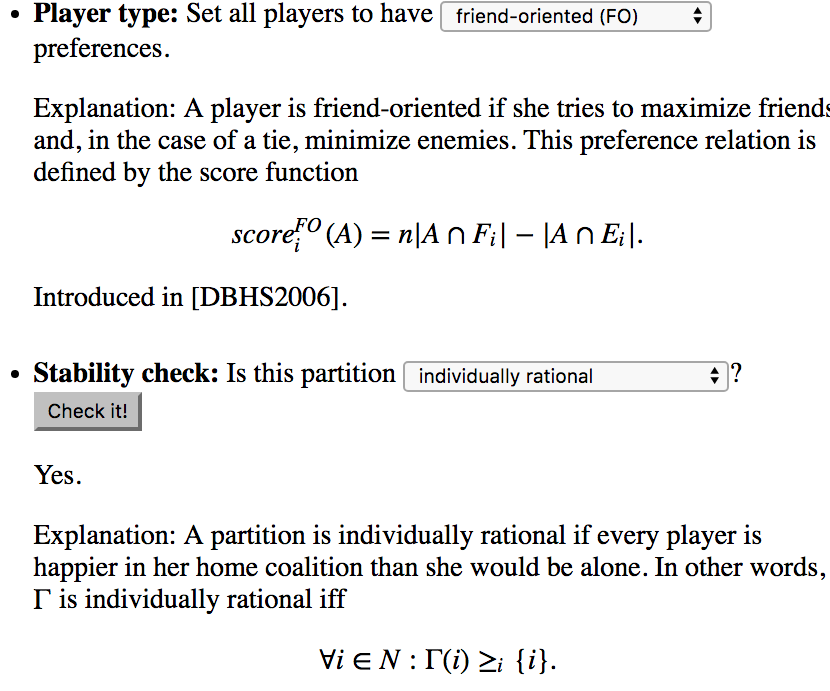 Figure 1
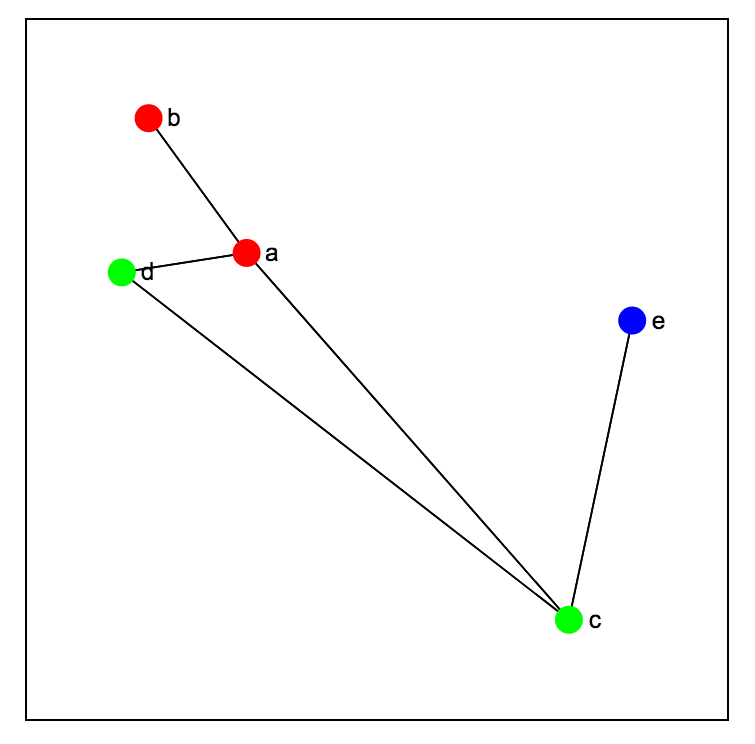 Figure 2
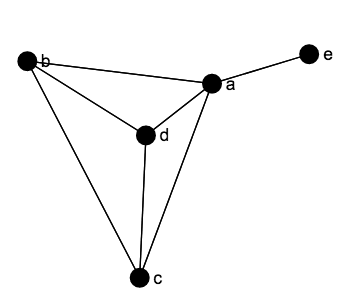 Figure 3
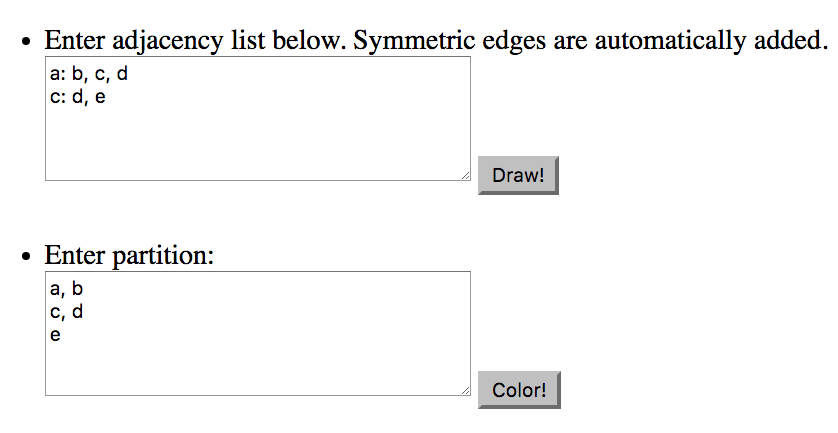 Figure 4
Peer Reviews
No public reviews on file for this paper yet. If you reviewed it on a platform where reviews are public (OpenReview, ICLR, NeurIPS, ICML), you can paste yours below so the community can read it here.
Videos
No videos yet. Explain this paper in a talk, walkthrough, or lecture? Add one.
Taxonomy
TopicsGame Theory and Voting Systems · Gambling Behavior and Treatments · Game Theory and Applications
11institutetext: University of Kentucky
A Simulator for Hedonic Games
Luke Harold Miles
1 A Story
Mr Holt, the kindergarten teacher, gives his class these instructions:
Hello class, The Metropolitan Museum of Art has a sudden shortage of sculptures and needs several new ones to fill its shelves. Please break into groups so that each group can build a Lego tower. The director of the museum will be here in an hour to pick up the towers and put them in the museum with your names on them. Please do the best job you can; you don’t want to be professionally embarrassed.
Each kindergartener wants to be in a group with her friends, but she also wants her friends to be happy in the group; she doesn’t want her friends to be miserable. The graph below is a map of who is friends with whom in the small class. Notice that would have more friends in the group than , but maybe doesn’t want to be in the group because knows that would make , , and less happy. Strangely, prefers to .
You can imagine that the kindergarteners might try to choose the best group in some other way. The class would split into groups one way, but then people would be unhappy and keep changing their groups. How can we model all this? How could we easily visualize all this?
2 Hedonic Games
Below is the original definition of a hedonic game. Hedonic games (Banerjee, Konishi, and Sönmez, 2001) were invented to model the formation and reformation of groups.
Definition 1
(Banerjee, Konishi, and Sönmez, 2001) A coalition formation game is a pair , where is a finite set of players and for every , is a reflexive, complete, and transitive binary relation on . If and and , then we write .
Definition 2
(Banerjee, Konishi, and Sönmez, 2001) A coalition structure is a partition of . The coalition containing a player is denoted . Any subset of is called a coalition.
That’s a very minimal definition, and these most general hedonic games don’t have many computationally useful properties. For that reason, several subclasses of hedonic games have been invented and studied. First though, let’s look at stability.
2.1 The Core
If Mr Holt were assigning groups, instead of letting the kids form their own groups, then he might want a way to predict if a given partition will stick before he actually moves people around. “Will the students stay in their groups or will they form new ones?” There are many ways you can ask the question “Is this coalition formation stable?” Seven good ways are mentioned in (Nguyen, Rey, Rey, Rothe, and Schend, 2016). One of the most important ways to ask the question (and the focus of the survey (Woeginger, 2013)) is “Is this this coalition formation core stable?”.
Definition 3
In a hedonic game with a partition , if there is a nonempty set where , then we say that blocks , or is a blocking coalition in . If cannot be blocked, then it is called core stable. The set of core stable partitions for a game is called the core of .
3 Varieties of Hedonic Games
In the below paragraphs, is the number of players, is a player in , and are coalitions which contain .
3.1 Fractional Hedonic Games
(Aziz, Brandt, and Harrenstein, 2014) In fractional hedonic games, assigns some real value to every player . It’s assumed that .111 Raising your own score is equivalent to lowering everyone else’s score. Lowering your own score is equivalent to raising everyone else’s score. We say if , where
[TABLE]
A fractional hedonic game is called simple if and is called symmetric if . Aziz, Brandt, and Harrenstein show that even in fractional hedonic games which are both simple and symmetric, the core is sometimes empty and that checking core emptiness is -complete.
3.2 Friend and Enemy Oriented Hedonic Games
(Dimitrov, Borm, Hendrickx, and Sung, 2006) In both of these kinds of games, splits the other players in into a set of friends, , and a set of enemies, .
In friend-oriented games, prefers coalitions with more friends and breaks ties by considering the number of enemies. In other words,
[TABLE]
So if has 8 of ’s friends and 600 of ’s enemies and has 7 of ’s friends and 0 of ’s enemies, then would still rather be in .
In enemy-oriented games, tries to minimize enemies and only considers friends to break a tie. In other words,
[TABLE]
Dimitrov, Borm, Hendrickx, and Sung show that the core is guaranteed to be non-empty in both kinds of games. However, finding a core stable partition is NP-hard in enemy-oriented games222 More precisely, if you could always find a core stable coalition structure in polynomial time, then you could also find the largest clique in any (undirected, unweighted) graph in polynomial time. but polynomial time in friend-oriented games.
3.3 Altruistic Hedonic Games
(Nguyen, Rey, Rey, Rothe, and Schend, 2016) As in friend and enemy oriented hedonic games, divides the other players into friends, , and enemies, . The idea is that a player wouldn’t want to be in a coalition where his friends were miserable, even if had all of his friends and none of his enemies.
Three levels of altruism are considered. Let denote the average of a multiset of numbers. And, as above, the utilities are defined so that .
In selfish-first altruistic games, a player cares most about his own happiness and uses his friends’ preferences to break ties. ‘Happiness’ here means the friend-oriented score. This is distinct from friend-oriented games in that a tightly connected coalition with 6 friends and 3 enemies is preferred to a sparse coalition with 6 friends and 3 enemies, because ’s friends in are happier than ’s friends in .
[TABLE]
In equal-treatment altruistic games, a player takes his and all his friends’ opinions into account equally when evaluating a partition:
[TABLE]
And in altruistic-treatment altruistic games (i.e., truly altruistic games), a player prefers coalitions where his friends are happy and breaks ties by considering his own happiness.
[TABLE]
Nguyen, Rey, Rey, Rothe, and Schend show that selfish-first altruistic games always have an nonempty core. Whether equal-treatment altruistic games and truly altruistic games ever have empty cores are open questions. I suspect that the core is always nonempty in both games.
4 The Simulator
I wrote software to simulate hedonic games and put in on the internet. You can draw graphs, choose partitions, choose several different player types, and check the stability of the partition under several different measures. Hopefully this will help others and myself quickly understand different hedonic games and speed up the process of finding stable partitions.
http://lukemiles.org/hedonic-games
The website works better on laptops than smartphones. Updates may have been made to the website since this arXiv version was uploaded.
The reference list from the paper itself. Each links out to its DOI / PubMed record.
- 1Aziz et al. [2014] Haris Aziz, Felix Brandt, and Paul Harrenstein. Fractional hedonic games. In Proceedings of the 2014 international conference on Autonomous Agents & Multi-Agent Systems (AAMAS) , 2014.
- 2Banerjee et al. [2001] Suryapratim Banerjee, Hideo Konishi, and Tayfun Sönmez. Core in a simple coalition formation game. Social Choice and Welfare , 2001.
- 3Dimitrov et al. [2006] Dinko Dimitrov, Peter Borm, Ruud Hendrickx, and Shao Chin Sung. Simple priorities and core stability in hedonic games. Social Choice and Welfare , 2006.
- 4Nguyen et al. [2016] Nhan-Tam Nguyen, Anja Rey, Lisa Rey, Jörg Rothe, and Lena Schend. Altruistic hedonic games. In Proceedings of the 2016 international conference on Autonomous Agents & Multi-Agent Systems (AAMAS) , 2016.
- 5Woeginger [2013] Gerhard J Woeginger. Core stability in hedonic coalition formation. In Proceedings of SOFSEM 2013: Theory and Practice of Computer Science , 2013.