Continuously observing a dynamically decoupled spin-1 quantum gas
R. P. Anderson, M. J. Kewming, L. D. Turner

TL;DR
This paper demonstrates continuous observation of dynamical decoupling in a spin-1 quantum gas, revealing real-time spectral features and a regime decoupled from magnetic fluctuations, with potential applications in sensitive biomagnetic measurements.
Contribution
It introduces a method for continuous measurement of dynamical decoupling in a spin-1 quantum gas, providing real-time spectral analysis and identifying a regime resilient to magnetic noise.
Findings
Real-time spectral analysis of spin states
Decoupling from magnetic field fluctuations up to fourth order
Potential for biomagnetic sensing applications
Abstract
We continuously observe dynamical decoupling in a spin-1 quantum gas using a weak optical measurement of spin precession. Continuous dynamical decoupling aims to dramatically modify the character and energy spectrum of spin states to render them insensitive to parasitic fluctuations. Continuous observation measures this new spectrum in a single-preparation of the quantum gas. The measured time-series contains seven tones, which spectrogram analysis parses as splittings, coherences, and coupling strengths between the decoupled states in real-time. With this we locate a regime where a transition between two states is decoupled from magnetic field instabilities up to fourth order, complementary to the parallel work at higher fields by Trypogeorgos et al. (arXiv:1706.07876). The decoupled microscale quantum gas offers magnetic sensitivity in a tunable band, persistent over many…
Click any figure to enlarge with its caption.
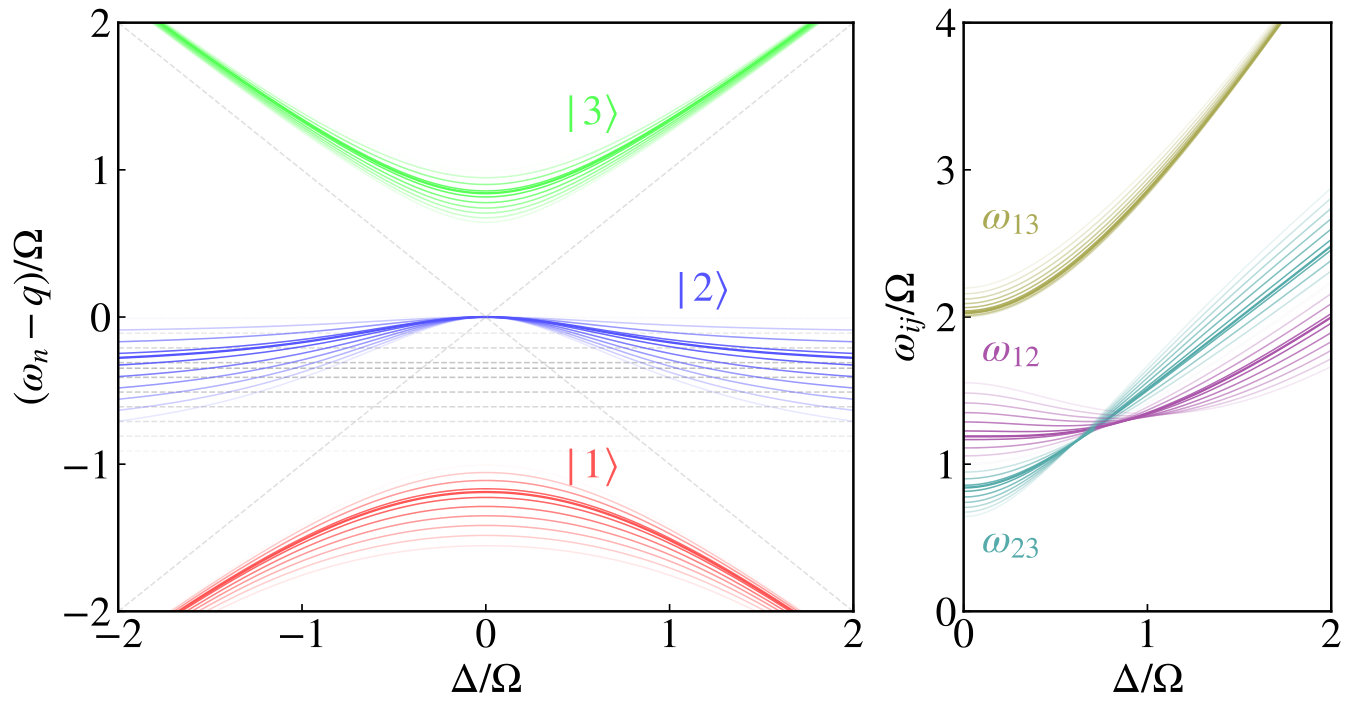 Figure 1
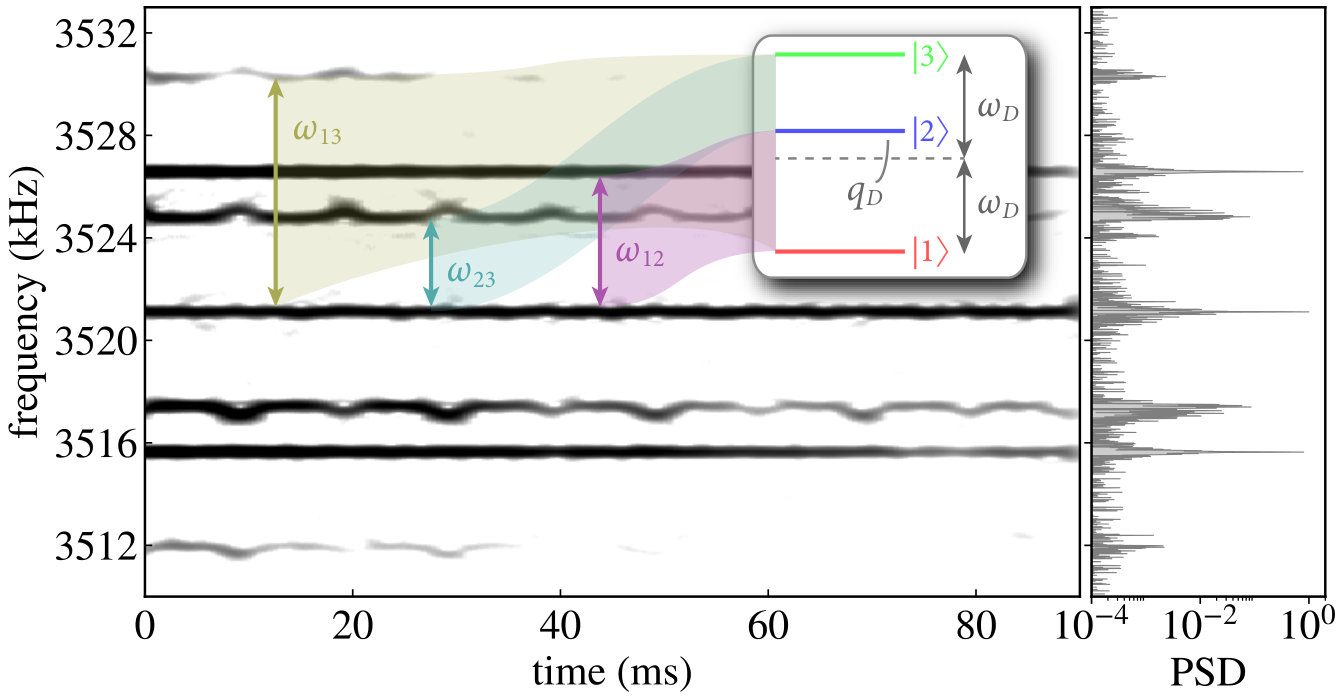 Figure 2
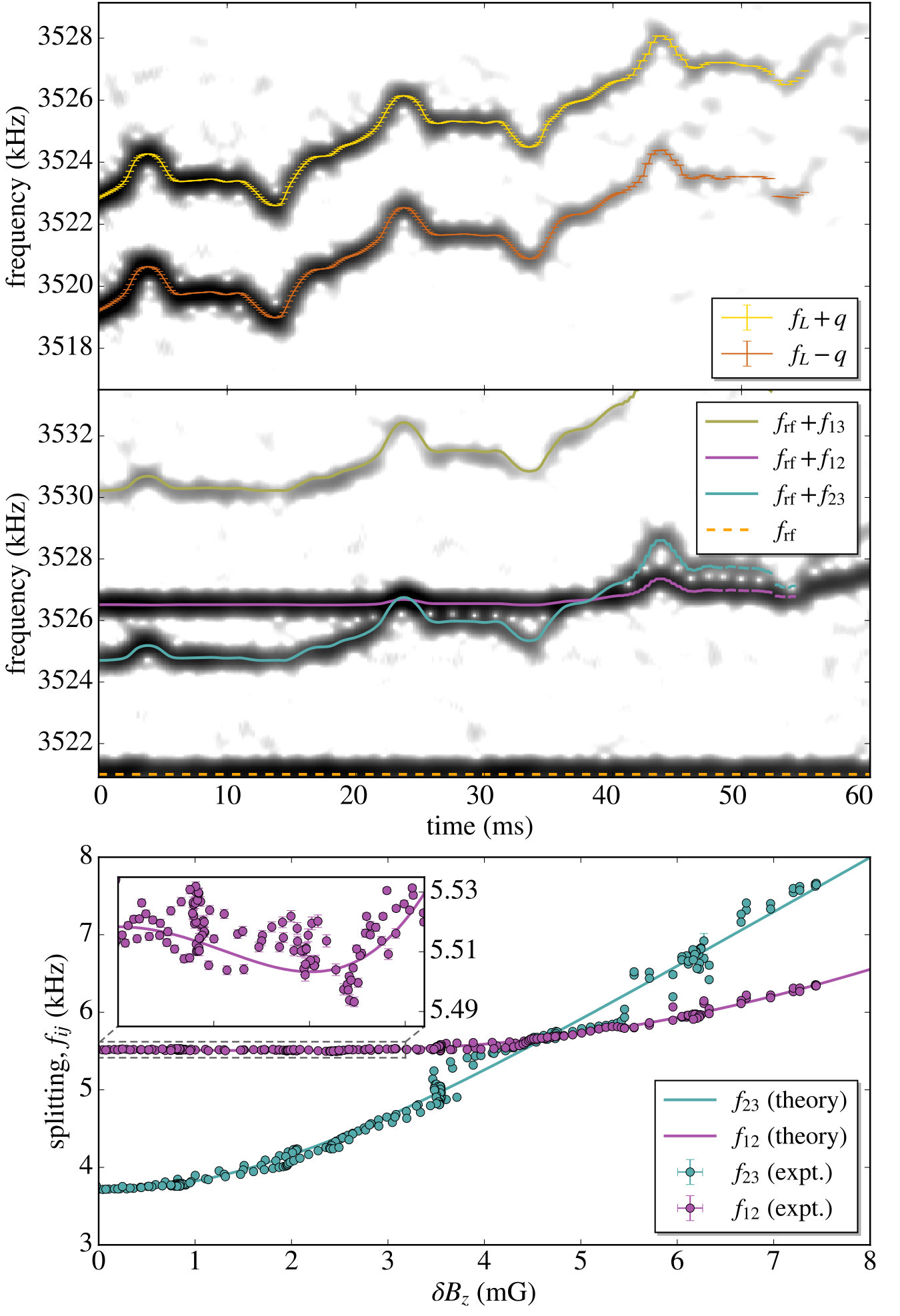 Figure 3
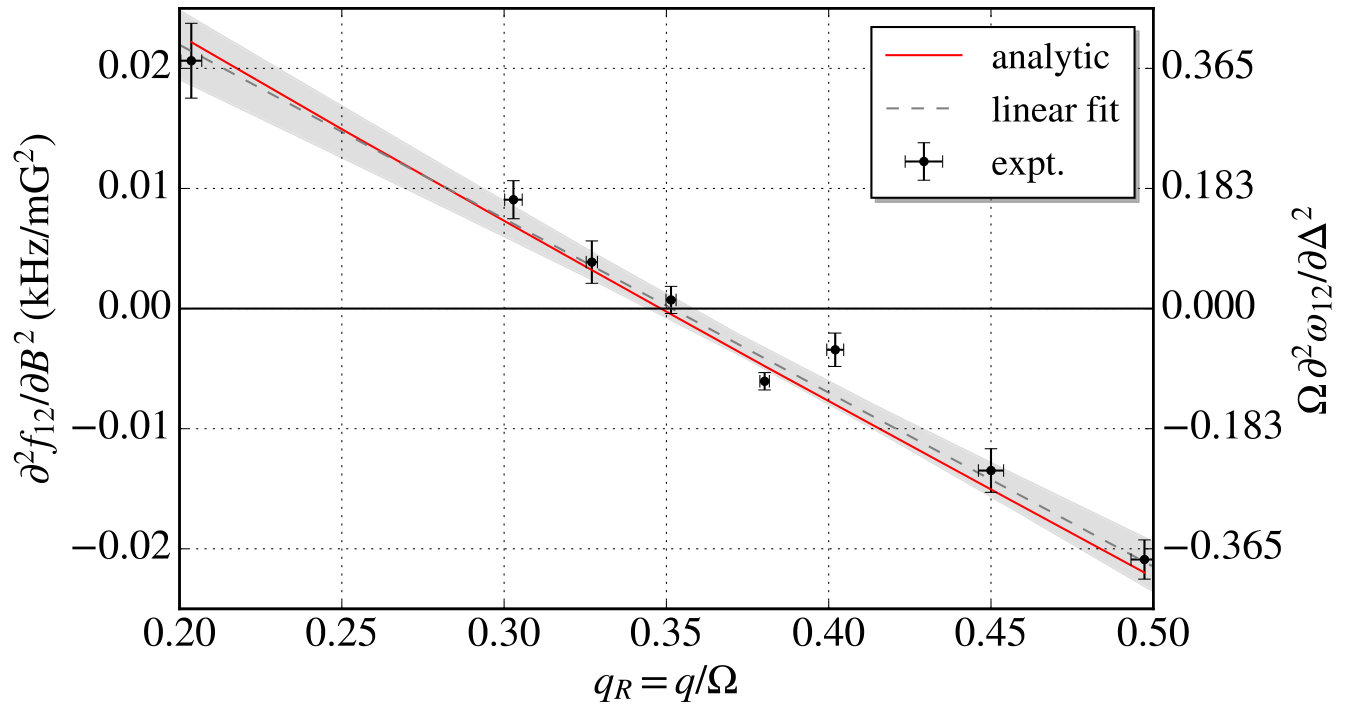 Figure 4
| transition | frequency | amplitude () | amplitude (, ) | |
|---|---|---|---|---|
| (carrier) | 0 | |||
Peer Reviews
No public reviews on file for this paper yet. If you reviewed it on a platform where reviews are public (OpenReview, ICLR, NeurIPS, ICML), you can paste yours below so the community can read it here.
Videos
No videos yet. Explain this paper in a talk, walkthrough, or lecture? Add one.
Continuously observing a dynamically decoupled spin-1 quantum gas
R. P. Anderson
M. J. Kewming
L. D. Turner
School of Physics & Astronomy, Monash University, Victoria 3800, Australia.
Abstract
We continuously observe dynamical decoupling in a spin-1 quantum gas using a weak optical measurement of spin precession. Continuous dynamical decoupling aims to dramatically modify the character and energy spectrum of spin states to render them insensitive to parasitic fluctuations. Continuous observation measures this new spectrum in a single-preparation of the quantum gas. The measured time-series contains seven tones, which spectrogram analysis parses as splittings, coherences, and coupling strengths between the decoupled states in real-time. With this we locate a regime where a transition between two states is decoupled from magnetic field instabilities up to fourth order, complementary to the parallel work at higher fields by Trypogeorgos et al. (arXiv:1706.07876). The decoupled microscale quantum gas offers magnetic sensitivity in a tunable band, persistent over many milliseconds: the length scales, frequencies, and durations relevant to many applications, including sensing biomagnetic phenomena such as neural spike trains.
From Hahn echoes to dynamical decoupling, pulse sequences have been used to protect spin superpositions from inhomogeneities and parasitic fluctuations, prolonging quantum coherence and circumventing deleterious energy shifts Biercuk et al. (2009); Lange et al. (2010); Bluhm et al. (2011). A complementary strategy is continuous dynamical decoupling: replacing the pulse sequence with an uninterrupted coupling of bare spin states yielding dressed spin eigenstates with new quantization direction, spectrum, and coupling. The new spectrum protects against low-frequency fluctuations, while the new couplings admit band-tunable sensing Fanchini et al. (2007). Continuous dynamical decoupling has been applied to nitrogen-vacancy centers Hirose et al. (2012); Loretz et al. (2013); Cai et al. (2012a); *cai_long-lived_2012; Golter et al. (2014) and superconducting qubits, and creates protected qubit Aharon et al. (2013) and decoherence-free Facchi and Pascazio (2002); *facchi_unification_2004 subspaces. Marrying continuous dynamical decoupling with weak continuous measurement could give rise to new forms of quantum sensing exploiting synchronous detection and feedback Vijay et al. (2012).
Here we demonstrate how a weak continuous measurement of spin precession can probe the spectrum of a continuously decoupled spin-1 quantum gas in a single experimental preparation (‘shot’). Time-resolved Fourier spectroscopy of this measurement record reveals not only all dressed-state splittings and their relative immunity to noise but also dressed state coherences and coupling strengths. Estimating the eigenspectrum of the multi-level dressed system brings into view a higher-order decoupling than exists in dynamically-decoupled two-level systems. In this regime, one transition is only quartically-sensitive to noise, surviving much larger amplitude fluctuations than conventional quadratic decoupling. Further, a new transition arises between states which are otherwise uncoupled, completing a cyclic coupling of all dressed states. This low-frequency magnetic stability combined with continuous detection is immediately applicable to band-tunable magnetometry Hirose et al. (2012); Loretz et al. (2013); Ockeloen et al. (2013); *horsley_frequency-tunable_2016 and experiments preparing delicate spin-entangled many-body states Stamper-Kurn and Ueda (2013); whereas the unconventional cyclic coupling could be applied to emulation of frustrated quantum spin chains Mikeska and Kolezhuk (2004).
Atomic Zeeman states in a magnetic field can be decoupled from fluctuations in by applying a perpendicular radiofrequency (rf) field , oscillating at , tuned near the Larmor frequency . At low magnetic fields, the degeneracy of the composite spin- systems Majorana (1932) renders the spin-1 behavior identical to continuous dynamical decoupling in spin- systems. The spin is quantized along in a frame rotating with the radiofrequency ; the eigenvalues of are , where is the detuning, is the Rabi frequency, and is the corresponding eigenstate at resonance . Radiofrequency dressing induces an avoided crossing in the spectrum; whereas the bare state energies are linearly sensitive to magnetic field variations ( where is the gyromagnetic ratio), the dressed energies are only quadratically sensitive near resonance.
The spin character and symmetries are otherwise unchanged: transverse magnetic fields oscillating near the splitting frequencies drive transitions between eigenstates. In the dressed system this means relatively low-frequency (‘ac’) fields oscillating near the Rabi frequency, such as and , drive transitions and . This is the basis for ac magnetometry Hirose et al. (2012) of relatively low-frequency fields; and for concatenated dynamical decoupling which protects against fluctuations in Cai et al. (2012a). Insensitivity to wider bandwidth and larger amplitude can be achieved by increasing , opening a broader gap in the dressed spectrum, but doing so changes the detection band of ac magnetometry Loretz et al. (2013) or pulsed dynamical decoupling Boss et al. (2017); *schmitt_submillihertz_2017. Henceforth we presume is fixed by the application.
Any interaction – from nonlinear Zeeman Ramsey (1956), microwave ac-Stark Gerbier et al. (2006), or tensor light Smith et al. (2004) shifts – raises the degeneracy of the and transitions. Now , where the quadratic Zeeman shift .
This yields dressed eigenstates that are no longer rotations of the bare Zeeman states , and an eigenspectrum shown in Fig. 1 (left).
Moreover, the couplings between these dressed states when are markedly different: and remain non-vanishing but becomes non-zero. The transitions are thus cyclic () and non-degenerate, characterized by a dressed Larmor frequency , and dressed quadratic shift , giving splittings , and . On resonance, and .
A figure-of-merit for decoupling is the curvature of the transition frequency at resonance. In a dressed two-level system there is one convex and one concave eigenstate whose splitting is simply convex. Figure 1 shows that in the spin-1 system with quadratic shift, two states are convex. This suggests that a regime may exist in which the curvature of their transition frequency vanishes Rabl et al. (2009); *xu_coherence-protected_2012. Indeed we find an analytic value of the normalized quadratic shift where the curvatures of and are equal 111 The curvature of the dressed-state energies is evaluated using perturbation theory. In particular, the dimensionless curvature of is . For , we recover the spin-1/2 result, .,
[TABLE]
resulting in the vanishing quadratic dependence of the transition frequency on . The leading-order sensitivity of these states to field variations at is quartic 222 We take for () and , valid to for the field strengths used here, resulting in vanishing third-order derivatives of with respect to detuning. In general, the variation of with (or ) can be accounted for using the Breit-Rabi equation, leading to a residual linear and cubic variation of with Trypogeorgos et al. (2017)., giving the subspace comprised of a higher-order decoupling than can be achieved with a two-level system; we term these the ‘hyper-decoupled states’.
We explore this high-order decoupling in the laboratory with a continuous measurement of the dressed spectrum of a spin-1 non-degenerate quantum gas. Using a single realization of the quantum gas we make many successive weak measurements, revealing all three splittings simultaneously. Our spinor quantum gas apparatus Wood et al. (2015) and Faraday atom-light interface Jasperse et al. (2017) are described elsewhere. We prepare an ultracold gas () of approximately 87Rb atoms in a crossed-beam optical dipole trap. A radiofrequency field of amplitude couples the three Zeeman states of the lowest hyperfine ground state. To perform a weak measurement of the evolving spin, we focus onto the atoms a linearly polarized far-off-resonant probe beam (, red detuned ) propagating along . The spin component parallel to the wavevector of the probe rotates its polarization via the paramagnetic Faraday effect; shot-noise limited polarimetry measures as an modulated tone near . Similar weak continuous Faraday measurements have tracked spin-mixing dynamics of a polar spinor condensate Liu et al. (2009) and enabled quantum state tomography Smith et al. (2004, 2006).
To probe the dressed state spectrum and coherences, we prepare a superposition of dressed states by suddenly turning on the Rabi coupling , projecting the polarized collective spin onto . The total magnetic field in the laboratory frame is , where varies slowly compared to . The resulting Faraday signal is analyzed in the time-frequency domain using the short-time Fourier transform (STFT), revealing the rich frequency and amplitude modulation related to the dressed state energies, coherences, and coupling strengths. Weak measurement allows this Fourier transform spectroscopy to be performed many times in one shot; recently Fourier transform spectroscopy has been applied to a quantum gas using projective measurements over many shots Valdés-Curiel et al. (2017).
With no deliberate variation of the Rabi frequency or detuning, we observe the STFT amplitude (spectrogram) shown in Fig. 2. Strong amplitude modulation of the Faraday signal is apparent as three pairs of sidebands, each equidistant from the carrier frequency .
Each pair of sidebands corresponds to a dressed state transition ; with sideband frequencies where . Thus the spectrogram is a calibration-free, real-time measurement of the dressed state spectrum. Restricting attention to the upper sidebands, the two closest to the carrier are from adjacent state transitions and with similar amplitudes and at frequencies above the carrier. The third, weaker sideband above the carrier signifies the cyclic transition, appearing when . No attempt is made to shield the apparatus from magnetic noise. The power line causes a temporally varying at the line frequency of and its odd harmonics, of () peak-to-peak amplitude. Each dressed transition is affected by the magnetic fluctuations differently: the sidebands corresponding to the and transitions exhibit asymmetric frequency modulation, whereas the optimally decoupled transition remains unperturbed within the frequency resolution of this spectrogram. The normalized power spectral density (Fig. 2, right) of the entire time-series yields maximum frequency resolution at the expense of all temporal resolution. The transition has a near transform-limited width, four times narrower than the and sidebands, which are also outwardly-skewed as expected transitions convex in .
The amplitude of each sideband is proportional to the corresponding dressed-state coherence , and the non-vanishing dressed state coupling(s) .
Analytic expressions for the sideband amplitudes near resonance () are summarized in Table 1. If the projection onto the dressed basis (and hence ) is known, our measurement constitutes a single-shot estimation of the coupling strengths. Alternatively, if the couplings are separately characterized Trypogeorgos et al. (2017), this amounts to continuous measurement of the dressed density matrix, effecting quantum state estimation of the dressed system.
Different platforms use different metrics for the fidelity of dynamical decoupling, and in addition to linewidth narrowing include prolonged coherence. We observe a three-fold increase in the lifetime of the spectral components corresponding to the and transitions as compared with the undressed system (Fig. 3a, decay time 23.8(2) ms). Dressed-state coherences are expected to last longer, but were limited here by the probe-induced photon scattering time. A less perturbative probe Jasperse et al. (2017) should reveal even longer dressed coherence times at the expense of signal-to-noise ratio.
To better expose the enhanced insensitivity of the hyper-decoupled states in the vicinity of , we sweep the the magnetic field over a wider range than is furnished by the power line noise. The longitudinal field , where is the linear sweep rate; the resulting detuning sweeps across (cf. the domain of Fig. 1) during the single-shot measurement. We interleave each rf-dressed shot with a magnetometry shot calibrating : an rf -pulse initiates Larmor precession of the undressed collective spin, and the Faraday signal is composed of two tones at , the Zeeman splittings (Fig. 3, top). For , where is the length of the spectrogram window, are resolved yielding the instantaneous and . We then use to find (and ) by inverting the Breit-Rabi equation Ramsey (1956); Note (3).
We measure the dressed spectrum for resonant magnetic fields ranging from to (applied rf frequencies from to ), with a mean Rabi frequency of (). At each field we ensure the Rabi frequency is fixed by measuring the voltage drop across the coil at with an rf lock-in amplifier. The Rabi frequency is ultimately measured using the atoms by analyzing the dressed energy spectrum near resonance () where . The measured Rabi frequencies have a standard deviation , validating the above method.
Figure 3 shows the dressed spectrum measured as varies across a range during a single-shot. The instantaneous dressed state splittings for all three transitions are predicted with no free parameters, and plotted atop the spectrogram data, showing excellent agreement with the measured sidebands. Line noise renders neither linear nor monotonic. By tracking the instantaneous peaks in the calibration and dressed spectrograms we plot parametrically, eliminating the line noise systematic. The sensitivity of the and transitions to magnetic field variations is shown in Fig. 3c. The hyper-decoupled transition is least sensitive; varies by (expt.), (theory) for (Fig. 3c, inset). Normalizing the variation to the Rabi frequency makes possible a comparison of the decoupling across platforms and ac magnetometry bandwidths. The normalized variation (expt.) and (theory) across a detuning range of half a Rabi frequency. By comparison, the normalized variation for conventional decoupling () is ; 14 (expt.) and 20 (theory) times higher than the variation. Alternatively, the normalized variation of the Zeeman transitions in the low-field limit is ; 58 (expt.) and 86 (theory) times higher than the variation in the hyper-decoupled transition frequency.
To optimally suppress the sensitivity of the hyper-decoupled states to small field variations, we experimentally determine the curvature of for between 0.2 and 0.5, independent of the predicted spectrum of . For each , we fit a polynomial to data to extract (Fig. 4). We perform linear regression of the measured curvature versus to infer . The predictive power of the measured dressed spectrum and this model-independent analysis is affirmed by the agreement with the theoretical curvature (red curve, Fig. 4) and in Eq. (1). The lowest curvature we measure is at . In dimensionless units with the splitting and detuning normalized to the Rabi frequency , times lower than the curvature of this transition for quadratic decoupling ().
This intra-shot revelation of the time and frequency domain renders the measurement of these spectra orders of magnitude more efficient. For example, the single spectrum shown in Fig. 3 would take shots per per distinct ) transitions shots, or minutes of data acquisition. We acquired this spectrum in a single shot, i.e. . The data used to generate Fig. 4 was acquired in only minutes.
In summary, we have demonstrated continuous measurement of continuous dynamical decoupling in a spin-1 quantum gas. Continuous weak measurement via the Faraday effect yields information about the rf-dressed superposition, the dressed-state couplings and energies, simultaneously, making possible full characterization over detunings in a single experimental shot. We posit that when viewed as an ac magnetometer, this information will not only measure fields oscillating at the dynamically-tunable Rabi frequency, but self-certifies both band center and residual detuning error, in real time, while remaining fourth-order decoupled. More broadly, the cyclic coupling we observe may emulate quantum spin ladders with frustrated interactions Mikeska and Kolezhuk (2004). Our measurement is readily extended into the back-action regime, where measurement of bare precessing spins induces simultaneous two-axis squeezing Colangelo et al. (2017). Strong measurement of dressed precessing spins adds the third axis and may expose non-Gaussian quantum noise geometries.
We thank A. A. Wood, I. B. Spielman, N. Lundblad, and F. A. Pollock for enlightening discussions. This work was supported by ARC LP130100857 and a Monash University IDR seed grant. This work complements parallel measurements of the same rf-dressed system by Trypogeorgos et al. Trypogeorgos et al. (2017) using projective readout of dressed state populations at higher magnetic fields.
The reference list from the paper itself. Each links out to its DOI / PubMed record.
- 1Biercuk et al. (2009) M. J. Biercuk, H. Uys, A. P. Van Devender, N. Shiga, W. M. Itano, and J. J. Bollinger, Nature 458 , 996 (2009) . · doi ↗
- 2Lange et al. (2010) G. d. Lange, Z. H. Wang, D. Ristè, V. V. Dobrovitski, and R. Hanson, Science 330 , 60 (2010) . · doi ↗
- 3Bluhm et al. (2011) H. Bluhm, S. Foletti, I. Neder, M. Rudner, D. Mahalu, V. Umansky, and A. Yacoby, Nature Physics 7 , 109 (2011) . · doi ↗
- 4Fanchini et al. (2007) F. F. Fanchini, J. E. M. Hornos, and R. d. J. Napolitano, Physical Review A 75 , 022329 (2007) . · doi ↗
- 5Hirose et al. (2012) M. Hirose, C. D. Aiello, and P. Cappellaro, Physical Review A 86 , 062320 (2012) . · doi ↗
- 6Loretz et al. (2013) M. Loretz, T. Rosskopf, and C. L. Degen, Physical Review Letters 110 , 017602 (2013) . · doi ↗
- 7Cai et al. (2012 a) J.-M. Cai, B. Naydenov, R. Pfeiffer, L. P. Mc Guinness, K. D. Jahnke, F. Jelezko, M. B. Plenio, and A. Retzker, New Journal of Physics 14 , 113023 (2012 a) . · doi ↗
- 8Cai et al. (2012 b) J. Cai, F. Jelezko, N. Katz, A. Retzker, and M. B. Plenio, New Journal of Physics 14 , 093030 (2012 b) . · doi ↗