On subtrees of the representation tree in rational base numeration systems
Shigeki Akiyama, Victor Marsault, Jacques Sakarovitch

TL;DR
This paper investigates the structure of representations of integers in rational base systems, introducing automata and transducers to analyze subtrees, and characterizes the topological nature of span sets as intervals or Cantor sets.
Contribution
It introduces a novel automaton-based framework for analyzing subtrees of rational base numeration systems and characterizes the topological structure of their span sets.
Findings
The set of span-words is accepted by an infinite automaton.
A function computing bottom words is realized by an infinite sequential transducer.
Span sets form intervals or Cantor sets depending on p and q values.
Abstract
Every rational number p/q defines a rational base numeration system in which every integer has a unique finite representation, up to leading zeroes. This work is a contribution to the study of the set of the representations of integers. This prefix-closed subset of the free monoid is naturally represented as a highly non-regular tree. Its nodes are the integers, its edges bear labels taken in {0,1,...,p-1}, and its subtrees are all distinct. We associate with each subtree (or with its root n) three infinite words. The bottom word of n is the lexicographically smallest word that is the label of a branch of the subtree. The top word of n is defined similarly. The span-word of n is the digitwise difference between the latter and the former. First, we show that the set of all the span-words is accepted by an infinite automaton whose underlying graph is essentially the same as the tree…
Click any figure to enlarge with its caption.
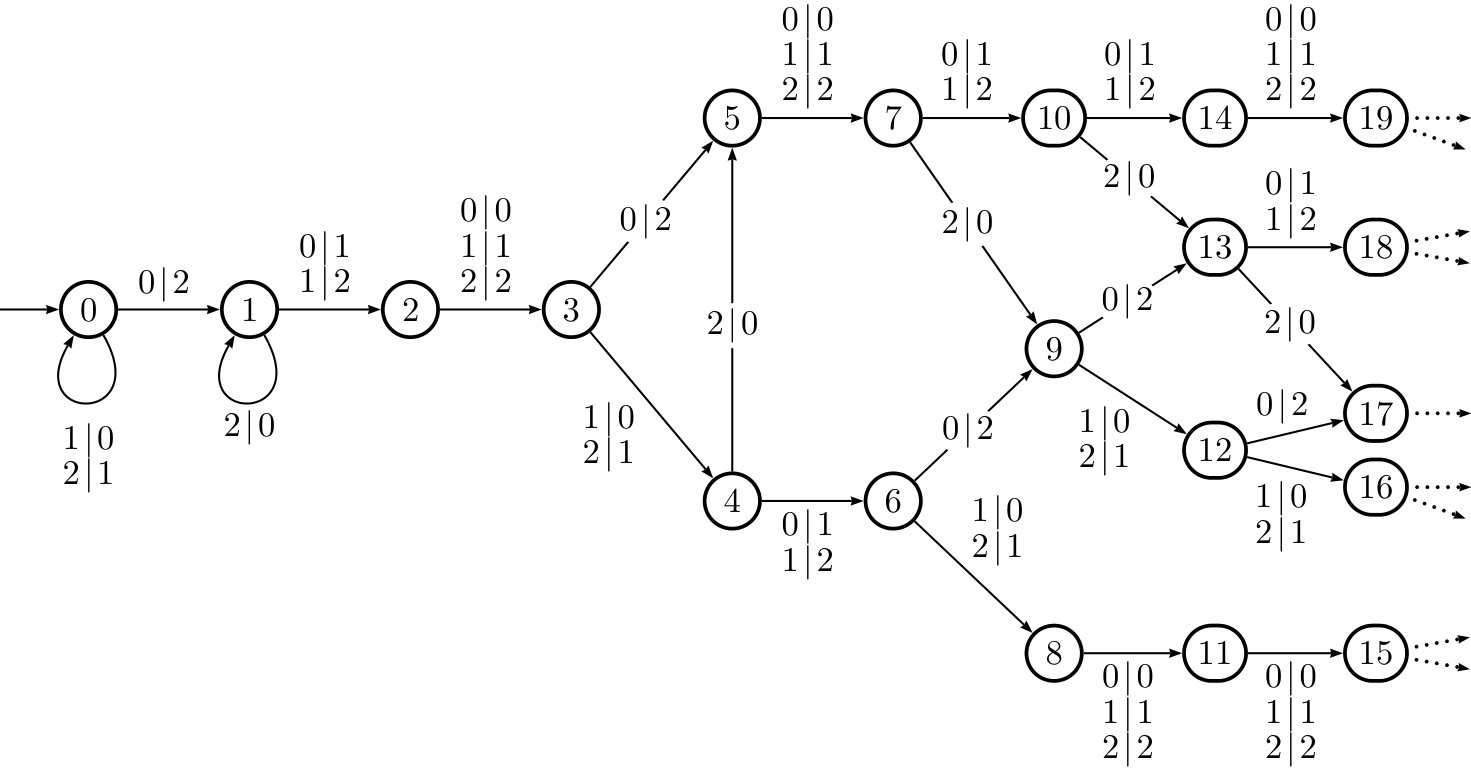 Figure 1
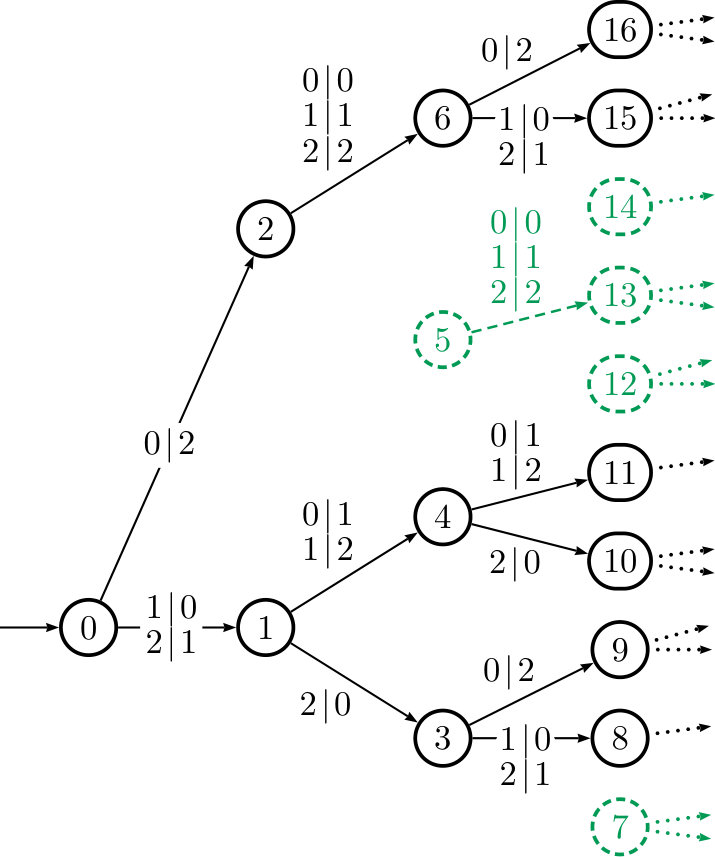 Figure 2
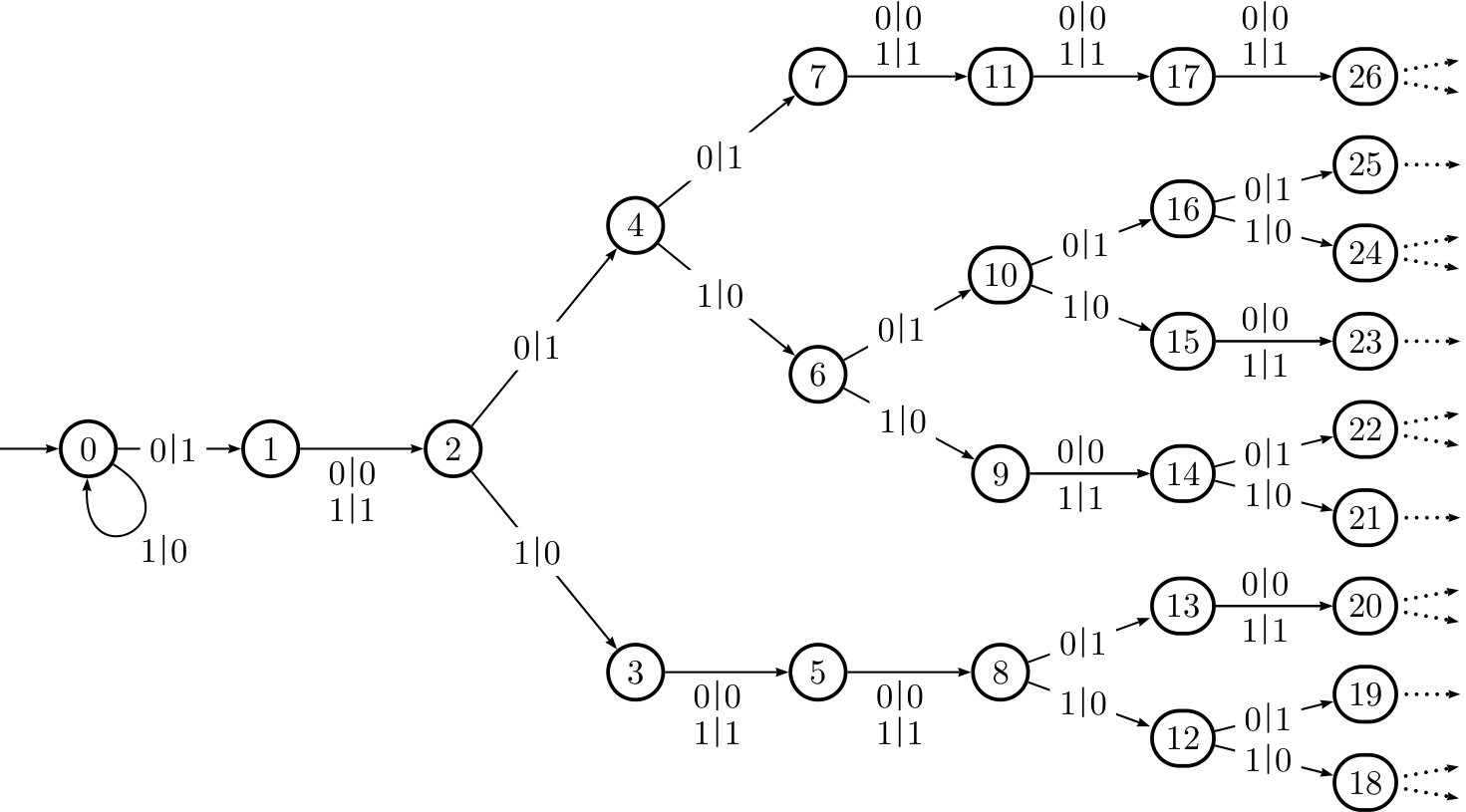 Figure 3
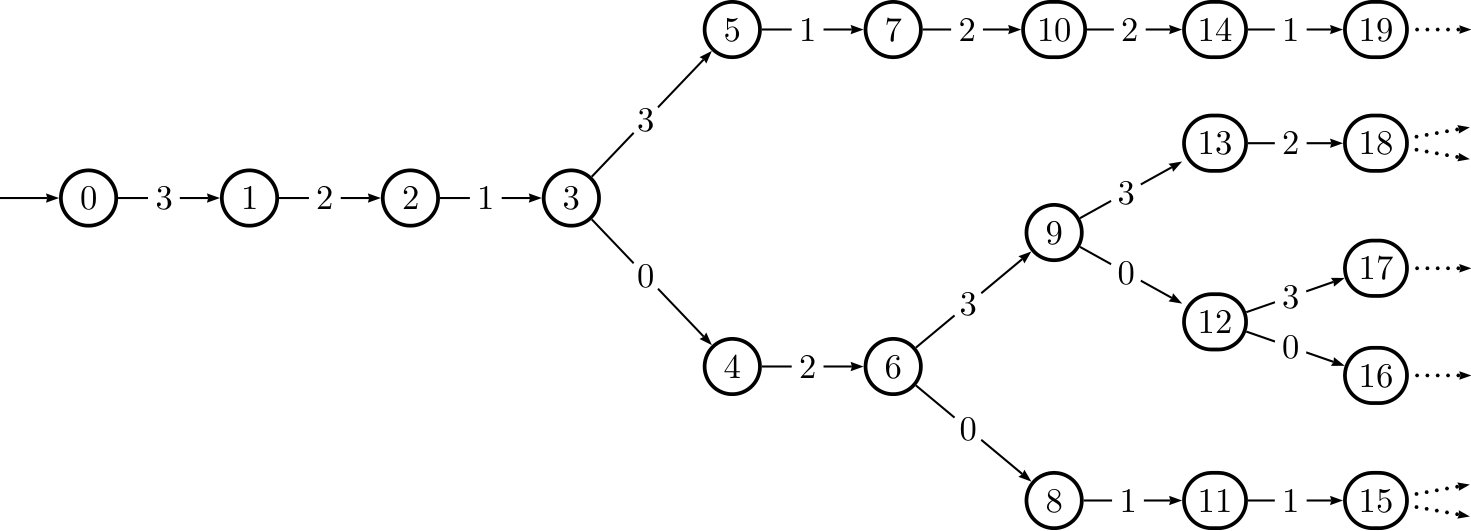 Figure 4
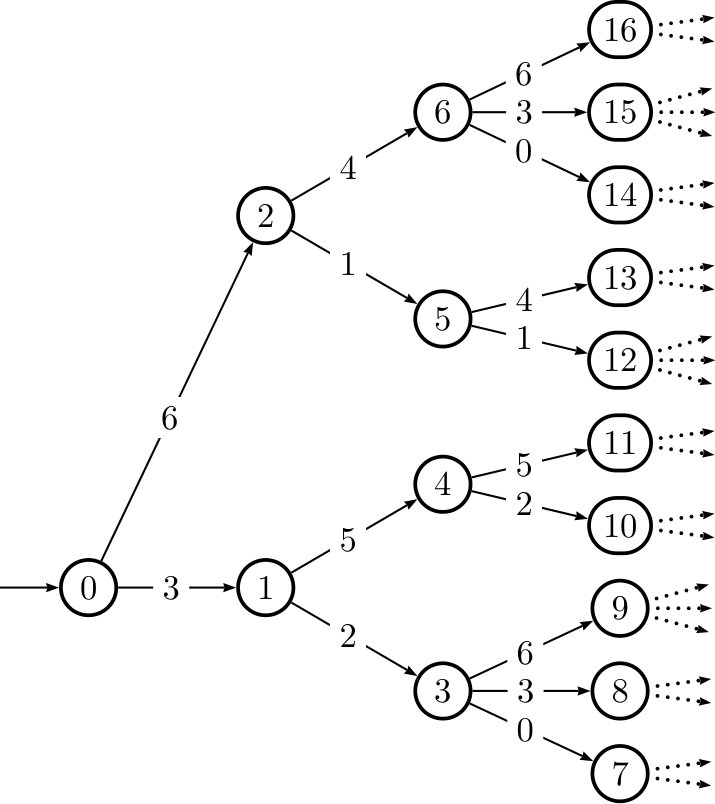 Figure 5
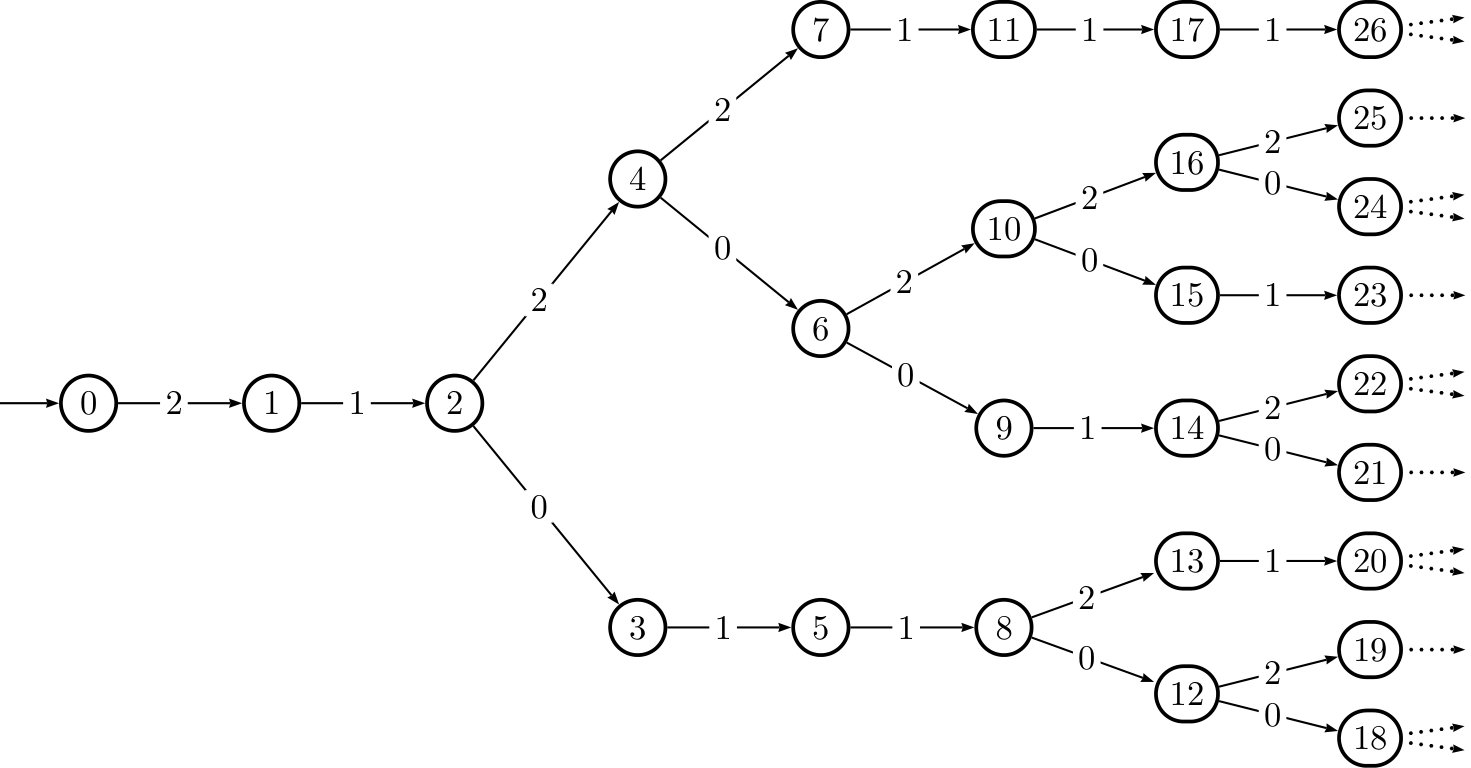 Figure 6
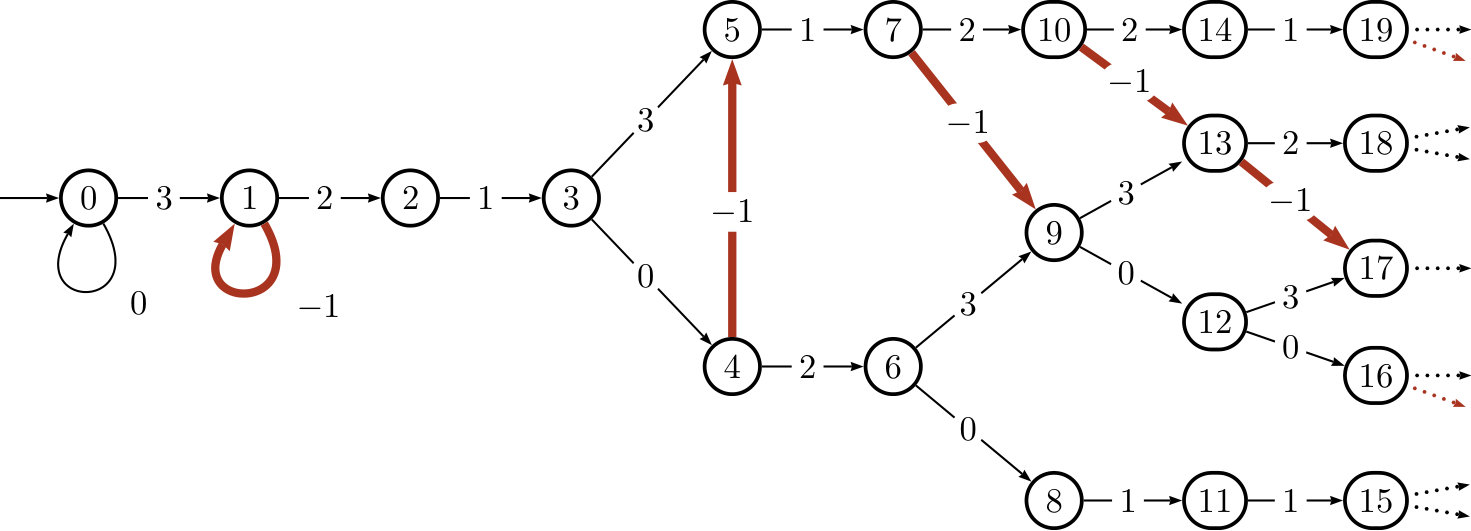 Figure 7
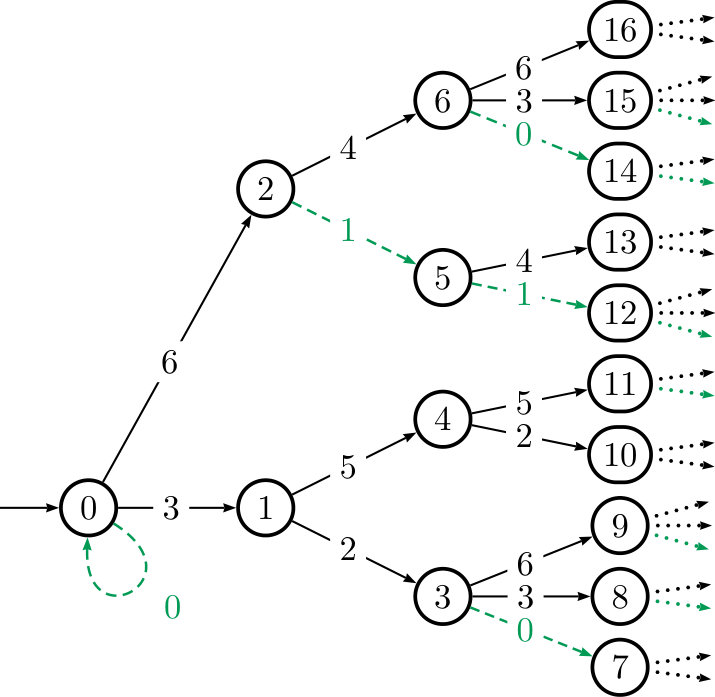 Figure 8
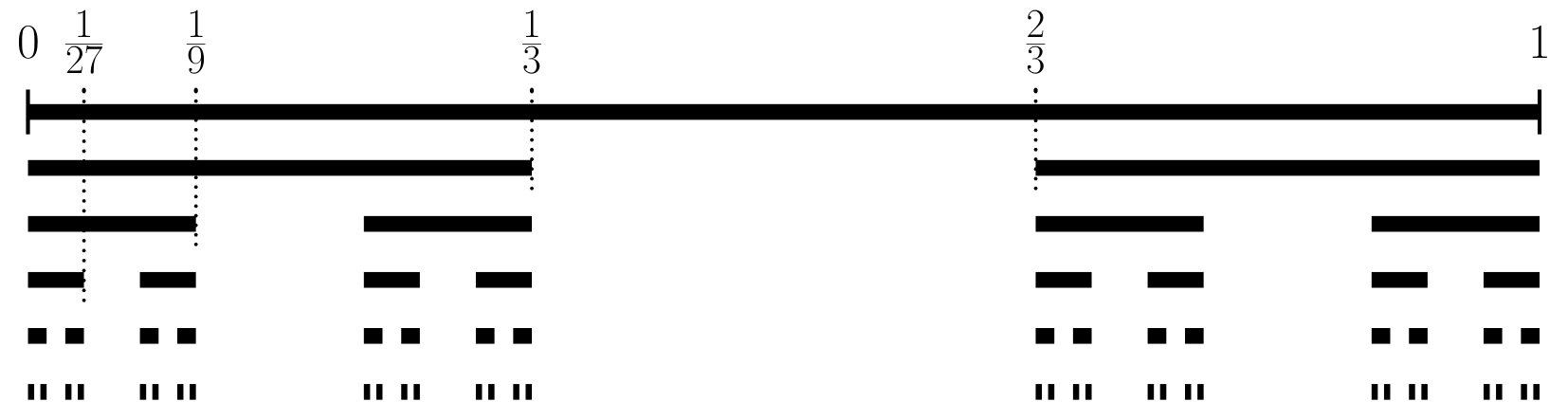 Figure 9
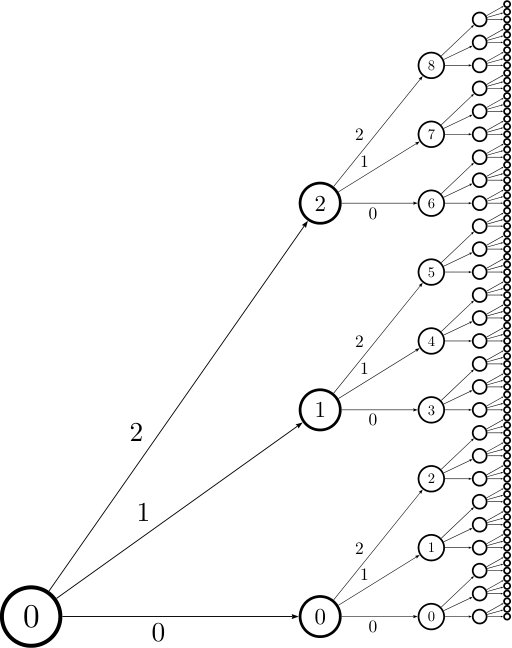 Figure 10
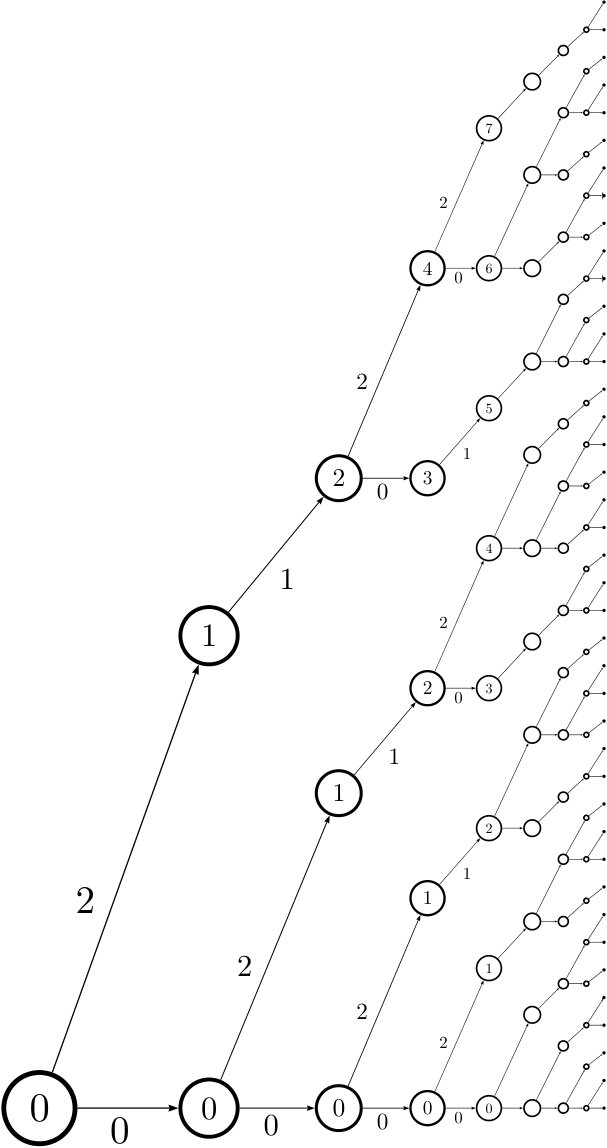 Figure 11
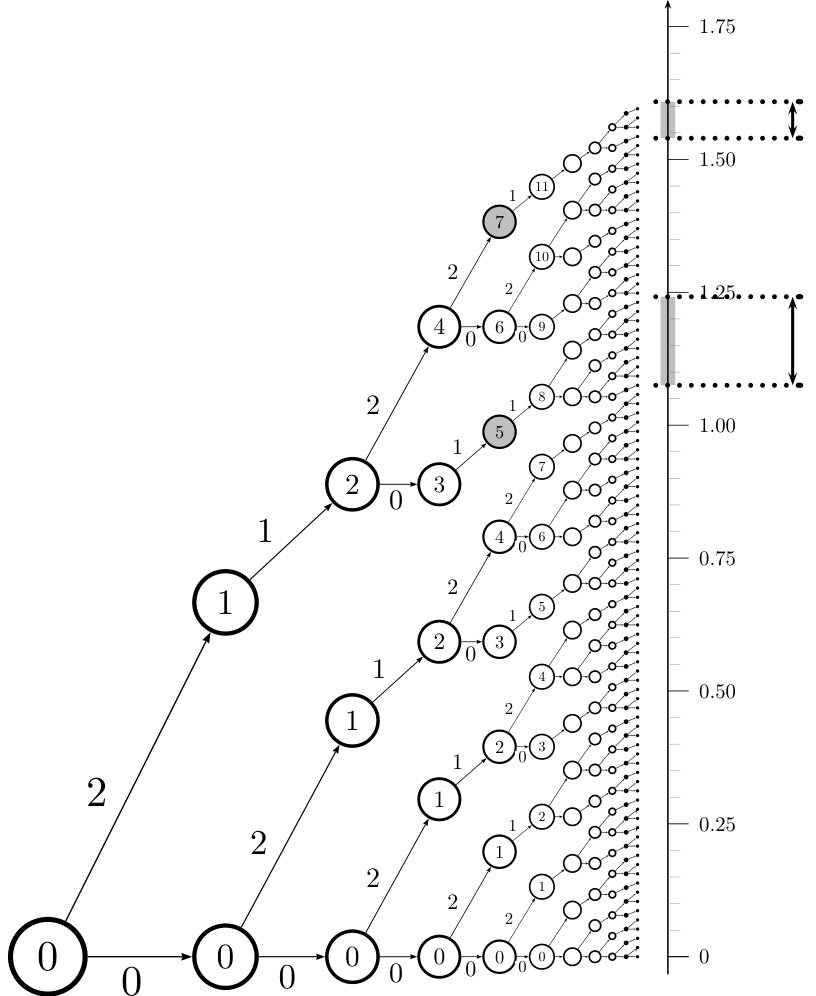 Figure 12
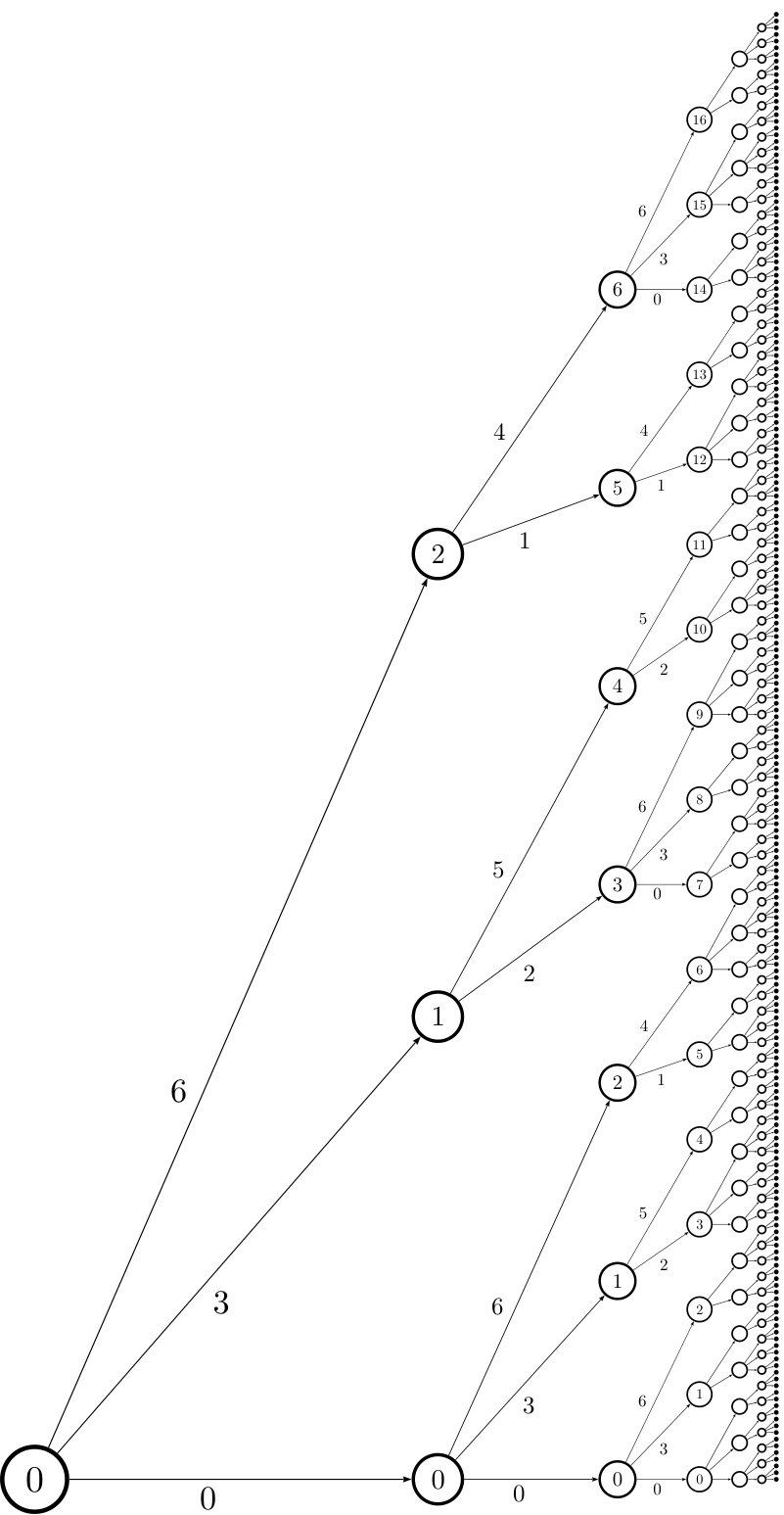 Figure 13
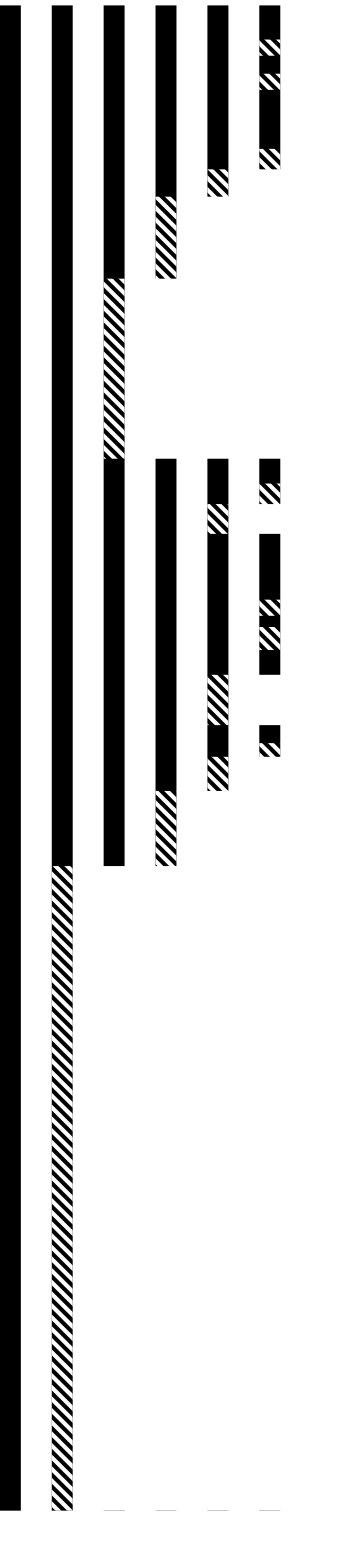 Figure 14
Peer Reviews
No public reviews on file for this paper yet. If you reviewed it on a platform where reviews are public (OpenReview, ICLR, NeurIPS, ICML), you can paste yours below so the community can read it here.
Videos
No videos yet. Explain this paper in a talk, walkthrough, or lecture? Add one.
\publicationdetails
2020181103742
On subtrees of the representation tree in rational base numeration systems
Shigeki Akiyama\affiliationmark1
Victor Marsault\affiliationmark2,3
Jacques Sakarovitch\affiliationmark4
University of Tsukuba, Ibaraki, Japan.
University of Edinburgh, United Kingdom.
University of Liège, Belgium.
IRIF, CNRS/Paris Diderot University, and LTCI, Telecom-ParisTech, France.
(2017-6-27; 2018-1-27; 2018-2-23; \isotoday)
Abstract
Every rational number defines a rational base numeration system in which every integer has a unique finite representation, up to leading zeroes. This work is a contribution to the study of the set of the representations of integers. This prefix-closed subset of the free monoid is naturally represented as a highly non-regular tree. Its nodes are the integers, its edges bear labels taken in , and its subtrees are all distinct.
We associate with each subtree (or with its root ) three infinite words. The bottom word of is the lexicographically smallest word that is the label of a branch of the subtree. The top word of is defined similarly. The span-word of is the digitwise difference between the latter and the former.
First, we show that the set of all the span-words is accepted by an infinite automaton whose underlying graph is essentially the same as the tree itself. Second, we study the function that computes for all the bottom word associated with from the one associated with , and show that it is realised by an infinite sequential transducer whose underlying graph is once again essentially the same as the tree itself.
An infinite word may be interpreted as an expansion in base after the radix point, hence evaluated to a real number. If is a subtree whose root is , then the evaluations of the labels of the branches of form an interval of . The length of this interval is called the span of and is equal to the evaluation of the span-word of . The set of all spans is then a subset of and we use the preceding construction to study its topological closure. We show that it is an interval when , and a Cantor set of measure zero otherwise.
keywords:
Rational base numeration systems, Real-representation tree, Infinite words, Infinite transducers, Cantor sets, Hausdorff measure
1 Introduction
The purpose of this work is a further exploration and a better understanding of the set of infinite words that appear in the definition of rational base numeration systems. These numeration systems have been introduced and studied by Akiyama, Frougny, and Sakarovitch (2008), leading to some progress and results in a number theoretic problem related to the distribution modulo of the powers of rational numbers and usually known as Mahler’s problem (Mahler, 1968). Besides these results, these systems raise many new and fascinating problems.
We give later the precise definition of rational base numeration systems and of the representation of numbers (integers and reals) in such systems. But one can hint at the results established in this paper by just looking at the figure showing the ‘representation tree’ in a rational base numeration system (Figure 1 (b) for the base ) and by comparison with the representation tree in a integer base numeration system (Figure 1 (a) for the base ). In these trees, nodes are the natural integers, and the label of the path from the root to an integer is the representation of in the system, whereas the label of an infinite branch gives the representation in the system of a real number, indeed, and because the trees are drawn in a fractal way, of the real number which is the ordinate of the point where the branch ends.
The first striking fact is that the representation language, that is, the set of representations of integers, in a rational base numeration system does not fit at all in the usual classifications of formal language theory. It looks very chaotic and defeats any kind of iteration lemma. Nevertheless, these representation languages hide a certain kind of regularity and we have shown (Marsault and Sakarovitch, 2017) that they are so to speak characterized by their periodic signatures, that is, if one of these languages is drawn as a tree and traversed breadth-first, the degrees of the nodes are periodic.
If we now turn to the infinite branches of the trees, we first find that every subtree in the tree of Figure 1 (a) is the full ternary tree, whereas every subtree in the tree of Figure 1 (b) is different from all other subtrees. With the hope of finding some order or regularity within what seems to be close to complete randomness (which, on the other hand, is not established either and would be a very interesting result) we consider the minimal words, that we rather call bottom words, originating from every node of the tree.
In the case of an integer base, this is perfectly uninteresting: all these bottom words are equal to . In the case of a rational base these words are on the contrary all distinct, none are even ultimately periodic (as the other infinite words in the representation tree). In order to find some invariant of all these distinct words, or at least a relationship between them, we have studied the function that maps the bottom word associated with onto , the one associated with . This function is easily seen to be online and realtime, that is, the knowledge of the first digits of the input is enough to compute the first digits of the output, and hence is computable by an infinite sequential letter-to-letter transducer.
The computation of such a transducer in the case the base , and more generally in the case of a base with , leads to a surprising and unexpected result. The transducer, denoted by , is obtained by replacing in the representation tree, denoted by , the label of every edge by a set of pairs of letters that depends upon this label only. In other words, the underlying graphs of and coincide, and is obtained from by a substitution from the alphabet of digits into the alphabet of pairs of digits, in this special and remarkable case.
The general case is hardly more difficult to describe, once it has been understood. In the special case, the canonical digit alphabet has elements; in the general case, we still consider a digit alphabet with elements denoted by , either by keeping the larger elements of the canonical digit alphabet, when is is greater than , or by enlarging the canonical alphabet with enough negative digits, when is smaller than ; in both cases, is the largest digit.
From and with the digit alphabet , we then define another ‘representation graph’ denoted by : either by deleting the edges of labelled by digits that do not belong to in the case where or, in the case where by adding edges labelled with the new negative digits. Then, is obtained from exactly as above, by a substitution from the alphabet of digits into the alphabet of pairs of digits. This construction of , and the proof of its correctness yields:
Theorem I**.**
Let be two coprime integers such that and . Then realises .
In the original article (Akiyama et al., 2008), the tree , which is built from the representations of integers, is used to define the representations of real numbers: the label of an infinite branch of the tree is the development ‘after the radix point’ of a real number and the drawing of the tree as a fractal object — like in Figure 1 — is fully justified by this point of view. The same idea leads to the definition of the (normalised111The classical definition of span of the node is, in the fractal drawing, the width of the subtree rooted in . This value is obviously decreasing (exponentially) with the depth of the node , hence the span of two nodes cannot be easily compared. In this work, we only consider the normalised span which is the span multiplied by , where is the depth of the node .) span of a node of the representation tree: it is the difference between the real numbers represented respectively by the top and the bottom words originating in the node and let us denote by the set of spans for all integers and by its topological closure.
Again, this notion is totally uninteresting in the case of a numeration system with an integer base : the span of every node is always . And again, the notion is far more richer and complex in the case of a rational base since we establish the following.
Theorem II**.**
Let be two coprime integers such that and .
- (a)
If , then is an interval. 2. (b)
If , then is a Cantor set of measure zero.
As different they may look, Theorems I and II have a common root in the construction of the automaton . The trivial relationship between the bottom word originating at node and the top word originating at node leads to the connexion between the construction of the transducer and the description of the set of spans . The digitwise difference between top and bottom words is written on the alphabet , and all these ‘difference words’ are infinite branches in the automaton . This is explained in Section 4. Theorem I is then established in Section 5 and Theorem II in Section 6. The second case of Theorem II is completed with an upper bound for the Hausdorff dimension of . This paper is meant to be self-contained and starts, in particular, with all necessary definitions concerning rational base number systems in Section 3. We conclude the paper with an open problem on minimal words which indeed was the motivating force of all this work, and with a conjecture on the Hausdorff dimension of .
The present article is a long version of a work (Akiyama et al., 2013) presented at the 9th International Conference on Words. Most of the results are also part of the thesis of the second author (Marsault, 2016).
2 Preliminaries and notation
2.1 On words and numbers
An alphabet is a finite set of symbols, called letters. A word (resp. an -word) is a finite (resp. infinite) sequence of letters and a language (resp. an -language) is a set of words (resp. -words). The set of the words (resp. -words) over an alphabet is denoted by (resp. ). Subsets of are called languages over and those of are called -languages over . For the sake of clarity, we use the standard math font for letters and words: …and a bold sans-serif font for -words: …The length of a word is denoted by and the concatenation of two words and is denoted simply by .
If (resp. ), then is called a prefix of (resp. of ); note that the prefixes of word or of -words always are words. We denote by Pre the function that maps a word or an -word to the set of all its prefixes; Pre is naturally lifted to languages and -languages, that is, to a function . A language is said prefix-closed if .
Words and -words will later be evaluated using a rational base numeration system (defined in Section 3). It is then convenient to have a different index convention for words and -words: we index (finite) words from right to left and use [math] as the rightmost index (as in ), while -words are indexed from left to right, starting with index (as in ).
In this article, letters always are (relative) integers and we use digit as a synonym for letter. Moreover, alphabets always are integer intervals, that is, sets of consecutive integers. In particular, our alphabets are totally ordered, which implies that any set of words is equipped with two total orders: the radix order and the lexicographic order:
Definition 1**.**
Let and be words over and their longest common prefix.
- (a)
* if*
- •
either , that is, is a prefix of ,
- •
*or and with in and . * 2. (b)
* if*
- •
either
- •
or and .
Let and be -words over .
- (c)
* if*
- •
either ,
- •
*or, if (in ) is their longest common prefix, and with in and in such that . *
The set of -words is classically equipped with the product topology which can also be defined with a distance.
Definition 2**.**
Let be two infinite words. The distance between these two words is
[TABLE]
2.2 On trees, automata and transducers
In this article we consider infinite, directed graphs of a special form. First, there is a special initial vertex called the root and indicated by an incoming arrow in figures. Second, the edges are labelled over a finite alphabet. Third, they are deterministic: there is never two different edges originating from the same vertex and labelled by the same letter. Such graphs are represented by quadruple where is the finite alphabet, is the (infinite) vertex-set, is a function is the set of edges. We call such graphs automata and we use terminology of automata theory; in particular we use state rather than vertex, and transition rather than edge.
A transition is denoted by s{\nolinebreak\hskip 2.84526pt\xrightarrow{~{}\leavevmode\hbox{\raise-3.5pt\hbox{\set@color\resizebox{}{}{{\leavevmode\hbox{\hskip 0.0pt\hbox{\set@color{\scriptstyle\makebox[14.22636pt]{}\hskip 2.0pt}}}}}}}~{}}\hskip 2.84526pt\nolinebreak}s^{\prime}, where are states and is a letter. We will consider finite and infinite paths in these graphs. We refer to infinite paths as branches and refer to finite paths simply as paths. A branch is thus denoted by s{\nolinebreak\hskip 2.84526pt\xrightarrow{~{}\leavevmode\hbox{\raise-3.5pt\hbox{\set@color\resizebox{}{}{{\leavevmode\hbox{\hskip 0.0pt\hbox{\set@color{\scriptstyle\makebox[14.22636pt]{}\hskip 2.0pt}}}}}}}~{}}\hskip 2.84526pt\nolinebreak}\cdots and a path by s{\nolinebreak\hskip 2.84526pt\xrightarrow{~{}\leavevmode\hbox{\raise-3.5pt\hbox{\set@color\resizebox{}{}{{\leavevmode\hbox{\hskip 0.0pt\hbox{\set@color{\scriptstyle\makebox[14.22636pt]{}\hskip 2.0pt}}}}}}}~{}}\hskip 2.84526pt\nolinebreak}s^{\prime}, where denote states, an -word and a word. We call dead-end a state with no outgoing transitions; in this article, automata will have no dead-end.
A run refers to a path starting from the root. The run of is the unique run labelled by as a label, if it exists; in which case is said to be accepted by the automaton. The language accepted by , denoted by is the set of the words accepted by . The notions of -run and accepted -language (denoted by ) are defined similarly. If has no dead-end, then .
We call tree an automaton in which every state is reached by exactly one run.
A transducer is an automaton where the labels are taken in a product alphabet ; is the input alphabet and the output alphabet. All the transducers we consider are input-deterministic: if s{\nolinebreak\hskip 2.84526pt\xrightarrow{~{}\leavevmode\hbox{\raise-3.5pt\hbox{\set@color\resizebox{}{}{{\leavevmode\hbox{\hskip 0.0pt\hbox{\set@color{\scriptstyle\makebox[14.22636pt]{}\hskip 2.0pt}}}}}}}~{}}\hskip 2.84526pt\nolinebreak}t and s{\nolinebreak\hskip 2.84526pt\xrightarrow{~{}\leavevmode\hbox{\raise-3.5pt\hbox{\set@color\resizebox{}{}{{\leavevmode\hbox{\hskip 0.0pt\hbox{\set@color{\scriptstyle\makebox[14.22636pt]{}\hskip 2.0pt}}}}}}}~{}}\hskip 2.84526pt\nolinebreak}t^{\prime} then and . They are interpreted as computing functions: the first component is the input and the second is the output. If labels a run of a transducer , then we say that is the image by of ; by abuse of language, this run will be called the run of .
With the usual definition of automata and transducers (as for instance in Sakarovitch, 2009) what we call automaton is indeed an infinite deterministic automaton with all states final and what we call transducer is indeed an infinite letter-to-letter pure-sequential transducer.
Let us conclude this section with a statement linking the language and the -language accepted by an automaton (more details on the subject in Perrin and Pin, 2004).
Lemma 3**.**
Let be an automaton with no dead-end and an -language. It holds if and only if .
Proof.
Forward direction. Let be an -word. The following sequence of equivalences holds.
[TABLE]
Backward direction. Let be a word. The following sequence of equivalences holds.
[TABLE]
3 Rational base numeration systems
In this section, we recall the definition of rational base numeration systems that have been introduced by Akiyama, Frougny, and Sakarovitch (2008), and the properties of the representation trees that were established in this paper.
Notation 4**.**
We denote by and two co-prime integers such that , and by the rational number . They will be fixed throughout the article.
Note that the numeration system in base we are about to describe is not the -numeration where . Indeed, in the latter, the representation of a number is computed by a left-to-right algorithm (called greedy, cf. Lothaire, 2002, Chapter 7), the digit set is and the weight of the -th leftmost digit is . Meanwhile, in base , the representations are computed by a right-to-left algorithm (Equation (1)), digits are taken in and the weight of the -th digits is .
3.1 Representation of integers
Given a positive integer , let us define and, for all ,
[TABLE]
where and are the remainder and the quotient of the Euclidean division of by . Hence belongs to the alphabet . Since , the sequence is first strictly decreasing until it reaches 0: there is an integer such that . The word of is denoted by . Equation (1), below, gives a compact definition of the same algorithm.
[TABLE]
If , then it holds
[TABLE]
The evaluation function is derived from this formula. The value of any word over , and indeed over any alphabet of digits, is defined by
[TABLE]
A word in is called a -expansion of an integer , if . Since -expansions are unique up to leading 0’s (cf. Akiyama et al. 2008, Theorem 1), is equal to for some integer and is called the -representation of . The set of the -representations of integers is denoted by :
[TABLE]
It follows from (1b) that is prefix-closed and right-extendable. As a consequence, can be represented as a tree with no dead-end (cf. Figures 2, 3 and later on 6). The node set is , the root is [math], and there is an arc n{\nolinebreak\hskip 2.84526pt\xrightarrow{~{}\leavevmode\hbox{\raise-3.5pt\hbox{\set@color\resizebox{}{}{{\leavevmode\hbox{\hskip 0.0pt\hbox{\set@color{\scriptstyle\makebox[14.22636pt]{}\hskip 2.0pt}}}}}}}~{}}\hskip 2.84526pt\nolinebreak}m if .
Moreover, the base is the “abstract numeration system” (cf. Lecomte and Rigo, 2001, 2010) built from , a property that may be stated as follows:
Proposition 5** (Akiyama et al., 2008, Proposition 11).**
.
or, equivalently as:
[TABLE]
It is known that is not a regular language (not even a context-free language). In fact, it even possesses a “Finite Left Iteration Property” which essentially says that cannot satisfy any kind of pumping lemma. Lemma 11, later on, is a consequence of this fact.
Definition 6**.**
- (a)
Let be the (partial) function defined by:
[TABLE] 2. (b)
We denote 222In Akiyama et al. (2008), denotes an infinite directed tree. The labels of the (finite) paths starting from the root precisely formed the language , as is in our case. by the infinite automaton: .
Remark 7**.**
- •
The function is defined on instead of in anticipation of future developments.
- •
The automaton is not quite a tree. Indeed, the state [math] (that is, the root) holds a loop labelled by the digit [math] since .
The transitions of are characterised by the following.
[TABLE]
Comparing (1) and (6) shows how the difference between and is mostly a question of formalism. It holds and next lemma gives a more precise statement.
Lemma 8**.**
Let be in .
Then, is in and
\leavevmode\hbox{\set@color\hskip 1.99997pt}0{\nolinebreak\hskip 2.84526pt\resizebox{}{}{{\leavevmode\hbox{\hskip 0.0pt\raise-2.0pt\hbox{\set@color{\xrightarrow[,{}\leavevmode\hbox{\raise 3.0pt\hbox{\set@color\resizebox{}{}{\scalebox{0.9}[0.9]{{\leavevmode\hbox{\hskip 0.0pt\raise-0.27779pt\hbox{\set@color{}}}}}}}}{},]{{}\leavevmode\hbox{\raise-3.5pt\hbox{\set@color\resizebox{}{}{{\leavevmode\hbox{\hskip 0.0pt\hbox{\set@color{\scriptstyle\makebox[14.22636pt]{\scriptstyle u}\hskip 2.0pt}}}}}}}{}}}}}}}\hskip 2.84526pt\nolinebreak}\pi^{~{}}_{z}(u)\leavevmode\hbox{\set@color\hskip 1.99997pt}.
Lemma 8 implies that the tree representation of , as in Figures 2, 3 and 6, augmented by an additional loop labelled by [math] onto the root [math] becomes a representation of . Moreover, since is right-extendable, the next statement holds.
Lemma 9**.**
* has no dead-end.*
We now state a few properties of . They are the translations of results due to Akiyama et al. (2008) into the formalism we use here.
Lemma 10** (Akiyama et al., 2008, Lemma 6).**
Let , be two integers. Let be another integer.
- (a)
If and are congruent modulo , then for every word of length , the following are equivalent.
- •
There exists an integer such that n{\nolinebreak\hskip 2.84526pt\xrightarrow{~{}\leavevmode\hbox{\raise-3.5pt\hbox{\set@color\resizebox{}{}{{\leavevmode\hbox{\hskip 0.0pt\hbox{\set@color{\scriptstyle\makebox[14.22636pt]{}\hskip 2.0pt}}}}}}}~{}}\hskip 2.84526pt\nolinebreak}m.
- •
There exists an integer such that n^{\prime}{\nolinebreak\hskip 2.84526pt\xrightarrow{~{}\leavevmode\hbox{\raise-3.5pt\hbox{\set@color\resizebox{}{}{{\leavevmode\hbox{\hskip 0.0pt\hbox{\set@color{\scriptstyle\makebox[14.22636pt]{}\hskip 2.0pt}}}}}}}~{}}\hskip 2.84526pt\nolinebreak}m^{\prime}. 2. (b)
If there exist two integers and a word of length such that n{\nolinebreak\hskip 2.84526pt\xrightarrow{~{}\leavevmode\hbox{\raise-3.5pt\hbox{\set@color\resizebox{}{}{{\leavevmode\hbox{\hskip 0.0pt\hbox{\set@color{\scriptstyle\makebox[14.22636pt]{}\hskip 2.0pt}}}}}}}~{}}\hskip 2.84526pt\nolinebreak}m and n^{\prime}{\nolinebreak\hskip 2.84526pt\xrightarrow{~{}\leavevmode\hbox{\raise-3.5pt\hbox{\set@color\resizebox{}{}{{\leavevmode\hbox{\hskip 0.0pt\hbox{\set@color{\scriptstyle\makebox[14.22636pt]{}\hskip 2.0pt}}}}}}}~{}}\hskip 2.84526pt\nolinebreak}m^{\prime}, then et are congruent modulo .
Lemma 11**.**
Let n{\nolinebreak\hskip 2.84526pt\xrightarrow{~{}\leavevmode\hbox{\raise-3.5pt\hbox{\set@color\resizebox{}{}{{\leavevmode\hbox{\hskip 0.0pt\hbox{\set@color{\scriptstyle\makebox[14.22636pt]{}\hskip 2.0pt}}}}}}}~{}}\hskip 2.84526pt\nolinebreak}\cdots be a branch of . If is periodic, then and .
Proof.
The hypothesis implies that there is a word such that n{\nolinebreak\hskip 2.84526pt\xrightarrow{~{}\leavevmode\hbox{\raise-3.5pt\hbox{\set@color\resizebox{}{}{{\leavevmode\hbox{\hskip 0.0pt\hbox{\set@color{\scriptstyle\makebox[14.22636pt]{}\hskip 2.0pt}}}}}}}~{}}\hskip 2.84526pt\nolinebreak}m{\nolinebreak\hskip 2.84526pt\xrightarrow{~{}\leavevmode\hbox{\raise-3.5pt\hbox{\set@color\resizebox{}{}{{\leavevmode\hbox{\hskip 0.0pt\hbox{\set@color{\scriptstyle\makebox[14.22636pt]{}\hskip 2.0pt}}}}}}}~{}}\hskip 2.84526pt\nolinebreak}\cdots is a branch of . From Lemma (b), and are congruent modulo for every integer . Hence . The only circuit in is 0{\nolinebreak\hskip 2.84526pt\xrightarrow{~{}\leavevmode\hbox{\raise-3.5pt\hbox{\set@color\resizebox{}{}{{\leavevmode\hbox{\hskip 0.0pt\hbox{\set@color{\scriptstyle\makebox[14.22636pt]{}\hskip 2.0pt}}}}}}}~{}}\hskip 2.84526pt\nolinebreak}0, hence the statement. ∎
For every integer let us define the (total) function in the following way. Equation (6) implies that every state of (incuding [math]) has exactly one incoming transition, hence, by induction on , exactly one incoming path of length : for every integer , where is the label of this unique path of length ending in .
Lemma 12** (Akiyama et al., 2008, Proposition 10).**
Let , be two integers. For every integer , and are congruent modulo if and only if .
Lemma 13**.**
*For every integer , is a bijection between any integer interval of cardinal and . *
Proof.
Two integers in are necessarily in different residue classes modulo , hence from Lemma 12, satisfy . It follows that is of cardinal . ∎
Applying Lemma 13 to every integer yields the following.
Lemma 14**.**
Every word in is the label of some path of .
3.2 Representation of real numbers
Let us define a second evaluation function . It evaluates an -word after the radix point (for short a.r.p.) hence computes a real number. The a.r.p. value of an -word over the alphabet , or indeed over any digit alphabet, is
[TABLE]
Proposition 15**.**
The function is uniformly continuous.
Let us stress that the function is not order-preserving. Since for every (non integer) rational base , and hold, the following inequalities hold
[TABLE]
However, is order-preserving on the -language accepted by (Proposition 17 below).
Definition 16**.**
We denote by the -language accepted by , that is, .
For instance, Figures 10 and 11(a) (pages 10 and 11(a)) are representations of and as fractal trees. In these figures, consider a path from the root to a node labelled by a word . The node is then at the ordinate and is labelled by . The abscissa has no particular meaning except that it grows with the length of . For example, in Figure 10, there is a path starting from the root and labelled by ; the endpoint of this path is a node labelled by and positioned at the ordinate . Similarly, the run of reaches a node labelled by and whose ordinate is also .
Proposition 17** (Akiyama et al., 2008, Lemma 34).**
*. *
As figures suggest, the set , when projected to by , produces an interval, as stated below.
Theorem 18** (Akiyama et al., 2008, Theorem 2).**
The image of by is an interval.
3.3 Bottom and top words
Lemma 9 states that every state of is the root of an infinite subtree. We now turn our attention to the -words that are the frontiers of these subtrees. Let us first call lower alphabet, and denote by , the set of the smallest integers: .
Definition 19**.**
- (a)
We call **bottom word333Bottom words* were called minimal words in Akiyama et al. (2008). of **, and denote by , the smallest -word that labels a branch of originating from .* 2. (b)
Let denote the set of the bottom words: .
Example 20**.**
One reads on Figure 2 some bottom words in base :
[TABLE]
Bottom words are characterised by the alphabet they are written on:
Property 21**.**
*. *
This property will be used under the following form.
Property 22**.**
*Let be in and in .
If
\leavevmode\hbox{\set@color\hskip 1.99997pt}n{\nolinebreak\hskip 2.84526pt\resizebox{}{}{{\leavevmode\hbox{\hskip 0.0pt\raise-2.0pt\hbox{\set@color{\xrightarrow[,{}\leavevmode\hbox{\raise 3.0pt\hbox{\set@color\resizebox{}{}{\scalebox{0.9}[0.9]{{\leavevmode\hbox{\hskip 0.0pt\raise-0.27779pt\hbox{\set@color{}}}}}}}}{},]{{}\leavevmode\hbox{\raise-3.5pt\hbox{\set@color\resizebox{}{}{{\leavevmode\hbox{\hskip 0.0pt\hbox{\set@color{\scriptstyle\makebox[14.22636pt]{\scriptstyle u}\hskip 2.0pt}}}}}}}{}}}}}}}\hskip 2.84526pt\nolinebreak}m\leavevmode\hbox{\set@color\hskip 1.99997pt},
then is a prefix of .
*
From Lemma 14 and Property 21 follows the next statement.
Lemma 23**.**
The set is dense in .
Symmetrically, we denote by the top word 444Top words* were called maximal words in Akiyama et al. (2008). of *, by the set of the top words and call upper alphabet the alphabet . Statements much similar to Property 21, Property 22 and Lemma 23 could be made about the top words and the upper alphabet.
Example 24**.**
*One reads on Figure 2 some top words in base :
[TABLE]
The bottom word of and the top word of are related by the function defined by
[TABLE]
and extended to a (letter-to-letter) morphism from to , and from to .
Lemma 25**.**
For every integer , .
Proposition 26**.**
Let be two integers and let be a letter of such that
n{\nolinebreak\hskip 2.84526pt\resizebox{}{}{{\leavevmode\hbox{\hskip 0.0pt\raise-2.0pt\hbox{\set@color{\xrightarrow[,{}\leavevmode\hbox{\raise 3.0pt\hbox{\set@color\resizebox{}{}{\scalebox{0.9}[0.9]{{\leavevmode\hbox{\hskip 0.0pt\raise-0.27779pt\hbox{\set@color{}}}}}}}}{},]{{}\leavevmode\hbox{\raise-3.5pt\hbox{\set@color\resizebox{}{}{{\leavevmode\hbox{\hskip 0.0pt\hbox{\set@color{\scriptstyle\makebox[14.22636pt]{\scriptstyle a}\hskip 2.0pt}}}}}}}{}}}}}}}\hskip 2.84526pt\nolinebreak}m and n{\nolinebreak\hskip 2.84526pt\resizebox{}{}{{\leavevmode\hbox{\hskip 0.0pt\raise-2.0pt\hbox{\set@color{\xrightarrow[,{}\leavevmode\hbox{\raise 3.0pt\hbox{\set@color\resizebox{}{}{\scalebox{0.9}[0.9]{{\leavevmode\hbox{\hskip 0.0pt\raise-0.27779pt\hbox{\set@color{}}}}}}}}{},]{{}\leavevmode\hbox{\raise-3.5pt\hbox{\set@color\resizebox{}{}{{\leavevmode\hbox{\hskip 0.0pt\hbox{\set@color{\scriptstyle\makebox[14.22636pt]{\scriptstyle a,{+},q}\hskip 2.0pt}}}}}}}{}}}}}}}\hskip 2.84526pt\nolinebreak}m+1.
Then, .
4 Span-words
The notion of span-word will be central in the proof of both Theorems I and II via the construction of a new automaton denoted by and obtained from by enlarging, or restricting, the alphabet.
Definition 27**.**
Let denote the set of the differences between letters from the upper alphabet and letters from the lower alphabet:
[TABLE]
The alphabet is the integer interval whose cardinal is the odd integer , whose largest element is . Its ‘central element’, called middle-point, is :
[TABLE]
Property 28**.**
- (a)
. 2. (b)
If , then . 3. (c)
If , then and contains negative digits. 4. (d)
If , then ; more precisely, is the set of the largest digits of .
Definition 29**.**
We denote by and the digitwise addition and subtraction of words of the same length respectively, that is,
[TABLE]
Digitwise addition and subtraction of -words are defined similarly.
Property 30**.**
For any in , there exist in and in such that .
Definition 31**.**
- (a)
We call span-word555The denomination span-word comes from the a.r.p. value of those -words, and will be explained in Section 6 (Definition 55). of , and denote by , the -word . 2. (b)
We denote by the set of all span-words: .
Example 32**.**
In base , it reads:
[TABLE]
Since bottom words belong to and top words to , it follows:
Property 33**.**
.
Definition 34**.**
Let be the automaton defined by
[TABLE]
where is defined by Equation (5) with domain restricted to .
The transitions of are characterised by:
[TABLE]
Using (9), it is a routine to show that Lemma 8 extends to .
Lemma 35**.**
*Let be in .
Then, is in and
\leavevmode\hbox{\set@color\hskip 1.99997pt}0{\nolinebreak\hskip 2.84526pt\resizebox{}{}{{\leavevmode\hbox{\hskip 0.0pt\raise-2.0pt\hbox{\set@color{\xrightarrow[,{}\leavevmode\hbox{\raise 3.0pt\hbox{\set@color\resizebox{}{}{\scalebox{0.9}[0.9]{{\leavevmode\hbox{\hskip 0.0pt\raise-0.27779pt\hbox{\set@color{}}}}}}}}{},]{{}\leavevmode\hbox{\raise-3.5pt\hbox{\set@color\resizebox{}{}{{\leavevmode\hbox{\hskip 0.0pt\hbox{\set@color{\scriptstyle\makebox[14.22636pt]{\scriptstyle u}\hskip 2.0pt}}}}}}}{}}}}}}}\hskip 2.84526pt\nolinebreak}\pi^{~{}}_{z}(u)\leavevmode\hbox{\set@color\hskip 1.99997pt}.
*
Example 36**.**
- (a)
The base satisfies , hence . In this case, is simply equal to . 2. (b)
The base satisfies , hence contains plus some negative digits (here only one: ). Transitions are added to in order to build . These transitions are drawn with a thick line in Figure 7 (page 7). 3. (c)
The base satisfies , hence is a strict subset of . The transitions labelled by the smallest two letters of are deleted from in order to produce . These transitions are dashed in Figure 4.
The main result of the section states that accepts the span-words, and more precisely reads as follows.
Theorem 37**.**
**
The proof essentially boils down to the linearity of (the transition function of and ) as expressed by the next lemma, which follows immediately from (6) and (9).
Lemma 38**.**
Let in and in and suppose that is defined. Then, is defined if and only if is defined.
In this case moreover, .
Proposition 39**.**
Let be in and and in such that n{\nolinebreak\hskip 2.84526pt\xrightarrow{~{}\leavevmode\hbox{\raise-3.5pt\hbox{\set@color\resizebox{}{}{{\leavevmode\hbox{\hskip 0.0pt\hbox{\set@color{\scriptstyle\makebox[14.22636pt]{}\hskip 2.0pt}}}}}}}~{}}\hskip 2.84526pt\nolinebreak}m in . Let be in of the same length as and and in . Then:
[TABLE]
Proof.
First, the statement holds if : is then reduced to one letter of , to one letter of , and to the letter which belongs to . By hypothesis, is defined and equal to , and Lemma 38 yields exactly Equation (10).
The case is trivial. Let us suppose that , and that
[TABLE]
If
\leavevmode\hbox{\set@color\hskip 1.99997pt}\displaystyle{i{\nolinebreak\hskip 2.84526pt\resizebox{}{}{{\leavevmode\hbox{\hskip 0.0pt\raise-2.0pt\hbox{\set@color{\xrightarrow[,{}\leavevmode\hbox{\raise 3.0pt\hbox{\set@color\resizebox{}{}{\scalebox{0.9}[0.9]{{\leavevmode\hbox{\hskip 0.0pt\raise-0.27779pt\hbox{\set@color{}}}}}}}}{},]{{}\leavevmode\hbox{\raise-3.5pt\hbox{\set@color\resizebox{}{}{{\leavevmode\hbox{\hskip 0.0pt\hbox{\set@color{\scriptstyle\makebox[14.22636pt]{\scriptstyle c-b}\hskip 2.0pt}}}}}}}{}}}}}}}\hskip 2.84526pt\nolinebreak}i^{\prime}{\nolinebreak\hskip 2.84526pt\resizebox{}{}{{\leavevmode\hbox{\hskip 0.0pt\raise-2.0pt\hbox{\set@color{\xrightarrow[,{}\leavevmode\hbox{\raise 3.0pt\hbox{\set@color\resizebox{}{}{\scalebox{0.9}[0.9]{{\leavevmode\hbox{\hskip 0.0pt\raise-0.27779pt\hbox{\set@color{}}}}}}}}{},]{{}\leavevmode\hbox{\raise-3.5pt\hbox{\set@color\resizebox{}{}{{\leavevmode\hbox{\hskip 0.0pt\hbox{\set@color{\scriptstyle\makebox[14.22636pt]{\scriptstyle v^{\prime}\mathbin{\hskip 1.0pt\ominus\hskip 1.0pt}u^{\prime}}\hskip 2.0pt}}}}}}}{}}}}}}}\hskip 2.84526pt\nolinebreak}j}\leavevmode\hbox{\set@color\hskip 1.99997pt}
then
\leavevmode\hbox{\set@color\hskip 1.99997pt}\displaystyle{n+i{\nolinebreak\hskip 2.84526pt\resizebox{}{}{{\leavevmode\hbox{\hskip 0.0pt\raise-2.0pt\hbox{\set@color{\xrightarrow[,{}\leavevmode\hbox{\raise 3.0pt\hbox{\set@color\resizebox{}{}{\scalebox{0.9}[0.9]{{\leavevmode\hbox{\hskip 0.0pt\raise-0.27779pt\hbox{\set@color{}}}}}}}}{},]{{}\leavevmode\hbox{\raise-3.5pt\hbox{\set@color\resizebox{}{}{{\leavevmode\hbox{\hskip 0.0pt\hbox{\set@color{\scriptstyle\makebox[14.22636pt]{\scriptstyle c}\hskip 2.0pt}}}}}}}{}}}}}}}\hskip 2.84526pt\nolinebreak}n^{\prime}+i^{\prime}}\leavevmode\hbox{\set@color\hskip 1.99997pt} and
\leavevmode\hbox{\set@color\hskip 1.99997pt}\displaystyle{n^{\prime}+i^{\prime}{\nolinebreak\hskip 2.84526pt\resizebox{}{}{{\leavevmode\hbox{\hskip 0.0pt\raise-2.0pt\hbox{\set@color{\xrightarrow[,{}\leavevmode\hbox{\raise 3.0pt\hbox{\set@color\resizebox{}{}{\scalebox{0.9}[0.9]{{\leavevmode\hbox{\hskip 0.0pt\raise-0.27779pt\hbox{\set@color{}}}}}}}}{},]{{}\leavevmode\hbox{\raise-3.5pt\hbox{\set@color\resizebox{}{}{{\leavevmode\hbox{\hskip 0.0pt\hbox{\set@color{\scriptstyle\makebox[14.22636pt]{\scriptstyle v}\hskip 2.0pt}}}}}}}{}}}}}}}\hskip 2.84526pt\nolinebreak}m+j}\leavevmode\hbox{\set@color\hskip 1.99997pt}, and hence\leavevmode\hbox{\set@color\hskip 1.99997pt}\displaystyle{n+i{\nolinebreak\hskip 2.84526pt\resizebox{}{}{{\leavevmode\hbox{\hskip 0.0pt\raise-2.0pt\hbox{\set@color{\xrightarrow[,{}\leavevmode\hbox{\raise 3.0pt\hbox{\set@color\resizebox{}{}{\scalebox{0.9}[0.9]{{\leavevmode\hbox{\hskip 0.0pt\raise-0.27779pt\hbox{\set@color{}}}}}}}}{},]{{}\leavevmode\hbox{\raise-3.5pt\hbox{\set@color\resizebox{}{}{{\leavevmode\hbox{\hskip 0.0pt\hbox{\set@color{\scriptstyle\makebox[14.22636pt]{\scriptstyle c\mathchoice{\hskip 1.07639pt}{\hskip 0.86108pt}{\hskip 0.6458pt}{\hskip 0.51663pt}v^{\prime}}\hskip 2.0pt}}}}}}}{}}}}}}}\hskip 2.84526pt\nolinebreak}m+j}\leavevmode\hbox{\set@color\hskip 1.99997pt}.
And Conversely, if
\leavevmode\hbox{\set@color\hskip 1.99997pt}\displaystyle{n+i{\nolinebreak\hskip 2.84526pt\resizebox{}{}{{\leavevmode\hbox{\hskip 0.0pt\raise-2.0pt\hbox{\set@color{\xrightarrow[,{}\leavevmode\hbox{\raise 3.0pt\hbox{\set@color\resizebox{}{}{\scalebox{0.9}[0.9]{{\leavevmode\hbox{\hskip 0.0pt\raise-0.27779pt\hbox{\set@color{}}}}}}}}{},]{{}\leavevmode\hbox{\raise-3.5pt\hbox{\set@color\resizebox{}{}{{\leavevmode\hbox{\hskip 0.0pt\hbox{\set@color{\scriptstyle\makebox[14.22636pt]{\scriptstyle c}\hskip 2.0pt}}}}}}}{}}}}}}}\hskip 2.84526pt\nolinebreak}n^{\prime}+i^{\prime}{\nolinebreak\hskip 2.84526pt\resizebox{}{}{{\leavevmode\hbox{\hskip 0.0pt\raise-2.0pt\hbox{\set@color{\xrightarrow[,{}\leavevmode\hbox{\raise 3.0pt\hbox{\set@color\resizebox{}{}{\scalebox{0.9}[0.9]{{\leavevmode\hbox{\hskip 0.0pt\raise-0.27779pt\hbox{\set@color{}}}}}}}}{},]{{}\leavevmode\hbox{\raise-3.5pt\hbox{\set@color\resizebox{}{}{{\leavevmode\hbox{\hskip 0.0pt\hbox{\set@color{\scriptstyle\makebox[14.22636pt]{\scriptstyle v^{\prime}}\hskip 2.0pt}}}}}}}{}}}}}}}\hskip 2.84526pt\nolinebreak}m+j}\leavevmode\hbox{\set@color\hskip 1.99997pt}
then
\leavevmode\hbox{\set@color\hskip 1.99997pt}\displaystyle{i{\nolinebreak\hskip 2.84526pt\resizebox{}{}{{\leavevmode\hbox{\hskip 0.0pt\raise-2.0pt\hbox{\set@color{\xrightarrow[,{}\leavevmode\hbox{\raise 3.0pt\hbox{\set@color\resizebox{}{}{\scalebox{0.9}[0.9]{{\leavevmode\hbox{\hskip 0.0pt\raise-0.27779pt\hbox{\set@color{}}}}}}}}{},]{{}\leavevmode\hbox{\raise-3.5pt\hbox{\set@color\resizebox{}{}{{\leavevmode\hbox{\hskip 0.0pt\hbox{\set@color{\scriptstyle\makebox[14.22636pt]{\scriptstyle c-b}\hskip 2.0pt}}}}}}}{}}}}}}}\hskip 2.84526pt\nolinebreak}i^{\prime}}\leavevmode\hbox{\set@color\hskip 1.99997pt} and
\leavevmode\hbox{\set@color\hskip 1.99997pt}\displaystyle{i^{\prime}{\nolinebreak\hskip 2.84526pt\resizebox{}{}{{\leavevmode\hbox{\hskip 0.0pt\raise-2.0pt\hbox{\set@color{\xrightarrow[,{}\leavevmode\hbox{\raise 3.0pt\hbox{\set@color\resizebox{}{}{\scalebox{0.9}[0.9]{{\leavevmode\hbox{\hskip 0.0pt\raise-0.27779pt\hbox{\set@color{}}}}}}}}{},]{{}\leavevmode\hbox{\raise-3.5pt\hbox{\set@color\resizebox{}{}{{\leavevmode\hbox{\hskip 0.0pt\hbox{\set@color{\scriptstyle\makebox[14.22636pt]{\scriptstyle v\mathbin{\hskip 1.0pt\ominus\hskip 1.0pt}u}\hskip 2.0pt}}}}}}}{}}}}}}}\hskip 2.84526pt\nolinebreak}j}\leavevmode\hbox{\set@color\hskip 1.99997pt}, and hence
\leavevmode\hbox{\set@color\hskip 1.99997pt}\displaystyle{i{\nolinebreak\hskip 2.84526pt\resizebox{}{}{{\leavevmode\hbox{\hskip 0.0pt\raise-2.0pt\hbox{\set@color{\xrightarrow[,{}\leavevmode\hbox{\raise 3.0pt\hbox{\set@color\resizebox{}{}{\scalebox{0.9}[0.9]{{\leavevmode\hbox{\hskip 0.0pt\raise-0.27779pt\hbox{\set@color{}}}}}}}}{},]{{}\leavevmode\hbox{\raise-3.5pt\hbox{\set@color\resizebox{}{}{{\leavevmode\hbox{\hskip 0.0pt\hbox{\set@color{\scriptstyle\makebox[14.22636pt]{\scriptstyle c\mathchoice{\hskip 1.07639pt}{\hskip 0.86108pt}{\hskip 0.6458pt}{\hskip 0.51663pt}v^{\prime}\mathbin{\hskip 1.0pt\ominus\hskip 1.0pt}b\mathchoice{\hskip 1.07639pt}{\hskip 0.86108pt}{\hskip 0.6458pt}{\hskip 0.51663pt}u}\hskip 2.0pt}}}}}}}{}}}}}}}\hskip 2.84526pt\nolinebreak}j}\leavevmode\hbox{\set@color\hskip 1.99997pt}.
∎
Theorem 40**.**
Let be an integer and a word in . The following are equivalent.
- (a)
There exists an integer such that \hskip 1.5pti{\nolinebreak\hskip 2.84526pt\xrightarrow{~{}\leavevmode\hbox{\raise-3.5pt\hbox{\set@color\resizebox{}{}{{\leavevmode\hbox{\hskip 0.0pt\hbox{\set@color{\scriptstyle\makebox[14.22636pt]{}\hskip 2.0pt}}}}}}}~{}}\hskip 2.84526pt\nolinebreak}j\hskip 1.5pt is a path of . 2. (b)
There exists an integer such that is a prefix of .
Proof.
. Let in and in such that (Property 30).
Since every word in labels a path of (Lemma 14), there exist and in such that n{\nolinebreak\hskip 2.84526pt\xrightarrow{~{}\leavevmode\hbox{\raise-3.5pt\hbox{\set@color\resizebox{}{}{{\leavevmode\hbox{\hskip 0.0pt\hbox{\set@color{\scriptstyle\makebox[14.22636pt]{}\hskip 2.0pt}}}}}}}~{}}\hskip 2.84526pt\nolinebreak}m. By hypothesis, the path i{\nolinebreak\hskip 2.84526pt\xrightarrow{~{}\leavevmode\hbox{\raise-3.5pt\hbox{\set@color\resizebox{}{}{{\leavevmode\hbox{\hskip 0.0pt\hbox{\set@color{\scriptstyle\makebox[14.22636pt]{}\hskip 2.0pt}}}}}}}~{}}\hskip 2.84526pt\nolinebreak}j is in , and by the choice of and , Proposition 39 yields that {(n+i){\nolinebreak\hskip 2.84526pt\xrightarrow{~{}\leavevmode\hbox{\raise-3.5pt\hbox{\set@color\resizebox{}{}{{\leavevmode\hbox{\hskip 0.0pt\hbox{\set@color{\scriptstyle\makebox[14.22636pt]{}\hskip 2.0pt}}}}}}}~{}}\hskip 2.84526pt\nolinebreak}(m+j)}. Since is in , it is a prefix of (Property 22). Similarly, is a prefix of . Hence, is a prefix of .
. Let be a prefix of . We write and for the prefixes of length of and respectively. Hence it holds (and ). We denote by and the endpoints of the paths n{\nolinebreak\hskip 2.84526pt\xrightarrow{~{}\leavevmode\hbox{\raise-3.5pt\hbox{\set@color\resizebox{}{}{{\leavevmode\hbox{\hskip 0.0pt\hbox{\set@color{\scriptstyle\makebox[14.22636pt]{}\hskip 2.0pt}}}}}}}~{}}\hskip 2.84526pt\nolinebreak}m and (n+i){\nolinebreak\hskip 2.84526pt\xrightarrow{~{}\leavevmode\hbox{\raise-3.5pt\hbox{\set@color\resizebox{}{}{{\leavevmode\hbox{\hskip 0.0pt\hbox{\set@color{\scriptstyle\makebox[14.22636pt]{}\hskip 2.0pt}}}}}}}~{}}\hskip 2.84526pt\nolinebreak}m^{\prime} of . Since , it holds and we write . Proposition 39 yields the existence of the path \leavevmode\hbox{\set@color\hskip 1.99997pt}i{\nolinebreak\hskip 2.84526pt\xrightarrow{~{}\leavevmode\hbox{\raise-3.5pt\hbox{\set@color\resizebox{}{}{{\leavevmode\hbox{\hskip 0.0pt\hbox{\set@color{\scriptstyle\makebox[14.22636pt]{}\hskip 2.0pt}}}}}}}~{}}\hskip 2.84526pt\nolinebreak}j\leavevmode\hbox{\set@color\hskip 1.99997pt} in . ∎
Corollary 41**.**
For every and in , the -word is the label of a branch of originating in state .
Theorem 37 is the direct consequence of Theorem 40 with , together with Lemma 3.
5 On the successor function for bottom words
We now consider the function that maps the bottom word of to the bottom word of . This function is related to span-words by the following.
- •
The span-word of is the digitwise difference of the top word of and bottom word of . In some sense, it is a way to transform the later into the former.
- •
The letter-to-letter morphism (previously defined in (8)) maps, for all , the top word of to the bottom word of .
Using these facts, we define in Section 5.2 a label-replacement function , which we apply to and obtain a transducer . Finally we show Theorem I, restated below.
Theorem I.
Let be two coprime integers such that . The infinite transducer realises the continuous extension of .
5.1 The function
Definition 42**.**
*Let be the function that maps onto for every . *
The function is “letter-to-letter”, or “on-line” and “real-time”, as stated by the following.
Lemma 43**.**
Let and be two integers. For every integer , the prefixes of length of and of are equal if and only if the prefixes of length of and of are.
Proof.
Let and be the prefixes of length of and respectively, and and those of and . These four words belong to .
If , then and both exist (in ). It follows from Lemma (b) that , hence also . Moreover, by definition of , exists. Applying Lemma (a) then yields that exists as well. Since is over the lower alphabet , it is a prefix of (Property 22) hence
Showing that implies is similar. ∎
Recall that is dense in (Lemma 23). Then, it follows from Lemma 43 that may be extended by continuity to a bijection . We still denote this function by . Lemma 43 states that the knowledge of the first letters of an -word is enough to compute the first letters of . In other words, is realised by an (infinite, letter-to-letter and sequential) transducer.
5.2 Definition of the transducer
Recall that is the function defined by , for every in .
Definition 44**.**
We denote by the function from into defined by:
[TABLE]
The function may be given a more self-contained definition: the function extended to computes the (signed) distance of to the middle-point of and the set is the set of all pairs in whose difference, , is equal to this distance.
Property 45**.**
\leavevmode\hbox{\set@color\hskip 1.99997pt}\forall\mathchoice{\hskip 1.07639pt}{\hskip 0.86108pt}{\hskip 0.6458pt}{\hskip 0.51663pt}d\in D_{z}\text{\qquad}\psi(d)~{}=~{}\big{\{}~{}(b,b^{\prime})~{}\big{|}~{}b^{\prime}-b=d-(p-q)~{}\big{\}}\leavevmode\hbox{\set@color\hskip 1.99997pt}.
The next property follows immediately.
Property 46**.**
For every pair of distinct and in , .
Definition 47**.**
Let be the transducer
[TABLE]
*defined by for every in and letters of . In other words,
[TABLE]
that is, is obtained from by substituting every label by .
The transitions of are then also characterised by:
[TABLE]
Example 48**.**
- (a)
In base , the middle-point of is and it reads:
[TABLE]
The transducer is shown in Figure 5. Since , it has the same underlying graph as . 2. (b)
In base , the middle-point is as well and it reads:
[TABLE]
Figures 6, 7 and 8 sum up the construction of . 3. (c)
In base , , its middle-point is and it reads:
[TABLE]
The transducer is shown in Figure 9; its inaccessible part is dashed out.
5.3 Behaviour of
The transducer is locally bijective, as both the underlying input and the underlying output automata are complete deterministic automata. More precisely:
Lemma 49**.**
*For every state of and every letter in , there exist:
(a)*
a unique transition
\leavevmode\hbox{\set@color\hskip 1.99997pt}\displaystyle{n{\nolinebreak\hskip 2.84526pt\resizebox{}{}{{\leavevmode\hbox{\hskip 0.0pt\raise-2.0pt\hbox{\set@color{\xrightarrow[,{}\leavevmode\hbox{\raise 3.0pt\hbox{\set@color\resizebox{}{}{\scalebox{0.9}[0.9]{{\leavevmode\hbox{\hskip 0.0pt\raise-0.27779pt\hbox{\set@color{}}}}}}}}{},]{{}\leavevmode\hbox{\raise-3.5pt\hbox{\set@color\resizebox{}{}{{\leavevmode\hbox{\hskip 0.0pt\hbox{\set@color{\scriptstyle\makebox[14.22636pt]{\scriptstyle(b,x)}\hskip 2.0pt}}}}}}}{}}}}}}}\hskip 2.84526pt\nolinebreak}m}\leavevmode\hbox{\set@color\hskip 1.99997pt}, and
** (b)
a unique transition
\leavevmode\hbox{\set@color\hskip 1.99997pt}\displaystyle{n{\nolinebreak\hskip 2.84526pt\resizebox{}{}{{\leavevmode\hbox{\hskip 0.0pt\raise-2.0pt\hbox{\set@color{\xrightarrow[,{}\leavevmode\hbox{\raise 3.0pt\hbox{\set@color\resizebox{}{}{\scalebox{0.9}[0.9]{{\leavevmode\hbox{\hskip 0.0pt\raise-0.27779pt\hbox{\set@color{}}}}}}}}{},]{{}\leavevmode\hbox{\raise-3.5pt\hbox{\set@color\resizebox{}{}{{\leavevmode\hbox{\hskip 0.0pt\hbox{\set@color{\scriptstyle\makebox[14.22636pt]{\scriptstyle(x,b^{\prime})}\hskip 2.0pt}}}}}}}{}}}}}}}\hskip 2.84526pt\nolinebreak}m^{\prime}}\leavevmode\hbox{\set@color\hskip 1.99997pt}.*
Proof.
(a)
From (11),
\leavevmode\hbox{\set@color\hskip 1.99997pt}\displaystyle{n{\nolinebreak\hskip 2.84526pt\resizebox{}{}{{\leavevmode\hbox{\hskip 0.0pt\raise-2.0pt\hbox{\set@color{\xrightarrow[,{}\leavevmode\hbox{\raise 3.0pt\hbox{\set@color\resizebox{}{}{\scalebox{0.9}[0.9]{{\leavevmode\hbox{\hskip 0.0pt\raise-0.27779pt\hbox{\set@color{}}}}}}}}{},]{{}\leavevmode\hbox{\raise-3.5pt\hbox{\set@color\resizebox{}{}{{\leavevmode\hbox{\hskip 0.0pt\hbox{\set@color{\scriptstyle\makebox[14.22636pt]{\scriptstyle(b,x)}\hskip 2.0pt}}}}}}}{}}}}}}}\hskip 2.84526pt\nolinebreak}m}\leavevmode\hbox{\set@color\hskip 1.99997pt} exists if and only if
, that is, if and only if
[TABLE]
The unicity of the pair in (12) follows, since is in .
A similar reasoning yields (b). ∎
Corollary 50**.**
For every state of and every -word in , there exist:
- (a)
a unique -word in such that
\leavevmode\hbox{\set@color\hskip 1.99997pt}\displaystyle{n{\nolinebreak\hskip 2.84526pt\resizebox{}{}{{\leavevmode\hbox{\hskip 0.0pt\raise-2.0pt\hbox{\set@color{\xrightarrow[,{}\leavevmode\hbox{\raise 3.0pt\hbox{\set@color\resizebox{}{}{\scalebox{0.9}[0.9]{{\leavevmode\hbox{\hskip 0.0pt\raise-0.27779pt\hbox{\set@color{}}}}}}}}{},]{{}\leavevmode\hbox{\raise-3.5pt\hbox{\set@color\resizebox{}{}{{\leavevmode\hbox{\hskip 0.0pt\hbox{\set@color{\scriptstyle\makebox[14.22636pt]{\scriptstyle({\boldsymbol{\mathsf{u}}},{\boldsymbol{\mathsf{w}}})}\hskip 2.0pt}}}}}}}{}}}}}}}\hskip 2.84526pt\nolinebreak}\cdots}\leavevmode\hbox{\set@color\hskip 1.99997pt}, and
2. (b)
a unique -word in such that
\leavevmode\hbox{\set@color\hskip 1.99997pt}\displaystyle{n{\nolinebreak\hskip 2.84526pt\resizebox{}{}{{\leavevmode\hbox{\hskip 0.0pt\raise-2.0pt\hbox{\set@color{\xrightarrow[,{}\leavevmode\hbox{\raise 3.0pt\hbox{\set@color\resizebox{}{}{\scalebox{0.9}[0.9]{{\leavevmode\hbox{\hskip 0.0pt\raise-0.27779pt\hbox{\set@color{}}}}}}}}{},]{{}\leavevmode\hbox{\raise-3.5pt\hbox{\set@color\resizebox{}{}{{\leavevmode\hbox{\hskip 0.0pt\hbox{\set@color{\scriptstyle\makebox[14.22636pt]{\scriptstyle({\boldsymbol{\mathsf{w}}},{\boldsymbol{\mathsf{v}}})}\hskip 2.0pt}}}}}}}{}}}}}}}\hskip 2.84526pt\nolinebreak}\cdots}\leavevmode\hbox{\set@color\hskip 1.99997pt}.
Corollary 51**.**
The transducer realises a bijection: .
For every in , we define the transducer obtained from by changing the initial state [math] into the state :
[TABLE]
Theorem I is the direct consequence of the following more general statement.
Theorem 52**.**
For every integer , accepts the pair .
Proof.
Let us write:
[TABLE]
By Corollary 41, the -word is the label of a branch of originating from the state . We write:
[TABLE]
For every index , (Lemma 25). Hence satisfies the three conditions: , and ; in other words, belongs to (Definition 44).
It then follows from Definition 47 of that the following branch exists in :
[TABLE]
In other words, accepts the pair . ∎
In particular, Theorem 52 implies, for , that accepts every pair , for in . Since is letter-to-letter (Definition 47), it realises a continuous function; since its domain is (Corollary 51) and since is dense in (Lemma 23), realises . This concludes the proof of Theorem I.
6 The set of spans
The proof of Theorem I draws the attention to the -words and naturally to their evaluation by the function . For every integer , let us write ; the real number is the length of the interval of the real line delimited, so to speak, by the ‘end-points’ of the -words and when the representation trees are drawn in a fractal way, as in the first Figure 1 or in the following Figure 10.
Of course, this value will decrease exponentially with the length of and a reasonable ‘renormalisation’ consists in considering the value instead, which we call the span of . In the case of a classical integer base numeration system, this notion is obviously uninteresting as this value is for every . And it is as easy to observe, for instance on Figure 10, that in a rational base numeration system, distinct integers may have distinct spans.
In this section we study the topological structure of the set of spans in a given system, and show that it depends upon whether is larger than 2 or not (Theorem II).
6.1 Span of a node
Notation 53**.**
For every integer , we denote by the set of all -words such that n{\nolinebreak\hskip 2.84526pt\xrightarrow{~{}\leavevmode\hbox{\raise-3.5pt\hbox{\set@color\resizebox{}{}{{\leavevmode\hbox{\hskip 0.0pt\hbox{\set@color{\scriptstyle\makebox[14.22636pt]{}\hskip 2.0pt}}}}}}}~{}}\hskip 2.84526pt\nolinebreak}\cdots is a branch of :
[TABLE]
Note that and that for every integer , the -words and belong to . Theorem 18 states that is an interval, and next proposition extends it to any .
Proposition 54**.**
\rho^{~{}}_{z}(\mathsf{V}_{n})=\Big{[}\,\rho^{~{}}_{z}({\boldsymbol{\mathsf{w}}}_{n}^{-}),~{}\rho^{~{}}_{z}({\boldsymbol{\mathsf{w}}}_{n}^{+})\,\Big{]}**
Proof.
For readability, we write and let . From the Definition 19 of bottom and top words, every word in satisfies
[TABLE]
Conversely, since the prefix of length of any -words such that is , it holds:
[TABLE]
Since preserves order on (Proposition 17), it follows that is an interval since is an interval.
For any -word , it holds:
[TABLE]
It follows that is the image of the interval by an affine transformation, hence an interval. ∎
Definition 55**.**
- (a)
For every integer , we call span of , and denote by , the length of the interval : . 2. (b)
We denote by the set of spans: {σ(n) —n∈N}={ρ^ _z(s(n)**) ** —n∈N} .
Since the function is continuous, and (Theorem 37), the next statement holds.
Theorem 56**.**
.
The topological properties of the set depend on whether is smaller or greater than .666It could seem simpler to write: ‘whether is smaller or greater than ’ which is logically equivalent since defines an integer base rather than a rational base. But this would hide that the true border case is when and this case behaves sometimes like — as here in Theorem II — and sometimes like — as in Theorem 3 in Akiyama et al. (2008). Note also that and coprime and imply . Before stating the result, let us recall a definition. A bounded closed set that is nowhere dense and has no isolated point is called a Cantor set. The classical ternary Cantor set is of measure zero, but it is not necessarily the case of all Cantor sets (cf. Kechris, 1995).
Theorem II.
Let be two coprime integers such that and .
- (a)
If , then is equal to the interval . 2. (b)
If , then is a Cantor set of measure zero.
The two parts of Theorem II are shown independently in Section 6.2 and Section 6.3.
Beforehand, we give a characterisation of that holds in all cases but the status of which lies in between the two parts of Theorem II. For small bases, its proof uses a result from the next Section 6.2 and, this part of the statement is never applied in the following. For large bases, the proof is easy but will be used in the proof of Theorem (b) later on. Recall that is the integer interval whose length is and whose largest element is (Definition 27).
Proposition 57**.**
**
Proof.
If , then (Properties (c) and ((b))), hence . It follows that . We will see in the next Section 6.2 (Proposition 60) that . Finally, Theorem 56 concludes the proof in this case:
[TABLE]
If , is built from by deleting the transitions labelled by . An -word of is accepted by if and only if 1) it is accepted by and 2) every digit of belongs to . In other words:
[TABLE]
Since by Definition 16, , Theorem 56 concludes the proof. ∎
6.2 The span-set in small bases ()
First, we show that the shortest run reaching a given state has the same length in and in , that is, the fact that in this case is obtained from by adding new transitions does not allow nevertheless any ‘shortcuts’.
Lemma 58**.**
Let be in and . If , then .
Proof.
By induction over the length of . The case is trivial. Let be a non-empty word over that is accepted by . If , then the lemma holds; we assume in the following that .
We denote the run of as follows:
[TABLE]
Lemma 35 yields that and . From induction hypothesis, it holds
[TABLE]
Since is a small base, is included in . The remainder of the proof depends on whether belongs to or to .
Case 1: . Then, the transition n{\nolinebreak\hskip 2.84526pt\xrightarrow{~{}\leavevmode\hbox{\raise-3.5pt\hbox{\set@color\resizebox{}{}{{\leavevmode\hbox{\hskip 0.0pt\hbox{\set@color{\scriptstyle\makebox[14.22636pt]{}\hskip 2.0pt}}}}}}}~{}}\hskip 2.84526pt\nolinebreak}m exists in (in addition to existing in ). Since moreover , it follow that
[TABLE]
Case 2: . The digit belongs to , hence is negative (Property (c)). We apply the Euclidean division algorithm to (Equation (1b) since ): there exists a unique pair in such that . Thus, the state has in the two incoming transitions n^{\prime}{\nolinebreak\hskip 2.84526pt\xrightarrow{~{}\leavevmode\hbox{\raise-3.5pt\hbox{\set@color\resizebox{}{}{{\leavevmode\hbox{\hskip 0.0pt\hbox{\set@color{\scriptstyle\makebox[14.22636pt]{}\hskip 2.0pt}}}}}}}~{}}\hskip 2.84526pt\nolinebreak}m and n{\nolinebreak\hskip 2.84526pt\xrightarrow{~{}\leavevmode\hbox{\raise-3.5pt\hbox{\set@color\resizebox{}{}{{\leavevmode\hbox{\hskip 0.0pt\hbox{\set@color{\scriptstyle\makebox[14.22636pt]{}\hskip 2.0pt}}}}}}}~{}}\hskip 2.84526pt\nolinebreak}m. Hence from Equation (9), is both equal to and . Since is negative and is not, . Moreover, since representation in base preserves order (Proposition 5)
[TABLE]
Finally, we conclude Case 2 by applying in succession the definition of , and Equations (14) and (13):
[TABLE]
Corollary 59**.**
*For every in , there exists in such that
[TABLE]
Proof.
With notation of Lemma 58, let with the suitable number of 0’s. ∎
Next, we show that although accepts more -words than , the extra accepted -words do not bring new a.r.p. values.
Proposition 60**.**
If , then .
Proof.
Since , is included in . It follows that every transition of also appears in and every -word of thus belongs to hence .
Let be an -word in that is accepted by . For every integer , we denote by the prefix of of length . From Corollary 59, there exists a finite word accepted by such that and . Since has no dead-end (Lemma 9), there exists an -word that features as prefix.
For every integer , the -words and have respective prefixes of length with the same value. It follows that
[TABLE]
Hence, tends to when tends to infinity. Besides, since is a closed set (Theorem 18), belongs to . In other words, there exists an -word in such that . Hence, . ∎
of Theorem (a).
Theorem 56 and Proposition 60 imply
[TABLE]
and is a closed interval by Theorem 18. ∎
6.3 The span-set in large bases ()
In order to prevent any misinterpretation in case of cursory reading, we repeat the hypothesis in every statement. The proof is divided in two parts: Proposition 64 and Proposition 69. Let us recall first that the set is closed and bounded and then the following two properties that hold in large bases.
Property 61**.**
We assume .
- (a)
Every state of has at least outgoing transitions. 2. (b)
The digits of are strictly positive.
Lemma 62**.**
We assume . For every integer , it holds , where and .
Proof.
We denote by the set consisting of the -words of that do not start with the digit [math]. Hence and are respectively the greatest and the least -word of in the lexicographic ordering. From Proposition 17 then follows that is a subset of .
On the other hand, it follows from Proposition 57 that belongs to . From Property (b), does not contain the digit [math], hence and it holds: . ∎
Lemma 63**.**
*We assume . For every integer , there exist in two branches originating from that are labelled by -words with distinct a.r.p. values. *
Proof.
We write . Since is included in (Property (a)), all the transitions of the branch n{\nolinebreak\hskip 2.84526pt\xrightarrow{~{}\leavevmode\hbox{\raise-3.5pt\hbox{\set@color\resizebox{}{}{{\leavevmode\hbox{\hskip 0.0pt\hbox{\set@color{\scriptstyle\makebox[14.22636pt]{}\hskip 2.0pt}}}}}}}~{}}\hskip 2.84526pt\nolinebreak}\cdots of also exists in .
Since is the label of a branch of , Lemma 11 yields that it is not equal to . (Recall that is the smallest letter of .) Thus, there exists a digit , , a prefix of and two states such that
[TABLE]
The integer is greater than (and smaller than ), hence a letter of . Then, the definition of (Equation (9)) implies that
[TABLE]
We denote by the word , which labels a branch originating from .
Proposition 26 (page 26) implies that the words and have the same a.r.p. value. Hence it holds
[TABLE]
Since is a large base, every span is positive (Lemma 62) and the lemma holds. ∎
Proposition 64**.**
If , the set contains no isolated point.
Proof.
Let be a real number in . There exists an -word accepted by such that . We denote its -run in as follows:
[TABLE]
Let be a positive integer. We apply the previous Lemma 63 to : there exist two -words that label branches originating from and that have different a.r.p. values. One of them must have a value distinct from ; we denote this -word by . We moreover write which then satisfies the following.
[TABLE]
Theorem 56 yields that and Equation (16) that belongs to . From (17), indeed belongs to \big{(}c\ell(\mathbf{Span}_{\textstyle{z}})\setminus\{x\}\big{)}.
From (18), the sequence tends to . Finally, since is continuous, is a sequence of which tends to . ∎
It remains to show that is of measure zero. Let us first recall the classical proof that the Ternary Cantor set has measure [math]. The set is obtained from the interval by successive refinements. At step , is a finite union of intervals , every is divided in three intervals of equal length, and is obtained by subtracting from each the (open) middle interval. The measure of , that is, the sum of the lengths of the disjoint is . The form an infinite decreasing sequence of sets, and its measure is the limit of the sequence , hence [math]. The proof of part (b) of Theorem II follows the same scheme, loaded with some technicalities.
Lemma 65**.**
We assume .
Let be an integer such that .
Then, for every integer , there exists an integer
and a path \leavevmode\hbox{\set@color\hskip 1.99997pt}n{\nolinebreak\hskip 2.84526pt\resizebox{}{}{{\leavevmode\hbox{\hskip 0.0pt\raise-2.0pt\hbox{\set@color{\xrightarrow[,{}\leavevmode\hbox{\raise 3.0pt\hbox{\set@color\resizebox{}{}{\scalebox{0.9}[0.9]{{\leavevmode\hbox{\hskip 0.0pt\raise-0.27779pt\hbox{\set@color{}}}}}}}}{},]{{}\leavevmode\hbox{\raise-3.5pt\hbox{\set@color\resizebox{}{}{{\leavevmode\hbox{\hskip 0.0pt\lower-1.0pt\hbox{\set@color{\scriptstyle\makebox[14.22636pt]{\scriptstyle}\hskip 2.0pt}}}}}}}{}}}}}}}\hskip 2.84526pt\nolinebreak}m\leavevmode\hbox{\set@color\hskip 1.99997pt} in of length that does not
exists in .
Proof.
Property (a) states that every state has at least outgoing transitions in . Hence every state is the origin of at least distinct paths of length .
Let be a state and the set of the states reachable from in steps. The cardinal of is greater than (previous paragraph) and is an integer interval. Hence visits at least different residue classes modulo . Since the function mapping the residue classes of a state and the label of the unique incoming transition of in . The incoming transitions of the states of are labelled by at least distinct letters. At least one of these letters does not belong to (since it is of cardinal ); we denote by this letter and by a state of the incoming transition of which is labelled by . The last transition of the path from to in is deleted in . ∎
For every finite word in , we denote by the set of the -words that are accepted by and that start with : . It is related to the sets (Notation 53) by the following:
[TABLE]
Moreover, we denote by the set of the a.r.p. values of these words: . It then follows from the previous equation and Proposition 54 that
[TABLE]
When the base is large, is never reduced to a single element since is equal to , a positive real from Lemma 62. Note also the following properties satisfied by these intervals:
[TABLE]
We denote by the set of all the intervals ,
[TABLE]
and by refine the function defined as follows.
[TABLE]
In (26), the variable is taken in whereas in (24) the variable is taken in . When is a large base, is strictly included , hence refine is a refinement function:
[TABLE]
Figure 11(b) shows the successive applications of function refine to in the large base . Hashed segments contain the points that are removed by the last application of refine.
Lemma 66**.**
We assume that . Let and for every integer , . Moreover, for every integer we write U_{j}=\big{(}\bigcup_{I\in\mathbb{S}_{j}}I\big{)}. Then, it holds
[TABLE]
Proof.
Right inclusion. Let be in and a word in such that . From Theorem 37, . We fix an integer and denote by the prefix of length of , hence belongs to . Inductively applying Equation (26) yields that
[TABLE]
It may be verified that belongs to , hence to . Since by definition and , the number belongs to hence to . Since was taken arbitrarily, it follows that belongs to . Hence, it holds
[TABLE]
Left inclusion. Let be a real number of . For every integer , the number belongs to , hence to some interval of , where and . Therefore, there exists an -word in that starts with and that evaluates a.r.p. to . In particular, note that the first letters of belong to .
The topology on implies that every infinite sequence has a convergent sub-sequence. We denote by the limit of an arbitrary convergent sub-sequence of . Since is closed, is a word of . Since for every integer , the first letters of belong to , also belongs to . Since is continuous, and then, belongs to . Finally, Proposition 57 yields that
[TABLE]
We denote by the Lebesgue measure on . Then, from (19), it holds
[TABLE]
Applying Lemma 62 then implies the following.
Lemma 67**.**
If , then for every , it holds
[TABLE]
(recall that and ).
By abuse of notation, we use on elements of with the following meaning
[TABLE]
Lemma 68**.**
If , there exists a positive integer and a real number , , such that for every word ,
[TABLE]
Proof.
We choose as in Lemma 65. Let be a word of . We denote by the length of and by the state reached by the run of in . Then, from (26) and the contrapositive of (23), it holds
[TABLE]
Then, Equation (24) yields that
[TABLE]
Now, we apply Lemma 65 to : there exists a state and a word of length such that the path n{\nolinebreak\hskip 2.84526pt\xrightarrow{~{}\leavevmode\hbox{\raise-3.5pt\hbox{\set@color\resizebox{}{}{{\leavevmode\hbox{\hskip 0.0pt\hbox{\set@color{\scriptstyle\makebox[14.22636pt]{}\hskip 2.0pt}}}}}}}~{}}\hskip 2.84526pt\nolinebreak}m exists in but does not exists in . Hence, features a digit that belongs to . It follows that belongs to , hence that the following holds.
[TABLE]
Since and are positive, then . Since is positive and , then . ∎
Proposition 69**.**
If , then is of measure zero.
Proof.
Let be the sequence defined in Lemma 66. Let be the two parameters from Lemma 68. Applying the later yields
[TABLE]
Since the sequence \big{(}U_{j}\big{)}_{j\in\mathbb{N}} is decreasing by inclusion, the sequence \big{(}\ell(U_{j})\big{)}_{j\in\mathbb{N}} is decreasing. Then, (29) implies that the later sequence tends to [math] when tends to infinity. Finally, the set , which is the limit of the sequence \big{(}U_{j}\big{)}_{j\in\mathbb{N}} (Lemma 66), is of measure zero. ∎
Hausdorff dimension
One can go further in the comparison between the Cantor sets and the span-sets, and investigate their Hausdorff dimension which give more accurate information on their topological structure (cf. Falconer, 2014). It is known that the Hausdorff dimension of the Ternary Cantor set is . Generalization of the construction that yields , in which parts out of are kept usually results in sets with Hausdoff dimension . In the case of , we keep “in average” parts out of , and one could expect a Hausdorff dimension of . We show below that this dimension is indeed strictly smaller.
Given a set , the -dimensional Hausdorff measure of is defined by
[TABLE]
Then, the Hausdorff dimension of is defined by:
[TABLE]
Proposition 70**.**
*If , then is an upper bound for the Hausdorff dimension of . *
Proof.
We compute indeed an upper bound for the Minkovski, or box-counting dimension, which is known to be an upper bound for the Hausdorff dimension. Let be a positive real number. We denote by the minimal number of interval of length required to cover . Let be a positive real number. The remainder of the proof consists in majoring .
In the process of deleting edges from to build , there are at most two surviving edges coming out from every node. Hence, at the depth of , there are at most nodes accessible from the root. We fix as follows:
[TABLE]
Note in particular that from Lemma 67, it holds:
[TABLE]
Hence, one interval of length is enough to cover and then
[TABLE]
Hence, is smaller than a constant times {r\rule{0.0pt}{8.61108pt}}^{\textstyle\big{(}d-\frac{\ln 2}{\ln z}\big{)}}. If moreover , then tends to [math] when tends to [math]. Since for every real , we may cover with intervals of length , it holds
[TABLE]
In all cases different from , the bound is better (smaller) than the bound that was inspired by the example of Cantor sets. This can be seen by means of some classical (though sometimes tedious) computations. The case is dealt with in a very similar way. In this case, every node in possesses at most surviving paths of length that remains in . This yields a bound which is easily checked to be smaller than the corresponding bound .
7 Conclusion
We have seen with Theorem I that the function , which transforms a bottom word of into another one, is realised by a transducer which is so to speak built upon itself. To tell the truth, we had in mind a stronger property when we began this work.
All bottom words of are distinct. But we conjecture that they all share something in common, that they are all of the ‘same kind’. Two infinite words would be considered very naturally to be of the same kind if they can be mapped one to the other by a finite state machine. It is obviously the case for and if one is a suffix of the other, that is, if is a node that is reached from by its bottom word. We conjectured it is the case for every pair of integers and but were not able to prove it. We thus leave it as an open problem:
Problem 71**.**
Prove, or disprove, the following statement:
Let be two coprime integers such that and . For every integer , there exists a finite letter-to-letter and cosequential transducer (which depends also on of course) such that .
Another problem that is left open by this work is the computation of the Hausdorff dimension of the set in the cases where , along the line of Proposition 70. We have seen that in this cases the set may be described in a way comparable to the construction of the classical ternary Cantor set. As a result, both sets have similar topological properties (closed, bounded, empty interior, no isolated point, Lebesgue-measure zero). This comparison hence suggests that the Hausdorff dimension of could be . We showed an upper bound that is strictly smaller than this last value. The exact computation of the Hausdorff dimension seems to be more difficult and is the subject of ongoing work by the authors. The first attempts lead to the following conjecture.
Conjecture 72**.**
If , then the Hausdorff dimension of is equal to .
Acknowledgements.
*The authors are very grateful to the unknown referee who suggested them to study the Hausdorff dimension of the span-sets and hinted at the bound from which they began to work. The second author gratefully acknowledges the support of a Marie Skłodowska–Curie post-doctoral fellowship, co-funded by the European Union and the University of Liège (Belgium), while he was completing this work during the academic year 2016/2017.
The reference list from the paper itself. Each links out to its DOI / PubMed record.
- 1Akiyama et al. (2008) S. Akiyama, C. Frougny, and J. Sakarovitch. Powers of rationals modulo 1 and rational base number systems. Israel J. Math. , 168:53–91, 2008.
- 2Akiyama et al. (2013) S. Akiyama, V. Marsault, and J. Sakarovitch. Auto-similarity in Rational Base Number Systems. In WORDS 2013 , number 8079 in Lect. Notes Comput. Sci., pages 34–45, 2013.
- 3Berthé and Rigo (2010) V. Berthé and M. Rigo, editors. Combinatorics, Automata and Number Theory . Number 135 in Encyclopedia Math. Appl. Cambridge University Press, 2010.
- 4Falconer (2014) K. J. Falconer. Fractal geometry: mathematical foundations and applications . Wiley, third edition edition, 2014. ISBN 978-1-119-94239-9.
- 5Kechris (1995) A. S. Kechris. Classical Descriptive Set Theory . Springer, 1995.
- 6Lecomte and Rigo (2001) P. Lecomte and M. Rigo. Numeration systems on a regular language. Theory Comput. Syst. , 34:27–44, 2001.
- 7Lecomte and Rigo (2010) P. Lecomte and M. Rigo. Abstract numeration systems , chapter 3, pages 108–162. In Berthé and Rigo (eds.), 2010.
- 8Lothaire (2002) M. Lothaire. Algebraic Combinatorics on Words . Cambridge University Press, 2002.