Multilevel Monte Carlo on a high-dimensional parameter space for transmission problems with geometric uncertainties
Laura Scarabosio

TL;DR
This paper demonstrates that multilevel Monte Carlo methods are effective for high-dimensional, non-smooth uncertainty quantification problems, such as transmission problems with uncertain interfaces, by analyzing solution regularity and optimizing sampling strategies.
Contribution
It provides a space regularity analysis for non-smooth solutions and establishes convergence results for Monte Carlo methods in high-dimensional uncertain transmission problems.
Findings
MLMC efficiently computes moments despite non-smoothness
Convergence results hold in high-dimensional settings
Optimal sampling strategies improve computational efficiency
Abstract
In the framework of uncertainty quantification, we consider a quantity of interest which depends non-smoothly on the high-dimensional parameter representing the uncertainty. We show that, in this situation, the multilevel Monte Carlo algorithm is a valid option to compute moments of the quantity of interest (here we focus on the expectation), as it allows to bypass the precise location of discontinuities in the parameter space. We illustrate how such lack of smoothness occurs for the point evaluation of the solution to a (Helmholtz) transmission problem with uncertain interface, if the point can be crossed by the interface for some realizations. For this case, we provide a space regularity analysis for the solution, in order to state converge results in the L1-norm for the finite element discretization. The latter are then used to determine the optimal distribution of samples among the…
Click any figure to enlarge with its caption.
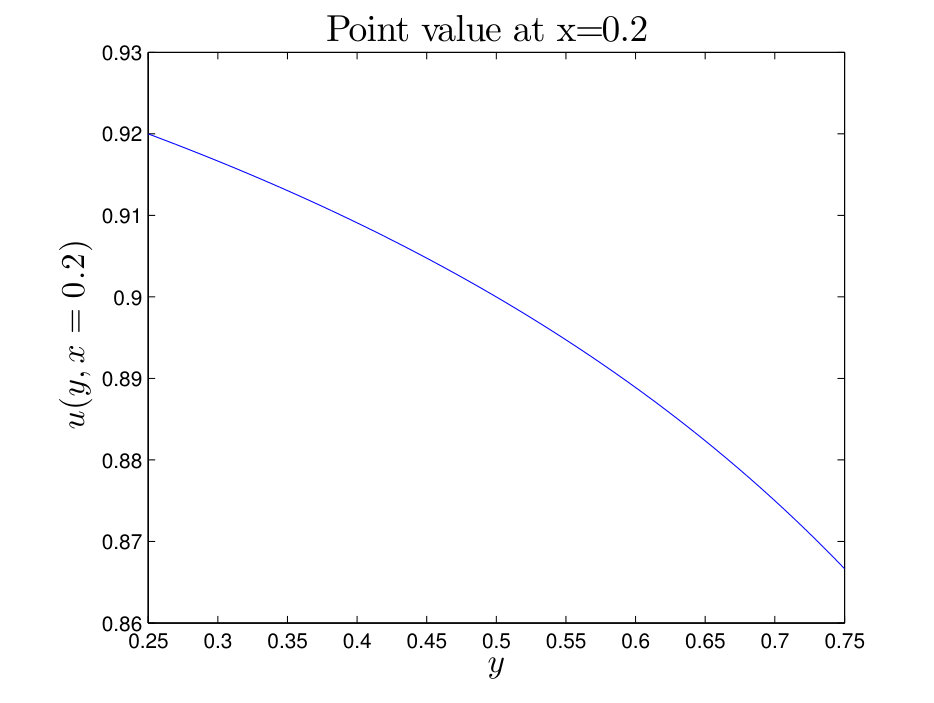 Figure 1
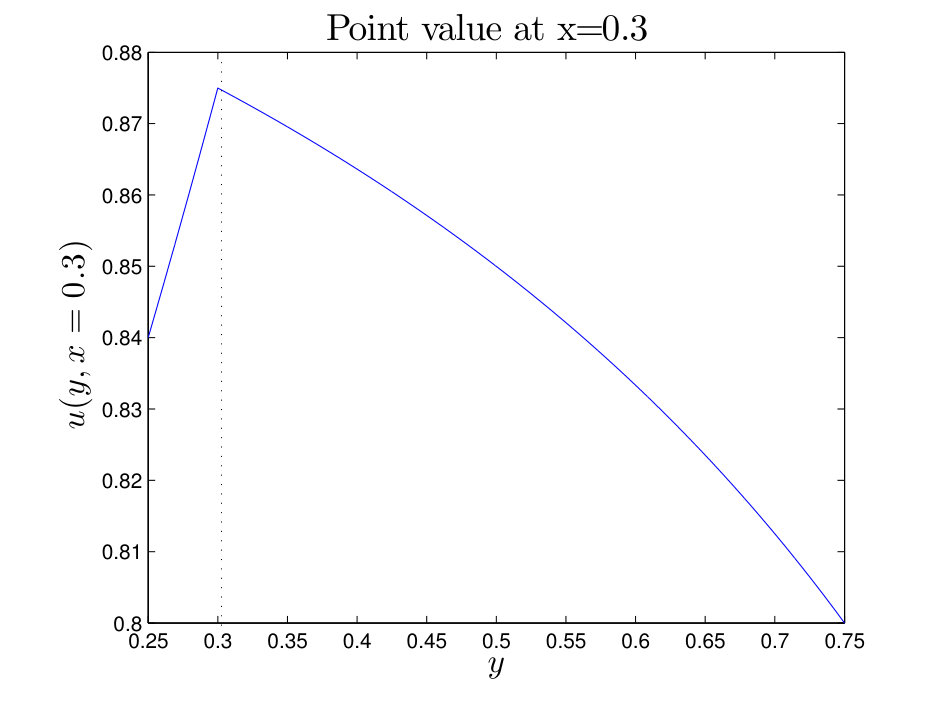 Figure 2
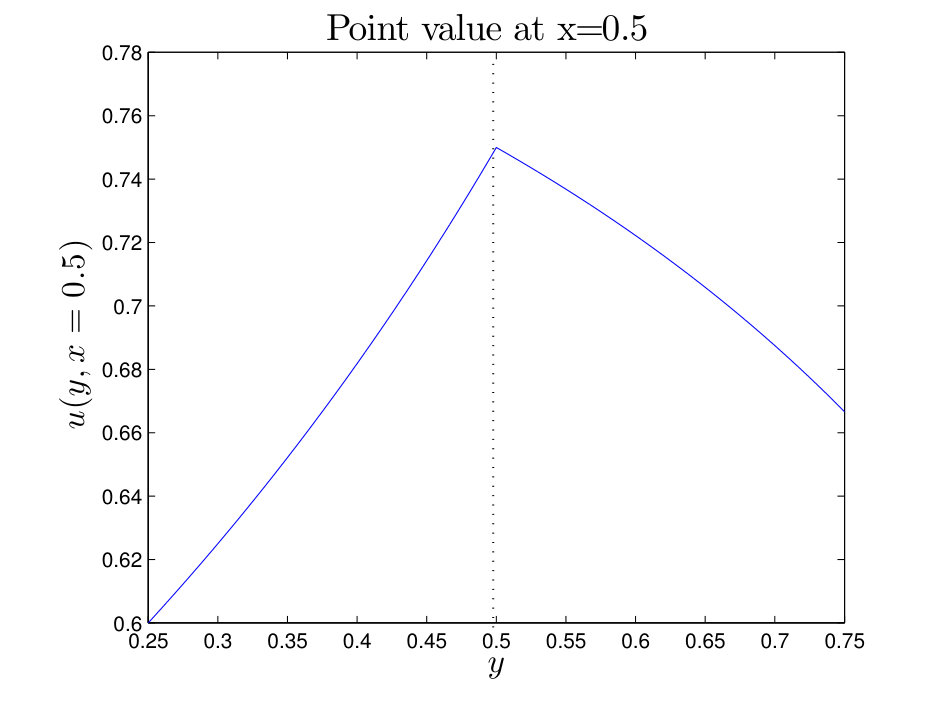 Figure 3
Peer Reviews
No public reviews on file for this paper yet. If you reviewed it on a platform where reviews are public (OpenReview, ICLR, NeurIPS, ICML), you can paste yours below so the community can read it here.
Videos
No videos yet. Explain this paper in a talk, walkthrough, or lecture? Add one.