Proxy-SU(3) symmetry in heavy nuclei: Foundations
Dennis Bonatsos, I. E. Assimakis, N. Minkov, Andriana Martinou, R. B., Cakirli, R. F. Casten, and K. Blaum

TL;DR
This paper explores an approximate SU(3) symmetry in heavy deformed nuclei by replacing intruder orbitals with proxy orbitals, testing the approximation's accuracy within the Nilsson model at large deformations.
Contribution
It introduces a novel proxy-SU(3) symmetry approach for heavy nuclei and analyzes its validity through Nilsson model calculations.
Findings
The proxy approach maintains a one-to-one orbital correspondence.
The approximation accurately reproduces key symmetry features.
Selection rules and avoided crossings are affected by parity differences.
Abstract
An approximate SU(3) symmetry appears in heavy deformed even-even nuclei, by omitting the intruder Nilsson orbital of highest total angular momentum and replacing the rest of the intruder orbitals by the orbitals which have escaped to the next lower major shell. The approximation is based on the fact that there is a one-to-one correspondence between the orbitals of the two sets, based on pairs of orbitals having identical quantum numbers of orbital angular momentum, spin, and total angular momentum. The accuracy of the approximation is tested through calculations in the framework of the Nilsson model in the asymptotic limit of large deformations, focusing attention on the changes in selection rules and in avoided crossings caused by the opposite parity of the proxies with respect to the substituted orbitals.
Click any figure to enlarge with its caption.
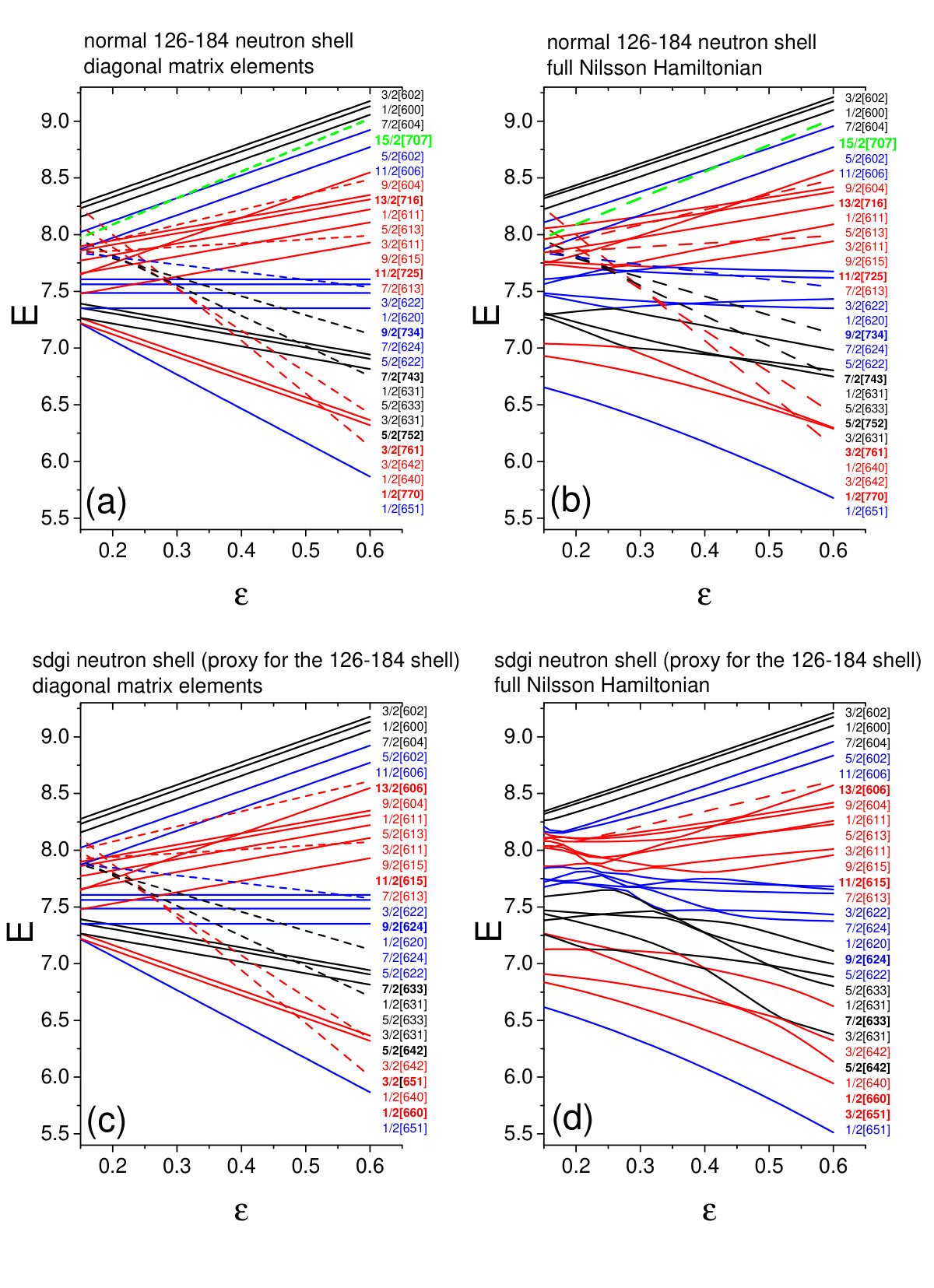 Figure 6
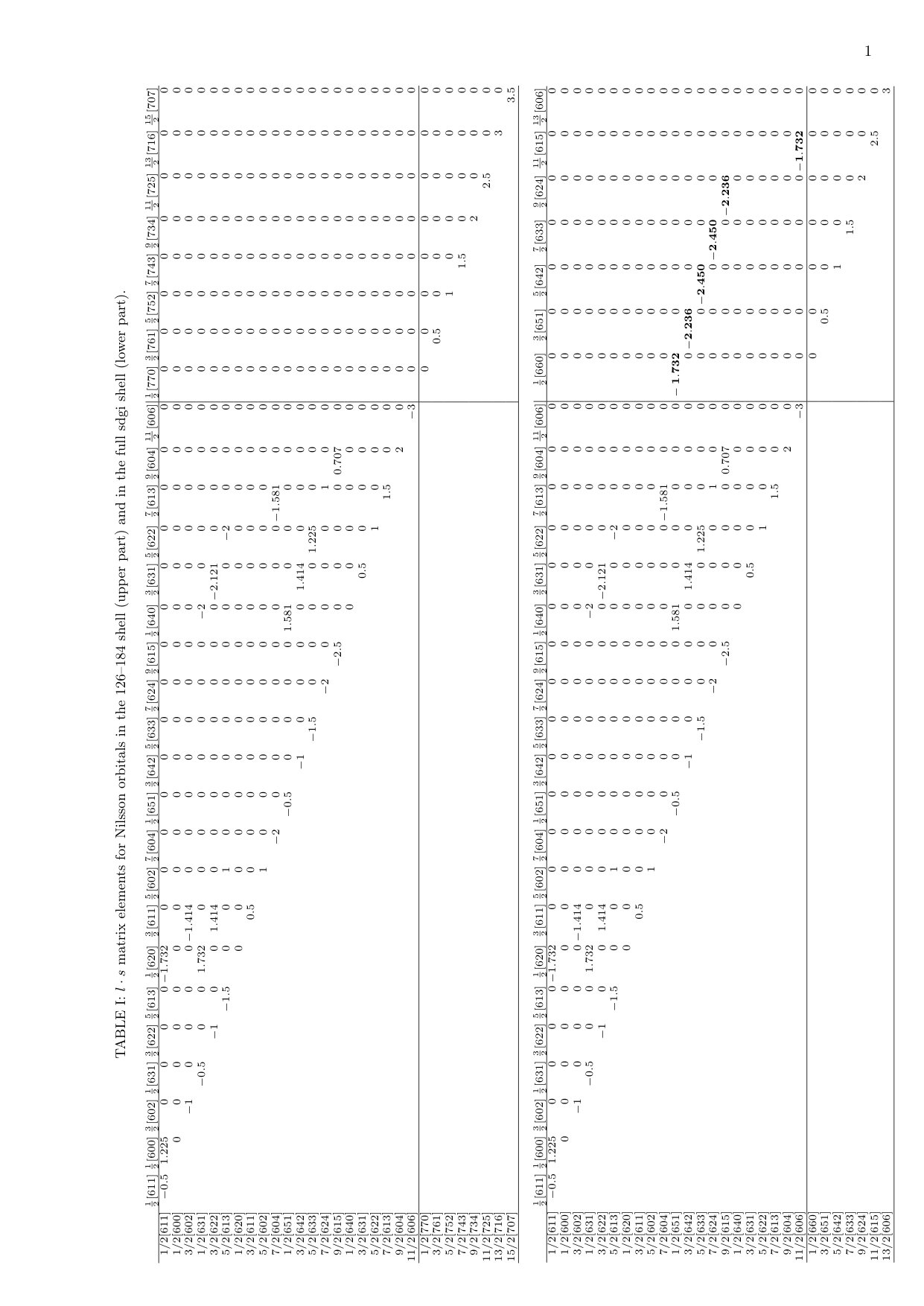 Figure 2
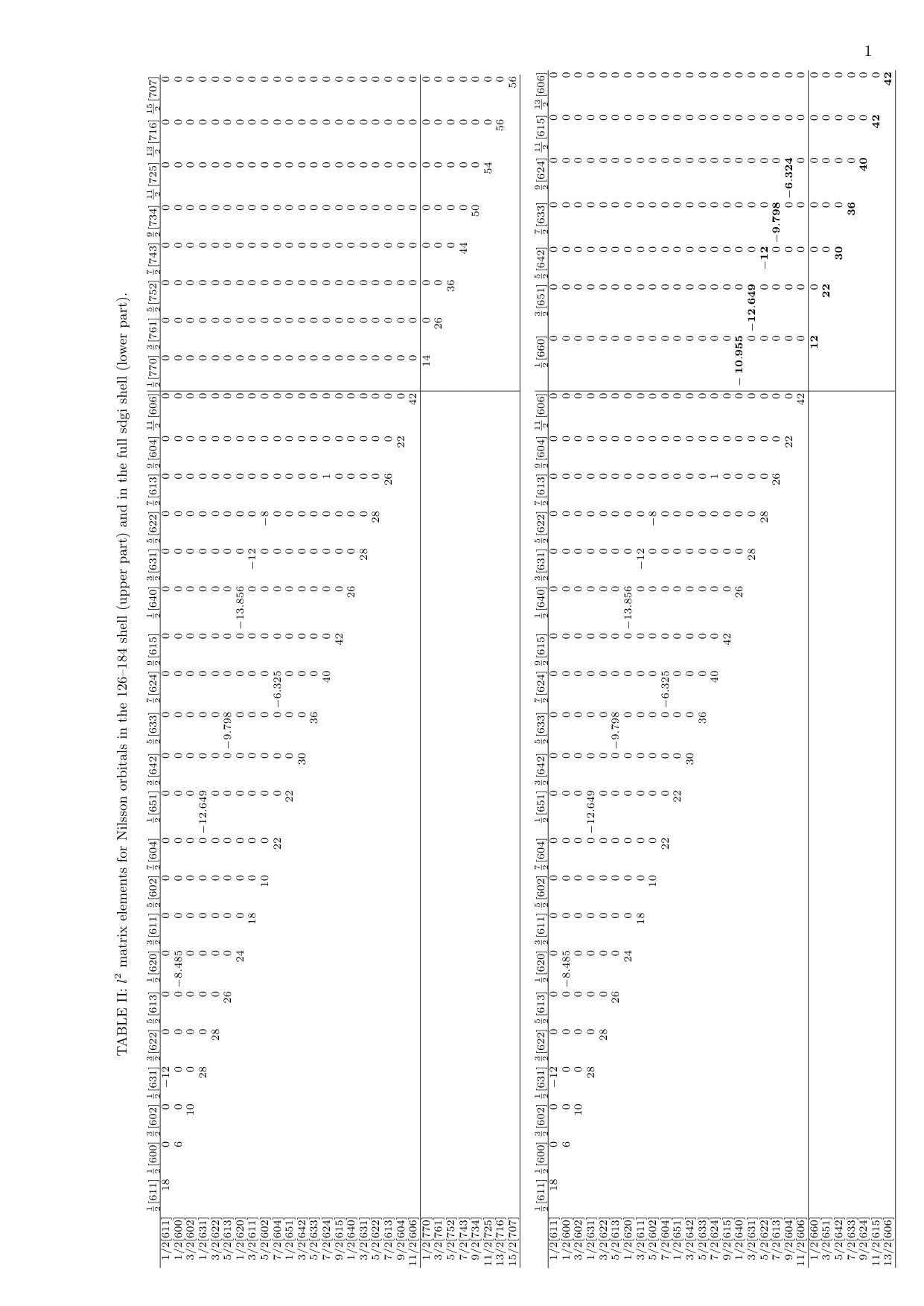 Figure 3
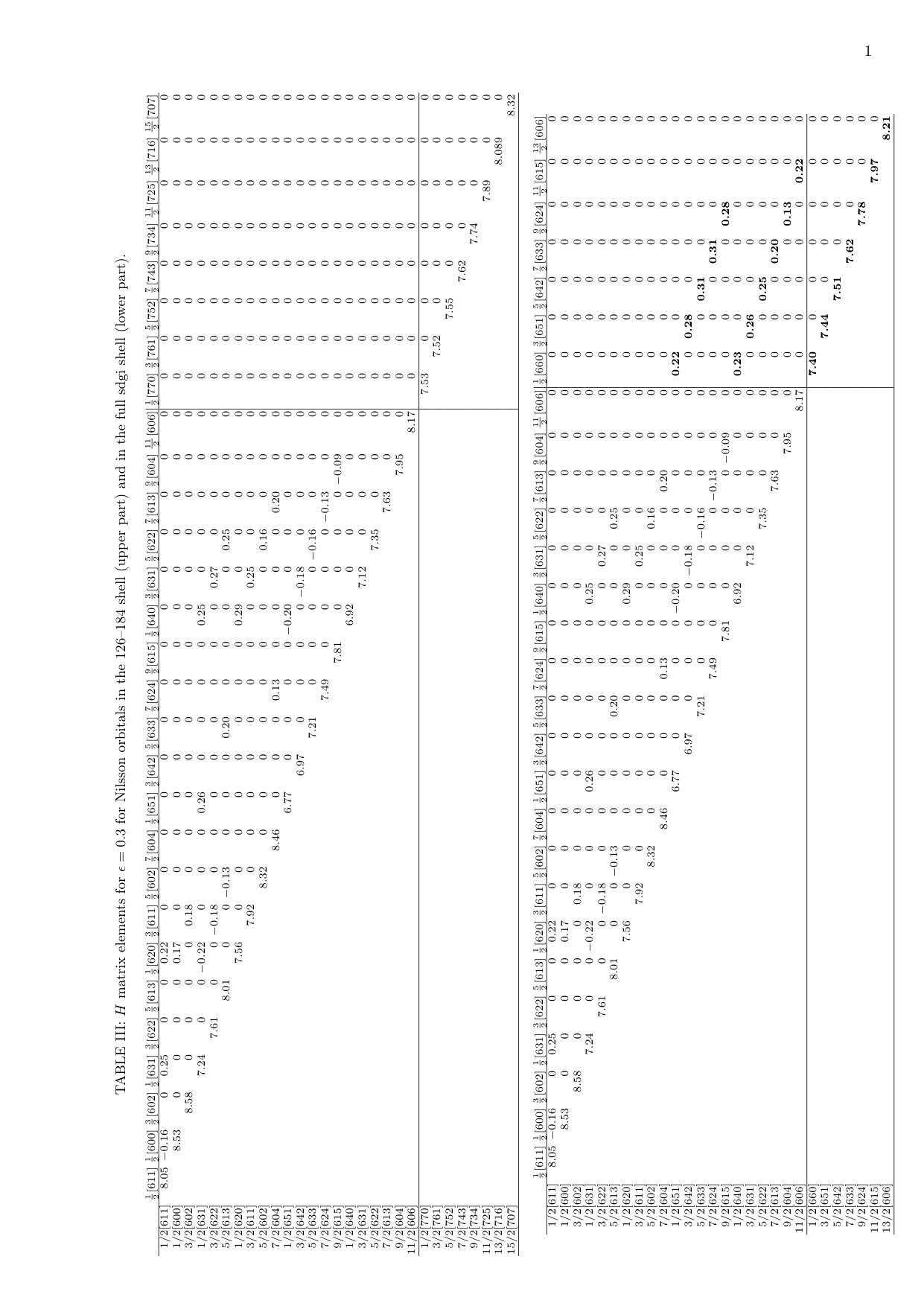 Figure 4
Peer Reviews
No public reviews on file for this paper yet. If you reviewed it on a platform where reviews are public (OpenReview, ICLR, NeurIPS, ICML), you can paste yours below so the community can read it here.
Videos
No videos yet. Explain this paper in a talk, walkthrough, or lecture? Add one.
Taxonomy
TopicsNuclear physics research studies · Quantum Chromodynamics and Particle Interactions · Advanced NMR Techniques and Applications
11institutetext: Institute of Nuclear and Particle Physics, National Centre for Scientific Research “Demokritos”, GR-15310 Aghia Paraskevi, Attiki, Greece 22institutetext: Institute of Nuclear Research and Nuclear Energy, Bulgarian Academy of Sciences, 72 Tzarigrad Road, 1784 Sofia, Bulgaria 33institutetext: Department of Physics, University of Istanbul, Istanbul, Turkey 44institutetext: Wright Laboratory, Yale University, New Haven, Connecticut 06520, USA 55institutetext: Facility for Rare Isotope Beams, 640 South Shaw Lane, Michigan State University, East Lansing, MI 48824 USA 66institutetext: Max-Planck-Institut für Kernphysik, Saupfercheckweg 1, D-69117 Heidelberg, Germany
Proxy-SU(3) symmetry in heavy nuclei: Foundations
Dennis Bonatsos 11
I. E. Assimakis 11
N. Minkov 22
Andriana Martinou 11
R. B. Cakirli 33
R. F. Casten 4455
K. Blaum 66
(Received: date / Revised version: date)
Abstract
An approximate SU(3) symmetry appears in heavy deformed even-even nuclei, by omitting the intruder Nilsson orbital of highest total angular momentum and replacing the rest of the intruder orbitals by the orbitals which have escaped to the next lower major shell. The approximation is based on the fact that there is a one-to-one correspondence between the orbitals of the two sets, based on pairs of orbitals having identical quantum numbers of orbital angular momentum, spin, and total angular momentum. The accuracy of the approximation is tested through calculations in the framework of the Nilsson model in the asymptotic limit of large deformations, focusing attention on the changes in selection rules and in avoided crossings caused by the opposite parity of the proxies with respect to the substituted orbitals.
pacs:
21.60.FwModels based on group theory and 21.60.EvCollective models
1 Introduction
The proxy-SU(3) scheme PRC1 ; PRC2 , already described in Ref. IoBonat , is a new approximate scheme applicable in medium-mass and heavy deformed nuclei, able to provide predictions for various nuclear properties, as it will be shown in Refs. IoMartinou ; IoSarant . In this contribution we are going to justify the relevant approximations by applying the proxy-SU(3) assumptions to the Nilsson model Nilsson1 ; Nilsson2 .
2 The Nilsson model
The Nilsson Hamiltonian Nilsson1 ; Nilsson2 contains a harmonic oscillator with cylindrical symmetry,
[TABLE]
where is the nuclear mass, is the momentum, and the rotational frequencies and are related to the deformation parameter by
[TABLE]
leading to
[TABLE]
with corresponding to prolate shapes and corresponding to oblate shapes. In addition it contains a spin-orbit term and an angular momentum squared term, the total Hamiltonian having the form
[TABLE]
where is the angular momentum, is the spin,
[TABLE]
is the average of the square of the angular momentum within the th oscillator shell, and and are constants determined from the available data on intrinsic nuclear spectra BM , their values being given in Table 5-1 of Ref. BM . The eigenvalues of are
[TABLE]
3 Calculation of matrix elements
In order to simplify the calculation of matrix elements, one can choose a more convenient basis. Using the creation and annihilation operators , , , for the quanta of the harmonic oscillator in the Cartesian coordinates and , one can define creation and annihilation operators Nilsson2 ; MN
[TABLE]
[TABLE]
These operators satisfy the commutation relations
[TABLE]
In this way one goes over to a new basis, , where () is the number of quanta related to the harmonic oscillator formed by and ( and ). The following relations hold
[TABLE]
where is the number of quanta perpendicular to the -axis.
It is then a straightforward task, described in detail in Ref. Nilsson2 , to calculate the matrix elements of the and operators in the new basis.
The spin-orbit term, , has diagonal matrix elements
[TABLE]
as well as non-diagonal matrix elements
[TABLE]
[TABLE]
[TABLE]
[TABLE]
The orbital angular momentum term, , has diagonal matrix elements
[TABLE]
as well as non-diagonal matrix elements
[TABLE]
[TABLE]
[TABLE]
[TABLE]
4 Numerical results
Numerical results for the matrix elements of for the 126-184 and sdgi shells are given in Table I, and those for the matrix elements of for the same shells are given in Table II. Furthermore, numerical results for the full Hamiltonian for for the 126-184 and sdgi shells are given in Table III, while Nilsson-like diagrams involving either just the diagonal terms of the Hamiltonian, or obtained through the diagonalization of the full Hamiltonian, are plotted for the same shells in Fig. 1. Many comments are in place.
In each of the Tables I, II, III, the upper table corresponds to the original Nilsson model 126-184 shell, while the lower table represents the proxy-SU(3) approximation to it, which is an sdgi shell. The lower table has one row and one column less than the upper table, since the orbital with the highest angular momentum in the 126-184 shell, 15/2[707], has no counterpart in the proxy-SU(3) sdgi shell. All tables are symmetric, thus only the upper half is shown.
All tables are divided into four blocks. The upper left block involves matrix elements among the normal parity orbitals, i.e. the orbitals which belong to the sdgi shell and remain in the 126-184 shell after the defection of the 1i13/2 orbital to the major shell below. Therefore the upper left blocks of the 126-184 and sdgi tables are identical.
The lower right block involves matrix elements among the abnormal orbitals, members of the 1j15/2 orbital which has invaded the sdgi shell coming from the major shell above. The 126-184 and sdgi results are either identical, or very similar, due to the fact that during the proxy-SU(3) approximation all angular momentum projections (orbital angular momentum, spin, total angular momentum) remain unchanged.
The upper right block of the 126-184 tables contains only vanishing matrix elements, since it connencts levels of opposite parity, namely positive parity sdgi orbitals to negative parity 1j15/2 orbitals. In the upper right block of the sdgi tables, though, a few non-vanishing matrix elements appear, connecting the original positive parity sdgi orbitals to the proxies of the 1j15/2 orbitals, which are positive parity 1i13/2 orbitals. These extra non-vanishing matrix elements represent the “damage” caused by the proxy-SU(3) approximation, i.e., by the replacement of the 1j15/2 orbitals (except the 15/2[707] one) by their 1i13/2 proxies.
The size of these extra non-vanishing matrix elements is comparable to the magnitude of the diagonal matrix elements in the case of the and operators, as one can see in Tables I and II. However, as one can see in Table III, the extra non-vanishing matrix elements are much smaller (by at least one order of magnitude) than the diagonal matrix elements. The reason behind this difference is the small values of the and coefficients ( and respectively, as given in Table 5-1 of Ref. BM ), by which the matrix elements of and are multiplied before entering Table III.
The smallness of the extra non-vanishing matrix elements means that the diagonalization of the Nilsson Hamiltonian for various values of the deformation will yield very similar results for the 126-184 and proxy-SU(3) sdgi shells, as seen in Fig. 1, indicating that the Nilsson diagrams are very little affected by these extra non-vanishing matrix elements and thus proving that the proxy-SU(3) approximation is a good one.
In a similar way one can see that good results are also obtained for the 28-50, 50-82, and 82-126 shells in comparison to their pf, sdg, and pfh proxy-SU(3) counterparts PRC1 .
5 Conclusions
By applying the proxy-SU(3) assumptions to the Nilsson model, we prove that the Nilsson diagrams of the 126-184 shell and of its proxy-SU(3) sdgi counterpart are very similar, thus justifying the use of the proxy-SU(3) scheme, some applications of which for the calculation of nuclear properties will be discussed in Refs. IoMartinou ; IoSarant .
The reference list from the paper itself. Each links out to its DOI / PubMed record.
- 1(1) D. Bonatsos, I. E. Assimakis, N. Minkov, A. Martinou, R. B. Cakirli, R. F. Casten, and K. Blaum, Proxy-SU(3) symmetry in heavy deformed nuclei, Phys. Rev. C (2017) accepted, ar Xiv 1706.02282 [nucl-th].
- 2(2) D. Bonatsos, I. E. Assimakis, N. Minkov, A. Martinou, S. Sarantopoulou, R. B. Cakirli, R. F. Casten, and K. Blaum, Analytic predictions for nuclear shapes, prolate dominance and the prolate-oblate shape transition in the proxy-SU(3) model, Phys. Rev. C (2017) accepted, ar Xiv 1706.02321 [nucl-th].
- 3(3) D. Bonatsos. I. E. Assimakis, N. Minkov, A. Martinou, R. B. Cakirli, R. F. Casten, and K. Blaum, A new symmetry for heavy nuclei: Proxy-SU(3), in the Proceedings of the 4th Workshop of the Hellenic Institute of Nuclear Physics (HIN Pw 4), ed. A. Pakou, http://hinpw 4.physics.uoi.gr
- 4(4) D. Bonatsos. I. E. Assimakis, N. Minkov, A. Martinou, S. Sarantopoulou, R. B. Cakirli, R. F. Casten, and K. Blaum, Parameter-independent predictions for shape variables of heavy deformed nuclei in the proxy-SU(3) model, in the Proceedings of the 4th Workshop of the Hellenic Institute of Nuclear Physics (HIN Pw 4), ed. A. Pakou, http://hinpw 4.physics.uoi.gr
- 5(5) D. Bonatsos. I. E. Assimakis, N. Minkov, A. Martinou, S. Sarantopoulou, R. B. Cakirli, R. F. Casten, and K. Blaum, Prolate dominance and prolate-oblate shape transition in the proxy-SU(3) model, in the Proceedings of the 4th Workshop of the Hellenic Institute of Nuclear Physics (HIN Pw 4), ed. A. Pakou, http://hinpw 4.physics.uoi.gr
- 6(6) S. G. Nilsson, Binding states of individual nucleons in strongly deformed nuclei, Mat. Fys. Medd. K. Dan. Vidensk. Selsk. 29 , no. 16 (1955).
- 7(7) S. G. Nilsson and I. Ragnarsson, Shapes and Shells in Nuclear Structure (Cambridge University Press, Cambridge, 1995).
- 8(8) A. Bohr and B. R. Mottelson, Nuclear Structure, Vol. II: Nuclear Deformations (Benjamin, New York, 1975).