Maximal trace distance between isoenergetic bosonic Gaussian states
T.J. Volkoff

TL;DR
This paper identifies pairs of single-mode Gaussian states with maximal trace distance under energy constraints, revealing their potential for optimal binary quantum state discrimination in continuous variable quantum communication.
Contribution
It characterizes the pairs of Gaussian states that achieve maximal trace distance under energy constraints, providing insights into optimal quantum state discrimination strategies.
Findings
Maximal trace distance scales as ^{2} for certain Gaussian pairs.
Maximally trace distant states outperform coherent and squeezed states in distinguishability.
Results extend to multi-mode Gaussian states, informing quantum communication protocols.
Abstract
We locate the set of pairs of Gaussian states of a single mode electromagnetic field that exhibit maximal trace distance subject to the energy constraint . Any such pair allows to achieve the minimum possible error in the task of binary distinguishability of two single mode, isoenergetic Gaussian quantum signals. In particular, we show that the logarithm of the minimal error probability for distinguishing two maximally trace distant, isoenergetic Gaussian states scales as , less than the achievable scaling of the minimal error probability for distinguishing, e.g., a pair of isoenergetic Heisenberg-Weyl coherent states with energy or a pair of isoenergetic quadrature squeezed states with energy . For the case of a field consisting of modes, we locate the set of…
Click any figure to enlarge with its caption.
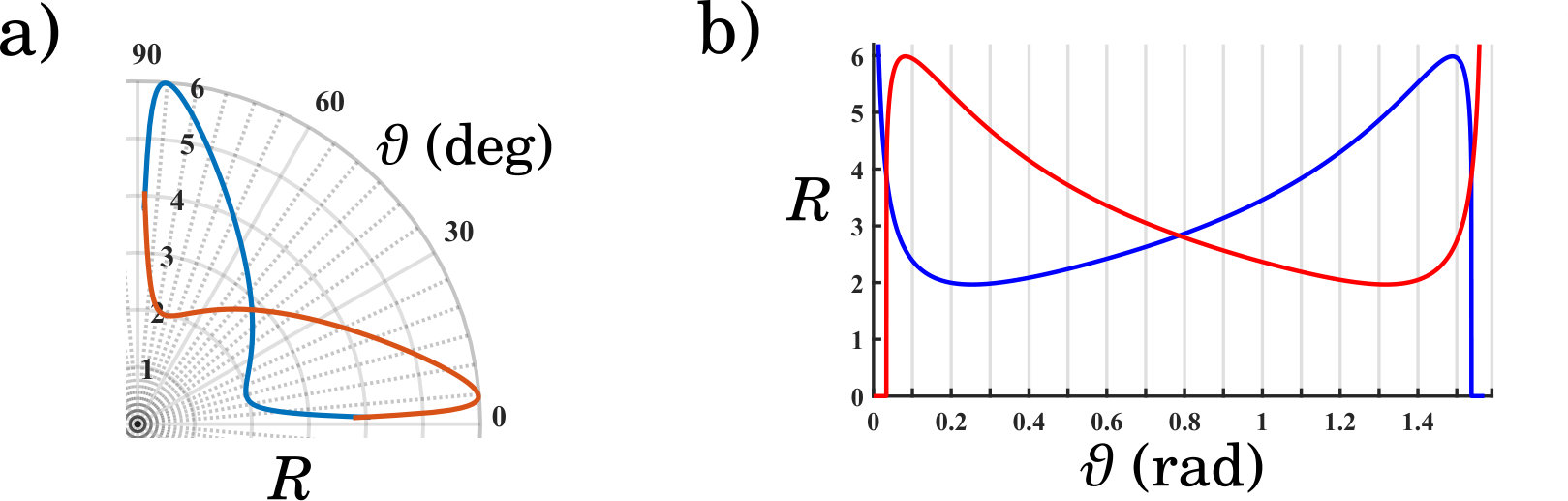 Figure 1
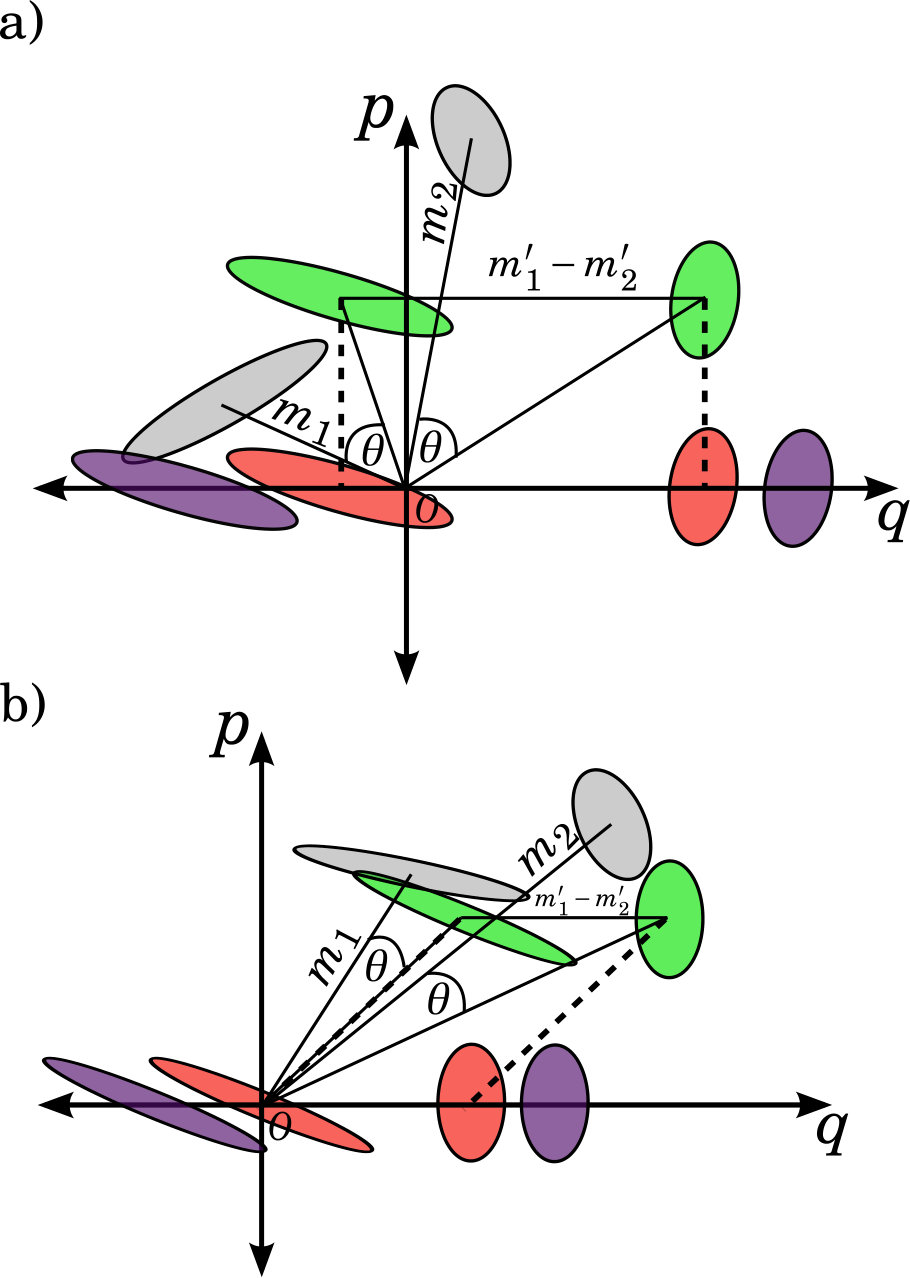 Figure 2
Peer Reviews
No public reviews on file for this paper yet. If you reviewed it on a platform where reviews are public (OpenReview, ICLR, NeurIPS, ICML), you can paste yours below so the community can read it here.
Videos
No videos yet. Explain this paper in a talk, walkthrough, or lecture? Add one.
Maximal trace distance between isoenergetic bosonic Gaussian states
T.J. Volkoff
Department of Physics, Konkuk University, Seoul 05029, Korea
Abstract
We locate the set of pairs of Gaussian states of a single mode electromagnetic field that exhibit maximal trace distance subject to the energy constraint . Any such pair allows to achieve the minimum possible error in the task of binary distinguishability of two single mode, isoenergetic Gaussian quantum signals. In particular, we show that the logarithm of the minimal error probability for distinguishing two maximally trace distant, isoenergetic Gaussian states scales as , less than the achievable scaling of the minimal error probability for distinguishing, e.g., a pair of isoenergetic Heisenberg-Weyl coherent states with energy or a pair of isoenergetic quadrature squeezed states with energy . For the case of a field consisting of modes, we locate the set of pairs of maximally trace distant isoenergetic, isocovariant Gaussian states. These results have basic applications in the theory of continuous variable quantum communications with Gaussian states of light.
I Introduction
Gaussian states (i.e., quasi-free states Bratteli and Robinson (1997)) on the canonical commutation relations (CCR) C*∗* - algebra generated by the Weyl operators of a single bosonic mode are fundamental in the theory of continuous variable quantum information processing due to the complete classification of their quantum dynamics Holevo (2007). In this sense, they have a similar standing in continuous variable quantum mechanics as states on , i.e., “qubit” states, have in finite-dimensional quantum mechanics. Several metrics on the space of trace class, positive operators on a separable Hilbert space can be used to quantify the distance between two Gaussian quantum states Morozova and Chentsov (1991). However, the distance which most directly quantifies the distinguishability of two quantum density operators and is the trace distance , i.e., the distance between and considered as elements of , the Schatten ideal of . Specifically, the trace distance appears in a central theorem of quantum estimation theory Helstrom (1976): given two normal, faithful states and of a von Neumann algebra with respective densities and present with equal a priori probability, the minimal error probability that can be obtained in the task of distinguishing and by outcomes of any quantum measurement is given by
[TABLE]
The simplicity of this theorem hides several difficulties. For instance, whereas a closed formula exists for, e.g., the Bures metric on the set of Gaussian quantum states Banchi et al. (2015), no analogous formula exists for the trace distance between two generic Gaussian states. Furthermore, the fact that any two Gaussian states and that have “finite energy” exhibit trace distance , complicates the analysis of the quantum information theory for continuous variables. In the first part of this work, we take to be the Hilbert space , defined as the norm closure of the complex linear span of vectors of the form , where , , and is the orthonormal basis of Fock vectors. Furthermore, a density operator is said to have finite energy if and only if the condition , where , are the annihilation and creation operators, respectively, is satisfied. Note that the finite energy states form the dense domain of the operator and that the linear functional is lower semicontinuous on Holevo (2012).
In the case of two finite energy, pure Gaussian states , , the condition is equivalent to , due to the formula
[TABLE]
It then follows that for any isometry between Hilbert spaces and with , (e.g., a noiseless quantum computation), the states , cannot be distinguished with certainty.
In this work, we consider the problem of locating the pairs of Gaussian states of a single quantum harmonic oscillator that exhibit maximal trace distance subject to the energy constraint . Before delving into the details of the proof, we will show that the pairs of energy constrained Gaussian states that achieve the maximum trace distance are pure, i.e., the maximum is obtained on certain pairs of pure states that satisfy the constraint , . To set the notation, consider the single mode Heisenberg-Weyl Lie algebra defined by the self-adjoint operators such that , . We write for the vector of quadratures, where , . A single mode Gaussian state can be fully specified by its characteristic function, defined for by , where is the mean vector and is the covariance matrix, viz., a positive matrix in with entries given by , where is the Jordan product. Therefore, a general single mode Gaussian state is parametrized by five real numbers: two positive numbers representing the diagonal entries of , one real number specifying the off-diagonal entry of , and two real numbers specifying .
We now define
[TABLE]
where is the set of Gaussian states on the single mode Hilbert space that satisfy . It follows that
[TABLE]
where is the closed, convex hull of and, for convenience, we denote the set of energy constrained Gaussian states by . That equality holds in all inequalities appearing in Eq.(4) can be shown by the following chain of standard arguments: 1) the set of quantum states that satisfy is compact Holevo (2012) and contains the closed set , which is, therefore compact, 2) is compact Aliprantis and Border (2006) and its extreme points are the pure states of , 3) the joint convexity of trace distance implies that it attains its extrema on pure states . Similar arguments have been used in quantum information theory to show, e.g., that the output entropy of a completely positive, trace preserving linear map on a finite dimensional, energy-constrained quantum state space is attained on a pure argument of the map Memarzadeh and Mancini (2016).
In order to solve for in Eq.(3), we first note that a pure Gaussian state is characterized by the property of satisfying the Heisenberg uncertainty principle with equality, or, equivalently, by the property that can be brought to the matrix by a symplectic transformation of (with symplectic form where is the Pauli matrix , ) Holevo (2012). Therefore, a pure single mode Gaussian state is specified by 4 real numbers. Due to the energy constraint (see also Eq.(5) below) the minimization problem in (3) is defined on a manifold of dimension (). Reduction of the problem of minimization of to the problem of minimization of a function of one real variable is the main task undertaken in the following.
A brief outline of the paper is as follows:
II Calculation of
By the Euler decomposition of the symplectic group , and the metaplectic representation of on the quantum state space of a single quantum oscillator Arvind et al. (1995), every pure single mode Gaussian state can be written as , where is the unitary squeezing operator, is the unitary displacement operator, is the Fock vacuum state, and . The energy constraint for a pure, single mode Gaussian state is given explicitly in terms of the displacement parameter and squeezing parameter by Mandel and Wolf (1995)
[TABLE]
For a pair of Heisenberg-Weyl coherent states that exhibit the lowest fidelity among energy constrained coherent states (i.e., ), one obtains linear scaling of the logarithm of the Helstrom error probability, . Logarithmic scaling of with the energy is obtained by considering centered Gaussian states and () that are squeezed in the canonically conjugate quadratures and , respectively. In particular, . We now show in Lemma 1 that the possibility of investing part of the allotted energy into quadrature squeezing allows to achieve .
Lemma 1. Let denote the minimal error probability for distinguishing , , present with equal a priori probability. Then satisfies
[TABLE]
The minimal error probability for distinguishing and (present with equal a priori probability) with an arbitrary quantum measurement is given by Helstrom (1976):
[TABLE]
where the second line follows from the MacLaurin series of . Therefore, the proof of Lemma 1 reduces to the task of identification of pure states , such that , subject to the energy constraint. The proof is considerably simplified by noticing that the constrained minimization of the fidelity can be carried out over pairs of pure Gaussian states , with real parameters , , i.e., with mean vectors on the real axis and on opposite sides of the origin, a fact which we presently demonstrate.
The fidelity between two pure Gaussian states and , with covariance matrices , , respectively, is given by
[TABLE]
which can be obtained from a more general formula for the quantum affinity between quasifree states and Holevo (1972) or for the Bures distance between displaced, squeezed thermal states , Scutaru (1998). Consider the states and , which are associated with mean vectors in (Fig.(1a), gray ellipses). For an appropriate value of , the rotation achieves the mapping , where is parallel to the -axis. The rotation preserves both the energy of each state and their inner product, producing the green ellipses in Fig.(1a). Projection of the mean vectors , to the -axis preserves the fidelity and lowers the expected energy of each state (Fig.(1a), red ellipses). In order for both of the resulting states to satisfy the energy constraint, the excess energy can be used to increase the magnitude of , and thereby reduce the fidelity (Fig.(1a), violet ellipses). If the rotation by produces a relative mean vector such that and are on the same side of the -axis, or such that either of , lie on the -axis, the mean vector nearer the origin can be displaced to the origin, see, e.g., Fig.(1b), reducing the energy of both states. The excess energy is again used to scale .
The proof of Lemma 1 now consists simply of choosing appropriate squeezing parameters defining the covariance matrices in Eq.(8).
Proof of Lemma 1. We specialize to and , with , , and . By defining , the formula of Eq.(8) becomes , where
[TABLE]
Note that taking , i.e., squeezing of each state along the quadrature, corresponds to due to the energy constraint.
For , the function takes the simple form . However, if , the energy constraint, combined with the conditions , , requires that . The fidelity therefore simplifies to
[TABLE]
with parametric dependence on the energy . On the interval , the minimum of the exponent of is achieved for , where . The corresponding value for the minimal fidelity, , is:
[TABLE]
where , and
[TABLE]
Using Eq.(11) in Eq.(7) and collecting multiplicative prefactors into the exponential proves Lemma 1.
In the limit of large , the ratio approaches . It is intriguing that the value of the squeezing parameter obtained in the proof above coincides with the maximal squeezing parameter for which a squeezed thermal state with thermal energy exhibits a positive -distribution Kim et al. (1989). In view of Eqs.(7) and (11), the question remains whether is equal to . If this is true, then the minimal value of for isoenergetic Gaussian states , is given by , where is defined in Eq.(12). We return to this question after we consider the special case for the mean vectors and of and , respectively.
Lemma 2. Let denote the set of pairs of pure Gaussian states with expected energy and mean vectors that are opposite, i.e., . Then
[TABLE]
Proof. Without loss of generality, consider again and , with , . Due to the energy constraint, if , then . The covariance matrix corresponding to is given by
[TABLE]
where . Taking derivatives with respect to , one finds that the critical points of the function
[TABLE]
with respect to the angles and occur at the angle pairs . Because the energy constraint is independent of , , it does not have to be taken into account to find the critical angles of the function in Eq.(15). We will not further consider the critical point because it does not yield a maximum of Eq.(15). In particular, for , , and
[TABLE]
where . The critical points correspond to the same physical scenario of a pair of pure Gaussian states , with mean vectors and , and with one state squeezed along the quadrature and other state squeezed along the quadrature. Therefore, we only need to compare the critical points and . For and , so that the energy constraint implies , the inner product corresponding to the case is given by
[TABLE]
where the allowed values of are in . The only extremum of the right hand side of Eq.(17) that lies in the interval of valid occurs for , which corresponds to the pair of opposite-phase coherent states , . However, for all , recall that Lemma 1 gives a pair of pure Gaussian states , with that saturates Eq.(13). Because for all . Therefore, a minimum occurs for the critical angles , specifically, for the states , . For , this minimum is a global one because Eq.(10) is strictly convex in .
Lemmas 1 and 2 are the main tools used to simplify the proof of Theorem 1, below, which shows that is indeed equal to , or, equivalently, that for all energies . The proof of this theorem proceeds by the introduction of a new optimization problem with a looser energy constraint.
Theorem 1.
Proof. Consider the less constrained problem (P1) below, which is defined by the constraint of total energy to be distributed between two pure Gaussian states:
Problem (P1)
[TABLE]
The same reasoning that led to Lemma 1 allows us to restrict the solution of (P1) to with mean vectors such that , . Furthermore, the unconstrained optimization over , carried out in the proof of Lemma 2 is also valid here and allows us to restrict to such that are real. In terms of , the constraint in problem (P1) is given by
[TABLE]
Therefore, without loss of generality, one may take , where . Eliminating from the expression for the fidelity results in
[TABLE]
where and the only remaining constraint is that . A minimum of Eq.(19) exists because the remaining constraint defines a compact subset of . At a local minimum of Eq.(19), we must have . Taking the derivative, one finds that . The case is not consistent with the fact that the minimum must occur for , unless . For , for all (see Appendix), so we conclude that the minimum must occur for the case of antipodal mean vectors, viz., . In this case, Eq.(19) becomes
[TABLE]
The gradient of (20) vanishes if and only if and , where is given by the following quartic:
[TABLE]
Going to polar coordinates via , transforms the problem of finding solutions to the system , to the problem of locating the intersection points in of the two polar curves given by
[TABLE]
A solution of is given by . This solution is the only critical point which satisfies the stronger condition , , because it is the only critical point for which the states , have equal magnitudes of displacement and equal magnitudes of squeezing. In terms of the parameters appearing in Eq.(19), the solution corresponds to , , (at this point, the determinant of the Hessian of Eq.(20) is given by , so it is a minimum). For , and ; therefore, is the only solution in this limiting case. For finite , Fig.2 shows one further solution in (which has a reflected counterpart in the interval ). This solution does not become degenerate with the solution for any .
Note that a lower bound for the solution of the more strongly constrained problem, viz., the problem of minimizing with , , can be obtained from the smallest value of Eq.(20) that also satisfies the stronger constraint. The solution of given by is a unique minimizer of Eq.(20) that satisfies the stronger constraint; this point corresponds to the same pair of states , appearing in Lemmas 1 and 2. Therefore, .
Because the unitary rotation , , is the only element of the one-mode metaplectic representation of that preserves the energy constraint, the set of pairs of energy constrained Gaussian states that achieve the minimal fidelity can be obtained from the single pair , by the application of to and .
III Maximal trace distance between isoenergetic multimode bosonic Gaussian states
We now briefly consider the problem of maximization of the trace distance between two Gaussian states , , for , and subject to the isoenergetic constraint , where and () is the annihilation (creation) operator on the -th tensor factor. Using Eq.(2) and the fact that the minimal fidelity occurs for two pure states, we state the problem symbolically as:
Problem (P2)
[TABLE]
In the special case that occurs when one restricts to pairs of symmetric Gaussian states of the form
, where , , it is an immediate corollary of Theorem 1 that the minimal fidelity in this restricted optimization problem is given by . However, much lower fidelity is achievable in the problem (P2), due to the fact that by taking all of the energy in a single tensor factor, i.e., taking, for example,
[TABLE]
the solution of problem (P2) is at most . In fact, if the appearing in problem (P2) are restricted to the submanifold of pure, separable states of , i.e., if the optimization is carried out over , where , , then the solution of problem (P2) is exactly . This result follows from the multiplicativity of the fidelity under tensor products.
The presence of tensor factors in problem (P2) increases the degeneracy of pairs that exhibit maximal trace distance. Specifically, when unitarily represented on the Hilbert space by the metaplectic representation, the maximal compact subgroup of is the maximal subgroup that preserves the total energy of and and their trace distance. One implication of this degeneracy is that the value for the fidelity can be obtained on pairs of pure states in the symmetric subspace of . To see this, simply consider the states in Eq.(23) after the transformation .
The main difficulty in Section II was to show that any maximally trace distant pair of isoenergetic, single mode bosonic Gaussian states is defined by a single covariance matrix and, therefore, that any such pair consists of opposite coherent states with respect to a certain complex structure on the symplectic space . We call two states , isocovariant if their respective covariance matrices are equal, i.e., if . Lemma 3 simplifies the calculation of the maximal trace distance between two multimode, isoenergetic, isocovariant bosonic Gaussian states. The possibility that the solutions to problem (P2) are isocovariant pairs of multimode, isoenergetic bosonic Gaussian states can be motivated by a scaling argument, which we provide at the end of this section.
Lemma 3. For , the -algebra of complex matrices, let denote the operator norm on and the non-normalized matrix trace. Then,
[TABLE]
where the constrained minimization on the right hand side of the first line is carried out over covariance matrices , i.e., and .
Proof. The constraint in problem (P2) can be restated as , . It follows that Eq.(8) can be rewritten as
[TABLE]
If , then follows immediately from Williamson’s theorem (see Holevo (2012), Exercise 12.19). Furthermore, in this case, both mean vectors and lie on the sphere of radius , and is maximized for . By taking the minimum over both sides of (25) with , the inequality appearing in the lemma is proven. Note that in this inequality, the constraints on correspond to the restriction to pure states with expected energy . Because corresponds to the covariance matrix of a pure Gaussian quantum state, there exists such that . In particular, . Because the spectrum of a positive definite symplectic matrix takes the form de Gosson (2006), it follows that , where we have noted that the number of modes, , is equal to . The final line of Eq.(24) can be further simplified, according to specific need. Note the the determinant constraint on (i.e., the restriction to pure Gaussian states) allows the representation in terms of symplectic matrices on in the final line of Eq.(24); this follows from the fact that for all .
In fact, equality holds in the inequality of Lemma 3. By showing this, one arrives at an immediate solution of the problem of maximal trace distance between isoenergetic, isocovariant bosonic Gaussian states.
Theorem 2.
Proof. The proof is a direct calculation that follows from Lemma 3. Taking to be the maximal eigenvalue of without loss of generality, the final line of Eq.(24) can be written
[TABLE]
Taking derivatives of the exponential function on the right hand side with respect to gives the critical values and for , which satisfy the energy constraint. The corresponding minimal fidelity is . This value of the fidelity can be achieved for the pair in Eq.(23); therefore, the bound in Eq.(26) is an equality.
Due to Eq.(23) and Theorem 2, it follows that the maximal isocovariant trace distance can be obtained on pairs of states with maximal energy density, i.e., pairs of states that have single mode marginal states that satisfy the energy constraint. However, the full solution of the problem of finding maximal trace distance between isoenergetic bosonic Gaussian states of modes requires that one perform the maximization of the trace distance over all pairs . Note that in the single mode case, the unconstrained optimization over in Lemma 2 allowed to reduce the problem in Theorem 1 to the case of commuting covariance matrices, i.e., to the case of . However, for the multimode case (), even if one loosens the restriction of isocovariance to consider the case of commuting covariance matrices, the constrained optimization problem over the spectra of and is considerably more challenging than the problem posed by Theorem 1. The resulting expressions may be amenable to numerical optimization for small, finite .
There are qualitative considerations that suggest that the minimum value appearing in Theorem 2 indeed coincides with the solution of problem (P2) for any . For example, the determinant appearing in the denominator of Eq.(8) contributes only to the exponent of the minimal fidelity, whereas the quadratic form appearing in the exponent scales polynomially with . This suggests that to reduce the fidelity between two isoenergetic Gaussian states, the pair of states should be taken isocovariant. Furthermore, given , it is also true that if the minimum value appearing in Theorem 2 were greater than the minimum in problem (P2), then it would follow from Theorem 1 that an energy value greater than is required for a pair of isoenergetic, single mode bosonic Gaussian states to achieve the minimal fidelity that can be obtained in the case of two -mode, isoenergetic bosonic Gaussian states.
IV Applications
The main results of sections II and III have several applications to the theory of low power quantum communication. In particular, a central problem in optical detection theory consists of the construction of optimal quantum measurements that saturate the minimal error probability in the task of discrimination of a finite set of pure quantum signals Helstrom (1976); Holevo (1977). An extension of this problem beyond the traditional settings of, e.g., narrow band coherent signals, or signals generated by the action of a finite cyclic unitary group, was provided in Ref.Barnett (2001). The present work motivates the investigation of optimal discrimination of a finite set of multimode, isoenergetic pure Gaussians which is generated from a single Gaussian state by a discrete subgroup of the energy conserving (i.e., compact) subgroup of . In the study of asymptotic quantum hypothesis testing in the independent, identically distributed (i.i.d.) setting Amari and Nagaoka (1993), the quantum Pinsker inequality allows one to bound the quantum relative entropy by a multiple of the squared trace distance, thereby relating the error of the second kind Ogawa and Nagaoka (2000) to the minimal error probability for distinguishing two quantum states. The recent calculation of the Petz-Rényi relative entropies of Gaussian states Seshadreesan et al. (2017) provides further motivation for the use of Gaussian states as model systems for asymptotic quantum hypothesis testing.
On the mathematical side, given a (dual) completely positive, unital map such that is a Hilbert space of at most countably infinite dimension and such that the image of is contained in the set of Gaussian states, one can define an energy-constrained Gaussian trace norm contraction coefficient as , where is the set of (densities of) normal states on (see Ref.Ruskai (1994, 2016) for analyses of contraction coefficients and applications). Knowledge of the maximal trace distance in for any allows one to bound . Such completely positive, unital maps appear in the analysis of dissipative dynamics of the electromagnetic field coupled to atomic matter. Furthermore, the structure of linear bosonic, non-Gaussian quantum channels defined by Stinespring isometries that map Fock states , , to , where is a metaplectic representation of an element of and is a normalization constant, have been explored in the context of generation of entanglement and nonclassicality Volkoff (2017). Finally, we note that the resource theory of quantum coherence, which has recently been extended to quantum optics Tan et al. (2017), provides a rigorous framework for the conversion rates of Gaussian and non-Gaussian states under a physically-motivated class of quantum dynamics. This progress allows further exploration of the uses of maximally distant pairs of constrained Gaussian states in quantum information processing.
V Conclusion
In this work, we have derived the pairs of Gaussian states of a single quantum harmonic oscillator that exhibit maximal trace distance subject to the energy constraint ; in particular, we have derived the corresponding mean vectors and covariance matrices of these pairs. We have also derived the set of maximally trace distant isoenergetic, isocovariant Gaussian states of the multimode quantum electromagnetic field. In both cases, each optimal pair consists of nonclassical pure states which are related by a local rotation in phase space. Given an optimal pair, the full set of optimal pairs can be constructed by the action of the symplectic subgroup that preserves the energy constraint.
We conclude by mentioning two major challenges for the theory of minimal error distinguishability of Gaussian states: 1) a general formula for the trace distance between Gaussian states, and 2) calculation of the maximal trace distance between isoenergetic bosonic Gaussian states given constraints not only on total energy, but on, e.g., physically-motivated quantities such as energy distribution, entropy, entanglement, and squeezing Idel et al. (2016). Furthermore, it may be fruitful to obtain shorter proofs of Theorems 1 and 2 in terms of dynamics, e.g., based on the properties of linear bosonic Gaussian quantum channels and their information-theoretic characterizations, to contrast with the “kinematical” proofs provided here. In general, the results of the present work provide a basis for future studies in the theory of optimal detection of Gaussian continuous variable quantum signals under local energy constraints.
Acknowledgements.
The author thanks Y. Kwon for hosting during the completion of this work and A.S. Holevo for useful comments. This work was supported by the Korea Research Fellowship Program through the National Research Foundation of Korea (NRF) funded by the Ministry of Science and ICT (2016H1D3A1908876) and by the Basic Science Research Program through the National Research Foundation of Korea (NRF) funded by the Ministry of Education (2015R1D1A1A09056745).
VI Appendix
In the proof of Theorem 1, we stated without proof the fact that centered, pure Gaussian states , with energy distributed between them, satisfy for all . This is a simple consequence of the fact that all the energy must go into squeezing the states. Let with . Then
[TABLE]
Using to eliminate gives
[TABLE]
The minimum fidelity occurs at , .
The reference list from the paper itself. Each links out to its DOI / PubMed record.
- 1Bratteli and Robinson (1997) O. Bratteli and D. W. Robinson, Operator algebras and quantum statistical mechanics 2 (Springer, Berlin, 1997).
- 2Holevo (2007) A. S. Holevo, “One-mode quantum Gaussian channels: structure and quantum capacity,” Probl. Inf. Transm. 43 , 1 (2007).
- 3Morozova and Chentsov (1991) E.A. Morozova and N.N. Chentsov, “Markov invariant geometry on manifolds of states,” J. Sov. Math. 56 , 2648 (1991).
- 4Helstrom (1976) C. W. Helstrom, Quantum detection and estimation theory (Academic Press, 1976).
- 5Banchi et al. (2015) L. Banchi, S.L. Braunstein, and S. Pirandola, “Quantum Fidelity for Arbitrary Gaussian States,” Phys. Rev. Lett. 115 , 260501 (2015).
- 6Holevo (2012) A. S. Holevo, Quantum Systems, Channels, Information: A Mathematical Introduction (de Gruyter, Berlin/Boston, 2012).
- 7Aliprantis and Border (2006) C.D. Aliprantis and K.C. Border, Infinite dimensional analysis: a hitchhiker’s guide (Springer, Berlin, 2006).
- 8Memarzadeh and Mancini (2016) L. Memarzadeh and S. Mancini, “Minimum output entropy of a non-Gaussian quantum channel,” Phys. Rev. A 94 , 022341 (2016).