Hidden Charged Dark Matter and Chiral Dark Radiation
P. Ko, Natsumi Nagata, and Yong Tang

TL;DR
This paper proposes a hidden-charged dark matter model with chiral fermions and dark radiation, which can address tensions in cosmological measurements by affecting the effective number of neutrinos and structure growth.
Contribution
It introduces a novel dark matter and dark radiation framework involving hidden gauge interactions and spontaneous symmetry breaking, providing testable predictions for cosmology and experiments.
Findings
Increases effective neutrino number by ~0.59, helping resolve Hubble tension.
Suppresses matter power spectrum, reducing structure growth rate.
Proposes detection avenues via Higgs mixing and direct detection experiments.
Abstract
In the light of recent possible tensions in the Hubble constant and the structure growth rate between the Planck and other measurements, we investigate a hidden-charged dark matter (DM) model where DM interacts with hidden chiral fermions, which are charged under the hidden SU(N) and U(1) gauge interactions. The symmetries in this model assure these fermions to be massless. The DM in this model, which is a Dirac fermion and singlet under the hidden SU(N), is also assumed to be charged under the U(1) gauge symmetry, through which it can interact with the chiral fermions. Below the confinement scale of SU(N), the hidden quark condensate spontaneously breaks the U(1) gauge symmetry such that there remains a discrete symmetry, which accounts for the stability of DM. This condensate also breaks a flavor symmetry in this model and Nambu-Goldstone bosons associated with this…
Click any figure to enlarge with its caption.
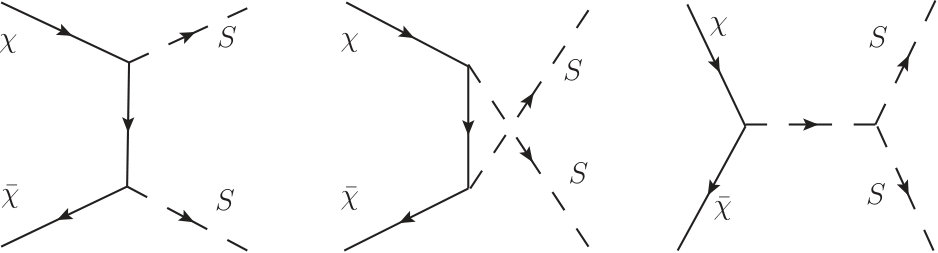 Figure 1
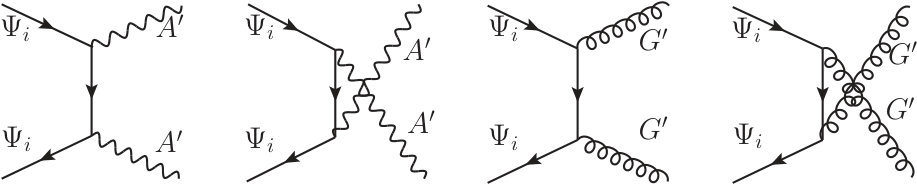 Figure 2
 Figure 3
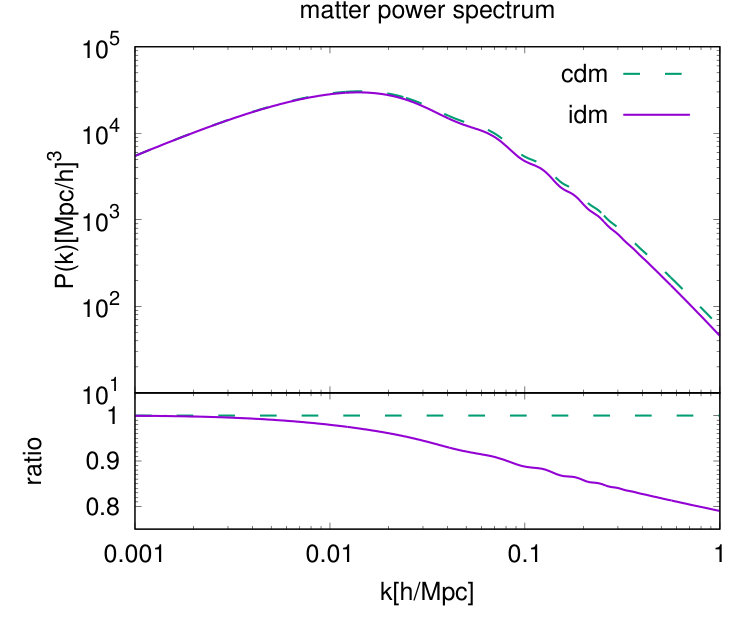 Figure 4
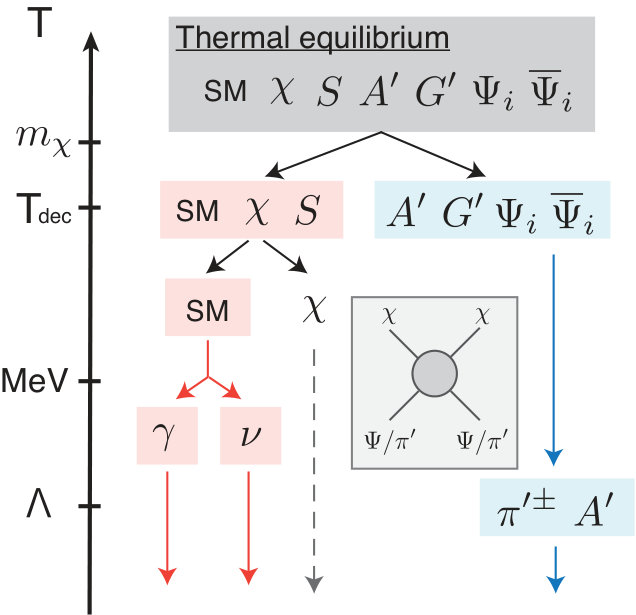 Figure 5
| SU() | 1 | 1 | |||||
|---|---|---|---|---|---|---|---|
| U(1) | 0 | ||||||
| U(1)B | 0 |
Peer Reviews
No public reviews on file for this paper yet. If you reviewed it on a platform where reviews are public (OpenReview, ICLR, NeurIPS, ICML), you can paste yours below so the community can read it here.
Videos
No videos yet. Explain this paper in a talk, walkthrough, or lecture? Add one.
KIAS-P17043
UT-17-23
**Hidden Charged Dark Matter and Chiral Dark Radiation **
P. Koa, Natsumi Nagatab, and Yong Tangb
a**School of Physics, Korea Institute for Advanced Study, Seoul 02455, South Korea
b**Department of Physics, University of Tokyo, Bunkyo-ku, Tokyo 113–0033, Japan
()
In the light of recent possible tensions in the Hubble constant and the structure growth rate between the Planck and other measurements, we investigate a hidden-charged dark matter (DM) model where DM interacts with hidden chiral fermions, which are charged under the hidden SU() and U(1) gauge interactions. The symmetries in this model assure these fermions to be massless. The DM in this model, which is a Dirac fermion and singlet under the hidden SU(), is also assumed to be charged under the U(1) gauge symmetry, through which it can interact with the chiral fermions. Below the confinement scale of SU(), the hidden quark condensate spontaneously breaks the U(1) gauge symmetry such that there remains a discrete symmetry, which accounts for the stability of DM. This condensate also breaks a flavor symmetry in this model and Nambu–Goldstone bosons associated with this flavor symmetry appear below the confinement scale. The hidden U(1) gauge boson and hidden quarks/Nambu–Goldstone bosons are components of dark radiation (DR) above/below the confinement scale. These light fields increase the effective number of neutrinos by above the confinement scale for , resolving the tension in the measurements of the Hubble constant by Planck and Hubble Space Telescope if the confinement scale is eV. DM and DR continuously scatter with each other via the hidden U(1) gauge interaction, which suppresses the matter power spectrum and results in a smaller structure growth rate. The DM sector couples to the Standard Model sector through the exchange of a real singlet scalar mixing with the Higgs boson, which makes it possible to probe our model in DM direct detection experiments. Variants of this model are also discussed, which may offer alternative ways to investigate this scenario.
1 Introduction
Cold Dark Matter (CDM) has been one of the main paradigms to account for the missing mass in our Universe. It provides a consistent theoretical framework and viable explanations for the compelling patterns observed in cosmic microwave background (CMB), large scale structure (LSS), galactic rotation curves, and so on. On top of its success, various microscopic models of CDM have been proposed, most of which modify the ultraviolet behavior of the Standard Model (SM) with new, weakly-interacting degrees of freedom. In these models, physics after Big-Bang Nucleosynthesis (BBN) essentially does not change from the standard cosmology since CDM decoupled earlier, except rare late-time annihilation and/or possible decay of DM.
The framework of CDM, however, does not fully determine particle contents and interactions in DM models, which leave a plenty of freedom for model building. For instance, we may consider a CDM model which contains extra stable particles besides DM and/or some interactions that are less relevant to the thermal relic abundance of DM particles. In this paper, we discuss a scenario where DM interacts with other very light particles even after the BBN time. These light particles behave as dark radiation (DR) in the Universe. The motivation for such a scenario is twofold: theoretically and observationally. On the theory side, DM-DR interactions are actually found in various models, such as hidden charged DM [1, 2, 3, 4, 5, 6, 7, 8, 9, 10, 11, 12], atomic DM [13, 14, 15], composite DM [16, 17, 18, 19, 20, 21], and so on. Our model provides a simple example for such models, which may be embedded into a more fundamental theoretical framework.
On the observation side, such a scenario could help to resolve some controversies in the CDM paradigm [22, 23]; for example, some recent models [24, 25, 26, 27, 28] may relax the tensions in the Hubble constant and the structure growth rate obtained in the Planck and other low red-shift measurements. The latest Hubble Space Telescope (HST) data [29] gives km s*-1Mpc-1*, which is about 3 larger than the Planck value [30]. Weak-lensing surveys, such as CFHTLenS [31], measured while the Planck data [32] yields . A more recent result on from KiDS-450 [33] also indicates deviation from the Planck value. The tension in can easily be relaxed if we add some amount of radiation component with the effective number of neutrinos of –1.0 [29], which increases the CMB value of . However, due to a positive correlation, a larger tends to result in a larger , which makes the tension in even worse. While extended cosmological models with more parameters [34, 35, 36, 37, 38, 39, 40, 41, 42, 43, 44] may be able to accommodate these tensions, specific solutions from particle physics have also been proposed recently in Refs. [45, 46, 47, 48] for decaying DM and in Refs. [24, 25, 26, 27, 49, 50] for interacting DM and DR where either gauge bosons or fermions are the DR so that their lightness is protected by gauge symmetry or chiral symmetry. In the scenario of interacting DM and DR, the scattering between DM and DR can induce diffusion damping on the matter power spectrum of DM [51, 52, 53, 54, 55, 56], possibly resulting in a suppressed structure growth rate, or smaller .
In this paper, we propose a new interacting DM-DR model where hidden SU()-charged quarks constitute DR and interact with Dirac fermion DM through a hidden U(1) gauge interaction. The symmetries in this model forbid the mass terms for hidden quarks and thus make them massless to be DR. Moreover, when the SU() interaction becomes strong and gives rise to confinement, the hidden quark would condense and spontaneously break the associated flavor symmetry, which leads to Nambu–Goldstone bosons below the confinement scale. The hidden U(1) gauge symmetry is assumed to be rather weak so that the flavor symmetry is a good symmetry, and thus the resultant Nambu–Goldstone bosons are naturally light and can behave as DR in the early Universe. The hidden quark condensate also breaks the hidden U(1) gauge symmetry into a symmetry, which stabilizes the DM in our model. When the confinement scale of the hidden SU() gauge interaction is very low, the hidden U(1) gauge boson would be extremely light and also comprises a part of DR. The light fields in this model contribute to the effective number of neutrinos by above the confinement scale for and resolve the discrepancy in the measurements of the Hubble constant if the confinement scale is eV. Moreover, the DM-DR interactions induced by the exchange of the hidden U(1) gauge boson suppress the matter power spectrum for wave-number , and make the measurements consistent with each other. The DM sector couples to the SM sector through the exchange of a real singlet scalar boson that mixes with the SM Higgs boson, which enables us to probe this model in DM direct detection experiments.
This paper is organized as follows. In Sec. 2, we explain our model setup in detail. Then, in Sec. 3, we discuss thermal history of this model, with estimating the DM relic density. In Sec. 4, we evaluate the abundance of DR, and discuss the diffusion damping on the matter power spectrum of DM induced by the DM-DR interactions. Section 5 is devoted to conclusion and discussions.
2 Model
2.1 Lagrangian
To begin with, let us present the model considered in the following discussion. We introduce a real singlet scalar , a Dirac fermion , and four Weyl fermions , , , and . These additional fields are singlets under the SM gauge symmetry. Besides the SM gauge symmetry, this model has the hidden gauge symmetry, under which all of the SM fields are singlets. The singlet scalar field has no charge under both the SM and hidden gauge symmetries. The Dirac fermion , which is regarded as DM in our model, is also singlet under the , but has the U(1) charge . and are fundamental representations of with the U(1) charge and , respectively. We here assume . () are anti-fundamental representations of SU() and have the U(1) charge and , respectively. Thus, this model is a chiral gauge theory for and . One can easily demonstrate that this model is free from gauge anomaly. The quantum numbers of the extra fields are summarized in Table. 1. Here, the fermion fields are described in terms of left-handed Weyl fermions; in particular, the Dirac DM field is decomposed as . We also show the assignment of the hidden baryon number U(1)B, which is a global U(1) symmetry in the dark sector— and have the hidden baryon number and , respectively, and the other fields have baryon number zero.
The generic Lagrangian terms for these hidden fields allowed by the gauge symmetries are given by111We may also write a kinetic mixing term between the U(1)Y and the hidden U(1) gauge fields, but we suppress it in the present discussion. In fact, this kinetic mixing is severely restricted by a recent global fit of solar precision data so that eV where is the kinetic-mixing parameter and is the mass of dark photon [57, 58]. The absence of the kinetic mixing can easily be explained if the SM U(1)Y gauge group is embedded into a simple gauge group such as SU(5) at high energies. In this case, the kinetic mixing is forbidden by the gauge symmetry, and if there is no particle which is charged under both the U(1)Y and the hidden U(1) gauge symmetries, then the kinetic mixing is not generated even after the unified gauge symmetry is spontaneously broken.
[TABLE]
with
[TABLE]
where is the SM Higgs doublet and s are the covariant derivatives. We can always take the mass term of the DM to be real; then, is in general complex, but we also take it to be real for simplicity. Notice that the mass terms of the hidden quark fields, as well as their couplings to the real scalar field , are forbidden by the gauge symmetries for . In these cases, the conservation of the hidden baryon number is also a consequence of the gauge symmetries. On the other hand, for , vector-like mass terms such as are allowed by the gauge symmetries. In this particular case, we use the U(1)B to forbid these mass terms. In any cases, this setup assures the hidden quark fields to be massless.
2.2 Confinement
In the early Universe, the chiral fermions and as well as the U(1) and SU() gauge bosons act as massless elementary fields and hence as DR. At later epochs, the non-Abelian SU() gauge interaction could confine if its coupling becomes large enough at low energies and the temperature of the Universe fell below the confinement scale. Then, due to the confinement, the chiral fermions and the SU() gauge bosons can not be regarded as fundamental fields any more; instead, composite states such as hidden hadrons appear as physical states. In addition, once the condensate of the chiral fermions forms, the chiral flavor symmetry of the Lagrangian (1) is spontaneously broken, and the Nambu–Goldstone bosons associated with these broken symmetries show up. If the confinement scale is low enough, these particles still behave as DR around the CMB epoch. For later convenience, we briefly review the strong dynamics in our model and refer Ref. [59] for detailed discussions, where the hidden charged pion was regarded as a DM candidate.222The possibility of the hidden charged pion being DR was pointed out in Ref. [60]. For previous studies in which (elementary) Nambu–Goldstone bosons are considered as DR, see Refs. [61, 62, 63, 64], and DR in other scenarios [65, 66, 67, 68, 69, 6, 27, 26] for example.
To that end, let us start with looking into the running of the hidden SU() gauge coupling . The running of the SU() gauge coupling at one-loop level is given by
[TABLE]
where is the renormalization scale. Therefore, for any , the SU() gauge theory is asymptotically free and its gauge coupling becomes very strong in the infrared region. The confinement scale for this gauge theory is estimated as
[TABLE]
where is an input value of at a scale where perturbativity still holds. As we discuss later in Sec. 4, the observation of the CMB anisotropy restricts the confinement scale to be eV in this model. Such a low confinement scale can easily be obtained with an input value of ; for instance, for , we have eV if (0.46) for TeV (the Planck scale GeV).
Since the hidden quarks in our model are massless, there is a global flavor symmetry. In the absence of the U(1) gauge symmetry, the flavor symmetry is maximal: . The axial U(1) symmetry is explicitly broken by anomalies. Once the U(1) gauge symmetry is turned on, a part of this flavor symmetry is explicitly broken. As we see below, however, we take the U(1) gauge coupling to be as small as , and thus the flavor-symmetry breaking effects from the U(1) gauge interactions can be treated as a small perturbation.
Now suppose that below the confinement scale the hidden quarks condense such that the flavor symmetry is spontaneously broken into the “isospin” subgroup just like the ordinary QCD; namely, the scalar bilinear of the hidden quarks develops a vacuum expectation value of
[TABLE]
where we expect . Then, we obtain three Nambu–Goldstone bosons associated with the broken axial-vector subgroup SU(2)A. We refer to these fields as the hidden pions (or dark pions) and denote them by () together with and . Notice that the hidden U(1) charge commutes with the generator of SU(2)A corresponding to the neutral hidden pion —for this reason, is exactly massless. On the other hand, the charged hidden pions in general acquire a mass through the radiative corrections by the U(1) gauge boson, which is estimated as
[TABLE]
where is the mass of the “hidden ”, which is expected to be around the cut-off scale of the effective theory of the hidden pions, namely, where is the “hidden-pion decay constant”. See Refs. [70, 71, 59] for more careful estimations.
The condensate in Eq. (5) has non-zero U(1) charge, and thus breaks the hidden U(1) gauge symmetry as well. The hidden U(1) photon (or dark photon) eats the neutral hidden pion to become massive, and its mass is approximately given by
[TABLE]
If eV, then this hidden U(1) photon, together with , behaves as DR around the CMB epoch.
Other hadronic states, such as “hidden ”, “hidden ”, “hidden baryons”, and so on, have masses of the order of the cut-off scale of the low-energy effective theory for hidden pions. The heavy hidden mesons can rapidly decay into hidden pions or dark photons, and thus play no role in the following analysis. On the other hand, “hidden nucleons” are stable due to the hidden baryon number.333The hidden baryon number is anomalous under the hidden U(1) gauge interaction, but this symmetry-breaking effect on the stability of hidden nucleons is negligibly small. Hence, hidden nucleons can potentially be DM in the Universe. Nevertheless, their thermal relic abundance is extremely small since they can efficiently annihilate into hidden pions through an “pion-nucleon coupling”. As a consequence, we can safely neglect their contribution to the cosmological evolution in the following discussion.
2.3 Dark matter sector
DM in our model couples to the SM sector only through the real singlet scalar , which mixes with the SM Higgs field via the trilinear coupling . This setup is the same as the so-called fermionic Higgs portal DM model [72, 73, 74, 75, 76]. Our model however has a new intriguing feature which is absent in the simple fermionic Higgs portal DM model. At Lagrangian level, the DM is stable because of the U(1) gauge symmetry. This stability is not spoiled even after the U(1) symmetry is spontaneously broken by the hidden-fermion condensate since there remains a symmetry, which is a subgroup of the hidden U(1) gauge symmetry.
To see this feature, let us consider the following transformation:
[TABLE]
The Lagrangian (1) is invariant under this transformation, which follows from the hidden U(1) gauge symmetry. In addition, the hidden quark condensate (5) is also invariant under this transformation. Therefore, the transformation (8), which is a subgroup of the U(1) gauge symmetry, remains a good symmetry even after the hidden U(1) gauge symmetry is spontaneously broken. Meanwhile, the transformation (8) is nothing but a symmetry under which the DM is odd while the other particles are even. As a consequence, we find that the condensate (5) breaks the U(1) symmetry down to a symmetry [77] which stabilizes the DM particle.444For DM models which exploit such a remnant discrete symmetry, see Refs. [78, 79, 80, 81, 82, 83, 5, 84, 85, 86, 87]. Thanks to this symmetry, the stability of DM is insured even if there exist higher-dimensional operators induced by ultraviolet effects.
2.4 Scalar sector
The connection between the dark sector and the SM particles is provided through the Higgs-portal terms, . If ,555We here assume that the singlet field does not develop a vacuum expectation value, just for simplicity. Relaxing this assumption does not change our discussion so much. there is a mixing between and the Higgs boson after the electroweak symmetry is broken, where with GeV. As a result, can couple to the SM Higgs boson and thus to all of the SM particles via the mixing. The mass matrix for and in the basis is given by
[TABLE]
where is the quartic coupling in the SM Higgs potential: . Diagonalization of the above mass matrix results in two mass eigenstates and :
[TABLE]
where the mixing angle is given by
[TABLE]
The mass eigenvalues of and are
[TABLE]
Using these masses, the mixing angle can also be given as
[TABLE]
In the rest of our discussion, we shall identify as the Higgs boson with and treat and other parameters as free variables.
If the mass of is less than a half of the Higgs boson mass, we would have exotic decay channels of the Higgs boson such as . No observation of such signals then puts constraints on the parameters and . The current bound [88, 89] can easily be satisfied if and . This bound is of course evaded if . The results of the Higgs boson measurements at the LHC also give a constraint on the mixing angle , but it is still rather weak; is enough to evade all of the existing bounds from the Higgs data [90].
3 Thermal History
3.1 Thermalization of the dark sector
In this section, we discuss the thermal history of the present model. The dark sector in our model is assumed to be in thermal equilibrium with the SM sector in the early Universe. This can be realized through the Higgs portal couplings, and this requirement imposes lower limits on these couplings. To have the dark sector in thermal equilibrium with the SM sector, the scattering rate for relevant processes such as should be larger than Hubble parameter ,
[TABLE]
where is the thermal temperature and GeV is the reduced Planck mass. From this expression, one can see that this condition is satisfied at a late time. For this to happen at a temperature TeV, therefore, we need
[TABLE]
As long as this condition is satisfied, the singlet scalar is in thermal equilibrium with the SM sector at a high temperature. Once this occurs, DM is also thermalized via the Yukawa coupling , and then the scattering processes shown in Fig. 1 take the whole dark sector in thermal equilibrium.
3.2 Relic density of dark matter
Next, we evaluate the thermal relic abundance of DM . Here, we focus on the case where , though it is not a necessary condition. In this case, the relic density of DM is mainly determined by the annihilation process, , shown in Fig. 2. For simplicity, we neglect the contribution from the last diagram due to the ignorance of triple-scalar coupling . In the case where is much less than , we can estimate the annihilation cross section of as
[TABLE]
where is the relative velocity between the annihilating DM particles and at the freeze-out time. To get the correct relic density [32], we need cms, which basically fixes the relation between the Yukawa coupling and the DM mass . Since the annihilation processes are -wave suppressed, the annihilation cross section in the current Universe is extremely small, and thus constraints from DM indirect searches can easily be avoided. We also note that the Sommerfeld enhancement [91, 92] for the DM annihilation due to the new U(1) gauge interaction can be neglected thanks to the smallness of the gauge coupling . This can be seen from the enhancement factor [93, 1]
[TABLE]
with . As we mentioned above, we take , i.e., . Since this is much smaller than (a typical size of DM velocities in galaxies), we have , which would not change the annihilation cross section drastically.
Although indirect DM searches are less promising, DM direct detection experiments may probe the DM candidate in our model. The DM-nucleon scattering process is induced by the exchange of the scalar bosons and , and its spin-independent scattering cross section is given by [94]
[TABLE]
with
[TABLE]
where is the nucleon mass, are the mass fractions, and . These mass fractions are computed using lattice QCD simulations [95]: , , and for proton. According to the rough estimate given in Eq. (16), the correct DM density is obtained for, e.g., and TeV. In this case, we obtain cm2 for GeV and . This size of evades the current experimental bound provided by the XENON1T experiment [96], but is within the reach of future DM direct detection experiments such as a two-year measurement at XENON1T [97], and therefore we may probe this scenario in the near future. More dedicated studies on the fermionic Higgs-portal DM scenario will give further prospects for the testability of this scenario in future experiments (see, for instance, Ref. [98] for a recent study on the detectability of the fermionic Higgs-portal DM).
3.3 Decoupling of the dark sector
As we have seen in Sec. 3.1, the scattering process can keep the dark photon in thermal equilibrium. When the temperature becomes lower than the DM mass, however, the rate of this process gets suppressed as the DM number density exponentially decreases. Eventually, decouples at a temperature . Since the hidden U(1) gauge coupling is taken to be much smaller than the Yukawa coupling , decoupled earlier than , i.e., . Indeed, we can estimate the decoupling temperature by comparing the scattering rate for with the Hubble expansion rate:
[TABLE]
where denotes the number density of the DM particle , which is given by
[TABLE]
This leads to
[TABLE]
This estimation shows that up to the small logarithmic dependence on parameters the decoupling temperature in the present scenario is given by . Therefore, if the DM mass is TeV, then GeV. Other scattering processes between DM and the dark photon or the hidden quarks (corresponding to the diagrams in the upper row in Fig. 1) are further suppressed by the small U(1) gauge coupling , and thus decoupled earlier. Consequently, the DR sector decouples from the SM sector at the temperature , which is before the chemical decoupling of DM. On the other hand, the processes , , and with being the SU() gauge boson, which are described by the diagrams in the lower row in Fig. 1, always keep those species in equilibrium with each other, especially at low energies. This is because the scattering rate for goes as , in comparison with Hubble parameter . This DR sector is composed of free hidden quarks, dark gluons , and dark photons before the confinement of the SU() gauge interaction. Below the confinement scale , only the dark pions and dark photons are left in the cosmic background.
After all, the thermal history in this model goes as follows. In the early Universe, the Higgs-portal couplings keep the whole dark sector in equilibrium with the SM sector. When temperature becomes as low as , , , , and decouple from the SM sector. Then, the chemical decoupling of occurs at a temperature and its abundance freezes out. is not stable and decays into the SM sector. After that, the SM and DR sectors are independently thermalized in each sector. The DM scatters with light particles in the DR sector via the exchange of a dark photon—with the hidden charged quarks for and with the hidden charged pions for . This continues until the time of the matter-radiation equality. The overall picture for the thermal history is illustrated in Fig. 3.
4 Dark Radiation and Diffusion Damping
Now we discuss the phenomenological consequences of DR in our model. In Sec. 4.1, we evaluate the contribution of DR to the effective number of neutrinos, . We then discuss the effects of the DM-DR interactions on the matter power spectrum of DM in Sec. 4.2.
4.1 Dark radiation
The hidden quarks, gluons, and photons (or the hidden pions and photons below the confinement scale) behave as DR, and thus contribute to the effective number of neutrinos. However, this contribution is fairly suppressed since the DR sector decouples much before the decoupling of neutrinos. Taking this suppression into account, we compute the shift in caused by the DR as
[TABLE]
where and are the bosonic and fermionic degrees of freedoms, normalized to massless gauge boson and Weyl fermion, respectively. and are the temperature of neutrinos and the DR sector, respectively, is the neutrino decoupling temperature, denotes the effective number of degrees of freedom for entropy density in the SM sector at temperature , and denotes the effective number of degrees of freedom that are in kinetic equilibrium with dark photon. In the last equality, we have used the conservation of entropy density.
A feature of our model is that could change over the time due to the factor . This is because the physical degrees of freedom in the hidden sector change when the temperature falls down below the confinement scale. Above the confinement scale, we have
[TABLE]
Therefore, if , we obtain at the BBN epoch as666Here, we have assumed that behaves as a non-relativistic particle at .
[TABLE]
This leads to and for and 3, respectively. Below the confinement scale, on the other hand, we have only hidden pions and photons, and thus
[TABLE]
where we have used () above (below) the confinement scale, which is obtained by multiplying the prefactor in Eq. (24) (Eq. (26)) by a factor of . Again, for , we have
[TABLE]
which would give for and for .
As a result, we find that the case provides a value of which lies in the favored range to relax the tension in observed values of [29], while the case is disfavored. Future CMB experiments such as CMB-S4 [99] may determine the value of within an error of 0.02–0.03, and thus can test this scenario with great accuracy since in this model.
We note that Planck [32] gives an upper bound on , which relies on combinations of data sets from different measurements and the assumed cosmological models. Possible systematic uncertainties and extended cosmological parameters could give more relaxed limits. Nevertheless, the above bound, if robust, would constrain the confinement scale, eV so that the hidden chiral fermions and gluons, rather than hidden pions, comprise physical degrees of freedom around the CMB epoch. Such a confinement scale would ensure during the CMB time, which evades the Planck limit. After the CMB time, even if increases to , DR does not affect the CMB anisotropy significantly since its contribution to the energy density is by far smaller than that of the matter component.
4.2 Diffusion damping
The scattering between DM and hidden-charged particles can induce diffusion damping in the matter power spectrum by modifying the evolution of the DM density perturbation. To resolve the discrepancy in the observed values of , we need a size of the hidden U(1) gauge coupling such that the interactions of and the U(1) charged DR decouple around the radiation-matter equality [25, 26]. This is estimated from the condition [26]
[TABLE]
where is the number density of DR and is the typical size of the cross section of DM-DR scatterings. It follows from this condition that
[TABLE]
where is the CMB temperature.
We need to include the scattering effects into the cosmological evolution of perturbations, which we perform numerically. We modify the Euler equations for DM and DR (collectively denoted as ) to
[TABLE]
where is the comoving wave number, is the gravitational potential, the dot means derivative over conformal time ( is the scale factor), and are velocity divergences of DR and DM , respectively, and are the density perturbation and the anisotropic stress potential of DR, respectively, and is the conformal Hubble parameter. Finally, the scattering rate and the density ratio are defined by and , respectively. Note that in our interested parameter regime because DR self-interacts strongly and behaves as a perfect fluid.
In Fig. 4, we show the damping effects in our model, which are obtained by using the Boltzmann code CLASS [100] with implement of above perturbation equations. We take for the case, which gives and is determined from the condition (28). The green dashed line shows the matter power spectrum for DM without DM-DR interactions and the purple solid line is for our model. This figure clearly shows the damping effects for wave-number . With an (10–15)% suppression at , we have , which is much closer to the values obtained from weak-lensing measurements [31].
Based on what we have discussed above, we might also explore a variant model where hidden SU() is replaced by another U(1), in which case no confinement or dark pion could arise. However, this variant model shares similar features for resolving the cosmological tensions: 1) both chiral fermions and gauge bosons are symmetry-assured massless and contribute to DR. In this case, the anomaly cancellation condition requires and , as well as and , to be vector-like, and their vector-like mass terms are forbidden by the hidden baryon number. 2) DM scatters with DR, which leads to a modified power spectrum. Since this model has less physical degrees of freedom, the amount of DR can be reduced by a factor , in comparison to Eq. (24) for the SU() model, if decoupled at the same temperature. Another variant is to introduce an extra set of chiral fermions. However, this case leads to a larger value of and thus is disfavored by the Planck constraint. Finally, we may also consider the cases where the DM is charged under the symmetry. The hypercharge of this DM should be zero in order to suppress the vector coupling with boson, which induces a too large DM-nucleon scattering cross section. In this case, we do not need to introduce the singlet scalar to couple the dark sector to the SM sector. A similar setup is considered in Refs. [24, 25]. The relic abundance of such a particle agrees to the observed DM density if its mass is TeV depending on the SU(2)L charge [91, 101, 102], which assures the dark sector to decouple above the weak scale. Since the annihilation cross sections of these DM candidates are rather large, they can efficiently be probed in indirect detection experiments [103, 104, 105, 106, 107, 108, 109, 110]. Their spin-independent scattering cross sections with a nucleon are larger than the neutrino floor background [111], and thus they can also be tested in future direct detection experiments.
5 Conclusion and Discussions
In this paper, we have illustrated a model where a fermionic DM particle interacts with chiral/composite DR via the exchange of a hidden U(1) gauge boson. The chiral DR, being massless assured by the symmetries in this model, consists of the hidden SU()-charged quarks. This sector possesses a flavor symmetry that is spontaneously broken by the hidden-quark condensate below the confinement scale of the hidden SU() gauge interaction. Then, dark pions as the associated Nambu-Goldstone bosons become the DR below the confinement scale. The hidden U(1) gauge symmetry is broken into a symmetry by the hidden quark condensate, which assures the stability of DM. The hidden U(1) gauge boson acquires a tiny mass since the confinement scale is bounded as low as eV by the limit on . Thus, both the nearly massless charged hidden pions and the dark photon behave as DR in our model. Thanks to the early decoupling of the DR sector, the contribution of DR to the effective number of neutrinos is above the confinement scale for the case, which can relax the tension in the observed values of if eV. The cases are disfavored as is shifted too much. Moreover, the DM-DR interactions via the exchange of a dark photon can induce diffusion damping in the matter power spectrum, which accounts for the discrepancy in obtained from the Planck and other low red-shift measurements. The DM in our model couples to the SM sector through the Higgs-portal coupling of a real singlet scalar, which enables us to probe the DM in this model in future DM direct detection experiments. We can also test this scenario in the next-generation CMB experiments, such as CMB-S4 [99].
Acknowledgments
The work of PK is supported in part by National Research Foundation of Korea (NRF) Research Grant NRF-2015R1A2A1A05001869, and by the NRF grant funded by the Korea government (MSIP) (No. 2009-0083526) through Korea Neutrino Research Center at Seoul National University. This work is supported by the Grant-in-Aid for Scientific Research (No.17K14270 [NN]; No.16H06490 [YT]).
The reference list from the paper itself. Each links out to its DOI / PubMed record.
- 1[1] J. L. Feng, M. Kaplinghat, H. Tu, and H.-B. Yu JCAP 0907 (2009) 004 [ ar Xiv:0905.3039 ]. · doi ↗
- 2[2] L. Ackerman, M. R. Buckley, S. M. Carroll, and M. Kamionkowski Phys. Rev. D 79 (2009) 023519 [ ar Xiv:0810.5126 ]. · doi ↗
- 3[3] S. Baek, P. Ko, and W.-I. Park JHEP 07 (2013) 013 [ ar Xiv:1303.4280 ]. · doi ↗
- 4[4] S. Baek, P. Ko, and W.-I. Park JCAP 1410 no. 10, (2014) 067 [ ar Xiv:1311.1035 ]. · doi ↗
- 5[5] P. Ko and Y. Tang JCAP 1405 (2014) 047 [ ar Xiv:1402.6449 ]. · doi ↗
- 6[6] P. Ko and Y. Tang Phys.Lett. B 739 (2014) 62–67 [ ar Xiv:1404.0236 ]. · doi ↗
- 7[7] S.-M. Choi and H. M. Lee JHEP 09 (2015) 063 [ ar Xiv:1505.00960 ]. · doi ↗
- 8[8] R. Foot and R. R. Volkas Phys. Rev. D 70 (2004) 123508 [ astro-ph/0407522 ]. · doi ↗