Symmetries and entanglement features of inner-mode resolved correlations of interfering nonidentical photons
Simon Laibacher, Vincenzo Tamma

TL;DR
This paper demonstrates how inner-mode resolved measurements can restore and harness quantum interference among nonidentical photons, revealing symmetries and enabling entanglement in linear optical networks without additional filtering.
Contribution
It introduces a method to use inner-mode quantum information to restore interference and generate multipartite entangled states with nonidentical photons in linear optical networks.
Findings
Restores quantum interference between nonidentical photons without filtering.
Reveals symmetries of multiphoton networks and states.
Generates multipartite entangled states with fixed interferometers.
Abstract
Multiphoton quantum interference underpins fundamental tests of quantum mechanics and quantum technologies. Consequently, the detrimental effect of photon distinguishability in multiphoton interference experiments can be catastrophic. Here, we employ correlation measurements in the photonic inner modes, time or frequency, to restore quantum interference between photons differing in their colors or injection times in arbitrary linear optical networks, without the need for additional filtering or post selection. Interestingly, we demonstrate how harnessing the multiphoton inner-mode quantum information enables to unravel symmetries of multiphoton networks and states and the generation of an entire class of multipartite entangled states with a fixed interferometer. These results are therefore of profound interest for future applications of universal inner-mode resolved linear optics across…
Click any figure to enlarge with its caption.
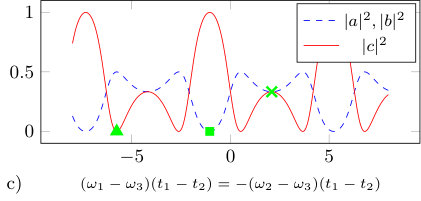 Figure 1
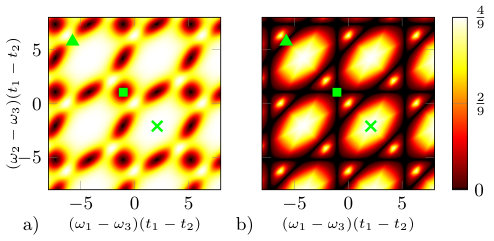 Figure 2
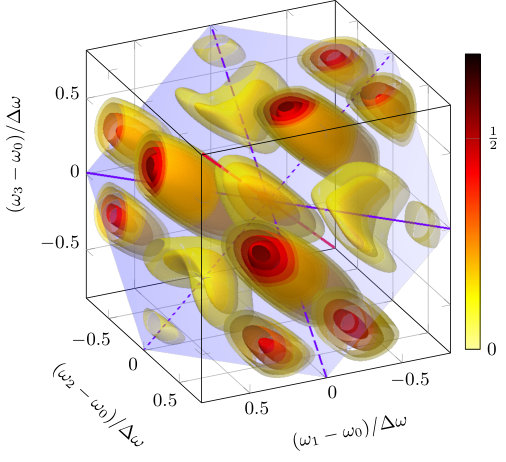 Figure 3
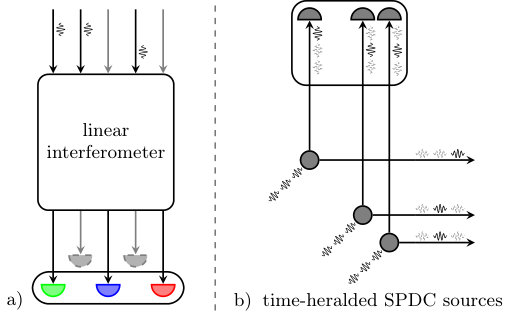 Figure 4
 Figure 5
 Figure 6
 Figure 7
 Figure 8
Peer Reviews
No public reviews on file for this paper yet. If you reviewed it on a platform where reviews are public (OpenReview, ICLR, NeurIPS, ICML), you can paste yours below so the community can read it here.
Videos
No videos yet. Explain this paper in a talk, walkthrough, or lecture? Add one.
Symmetries and entanglement features of inner-mode resolved correlations of interfering nonidentical photons
Simon Laibacher
Institut für Quantenphysik and Center for Integrated Quantum Science and Technology (IQST), Universität Ulm, D-89069 Ulm, Germany
Vincenzo Tamma
Institut für Quantenphysik and Center for Integrated Quantum Science and Technology (IQST), Universität Ulm, D-89069 Ulm, Germany
School of Mathematics and Physics, University of Portsmouth, Portsmouth PO1 3QL, UK
Institute of Cosmology & Gravitation, University of Portsmouth, Portsmouth PO1 3FX, UK
Abstract
Multiphoton quantum interference underpins fundamental tests of quantum mechanics and quantum technologies. Consequently, the detrimental effect of photon distinguishability in multiphoton interference experiments can be catastrophic. Here, we employ correlation measurements in the photonic inner modes, time or frequency, to restore quantum interference between photons differing in their colors or injection times in arbitrary linear optical networks, without the need for additional filtering or post selection. Interestingly, we demonstrate how harnessing the multiphoton inner-mode quantum information enables to unravel symmetries of multiphoton networks and states and the generation of an entire class of multipartite entangled states with a fixed interferometer. These results are therefore of profound interest for future applications of universal inner-mode resolved linear optics across fundamental science and quantum technologies with photons with experimentally different spectral properties.
The nonclassical interference of light Hong et al. (1987); Alley and Shih (1986); Shih and Alley (1988) is one of the main consequences of the quantum nature of the electromagnetic field and lies at the heart of many quantum optics experiments Hong et al. (1987); Alley and Shih (1986); Shih and Alley (1988); Pan et al. (2012); Tamma and Laibacher (2015a); Metcalf et al. (2013); Carolan et al. (2015); Flamini et al. (2015); Hanbury Brown and Twiss (1956); Tamma and Laibacher (2014); Tamma and Seiler (2016); Cassano et al. (2017); Peng et al. (2016); D’Angelo et al. (2017). It plays a central role in a variety of applications ranging from quantum computing Pan et al. (2012); Ladd et al. (2010); Franson (2013); Knill et al. (2001); Aaronson and Arkhipov (2011); Laibacher and Tamma (2015) over quantum communication and quantum cryptography Lo et al. (2014); Mattle et al. (1996) to quantum metrology and state tomography Dowling (2008); Lemos et al. (2014); Wasilewski et al. (2007); Hanbury Brown and Twiss (1956); Tamma and Laibacher (2014); Tamma and Seiler (2016); Cassano et al. (2017); D’Angelo et al. (2017). Conventional multiphoton experiments in linear interferometers rely on measurements at the interferometer output which do not resolve the structure of the multiphoton interference in the photonic spectral degrees of freedom, namely frequency and time, effectively ignoring the full quantum information encoded in the photonic spectra. This “ignorance” can lead to the degradation of the observed multiphoton interference with increasing distinguishability for photons with nonidentical input states Tamma and Laibacher (2015a). This is indeed the case for single-photon emitters, such as diamond colour centers Babinec et al. (2010), single molecules Lounis and Moerner (2000) and quantum dots Shields (2007); Michler (2000). Here, photons emitted by different sources or by the same source at different times are generally different in their spectra.
Fortunately, with the advent of detectors with unprecedented time- or frequency-resolution, linear optical correlation experiments based on inner-mode resolving measurements either in time or frequency have become feasible Legero et al. (2004); Avenhaus et al. (2009); Davis et al. (2017); Polycarpou et al. (2012); Gerrits et al. (2015); Jin et al. (2015); Shcheslavskiy et al. (2016); Grimau Puigibert et al. (2017). As a result, full multiphoton interference can be observed at the output of a linear network even in the case of nonidentical input photons Tamma and Laibacher (2015a); Legero et al. (2004). Additionally, the dependence of the correlations of three photons at the output of a linear network has been investigated as a function of the spectral overlap of the input photons Tan et al. (2013); de Guise et al. (2014).
Furthermore, the generation of maximally entangled W-states was also demonstrated theoretically by postselecting events at equal detection times at the output of a tritter for photons of completely different colors Tamma and Laibacher (2015a).
It was also shown that the access to the quantum information encoded in the spectra of the interfering photons via correlation measurements in the photonic inner degrees of freedom can unravel the full classical hardness of multiphoton interference in boson sampling schemes Aaronson and Arkhipov (2011); Laibacher and Tamma (2015). This is even the case if no overlap between the input photon frequency and temporal spectra occurs Laibacher and Tamma (2015); Tamma and Laibacher (2015b); Tamma (2014). Furthermore, it is possible to approach, in principle, deterministic boson sampling realizations with photons of random spectral overlap and/or random input photonic occupation numbers Laibacher and Tamma (2018).
Despite all these remarkable results, the full quantum advantages of multiphoton interference based on inner-mode resolved linear optics arising in quantum optics experiments even beyond boson sampling are still far from being fully explored. In particular, working towards novel schemes for the characterization of multiphoton networks and entanglement generation with nonidentical photons, important questions arise:
a) How can given symmetries in the multiphoton input state and in its evolution in a linear optical network be inferred from the measurement of inner-mode correlations at the network output? b) How do time and frequency resolved measurements tailor the type of entanglement correlations at the output of a linear network depending on the photonic input spectra?
By tackling these fundamental questions, we demonstrate in this paper how the full set of outcomes of inner-mode resolved measurements of multiple nonidentical input photons in a linear optical network allows one to: a) unravel symmetries of optical networks and of multiphoton quantum states; b) generate a whole class of entangled multiphoton states even with a fixed configuration of the linear optical network. Remarkably, these results apply to photons of either different colors or injection times, dramatically increasing the number of possible sources that can be exploited for future experiments (e.g. quantum dots).
All of the experimental scenarios described in this paper are based on the -photon linear optical networks depicted in Fig. 1 with ports .
Contrary to conventional multiphoton linear optical networks, input single photons
[TABLE]
with nonidentical normalized spectra , differing either in their injection times or in their central frequencies , are injected in a set of input ports, leading to the overall input state
[TABLE]
For simplicity, we assume that the spectra of the input photons satisfy the narrow bandwidth approximation and a polarization-independent interferometric evolution. Furthermore, given an overall frequency spread of the input light, we assume that all possible paths through the network are equal on the scale of the coherence length . In this case, the interferometric evolution is also frequency independent and can be described by a single unitary matrix which defines the linear transformation
[TABLE]
between the mode operators and at the output and input of the network, respectively 111See section I of the Supplemental Material for details..
The photons are subsequently detected in a subset containing of the output ports and at frequencies or at times . Indeed, these measurements “erase” the distinguishability of the input photons in the respective conjugate photonic inner parameters: If the photons are distinguishable in frequency, multiphoton indistinguishability at the output of the network is ensured by a small enough detector integration in time Tamma and Laibacher (2015a)
[TABLE]
while a high frequency resolution
[TABLE]
ensures the indistinguishability of photons injected at different times Laibacher and Tamma (2018).
In order to emphasize that our results apply to both time and frequency resolved detection schemes due to the conjugacy of time and frequency, we will from here on use the following notation: The inner-mode parameter measured at detector will be denoted as ( or for time or frequency resolved detection, respectively) while the conjugate inner-mode parameter in which the photons are distinguishable at the input ports in Eq. (2) will be labeled as ( or for time or frequency resolved detection, respectively).
The detection probability at the output at frequencies or times for input photons of different central times or frequencies , respectively, can be easily expressed in terms of the bosonic mode operators or at the output channels as Tamma and Laibacher (2015a)
[TABLE]
Defining for frequency resolved detection or for time resolved detection (where is the Fourier transform of the frequency distribution ) and using the linear transformation in (3) connecting the mode operators at the input channels and the output channels , this can be rewritten as 222See section II of the Supplemental Material.
[TABLE]
Here, the sum runs over all possible multiphoton paths (permutations from the symmetric group of order ) which bijectively connect the output ports with the input ports .
The probabilities in Eq. (4) are the result of the interference between multiphoton probability amplitudes each corresponding to one of the possible multiphoton quantum paths from the sources to the detectors Tamma and Laibacher (2015a, b). These amplitudes are not only determined by the linear network but also depend on the state of the input photons and on the detected frequencies or times. This is a manifestation of the drastically enlarged Hilbert space accessible by inner-mode resolved detections which can be employed as a quantum resource to unravel symmetry structures in multiphoton interference patterns as well as to tailor non-local -photon correlations.
Symmetries of inner-mode resolved correlations.
We show how symmetries in the interference pattern of the correlations in the photonic inner modes described by Eq. (4) provide a powerful tool to reveal information about the -photon states, their interferometric evolution, or both simultaneously.
Indeed, each -photon interference amplitude in these correlations is given by the product of an interferometric amplitude and a spectral amplitude . To investigate the symmetry properties of the -photon detection probability in Eq. (4), we consider its behaviour under an arbitrary linear transformation of its inner-mode arguments leading to
[TABLE]
As a first example, we address the case where the multiphoton spectral amplitude defined by the spectra of the input photons is symmetric under a given transformation apart from a permutation-independent factor, i.e. \mathcal{B}_{\sigma}\bigl{(}\mathcal{T}(\{\beta_{d}\}),\{\alpha_{s}\}\bigr{)}=\text{const.}\times\mathcal{B}_{\sigma}(\{\beta_{d}\},\{\alpha_{s}\}). In this case also the correlations in Eq. (5) manifest the same symmetry. Therefore, symmetric properties of the input temporal and frequency spectra can be revealed from the measured symmetries of the multiphoton interference pattern independently of the optical network. For example, as we will show later, a mirror symmetry of the measured inner-mode resolved correlations can arise from the highly symmetric input state of photons with the same Gaussian distribution centered at the frequency or time , respectively.
As a second example, we consider photonic input spectral distributions in general different but symmetric around a common value . In this case, the multiphoton amplitudes satisfy the property
[TABLE]
apart from a phase term independent of the permutation . Consequently, the measured multiphoton interference pattern in Eq. (5) is invariant under the parity transformation if the unitary interferometer transformation is characterized by multiphoton amplitudes with the same phase 333See section IIIa of the Supplemental Material.
As a final example, we consider the case of a permutation of the inner-mode arguments in Eq. (5) corresponding to the transformation . By reordering the product defining the spectral amplitude, it is straightforward to show that , where denotes the concatenation of permutations. Consequently, a permutation of the values can be mapped to a permutation of the interferometric amplitudes as 444See section IIIb of the Supplemental Material.
[TABLE]
Interestingly, this implies that some symmetries in the measured inner-mode resolved correlations can be intrinsically connected to symmetries in the interferometric amplitudes. Namely, if with a phase for a given permutation the interference pattern is symmetric under the corresponding permutation of the detected parameters ,
[TABLE]
Furthermore, in the case where , we find – using Eqs. (6) and (7) – that the correlations are symmetric under a combination of the permutation and the parity operation if the spectral distributions are all symmetric around the same central value .
[TABLE]
In order to provide a practical example of some of the symmetric properties described so far, we consider the case of three photons with identical spectral distributions but different injection times or central frequencies measured at the output of a symmetric tritter at frequencies or times , respectively. The corresponding correlations depicted in Fig. 2 depicted as a function of the detected inner-mode parameters exhibit not only three-photon quantum beating Tamma and Laibacher (2015a) but also several evident symmetries in the measured photonic inner parameters. We will now describe how these symmetries originate from either the interferometer transformation , or the input state, or a combination of both.
We first find from the symmetric tritter single-photon amplitudes () that if the permutation is either , , or [using cycle notation of permutations] and consequently that the probability remains unchanged under these permutations of the inner-mode variables , as is clear from the result for arbitrary values of in Eq. (8). As depicted in Fig. 2, this results in a threefold rotational symmetry axis (red line) emerging solely from the symmetry of the linear optical network. We understand this by noting that the permutation acting onto the vector corresponds to a permutation matrix
[TABLE]
which at the same time represents a rotation of around the axis . Consequently, yields a rotation of the correlation pattern itself or equivalently . Equivalently, the permutation corresponds to a rotation by around the same axis.
A second class of symmetries correspond to the permutations , , or for which . According to Eq. (9), these correlations are symmetric under a combination of these permutations with a parity operation, given a symmetry of the inner-mode distributions of the input photons around a common value of the central inner-mode parameter . These symmetries show up as three distinct twofold rotational symmetry axes in Fig. 2 (blue lines). For example, the permutation together with the parity operation is represented by the negative permutation matrix
[TABLE]
which is equivalent to a rotation by around the axis (solid blue line in Fig. 2). The two remaining permutations and are analogously connected to twofold rotational symmetries around the axes defined by (dashed blue line) or by (dotted blue line), respectively.
Finally, a mirror symmetry with respect to the blue plane orthogonal to the axis in Fig. 2 can be attributed solely to the choice of a highly symmetric input state (three photons with identical Gaussian frequency distributions) 555See section IIIc of the Supplemental Material.. In combination with this mirror symmetry, the rotational symmetries corresponding to the permutations , , and are equivalent to three distinct mirror planes, each spanned by the red axis and one of the blue axes.
We also notice that no parity invariance arises in the interference pattern in Fig. 2 since the multiphoton amplitudes do not have the same complex phase and therefore do not satisfy the condition pointed out before for parity invariance.
We emphasize that the symmetries in the optical network described here are encoded in the beating pattern of the correlations in the detected inner-mode values only for input photons with different central inner-mode values , respectively. However, the exact values of the differences () solely determine the periodicity of the observed beatings. If no inner-mode resolved measurements are employed interference beatings cannot be observed and the corresponding symmetries cannot be retrieved Tamma and Laibacher (2015a, c).
Multiphoton entanglement features.
Remarkably, inner-mode correlation measurements also allow us to encode a whole family of entangled -qubit states in the outcomes of the measurements. In particular, we will show how entanglement in the polarization modes can be tailored depending on the inner-mode input parameters and the detected conjugate parameters . For this purpose, we generalize the photonic input state in Eq. (1) to describe photonic qubits with horizontal (H) or vertical (V) polarization as
[TABLE]
with . Then, inner-mode correlation measurements at the output of a generalised symmetric beam splitter – described by the unitary and assumed to be polarization independent – can lead to entanglement correlations spanning the full class of -qubit W-states Dür et al. (2000). This can be achieved by choosing - and one -polarized photons () with identical frequency distribution as the input state . By propagating this input state to the output of the linear network using Eq. (3), we find that a frequency-resolved, -fold coincidence measurement at the output of the network is only sensitive to the contribution 666See section IVa of the Supplemental Material
[TABLE]
from the overall output state. For given detected inner-mode values , the sum in this expression defines a state from the class of -qubit W-states.
To illustrate this further, we will now consider the case of as an example. Here, for a given set of measured values , the polarization state of the photons corresponds to a three-photon W-state
[TABLE]
with amplitudes , , parametrized by the detected inner-mode values and the input values , respectively. As we demonstrate in the Supplemental Material 777See section IVb of the Supplemental Material, the absolute values are given by
[TABLE]
apart from a common normalization constant. We notice that the moduli of these coefficients only arise from the interference between the H-polarized photons and that the degree of entanglement is therefore independent of the inner-mode parameter of the V-polarized photon. Indeed, if the two -polarized photons are offset in their initial inner-mode parameters with respect to each other (), their interference manifests in a beating behavior of the coefficients , , , independently of the photonic frequency distribution .
This beating behavior is depicted in Fig. 3a) in the particular case for which . Therefore, the inner-mode measurements span the full family of three-photon W-states in Eq. (11) through the beating behavior of the corresponding weights in Eq. (12) as a function of the detected inner-mode values and the input inner-mode values . In this respect, the input values can also be spanned experimentally via inner-mode multiplexing with SPDC sources, independently of the output values Laibacher and Tamma (2018).
It is straightforward to describe how these inner-mode correlation measurements tailor the W-state entanglement by measuring the corresponding squared concurrences for each of the three possible reduced density matrices obtained by tracing out either photon 1, 2, or 3 Coffman et al. (2000). In particular, the average squared concurrence Dür et al. (2000)
[TABLE]
and the minimum squared concurrence
[TABLE]
depicted in Fig. 3b) and 3c), respectively, define the degree of entanglement for each W-state as a function of the relative detected inner-mode parameters and of the input inner-mode parameters according to Eq. (12). Evidently, the states encoded into the outcomes of the inner-mode measurements exhibit arbitrary degrees of tripartite entanglement of the W-state type from complete separability up to maximal entanglement (Fig. 3) 888See section IVc of the Supplemental Material..
Discussion
We have shown how frequency and time resolved multiphoton interference between nonidentical photons is a promising tool to unravel the symmetries characterizing their quantum states and their evolution in linear optical networks. Exploiting inner-mode correlation measurements, the differences in the photonic inner-mode parameters (i.e. color or injection times), instead of being a challenge to overcome, become also a powerful resource to generate the entire family of -photon W-states with a single network. Indeed, this is possible by recording the inner-mode quantum information encoded in the beating behavior of interfering nonidentical photons.
In conclusion, these results have the potential to inspire novel platforms for the analysis of multiphoton linear networks and for multiphoton entanglement generation by employing the full quantum capabilities of inner-mode multiphoton interference in universal linear optics with arbitrary sources of nonidentical photons. In particular, the experimental verification of the emergence of some of the multiphoton symmetries of optical networks predicted here has just recently been reported in Ref. Wang et al. (2018).
Acknowledgements.
The authors are grateful to C. Dewdney, S. Kolthammer, A. Laing, F. Sciarrino, and P. Walther for discussions related to this work. Research was partially sponsored by the Army Research Laboratory and was accomplished under Cooperative Agreement Number W911NF-17-2-0179. The views and conclusions contained in this document are those of the authors and should not be interpreted as representing the social policies, either expressed or implied, of the Army Research Laboratory or the U.S. Government. The U.S. Government is authorized to reproduce and distribute reprints for Government purposes notwithstanding any copyright notation herein. V. T. is also thankful to W. P. Schleich for the time passed until the summer of 2016 at the Institute of Quantum Physics in Ulm where some of the ideas behind this work started to flourish. S. L. acknowledges support by a grant from the Ministry of Science, Research and the Arts of Baden-Württemberg (Az: 33-7533-30-10/19/2). Both authors contributed equally to the obtained results. The project was conceived and managed by V.T.
I Frequency independence of linear networks
In order to implement a phase shift at the central frequency of the light, a change of the optical path length by is sufficient. This length is on the order of the optical wavelength and can therefore be neglected with respect to all optical path lengths , . Furthermore, if the light has a narrow overall bandwidth , can also be neglected with respect to the correlation length of the light pulses since
[TABLE]
Analogously, the frequency dependence of the beam splitters can also be assumed for sufficiently narrow bandwidth.
Let us now turn to the unitary transformation of the linear network. In typical designs, the beam splitters are located on a regular grid ensuring that the path lengths of all possible paths through the interferometer are approximately equal to a given length on the scale of the correlation length of the light, with ( labels all possible paths connecting a fixed pair of input and output channel). Consequently, with ()
[TABLE]
since
[TABLE]
It immediately follows that the total probability amplitude connecting input channel with output channel can be written as
[TABLE]
where . Without losing generality, we can set since non-zero values only correspond to an offset of the detection times .
II Inner-mode correlations of photons
As discussed in the main paper, the probability for an -fold, inner-mode resolved coincidence detection of the photons at the output ports and at times or frequencies is given by
[TABLE]
where is the -photon input state defined in Eq. (2) of the main paper and are the detector integration intervals.
The correlation function in this expression can be evaluated by using the linear transformation connecting the mode operators of the input and output channels, Eq. (3) of the main paper. For a given set of input channels, the latter equation effectively becomes
[TABLE]
since the unoccupied input ports do not contribute to the correlations in Eq. (S.5).
Using the notation and Eq. (S.6), we can rewrite the correlation function in Eq. (S.5) as
[TABLE]
This expression can be further simplified by noting that due to the structure of the state , Eq. (2) in the main paper, only those terms contribute, in which each of the annihilation operators , , appears exactly once. Denoting the set of all permutations of elements, the symmetric group of order , as and recalling Eq. (2) in the main paper, the correlation function becomes
[TABLE]
With the help of the definition of the single-photon states in Eq. (1) of the main paper, this can finally be simplified to
[TABLE]
If the detector integration intervals are sufficiently small, Eq. (S.5) consequently reduces to Eq. (4) given in the main paper.
III Inner-mode resolved correlation symmetries of interfering nonidentical photons
III.1 Parity invariance
Let us assume that the photon spectra are symmetric around a common central value . In this case, we can write all expressions in terms of the differences and Eq. (6) follows immediately since
[TABLE]
Combining this with the condition yields the parity symmetry
[TABLE]
discussed in the main paper.
III.2 Symmetries under permutations of the detected inner-mode values
We investigate how the probabilities for correlated detection in Eq. (4) of the main paper behave under a permutation of the arguments . From the definition of the spectral amplitudes , we obtain
[TABLE]
Therefore, Eq. (7) in the main paper follows from Eq. (5) in the main paper as
[TABLE]
Here, we could relabel since, when summing over all permutations , also covers all permutations in .
III.3 Mirror symmetry for tritters
Here, we consider the case three photons (), in which a mirror symmetry with respect to the plane (we again define )
[TABLE]
depicted as a light blue plane in Fig. 2 in the main paper, appears for the highly symmetric state in which all photons share the same Gaussian distribution with the same central value . This symmetry is independent of the interferometer transformation. Indeed, under the assumption that the inner-mode distributions of all single-photon pulses are identical Gaussian functions
[TABLE]
the spectral amplitudes take the form
[TABLE]
In order to investigate the effect of the mirror operation on the amplitudes , an expression for the corresponding unitary transformation matrix acting on the vector is needed. It can be found easily by noting that the operation can be divided into three steps: First, a rotation is applied which maps the normal vector to the unit vector in direction. Then, the mirror operation can simply be described as the inversion of the sign of the inner-mode value . To complete the mirroring, the initial rotation then has to be inverted.
The rotation mapping to can be described as a rotation around the axis by the angle . With the help of the rotation matrix
[TABLE]
describing a general rotation by an angle around an axis , we can finally express the mirror operation as
[TABLE]
It is obvious that the argument of the first exponential in Eq. (S.17) is invariant (due to its spherical symmetry) under this transformation while the second exponential becomes
[TABLE]
leading to
[TABLE]
Therefore, the mirror transformation only introduces a complex phase factor which is equal for all multiphoton amplitudes and consequently does not contribute to the correlations, Eq. (4) in the main text, i.e.
[TABLE]
IV Multiphoton entanglement features
IV.1 Emergence of the whole class of -states
Choosing a computational basis , for the polarization, a single-photon pulse at the input port with frequency distribution , initial time , and polarization is described by the state
[TABLE]
where if . Using the polarized single-photon input pulses , defined in Eq. (10), the input state of an -port interferometer is
[TABLE]
By rewriting the input-port creation operators in terms of the output-port creation operators as
[TABLE]
the propagation of the input state , defined in Eq. (2) of the main paper, to the output of the interferometer leads to
[TABLE]
In the following, we will only consider events, in which a photon is detected at each of the output ports . The corresponding part of the output state reads
[TABLE]
IV.2 Three-photon W-state
Let us now assume that and that all three photons have equal spectral distributions, , and that and . We can then rewrite Eq. (S.26) in the form
[TABLE]
Inserting the interferometer multiphoton amplitudes for the symmetric tritter the coefficient evaluates as
[TABLE]
or
[TABLE]
Since the coefficients only depend on the differences in the inner-mode values we made the arbitrary choice to write them as functions of the pair of differences and . Equivalently, we could have chosen and or and . Consequently, for any given set of detected inner-mode values the measured state is
[TABLE]
with the coefficients
[TABLE]
whose squared moduli are plotted for the exemplary case in Fig. 3a) in the main paper.
IV.3 Inner-mode dependent entanglement in -states
The three-photon -states are defined as Dür et al. (2000)
[TABLE]
with 999Note that the definition of the -state class in Dür et al. (2000) includes a fourth state component . However, the entanglement between the three qubits is not influenced by this fourth component, as shown in Dür et al. (2000). This class of states shows true tripartite-entanglement, i.e. is neither 2- nor 3-separable, as long as . In this class, there is no entanglement that is shared between all three particles at the same time, however each pair of particles is entangled. We can therefore quantify the entanglement of the states in Eq. (S.41) using the concurrences between all three pairs of the subsystems , , and . For example, the entanglement between subsystems and of a tripartite state can be quantified Wootters (1998); Coffman et al. (2000) by using the reduced density matrix
[TABLE]
where denotes the partial trace over subsystem . By using the Pauli spin matrix , we can define the matrix
[TABLE]
whose eigenvalues determine the concurrence
[TABLE]
From these definitions, we find for the class of states in Eq. (S.41) that (see Dür et al. (2000))
[TABLE]
To quantify the tripartite entanglement, we use the average squared concurrence (the inequalities are proved in Dür et al. (2000))
[TABLE]
and the minimal squared concurrence
[TABLE]
By explicitly writing the concurrences in Eq. (S.45) in terms of the coefficients in Eqs. (S.38)-(S.40) and substituting their expressions into Eqs. (S.46) and (S.47) we find the average concurrence and the minimum concurrence, respectively, as a function of the detected inner-mode values at the output of a symmetric tritter, as reported in the main paper.
References
- Dür et al. (2000) W. Dür, G. Vidal, and J. I. Cirac, Phys. Rev. A 62, 062314 (2000).
- Note (9) Note that the definition of the -state class in Dür et al. (2000) includes a fourth state component . However, the entanglement between the three qubits is not influenced by this fourth component, as shown in Dür et al. (2000).
- Wootters (1998) W. K. Wootters, Phys. Rev. Lett. 80, 2245 (1998).
- Coffman et al. (2000) V. Coffman, J. Kundu, and W. K. Wootters, Phys. Rev. A 61, 052306 (2000).
The reference list from the paper itself. Each links out to its DOI / PubMed record.
- 1Hong et al. (1987) C. K. Hong, Z. Y. Ou, and L. Mandel, Phys. Rev. Lett. 59 , 2044 (1987) . · doi ↗
- 2Alley and Shih (1986) C. O. Alley and Y. H. Shih, in Proceedings of the Second International Symposium on Foundations of Quantum Mechanics in the Light of New Technology (Physical Soc. of Japan, Tokyo, 1986) pp. 47–52. · doi ↗
- 3Shih and Alley (1988) Y. H. Shih and C. O. Alley, Phys. Rev. Lett. 61 , 2921 (1988) . · doi ↗
- 4Pan et al. (2012) J.-W. Pan, Z.-B. Chen, C.-Y. Lu, H. Weinfurter, A. Zeilinger, and M. Żukowski, Rev. Mod. Phys. 84 , 777 (2012) . · doi ↗
- 5Tamma and Laibacher (2015 a) V. Tamma and S. Laibacher, Phys. Rev. Lett. 114 , 243601 (2015 a) . · doi ↗
- 6Metcalf et al. (2013) B. J. Metcalf, N. Thomas-Peter, J. B. Spring, D. Kundys, M. A. Broome, P. C. Humphreys, X.-M. Jin, M. Barbieri, W. S. Kolthammer, J. C. Gates, and others, Nature Commun. 4 , 1356 (2013) . · doi ↗
- 7Carolan et al. (2015) J. Carolan, C. Harrold, C. Sparrow, E. Martín-López, N. J. Russell, J. W. Silverstone, P. J. Shadbolt, N. Matsuda, M. Oguma, M. Itoh, Graham D. Marshall, Mark G. Thompson, Jonathan C. F. Matthews, Toshikazu Hashimoto, Jeremy L. O’Brien, and Anthony Laing, Science 349 , 711 (2015) . · doi ↗
- 8Flamini et al. (2015) F. Flamini, L. Magrini, A. S. Rab, N. Spagnolo, V. D’Ambrosio, P. Mataloni, F. Sciarrino, T. Zandrini, A. Crespi, R. Ramponi, and R. Osellame, Light Sci. Appl. 4 , e 354 (2015) . · doi ↗