Kaleidoscope of Quantum Coherent States
Oktay K. Pashaev, Ayg\"ul Ko\c{c}ak

TL;DR
This paper generalizes Schr"odinger cat states to a kaleidoscope of coherent states with n-polygon symmetry, exploring their mathematical properties and potential for quantum information processing.
Contribution
It introduces a new class of coherent states based on regular n-polygon symmetry, linking them to quantum Fourier transforms and quantum groups, expanding the framework of quantum state engineering.
Findings
States can be generated by Quantum Fourier transform.
States provide qubit, qutrit, ququat, and qudit units.
Normalization involves symmetry-specific exponential functions.
Abstract
The Schr\"odinger cat states, constructed from Glauber coherent states and applied for description of qubits, are generalized to the kaleidoscope of coherent states related with regular n-polygon symmetry and the roots of unity. The cases of the trinity states and the quartet states are described in details. Normalization formula for these states requires introduction of specific combinations of exponential functions with mod 3 and mod 4 symmetry. We show that for an arbitrary , these states can be generated by the Quantum Fourier transform and can provide qutrits, ququats and in general, qudit units of quantum information. Relations with quantum groups and quantum calculus are discussed.
Click any figure to enlarge with its caption.
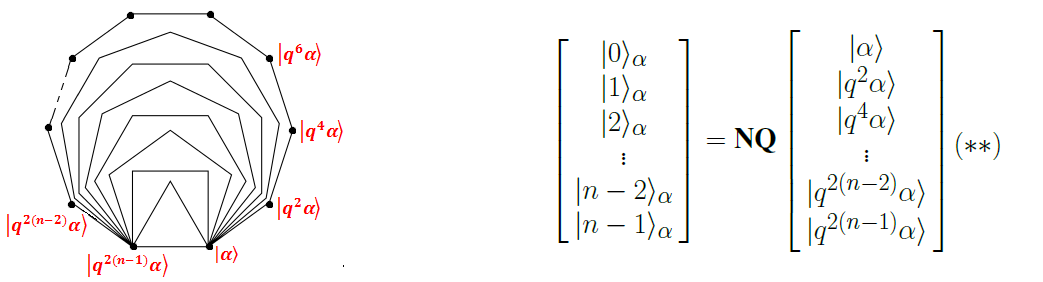 Figure 1
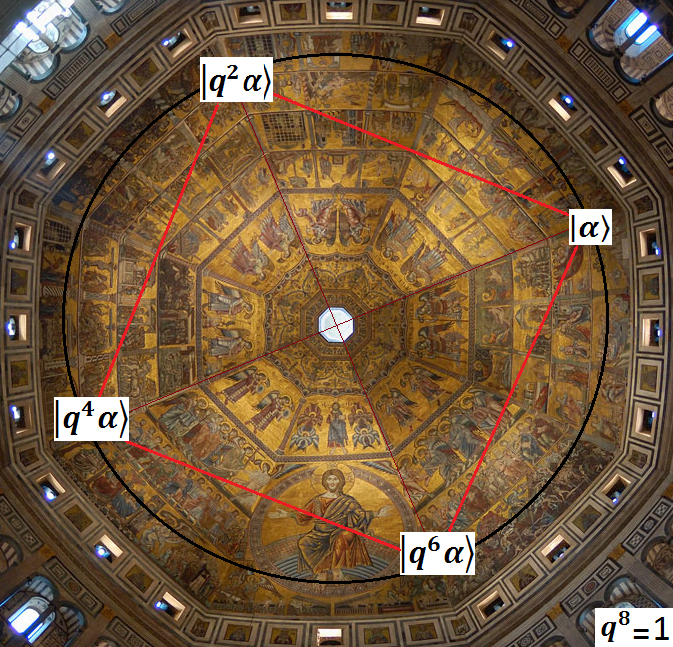 Figure 2
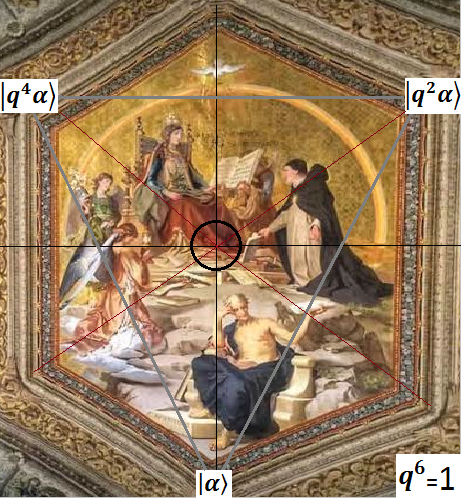 Figure 3
Peer Reviews
No public reviews on file for this paper yet. If you reviewed it on a platform where reviews are public (OpenReview, ICLR, NeurIPS, ICML), you can paste yours below so the community can read it here.
Videos
No videos yet. Explain this paper in a talk, walkthrough, or lecture? Add one.
Taxonomy
TopicsQuantum Mechanics and Applications · Quantum Computing Algorithms and Architecture · Fractal and DNA sequence analysis
Kaleidoscope of Quantum Coherent States
Oktay K. Pashaev and Aygül Koçak
Department of Mathematics
Izmir Institute of Technology
Izmir, 35430, Turkey
Abstract
The Schrödinger cat states, constructed from Glauber coherent states and applied for description of qubits, are generalized to the kaleidoscope of coherent states related with regular n-polygon symmetry and the roots of unity. The cases of the trinity states and the quartet states are described in details. Normalization formula for these states requires introduction of specific combinations of exponential functions with mod 3 and mod 4 symmetry. We show that for an arbitrary , these states can be generated by the Quantum Fourier transform and can provide qutrits, ququats and in general, qudit units of quantum information. Relations with quantum groups and quantum calculus are discussed.
Keywords: qubit, qutrit, ququat, qudit, coherent states, cat-states, quantum Fourier transform
††Extended version of poster presentation in ”Quantum foundations summer school” and ”Contextuality workshop”, ETH Zurich, Switzerland, 18-23 June, 2017; ”Mathematical Aspects of Quantum Information”, Cargese, France, 4-8 September 2017
1 Introduction
The Schrödinger cat states as superposition of Glauber, optical coherent states with opposite phases can be considered as qubits, a unit of quantum information. This construction can be generalized to the kaleidoscope of coherent states related with regular n-polygon symmetry and the roots of unity. Superposition of coherent states with such symmetry provides the set of orthonotmal quantum states, as a description of qutrits, ququats and qudits. It was shown recently that such quantum states as a units of quantum information processing, have advantage in secure quantum communication. Our consideration here is motivated by ideas of symmetry and -calculus. As was shown in our papers [1], [2], [3], application of method of images in hydrodynamics in wedge domain requires construction of -periodic functions with as a root of unity and self-similar -periodic functions. This construction can be considered as a discrete Fourier transform in space of complex analytic functions. Extension of these ideas to the Hilbert space for the coherent states results in a construction which we presents below.
1.1 Glauber Coherent States
Heinsenberg-Weyl Algebra Bosonic Algebra:
[TABLE]
Coherent States are eigenstate of annihilation operator : . This gives us relation between complex plane and Hilbert space such that .
Representation of coherent states in the Fock space basis: , where is displacement operator
[TABLE]
Inner product of coherent states: Coherent states are not orthogonal states. Our aim is by using coherent states to construct orthogonal set of states with discrete regular polygon symmetry.
2 Schrödinger’s Cat States
In description of Schrödinger cat states one introduces two orthogonal states, which are called even and odd cat states. These cat states are superposition of :
[TABLE]
These states can be considered as a superposition of two coherent states related by rotation to angle , which corresponds to primitive root of unity , so that and normalization constants are :
[TABLE]
[TABLE]
We can represent these states in matrix form by acting with Hadamard gate:
[TABLE]
[TABLE]
where
[TABLE]
and
[TABLE]
These state have been used as superposition of optical coherent states for description of qubit in quantum information processing.
3 Trinity States
To construct three orthonormal states we consider three coherent states rotated to angle (Figure 1), which corresponds to . First we define
[TABLE]
and
[TABLE]
[TABLE]
[TABLE]
From normalization by using (10) we introduce
[TABLE]
Then we find three orthonormal basis states as :
[TABLE]
Matrix form of Trinity states:
[TABLE]
[TABLE]
[TABLE]
These states can be used as qutrits quantum information states, having advantage in secure quantum communications.
4 Quartet States
In Figure 2, we have four states rotated by angle , determined by primitive root
[TABLE]
Superposition of these states with proper coefficients give us quartet of basis orthogonal states:
[TABLE]
where
[TABLE]
[TABLE]
These states can be used as ququats quantum information states, having advantage in secure quantum communications.
5 Generalized n-Cat States
Consider superposition of coherent states, which are belonging to vertices of regular -polygon and rotated by angle (Figure 3). It is related with primitive root of unity:
[TABLE]
Inner product of rotated coherent states:
- •
- •
Lemma: For
- •
- •
5.1 Quantum Fourier Transformation
Construction , shows that our orthogonal states can by described by the Quantum Fourier transform:
[TABLE]
This matrix corresponds to the Quantum Fourier transform, where is a n-th rooth of unity, so that it is unitary matrix satisfying :
[TABLE]
In order to get orthonormal states, we define normalization matrix:
[TABLE]
[TABLE]
These functions are solution of the ordinary differential equation with proper initial values.
Differential equation:
These states can be used as qudits quantum information states, having advantage in secure quantum communications.
6 Conclusions
Decomposition with Clock Shift Matrices, such that , relates our results with Quantum groups. By using cat states for qubit as a unit of quantum information we can apply our generalized n-cat states for information units as qutrits, ququats and qudits. Description of our kaleidoskope of coherent states can be realized by operator Quantum Calculus and Quantum Fourier transform.
Acknowledgements
This work is supported by TUBITAK grant 116F206.
The reference list from the paper itself. Each links out to its DOI / PubMed record.
- 1[1] Pashaev O.K., Two-circles theorem, q-periodic functions and entangled qubit states, J of Physics: Conf Series, 482, 012033, 2014.
- 2[2] Pashaev O.K., Variations on a theme of q-oscillator, Physica Scripta, 90, 074010, 2015.
- 3[3] Pashaev O.K., Quantum calculus of classical vortex images, integrable models and quantum states, J of Physics: Conf Series, 766, 012015, 2016.