Legendre curves and singularities of a ruled surface according to rotation minimizing frame
Murat Bekar, Fouzi Hathout, Yusuf Yayli

TL;DR
This paper explores the geometry of Legendre curves on the unit tangent bundle using rotation minimizing frames, analyzes the singularities of associated ruled surfaces, and classifies these singularities.
Contribution
It introduces a novel approach to studying ruled surface singularities via Legendre curves and RM vector fields, providing new classifications and insights.
Findings
Singularities of ruled surfaces are classified.
Legendre curves are characterized using RM vector fields.
New geometric insights into ruled surface singularities.
Abstract
In this paper, Legendre curves on unit tangent bundle are given using rotation minimizing (RM) vector fields. Ruled surfaces corresponding to these curves are represented. Singularities of these ruled surfaces are also analyzed and classifed.
Click any figure to enlarge with its caption.
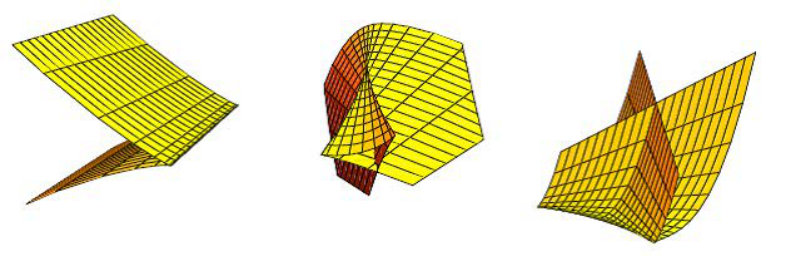 Figure 1
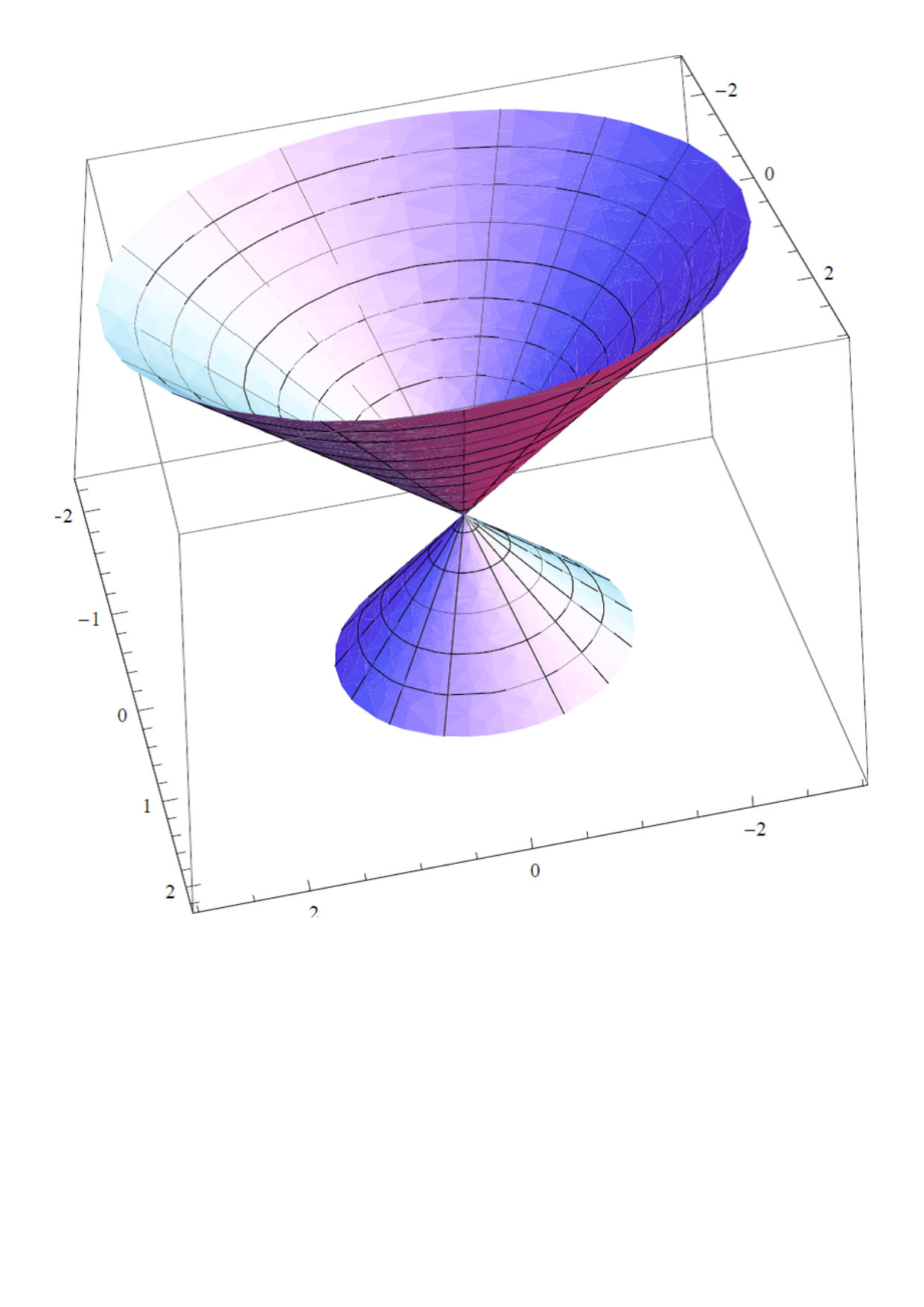 Figure 2
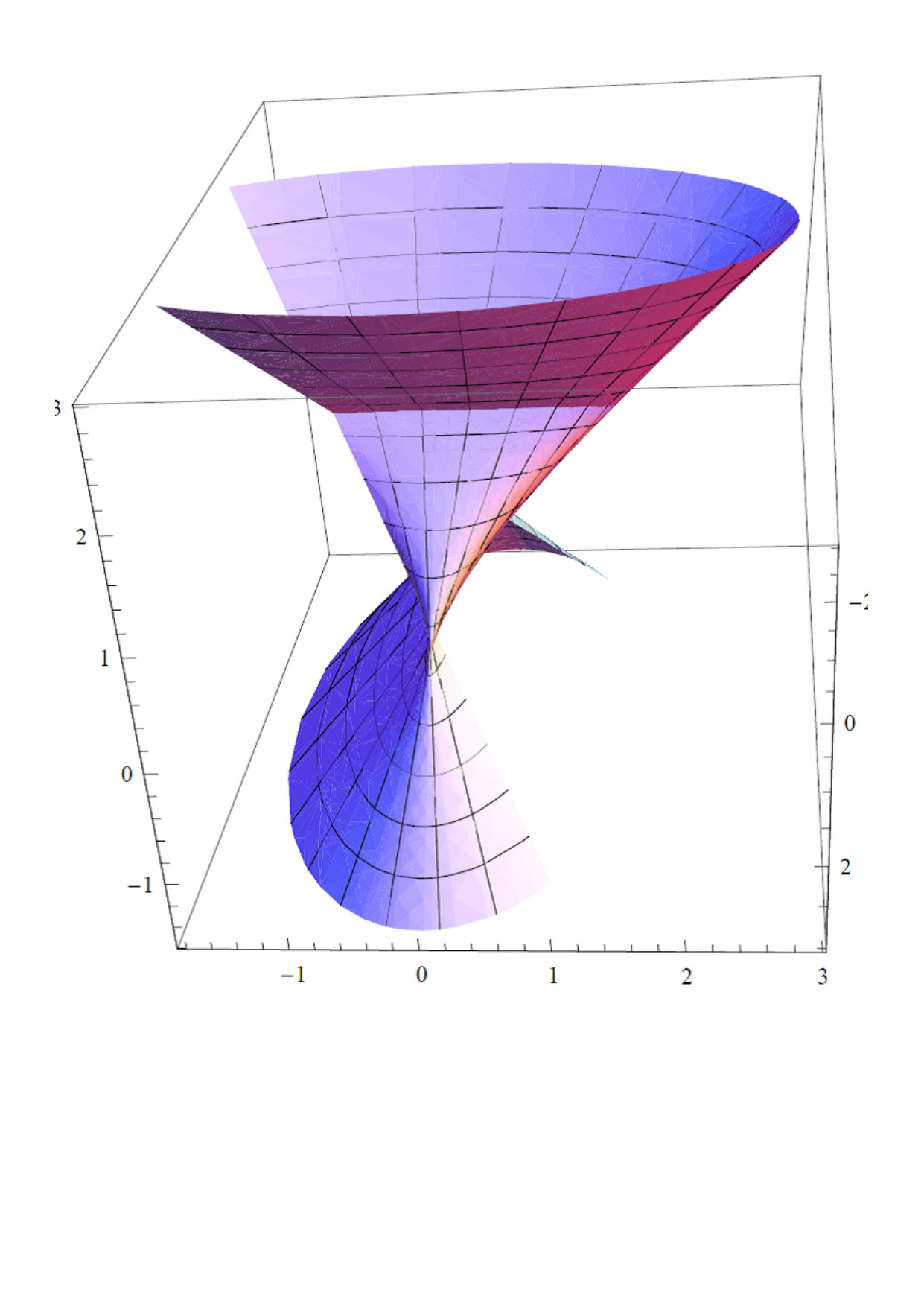 Figure 3
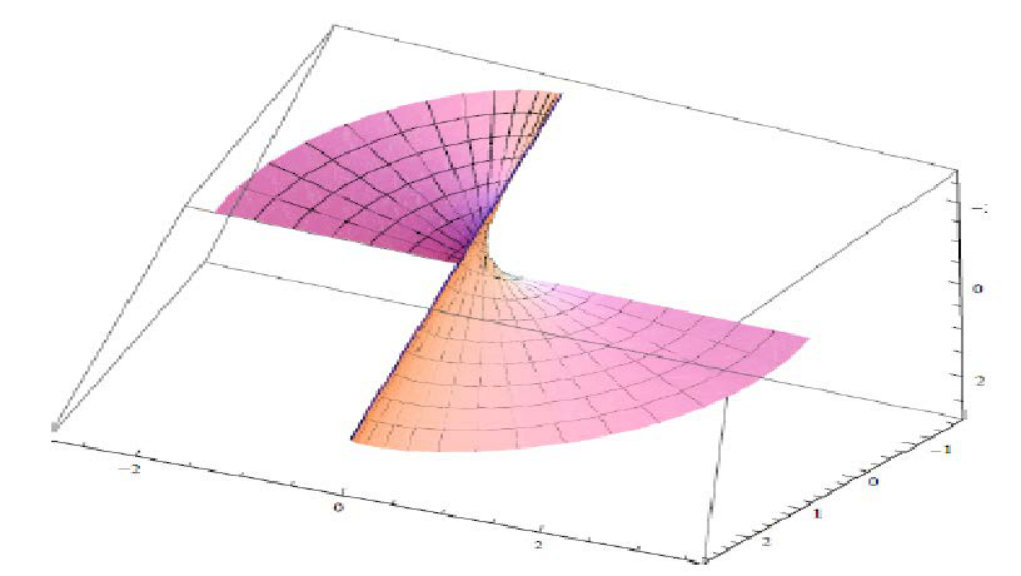 Figure 4
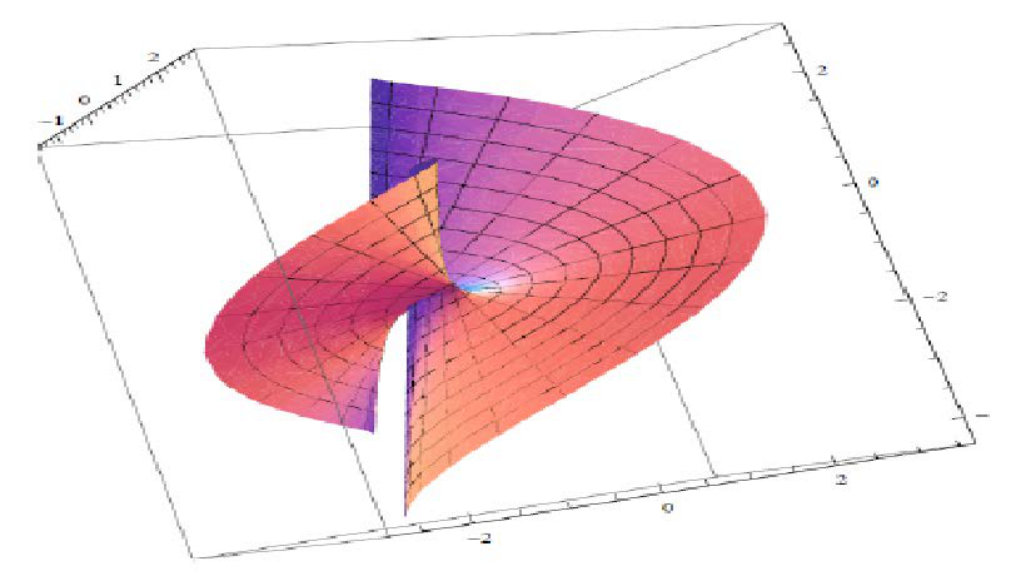 Figure 5
Peer Reviews
No public reviews on file for this paper yet. If you reviewed it on a platform where reviews are public (OpenReview, ICLR, NeurIPS, ICML), you can paste yours below so the community can read it here.
Videos
No videos yet. Explain this paper in a talk, walkthrough, or lecture? Add one.
Taxonomy
TopicsAdvanced Numerical Analysis Techniques · Geometric Analysis and Curvature Flows · Elasticity and Material Modeling
Legendre curves and singularities of a ruled surface according to
rotation minimizing frame
Murat Bekar , Fouzi Hathout2, Yusuf Yayli3 Corresponding author. 2010 2010 AMS Mathematics Subject Classification: Primary: 53A04, 32S25; Secondary: 14J60.
1Gazi University, Department of Mathematics, 06900 Polatli/Ankara, Turkey
2Saida University, Department of Mathematics, 2000 Saida, Algeria
3Ankara University, Department of Mathematics, 06100 Ankara, Turkey
Abstract
In this paper, Legendre curves on unit tangent bundle are given using rotation minimizing (RM) vector fields. Ruled surfaces corresponding to these curves are represented. Singularities of these ruled surfaces are also analyzed and classified.
Key words: Rotation minimizing vector field; Tangent bundle of sphere; Legendre curve; Ruled surface; Singularity.
1 Introduction
One of the most known orthonormal frame on a space curve is the Frenet-Serret frame, comprising the tangent vector field , the principal normal vector field and the binormal vector field . When this frame is used to orient a body along a path, its angular velocity vector (known also as the Darboux vector) satisfies , i.e. it has no component in the principal normal vector direction. This means that the body exhibits no instantaneous rotation about the unit normal vector from point to point along the path.
Bishop introduced the rotation minimizing frame (RMF) which is an alternative to Frenet-Serret frame, see [5]. This alternative frame does not have an instantaneous rotation about the unit tangent vector field . Nowadays, RMF is widely used in mathematical researches and Computer Aided Geometric Desing, e.g. [1, 8, 13].
More precisely, in -dimensional Riemannian manifold , an RMF along a curve is an orthonormal frame defined by the tangent vector field (of the curve in ) and by normal vector fields , which do not rotate with respect to the tangent vector field (i.e., is proportional to , where is the Levi Civita connection of g. This type of a normal vector field along a curve is said to be a rotation minimizing vector field (RM vector field). Any orthonormal basis at a point defines a unique RMF along the curve . The RMF can be defined at any situation of the derivatives of the curve . The notion of RMF particularizes to that of Bishop in Euclidian case, see [7]. The Frenet type equations of the RMF is given by
[TABLE]
where are called the natural curvatures along the curve
On the other hand, Legendre curves (especially in the tangent bundle of -sphere, ) are studied by many authors, e.g., [10, 11]. We call the pair satisfying as Legendre curve. We have proved that any two RM vector fields correspond to a Legendre curve in (the unit tangent bundle of -sphere) of some curves, see Theorems 3 and 4.
In [11], we have shown that to any Legendre curve in corresponds a developable ruled surface. According to RMF along a curve in 3-dimensional manifold, one can define six ruled surfaces. In this study, we want to describe what the offsetting process does to the local shape of a curve. In particular, we want to determine what happens to the singularities on the ruled surfaces which we have considered. We have observed that our six ruled surfaces can be one of the following according to their singularities: Cuspidal edge , *Swallowtail *SW, Cuspidal crosscap CCR or a cone surface.
This paper is divided into two parts: In Section 2, we give some definitions and notions about the Legendre curves in and about the RM vector fields. By Theorems 3 and 4, we give some relationships between these curves and vector fields. In Section 3, we show that the ruled surfaces obtained from RMF are developable and we analyze the singularities of these ruled surfaces.
All curves and manifolds considered in this paper are of class unless otherwise stated.
2 Legendre curves and RM vectors fields
Let be a non-null curve with arc-length parameter in three-dimensional Riemannian manifold . Then, there exists an accompanying three-frame known as the Frenet-Serret frame of . In this case, the moving Frenet-Serret formulas in are given by
[TABLE]
where and are called the curvature and the torsion of the curve at the point , respectively. The set is also called the Frenet-frame apparatus.
Definition 1**.**
Let be a curve in . A normal vector field over is said to be a rotation minimizing vector field (RM vector field) if it is parallel with respect to the normal connection of . This means that and are proportional.
A rotation minimizing frame (RMF) along a curve in is an orthonormal frame defined by tangent vector and by two normal vector fields and , which are proportional to . Any orthonormal basis at a point defines a unique RMF along the curve . Let be the Levi Civita connection of the metric . Then, Frenet type equations read as
[TABLE]
Here, the functions and are called the natural curvatures of RMF given by
[TABLE]
where and is the derivative of with respect to the arc-length.
If is the Euclidean 3-space , then the notion of RMF particularizes to that of Bishop frame.
Let be the unit 2-sphere in . Then, the tangent bundle of is given by
[TABLE]
and the unit tangent bundle of is given by
[TABLE]
which is a -dimensional contact manifold and its canonical contact -form is where and denotes the usual inner product and norm in , respectively. For further information see [10, 15]
In general, in any Riemannian manifold a curve is said to be Legendre if it is an integral curve of the contact distribution , i.e. , see [2]. In particular, Legendre curves in 3-dimensional contact manifold on can be given by the following definition:
Definition 2**.**
The smooth curve
[TABLE]
is called Legendre curve in if
[TABLE]
The Legendre curve condition in can be seen in [9] as a definition of -dual to each other in . By the following theorem we give the relationship between RM vector fields and the Legendre curve conditions in :
Theorem 3**.**
Let be a regular unit speed curve with the frame apparatus . Then, we have the following assertions:
If and are RM vector fields along , the curve is Legendre in . 2. 2.
If and are RM vectors along -direction curve the curve is Legendre in . 3. 3.
If and are RM vector fields along -direction curve the curve is Legendre in .
Proof.
Assume that is a regular unit speed curve with the frame apparatus . Then,
Consider the curve . Since and are RM vector fields along , from Equation (2) we get that
[TABLE]
Thus, from Equation (4) we can say that is a Legendre curve in 2. 2.
Consider the curve along the -direction curve . The Frenet type equations can be given as
[TABLE]
with the natural curvatures
[TABLE]
From Equation (5), we get that
[TABLE]
Thus, from Equation (4), we can say that is a Legendre curve in The proof of Assertion 3 can be given by the similar way as Assertions 1 and 2.
∎
From the definition of the set , we know that for a smooth curve in it is . Thus, we can define a new frame using the unit vector , where denotes the usual vector product in It is obvious that . Hence, we get the following Frenet frame along ;
[TABLE]
where , The triple is called the *curvature functions *of .
We know that, if the curve is Legendre in with the curvature functions .
Theorem 4**.**
Let be a smooth curve in . If is Legendre, the vectors and are RM vector fields along the -direction curve , i.e. and the triple vector field set is an RMF.
Proof.
Let be a smooth Legendre curve in Then, the frenet frame Equation (6) for Legendre condition that is, can be given by
[TABLE]
From Equation (2), we can say that is an RMF along the -direction curve . ∎
3 Singularities of ruled surface according to RMF
A ruled surface in is locally the map
[TABLE]
defined by
[TABLE]
where and are smooth mappings defined from an open interval (or a unit circle ) to . is the base curve (or directrix) and the non-null curve is the director curve. The straight lines are the rulings.
The striction curve of the ruled surface is defined by
[TABLE]
If the striction curve coincides with the base curve .
A ruled surface is said to be developable if
[TABLE]
From Theorem 4, we can say that if is a Legendre curve, the vector set is an RMF along the -direction curve . One can define by this frame the following six ruled surfaces:
[TABLE]
where and are different unit curves from the set
Proposition 5**.**
Ruled surfaces , for , given by Equation (9) are developable.
Proof.
Let be a ruled surface defined by Equation (9). Using Equation (7), we get the developability condition of ;
[TABLE]
Proof of the other ruled surfaces for can be given by the similar way. ∎
Now, recall the parametric equations of the surfaces Cuspidal edge, *Swallowtail *and Cuspidal crosscap in given by Figure 1, see [12]:
Cuspidal edge: . 2. 2.
Swallowtail: SW. 3. 3.
Cuspidal crosscap: CCR.
By the following theorem, we give the local classification of singularities of the ruled surfaces defined by using Equation (9):
Theorem 6**.**
Let be a smooth Legendre curve in According to RMF along the -direction curve , we have the following:
* which is locally diffeomorphic to;*
- (a)
C\times R\at if and only if and 2. (b)
* at if and only if , and .* 2. 2.
* which is locally diffeomorphic to;*
- (a)
C\times R\* at if and only if and * 2. (b)
* at if and only if , and .* 3. 3.
* (resp. ) which is a cone surface if and only if (resp., ) is constant.*
Proof.
Assume that is a smooth Legendre curve in according to the RMF along the -direction curve Using Equation (9) and , we get
[TABLE]
Singularities of the normal vector field of are
[TABLE]
From Theorem 3.3 of the paper [12], we know that if there exists a parameter such that and (i.e., ), then is locally diffeomorphic to the C\times\mathbb{R}\ at . This completes the proof of Assertion 1.(a). Again from Theorem 3.3 of [12], we know that if there exists a parameter such that , and , then is locally diffeomorphic to at , and this completes the proof of Assertion 1.(b).
The proof of Assertion 2 can be given similar to the proof of Assertion 1. The proof of Assertion 3 can be given as: The singularity points are equal to the striction curve of and can be given by
[TABLE]
[TABLE]
Thus, we have
[TABLE]
which means that if is a constant function, then
[TABLE]
So, (resp., ) has only one singularity point and thus it is a cone surface. ∎
Corollary 7**.**
Let be a smooth curve with frame apparatus given by Equation (5). If we choose we obtain the Theorem 3.1 given in [9]. If we choose , we obtain the Theorem 3.2 given in [9].
Proof.
Let be a smooth curve with frame apparatus given by Equation (2). The vector fields is an RMF along the -direction curve . This means that is a Legendre curve in . Using Theorem 6, we complete the proof, where and ∎
Theorem 8**.**
Let be a smooth Legendre curve in Then, according to RMF along the -direction curve , we have the foolowing:
* which is locally diffeomorphic to;*
- (a)
C\times R\at if and only if and 2. (b)
* at if and only if , and .* 3. (c)
* at if and only if and .* 2. 2.
* which is locally diffeomorphic to;*
- (a)
C\times R\* at if and only if and * 2. (b)
* at if and only if and .* 3. (c)
* at if and only if and .* 3. 3.
* (resp., ) which is a cone surface if and only if (resp., ) is constant.*
Proofs of Theorems 8 and 9 can be given similar to the proof of Theorem 6.
Theorem 9**.**
Let be a smooth Legendre curve in with curvature functions . Then we have the following:
Ruled surface is locally diffeomorphic to;
- (a)
C\times R\* at if and only if and * 2. (b)
* at if and only if , and .* 3. (c)
* at if and only if (i.e., * and ) and . 2. 2.
Ruled surface is locally diffeomorphic to;
- (a)
C\times R\* at if and only if and * 2. (b)
at if and only if and 3. (c)
* at if and only if (i.e., * and ) and . 3. 3.
Ruled surfaces (resp., ) is a cone surface if and only if (resp., ) is constant.
Corollary 10**.**
Let be a smooth curve with frame apparatus . If we choose we obtain the Theorem 3.2 given in [12].
Proof.
Since and are RM vector fields along the -direction curve , the curve is a Legendre in . Using Theorem 8 and taken , we get the proof. ∎
Corollary 11**.**
Let be a smooth curve with frame apparatus , see [3, 4]. If we choose , we obtain the Theorem 3.3 given in [12], where
[TABLE]
is the unit Darboux vector field.
Proof.
Let be a smooth curve with frame apparatus . Then, the curve is a Legendre in . Using Theorem 9, we get the slant helix condition
[TABLE]
which completes the proof. ∎
We close this section by given some examples to illustrate the main results. The first example is an application of Theorem 9:
Example 12**.**
Let us take a smooth curve given by
[TABLE]
and a unit vector given by
[TABLE]
Then, we have
[TABLE]
Thus, is a Legendre curve in The RMF along the -direction curve can be given as
[TABLE]
The ruled surface
[TABLE]
represents a cone surface, see Figure 2.
The second example is an application of Theorem 6:
Example 13**.**
Let be a smooth curve defined by
[TABLE]
Then, the tangent and binormal vector fields of are, respectively,
[TABLE]
with the curvature and the torsion . So, is a helix. The curve is Legendre in and the ruled surface
[TABLE]
is a cone. We get the singularity point for on the point see Figure 3.
The last example is an application of Theorem 8:
Example 14**.**
Let be a smooth curve (for ) defined by
[TABLE]
Then, is a Legendre curve with Legendre curvature function
[TABLE]
*and we have the following:
- If , then , and The ruled surface*
[TABLE]
is locally diffeomorphic to at , see Figure 4.
2. If , then , The ruled surface is locally diffeomorphic to at , see Figure 5.
4 Conclusions
In this paper, we give the Legendre curves on the unit tangent bundle using the rotation minimizing (RM) vector fields. We represent the ruled surfaces corresponding to these Legendre curves and discuss their singularities. For some special cases, given by Corollaries 7, 10 and 11, we get the main ideas of the studies [9] and [12].
The reference list from the paper itself. Each links out to its DOI / PubMed record.
- 1[1] Anco SC. Group-invariant soliton equations and bi-Hamiltonian geometric curve flows in Riemannian symmetric spaces. J Geom Phys 2008; 58: 1-37.
- 2[2] Baikoussis C, Blair DE. On Legendre curves in contact 3-manifolds. Geom. Dedicata 1994; 49: 135-142.
- 3[3] Beyhan U, Gök I, Yayli Y. A new approach on curves of constant precession. Appl Math Comput 2016; 275: 317-323.
- 4[4] Bekar M, Yayli Y. Slant Helix Curves and Acceleration Centers in Minkowski 3-Space ℝ 1 3 superscript subscript ℝ 1 3 \mathbb{R}_{1}^{3} . J Adv Phys. 2017; 6: 133-141.
- 5[5] Bishop RL. There is more than one way to frame a curve. Am Math Mon 1975; 82: 246-251.
- 6[6] Bruce JW, Giblin PJ. Curves and Singularities (2nd. ed), Cambridge Univ Press, Cambridge 1992.
- 7[7] Etayo F. Rotation Minimizing vector fields and frames in Riemannian manifold. Proceedings in Mathematics and Statistics 2016; 161: 91-100.
- 8[8] Farouki RT. Pythagorean-hodograph curves: algebra and geometry inseparable. Berlin, Germany: Spinger, Geometry and Computing 1 2008.