EXO 2030+375 Restarts in Reverse
Peter Kretschmar, Felix Fuerst, Colleen A. Wilson-Hodge, Pere Blay,, Jari Kajava, Julia Alfonso-Garz\'on, Matthias K\"uhnel, Ingo Kreykenbohm,, J\"orn Wilms, Peter A. Jenke, Katja Pottschmidt

TL;DR
This study investigates the unusual low-flux state and potential transition to centrifugal inhibition in the Be X-ray binary pulsar EXO 2030+375 through multi-instrument observations, revealing changes in accretion behavior and disk properties.
Contribution
First multi-instrument campaign exploring the low-flux state and possible accretion transition in EXO 2030+375, providing new insights into its variable accretion dynamics.
Findings
Decreased outburst regularity and brightness in 2015.
Indications of disk changes from Hα line variations.
Preliminary evidence of altered accretion behavior.
Abstract
The Be X-ray binary pulsar EXO 2030+375, first detected in 1985, has shown a significant detected X-ray outburst at nearly every periastron passage of its 46-day orbit for the past ~25 years, with one low state accompanied by a torque reversal in the 1990s. In early 2015 the outbursts progressively became fainter and less regular while the monotonic spin-up flattened. At the same time a decrease in the H line equivalent width was reported, indicating a change in the disk surrounding the mass donor. In order to explore the source behaviour in the poorly explored low-flux state with a possible transition to a state of centrifugal inhibition of accretion we have undertaken an observing campaign with Swift/XRT, NuSTAR and the Nordic Optical Telescope (NOT). This conference contribution reports the preliminary results obtained from our campaign.
Click any figure to enlarge with its caption.
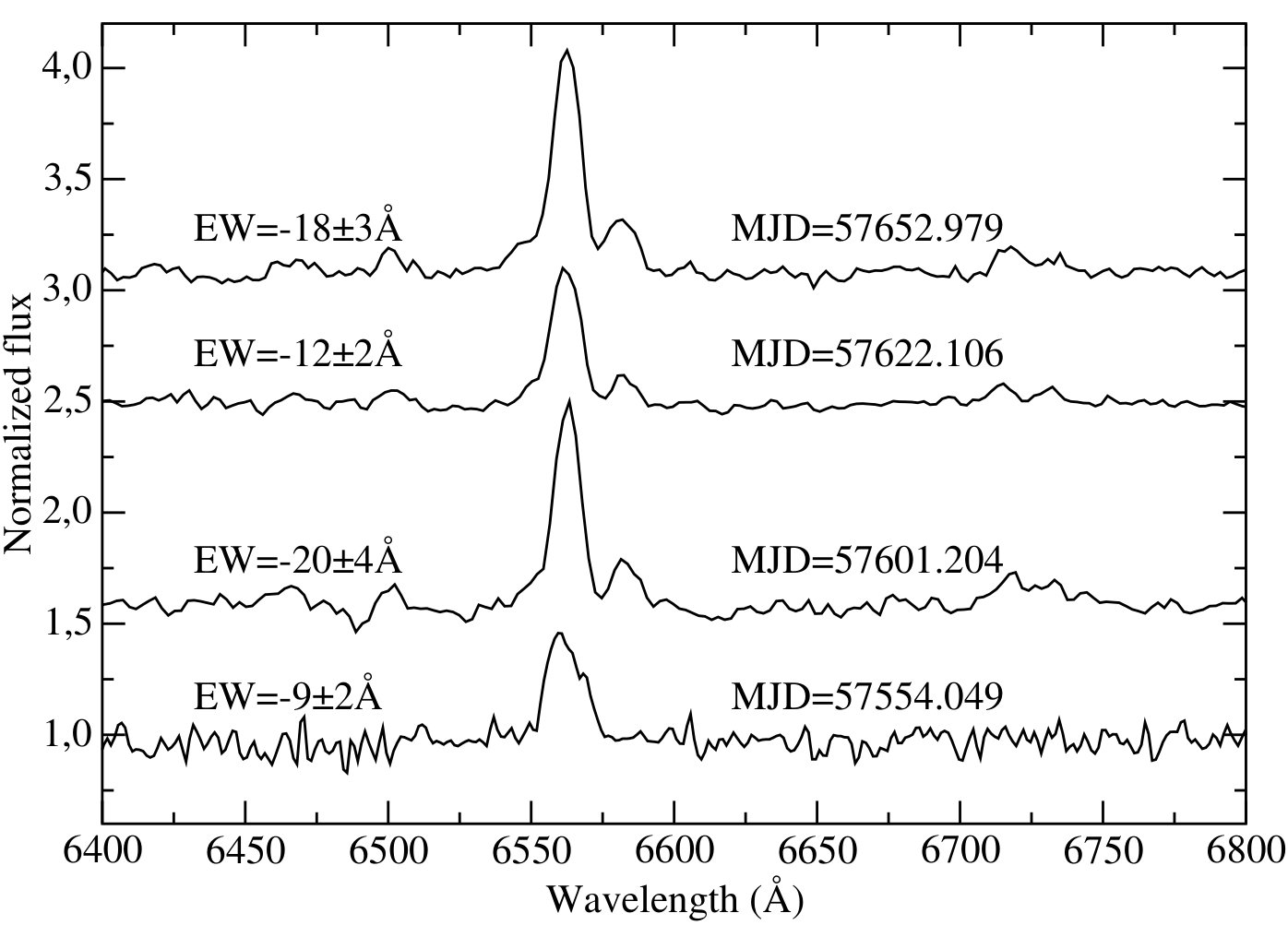 Figure 1
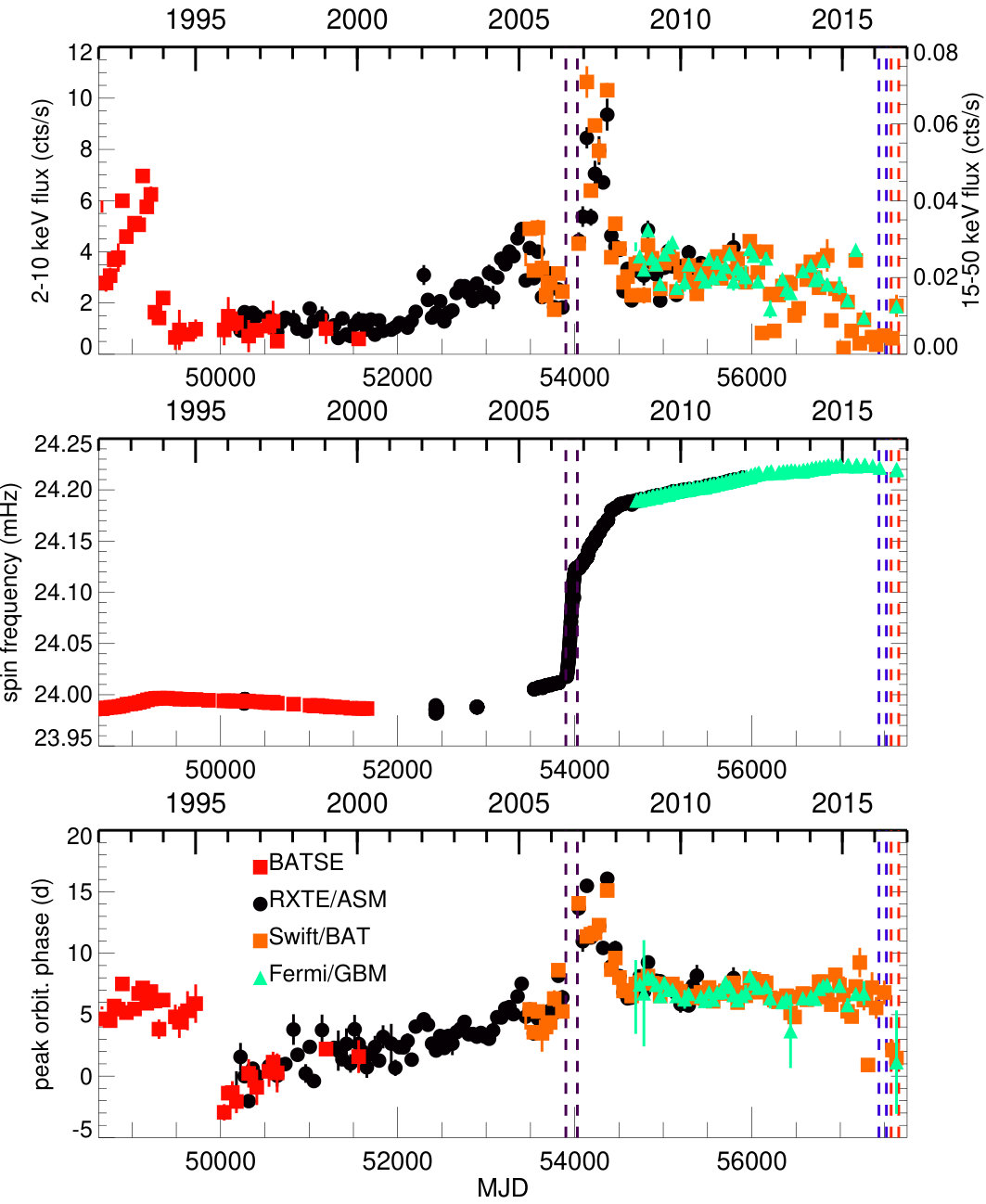 Figure 2
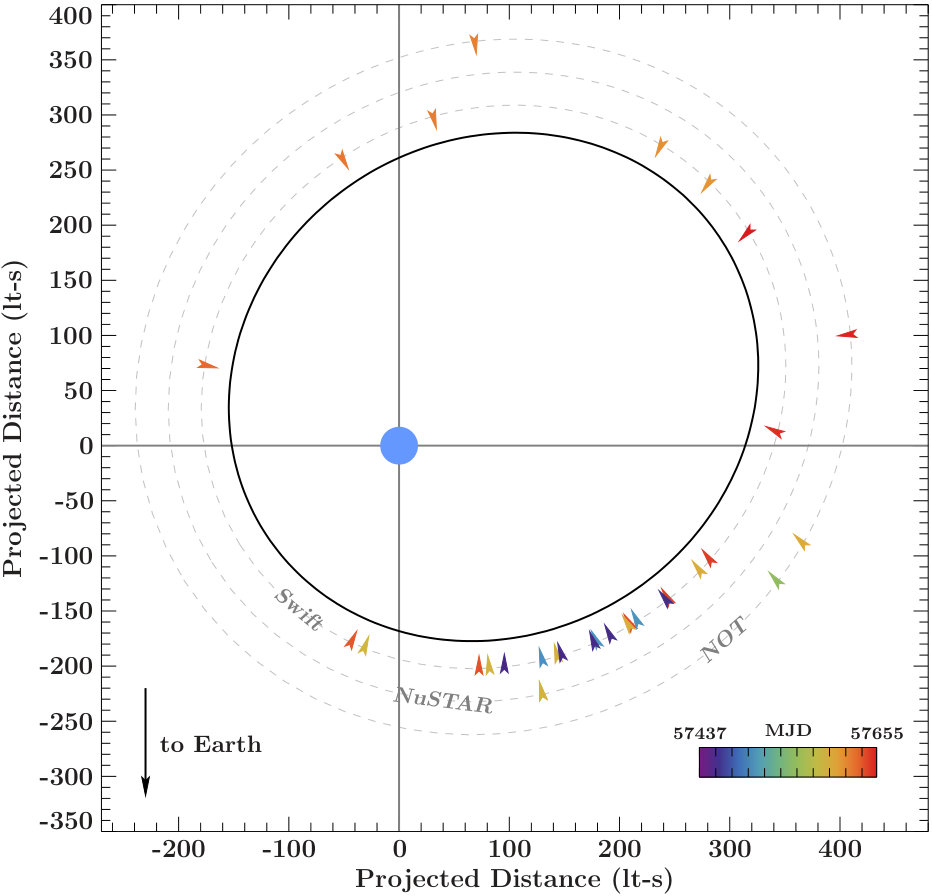 Figure 3
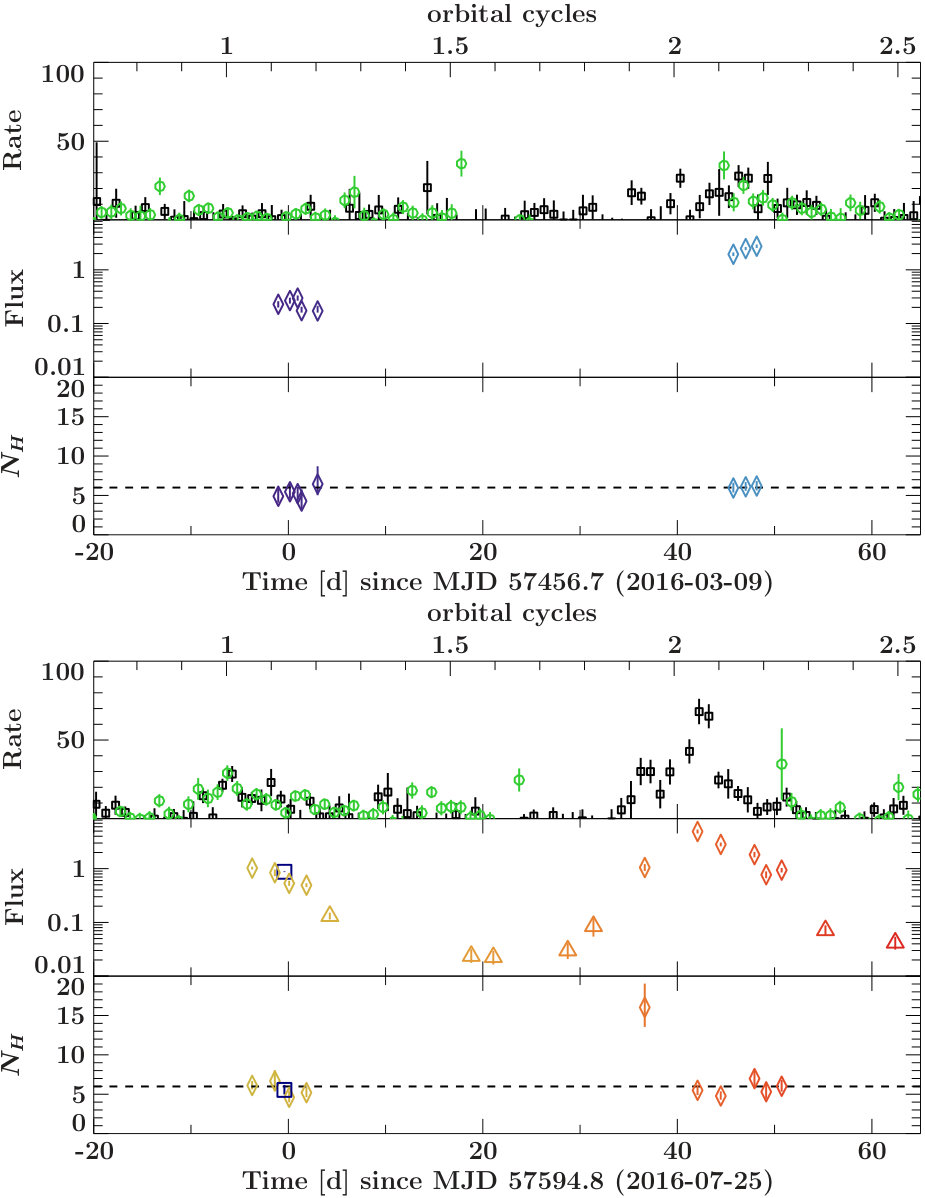 Figure 4
Peer Reviews
No public reviews on file for this paper yet. If you reviewed it on a platform where reviews are public (OpenReview, ICLR, NeurIPS, ICML), you can paste yours below so the community can read it here.
Videos
No videos yet. Explain this paper in a talk, walkthrough, or lecture? Add one.
EXO 2030+375 Restarts in Reverse
European Space Astronomy Centre (ESA/ESAC), Science Operations Department
P.O. Box 78, E-28691, Villanueva de la Cañada, Madrid, Spain
E-mail We thank the Swift, NuSTAR, and NOT teams for scheduling the requested observations, sometimes on short notice.
Felix Fuerst
Cahill Center for Astronomy and Astrophysics, California Institute of Technology, Pasadena, CA 91125, USA
Colleen A. Wilson-Hodge
NASA Marshall Space Flight Center, Huntsville, AL 35812, USA
Pere Blay
Nordic Optical Telescope – IAC, P.O.Box 474, E-38700, Santa Cruz de La Palma
Santa Cruz de Tenerife, Spain
Jari Kajava
European Space Astronomy Centre (ESA/ESAC), Science Operations Department
P.O. Box 78, E-28691, Villanueva de la Cañada, Madrid, Spain
Julia Alfonso-Garzón
Centro de Astrobiología (CSIC–INTA), Camino Bajo del Castillo s/n,
Urb. Villafranca del Castillo, E-28692 Villanueva de la Cañada, Madrid, Spain
Matthias Kühnel
Dr. Karl Remeis-Observatory & ECAP, Universität Erlangen-Nürnberg,
Sternwartstr. 7, D-96049 Bamberg, Germany
Ingo Kreykenbohm
Dr. Karl Remeis-Observatory & ECAP, Universität Erlangen-Nürnberg,
Sternwartstr. 7, D-96049 Bamberg, Germany
Jörn Wilms
Dr. Karl Remeis-Observatory & ECAP, Universität Erlangen-Nürnberg,
Sternwartstr. 7, D-96049 Bamberg, Germany
Peter A. Jenke
CSPAR, SPA University of Alabama in Huntsville, Huntsville, AL 35805, USA
Katja Pottschmidt
Department of Physics & Center for Space Science and Technology, University of Maryland Baltimore County, Baltimore, MD 21250, USA
CRESST & NASA Goddard Space Flight Center, Code 661, Greenbelt, MD 20771, USA
Abstract:
The Be X-ray binary pulsar EXO 2030+375, first detected in 1985, has shown a significant detected X-ray outburst at nearly every periastron passage of its 46-day orbit for the past 25 years, with one low state accompanied by a torque reversal in the 1990s. In early 2015 the outbursts progressively became fainter and less regular while the monotonic spin-up flattened. At the same time a decrease in the H line equivalent width was reported, indicating a change in the disk surrounding the mass donor.
In order to explore the source behaviour in the poorly explored low-flux state with a possible transition to a state of centrifugal inhibition of accretion we have undertaken an observing campaign with Swift/XRT, NuSTAR and the Nordic Optical Telescope (NOT). This conference contribution reports the preliminary results obtained from our campaign.
1 Introduction
EXO 2030+375 is a well-known transient Be X-ray Binary, discovered during a giant outburst in 1985 [1, 2]. Since 1991 normal (type I) outbursts have been observed at nearly every periastron passage of its 46 day orbit. From 1992 to 1994 outbursts were bright and the pulsar was spinning up. Then the flux levels dropped suddenly and a global spin-down trend ensued. Furthermore, 1995 the orbital phase of the type I outbursts shifted to 8–9 days earlier [3, 4].
Since 2002 the outbursts brightened and the spin trend reversed again. Another giant outburst took place in summer 2006, accelerating the pulsar significantly [5]. For more than eight years regular outbursts and the spin-up trend, monitored first by RXTE and then the Fermi/GBM, continued (see Figure 2), albeit gradually reducing in amplitude.
In early 2015 the regularity of outbursts decreased with first every second outburst much fainter than usual and then hardly any outburst activity at all. At the same time, the spin-up trend flattened to almost zero [6]. Optical spectroscopic observations in this period demonstrated a clear decrease in the H emission equivalent width, which is usually taken as a measure of the size of the disk around the Be star feeding regular outbursts.
2 Observations
Prompted by the evident change in source behaviour, we began to observe EXO 2030+375 with Swift/XRT. First with a few snapshots, then with an extended monitoring, with a tighter monitoring around the expected outburst peaks and increasingly wider spaced observations around the rest of the orbit. In addition, we obtained one 60 ks NuSTAR observation and took optical spectra of the H line with the Nordic Optical Telescope on four occasions of our campaign. The orbital phases of our observations are indicated in Figure 1.
3 Preliminary Results
In our targeted X-ray observations, we always find some low-level pulsed emission from EXO 2030+375, thus no sign of a magnetospheric cutoff of emission (a.k.a. “propeller effect”). The luminosity during the faint states is low enough that accretion directly from the stellar wind can account for it. While the absorption and spectral hardness are rather constant despite strong flux variations, we find a much higher absorption in one observation during the last monitored outburst, possibly the neutron star passing behind the Be star disk.
Both Fermi/GBM and Swift/XRT clearly show that EXO 2030+375 is again in spin-down. This torque reversal is remarkably similar in duration and magnitude to the one observed 21 years ago, as is the shift in the orbital phase of outburst peaks. The same time interval lies between the two known giant outbursts, suggesting a 21 year quasi-period in this system, as also noted by [7, 8].
The minimum EW we measure is similar to the values measured by [4, 9] after the spin-down and orbital phase shift of 1995, and by [10] after the giant outburst, pointing to a relation between the circumstellar state disc and the changes in the pulsar behaviour.
The H profile clearly evolves between the first two observations (June 15th, MJD 57554 and August 1st, MJD 57601) – indicating an important change in structure, density gradient, size or geometry of the Be disk – but then remains similar for the remaining observations.
The reference list from the paper itself. Each links out to its DOI / PubMed record.
- 1[1] A. N. Parmar, L. Stella, P. Ferri, and N. E. White. EXO 2030+375. IAU Circular , 4066, May 1985.
- 2[2] A. N. Parmar, N. E. White, L. Stella, C. Izzo, and P. Ferri. The transient 42 second x-ray pulsar exo 2030+375. i – the discovery and the luminosity dependence of the pulse period variations. Ap J , 338:359–372, Mar 1 1989.
- 3[3] P. Reig and M. J. Coe. Timing properties of the x-ray pulsar EXO 2030+375 during an x-ray outburst. MNRAS , 294:118–126, 1998.
- 4[4] C. A. Wilson, M. H. Finger, M. J. Coe, S. Laycock, and J. Fabregat. A Decade in the Life of EXO 2030+375: A Multiwavelength Study of an Accreting X-Ray Pulsar. Ap J , 570:287–302, May 2002.
- 5[5] C. A. Wilson, M. H. Finger, and A. Camero-Arranz. Outbursts Large and Small from EXO 2030+375. Ap J , 678:1263–1272, May 2008.
- 6[6] F. Fuerst, C. A. Wilson-Hodge, P. Kretschmar, J. Kajava, and M. Kuehnel. Fading outbursts of EXO 2030+375. The Astronomer’s Telegram , 8835, Mar. 2016.
- 7[7] E. Laplace, T. Mihara, T. Takagi, Y. Moritani, M. Nakajima, K. Makishima, and A. Santangelo. Orbital phase shift in a new type I outburst of the Be/X-ray binary EXO 2030+375. The Astronomer’s Telegram , 9263, July 2016.
- 8[8] E. Laplace, T. Mihara, Y. Moritani, M. Nakajima, T. Takagi, K. Makishima, and A. Santangelo. Possible regular phenomena in EXO 2030+375. Ar Xiv e-prints 1610.03631 , Oct. 2016.