The Chain Group of a Forest
Felix Gotti, Marly Gotti

TL;DR
This paper introduces the concept of the chain group of a forest, exploring its properties and characterizing which groups can or cannot be realized as chain groups of forests.
Contribution
It defines the chain group of a forest and characterizes its structure, including identifying which groups can be realized as chain groups and which cannot.
Findings
Determined the chain groups for several families of forests.
Proved that the dihedral group cannot be realized as a chain group of any forest.
Abstract
For every labeled forest with set of vertices we can consider the subgroup of the symmetric group that is generated by all the cycles determined by all maximal paths of . We say that is the chain group of the forest . In this paper we study the relation between a forest and its chain group. In particular, we find the chain groups of the members of several families of forests. Finally, we prove that no copy of the dihedral group of cardinality inside can be achieved as the chain group of any forest.
Click any figure to enlarge with its caption.
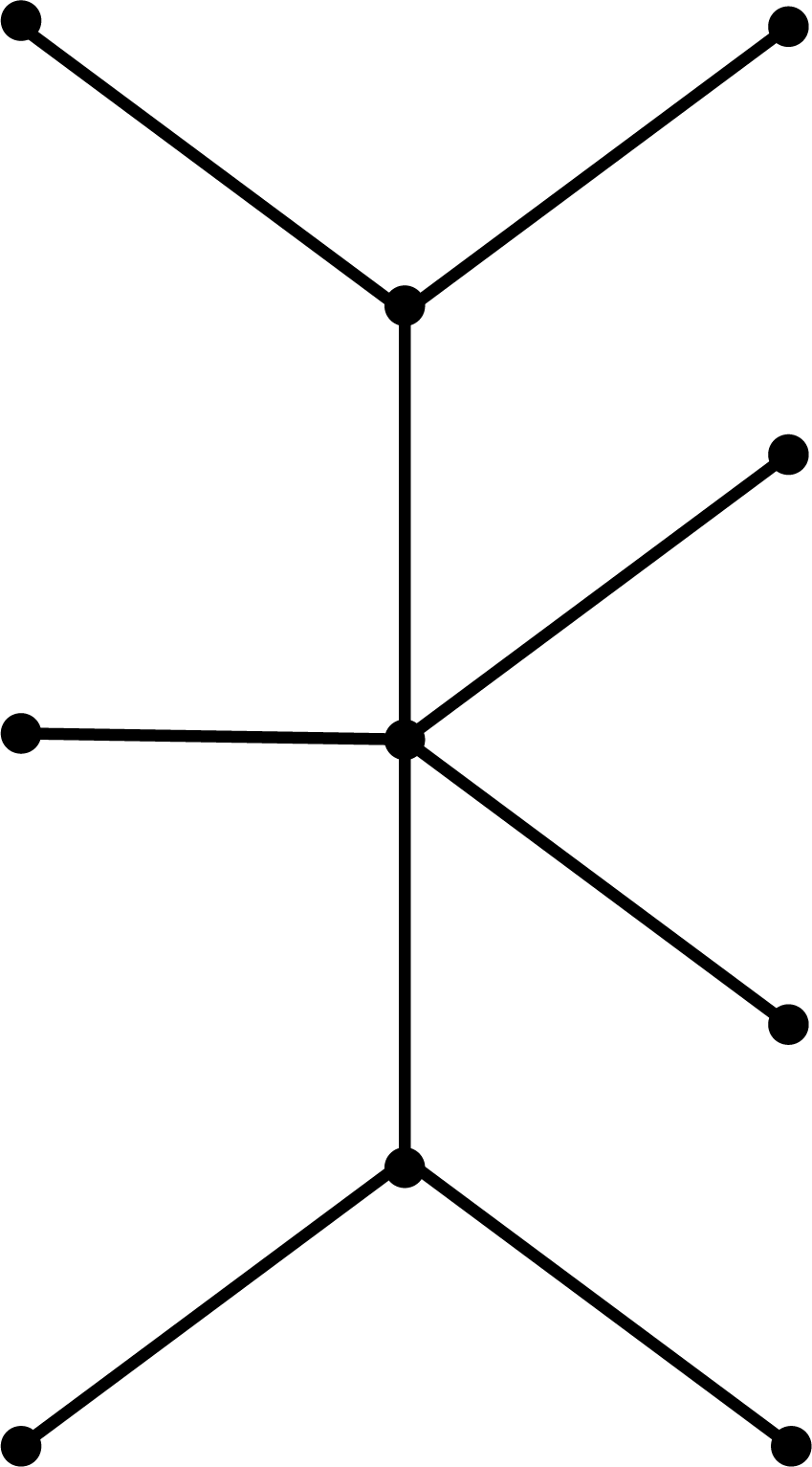 Figure 1
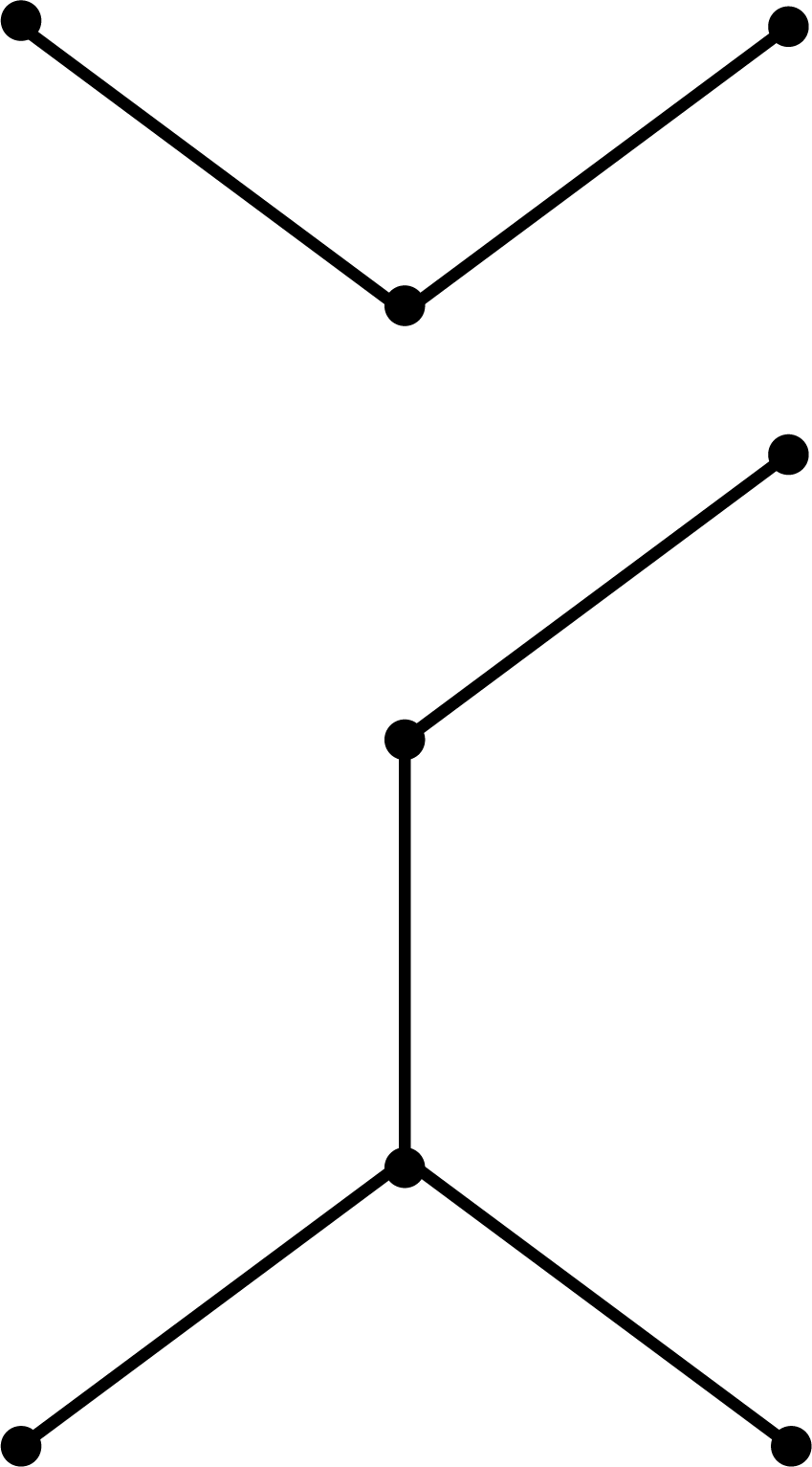 Figure 2
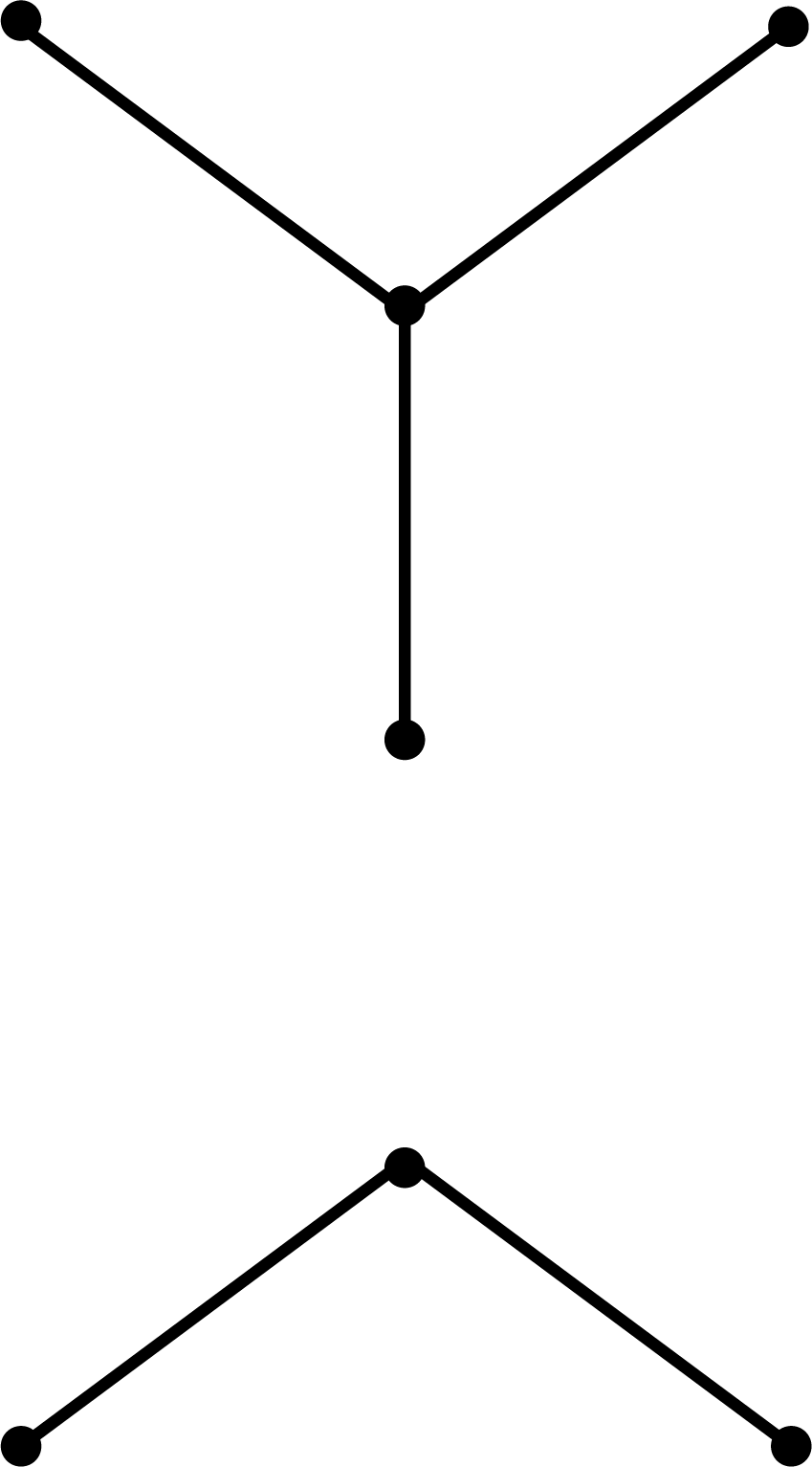 Figure 3
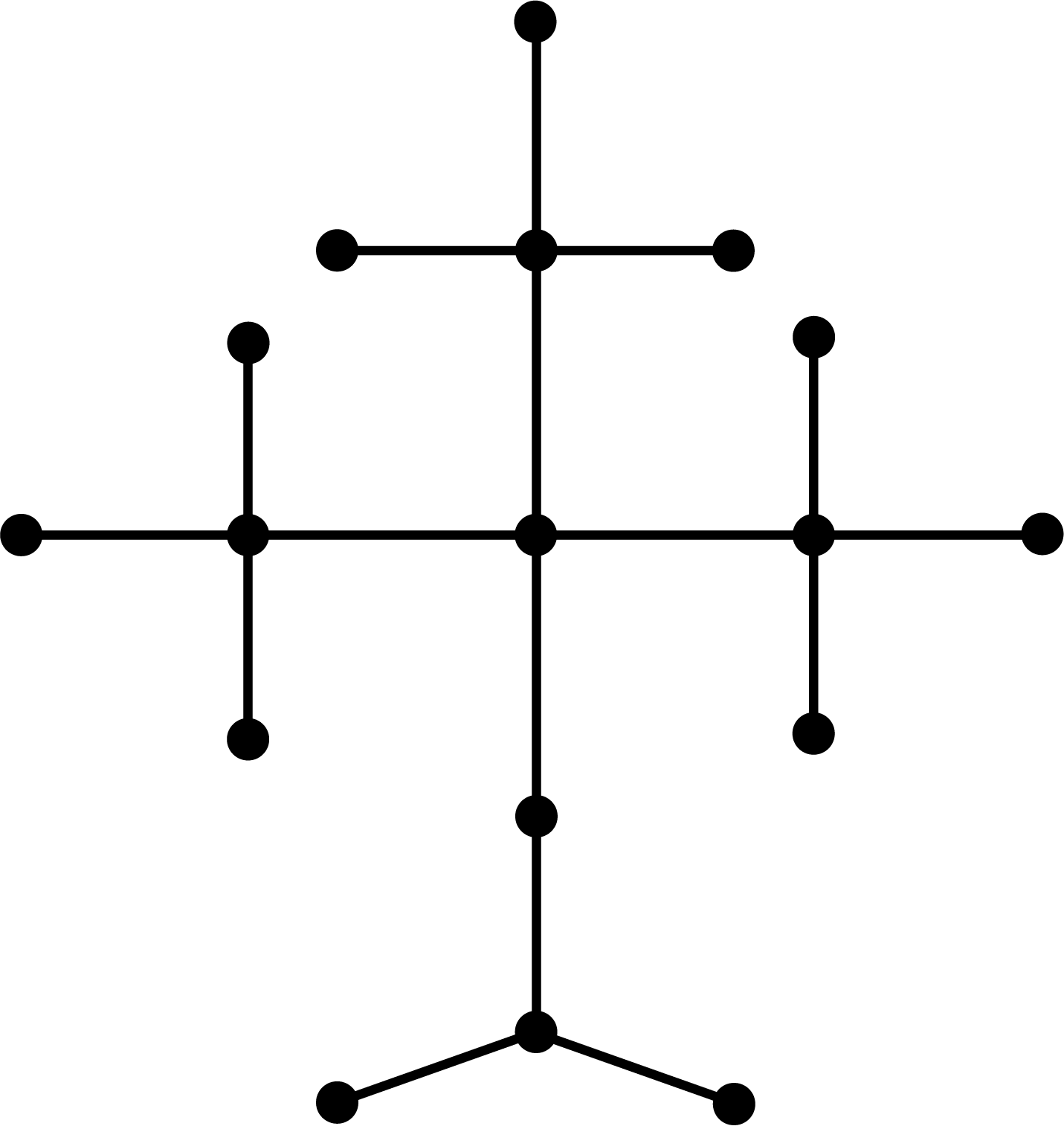 Figure 4
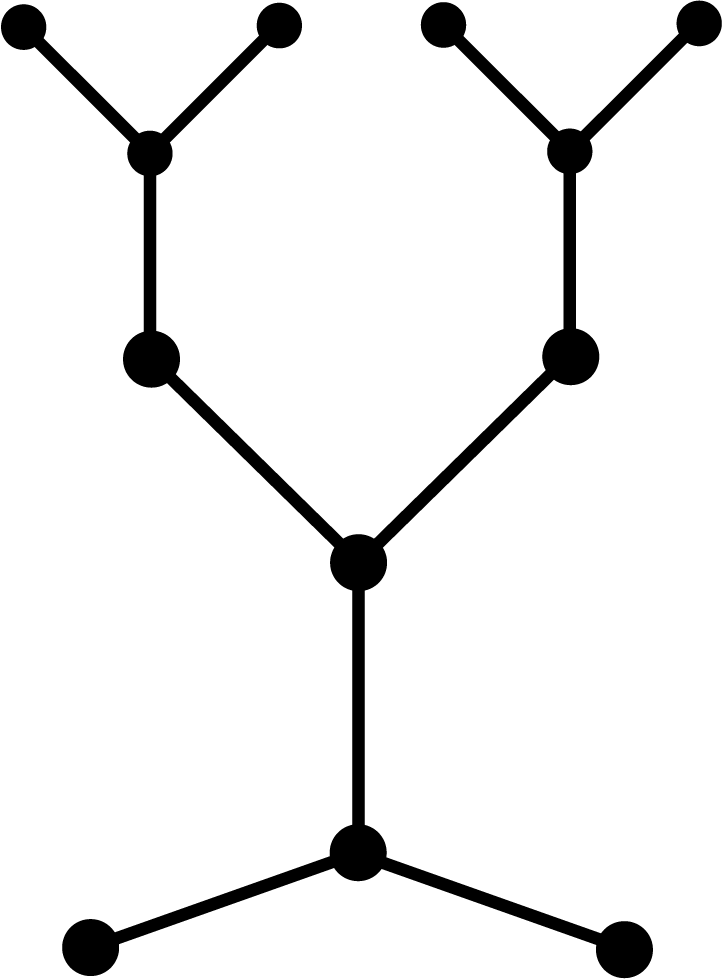 Figure 5
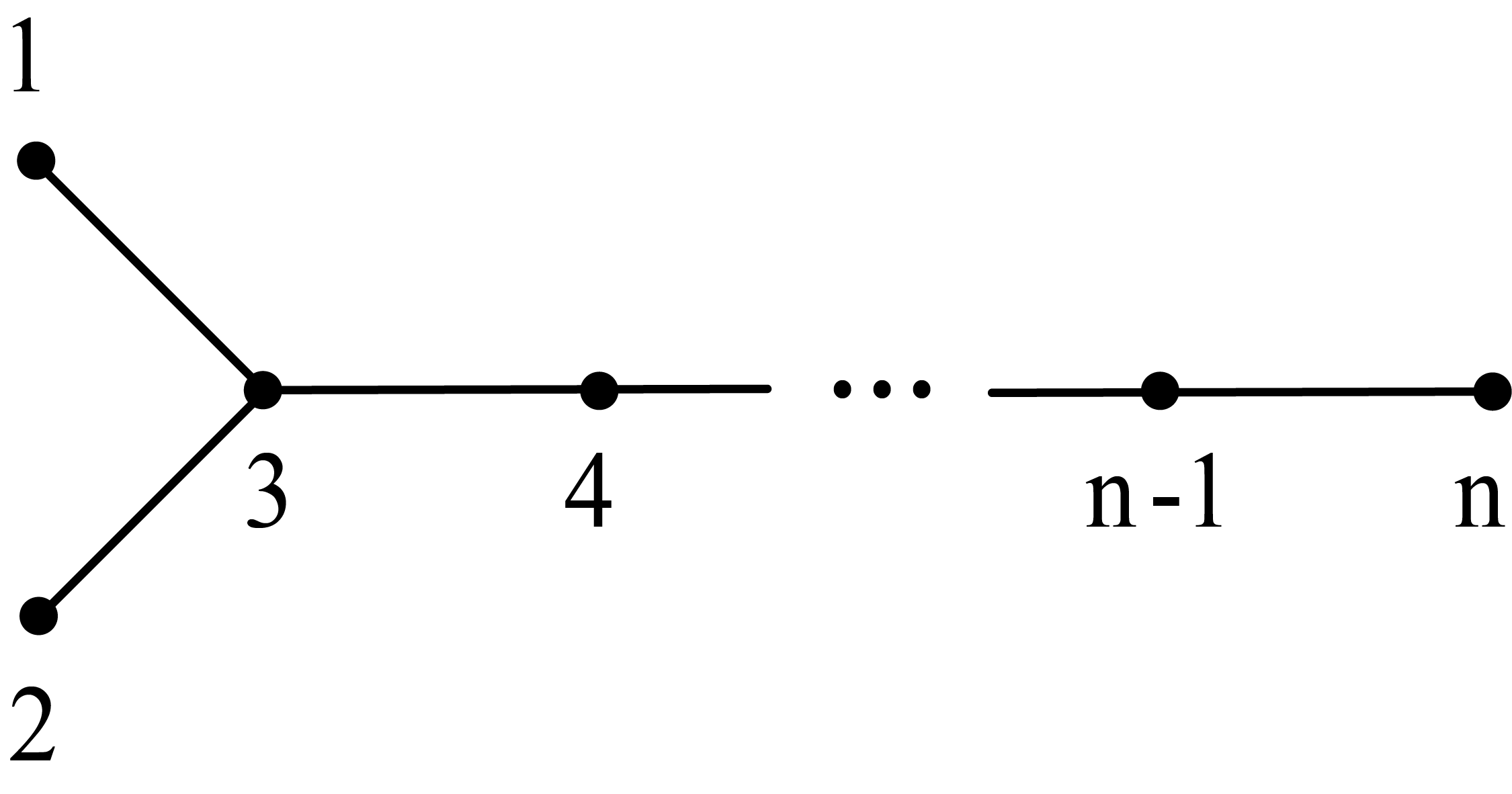 Figure 6
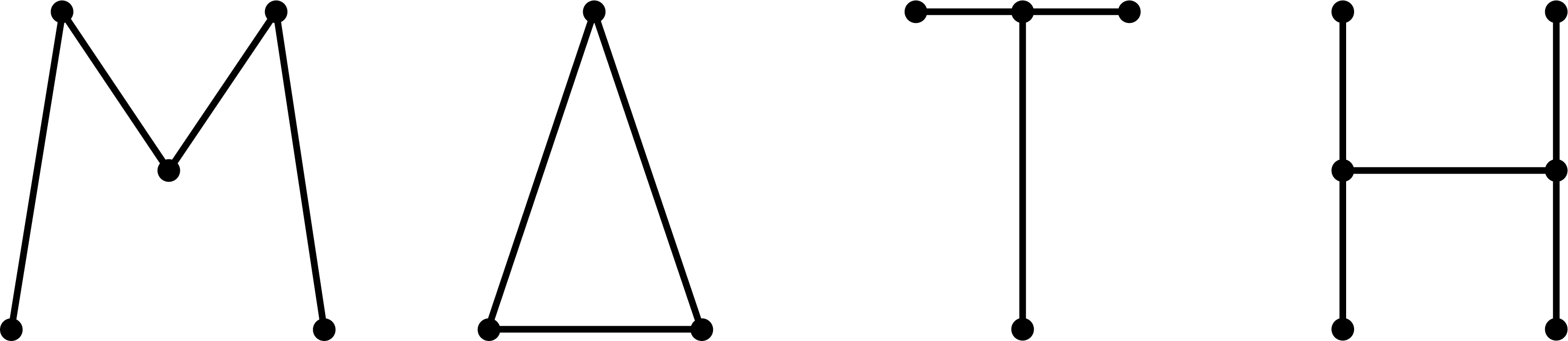 Figure 7
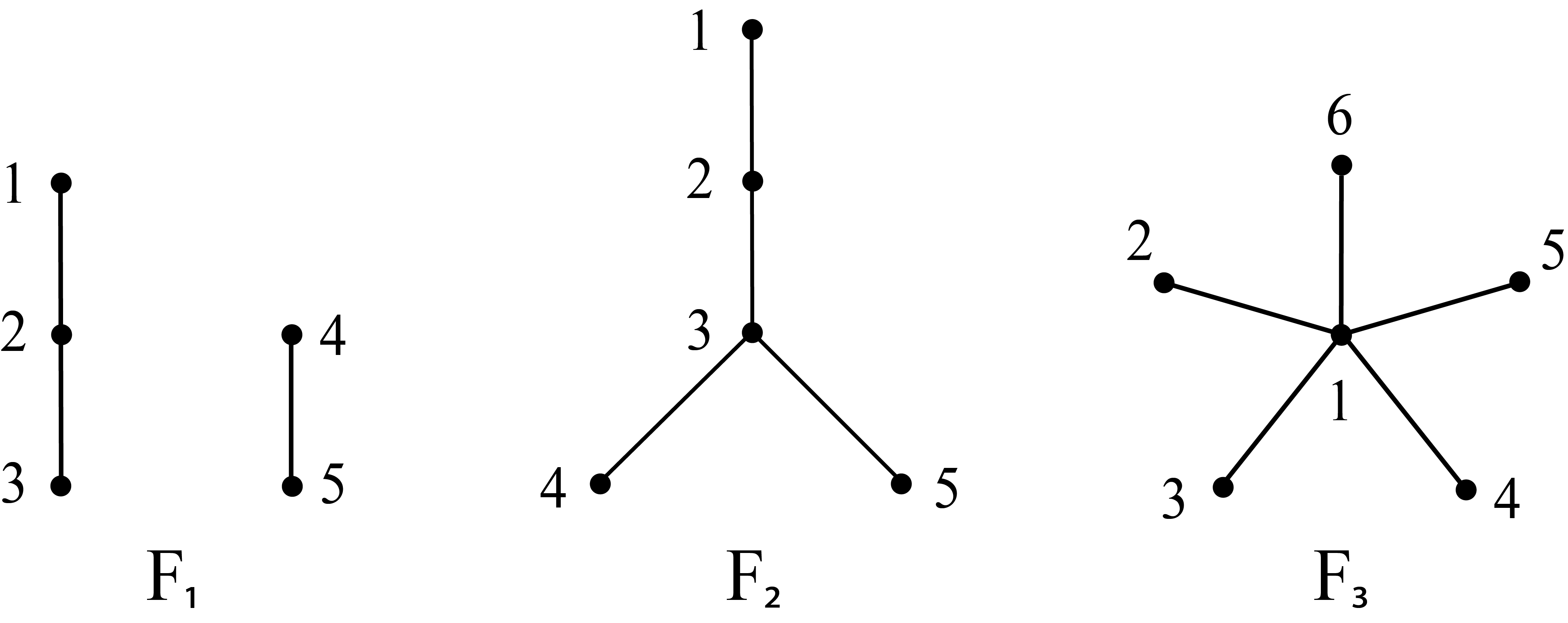 Figure 8
Peer Reviews
No public reviews on file for this paper yet. If you reviewed it on a platform where reviews are public (OpenReview, ICLR, NeurIPS, ICML), you can paste yours below so the community can read it here.
Videos
No videos yet. Explain this paper in a talk, walkthrough, or lecture? Add one.
Taxonomy
TopicsAdvanced Combinatorial Mathematics · Advanced Graph Theory Research · Graph theory and applications
The Chain Group of a Forest
Felix Gotti
Mathematics Department
UC Berkeley
Berkeley, CA 94720
and
Marly Gotti
Mathematics Department
University of Florida
Gainesville, FL 32611
Abstract.
For every labeled forest with set of vertices we can consider the subgroup of the symmetric group that is generated by all the cycles determined by all maximal paths of . We say that is the chain group of the forest . In this paper we study the relation between a forest and its chain group. In particular, we find the chain groups of the members of several families of forests. Finally, we prove that no copy of the dihedral group of cardinality inside can be achieved as the chain group of any forest.
1. Introduction
It is typical in Mathematics to use intrinsic information of discrete objects such as graphs, trees, and finite posets, to carry out algebraic and geometric constructions. For instance, such constructions include the fundamental group of a graph [4, Chapter 11], the incidence algebra of a finite poset [8, Chapter 3], and the forest polytope of a graph [7, Chapter 50]. In this paper we use the maximal paths of a forest to construct a finite group, which we call the chain group of . The method we use to produce the chain group of a given forest is motivated in part by the way Stanley defines a chain polytope from a locally finite poset (see [9]).
Given a finite poset , its corresponding chain polytope is defined to be the set of points satisfying the condition
[TABLE]
In other words, the chain polytope is the intersection of the half-spaces determined by the maximal chains of as indicated in (1.1).
Let us see how to reuse the same method Stanley applies to build the chain polytope of a poset, to naturally associate a finite group to each forest . Instead of taking as the universe containing the half-spaces utilized in (1.1) to produce , we can rather consider as the universe containing the generators of a group , which is defined by
[TABLE]
We call the chain group of the forest .
Chain polytopes, as introduced in [9] by Stanley, have nice features. For example, if is the chain polytope of the poset , then the number of vertices of equals the number of antichains of ; see [9, Theorem 2.2]. In addition, the volume of is determined by the combinatorial structure of ; see [9, Corollary 4.2]. We will see in Section 3 that the chain group of a forest has a nice behavior; for example, disjoint unions of forests become direct sums of groups (see Proposition 3.4). On the other hand, if we relabel a given forest , the resulting forest has chain group conjugate to (see Proposition 3.3).
There are a few natural questions we might ask about this assignment. How the chain groups of two distinct labeling of the same forest are associated? If is the chain group of the forest , can we determine whether satisfies certain properties only by studying ? It is our intension to answer such questions here.
In addition, we might wonder, for a fixed , which subgroups of will show as a chain group of some forest labeled by . Given that, every finite subgroup is a subgroup of for large enough, this is not a question that we expect to answer in its full generality. However, we might hope to decide whether relatively simple families of subgroups of can be realized as chain groups of some -forest. For example, is the alternating group a chain group of an -forest for every ? This question, along with other similar ones, will be answered later in the sequel.
This paper is structured as follows. In Section 2 we review the definitions on graph theory we will be using later. Then, in Section 3, we prove that passing from a forest to its chain group behaves well with respect to relabeling and changes disjoint union for direct sum. In Section 4 we study the abelian chain groups. In Section 5 we compute the chain groups of members of several families of trees. We also provide some results useful to find the chain groups of some forests. Finally, in Section 6, we show that the dihedral cannot be achieved as the chain group of any forest.
2. Background and Notation
In this section, we fix notation and briefly recall the definitions of the main objects related to those being studied here. We also state the relevant properties of such objects necessary to follow the present paper. For background material in group theory, symmetric groups, and graph theory we refer the reader to Rotman [5], Sagan [6], and Bondy and Murty [2], respectively.
The double-struck symbols and denote the sets of positive integers and non-negative integers, respectively. For , we denote the set just by . Following the standard notation of group theory, we let and denote the symmetric and the alternating group on letters, respectively. In addition, the dihedral group of order is denoted by .
To settle down our nomenclature, let us recall some basic definitions concerning graphs. A graph is a pair , where is a finite set and is a collection of -element subsets of . The elements of are called vertices of while the elements of are called edges of . It is often convenient to denote the set of vertices and the set of edges of by and , respectively. The degree of a vertex , denoted by , is the number of edges containing it. We say that a vertex is a leaf if it has degree one. An edge is also denoted by . Distinct vertices and of are called adjacent if . In the context of this paper, a walk in is a sequence of vertices, say such that is adjacent to for each . If , then the walk is said to be closed. If, in addition, implies that or then is called a path; in this case we say that the length of is . A path of is maximal if it is not strictly contained in another path. A closed path of length at least three is called a cycle. A graph is said to be connected if any two distinct vertices can be connected by a path. Every graph is the finite disjoint union of connected graphs, which are called connected components of . On the other hand, a graph is called acyclic provided it does not contain any cycle.
Definition 2.1**.**
An acyclic connected graph is called a tree. A finite disjoint union of trees is said to be a forest.
Example 2.2**.**
The next figure illustrates a graph having four connected components. The leftmost component is a chain, the second component is a cycle, the third component is a star, and the fourth component is a tree. Notice that is not a forest.
A labeled forest is a forest , whose vertices are labeled by the set . All the forests we will be interested in throughout this paper are labeled.
3. General Observations
In this section we formally define the chain group of a forest and explore some general facts connecting them. We also present some examples to illustrate the connection.
Definition 3.1**.**
For let be a labeled forest with vertices. The chain group of , which we denote by , is the subgroup of generated by all cycles such that is a maximal path in .
Example 3.2**.**
Figure 2 shows three forests , , and .
The forest consists of only two disjoint maximal paths, namely and ; therefore (cf. Proposition 3.4 below).
On the other hand, has exactly three maximal paths, which are , , and . As , the chain group contains a -cycle. On the other hand, as it follows that also contains the two cycle . Hence , and so .
Finally, has maximal paths. The chain group of is generated by the -cycles for all with . These -cycles are enough to generate the whole alternating group (see the proof of Theorem 5.1 for more details). Hence .
Note that acts on the set of labeled forests having exactly vertices by relabeling their vertices. We show now that this action conjugates the chain groups.
Proposition 3.3**.**
If and are forests with vertices that are a relabeling version of each other, then their chain groups are conjugate in .
Proof.
Let and denote the chain groups of and , respectively. Let be a graph isomorphism. In particular, we can interpret as an element in . Consider the map defined by . For every maximal path in , we have that is a maximal path in and, therefore,
[TABLE]
is a maximal path in . So the map is well defined. It follows immediately that is a group homomorphism. Now we can define by , and similarly verify that it is a well-defined homomorphism of groups. Since and are inverses of each other, is an isomorphism. ∎
Proposition 3.3 gives us the freedom to talk about the chain group of a non-necessarily labeled forest as long as we are not interested in the specific subgroup of the symmetric group we are dealing with but only in its isomorphic class.
Let us verify now that the chain group of a forest is the direct product of the chain groups of the trees of the given forest.
Proposition 3.4**.**
If is a forest which is the disjoint union of the trees , then .
Proof.
Let . It suffices to assume that . Let be the generating cycles induced by the maximal paths of , and let be the generating cycles induced by the maximal paths of . As and are disjoint cycles in for each pair , we can write every element of as for some and . Now it immediately follows that the assignment is, indeed, an isomorphism from to . ∎
4. Abelian Chain Groups associated to -Forests
In this section we characterize the forests whose chain groups are abelian. In addition, we determine those abelian groups that show up as chain groups of some forest.
Example 4.1**.**
Let be an -tree with at most two leafs. Then there is only one maximal path, namely for some bijection . Thus, the chain group associated to is .
More generally, we have the following result.
Proposition 4.2**.**
Let be a natural, and let be an -forest. Then the associated chain group of is abelian if and only if is the disjoint union of paths.
Proof.
Example 4.1, along with Proposition 3.4 in the preview section, immediately implies that if is the disjoint union of chains of lengths , then . In particular, is abelian. To prove the direct implication, suppose by contradiction that there are two distinct maximal paths and that are not disjoint. Set and . As has no cycles, . We can assume, without loss of generality that . Because , there exists an index such that and (let ). In this case . Hence and do not commute, contradicting the fact that is abelian. ∎
For , we study which abelian groups are chain groups associated to -forests.
Proposition 4.3**.**
The elementary abelian group , where is prime and is a natural, is the chain group associated to an -forest if and only if .
Proof.
For the direct implication, suppose that is the chain group of an -forest. This implies that contains a copy of . Consider the set of -cycles inside any disjoint-cycle decomposition of any element of . Take a maximal subset of satisfying that no element is a power of another one. As is abelian the ’s are pairwise disjoint. In addition, is isomorphic to and contains , which yields that . As the -cycles are disjoint, one finds that .
Suppose, on the other hand, that . Consider the forest having connected components, of them being path graphs on vertices and of them being -vertex trees. The chain group of is generated then by disjoint -cycles. Hence is a subgroup of isomorphic to the elementary abelian group , which completes the proof. ∎
Not every abelian subgroup of can be reached as an associated chain group of an -forest. In particular, the abelian subgroups of maximal order are never achieved in this way, as we shall prove in Theorem 4.5. The following theorem describes the abelian subgroups of of maximum order.
Theorem 4.4**.**
[3, Theorem 1]** Let be an abelian subgroup of maximal order of the symmetric group . Then
- (1)
* if ;* 2. (2)
* if ;* 3. (3)
either or if .
We can use Theorem 5.1 to argue the following proposition.
Theorem 4.5**.**
The maximum order abelian subgroups of are the chain group of -forests.
Proof.
Suppose first that . Theorem 5.1 guarantees that any maximum order abelian group of is a copy of . It follows by Proposition 4.3 that is the chain group of an -forest.
Assume now that . Consider the -forest consisting of the following connected components: -vertex paths and one two-vertex path. The chain group associated to is isomorphic to , which is a maximum order abelian group of by Theorem 5.1.
Lastly, assume that . Then consider the -forest having as connected components three-vertex paths and one -vertex path, and also consider the -forest having as connected components three-vertex paths and two -vertex path. Notice the chain groups of and are isomorphic to and , respectively. As before such groups have both maximum orders by Theorem 5.1, and the result follows. ∎
5. Chain Groups of some Trees
In this section, we will only consider trees. The simplest family of trees consists of chains (i.e., trees containing exactly one maximal path), and chain groups of chains are cyclic. Another very simple example of trees are the ones having all their vertices except one having degree (see the second graph in Figure 2). It turns out that the chain group of this family of trees is always as the next theorem indicates.
Theorem 5.1**.**
For every , there exists a labeled tree with vertices whose chain group is .
Proof.
When , the alternating group is is isomorphic to , and it is enough to take to be the only tree on vertices. Assume that . From the fact that every -cycle in not containing satisfies and the fact that every -cycle in not containing satisfies , we can immediately deduce that is generated by -cycles of the form for all . Now we just need to take to be the star graph to have that (see, for an illustration, the central forest in Figure 2). ∎
Now we turn to find a large family of forests each of its members has chain group , where . First, let us introduce the following definition.
Definition 5.2**.**
We say that a tree is an antenna if it has exactly one vertex of degree three and exactly one maximal path of length two.
It is not hard to verify that if a tree is an antenna, then it must be like in Figure 2 with, perhaps, the vertical path more prolonged upward. In particular, an antenna has exactly three maximal paths.
Proposition 5.3**.**
Let be a labeled antenna with an odd number of vertices. Then the chain group of is .
Proof.
By Proposition 3.3, we can relabel if necessary so that its labels look like the one in Figure 3. Let be the chain group of .
The maximal path of are the with corresponding generator , the path with corresponding generator , and the path with corresponding generator . Notice that is a cycle of length . In addition, the disjoint cycle decomposition of contains exactly a cycle of length two and a cycle of length . Therefore is a transposition. As contains a full cycle and a transposition, it must be . ∎
Proposition 5.3 says in particular that for every odd there is a tree whose chain forest is . In addition, we can use this proposition to find the chain group of more complex forests. Before explaining how to do this, let us introduce the following definition.
Definition 5.4**.**
Let be a graph, and let be a subgraph of . We say that is an extended subgraph of is every leaf of is also a leaf of .
Extended subtrees and extended subforests are defined in a similar fashion. Notice that a connected component of a graph is always an extended subtree. The next figure depicts a tree and two of its subgraphs (which happen to be forests) only one of them being extended.
It follows immediately that if is a forest and is an extended subforest of , then the chain group of is a subgroup of the chain group of . Using this observation and Proposition 5.3 is not hard to argue the following result.
Proposition 5.5**.**
Let be a tree with vertices and a maximal path of length two. If the distance from any of the two leaves in to any leaf that is not in is odd, then the chain group of is .
Proof.
Left to the reader. ∎
Proposition 5.5, along with Proposition 3.4, allows us to easily determine the chain groups of relatively complex forests. For example, the chain group of the forest illustrated in Figure 5 is .
We closed this section providing a sufficient condition for the chain groups of some antenna-like trees to have a full cycle.
Proposition 5.6**.**
Let be a labeled tree with vertices having exactly one vertex of degree three and the rest of its vertices of degree at most two. If is odd for some leave , then has a cycle of length .
Proof.
Note first that only has three leaves, say and . Suppose, without loss of generality, that is odd. Let be the path from to . Also, let and . Then notice that
[TABLE]
is a cycle of length . ∎
6. The Dihedral is Missing
The symmetric group contains many copies of the dihedral group . However, none of these copies is the chain group of any labeled forest with vertices.
Lemma 6.1**.**
Let be a tree with at least two vertices whose degree is strictly greater than . Then contains a maximal chain such that .
Proof.
Let and be two distinct vertices of with degrees at strictly greater than . Let be the unique path in from to . As there exist two maximal paths and among those starting at such that . Similarly, there are two paths and maximal among those starting at satisfying that . Let be the leaves contained in , respectively. Now take to be the unique maximal chain from to . Because does not contain any vertex in , the lemma follows. ∎
Theorem 6.2**.**
For every , the dihedral group is not a chain group of any labeled forest with vertices.
Proof.
The dihedral cannot be the chain group of the trivial forest because the latter is trivial. In addition, the possible chain groups of a -forest are isomorphic to either the trivial group or and ; therefore the theorem is also true in the case of . Let and assume, by way of contradiction, that is an -forest whose chain group is the dihedral .
First, let us consider the case in which is disconnected. Since the action of on does not fix any point, cannot have trivial connected components (i.e., isolated vertices). If had a connected component with at least three vertices, then any element of associated to a maximal path of a component would fix at least three elements of , namely the vertices of , which is impossible because every nontrivial element of fixes at most two elements of . Therefore every connected component of contains exactly two vertices. But the fact that is the disjoint union of paths, contradicts that is not abelian. Hence cannot be disconnected.
Now let be a tree with vertices whose associated chain group is . Since is not abelian, is not a path graph. If contains two vertices of degree strictly greater than , then Lemma 6.1 guarantees the existence of a maximal chain such that contains at least three vertices. Thus, the generator of associated to the chain would fix at least three elements of , which cannot be possible. Hence must contain at most one vertex such that .
Suppose first that . If , then it is not hard to see that for every maximal chain of containing one has , which would imply that the generator of associated to fixes at least elements of . Thus, assume . If , then it follows as before that there are at least vertices in the complement of any maximal chain of having minimum size among those containing . On the other hand, implies that is isomorphic to . By Theorem 5.1, the chain group of is , which is not isomorphic to (for instance, ), a contradiction.
Finally, suppose that . To argue this case, let be a maximal chain of with maximum cardinality among those containing , and let be the generator of the copy of in induced by . The element is not an -cycle as . On the other hand, the maximality of implies that has order strictly greater than . As the only elements in of order are the -cycles, we obtain a contradiction. The theorem now follows. ∎
The reference list from the paper itself. Each links out to its DOI / PubMed record.
- 1[1] A. Björner and F. Brenti, Combinatorics of Coxeter Groups , Grad. Texts in Math., 231, Springer-Verlag, New York, 2005.
- 2[2] A. Bondy and U. S. R. Murty, Graph Theory , Grad. Texts in Math., 244, Springer-Verlag, New York, 2008.
- 3[3] J. M. Burns and B. Goldsmith, Maximal order abelian subgroups of symmetric groups , Bull. London Math. Soc. 21 (1989) 70–72.
- 4[4] A. Hatcher, Algebraic Topology , Cambridge University Press, New York, 2001.
- 5[5] J. J. Rotman, An Introduction to the Theory of Groups , Grad. Texts in Math., 148, Springer-Verlag, New York, 1994.
- 6[6] B. E. Sagan, The Symmetric Group: Representations, Combinatorial Algorithms, and Symmetric Functions , Grad. Texts in Math., 203, Springer-Verlag, New York, 2001.
- 7[7] A. Schrijver, Combinatorial Optimization: Polyhedra and Efficiency , Vol. B, Springer-Verlag, New York, 2003.
- 8[8] R. P. Stanley, Enumerative Combinatorics , Vol. 1, Cambridge University Press, New York, 2011.