Quantum Slow Relaxation and Metastability due to Dynamical Constraints
Zhihao Lan, Merlijn van Horssen, Stephen Powell, and Juan P. Garrahan

TL;DR
This paper demonstrates that dynamical constraints in quantum many-body systems can cause slow thermalization and metastability, similar to classical glasses, with models showing long-lived memory effects and entanglement heterogeneity.
Contribution
It introduces quantum models with dynamical constraints that exhibit slow relaxation and metastability, extending classical glass concepts to quantum systems.
Findings
Slow thermalization near the potential energy dominated regime.
Persistence of initial conditions over long times.
Dynamical heterogeneity with spatially segregated entanglement growth.
Abstract
One of the general mechanisms that give rise to the slow cooperative relaxation characteristic of classical glasses is the presence of kinetic constraints in the dynamics. Here we show that dynamical constraints can similarly lead to slow thermalization and metastability in translationally invariant quantum many-body systems. We illustrate this general idea by considering two simple models: (i) a one-dimensional quantum analogue to classical constrained lattice gases where excitation hopping is constrained by the state of neighboring sites, mimicking excluded-volume interactions of dense fluids; and (ii) fully packed quantum dimers on the square lattice. Both models have a Rokhsar--Kivelson (RK) point at which kinetic and potential energy constants are equal. To one side of the RK point, where kinetic energy dominates, thermalization is fast. To the other, where potential energy…
Click any figure to enlarge with its caption.
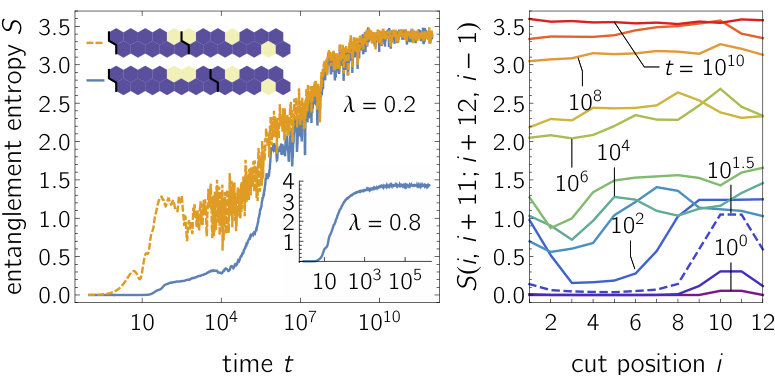 Figure 1
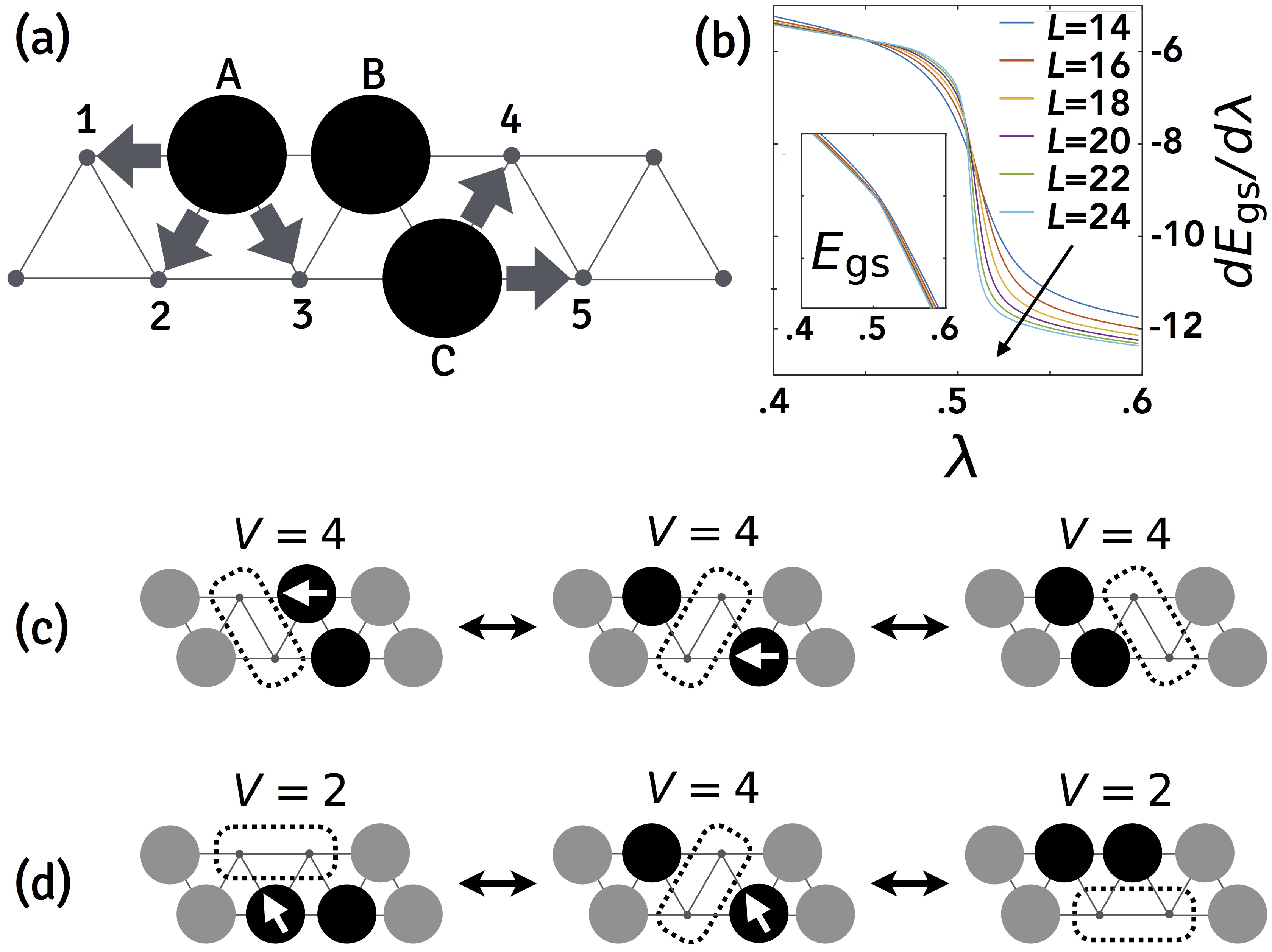 Figure 1
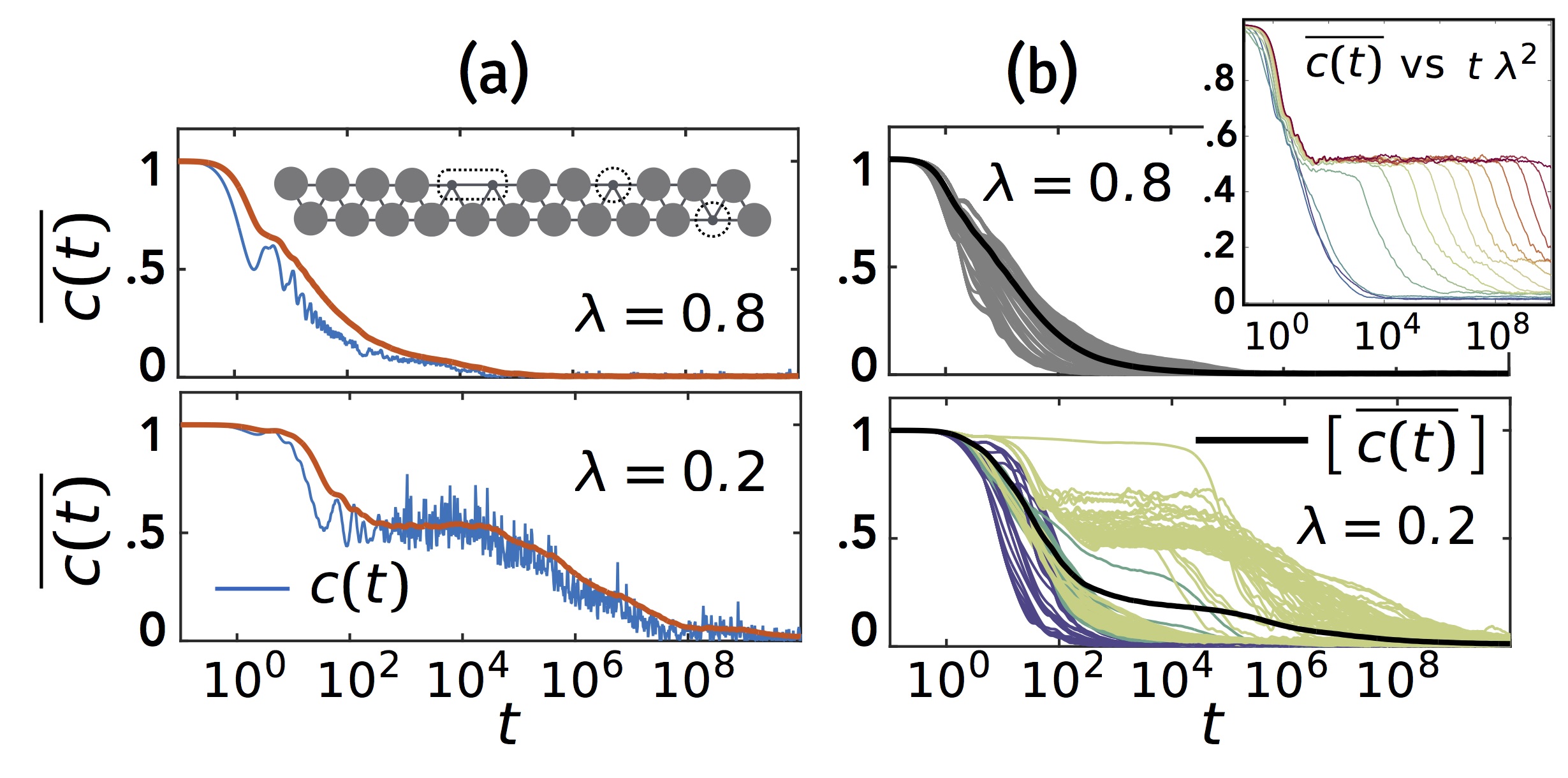 Figure 2
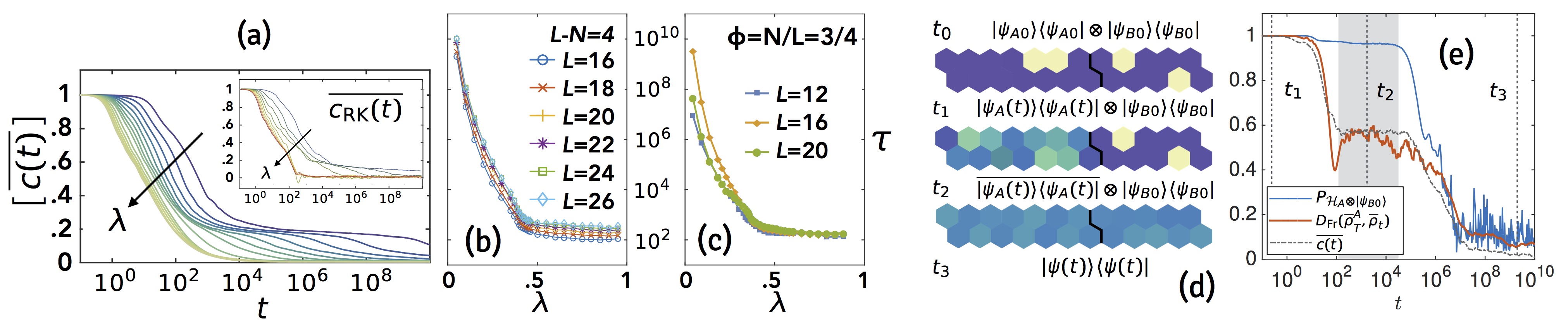 Figure 3
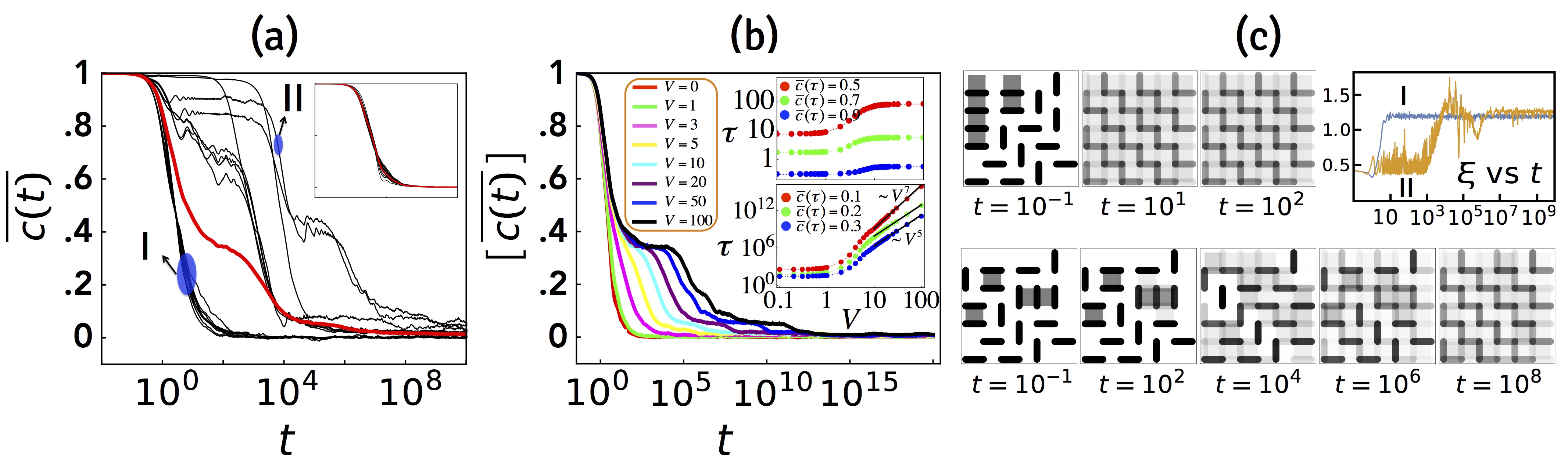 Figure 5
 Figure 6
 Figure 7
Peer Reviews
No public reviews on file for this paper yet. If you reviewed it on a platform where reviews are public (OpenReview, ICLR, NeurIPS, ICML), you can paste yours below so the community can read it here.
Videos
No videos yet. Explain this paper in a talk, walkthrough, or lecture? Add one.
Quantum Slow Relaxation and Metastability due to Dynamical Constraints
Zhihao Lan
Centre for the Mathematics and Theoretical Physics of Quantum Non-equilibrium Systems
School of Physics and Astronomy, University of Nottingham, Nottingham NG7 2RD, United Kingdom
Merlijn van Horssen
Centre for the Mathematics and Theoretical Physics of Quantum Non-equilibrium Systems
School of Physics and Astronomy, University of Nottingham, Nottingham NG7 2RD, United Kingdom
Stephen Powell
Centre for the Mathematics and Theoretical Physics of Quantum Non-equilibrium Systems
School of Physics and Astronomy, University of Nottingham, Nottingham NG7 2RD, United Kingdom
Juan P. Garrahan
Centre for the Mathematics and Theoretical Physics of Quantum Non-equilibrium Systems
School of Physics and Astronomy, University of Nottingham, Nottingham NG7 2RD, United Kingdom
Abstract
One of the general mechanisms that give rise to the slow cooperative relaxation characteristic of classical glasses is the presence of kinetic constraints in the dynamics. Here we show that dynamical constraints can similarly lead to slow thermalization and metastability in translationally invariant quantum many-body systems. We illustrate this general idea by considering two simple models: (i) a one-dimensional quantum analogue to classical constrained lattice gases where excitation hopping is constrained by the state of neighboring sites, mimicking excluded-volume interactions of dense fluids; and (ii) fully packed quantum dimers on the square lattice. Both models have a Rokhsar–Kivelson (RK) point at which kinetic and potential energy constants are equal. To one side of the RK point, where kinetic energy dominates, thermalization is fast. To the other, where potential energy dominates, thermalization is slow, memory of initial conditions persists for long times, and separation of timescales leads to pronounced metastability before eventual thermalization. Furthermore, in analogy with what occurs in the relaxation of classical glasses, the slow-thermalization regime displays dynamical heterogeneity as manifested by spatially segregated growth of entanglement.
Introduction.—Interacting quantum systems generically equilibrate: their long-time state after unitary evolution under the Hamiltonian is, loosely speaking, indistinguishable from the time-integrated state, as concerns expectation values of local observables Reimann (2008); Linden et al. (2009); Short (2011); Short and Farrelly (2012); Reimann and Kastner (2012). Equilibration requires (almost) no degeneracies in energy gaps and stationarity is due to dephasing in the energy eigenbasis Gogolin and Eisert (2016); D’Alessio et al. (2016); Borgonovi et al. (2016). Most quantum many-body systems, furthermore, are believed to thermalize Gogolin and Eisert (2016); D’Alessio et al. (2016); Borgonovi et al. (2016): if and are partitions, the reduced state in at long times tends to , with temperature set by the constant Gogolin and Eisert (2016); D’Alessio et al. (2016); Borgonovi et al. (2016). Expectation values in hence take thermal values, and memory of initial conditions is lost except for the energy. This is the general setup for quantum ergodicity, where the system acts as its own thermal reservoir Gogolin and Eisert (2016); D’Alessio et al. (2016); Borgonovi et al. (2016). Thermalization can be seen as a consequence of the eigenstate thermalization hypothesis (ETH) Deutsch (1991); Srednicki (1994); Tasaki (1998); Rigol et al. (2008).
Exceptions to this scenario include integrable systems Essler and Fagotti (2016) which equilibrate to a generalized Gibbs ensemble (i.e., being “as ergodic as possible” given their large number of conserved quantities) Rigol et al. (2007); Vidmar and Rigol (2016). Another notable exception is many-body localization (MBL) Altshuler et al. (1997); Basko et al. (2006); Gornyi et al. (2005); Oganesyan and Huse (2007); Znidaric et al. (2008); Pal and Huse (2010); Bardarson et al. (2012); Serbyn et al. (2013); Huse et al. (2014); Andraschko et al. (2014); Yao et al. (2014); Serbyn et al. (2014); Laumann et al. (2014); De Roeck and Huveneers (2014); Ros et al. (2015); Vasseur et al. (2015); Agarwal et al. (2015); Bar Lev et al. (2015); Imbrie (2016); Schreiber et al. (2015); Bordia et al. (2016); Smith et al. (2016) displayed by many-body quantum systems with quenched disorder; for reviews see Nandkishore and Huse (2015); Altman and Vosk (2015); Abanin and Papic (2017). Under MBL conditions – typically when the disorder exceeds some threshold – ETH breaks down, dynamics becomes nonergodic, and the long-time state depends on initial conditions.
One can compare the above to mechanisms for classical nonergodicity. MBL is analogous to classical systems with random fields or interactions, such as spin glasses Binder and Young (1986), where strong disorder leads to thermodynamic phase transitions to nonergodic states. But classically, disorder is not the only mechanism that impedes relaxation. Structural glasses, such as those formed from supercooled liquids or densified colloids, are nonthermalising without quenched disorder Binder and Kob (2011); Berthier and Biroli (2011); Biroli and Garrahan (2013). The central ingredients are excluded-volume (steric) interactions that lead to effective kinetic constraints in the dynamics Fredrickson and Andersen (1984); Palmer et al. (1984); Ritort and Sollich (2003). In contrast to spin-glasses, it is debated Lubchenko and Wolynes (2007); Chandler and Garrahan (2010); Binder and Kob (2011); Berthier and Biroli (2011); Biroli and Garrahan (2013) whether structural glasses eventually undergo a phase transition to a truly nonergodic state, or if, given enough time, they would eventually thermalize. If the latter, they are dynamically metastable, appearing nonergodic on experimental timescales. Similarly, an important open question in quantum nonergodicity is whether MBL is possible in translational invariant systems Carleo et al. (2012); van Horssen et al. (2015); Schiulaz et al. (2015); Papić et al. (2015); Barbiero et al. (2015); Yao et al. (2016); Prem et al. (2017); Smith et al. (2017); Yarloo et al. (2018); Mondaini and Cai (2017).
Here we address the question of slow quantum relaxation in nondisordered systems due to dynamical constraints. We consider systems that obey ETH – and thus thermalize asymptotically – but where thermalization is slow due to a separation of timescales that leads to pronounced metastability. We consider two prototypical models, a one-dimensional (1D) quantum analogue to classical constrained lattice gases Kob and Andersen (1993); Jackle and Kronig (1994); Ritort and Sollich (2003); Pan et al. (2005) and quantum dimers on the two-dimensional (2D) square lattice Rokhsar and Kivelson (1988); Moessner and Raman (2011); Chalker . In both cases, we show the existence of slow relaxing regimes when interactions dominate over kinetic energy. As in classical glasses, we find that metastability is associated to spatially heterogeneous relaxation dynamics.
1D constrained quantum lattice gas.—Consider hard-core particles moving on a 1D strip of a triangular lattice with sites (and periodic boundary conditions along the strip) and particles; see Fig. 1. The Hamiltonian is
[TABLE]
Here , , , with and the empty and occupied states on site , respectively, and the sum is over nearest neighbors . The operator is a dynamical constraint, where the product is over all common-neighbor sites of and . As for classical constrained lattice gases Kob and Andersen (1993); Jackle and Kronig (1994); Ritort and Sollich (2003); Pan et al. (2005), mimics steric restrictions: particles occupy finite volume and impede motion of their neighbors; see Fig. 1(a). The model conserves density but has no particle–hole symmetry. The effect of the constraints is only significant for large fillings, where many moves possible in the unconstrained problem are blocked.
The first term of the summand in Eq. (1) describes nearest-neighbor hopping with frequency , while the second is an interaction energy between the same neighbors of strength . Both terms vanish if the constraint on the bond is not satisfied, and thus, only bonds for which contribute 111 The structure of is similar to those in van Horssen et al. (2015) and Hickey et al. (2016). Constraints partition Hilbert space into disconnected components: states with only isolated vacancies cannot be dynamically connected with ; but most states have at least one pair of neighouring vacancies and belong to the ergodic partition (we consider the dynamics in this main subspace). The model here and those of van Horssen et al. (2015); Hickey et al. (2016) are termed “embedded” Hamiltonians in Shiraishi and Mori (2017). . The system has a Rokhsar–Kivelson (RK) point at Rokhsar and Kivelson (1988); Castelnovo et al. (2005): the Hamiltonian is equivalent to (minus) the generator of classical stochastic dynamics and the ground-state wave function is given by an equal superposition of all classical states for each filling. For , is also related to classical dynamics, being (minus) the “tilted” generator for ensembles of trajectories whose probability is biased by with the total number of particle hops Lecomte et al. (2007); Garrahan et al. (2009a). The ground-state energy of then gives the large-deviation Touchette (2009) cumulant-generating function of . For constrained lattice gases, it is known Garrahan et al. (2009a) that this has a first-order singularity at in the large size limit, corresponding to a quantum phase transition in the quantum problem; see Fig. 1(b).
We consider evolution under the dynamics generated by Eq. (1), , taking as initial states product states corresponding to classical configurations, (discarding those with only isolated vacancies, which are disconnected under ). To quantify relaxation, we study two-time correlation functions, in particular the autocorrelator,
[TABLE]
where is the Heisenberg-picture number operator and is the filling fraction. Equation (2) defines the connected correlator, scaled to go from to . Since is a product state, reduces to the expectation value for initially occupied sites .
Figure 2(a) shows and the time-averaged (to smooth out short-scale fluctuations) for one particular initial condition. For , the kinetic term in dominates over the potential and thermalization is fast. In sharp contrast, for , where potential energy dominates over kinetic, displays a pronounced separation of timescales, decaying fast to a nonzero plateau, and thermalizing only at much longer times. Such two-step correlators are typical of classical glassy systems Binder and Kob (2011); Berthier and Biroli (2011); Biroli and Garrahan (2013). Figure 2(b) shows for all product-state initial conditions. For , there is little variation between initial conditions, and all correlators decay rapidly. In turn, for , there is a strong dependence on initial conditions, some thermalizing fast, while others thermalize much more slowly.
This can be understood as follows. For small , we can consider the hopping term in perturbatively. The simplest mechanism for relaxation is effective hopping of dimers of vacancies, cf. Fig. 1(c,d), which requires the hybridization of unperturbed states with energy . Dimers therefore diffuse with an effective rate scaling as . However, when a dimer encounters an isolated vacancy, this mechanism breaks down as the corresponding states become off-resonant; isolated vacancies therefore act as barriers to dimer propagation. The separation of timescales can be seen in the inset of Fig. 2(b), which shows for the initial state of Fig. 2(a) for varying : the rate accounts for the whole correlators in the fast regime () but only up to the plateau in the slow regime () where subsequent relaxation requires more complex collective processes.
Figure 3(a) shows the autocorrelator for an equal mixture of all initial conditions (infinite-temperature average), . It is dominated by slow-relaxing initial states [i.e., those with isolated vacancies, cf., inset of Fig. 2(a)] and displays two-step behavior for . The inset to Fig. 3(a) shows the (time-averaged) autocorrelator for an initial state that is the ground state at the RK point (an equal superposition of all basis states), amounting to a quench from the RK point. In contrast to the product states of the mixture, this initial state is entangled. Nonetheless, slow relaxation for is still apparent.
An overall relaxation time can be defined from . The values of for a threshold are shown in Fig. 3(b,c) as a function of : in (b) we fix the number of vacancies and change system size , while in (c) we fix the filling . In both cases, there is a clear change around the RK point, , from a regime where the timescale grows modestly, to one where increases substantially with decreasing . In particular from Fig. 3(c), we expect that this behavior will persist in the limit with fixed.
Metastability for is associated with dynamically heterogeneous relaxation, as illustrated in Fig. 3(d). The initial state is the product state of Fig. 2(a), which can be written as where the system is split into region containing the vacancy dimer and region containing the isolated vacancies. The figure shows three time regimes. Times are for evolving from to its plateau value. This initial relaxation only entangles region , and the state is well approximated by , where with the restriction of Eq. (1) to . Times correspond to the metastable regime, where region is thermalized while region is not. The state here is . Indeed, within regimes and the state is almost entirely supported on the subspace , where indicates the Hilbert space of region . Only on much longer timescales is full entanglement established between regions and , see Fig. 3(e).
Heterogeneity in the dynamics is further confirmed by the behavior of the entanglement entropy , for different choices of – bipartition, as shown in Fig. 4. This supports the picture of propagating dimers entangling parts of the system: e.g., at , entanglement is large for partitions that allow the dimer to visit both regions (dashed line in the left panel, and in the right), but much smaller for those where the dimer is hindered from crossing the boundary (solid line and ).
Square-lattice quantum dimer model.—The Hilbert space of the quantum dimer model (QDM) consists of all close-packed dimer configurations, where each site of the lattice forms a dimer with one of its nearest neighbors Rokhsar and Kivelson (1988); Moessner and Raman (2011); Chalker . ETH in the square- and triangular-lattice QDM has recently been studied in Lan and Powell (2017). On the square lattice, the Hamiltonian is
[TABLE]
where the sum is over all plaquettes (squares) of the lattice. The first (kinetic) term flips adjacent parallel dimers while the second (potential) counts the number of flippable plaquettes. has an RK point at Rokhsar and Kivelson (1988). A quantity conserved by Chalker – cf., the occupation for the lattice gas – is the flux , defined on an lattice by , where is the number of dimers, [math] or , on the link from site in direction .
We consider dynamics starting from a dimer configuration and define the two-time correlation , where the sum is over all links and the Heisenberg picture is again used. As for the lattice gas, we denote by and the time-integrated average and infinite-temperature average of , respectively, normalized so that and .
Figure 5(a) shows for all starting configurations with on a lattice with periodic boundary conditions. For , the decay of is consistently fast, while for , relaxation is instead either fast or slow depending on initial configuration. The infinite-temperature average displays a plateau before the correlation decays to its long-time limit; Fig. 5(b) shows that this plateau appears for . The distinction between fast (small ) and slow (large ) dynamics is clearly visible in the lower inset of Fig. 5(b), which shows the time at which for that are below the level of the plateau (). For very large , follows a power law, but with the exponent depending on . While the exponent may depend on the details of the relaxation, which involves passing through multiple steps, the presence of a power law is likely physical. The same fast–slow distinction is evident even before the appearance of the plateau, as the upper inset of Fig. 5(b) shows, with a step change in the time taken to reach thresholds that are above the plateau.
These results can be understood through a physical picture similar to that for the lattice gas, in which spatial inhomogeneities play an important role. Figure 5(c) shows the expectation value of the potential energy for each plaquette as time evolves, for two different initial configurations at . For configuration I (top), correlations decay fast and relaxation becomes homogeneous quickly, while for the slower configuration II (bottom), heterogeneity persists even at late times.
The inset to Fig. 5(c) shows the correlation length where , and is the lattice distance accounting for periodic boundary conditions. eventually becomes larger than the lattice spacing, implying that neighboring degrees of freedom are correlated (unlike in the ground state at this value of ). The time at which grows towards its asymptotic value coincides with the relaxation time of autocorrelators, cf. Fig. 5(a).
Conclusions.— We have demonstrated slow relaxation due to dynamical constraints in closed quantum systems without quenched disorder. The two models studied exhibit thermalization asymptotically, but for certain parameter values the relaxation is anomalously slow, strongly sensitive to initial conditions, and spatially heterogeneous. Our work should be contrasted with studies of two-component systems Yao et al. (2016); Yarloo et al. (2018), where timescale separation is due to the distinction between heavy and light components. As in the case of classical glasses Chandler and Garrahan (2010), constrained dynamics – either explicit or effective Garrahan and Newman (2000); Berges et al. (2004); Chamon (2005); Garrahan et al. (2009b); Castelnovo et al. (2012); Nandkishore and Hermele (2018) – should be a generic mechanism for slow and spatially fluctuating relaxation in quantum systems.
We thank E. Levi and M. Rigol for discussions. This work was supported by EPSRC Grants No. EP/L50502X/1 (M.V.H.), No. EP/M014266/1 (J.P.G.) and No. EP/M019691/1 (Z.L. and S.P.).
The reference list from the paper itself. Each links out to its DOI / PubMed record.
- 1Reimann (2008) P. Reimann, Phys. Rev. Lett. 101 , 190403 (2008) . · doi ↗
- 2Linden et al. (2009) N. Linden, S. Popescu, A. J. Short, and A. Winter, Phys. Rev. E 79 , 061103 (2009) . · doi ↗
- 3Short (2011) A. J. Short, New Journal of Physics 13 , 053009 (2011) .
- 4Short and Farrelly (2012) A. J. Short and T. C. Farrelly, New Journal of Physics 14 , 013063 (2012) .
- 5Reimann and Kastner (2012) P. Reimann and M. Kastner, New Journal of Physics 14 , 043020 (2012) .
- 6Gogolin and Eisert (2016) C. Gogolin and J. Eisert, Reports on Progress in Physics 79 , 056001 (2016) .
- 7D’Alessio et al. (2016) L. D’Alessio, Y. Kafri, A. Polkovnikov, and M. Rigol, Adv. Phys. 65 , 239 (2016).
- 8Borgonovi et al. (2016) F. Borgonovi, F. M. Izrailev, L. F. Santos, and V. G. Zelevinsky, Quantum chaos and thermalization in isolated systems of interacting particles , Physics Reports 626 , 1 (2016) . · doi ↗