Active Learning for Structured Prediction from Partially Labeled Data
Mehran Khodabandeh, Zhiwei Deng, Mostafa S. Ibrahim, Shinichi Satoh,, Greg Mori

TL;DR
This paper introduces a versatile active learning algorithm for structured prediction tasks, effectively reducing labeled data requirements while maintaining high accuracy, demonstrated on human action recognition in videos.
Contribution
The paper presents a novel active learning method based on expected information gain for structured prediction, applicable across various models and tasks.
Findings
Outperforms previous active learning methods
Achieves comparable accuracy to fully supervised models
Uses significantly less labeled data
Abstract
We propose a general purpose active learning algorithm for structured prediction, gathering labeled data for training a model that outputs a set of related labels for an image or video. Active learning starts with a limited initial training set, then iterates querying a user for labels on unlabeled data and retraining the model. We propose a novel algorithm for selecting data for labeling, choosing examples to maximize expected information gain based on belief propagation inference. This is a general purpose method and can be applied to a variety of tasks or models. As a specific example we demonstrate this framework for learning to recognize human actions and group activities in video sequences. Experiments show that our proposed algorithm outperforms previous active learning methods and can achieve accuracy comparable to fully supervised methods while utilizing significantly less…
Click any figure to enlarge with its caption.
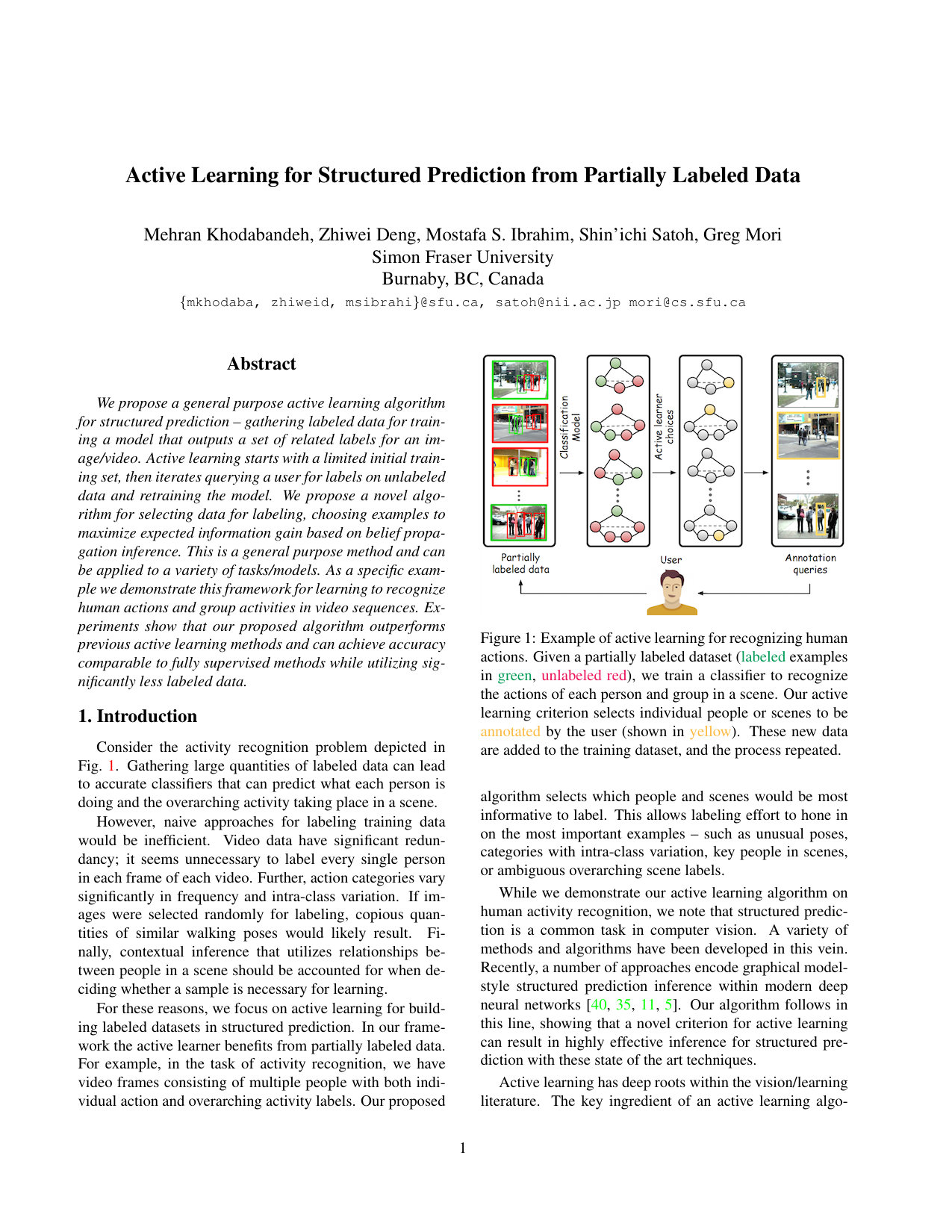 Figure 1
Peer Reviews
No public reviews on file for this paper yet. If you reviewed it on a platform where reviews are public (OpenReview, ICLR, NeurIPS, ICML), you can paste yours below so the community can read it here.
Videos
No videos yet. Explain this paper in a talk, walkthrough, or lecture? Add one.
Taxonomy
TopicsMachine Learning and Algorithms · Machine Learning and Data Classification · Anomaly Detection Techniques and Applications
See pages 1-last of paper.pdf