Scattering by a periodic array of subwavelength slits I: field enhancement in the diffraction regime
Junshan Lin, Hai Zhang

TL;DR
This paper analyzes electromagnetic scattering by a periodic array of subwavelength slits in the diffraction regime, focusing on resonances, field enhancement, and the absence of Fano resonances, providing asymptotic and quantitative insights.
Contribution
It offers the first detailed asymptotic analysis of resonances and field enhancement in the diffraction regime for subwavelength slit arrays, including the characterization of embedded eigenvalues.
Findings
Resonances and eigenvalues are asymptotically expanded away from Rayleigh cut-off frequencies.
Field enhancement is quantified and shown to weaken near Rayleigh cut-off frequencies.
Fano resonant phenomena do not occur in narrow slit arrays.
Abstract
This is the first part in a series of two papers that concern with the quantitative analysis of the electromagnetic field enhancement and anomalous diffraction by a periodic array of subwavelength slits. The scattering problem in the diffraction regime is investigated in this part, for which the size of the period is comparable to the incident wavelength. We distinguish scattering resonances and real eigenvalues, and derive their asymptotic expansions when they are away from the Rayleigh cut-off frequencies. Furthermore, we present quantitative analysis of the field enhancement at resonant frequencies, by quantifying both the enhancement order and the associated resonant modes. The field enhancement near the Rayleigh cut-off frequencies is also investigated. It is demonstrated that the field enhancement becomes weaker at the resonant frequency if it is close to the Rayleigh cut-off…
Click any figure to enlarge with its caption.
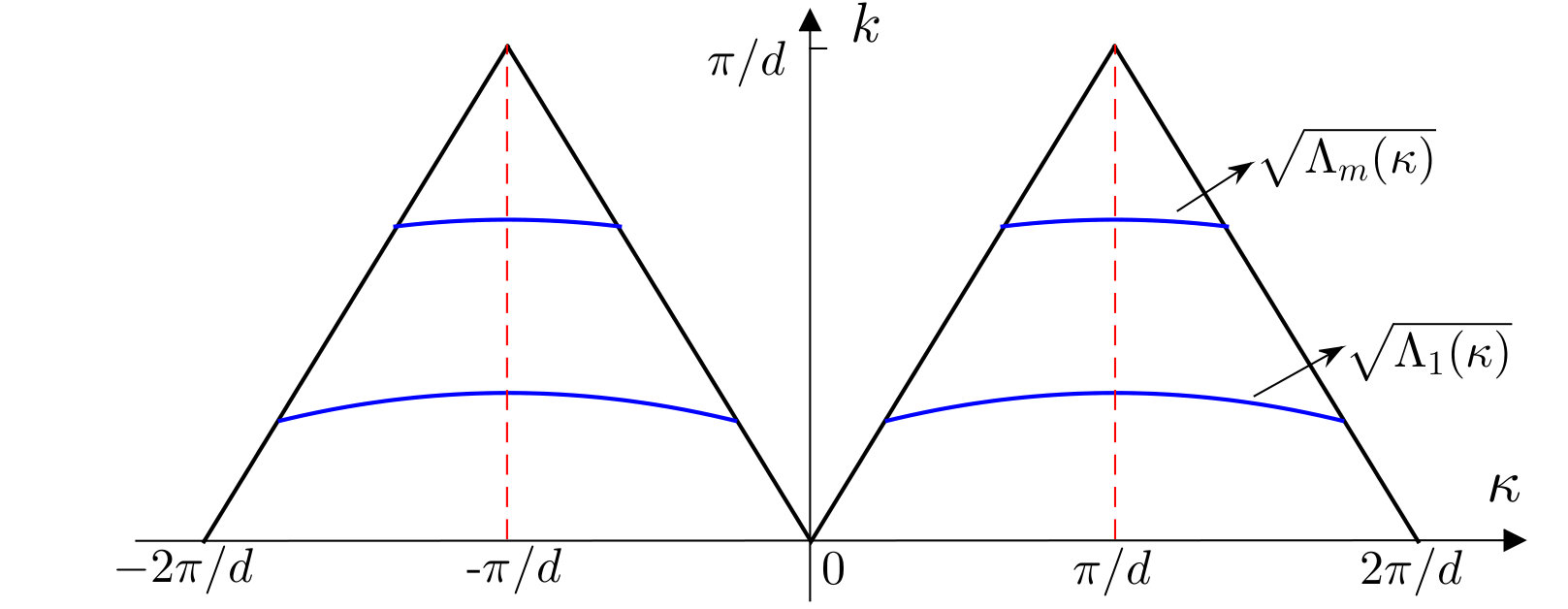 Figure 1
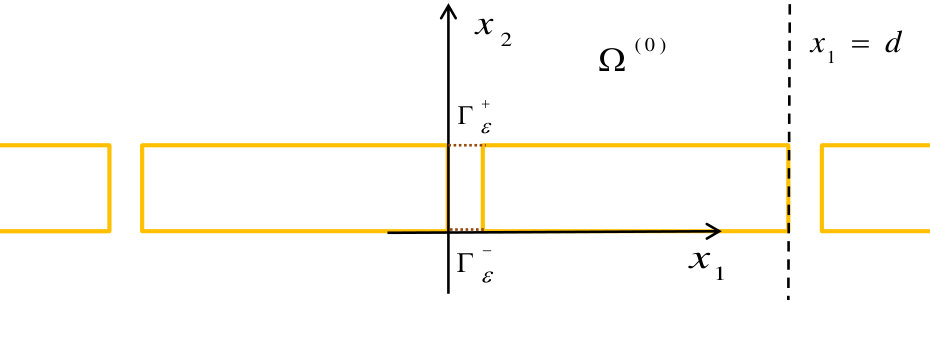 Figure 2
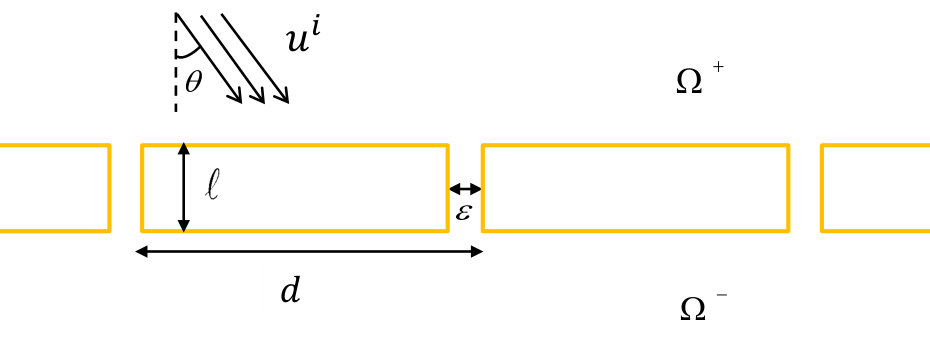 Figure 3
Peer Reviews
No public reviews on file for this paper yet. If you reviewed it on a platform where reviews are public (OpenReview, ICLR, NeurIPS, ICML), you can paste yours below so the community can read it here.
Videos
No videos yet. Explain this paper in a talk, walkthrough, or lecture? Add one.
Taxonomy
TopicsPlasmonic and Surface Plasmon Research · Metamaterials and Metasurfaces Applications · Near-Field Optical Microscopy
Scattering by a periodic array of subwavelength slits I: field enhancement in the diffraction regime
Junshan Lin and Hai Zhang Department of Mathematics and Statistics, Auburn University, Auburn, AL 36849 (jzl0097@ auburn.edu). Junshan Lin was partially supported by the NSF grant DMS-1417676.Department of Mathematics, HKUST, Clear Water Bay, Kowloon, Hong Kong ([email protected]). Hai Zhang was supported by HK RGC grant ECS 26301016 and the UGC grant SBI17SC12 from HKUST.
Abstract
This is the first part in a series of two papers that concern with the quantitative analysis of the electromagnetic field enhancement and anomalous diffraction by a periodic array of subwavelength slits. The scattering problem in the diffraction regime is investigated in this part, for which the size of the period is comparable to the incident wavelength. We distinguish scattering resonances and real eigenvalues, and derive their asymptotic expansions when they are away from the Rayleigh cut-off frequencies. Furthermore, we present quantitative analysis of the field enhancement at resonant frequencies, by quantifying both the enhancement order and the associated resonant modes. The field enhancement near the Rayleigh cut-off frequencies is also investigated. It is demonstrated that the field enhancement becomes weaker at the resonant frequency if it is close to the Rayleigh cut-off frequencies. Finally, we also characterize the embedded eigenvalues for the underlying periodic structure, and point out that transmission anomaly such as Fano resonant phenomenon does not occur for the narrow slit array.
Keywords: Electromagnetic field enhancement, nano gap, subwavelength structure, grating, Helmholtz equation.
1 Introduction
There has been increasing interest in the electromagnetic scattering by subwavelength apertures or holes in recent years, due to their significant applications in biological and chemical sensing, near-field spectroscopy, etc [1, 10, 16, 17, 18, 20, 21, 22, 27, 31, 32, 33]. Such subwavelenth structures can generate extraordinary optical transmission and strongly enhanced local electromagnetic fields, which leads extremely high sensitivity in the sensing or imaging of biological or chemical samples. However, as of today there are still controversies over the mechanisms contributing to the anomalous field enhancement [18]. The complication has to do with the multiscale nature of the underlying metallic structures as well as various enhancement behaviors that it induces. For instance, the enhancement can be attributed to surface plasmonic resonance [17, 18], non-plasmonic resonances [32, 33], or even without the resonant effect (cf. [21, 22, 23])
Very recently, for a single narrow slit perforated in a perfect conducting slab, we have presented quantitative analysis of the field enhancement, which provides a complete picture for its enhancement mechanisms [23]. In this paper and its sequel [24], we investigate the scattering and field enhancement when the slab is patterned with a periodic array of narrow slits. The physics becomes richer compared to the single slit case. In addition, the quantitative studies of field enhancement also present new mathematical challenges. (i) While the scattering problem for the single slit attains a unique solution, there exists a set of singular frequencies (real eigenvalues) for the periodic strucuture; (ii) In contrast to the single slit case, the field enhancement factor for the periodic case would depend on the size of period and the incident angle for a given frequency; (iii) The scattering by the periodic structure will exhibit so-called Rayleigh anomaly when certain propagating spatial harmonics turns into an evanescent mode, which gives rise to diffractive anomaly near such cut-off frequencies; (iv) The field enhancement mechanisms in the diffraction regime and the homogenization regime are different and need separate investigations. The incident wavelength is comparable to the size of the period in the former case, but much larger than the size of the period in the latter. As to be demonstrated in this paper and [24], while the field enhancement in the diffraction regime is mostly attributed to the resonant phenomenon, the enhancement and diffraction anomaly in the homogenization regimes can be induced by non-resonant phenomenon.
We now present the setup of our scattering problem. We consider a perfect conducting slab that is perforated with a periodic array of slits and the geometry of its cross section is depicted in Figure 1. The slab occupies the domain on the plane, where is the thickness of the metal. The slits, which are invariant along the direction, occupy the region , where is the size of the period, and has a rectangular shape. Let us denote the semi-infinite domain above and below the slab by and . We also denote by be the domain exterior to the perfect conductor, i.e., , and denotes the unit outward normal pointing to the exterior domain or .
We are interested in the case when the width of the slit is much smaller than the thickness of the slab . In this paper, we shall assume that the size of period has the same order as the thickness of the slab . Furthermore, the incident wavelength is comparable to such that the problem under consideration is in the diffraction regime. Namely, and hold for the scaling of parameters for the problem under consideration. For clarity, we shall assume in all technical derivations throughout the paper. The enhancement theory for the case of then follows by a normalization process and a scaling argument.
Assume that a polarized time-harmonic electromagnetic wave impinges upon the perfect conductor from the above. We consider the transverse magnetic (TM) case where the incident magnetic field is perpendicular to the plane, and its component is given by the scalar function . Here be the wavenumber and is the incident angle. The total field , which consists of the incident wave and the scattered field in and the scattered field only in , satisfies the Helmholtz equation
[TABLE]
and the boundary conditition
[TABLE]
Let , we look for quasi-periodic solutions such that , where is a periodic function with , or equivalently,
[TABLE]
Define
[TABLE]
where the function is understood as an analytic function defined in the domain by
[TABLE]
throughout the paper. Then it can be shown that the outgoing scattered field adopts the following Rayleigh-Bloch expansion (cf. [11, 13, 30])
[TABLE]
in the domain and respectively for some coefficients . The expansion (1.4) is usually referred to as the outgoing radiation condition and is imposed for the scattered field above and below the metallic slab.
Due to the quasi-periodicity of the solution, one can restrict to the first Brillouin zone . Such is called the reduced wave vector component [13, 30]. For given , we denote three sets of indices: , , and . The spacial harmonics are called propagating modes, evanescent modes and linear modes for belonging to , and , respectively.
In contrast to the scattering problem for a single slit where one has uniqueness, the solution to the scattering problem (1.1) - (1.4) may not be unique. Indeed, the corresponding homogeneous problem with may attain non-trivial solutions for [13, 29, 28]. Such real-valued is called singular frequency and is the corresponding guided mode or surface bound state that decays exponentially away from the periodic structure [13, 29, 28]. On the other hand, there may also exist complex-valued ’s such that the homogeneous problem attains nontrivial solutions. Such is called a resonance (or scattering resonance) of the scattering problem, and the associated nontrivial solutions are called leaky modes (or quasi-normal modes). If the frequency of the incident wave is close the real part of the resonance (resonance frequency), then an enhancement of scattering is expected if the imaginary part of the resonance is small. This is the mechanism of resonant scattering. We refer to [3, 4, 5, 6, 7, 8, 9] for the recent mathematical investigation of the interesting applications of resonances in super-resolution/super-focusing and metasurfaces. Finally, if , then near a cut-off frequency where for some integer , the propagating spatial harmonics becomes an evanescent mode or vice versa. As such the diffracted field will exhibit anomalous behaviors near the cut-off frequencies and this is the so-called Rayleigh anomaly [26]. If resonances occur near such cut-off frequencies, then the enhancement behavior at resonant frequencies will be different from that of resonant phenomenon away from the cut-off frequencies.
In this paper, by using layer potential techniques, variational approaches and asymptotic analysis, we explore the field enhancement mechanism for the scattering problem in the diffraction regime. We derive the asymptotic expansions for both real eigenvalues and complex scattering resonances, which lie below and above the light line respectively. It is known that surface bound states, for which the relation holds, can not be excited by a plane incident wave that satisfies . Whereas the quasi-modes, for which holds, would be amplified if the incident frequency coincides the resonant frequencies. We analyze quantitatively the field enhancement at resonant frequencies, and show that enhancement with an order of is achieved. We also give the explicit dependence of the enhancement magnitude on the size of the period and the incident angle . Furthermore, the enhanced wave modes are also characterized in both near-field and far-field zones. In this paper, we also demonstrate that if resonances are near the Rayleigh cut-off frequencies with a distance of , where , then the field enhancement at the resonant frequency becomes weaker and is of order .
The rest of the paper is organized as follows. We introduce layer potentials for the scattering problem and the boundary integral formulations in Section 2. The asymptotic expansion for the solution to the scattering problem is derived in Section 3, which lays the foundation for the quantitative analysis of field enhancement. The asymptotic expansions of real eigenvalues and complex resonances, and the investigation of field enhancement at resonant frequencies are presented in Section 4. In Section 5, we study the field enhancement when the resonant frequency is close to the Rayleigh cut-off frequencies. Finally, we discuss briefly on the embedded eigenvalues associated with the scattering problem.
2 Boundary integral formulation
For each fixed , let be the periodic Green’s function solving the following equation:
[TABLE]
Then (cf. [25])
[TABLE]
where
[TABLE]
We define the exterior Green’s function with the Neumann boundary condition as , where
[TABLE]
It is easy to verify that on and .
We also define the Green’s function in the slit with the Neumann boundary condition as
[TABLE]
Here , and the coefficient is given by
[TABLE]
It is easy to check that
[TABLE]
To formulate the scattering problem as boundary integral equations, let us reduce the problem to one reference period as shown in Figure 2. Recall that the slit sitting in is given by . We also denote the the upper and lower aperture of the slit by and respectively (see Figure 2).
Lemma 2.1
Let be the solution of the scattering problem (1.1) - (1.4), then
[TABLE]
Here is the reflected field of the ground plane without slits.
Proof For , define , and . Then and are periodic with respect to . Furthermore, a direction calculation yields
[TABLE]
Choose . Define the bounded domain above the perfect conductor by
[TABLE]
Denote the boundary of by . Let and be its upper and lower boundaries respectively. An application of the Green’s second identity and the divergence theorem over the domain yields
[TABLE]
Using the fact that and are periodic along , the second integral vanishes by noting that on the horizontal boundaries and take opposite signs on two vertical boundaries. Substituting the Rayleigh expansions (1.4) and (2.1), it follows that
[TABLE]
Thus, again applying the periodic boundary conditions for and , we have
[TABLE]
or equivalently,
[TABLE]
where . A direct calculation leads to
[TABLE]
Since , , and . It follows that
[TABLE]
where we have used the boundary condition on .
Following the similar lines above, it can be shown that
[TABLE]
On the other hand, an application of Green’s second identity over the slit gives rise to
[TABLE]
Based upon Lemma 2.1 and the continuity of the single layer potential (cf. [19]), we obtain the following boundary integral equations defined over the slit apertures .
Lemma 2.2
The following hold for the solution of the scattering problem (1.1) - (1.4):
[TABLE]
[TABLE]
[TABLE]
An application of the above Lemma leads to the following system of integral equations:
[TABLE]
Proposition 2.3
The scattering problem (1.1) - (1.4) is equivalent to the system of boundary integral equations (2.5).
It is clear that
[TABLE]
Note that the above functions are defined over narrow intervals with size . To facilitate the analysis, we shall rescale the functions by introducing and . Let us define the following quantities:
[TABLE]
We also define three boundary integral operators:
[TABLE]
By a change of variable and in (2.5), the following proposition follows.
Proposition 2.4
The system of equations (2.5) is equivalent to the following one:
[TABLE]
3 Solution to the scattering problem
In this section, based upon the integral equation formulation, we derive the asymptotic expansion of the solution to the scattering problem (1.1) - (1.4). From the derived expansion formulas, we obtain and classify different conditions for extraordinary field enhancement for the underlying periodic structure. In addition, the expansions also lead to explicit asymptotic formulas for the enhanced wave fields presented in Section 4 and 5.
We begin with asymptotic expansions of the boundary integral operators , , and . Then the solution for the integral equation system (2.9) will be obtained, followed by the asymptotic expansion of the waves in the far-field and near-field zones.
3.1 Preliminaries
We introduce several function spaces to be used in the rest of the paper. Let , we denote by the standard fractional Sobolev space with the norm
[TABLE]
where is the Fourier transform of . Let be a bounded open interval in and define
[TABLE]
Then is a Hilbert space with the norm
[TABLE]
We also define
[TABLE]
One can show that the space is the dual of and the norm for can be defined via the duality [2]. As such is also a Hilbert space. Here and henceforth, for simplicity, we denote and . The duality between and will be denoted by for any , .
3.2 Asymptotic expansion of the boundary integral operators
For each fixed , we derive the asymptotic expansion of the boundary integral operators , , and . This is performed for away from the Rayleigh cut-off frequencies where for some integer . In this way we exclude the scenario where the Green’s function is not well defined because of a vanishing . To this end, let us introduce a parameter such that and denote
[TABLE]
Let be the disk with radius centered at . Here and henceforth, we define
[TABLE]
and restrict to the domain . The following notations will be used throughout the paper.
[TABLE]
Remark 3.1 From the definition of , it is clear that for . In the above and throughout, the substraction
[TABLE]
is viewed as the sum of the convergent series
[TABLE]
Therefore, the scalar function is well defined.
Remark 3.2 The real number denotes the distance from the Rayleigh cut-off frequencies. When and , the frequency in is then far away from the Rayleigh cut-off frequencies. On the other hand, if , a frequency in can be close to the Rayleigh anomaly. It should be pointed out that the assumption is essential for a uniform asymptotic expansions of the Green’s functions, which are given in Lemma 3.1 below. The treatment for would require more dedicated asymptotic analysis. A promising approach is to use new Green’s functions that converge rapidly around the Rayleigh cut-off frequencies [12].
The asymptotic expansions for the kernels , , and are given in the following Lemma.
Lemma 3.1
For and , where and . If , then
[TABLE]
Here , , and are bounded functions with , , and for all .
Proof The asymptotic expansion for the kernels and has been derived in [23]. See also Appendix A for the proof. To obtain asymptotic expansion for the kernel , let us consider the case when . The case of can be calculated in a similar fashion. Using Taylor expansion, we have
[TABLE]
Then it follows that
[TABLE]
Notice that
[TABLE]
Furthermore, for ,
[TABLE]
Substituting the above into (3.10), we have
[TABLE]
Using the relation
[TABLE]
we get
[TABLE]
Therefore, the desired asymptotic expansion follows by noting that
[TABLE]
Let and be defined in (3.6) and (3.9) respectively. Set , where and are given in (3.7) and (3.8) respectively. We denote by , , the integral operators corresponding to the Schwarz kernels , and , respectively. We also define the operator by
[TABLE]
where is a function defined on the interval and is equal to one therein. We will use this notation in the sequel. One can easily check that . Thus the above definition is valid.
Lemma 3.2
For and , where and .
- (1)
The operator admits the following decomposition:
[TABLE]
Moreover, is bounded from to with operator norm uniformly for bounded ’s. 2. (2)
The operator admits the following decomposition:
[TABLE]
Moreover, is bounded from to with operator norm uniformly for bounded ’s. 3. (3)
The operator is bounded from to with a bounded inverse. Moreover,
[TABLE]
The proof of (1) and (2) follows directly from the definition of the operators , and in (2.6) - (2.8) and the asymptotic expansions of their kernels (see Lemma 3.1). The proof of (3) can be found in Theorem 4.1 and Lemma 4.2 of [14].
3.3 Asymptotic expansion of the solution to the system (2.9)
Define
[TABLE]
Then from the decomposition of the operators in Lemma 3.2, we may rewrite the system of the integral equations (2.9) as
[TABLE]
Next, we derive the asymptotic expansion of the solution . By Lemma 3.2, it is also easy to see that is invertible for sufficiently small . Applying the Neumann series yields
[TABLE]
Therefore, the following lemma follows.
Lemma 3.3
Let and . Then
[TABLE]
and
[TABLE]
The following identities are proved in [23].
Lemma 3.4
Let and . Then
[TABLE]
By applying on both sides of (3.11), we see that
[TABLE]
Note that
[TABLE]
the above operator equation can be written as
[TABLE]
By taking the inner product of (3.14) with and respectively, it follows that
[TABLE]
where the matrix is defined as
[TABLE]
Therefore,
[TABLE]
Substituting into (3.13) yields
[TABLE]
From Lemma 3.4, it is observed that
[TABLE]
A straightforward calculation shows that the eigenvalues of are
[TABLE]
and the associated eigenvectors are and . For simplicity of notation, we define two scalar functions
[TABLE]
We also define
[TABLE]
Then a combination of (3.19) - (3.21), the expressions (3.2) - (3.5) for and , and Lemma 3.3 yields
[TABLE]
and
[TABLE]
Lemma 3.5
Let , where , and be bounded and not an eigenvalue of the scattering operator. Then the following asymptotic expansion holds for the solution of (2.9) in :
[TABLE]
Moreover,
[TABLE]
Proof. The matrix has two eigenvalues and given by (3.19) and (3.20), which are associated with the eigenvectors and respectively. Thus
[TABLE]
By substituting into (3.18) (3.17), it follows that
[TABLE]
and
[TABLE]
A further calculation yields
[TABLE]
On the other hand, it is easy to check that
[TABLE]
Thus we have from Lemma 3.3 that
[TABLE]
Combined with Lemma 3.4, it follows that
[TABLE]
Similarly, we can deduce (3.25). This completes the proof of the lemma.
3.4 Asymptotic expansion of the solution to the scattering problem
Define the far-field zones and above and below the slits respectively.
Lemma 3.6
The scattered field
[TABLE]
in .
Proof In , the scattered field
[TABLE]
Recall that
[TABLE]
we have
[TABLE]
By noting that
[TABLE]
and using the asymptotic expansion for in Lemma 3.5, we arrive at the desired formula. The scattered field in can be obtained analogously.
Next we consider the wave field in the slits. Since is quasi-periodic, we restrict the discussion to the reference slit only. Observe that satisfies
[TABLE]
If , in light of the boundary condition on the slit walls, we may expand as the sum of wave-guide modes as follows:
[TABLE]
where .
Lemma 3.7
The wave field in the slit region is given by
[TABLE]
Proof Taking the derivative of (3.29) and evaluating on the slit apertures, one has
[TABLE]
Therefore,
[TABLE]
Consequently
[TABLE]
For , the coefficients and can be obtained similarly by taking the inner product of (3.30) and (3.31) with . Then a direct estimate leads to
[TABLE]
where is some positive constant independent of , and . The proof is complete by substituting (3.32) and (3.33) into (3.29).
To obtain wave field on the apertures of the slits, we consider the two apertures and of the reference slit . Define
[TABLE]
Let us rewrite , where
[TABLE]
Lemma 3.8
The following expansions hold for the total field
[TABLE]
and
[TABLE]
on the slit apertures and respectively.
Proof Recall that on ,
[TABLE]
Let , . We have
[TABLE]
Using Lemma 3.5 and the asymptotic expansion of in Lemma 3.1, we obtain
[TABLE]
The desired expansion follows by noting (3.34) and (3.35). The wave field on the lower aperture can be obtained similarly.
3.5 An overview of field enhancement and diffraction anomalies
From Lemma 3.6 to 3.8, we observe that and are two key scalar functions that will contribute to anomalous behaviors of the diffracted wave field. For instance, the wave field will exhibit extraordinary enhancement for vanishing or . In addition, , and consequently the function (see (3.22)-(3.24)) has a branch cut at certain frequencies, and this may give rise to anomalous diffracted field too. The following is a summary of several cases that we will explore in the rest of the paper.
- (i)
or attain complex roots with negative imaginary part and real part . Such are called resonances and the corresponding modes are called quasi-modes or leaky modes. If the incident frequency coincides with the resonant frequency, then field enhancement will occur. 2. (ii)
or attain real roots with . Such are called real eigenvalues of the scattering operator, and the corresponding eigenmodes are called Rayleigh-Bloch surface bound states that are confined near the periodic structure. The surface bound-state modes can be excited by nearby sources through near field interaction, but not by a plane incident wave as we consider here. 3. (iii)
or attain real roots with . In such scenario, the periodic slab structures possesses certain finite bound state embedded in the continuum states (or a point spectrum embedded in the continuous spectrum). 4. (iv)
The function has a branch cut at the triplet such that and . This corresponds to the Rayleigh anomaly, where the propagating mode become an evanescent mode or vice versa.
We investigate (i) (ii) in Section 4, and explore field enhancement in Section 5 when the resonance frequency is close to the Rayleigh anomaly. The embedded eigenvalues (iii) is discussed briefly in Section 6.
4 Resonances and eigenvalues away from Rayleigh cut-off frequencies
4.1 The homogenous scattering problem
In order to obtain eigenvalues or resonances of the scattering problem, we consider the corresponding homogeneous problem when the incident wave . The solution is either real-valued or complex-valued with negative imaginary part. The former is called an eigenvalue and the latter is called a resonance. Here we focus on eigenvalues or resonances sufficiently away from the Rayleigh cut-off frequencies by assuming that in (3.1) such that . In addition, it is natural to assume that so that . On the other hand, we only consider eigenvalues/resonances not in the high frequency regime. Therefore, we restrict to the domain of interest to
[TABLE]
where is a fixed constant.
As to be shown later on, for each , the eigenvalues and resonances in lie in the vicinity of
[TABLE]
Therefore, we extend the asymptotic expansions of the boundary integral operators to a neighborhood of on the complex plane. More precisely, let . If , we choose the disc with radius centered at on the complex -plane, which is denoted as . We analytically extend the functions , , and , which are defined in (3.2) - (3.5) for real , to the neighborhood of , . One can show that the asymptotic expansions for the kernels , , and given in Lemma 3.1 holds in .
By virtue of (3.11), the homogeneous problem is equivalent to the operator equation
[TABLE]
In light of (3.15), this reduces to
[TABLE]
where the matrix is defined by (3.16). Note that the eigenvalues of are given by (3.19) and (3.20), thus the characteristic values of the operator-valued function are the roots of the two analytic functions and , or equivalently, and as defined in (3.21).
Lemma 4.1
The resonances of the scattering problem (1.1) - (1.4) in are the roots of one of the analytic functions and with , and the eigenvalues are those with .
Lemma 4.2
For each , the roots of and in the domain attain the following asymptotic expansion:
[TABLE]
for even and odd integers respectively.
Proof. Let . From (3.23), it follows that
[TABLE]
where is defined in (3.22), is analytic in and . It is clear that the analytic function attains a simple root in for odd integers . From Rouche’s theorem, we deduce that there is a simple root of , which is denoted as , close to if is sufficiently small.
To obtain the leading-order asymptotic terms of , first let us consider the root for
[TABLE]
The Taylor expansion for at yields
[TABLE]
A direct calculation gives . We can deduce that has a simple root close to , and is given by
[TABLE]
Next we show that and the desired asymptotic expansion (4.6) follows. Note that
[TABLE]
and
[TABLE]
Hence, one can find a constant such that
[TABLE]
for all such that . By the Rouche’s theorem, has a simple root in the disc , which proves our claim.
Similarly, we obtain the root of in for even integers . The arguments are the same as above and we omit here.
4.2 Asymptotic expansions of resonances and eigenvalues
The formula (4.1) gives the asymptotic expansion of resonances and eigenvalues for the scattering problem (1.1) - (1.4). We now distinguish between resonances and eigenvalues. First, observe that
[TABLE]
Therefore, attains a non-zero imaginary part, and is a complex-valued resonance. We immediately have the following proposition.
Proposition 4.3
For each , if such that , then there exists resonance in the domain for the scattering problem (1.1) - (1.4) with the following asymptotic expansion
[TABLE]
Here .
Remark 4.4
In Proposition 4.3, the imaginary part of the resonance is given by , which is negative and is of order . As the size of period , we see that
[TABLE]
*This constant is consistent with the one obtained for the case of a single slit perforated in a slab of infinite length (cf [23]).
Now if such that
[TABLE]
the imaginary part of -term of in (4.1) is zero. However, one can not tell directly from the asymptotic expansion (4.1) whether the higher order terms of are real or complex-valued. Instead, we resort to the variational formulation to verify that those are indeed real eigenvalues.
Let us first recall some basic facts from [13]. Denote and define the function space
[TABLE]
We define a sesquilinear form
[TABLE]
on and denote
[TABLE]
Let be the operator associated with the sesquilinear form such that
[TABLE]
for all . The following statement holds (cf. [13]).
Lemma 4.5
* is a solution to the homogeneous problem with if and only if is an eigenvalue of and is the associated eigenfuction.* 2. 2.
* is a positive self-adjoint operator.*
For each positive integer , let
[TABLE]
where denotes the set of all m-dimensional subspaces of . It is clear that for each fixed , is an increasing sequence. We denote by the number of eigenvalues of , counting their multiplicity, which are strictly less than .
Lemma 4.6
The following statements hold (cf. [13]):
* for .* 2. 2.
For each fixed , is a continuous function of . 3. 3.
For , if , then and . In addition, , , , are the first eigenvalues of .
Now let us first consider the special case when and . Then for real in the neighborhood of , the Green’s function is a real-valued function, by noting that the and terms in the following series expansion
[TABLE]
are conjugate pairs. Therefore, all the terms in (3.19) and (3.20) are real. Consequently, or attains a real root near , which is an eigenvalue of the scattering problem. The asymptotic expansion of the eigenvalue is given by (4.1). In particular, by Lemma 4.5 and 4.6, we have
[TABLE]
For , the continuity of and implies that as long as , and is a real eigenvalue. In summary, we can draw the following conclusion.
Proposition 4.7
For each , if such that , then there exists exactly eigenvalues in the domain for the scattering problem (1.1) - (1.4). Moreover, the following asymptotic expansion holds for each eigenvalue :
[TABLE]
Here .
Note that and is a pure imaginary number for all , we see that the associated eigenfunctions are Rayleigh-Bloch surface bound states that decays exponentially away from the slab structure.
Remark 4.8
Note that if the size of period satisfies the inequality
[TABLE]
then . Therefore, there is no eigenvalue for the scattering problem and only resonances exist. On the other hand, if
[TABLE]
then . That is, in addition to resonances, there exists at least one eigenvalue which is near .
4.3 Field enhancement at resonant frequencies
To investigate the field enhancement, recall that and .
Lemma 4.9
If , then at the resonant frequencies ,
[TABLE]
and
[TABLE]
where is odd and even respectively.
Proof We expand and in the disk . If is odd, from the definition of in (4.3) and its expansion (4.1), it follows that
[TABLE]
Note that
[TABLE]
We deduce that at the odd resonant frequencies ,
[TABLE]
The calculations for at the even resonant frequencies are the same.
The following proposition follows directly from Lemma 3.5 and Lemma 4.9 .
Proposition 4.10
At resonant frequencies, in and , i=1,2.
We now investigate the field enhancement in far-field and near-filed zones. From Lemma 3.6, the scattered field
[TABLE]
At the resonant frequencies when is odd, an application of Lemma 4.9 yields
[TABLE]
Hence the scattered field
[TABLE]
It is seen that the scattering enhancement is of order compared to the order for the scattered field at non-resonant frequencies. In addition, the scattered field behaves as the radiating field of a periodic array of monopoles located at . The same occurs at resonant frequencies when is even by an application of Lemma 4.9.
Following the similar calculations as above, in the far-field zone below the slits, the transmitted field is equivalent to the radiating field of an array of monopoles located at , and is given by
[TABLE]
It follows that
[TABLE]
and
[TABLE]
in at the odd and even resonant frequencies respectively. The transmission enhancement is of order at the resonant frequencies.
Remark 4.1 The amplitude of the scattered and transmitted field also depends on the reduced wave vector and the size of the period . This is explicitly given by the scalar function . The same holds true in the near field described below.
The shape of resonant wave modes in the slits and their enhancement orders are characterized in the following theorem.
Theorem 4.11
The wave field in the slit region is given by
[TABLE]
[TABLE]
at the resonant frequencies where is odd and even respectively.
Proof By Lemma 3.7, in the region ,
[TABLE]
At resonant frequencies when is odd,
[TABLE]
Therefore,
[TABLE]
Similarly, at resonant frequencies when is even,
[TABLE]
and we obtain
[TABLE]
Therefore, the enhancement due to resonance is of order in the slit. Moreover, the dominant modes in the slit takes the simple form of and at odd and even resonant frequencies respectively.
An application of Lemma 3.8 and Lemma 4.9 leads to the enhanced field on the apertures of slits as stated below.
Theorem 4.12
Let function and be defined by (3.34) and (3.35) respectively. The wave fields on the apertures and are
[TABLE]
at the resonant frequencies for odd . At the resonant frequencies when is even, the wave fields on the slit apertures and are
[TABLE]
It is seen that the leading-order of the resonant mode is a constant of order along the slit apertures, and the enhancement due to the resonant scattering is of order .
5 Field enhancement at resonant frequencies near Rayleigh anomaly
Rayleigh anomaly occurs at cut-off frequencies when for some integer such that . According to the Rayleigh-Bloch expansion (1.4), this corresponds to a grazing angle near which the propagating mode becomes an evanescent mode and vice versa. In this section, we investigate the field enhancement at those resonant frequencies that are close to the Rayleigh cut-off frequencies, by assuming that in (3.1) and .
We consider a pair which satisfies for some integer and is a cut-off frequency. For clarity of presentation, let us assume that so that only one mode among all diffracted orders turns into an evanescent mode near . However, the following derivations can be extended straightforwardly for . Suppose that is perturbed away from the cut-off frequency such that , where and . It is clear that is a propagating mode if and an evanescent mode if .
A direct expansion yields
[TABLE]
From the definition of in (3.22), we see that
[TABLE]
Consequently, from (3.23) it follows that
[TABLE]
Similarly, using for yields
[TABLE]
Lemma 5.1
Assume that wherein is some constant and , and . If , then for ,
[TABLE]
and
[TABLE]
when is odd and even respectively. For ,
[TABLE]
and
[TABLE]
when is odd and even respectively.
The lemma follows by noting that and when for odd and even respectively.
From the discussions in Section 2, the field enhancement will occur for small or . If the resonant frequency is close to a cut-off frequency , then from Lemma 5.1 and the same calculation as in Section 4.3, it can be seen that the magnitude of the near-field wave is and in the silts and on the slit apertures, respectively. Therefore, in contrast to the case when the resonant frequency is away from the Rayleigh cut-off frequencies, for which the field is enhanced by an order of , the field enhancement becomes weaker if the resonant frequency is close the Rayleigh cut-off frequencies. In addition, from the above lemma, it is observed that the wave field at the resonance frequency has a phase difference of for and .
6 A discussion on embedded eigenvalues
As discussed in Section 4, for each , there exist real eigenvalues such that and is below the light line. The corresponding eigenmodes are surface bound states that are confined near the periodic structure. In addition, the dispersion curve is continuous (cf. Lemma 4.6), and such surface bound states are robust in the sense that they persist if is perturbed. For the periodic structure, there may exist real eigenvalues that satisfy and lie above the light line. Such eigenvalues are embedded in the continuous spectrum, and they coincide with the intersection point of the complex dispersion relation for the quasi-modes [28, 29, 30] and the real -plane. Especially, the corresponding eigenmodes are not robust with respect to perturbation of . The dissolution of embedded eigenvalues in the continuous spectrum is the mechanism behind transmission anomaly and field enhancement for the periodic slab structure (for instance, Fano resonance) when it is illuminated by a plane wave. We refer to [30] and references therein for detailed discussion.
For the periodic structure considered in this paper, unfortunately, such embedded eigenvalues do not exist for the scattering operator when the domain of the operator is restricted to the space of quasi-periodic functions such that
[TABLE]
or more precisely, the function space
[TABLE]
Indeed, as discussed in Section 4, the associated dispersion relation is determined by the roots of the functions or , and its asymptotic expansion is given by (4.1). Moreover, as stated in Section 4.2, holds as long as . Therefore, will not be a real eigenvalue if it lies above the light line or when .
However, if we view the periodic structure with a period of instead of , and seek for quasi-periodic solutions in such that
[TABLE]
then embedded eigenvalues may exist for the corresponding scattering operator . In what follows, we explore the embedded eigenvalues of the operator , which follows the construction in [13].
Let us start with an elementary observation. For each fixed , we define to be one of the two numbers, and , for which . The Hilbert space is then well-defined, and it is clear that .
Lemma 6.1
The Hilbert space is the orthogonal sum of the two subspaces and
Proof. It is clear that and are subspaces of and they are orthogonal to each other. We only need to show that any functions in can be written as the sum of two functions in and respectively. Without loss of generality, let us take .
Let . Then adopts the following representation:
[TABLE]
when ’s are expansion coefficients. By rearranging the terms in the above series, we see that
[TABLE]
It is clear that the former belongs to and the latter belongs to . This completes the proof of the lemma.
As a consequence of the above lemma, we see that the embedded eigenvalues for the operator of the 2d-periodic scattering problem are either associated with the eigenvalues of the operator or those of the operator . Equivalently, these correspond to the roots of the functions and , or the functions or . We now give a concrete example for such embedded eigenvalues. From Remark 4.8, it is known that if
[TABLE]
then is an eigenvalue of the operator for , and the corresponding surface bound state satisfies
[TABLE]
Therefore, it follows
[TABLE]
This shows that is also an eigenvalue of the operator for , and it is an embedded eigenvalue that satisfies . We may draw similar conclusion for those near .
In general, if we view the periodic structure with a period of , where is an arbitrary positive integer, and seek for the quasi-periodic solutions in such that
[TABLE]
a discussion similar to the -period scattering problem would show the existence of embedded eigenvalues for the corresponding operator . However, all these embedded eigenvalues are constructed for the -period scattering problem, and consequently they are robust. Transmission anomaly and field enhancement would not necessarily occur when the periodic slab structure is illuminated by a plane wave with a frequency given by an embedded eigenvalue. Since, as stated at the beginning of this section, the transmission anomaly such as Fano resonant phenomenon occurs when the eigenvalue is dissolved into complex-valued resonances, and the corresponding surface bound state is not robust with respect to perturbation of . More precisely, let be a simple embedded eigenvalue of the operator , then a sufficient condition for Fano resonance to occur is the following (cf. [28, 29, 30]): there exist a small neighbourhood of such that is the unique point in satisfying the dispersion relation
[TABLE]
That is, is an isolated pair in the real place . However, from previous analysis, it is clear that this condition is not satisfied for embedded eigenvalues constructed for the -period scattering problem.
Appendix A Asymptotic expansion of and
Recall that
[TABLE]
Let . Then from the representation of elementary functions by series, it can be shown that
[TABLE]
[TABLE]
Substituting into (A.1) yields the desired expansion for given as follows:
[TABLE]
On the other hand,
[TABLE]
Let . Again from the following representation of elementary functions as series
[TABLE]
[TABLE]
we obtain
[TABLE]
The reference list from the paper itself. Each links out to its DOI / PubMed record.
- 1[1] F. J. García de Abajo , Colloquium: Light scattering by particle and hole arrays , Review of Modern Physics 79(4), 2007.
- 2[2] R. Adams and J. Fournier , Sobolev Spaces , vol. 140, Academic Press, 2003.
- 3[3] H. Ammari, B. Fitzpatrick, D. Gontier, H. Lee and H. Zhang , Minnaert resonances for acoustic waves in bubbly media , ar Xiv:1603.03982.
- 4[4] H. Ammari, B. Fitzpatrick, D. Gontier, H. Lee and H. Zhang , A mathematical and numerical framework for bubble meta-screens , to appear in SIAM Journal on Applied Mathematics.
- 5[5] H. Ammari, P. Millien, M. Ruiz, and H. Zhang , Mathematical analysis of plasmonic nanoparticles: the scalar case. Archive on Rational Mechanics and Analysis , 224 (2017), 597-658.
- 6[6] H. Ammari, M. Ruiz, W. Wu, S. Yu, and H. Zhang , Mathematical and numerical framework for metasurfaces using thin layers of periodically distributed plasmonic nanoparticles , Proceedings of the Royal Society A, 472 (2016), 20160445.
- 7[7] H. Ammari and H. Zhang , A mathematical theory of super-resolution by using a system of sub-wavelength Helmholtz resonators , Comm. Math. Phys., 337 (2015), 379-428.
- 8[8] H. Ammari and H. Zhang , Super-resolution in high contrast media , Proceedings of the Royal Society A, 471(2015).