Stop Co-Annihilation in the Minimal Supersymmetric Standard Model Revisited
Aaron Pierce, Nausheen R. Shah, Stefan Vogl

TL;DR
This paper revisits the stop co-annihilation scenario in the MSSM, analyzing its cosmological implications, direct detection prospects, and collider search strategies, especially considering the Higgs mass constraints.
Contribution
It provides a detailed re-evaluation of the stop co-annihilation mechanism in the MSSM, focusing on low energy parameters and experimental detectability.
Findings
Direct detection signals are generally below experimental sensitivity.
LHC searches are essential for probing this scenario.
Higgs mass constraints influence the viable parameter space.
Abstract
We re-examine the stop co-annihilation scenario of the Minimal Supersymmetric Standard Model, wherein a bino-like lightest supersymmetric particle has a thermal relic density set by co-annihilations with a scalar partner of the top quark in the early universe. We concentrate on the case where only the top partner sector is relevant for the cosmology, and other particles are heavy. We discuss the cosmology with focus on low energy parameters and an emphasis on the implications of the measured Higgs boson mass and its properties. We find that the irreducible direct detection signal correlated with this cosmology is generically well below projected experimental sensitivity, and in most cases lies below the neutrino background. A larger, detectable, direct detection rate is possible, but is unrelated to the co-annihilation cosmology. LHC searches for compressed spectra are crucial for…
Click any figure to enlarge with its caption.
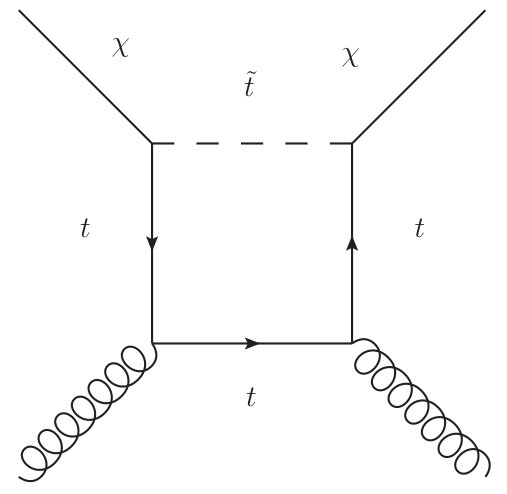 Figure 1
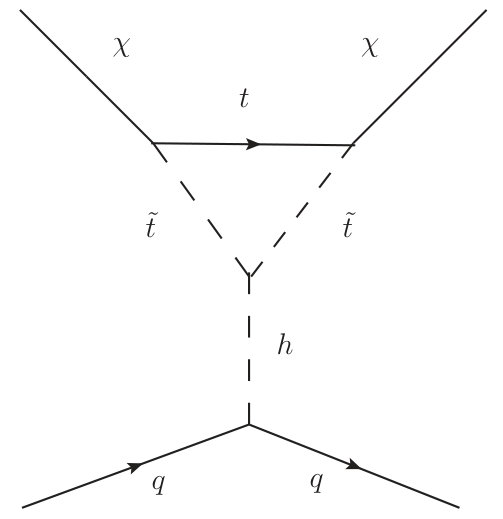 Figure 2
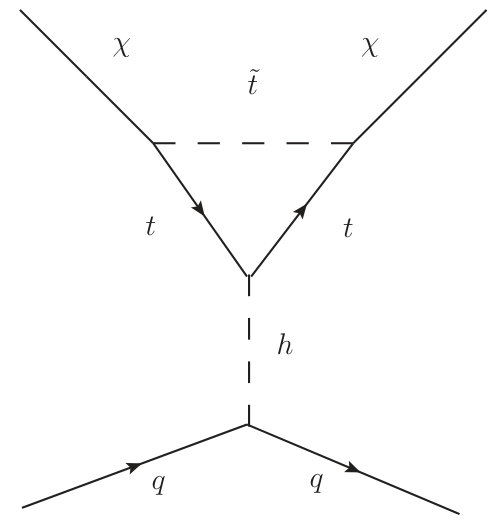 Figure 3
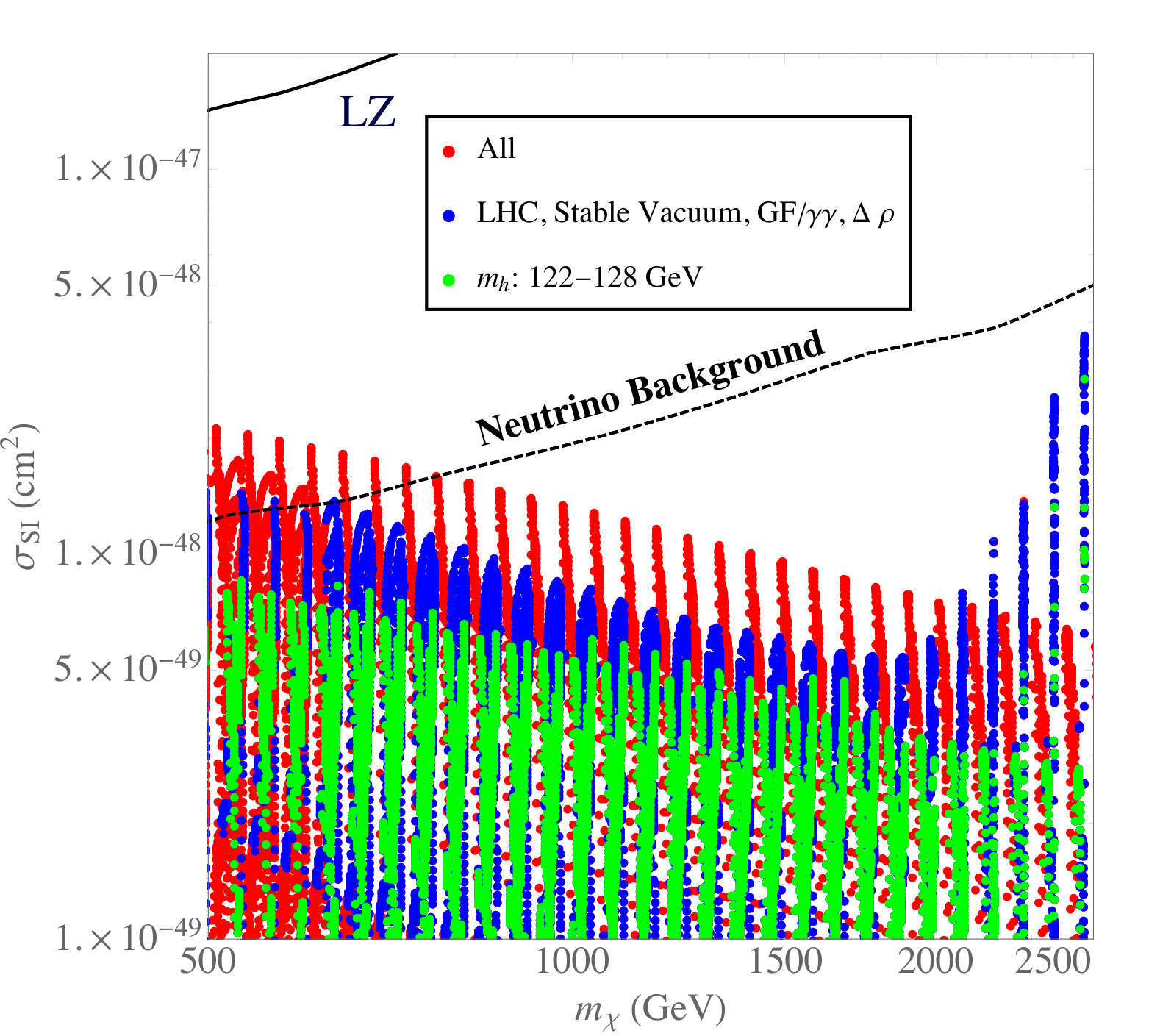 Figure 4
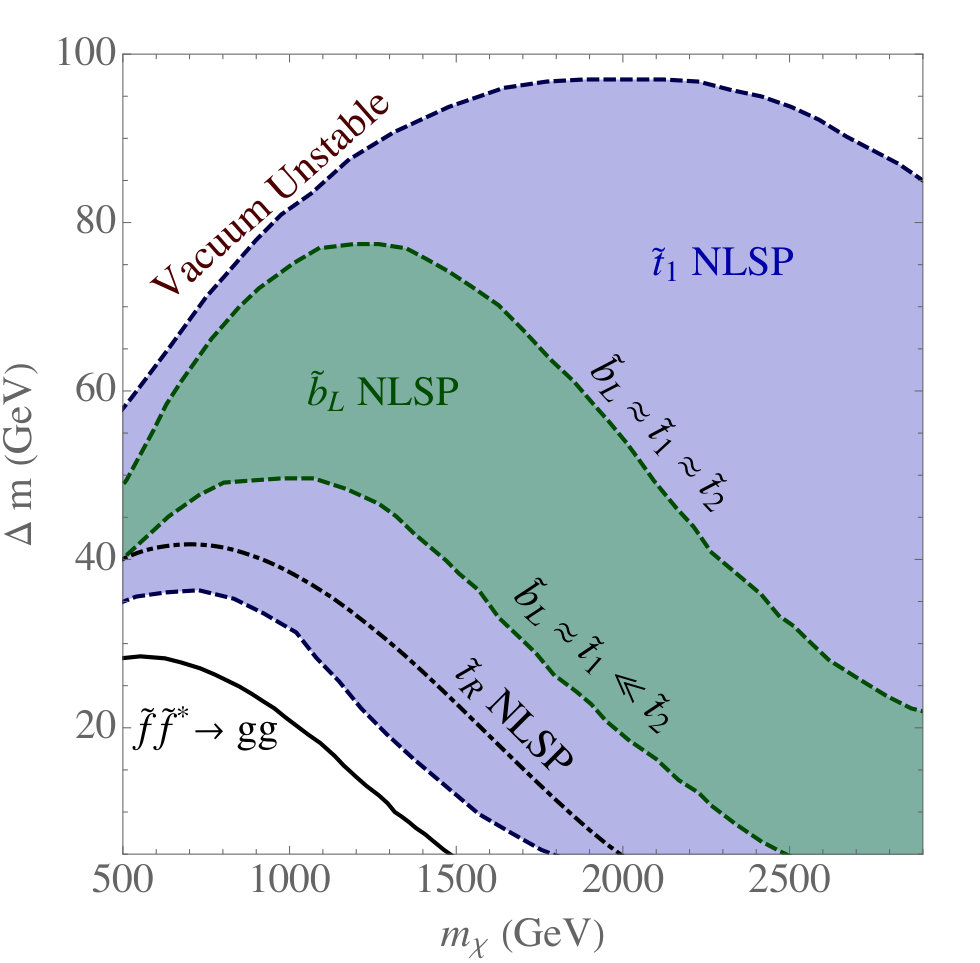 Figure 5
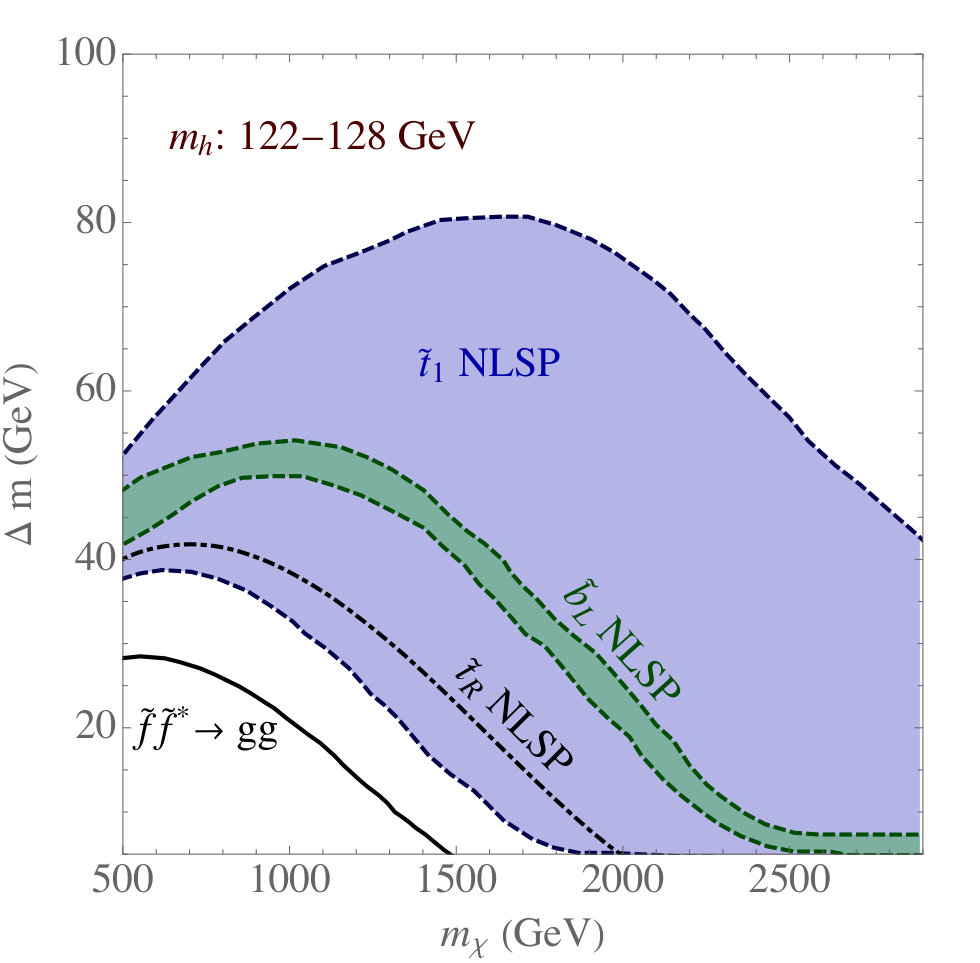 Figure 6
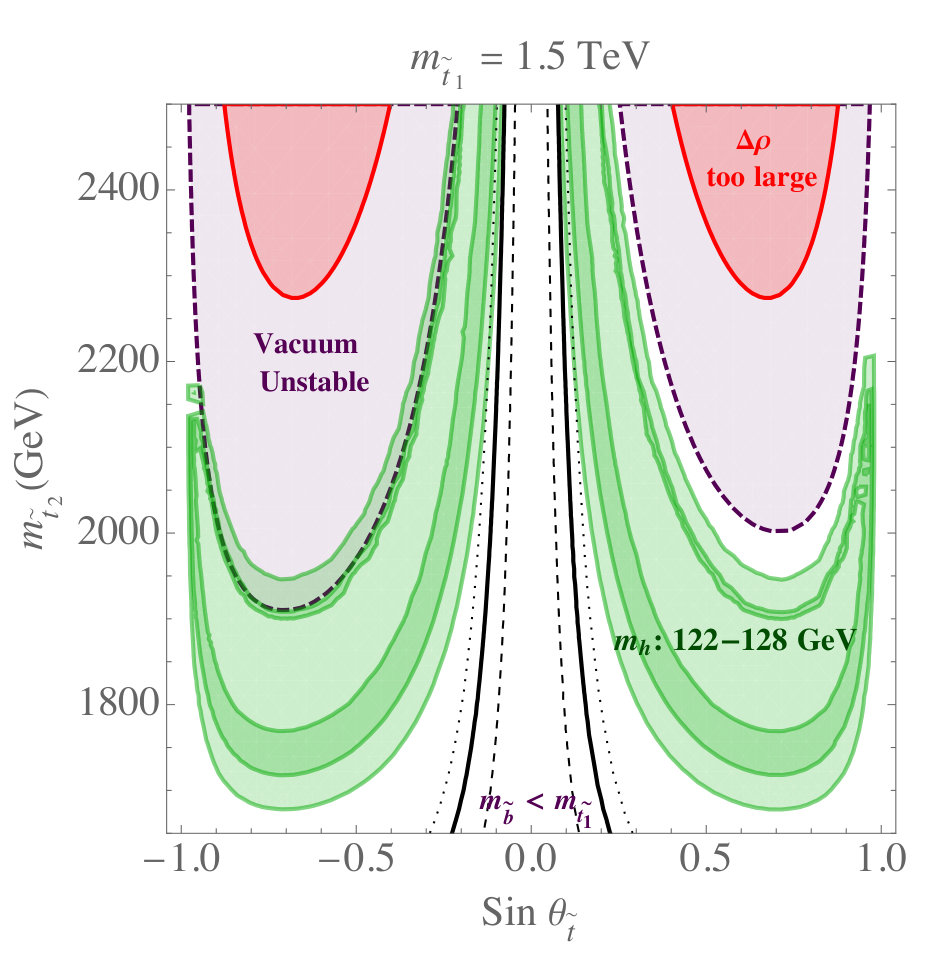 Figure 7
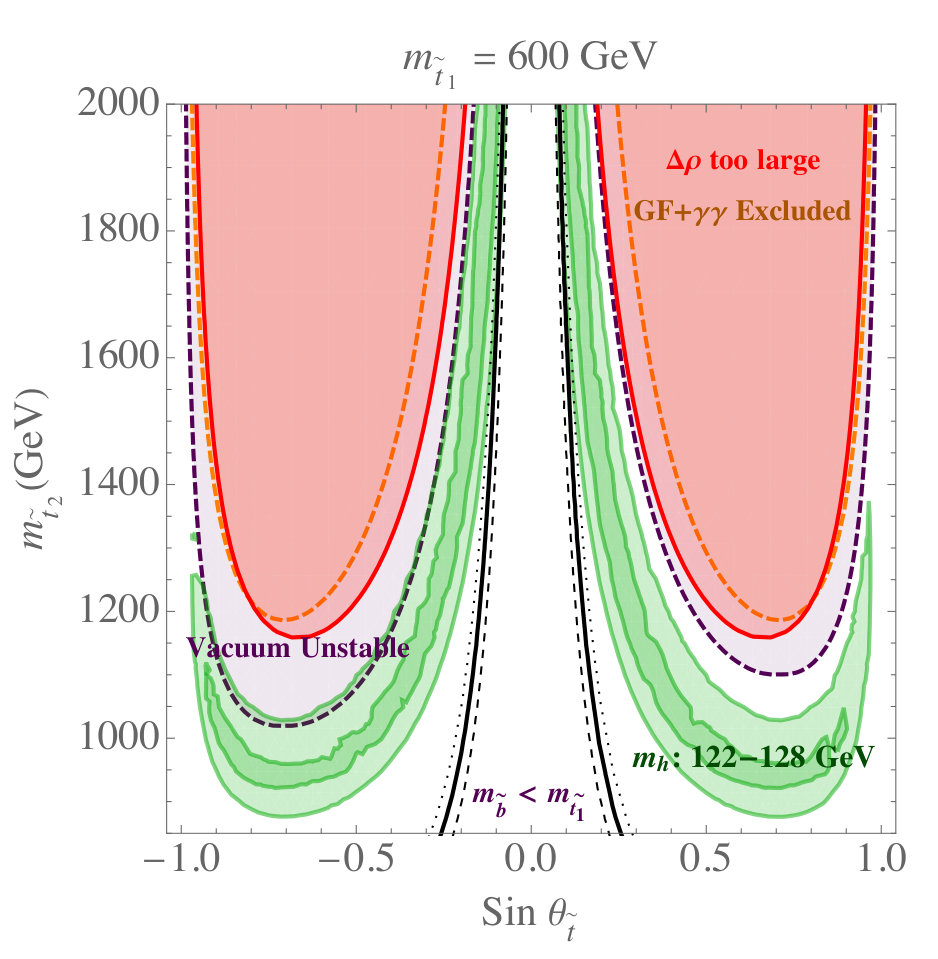 Figure 8
Peer Reviews
No public reviews on file for this paper yet. If you reviewed it on a platform where reviews are public (OpenReview, ICLR, NeurIPS, ICML), you can paste yours below so the community can read it here.
Videos
No videos yet. Explain this paper in a talk, walkthrough, or lecture? Add one.
MCTP-17-07
WSU-HEP-1710
Stop Co-Annihilation in the Minimal Supersymmetric Standard Model Revisited
Aaron Pierce, Nausheen R. Shah and Stefan Vogl
aMichigan Center for Theoretical Physics, Department of Physics, University of Michigan, Ann Arbor, MI 48109
bDepartment of Physics & Astronomy, Wayne State University, Detroit, MI 48201
cMax Planck Institute for Nuclear Physics, 69117 Heidelberg, Germany
Abstract
We reexamine the stop co-annihilation scenario of the Minimal Supersymmetric Standard Model, wherein a bino-like lightest supersymmetric particle has a thermal relic density set by co-annihilations with a scalar partner of the top quark in the early universe. We concentrate on the case where only the top partner sector is relevant for the cosmology, and other particles are heavy. We discuss the cosmology with focus on low energy parameters and an emphasis on the implications of the measured Higgs boson mass and its properties. We find that the irreducible direct detection signal correlated with this cosmology is generically well below projected experimental sensitivity, and in most cases lies below the neutrino background. A larger, detectable, direct detection rate is possible, but is unrelated to the co-annihilation cosmology. LHC searches for compressed spectra are crucial for probing this scenario.
I Introduction
The Minimal Supersymmetric Standard Model (MSSM) is a leading candidate for physics beyond the Standard Model (SM). However, superpartners have remained stubbornly absent at the Large Hadron Collider (LHC). Moreover, bounds from direct detection experiments, including LUX, PandaX, and Xenon1T Akerib:2016vxi ; Tan:2016zwf ; Aprile:2017iyp present an increasingly strong challenge to the WIMP (weakly interacting massive particle) paradigm both in the MSSM and more broadly Kearney:2016rng . These experiments place the most pressure on models where dark matter–nucleon scattering is related to the cosmological history via a crossing symmetry. Crossing symmetry is spoiled if the dark matter coinhabits the thermal bath with another exotic state at the time of freeze-out Griest:1990kh . Then processes involving this co-annihilating partner can be important for the determination of the relic density, but are unrelated (at tree level) to direct detection. These co-annihilating scenarios are therefore among the WIMP models least constrained by direct detection bounds. The MSSM realizes this scenario when the superpartner of the top quark, the stop, is light, and neutralino co-annihilations with this state determine the relic density.
In this work, we examine the stop co-annihilation scenario in terms of the low energy parameters most relevant for cosmology and direct detection. Many analyses of the stop co-annihilation parameters place an emphasis on simplified high-energy models, see e.g. Ref. Ellis:2001nx ; Ellis:2014ipa ; Athron:2017yua ; Athron:2017qdc However, because there are typically a small number of processes that dominate the cosmology involving only a handful of particles and couplings, it is illuminating to analyze these models in terms of the low energy parameters. Consistent with this approach, in previous work Ibarra:2015nca we considered the possibility where a single top partner (perhaps the superpartner of the right-handed top) was responsible for co-annihilation, see also Refs. Delgado:2012eu ; deSimone:2014pda ; Garny:2012eb ; Garny:2014waa ; Kilic:2015vka ; Berlin:2015njh for related work. In the context of the MSSM, however, a simplified model that includes a single co-annihilator, e.g. a , may be too simple to capture the physics of both cosmology and direct detection. Mixing between the light stop and the heavy stop can impact both of these processes. Indeed, the measurement of the Higgs boson mass suggests that there may be large mixing in the stop sector. In this case, it makes sense to include the full stop sector in the simplified model.
This article is organized as follows. In Sec. II we discuss the basics of the parameter space and discuss constraints unrelated to the dark matter story. Cosmology is analyzed in Sec. III and we turn to implications for direct detection in Sec. IV. Finally, Sec. V is reserved for our conclusions.
II Orientation
We consider the case of pure bino neutralino dark matter , with co-annihilations resulting from the presence of one or more colored states with masses not dissimilar to that of the neutralino. If equilibrium between the neutralino and the colored state is maintained (as is typically the case due to scatterings off the SM bath), then processes of the form or are relevant for setting the dark matter abundance.
A small admixture of Higgsino will not affect the cosmological history in detail. However, doping the bino with even a small Higgsino fraction can impact direct detection since the Higgs boson has a tree-level bino-Higgsino coupling. The Higgsino fraction of the neutralino is controlled by mixing suppressed by , with the Higgsino mass parameter. The tree-level direct detection cross section is well approximated by Ibarra:2015nca :
[TABLE]
Here, where is the ratio of vacuum expectation values of the two Higgs doublets. In this work, we will be interested in the case where this contribution to direct detection is subdominant. That is, we consider the case where is (quite) large, and we ask the question: what is the direct detection cross section induced only by the presence of a stop co-annihilation cosmology?
Because we will be interested in discussing the effects of reproducing the required Higgs boson mass, we will include the full stop sector, i.e both and . This means that the left-handed sbottom is necessarily in the spectrum as well. For simplicity, we assume the partner of the right-handed bottom is decoupled. The precise value of its mass has little effect on either the physical Higgs boson mass or any fine-tuning arguments.111While we do not focus on this case, it is possible that the right-handed sbottom could be responsible for co-annihilation with the neutralino. We will comment briefly on this case in Sec. IV. The stop mass matrix is given by:
[TABLE]
where , are the left and right-handed soft masses, and the -terms are: and . Here, is the weak mixing angle. We choose sign conventions for the sign of the stop mixing angle consistent with SuSpect_2.41 Djouadi:2002ze . We have:
[TABLE]
where we denote the stop mass eigenstates as and and use the shorthand , etc. The stop mixing angle is a function of rather than , or directly. In the region of interest, , and the dependence on is minimal. For concreteness we fix but numerically verify that results are approximately independent of , as long as the values are not too extreme.
The heaviness of the right-handed sbottom ensures that the state has mass given approximately by . But for simplicity, we also set so there is no mixing in the sbottom sector, regardless of . This ensures that the is completely left-handed, and its mass may be expressed in terms of the stop masses and mixing angles:
[TABLE]
For later reference, we record the couplings of the stops and the left-handed sbottom to the Higgs and the bino:
[TABLE]
where the Higgs vacuum expectation value GeV, is the hypercharge gauge coupling and , are the projection operators.
We implemented this simplified model containing the third generation squark doublet, right-handed stop and a bino neutralino in MicroOmegas Belanger:2013oya . As a cross-check we validated our numerics with the full MSSM implementation.
II.1 Indirect Constraints
Under the assumption that the MSSM is the underlying theory, important information about the superpartner spectrum can be gleaned from the Higgs boson mass. Indeed, the MSSM cannot reproduce a Higgs boson mass of GeV without substantial radiative corrections from the stop sector. Because the Higgs mass constraint impacts the allowed properties of the stops, it is of interest to study whether it has phenomenological implications for the stop co-annihilation region. Nevertheless, one should bear in mind the possibility that the observed Higgs mass is generated by physics beyond the MSSM.
We therefore prefer to begin by considering additional indirect consequences of the stop sector, potentially relevant even if there are additional contributions to the mass of the Higgs boson. In particular, before discussing the impact of the Higgs mass, we discuss three sets of constraints: electroweak precision observables (EWPO), Higgs boson production and decays, and the stability of the physical vacuum due to the presence of charge and color breaking vacuua. It is a model-dependent question as to whether the above would be affected by deviations from the MSSM. At minimum, however, these constraints give an indication of cancellations that would need to occur between the stop sector and any additional contributions. Once collider bounds are imposed, we find constraints from vacuum stability are generally the strongest of the three.
Regarding EWPO, we require the stop sector contribution to not exceed the bound from the measured Olive:2016xmw . Assuming negligible mixing in the sbottom sector, the third generation squarks yield Bilal:1990gh :
[TABLE]
with the Fermi constant while the loop function is given by
[TABLE]
In the limit of negligible mixing in the stop sector, the bound on implies GeV. In the case with hierarchical stops, where the lightest stop is still mostly left-handed, it can be shown that minimizes the above contribution to Batell:2013psa . This is due to an approximate custodial symmetry between the sbottom and the lightest stop – these two states have an approximate mass degeneracy in this regime: . Deviating too far from this limit (i.e. very large ), causes the constraints to become significant. The excluded region is shown in Fig. 1 (red region) in the vs. plane for two different values of GeV (a) and 1.5 TeV (b).
Higgs boson properties can also be influenced by the presence of a light stop. The primary impact is a potential contribution to the gluon fusion production cross section. The contribution to , while less pronounced, should also be considered. Using the Higgs low energy theorem, the contribution of to the production amplitude of the Higgs boson in gluon fusion can be approximated as Kniehl:1995tn ; Carena:2012xa ; Carena:2013iba
[TABLE]
where is the SM amplitude. Analogously we can write the amplitude for as
[TABLE]
where Kniehl:1995tn ; Carena:2012xa ; Carena:2013iba ; Ellis:1975ap ; Shifman:1979eb ; Gunion:1989we . Again, if , both gluon fusion and the diphoton rate will be impacted, but because , the stop contribution to gluon fusion provides a larger deviation from SM expectations. The combined analysis of the 8 TeV LHC run by ATLAS and CMS constrains the signal strength of the production in gluon fusion, normalized to the SM prediction, to be while ATLAS-CONF-2015-044 . Allowing for near future improvements in these measurements, we allow a deviation of up to 20% in these observables. With the increasingly powerful direct searches for the stop (which impose GeV, more below), these constraints are only relevant for particularly large values of the parameter. The region excluded by Higgs signal strength measurements is shown in orange in Fig. 1.
Charge and color breaking vacua may appear at large values of the trilinear coupling and the physical vacuum can become metastable, possibly with a lifetime shorter than that of the observed universe. To ensure a metastable physical vacuum with a sufficiently long lifetime, following Ref. Blinov:2013fta 222We have verified with the authors of this reference that this approximation remains roughly applicable for the larger values of which we are interested in here. we impose the rule of thumb condition
[TABLE]
with , , and . We see that stability of the physical vacuum roughly requires . Because , the precise impact of Eq. (15) on the stop sector will depend on the choice of and . However, even for fairly large values of , as long as is larger than a few, and the impact of the exact choice of and is minimal. For concreteness, when imposing the vacuum stability constraint, Eq. (15), on the stop parameters, we fix , a value large enough that the tree-level direct detection cross-section will be small, see Eq. (1).333In discussing direct detection in Sec. IV, however, we explicitly set bino-Higgsino mixing to zero (as would be appropriate for very large ), focusing instead on the contributions arising from the stops/sbottom. In Fig. 1, the purple region denotes where the vacuum becomes unstable according to this prescription. The slight asymmetry between positive and negative values of is because of the difference between and due to our choice of .
In the absence of Higgs mass information, the above constraints are responsible for limiting the maximal value of allowed. Because enters the Higgs boson couplings to the stops, this affects both cosmology and direct detection. As we will now see, the Higgs mass constraint gives comparable, and often stronger bounds on .
II.2 Higgs Mass
At tree level, the MSSM predicts a Higgs boson with mass below . However, loop effects give important contributions Ellis:1990nz ; Haber:1990aw ; Okada:1990vk . In our analysis, we employ the Higgs mass calculation as implemented in FeynHiggs-2.13.0 Bahl:2016brp ; Hahn:2013ria ; Frank:2006yh ; Degrassi:2002fi ; Heinemeyer:1998np ; Heinemeyer:1998yj . In the stop sector, we scan over , and . For concreteness we fix TeV, , and all other soft masses and trilinear couplings to 5 TeV. To capture potential uncertainties due to even higher order corrections and – more importantly – uncertainties in inputs (such as the top quark mass or the Gluino mass, which can change the Higgs mass up to 4 GeV when the Gluino mass is varied from 1 to 3 TeV Degrassi:2001yf ; Bagnaschi:2014rsa ) we allow a Higgs boson mass in a window from 122 to 128 GeV. The sign of has an asymmetric effect on the Higgs mass primarily due to the running of the top Yukawa (see Ref. Draper:2016pys and references therein). However, this sign does not otherwise affect the dark matter phenomenology. Hence, we check both signs of the gluino mass, to see whether either realizes a valid Higgs mass.
Consistency with the observed Higgs boson mass in the presence of a relatively light TeV requires a relatively heavy . Unless one wishes to allow for an extreme hierarchy between the stop masses, an appreciable mixing, is also preferred Carena:2011aa ; Carena:2012gp ; Carena:2013iba ; Batell:2013psa . In Fig. 1, the green swath denotes the region with an observationally consistent Higgs boson mass. The two bands that comprise the swath correspond to the two signs of .
Also in Fig. 1, we indicate where the sbottom mass is degenerate with by the solid black line. The two dashed (dotted) contours show where the sbottom is 5 GeV lighter (heavier) than . The central region enclosed by the thick black lines is then where the sbottom is lighter than the lightest stop, and hence would be the next to lightest supersymmetric particle (NLSP). Close to these lines, we expect the sbottom and stop to act as co-NLSPs. This information will be relevant when we discuss the cosmology associated with this scenario.
To summarize, the region compatible with the Higgs boson mass is mostly unaffected by the indirect constraints of the previous section. However, the largest values of consistent with the Higgs mass can be in tension with the stability of the vacuum.
II.3 LHC
Owing to its small production cross section, pure bino dark matter is difficult to probe at the LHC. The colored, nearly degenerate co-annihilation partner, on the other hand, possesses a relatively large production cross section. While small mass splittings between the states degrade the classic missing energy signature, a variety of searches targeting this region now exist. We review a few of the most relevant searches here. Other particles in the SUSY sector are also potentially accessible, i.e. and . Since they will typically have a larger splitting with the lightest supersymmetric particle (LSP), the sensitivity to these states can be enhanced. Hence, in some cases it is possible that their limits can be important, despite the smaller production cross section.
In the co-annihilation scenario the mass splitting between the and the dark matter is always less than , so the two-body decay of the stop is kinematically forbidden. Indeed, for all but the heaviest stops, the splitting is much less than , which also forbids the three-body decay , leaving only the four-body decay , or the flavor violating two-body decay . The relative importance of these last two decays depends on the flavor properties of the SUSY breaking sector Blanke:2013uia ; Agrawal:2013kha . Recent searches by the CMS collaboration have focused on this compressed region, and have ruled out stop masses up to roughly 500 GeV CMS-PAS-SUS-16-049 . The exact mass excluded depends on the precise value of the mass splitting and the relative branching ratio of these two channels. Monojet searches, such as those undertaken at ATLAS Aaboud:2016tnv can also be relevant, but typically are not as constraining.
For the sbottom decay pattern depends strongly on the mass splitting. If kinematically accessible and if there is any left-handed component in the lightest stop, () dominates, which is challenging to observe. However, a dedicated search may be possible. If the splitting is less than , robustly excludes GeV CMS-PAS-SUS-16-032 . A phenomenological projection An:2016nlb suggests that a combined search for all the different decay modes of the sbottom could ultimately probe GeV with of data.
Finally, the decay width of the lightest stop is suppressed if the mass splitting is small, and for GeV the has a proper decay length exceeding a meter Grober:2014aha . Current limits on such long-lived particles exclude stable stops with GeV Khachatryan:2016sfv . As we shall see, a co-annihilation cosmology does not motivate such a small mass splitting for stops this light (see next section). Even with 300 fb*-1* it will be challenging for these searches to probe the relevant region, where the stop mass exceeds 1.5 TeV.
At present, stops with modest mass splittings from the neutralino and mass roughly greater than 500 GeV are allowed, so in what follows we will focus on this region. The LHC will continue to push these bounds upwards as additional data are taken.
III Relic Density
In the model studied here, co-annihilation of with and Ellis:2001nx , as well as the annihilation of pairs of and/or are relevant for the precise determination of PlanckCollaboration2013 . For some spectra, even processes involving can be relevant. Contributions from processes with particles other than in the initial state must be appropriately weighted by their thermal abundance. The impact of these additional processes is accounted for via an effective annihilation cross section Griest:1990kh
[TABLE]
where ; is the mass of the particle , and counts the number of internal degrees of freedom.
Since the abundance of a heavier state is suppressed relative to that of the LSP by factors of , where , the relic density is extremely sensitive to the mass splitting between and the co-annihilator. For co-annihilations can safely be neglected. Contributions to the effective cross section from the annihilations of a pair of NLSPs are doubly exponentially suppressed compared to annihilations, and the annihilations of with a single co-annihilator are singly exponentially suppressed. Note, strongly interacting particles always possess the annihilation channel with cross section
[TABLE]
Thus, co-annihilations impose a lower limit on as a function of , since co-annihilations will be too effective if the mass splitting is too small.444 This conclusion may be avoided if chemical equilibrium between the dark matter and its co-annihilation partner does not hold Garny:2017rxs , but for the current scenario processes such as are expected to be sufficiently rapid to maintain chemical equilibrium.
A complication arises from the Sommerfeld effect, which is known to have an impact on the annihilation rate of charged non-relativistic particles Orig:Somm ; Hisano:2003ec ; Hisano:2004ds ; ArkaniHamed:2008qn . While the Sommerfeld effect does not directly affect the annihilation of binos, it will have an impact on the annihilation rates of and (and potentially their analogs including the sbottom). These corrections can modify the relic density significantly deSimone:2014pda ; Baer:1998pg ; Freitas:2007sa ; Hryczuk:2011tq ; Ibarra:2015nca . Qualitatively, the Sommerfeld effect can be understood as an enhancement (or suppression) of the leading order cross section due to the presence of an attractive (repulsive) potential between the initial state particles generated by the exchange of light force carriers. In the context of color charged particles such a potential is generated by gluon exchange and can be approximated by the leading term of the static QCD potential Fischler:1977yf ,deSimone:2014pda :
[TABLE]
where and are the quadratic Casimirs of the color representation of the incoming particles while is the quadratic Casimir of the final state. In this case the long and the short range contributions to the annihilation process factorize. The Sommerfeld corrected s-wave cross section is given by where is the short distance contribution, and is an enhancement (suppression) factor given by
[TABLE]
Here is the strength of the potential, and where corresponds to the velocity of the particles in the initial state. The appropriate Sommerfeld factors for higher partial waves can be constructed using a recursion relation starting from Cassel:2009wt . For a detailed description of our treatment of the Sommerfeld effect see Ref. Ibarra:2015nca . We have implemented the Sommerfeld effect in MicrOmegas 3.3 Belanger:2013oya which we use to solve the relevant Boltzman equations numerically555 It has recently been emphasized that the color structure of the final state for the process forces a separate treatment for the odd and even angular momentum states ElHedri:2016onc . This leads to a different Sommerfeld factor for the -wave compared to our implementation. We have checked the numerical impact of this correction and find that it changes the predicted relic density by less than throughout the parameter space considered in this study. .
NLO calculations of the relic density have made significant progress in recent years and indicate that perturbative corrections can have a relevant impact on the annihilation rate Herrmann:2007ku ; Baro:2007em ; Harz:2012fz ; Harz:2014tma ; Harz:2014gaa ; Harz:2016dql . For stop coannihilation these corrections were found to change the relic density by Harz:2014tma . As expected the impact is even larger if Sommerfeld corrections are also included Harz:2014gaa . This is certainly larger than the observational uncertainty on the relic density and should be included in detailed studies of the MSSM. In the scenario at hand this correction can be absorbed via a shift of which does not have an appreciable effect of the qualitative features of the phenomenology.
It has recently been emphasized that bound state formation may have an impact on dark matter freeze-out Wise:2014jva ; vonHarling:2014kha ; Ellis:2015vaa ; Kim:2016kxt ; Liew:2016hqo ; Mitridate:2017izz ; Keung:2017kot . For squarks the non-Abelian structure of QCD leads to a partial accidental cancellation in the matrix element for bound state formation Mitridate:2017izz which somewhat diminishes its importance. Once all electroweak annihilation channels are included in the freeze-out calculation, the impact of bound states was found to be at the level for all viable neutralino masses Keung:2017kot . We do not consider their effects here, but note that while the formation of bound states would allow for somewhat heavier dark matter consistent with the relic density constraint, the qualitative picture would remain the same.
In Fig. 2 we show the mass difference between and the NLSP where co-annihilations provide a viable mechanism for reproducing the dark matter density. We have shown separately the regions where the left-handed sbottom is the NLSP and where the lightest stop is the NLSP. To give guidance for the importance of various processes in the early universe we have shown two additional curves. The first is the curve (solid black line) if only the process were active. The true is always larger, showing the importance of other annihilation channels. Another curve, labeled (dot-dashed black line), shows the mass splitting if the NLSP were a single pure right-handed stop. In this case, there are no enhanced couplings to the Higgs boson, but the pure right-handed stop has the largest coupling to the bino [cf. Eqs. (5)-(10)]. In this case, the processes , , are relevant Ibarra:2015nca .
The precise value of the mass splitting depends strongly on the mixing in the stop sector. This mixing controls both interactions with the Higgs boson and the bino, see Eqs. (5)-(9). The variation in these couplings due to different mixings explains the width of the band of consistent at each given value of the dark matter mass.
In Fig. 2, the allowed mass splitting for stop NLSPs broadens for higher dark matter masses. Near GeV, it populates a band from GeV, but in the multi-TeV range it can range from near degeneracy to mass splittings approaching 100 GeV. The largest mass splittings require contributions from channels such as to be large – realized by increasing [cf. Eq. (5)]. The cut-off in the maximal values of seen in the left panel results from the need for an so large as to make the vacuum unstable. The smallest obtained are somewhat smaller than the values consistent with a purely right handed stop NLSP. This is because perturbing away from the pure case, an important effect is that the admixture has a much smaller hypercharge and hence the coupling to is reduced, see Eq. (8). This suppresses diagrams that rely on this coupling, necessitating a smaller to maintain the thermal relic abundance.
In contrast, sbottom NLSPs never have exceeding 80 GeV, irrespective of the vacuum stability constraint. This is because for the sbottom to be the NLSP, cannot be too large (lest the mass be driven down by level repulsion). In the sbottom NLSP case, the lightest stop will always be nearby, and for some parameter choices the heavier stop is also allowed to be degenerate. In fact the largest mass splitting obtained for the sbottom NLSP is precisely where both the stops are nearly degenerate with the sbottom, and dominant annihilation channels may include and ; for example or . As the heavier stop decouples from the cosmology, the required mass splitting decreases and the smallest is obtained when only and contribute to co-annihilations.
The right panel of Fig. 2 shows the region that is carved out demanding consistency with the Higgs mass. Note that in particular the width of the sbottom NLSP region is significantly reduced. This can be understood by looking at the region in Fig. 1 where the sbottom is the NLSP: Only values of close to 0 and very large can accommodate both a sbottom NLSP and a consistent Higgs mass. This results in a well-defined cosmology for this scenario, and hence a well-defined : values of the mass splitting are obtained close to the ones denoted by the bottom of the NLSP band in the left panel of Fig. 2 (). Regarding the stop NLSP region, some of the largest are eliminated as they require an so large that a large enough Higgs boson mass may not be achieved (see the right panel of Fig. 1, particularly for ).
While the masses of the stop NLSPs shown in Fig. 2 are in broad agreement with the latest LHC limits, it should be noted that the very lightest masses for a NLSP (approximately GeV) are excluded by LHC searches, see Sec. II.3. The mass splittings shown in Fig. 2 represent important future targets for the LHC experiments.
IV Direct Detection
Having determined the regions of parameter space in which thermal freeze-out can account for the observed relic density, we now turn to direct searches for dark matter.
The bino dark matter candidate considered here has a vanishing direct detection cross section at tree level. A process that can generate a direct detection cross section arises from the loop-induced coupling of the dark matter with the Higgs boson. Such an effective coupling is generated by triangle diagrams with tops and stops in the loop, see Figs. 3a and 3b. This effective coupling has been calculated in Ref. Djouadi:2001kba and re-derived by us using the low energy Higgs theorem Kniehl:1995tn .666Loops with the will also contribute to the Higgs coupling to gluons. This effect is always subleading and we do not include it in the following qualitative discussion. Our numerical calculations take the effect into account. For a discussion of the full SUSY-QCD corrections to direct detection see for instance Klasen:2016qyz In addition to the Higgs triangle-diagrams there are also box-diagrams with and in the loop which induce an effective coupling between the bino and the gluon content in the nucleus (see Fig. 3c as an example diagram). The full loop result for this contribution is available in the literature Drees:1993bu and is already included in the MSSM implementation of MicrOmegas.
We show the direct detection cross section as a function of the neutralino mass in Fig. 4 considering different constraints. First, in red, we show all points in our scan, which include that would violate the vacuum stability constraint by as much as . Next, in blue, we show points consistent with the observed Higgs signal strength (gluon fusion rate), EWPO (), and a metastable vacuum with sufficiently long lifetime. Because all points shown have GeV, they are consistent with current stop searches CMS-PAS-SUS-16-049 . In addition, we ensure that the points are consistent with the recent sbottom searches CMS-PAS-SUS-16-032 , which eliminates some points with mass between 500 and 625 GeV where the sbottom was nearly degenerate with the LSP. Finally, in green, we show points that also yield a Higgs mass 122 GeV 128 GeV. Once the Higgs mass is imposed, all points lie well below future experimental sensitivity, and indeed below the neutrino floor. We can understand the behavior of the direct detection in some detail by examining the relevant amplitudes.
At the nucleon level the direct detection cross section is given by:
[TABLE]
where specifies the nucleon (i.e. the neutron or the proton) and is the amplitude which can be separated into a Higgs exchange contribution and the gluon box contribution
[TABLE]
We discuss each of these contributions in turn, attempting to understand how large an amplitude can be realized for each.
The gluon box diagram is suppressed by the relevant fermion mass and hence can be enhanced when the sbottom is the NLSP and the mass splitting is comparable to . In this case, is well approximated by
[TABLE]
where we use default values from MicrOmegas for and .
The Higgs amplitude receives contributions from diagrams where the Higgs boson couples to the as well as to both the stops . It can be decomposed as
[TABLE]
where , parametrizes the gluon contribution to the nucleon mass, are the contributions from the light quark species and , and GeV is the electroweak vacuum expectation value. We use the default values in MicrOmegas which lead to .
As we showed in the previous section, the mass splitting necessary to reproduce the thermal relic density is much smaller than the top mass independently of whether the NLSP is the stop or the sbottom. In this case, taking advantage of the expressions for the couplings Eqs. (5)–(10), and using the relevant limit for the loop integrals, the various contributions to the amplitudes are well approximated by
[TABLE]
Unless , the above can be seen to be at most .
Taking into account these potentially important contributions, we can write down how the direct detection cross section scales ()
[TABLE]
where is the splitting with the sbottom. It should be noted that this expression will breakdown at smaller cross sections, in part, due to the omission of stop loop contributions to the gluon amplitude.
We now discuss how behaves in various limits to gain further insight into the expected size of the direct detection cross section. Naively, it appears that the cross section may be driven arbitrarily large for maximally mixed stops, by taking large (hence ), where the contribution completely dominates giving . However, constraints both from vacuum stability and the Higgs mass prevent going too far into this regime.
Once we impose the Higgs mass constraint it is possible to make detailed statements about the Higgs mediated amplitude. As can be seen from Fig. 1, for any given mixing angle, generally the largest values of or consistent with the Higgs boson mass are close to the largest values allowed by the stability of the vacuum. It is useful to consider different mixing angles separately. First, we examine the case of significantly mixed stops. Here, the proper Higgs boson mass is obtained for values of not too much heavier than and approximately . The contribution to the amplitude from the stops can then be approximated as for positive () and = 2 TeV. For negative (), this contribution can be approximately a factor of 2 larger in magnitude than the case, but with a negative sign. This negative sign yields destructive interference with the subdominant gluon contribution. We now turn to the case of small, but finite mixing, ( or 0). In this case, a consistent Higgs mass is obtained when and . For a predominantly right-handed light stop, we find for TeV, TeV and positive . As can be seen from Eqs. (27)-(30), most of the contributions to the direct detection cross section for a purely left-handed stop, close to , are suppressed by factors of 1/16 compared to the right-handed approximation owing to the smaller hypercharge of the left-handed multiplet. However, there is an unsuppressed contribution from , and as long as the mixing angle is not too small, it tends to dominate. It leads to an approximate amplitude for negative and 2 TeV. Given these considerations, and demanding consistency with the Higgs mass, it is clear that unless the mass splitting between and is , which happens for TeV, the direct detection cross section for a predominantly left-handed stop is much smaller than a right-handed stop. Due to the destructive interference of the stop contributions with the gluon contribution for , the maximal cross section, in the absence of very small mass-splitting with the sbottom, consistent with the Higgs mass is obtained for a dominantly right-handed light stop with . This maximal value can be roughly approximated by , a value well below the neutrino floor.
Finally, a comment regarding the direct detection prospects for a mixed co-annihilation scenario is in order. We have set identically zero throughout, in part for simplicity, and in part because a mixing in the sbottom sector is not motivated by the Higgs boson mass. Relaxing this assumption would allow the lightest sbottom to be an admixture of the right and left-handed states. In cases where the sbottom is the co-NLSP, this enhances the direct detection cross section with respect to Eq. (31) due to the larger hypercharge of the . To get a feel for the maximum size of this effect, we consider the limiting case of a pure NLSP. The and the entire stop sector can be substantially heavier than the NLSP. In this case the thermal expectation for found in Ref. Keung:2017kot is rather similar to the expectation for shown in Fig. 2. Note that this is substantially smaller than the expectation for a purely left-handed sbottom NLSP and hence will lead to significant enhancement of the gluon box contribution, Eq. (22). The corresponding direct detection cross section has recently been studied in Ref. Berlin:2015njh , and for a thermal mass splitting, as read from our Fig. 2, their results indicate an expected scattering rate above the neutrino floor throughout the allowed parameter space. However, LZ is only expected to be sensitive to the very smallest mass splittings, corresponding to 1300 GeV 1700 GeV.
V Conclusion
We have revisited the stop co-annihilation scenario wherein dark matter freeze-out, stop-induced corrections to the Higgs boson mass as well as an irreducible direct detection cross section mediated by stop/sbottom loops are interrelated. After accounting for collider limits on light stops and sbottoms we find that the constraints on the stop sector from the stability of the vaccuum are more stringent than EWPOs and the Higgs signal strength measurements. The region of stop parameters consistent with the Higgs mass is generally unconstrained by any of the above listed indirect constraints, however there may be slight tension between the largest values of consistent with the Higgs mass and the stability of the vacuum.
We analyze the irreducible, stop/sbottom-loop induced direct detection cross section in detail taking into account the mass splittings motivated by cosmology. Unfortunately, we find that this minimal direct detection rate generally falls well below the neutrino floor, particularly once the Higgs mass is taken into account. It should be kept in mind, however, that even a small amount of bino-Higgsino mixing can induce substantial spin-independent neutralino-nucleus scattering at tree-level. In this case the rate could be large, even going up to the current limit, but the direct connection between the cosmological origin of dark matter in the early Universe and direct detection rates would be lost.
In light of the potentially challenging direct detection situation, collider searches may be the best available probes for this scenario. The mass splitting between the (or and the neutralino is small in the co-annihilation region, and naively, absent a detailed model of supersymmetry breaking it is not clear why this should be so. However, given that it produces the proper thermal dark matter relic density consistent with increasingly strong direct detection bounds, this mass spectrum is extremely well motivated. Therefore the region in the vs. plane shown in Fig. 2 represents an important target. Dedicated LHC searches for such compressed spectra will be crucial in testing the co-annihilation scenario.
Acknowledgements
AP thanks D. Morrissey and N. Blinov for communicatons regarding charge color breaking vacuua. We would like to thank K. Zurek, A. Berlin and S. Wild for discussions related to direct detection and the authors of ElHedri:2016onc for valuable comments regarding Sommerfeld corrections. NRS thanks C. Wagner for discussions regarding Higgs phenomenology. This material is based upon work supported by the U.S. Department of Energy, Office of Science, Office of High Energy Physics under Award Number DE-SC0007859. AP and NS thank the Aspen Center for Physics and the NSF Grant #1066293 for hospitality.
The reference list from the paper itself. Each links out to its DOI / PubMed record.
- 1(1) LUX Collaboration, D. S. Akerib et al. , “Results from a search for dark matter in the complete LUX exposure,” Phys. Rev. Lett. 118 no. 2, (2017) 021303 , ar Xiv:1608.07648 [astro-ph.CO] . · doi ↗
- 2(2) Panda X-II Collaboration, A. Tan et al. , “Dark Matter Results from First 98.7 Days of Data from the Panda X-II Experiment,” Phys. Rev. Lett. 117 no. 12, (2016) 121303 , ar Xiv:1607.07400 [hep-ex] . · doi ↗
- 3(3) XENON Collaboration, E. Aprile et al. , “First Dark Matter Search Results from the XENON 1T Experiment,” ar Xiv:1705.06655 [astro-ph.CO] .
- 4(4) J. Kearney, N. Orlofsky, and A. Pierce, “ Z 𝑍 Z boson mediated dark matter beyond the effective theory,” Phys. Rev. D 95 no. 3, (2017) 035020 , ar Xiv:1611.05048 [hep-ph] . · doi ↗
- 5(5) K. Griest and D. Seckel, “Three exceptions in the calculation of relic abundances,” Phys. Rev. D 43 (1991) 3191–3203 . · doi ↗
- 6(6) J. R. Ellis, K. A. Olive, and Y. Santoso, “Calculations of neutralino stop coannihilation in the CMSSM,” Astropart.Phys. 18 (2003) 395–432 , ar Xiv:hep-ph/0112113 [hep-ph] . · doi ↗
- 7(7) J. Ellis, K. A. Olive, and J. Zheng, “The Extent of the Stop Coannihilation Strip,” Eur. Phys. J. C 74 (2014) 2947 , ar Xiv:1404.5571 [hep-ph] . · doi ↗
- 8(8) GAMBIT Collaboration, P. Athron et al. , “A global fit of the MSSM with GAMBIT,” ar Xiv:1705.07917 [hep-ph] .