On the eigenvalues of weighted directed graphs
Marwa Balti (LMJL)

TL;DR
This paper explores the spectral properties of weighted directed graphs by introducing a self-adjoint operator and analyzing how graph perturbations influence eigenvalues, extending matrix analysis techniques to graph Laplacians.
Contribution
It introduces a new self-adjoint operator for weighted directed graphs and generalizes matrix analysis methods to study eigenvalue behavior under graph perturbations.
Findings
Eigenvalues are affected by graph perturbations.
A new self-adjoint operator is proposed for spectral analysis.
Techniques from matrix analysis are extended to directed graph Laplacians.
Abstract
This paper deals with spectral graph theory issues related to questions of monotonicity and comparison of eigenvalues. We consider finite directed graphs with non symmetric edge weights and we introduce a special self-adjoint operator as the sum of two non self-adjoint Laplacians. We investigate how the perturbation of the graph can affect the eigenvalues. Our approach is to take well known techniques from finite dimensional matrix analysis and show how they can be generalized for graph Laplacians.
Click any figure to enlarge with its caption.
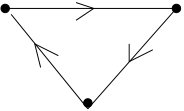 Figure 1
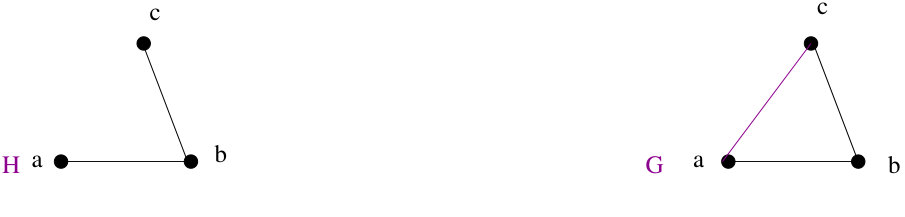 Figure 2
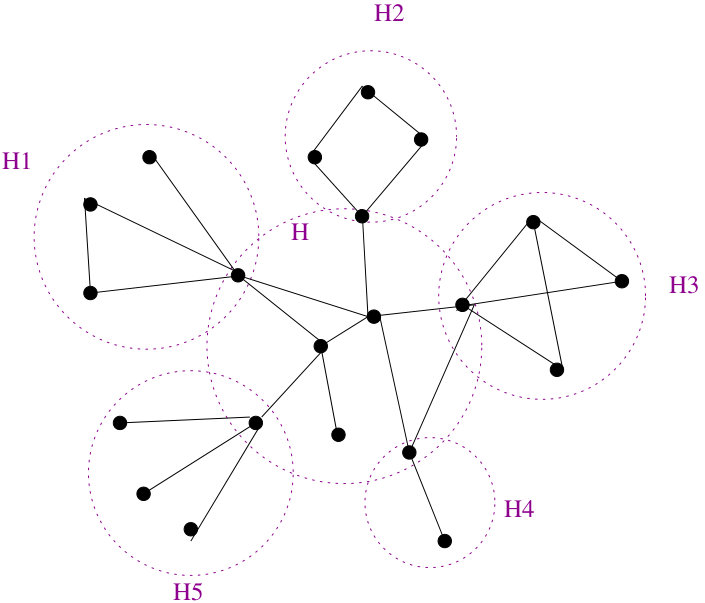 Figure 3
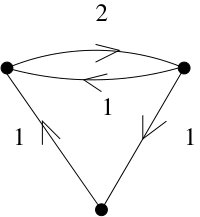 Figure 4
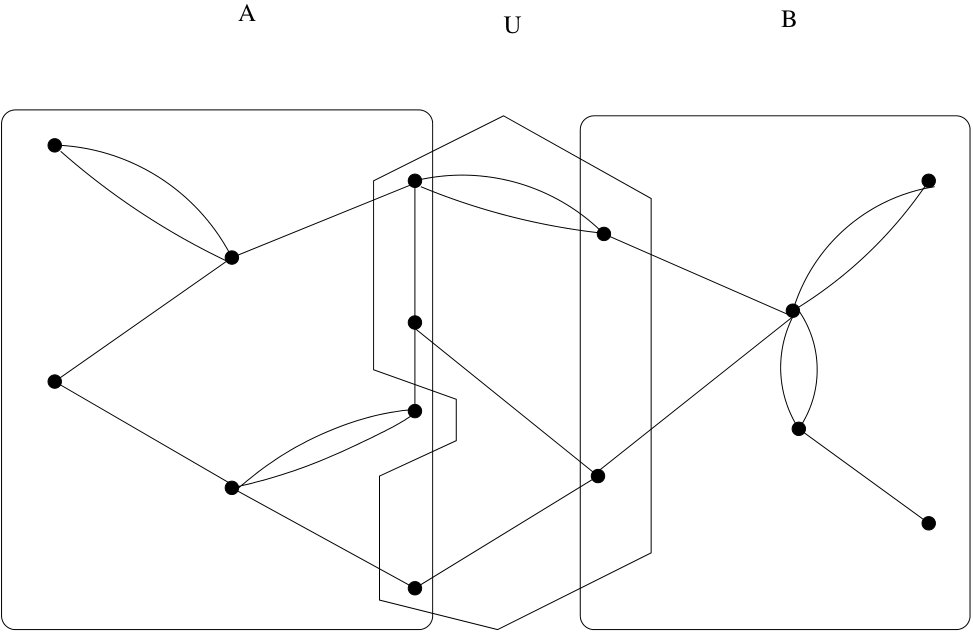 Figure 5
Peer Reviews
No public reviews on file for this paper yet. If you reviewed it on a platform where reviews are public (OpenReview, ICLR, NeurIPS, ICML), you can paste yours below so the community can read it here.
Videos
No videos yet. Explain this paper in a talk, walkthrough, or lecture? Add one.
On the eigenvalues of weighted directed graphs
MARWA BALTI
Université de Carthage, Faculté des Sciences de Bizerte: Mathématiques et Applications (UR/13ES47) 7021-Bizerte (Tunisie)
Université de Nantes, Laboratoire de Mathématique Jean Lauray, CNRS, Faculté des Sciences, BP 92208, 44322 Nantes, (France).
Abstract.
We consider a non self-adjoint Laplacian on a directed graph with non symmetric edge weights. We analyse spectral properties of this Laplacian under a Kirchhoff’s assumption. Moreover we establish isoperimetric inequalities in terms of the numerical range to show the lack of essential spectrum of Laplacian on heavy ends directed graphs. We introduce a special self-adjoint operator and compare its essential spectrum with that of the non self-adjoint Laplacian considered.
Key words and phrases:
Graph Laplacian, Bounds of eigenvalues, Domain monotonicity, Comparison of eigenvalues
1991 Mathematics Subject Classification:
47A10, 35P15, 49R05, 05C50, 47A75
Contents
Introduction
This article follows up on the ideas in [4] and [12] on monotonicity eigenvalues which are relative to continuous domains. The purpose of this work is to explore in the case of weighted directed graphs, some familiar facts of monotonicity proved on domains of and on compact Riemannian manifolds. Specially, our main question is: ”can one study the behavior of the eigenvalues of a special operator under perturbations on finite graphs?” First, we consider a finite, directed and connected graph with non symmetric edge weights. Then, we introduce the associated non symmetric Laplacian . We introduce the self-adjoint operator , such that it is easier to examine its spectrum thanks to selfadjointness. We give some spectral properties of and we show that the real part of its eigenvalues can coincide with the eigenvalues of . Secondly, we study the monotonicity of eigenvalues relative to vertices or edges of . We prove that the eigenvalue of is decreasing only in a class of graphs called here flower-like-graphs, and it is monotone increasing in the set of edges. These results are inspired by the classical results going back from M. Fiedler [6] and P. Kurasov, G. Malenova, S. Naboko [11] on the first nonzero eigenvalue of a simple graph. We extend these results for the higher eigenvalues of our special operator. In the second part of our work, we try to establish and improve the Proposition 2.1 of [3] for a Riemannian manifold which gives upper bounds on the higher eigenvalues in terms of Dirichlet eigenvalues on components of a partition of .
Let us briefly outline the contents of this article. We shall start with a short section of preliminaries consisting on some basic properties of the non symmetric Laplacian on and the associated Green formula. In section 3, we establish a generalization of some monotonicity eigenvalue results. Furthermore, we study the example of flower-like graphs and insist on the interest of the subgraph concept. Hence, we can remark that these considerations of graph help to give an upper bound of the eigenvalues of a simple tree. This section includes also similar Weyl and Cauchy theorems for the matrices [10]. In section 4, we are interested on the study of the eigenvalues of the Dirichlet Laplacian. We involve a comparison on the eigenvalues to use the decomposition of into two components and and we give an upper bound on the eigenvalues of in terms of Dirichlet eigenvalues of and .
1. Preliminaries
We will review in this section some basic definitions and introduce the notation used in the article. They are introduced in [2] for the infinite graph.
1.1. Notion of Graphs
We call oriented or directed graph, the couple , where is a set of vertices, and is a set of directed edges. For two vertices of , we denote by the edge that connects to , we also say that and are * neighbors*.
For all , we set:
- •
- •
- •
- •
.
The valency on is given by:
[TABLE]
We introduce some definitions given in [1], [2], [5], [14] for the case of symmetric graphs.
Definitions 1.1**.**
- •
A path between two vertices and in is a finite set of directed edges such that
[TABLE]
- •
* is called connected if two vertices are always related by a path.*
- •
* is called strongly connected if there is for all vertices a path from to and one from to .*
Example 1.1**.**
The cycle graph , with
[TABLE]
is strongly connected.
- •
Define for a finite subset of , the interior, the vertex boundary and the edge boundary of respectively by:
[TABLE]
[TABLE]
[TABLE]
We remark that the strong connectedness of assures that:
[TABLE]
In this work we suppose that is finite, connected and satisfies the Hypothesis (1). In this work, we take the following definition.
Definition 1.1**.**
Directed weighted Graph: A weighted graph is the data of a graph and a weight satisfying the following conditions:
- •
* for all , (no loops in )*
- •
* iff *
- •
Assumption .
Assumption : for all ,
where
[TABLE]
The weight on a vertex is given by:
[TABLE]
Remark 1.1**.**
The Assumption is natural, it looks like the Kirchhoff’s law in the electrical networks.
The weighted graph is symmetric if for all , ,
as a consequence (the graph is symmetric).
In addition, we consider a weight on :
[TABLE]
1.2. Functional spaces
Let us introduce the following function spaces associated to the graph :
[TABLE]
endowed with the following inner product:
[TABLE]
We define its associated norm by:
[TABLE]
A particular case called normalized is for .
For a subset of , Let
[TABLE]
The weights and are called simple if they are constant equal to on and respectively. We denote by the simple graph (with simple weights).
2. Laplacian on directed graphs
For a weighted connected directed graph , we introduce the combinatorial Laplacians:
Definitions 2.1**.**
- •
We define the Laplacian on by:
[TABLE]
- •
In particular, if for all , , the Laplacian is said to be the normalized Laplacian and is defined on by:
[TABLE]
- •
For any operator on , the Dirichlet operator , where is a subset of , is defined by:
[TABLE]
Thanks to Hypothesis the adjoint of has a simple expression.
Definition 2.1**.**
Adjoint of an operator: The adjoint operator of is defined by:
[TABLE]
Proposition 2.1**.**
Let be a function of , we have
[TABLE]
Proof:
The following calculation for all gives:
[TABLE]
The Green’s formula is one of the main tools when we are working with the symmetric Laplace operator. In the following we establish it for the non symmetric Laplacian.
Lemma 2.1**.**
Green’s Formula. Let and be two functions of . Then
[TABLE]
Proof:
The proof is a simple calculation:
[TABLE]
Definition 2.2**.**
Special Laplacian. We define a special Laplacian as the sum of the two non self-adjoint Laplacians and , given by:
[TABLE]
where for any .
Remark 2.1**.**
- (1)
* is a symmetric operator on , because .* 2. (2)
* is a positive operator: for all ,*
[TABLE]
In our discussion on the study of eigenvalues of a self-adjoint operator, it is natural to introduce the different characterization by variational principles [9].
2.1. Variational principles and Properties
Let be a bounded from below self-adjoint operator. The eigenvalues of can be characterized by three fundamental variational principles: the Rayleigh’s principle, the Poincaré-Ritz max-min principle and the Courant-Fischer-Weyl principle applied to the Rayleigh quotients , .
Let us arrange the eigenvalues of as
[TABLE]
counted according to their multiplicities.
In this case we have :
- (1)
The Rayleigh’s principle states:
[TABLE]
where are eigenvectors corresponding to the eigenvalues and the minimum is reached at the eigenvector . 2. (2)
The Poincaré-Ritz principle establishes:
[TABLE] 3. (3)
The Courant-Fischer-Weyl principle is given in the form:
[TABLE]
The result below establishes a link between the eigenvalues of and . We assume that the eigenvalues of are ordered as follows respectively:
[TABLE]
Lemma 2.2**.**
[TABLE]
Proof:
Let be an eigenfunction associated to , we have
[TABLE]
Remark 2.2**.**
In a particular case, the previous inequalities are strict. Let us consider the following example, where ,
we have and .
We introduce in the following a particular case of graphs whose \sigma(S_{G})=2\mathcal{R}e\big{(}\sigma(\Delta_{G})\big{)}.
Example 2.1**.**
Let us consider the simple cycle graph , see the Figure 2, we have ,
[TABLE]
In the following proposition we determine the spectrum of the non symmetric Laplacian . We follow the same approach as Grigoryan for the symmetric Laplacian [7] page 49.
Proposition 2.2**.**
The eigenvalues of are as follows:
- (1)
If is odd then the eigenvalues are (simple) and for all (simple). 2. (2)
If is even then the eigenvalues are (simple) and for all (simple).
Proof:
To compute the eigenvalues of , it is sufficient to determine the spectrum of . Let be an eigenvalue of the operator , for , which leads to but thus . As is an eigenfunction , then . As is n-periodic provided is a multiple of , hence,
[TABLE]
where is an integer of .
Observe that an interesting corollary concerning the spectra of and .
Corollary 2.1**.**
[TABLE]
Proof:
We refer the Lemma 2.7 of [7], we remark that the eigenvalues of the operator \dfrac{1}{2}(P+P^{*})f(k)=\dfrac{1}{2}\big{(}f(k+1)+f(k-1)\big{)} coincide with the real part of the eigenvalues of .
Using the Green’s formula, we establish some properties of the spectrum on any graph .
Proposition 2.3**.**
- (1)
[math]* is a simple eigenvalue of and .* 2. (2)
All the eigenvalues of are contained in . 3. (3)
The real part of the eigenvalues of are also contained in .
Proof:
- (1)
As in the case of undirected graph [7], we have for all ,
[TABLE]
Clearly, the constant function is an eigenfunction of [math]. Assume now that f is an eigenfunction of the eigenvalue [math]. By the connectedness of , is constant, which will imply that [math] is a simple eigenvalue. It is similar for . 2. (2)
It is sufficient to prove that is bounded by because is non negative by the Green’s formula. In fact, for all and thanks to Assumption , we obtain
[TABLE] 3. (3)
We deduce directly our inclusion thanks to the Lemma 2.2.
3. Domain monotonicity of eigenvalues
The purpose of this part is to give an overview of some results concerning the monotonicity with regard to the domain, of eigenvalues of , the special self-adjoint Laplacian associated to directed graphs with non symmetric edge weights. We could be concerned with the related question:
Does a given eigenvalue increases or decreases under a given perturbation of ?
3.1. Definitions on
Before discussing the study of variation of eigenvalues, let us recall some basic definitions: let be a graph,
- •
The graph is called a partial graph of , if is included in .
- •
A graph is called a subgraph of if and \vec{E}_{H}=\big{\{}(x,y);\leavevmode\nobreak\ x,y\in V_{H}\leavevmode\nobreak\ \leavevmode\nobreak\ \big{\}}\cap\vec{E}_{G}.
- •
A graph is called a part of a graph if and \vec{E}_{U}=\big{\{}(x,y),\leavevmode\nobreak\ \leavevmode\nobreak\ x,y\in V_{U}\big{\}}\subset\vec{E}_{G}.
Remark 3.1**.**
A subgraph is a part of but the converse is not true, for example let us give the following undirected graphs, see the Figure 3.
* is a part of , but not a subgraph.*
Remark 3.2**.**
A confusion between a subgraph and a part of a graph can create a false interpretation on the monotonicity of eigenvalue.
3.2. Monotonicity relative to vertices
We study the monotonicity of eigenvalues under the variation of the set of vertices.
By the Courant-Fischer-Weyl principle we establish the following statement.
Theorem 3.1**.**
Let be a connected subgraph of a graph , , then for any :
[TABLE]
Proof:
Let be eigenfunctions associated to ; and , are the Dirac measures on relative to the vertices in . It is clear that . Then using (4), we obtain ;
[TABLE]
hence with support in such that
[TABLE]
For studying the behavior of eigenvalues relative to perturbations, we propose a special construction of graphs.
Definition 3.1**.**
Let be a weighted graph. is called -flower-like with respect to the subgraph of if there exists a family of subgraphs of such that:
- (1)
** 2. (2)
. 3. (3)
.
These special graphs are used to create a rule of monotonicity of under a given graph perturbation.
Theorem 3.2**.**
Let be a -flower-like graph, we have then for any ,
[TABLE]
Proof:
We use the variational principle (2). Let be eigenfunctions of in associated to , and be the eigenfunction associated to , for . We define a function on by:
[TABLE]
where
Let , so, there exist reals not all equal to zero, satisfying:
[TABLE]
Therefore the function is orthogonal to for all , we define for , . Then we get :
[TABLE]
as
[TABLE]
then
[TABLE]
The above results have several important consequences, for instance on a tree seen as a flower-like graph.
Corollary 3.1**.**
Let be a simple symmetric tree and then the eigenvalues of satisfy for all :
[TABLE]
and
[TABLE]
Proof:
Clearly there exists a symmetric star graph with vertices seen as a subgraph of . It can be considered as a -flower-like graph. Therefore satisfies the assumptions of the Proposition 3.2. Hence we get the result because the spectrum of is : , see [13].
In the following, we will show more general results : instead of adding only one vertex and one edge, we would also add a graph.
Corollary 3.2**.**
Let be a graph with vertices, let connected to G by a single edge.Then for ;
[TABLE]
Remark 3.3**.**
The previous corollary is an immediate consequence of the Proposition 3.2. In addition this is an interesting generalization of Proposition 2 in [11] which shows that where is obtained from by adding one edge between one vertex of and one new vertex.
3.3. Monotonicity relative to edges
We apply the Weyl and interlacing Theorems for matrices to study how the spectrum of the special operator of a directed graph changes under adding an edge or a set of edges.
Now we have several opportunities to refer to the following basic observation about subspace intersections (see [10] page 235).
Lemma 3.1**.**
Let be a finite dimensional vector space and let , ,.., be subspaces of , if
[TABLE]
then linearly independent vectors, in particular , it contains a nonzero vector.
Observation 3.1**.**
Let be the special self-adjoint operator with eigenvalues . Then the ordered eigenvalues of are , that is,
We show that the eigenvalue is monotonously increasing functions of the set of edges. The following results are the generalizations of the Proposition 1 and the Proposition 2 in [11].
Proposition 3.1**.**
Let be a connected finite weighted graph , consider the partial graphs and where (disjoint union). Then for all and , :
[TABLE]
and
[TABLE]
Proof:
Let , , and be the eigenfunctions associated to , and respectively for .
For , we define , and by the Lemma (3.1) there exists a non zero function in and so we will have
[TABLE]
In the following we apply the equality (6) to the operator because the inequalities (7) does not depend on positivity of , and by:
[TABLE]
We obtain by re-indexing:
[TABLE]
We can easily deduce,
Corollary 3.3**.**
Let be a connected finite graph, and two partial graphs of where , then for all and , :
[TABLE]
Proof:
By applying the proposition 3.1 to and respectively, we obtain the result because
In other words, adding a subset of edges to while keeping the same set of vertices always induces an increasing of the eigenvalue or keeps it unchanged.
Corollary 3.4**.**
Let be a connected finite graph with vertices, and a graph obtained by adding a set of edges to then for all :
[TABLE]
4. Comparison eigenvalues of Dirichlet Laplacian on graphs
In this section, we present some results about the spectrum comparison between the Laplacian and the Dirichlet Laplacian. The purpose of this part is to find the relation between the usual vertex weight on a subgraph of and its boundary weight to compare eigenvalues.
This is done by establishing a clear and explicit link between the eigenvalues and the Dirichlet eigenvalues on .
In the following proposition, we treat the Dirichlet Laplacian case :
[TABLE]
By the same techniques used in the Lemma 2.2, we can show the following Lemma.
Lemma 4.1**.**
[TABLE]
and
[TABLE]
Proof:
Let and be eigenfunctions associated to and respectively. By the variational principle of and , we have
[TABLE]
and
[TABLE]
In the same spirit as the Cauchy interlacing theorem concerning hermitian bordered matrices (see [9] theorem 4.3.28 for a generalized statement) one can prove the following.
Proposition 4.1**.**
Consider a connected subgraph of , , then the eigenvalues on of the normalized Laplacian satisfies:
[TABLE]
Proof:
Let and be the eigenfunctions associated to and respectively, define the function for by:
[TABLE]
Let and fix and by the Lemma 3.1 there exists a function in . Since , it has the form
[TABLE]
for some . Observe that:
[TABLE]
since , we get
[TABLE]
then,
[TABLE]
We deduce easily from the Proposition 4.1 an estimation of the eigenvalues of and , thanks to Theorem 3.1, as follows:
Corollary 4.1**.**
Consider a connected subgraph of , , then the eigenvalues on satisfies:
[TABLE]
Corollary 4.2**.**
Consider a connected subgraph of , , then:
[TABLE]
Corollary 4.3**.**
Consider a connected subgraph of the cycle graph , , then:
[TABLE]
In the following Proposition we prove how to give an upper bound for in terms of a Rayleigh quotient. We give a discrete version of the Proposition 2.1 [3] by applying the Poincaré min-max principle. The methods we use follow closely the arguments given in B. Benson [3] in the case of the Laplacian of Riemannian manifolds. Next we provide an upper bound of the eigenvalues of according to Dirichlet eigenvalues on such repartition of as in the Figure 5.
Proposition 4.2**.**
Let a finite connected graph, a part of and , two subgraphs satisfying the following conditions:
- (1)
* (** disjoint union**)* 2. (2)
** 3. (3)
.
Then we get for :
[TABLE]
Proof:
Let and be the eigenvectors associated to and respectively, for and .
We define on by:
[TABLE]
We have
[TABLE]
Using the Poincaré min-max principle (3), we obtain:
[TABLE]
Hence
[TABLE]
Remark 4.1**.**
The previous Proposition remains true in the particular case of the Laplacian .
An estimate of can also be obtained with respect to and .
Corollary 4.4**.**
Under the same hypothesis of the previous Proposition we have
[TABLE]
Corollary 4.5**.**
Under the same hypothesis of the previous Proposition, from the cycle graph , we have
[TABLE]
Acknowledgement: I take this opportunity to express my gratitude to my PhD advisors Colette Anné and Nabila Torki-Hamza for all the fruitful discussions, helpful suggestions and their guidance during this work. This work was financially supported by the ”PHC Utique” program of the French Ministry of Foreign Affairs and Ministry of higher education and research and the Tunisian Ministry of higher education and scientific research in the CMCU project number 13G1501 ” Graphes, Géométrie et théorie Spectrale”. Also I would like to thank the Laboratory of Mathematics Jean Leray of Nantes (LMJL) and the research unity (UR/13ES47) of Faculty of Sciences of Bizerte (University of Carthage) for its financial and its continuous support.
The reference list from the paper itself. Each links out to its DOI / PubMed record.
- 1[1] C. Anné, N. Torki-Hamza. The Gauss-Bonnet operator of an infinite graph. Anal. Math. Phys. 5 , (2015), 137-159.
- 2[2] M. Balti. Non self-adjoint Laplacian on a directed graph. Submitted, (2016).
- 3[3] B. Benson. Sturm-Liouville Estimates for the Spectrum and Cheeger Constant. arxiv.org/1308.5936. International Mathematics Research Notices, 2015 , (2015), 7510-7551.
- 4[4] I. Chavel. Eigenvalues in Riemannian Geometry. Academic Press, INC, (1984).
- 5[5] R. Diestel. Graph theory. Springer-Verlag New York, (2005).
- 6[6] M. Fiedler. Algebraic Connectivity of Graphs. Czechoslovak Mathematical Journal, 23 , (1973), 298-305.
- 7[7] A. Grigoryan. Analysis on graphs. Lecture Notes, University of Bielefeld, WS (2011/12).
- 8[8] L. Golinskii, S. S. Capizzano. The asymptotic properties of the spectrum of non symmetrically perturbed Jacobi matrix sequences. Journal of Approximation Theory, 144 , (2005), 84-102.