Weighted $1\times1$ cut-and-project sets in bounded distance to a lattice
Dirk Frettl\"oh, Alexey Garber

TL;DR
This paper demonstrates that certain weighted cut-and-project sets in one dimension are bounded distance equivalent to a lattice under specific smoothness conditions on the weight function.
Contribution
It extends previous results by establishing bounded distance equivalence for weighted cut-and-project sets with particular regularity conditions on the weight function.
Findings
Weighted cut-and-project sets are bounded distance equivalent to a lattice under certain conditions.
Continuity, piecewise linearity, or bounded curvature of the weight function ensure bounded distance equivalence.
Results apply to one-dimensional physical and internal spaces.
Abstract
Recent results of Grepstad and Lev are used to show that weighted cut-and-project sets with one-dimensional physical space and one-dimensional internal space are bounded distance equivalent to some lattice if the weight function is continuous on the internal space, and if is either piecewise linear, or twice differentiable with bounded curvature.
Click any figure to enlarge with its caption.
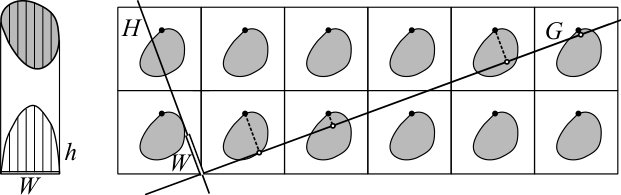 Figure 1
Peer Reviews
No public reviews on file for this paper yet. If you reviewed it on a platform where reviews are public (OpenReview, ICLR, NeurIPS, ICML), you can paste yours below so the community can read it here.
Videos
No videos yet. Explain this paper in a talk, walkthrough, or lecture? Add one.
Weighted cut-and-project sets in bounded
distance to a lattice
Dirk Frettlöh
Technische Fakultät, Bielefeld University
and
Alexey Garber
School of Mathematical & Statistical Sciences, The University of Texas Rio Grande Valley, 1 West University Blvd., Brownsville, TX 78520, USA.
(Date: March 14, 2024)
Abstract.
Recent results of Grepstad and Larcher are used to show that weighted cut-and-project sets with one-dimensional physical space and one-dimensional internal space are bounded distance equivalent to some lattice if the weight function is continuous on the internal space, and if is either piecewise linear, or twice differentiable with bounded curvature.
Key words and phrases:
cut-and-project sets, bounded distance equivalence, bounded remainder sets
2010 Mathematics Subject Classification:
52C23, 11J72, 11K38, 37A45
1. Introduction
A Delone set is a non-empty set of points in some metric space such that (1) there is such that each open ball of radius centered at a point of contains no other points of , and (2) there is such that each closed ball of radius centered at a point of contains at least one more point of . Depending on the context, Delone sets are also called separated nets, or -sets. Two Delone sets in the same metric space are called bounded distance equivalent () if there is a bijection such that is uniformly bounded. In 1993 M. Gromov asked whether any Delone set in is bilipschitzequivalent with [9]; i.e., whether there is a bijection from to such that the bijection is Lipschitz continuous in both directions. In 1998 D. Burago and B. Kleiner, and independently C. McMullen, gave a negative answer [3, 16]. The analogous question for the hyperbolic plane was answered positively by Bogopolskii [2] by showing that all Delone sets in are bounded distance equivalent to each other. Bounded distance equivalence implies bilipschitzequivalence.
Even before that physicists asked whether some given crystallographic or quasicrystallographic Delone set in or has an “average lattice” of the form ; i.e. whether there is such that . A lattice in is the -span of linearly independent vectors . In [4] it is shown that any two lattices in with equal density are bounded distance equivalent. In [5] a sufficient condition for a cut-and-project set (CPS) being bounded distance equivalent to some lattice with the same density is given. For a definition of a CPS see below. There is no precise mathematical definition of a quasicrystal; but often when speaking of a (mathematical) quasicrystal a CPS set is meant.
Recently bounded distance equivalence of Delone sets did get some attention, see e.g. [15, 8, 10, 11, 12] and references therein. A frequently exploited connection is the correspondence between (certain) CPS and (certain) bounded remainder sets for (discrete) toral rotations. Given a set and some (irrational) the deficiency (or discrepancy) of with respect to some is
[TABLE]
where denotes Lebesgue measure on . A set is called a bounded remainder set (BRS) with respect to if there is such that for almost all we have . As we will see, for our purposes the plays no role; it is included in the definition only because in some contexts there is an exceptional null-set of to consider.
A profound theorem of Kesten [14] shows that an interval is a BRS for the discrete toral rotation on the one-dimensional torus if and only if . Applied to CPS this proves for instance that the Fibonacci sequence, defined by a CPS with lattice and window is bounded distance equivalent to some lattice, whereas the Half-Fibonacci sequence using the same lattice but window , is not bounded distance equivalent to any lattice. See Examples 2.1 and 4.5 for more details.
In this paper we exploit the connection between continuous toral rotations and weighted cut-and-project sets. Our main result Theorem 4.1 uses two theorems of [7] on continuous toral rotations. It shows that many weighted CPS where the window is an interval and the weight function is continuous and supported on (hence equals 0 at the endpoints of the interval) are bounded distance equivalence to some lattice, with no restrictions on the length of the window. This is in strong contrast with the discrete case, see Kesten’s theorem mentioned above, respectively the Half-Fibonacci example.
Notation: Throughout the paper, denotes -dimensional Lebesgue measure (where or , depending on the context). The Dirac measure in is denoted .
2. Cut-and-project sets
A cut-and-project set (CPS, aka model set) is given by a collection of maps and spaces:
[TABLE]
where in general and are locally compact abelian groups. Furthermore, is a lattice (i.e., a discrete cocompact subgroup) in , is a relatively compact set in , and and are projections to and to respectively, such that is one-to-one, and is dense in . Then
[TABLE]
is called a CPS.
Throughout this paper we will always have and , hence we call the resulting CPS sometimes -CPS in order to distinguish them from CPS where or have higher dimension. For the sake of clarity, we will refer to these spaces as and (rather than and ) in order to distinguish the space supporting the CPS (often called direct space) from the space supporting (often called internal space).
It does not really matter whether is a proper lattice, or a translate of some lattice, since translating the lattice by yields the same CPS (shifted by ) as translating the window by . In general, translating the window corresponds just to changing the CPS to another CPS that is locally indistinguishable from provided has empty intersection with boundaries of windows for and , in the sense that a copy of each local piece of appears in , and vice versa.
The density of a CPS is the average number of points per unit area. It is known that the density of a CPS exists and equals
[TABLE]
where is the matrix whose columns are the spanning vectors of the lattice . See [1, Thm. 7.2] and references there for details.
Example 2.1**.**
Probably one of the most prominent CPS is the Fibonacci sequence. The corresponding CPS has , , , lattice \Gamma=\langle\big{(}\begin{smallmatrix}1\\ 1\end{smallmatrix}\big{)},\big{(}\begin{smallmatrix}\tau\\ -\tau^{-1}\end{smallmatrix}\big{)}\rangle_{\mathbb{Z}}, and and are orthogonal projections to , respectively to .
See also Example 4.5 below.
Weighted CPS are a generalisation of the notion of a CPS. A weighted CPS is a Dirac comb , where , , and the restriction is continuous, and . Here, makes sense since is one-to-one. A weighted CPS with constant weight function for all (and for ) is just an ordinary CPS, viewed as a measure. Weighted Dirac combs and weighted CPS are relevant in the study of diffraction properties of CPS, see [1] and references therein. It is easy to see that the density formula (1) for CPS generalises to weighted CPS as follows:
[TABLE]
3. BRS for continuous rotations and weighted CPS
In order to utilize the results of [7] we generalize the notion of bounded distance equivalence from point sets to measures.
Definition 3.1**.**
Two measures on are bounded distance equivalent, if there is such that for all with
[TABLE]
Remark 3.2**.**
The only restriction we impose on the measures and in the definition above is that all intervals (open, closed, semi-open) are measurable with respect to and . However, in the further discussion we will mostly work with multiples of standard Lebesgue measure and with (weighted) Dirac comb measures defined for discrete sets, see the definition below.
It is easy to see that the relation above defines an equivalence relation.
Since a point set in can be identified with a measure it is not hard to see that Definition 3.1 reduces for Delone sets to the definition of bounded distance equivalence above. Nevertheless, we spell out the details in the proof of the next lemma.
Lemma 3.3**.**
Two Delone sets in are bounded distance equivalent as point sets if and only if the corresponding Dirac combs and are bounded distance equivalent as measures.
Proof.
Without loss of generality let (with if ) and (with if ). Let respectively be the corresponding Dirac combs. Let be such a number that if , then and . The constant can be taken as the smallest of two smaller radii in the Delone property of and .
If there is a bounded distance bijection between and then is a bounded distance bijection, too. Hence there is such that for all .
Let be the largest with . By the Delone property the interval contains at most points of , hence
[TABLE]
Thus the difference
[TABLE]
is bounded by the number of points such that (or vice versa). Thus
[TABLE]
where and depend only on and .
Conversely, if for all , then the number of points in deviates at most by from the number of points in . For , if but , then can contain at most points of ; again by the Delone property of . Hence
[TABLE]
where and depend only on and . The same holds for with . ∎
The paper [7] studies BRSs of the continuous analogue of the discrete toral rotations above. We state two definitions from [7], slightly simplified for our purposes.
Definition 3.4**.**
Let , and let . We say that the function defined by
[TABLE]
is the two-dimensional continuous irrational rotation with slope and starting point .
The notion of deficiency translates as follows.
Definition 3.5**.**
Let be an arbitrary measurable set with Lebesgue measure . We say that is a bounded remainder set (BRS) for the continuous irrational rotation with slope and starting point if the distributional error
[TABLE]
is uniformly bounded for all . Here, denotes the characteristic function for the set .
The following simple observation will be useful in the sequel. It can be shown easily by spelling out the definition (resp., definitions, since it holds in both cases, discrete toral rotations and continuous toral rotations).
Lemma 3.6**.**
Let be BRSs. If then the union is a BRS, too. If then the difference is a BRS, too.
Two of the main results in [7] are the following.
Theorem 3.7**.**
For almost all and every , every polygon with no edge of slope is a BRS for the continuous irrational rotation with slope and starting point .
Theorem 3.8**.**
For almost all and every , every convex set whose boundary is a twice continuously differentiable (regular) curve with positive curvature at every point is a BRS for the continuous irrational rotation with slope and starting point .
Remark 3.9**.**
From a geometric point of view the curvature at can be defined for a twice continuously differentiable regular curve as the reciprocal of the radius of a circle (or a line, in that case ) that gives the best approximation of at . Here regularity means that there exists a parametrization of the curve, for example a natural parametrization with its length, such that is never a zero vector. Here dot denotes the derivative with respect to the variable . We will also assume only regular parametrizations in the sequel.
If is a parametrization of a regular curve, then where the numerator is the length of the cross-product in the ambient -space. If is parametrized with its length, then . If the curve is given by equation in standard rectangular coordinate system, then can be treated as a parameter and
[TABLE]
Note, that the value of the curvature at given point does not depend on a (regular) parametrization of in a neighborhood because the geometric description of the curvature given above.
We refer to [17], or almost any other differential geometry textbook, for more details about geometry of planar curves.
To a BRS and an irrational slope as above one can associate a weighted CPS as follows; see also Figure 1. The direct space is G=\big{(}\begin{smallmatrix}1\\ \alpha\end{smallmatrix}\big{)}\mathbb{R}, the internal space is the orthogonal complement H=\big{(}\begin{smallmatrix}1\\ \alpha\end{smallmatrix}\big{)}^{\perp} of in . The projections and are the orthogonal projections to , respectively to , and . Since is connected, is a line segment in , so we have for some . Because of the properties of (either positive curvature, or no slope in direction ) there is exactly one point such that . Let be . Hence is not actually a lattice here, but a translation of the lattice . This makes no difference, see the remark in the definition of a CPS in Section 2. Since is irrational, is one-to-one, and is dense in . Let be the CPS defined by these data.
The map is defined by letting (for ) be the length of \big{(}\begin{smallmatrix}1\\ \alpha\end{smallmatrix}\big{)}\mathbb{R}\cap(y+P). Clearly, vanishes outside , and each fulfilling either the conditions of Theorem 3.7 or of Theorem 3.8 yields a map that is continuous on : the support of is , and . Hence is a weighted CPS. (Recall that for .)
Conversely, given a weighted CPS with data G=\big{(}\begin{smallmatrix}1\\ \alpha\end{smallmatrix}\big{)}\mathbb{R},H=\big{(}\begin{smallmatrix}1\\ \alpha\end{smallmatrix}\big{)}^{\perp},\Gamma=\mathbb{Z}^{2},W=[a,b],\Gamma=\mathbb{Z}^{2},h, we can apply the opposite construction to obtain a candidate for a BRS with respect to a continuous rotation on the torus. One possible problem is that the window for may be too large to fit into a standard fundamental domain of the lattice . One way to handle this is to split the “big” CPS into smaller ones.
Lemma 3.10**.**
Let . A CPS with lattice , G=\big{(}\begin{smallmatrix}1\\ \alpha\end{smallmatrix}\big{)}\mathbb{R}, , and is the union of CPS with lattice translates , and the same , , .
Proof.
It is enough to notice that . ∎
Hence we assume without loss of generality in the following that fits into the interior of the projection of the fundamental domain of along . Otherwise we split the CPS into smaller ones as in the lemma above for appropriate large enough . Such a number exists because the projection of the fundamental domain of is times bigger than the projection of the fundamental domain of , and the window is bounded.
Now we choose a compact set such that for the value equals the length of (z+\big{(}\begin{smallmatrix}1\\ \alpha\end{smallmatrix}\big{)}\mathbb{R})\cap P. (For instance, if , then can be the region between the graph of and the graph of .) Now again, the values of may be too large to fit into . Hence, if needed, we may rescale by some appropriate factor such that fits into .
Lemma 3.11**.**
Let and , that depends on , be as in the preceding construction. The weighted CPS is bounded distant equivalent to for some , if and only if is a BRS with respect to .
Proof.
We compare with . By construction we have . Also by construction, is the width of the intersection of the line segment with a translation of by an integer vector. So for we have
[TABLE]
Hence the right hand side is uniformly bounded if and only if the left hand side is. ∎
Remark 3.12**.**
The authors of [7] give a precise meaning to the “almost all” in Theorems 3.7 and 3.8. Namely, the results hold for all whose continued fraction expansion satisfies
[TABLE]
where is a constant independent of . Here, is the sequence of best approximation denominators for . In particular this implies that the results hold for all where the are uniformly bounded by some constant . This follows from the fact that the grow at least as fast as (where ). Then the sum above is less than the convergent sum
[TABLE]
Since many CPS in the literature use quadratic irrationals for the slope , and quadratic irrationals have periodic continued fraction expansion, these results apply to most cases of CPS studied in the literature.
Remark 3.13**.**
The proofs of Theorems 3.7 and 3.8 from [7] are based on the connection between BRS and -periodic bounded remainder functions. A -periodic function is called a bounded remainder function with respect to an irrational number if the there is a constant such that
[TABLE]
for all integers .
Two results [7, Props. 2.5 and 2.6] by Grepstad and Larcher state that a -periodization of a positive hat-function (“simplest” continuous piecewise linear function with compact support) or a -periodization of a positive dome-function (a certain twice-differentiable function inside its compact support, continuous everywhere, with bounded growth/decay at the boundary points of support) are bounded remainder functions. These propositions are the main building blocks for the proofs of Theorems 3.7 and 3.8.
In the same way as we have shown how one can transfer the notion of BRS to the notion of weighted CPS, we can transfer bounded remainder functions to weighted CPS and vice versa. The non-weighted CPS can be treated as a weighted CPS with non-continuous weight function being the indicator function of the window . If is bounded distance equivalent (as a point set) to a lattice, then the corresponding bounded remainder function will be a -periodic piecewise constant function. Later in Theorem 4.1 we will see that weighted CPS with many continuous weight functions are bounded distance equivalent to lattices. This is in contrast to the case of non-weighted CPS, where Kesten’s theorem [14] shows that in the non-weighted case the conditions are more restrictive.
We refer to [18] for more discussion on the difference between continuous bounded remainder functions and piecewise constant bounded remainder functions.
4. Main results
Using the results from the last section we can now prove the following result.
Theorem 4.1**.**
Let be a CPS with lattice , G=\big{(}\begin{smallmatrix}1\\ \alpha\end{smallmatrix}\big{)}\mathbb{R} and , window , and let be continuous on with support (i.e., vanishes outside , and for in the interior of ). Furthermore, let fulfill the condition (4) in Remark 3.12.
- (1)
If is piecewise linear, or 2. (2)
if is twice differentiable on , and is uniformly bounded on ,
then the weighted Dirac comb is bounded distance equivalent to , where .
Remark 4.2**.**
Though the theorem above is stated for a scaled Lebesgue measure , it is also true for any measure which is bounded distance equivalent to . In particular we can use any -periodic measure with , or the Dirac comb associated with the lattice of density , or its translates.
Indeed, let be a -periodic measure with . Given with , let by the largest integer such that . Then
[TABLE]
and the difference does not exceed .
Proof.
Let us first assume that is twice differentiable on , and is uniformly bounded on . Choose a compactly supported twice differentiable (we require that must be twice differentiable in the interior of its support, not at the endpoints), such that the support of is contained in the interior of the support of , and such that there is such that the second derivative of is less than . We will take to be the width function of an appropriate big circle . Choose such that the second derivative of is bounded away from 0. I.e., there is such that for all holds: . Then is twice differentiable, has negative second derivative less than , and consequently is convex.
Both and yield convex sets , that fulfill the conditions of Theorem 3.8: The convex set for is just an ellipse which is the -dilation of the circle . Therefore has positive curvature as any ellipse has positive curvature (this can be checked using the parametrization and the formulas from Remark 3.9). As we might again choose the region between the graphs of . The curvature of is positive in because the second derivative of both functions is bounded from zero by in . Hence the numerator from the formulas of Remark 3.9 can not equal [math]. The curvature of is positive in because the functions coincide with in , and therefore the curvature of is equal to the curvature of in , hence non-zero.
Thus both and yield BRS. By Lemma 3.6 the difference of two BRS with is again a BRS, hence corresponds to a BRS, too. By Lemma 3.11 the claim follows.
The case of piecewise linear is handled analogously. Note that if is piecewise linear and continuous on , then the corresponding polygon has no edge parallel to \big{(}\begin{smallmatrix}1\\ \alpha\end{smallmatrix}\big{)}. ∎
Since Lemma 3.11 and Lemma 3.6 imply that the sum of two measures that are bounded distance equivalent with , respectively , is bounded distance equivalent to , the following result is immediate.
Corollary 4.3**.**
Any linear combination of Dirac combs as in Theorem 4.1 is again bounded distance equivalent to , for some appropriate .
Theorem 4.1 holds for almost all , more precisely: for all fulfilling Equation (4). In particular, Theorem 4.1 holds for all with bounded values in their continued fraction expansion. However, there is no particular example of an algebraic number of degree larger than two where it is known whether the values in its continued fraction expansion are bounded. Fortunately, many CPS in the literature arise from two-letter substitutions [1]. The slope for a CPS for some two letter substitution is always a quadratic irrational, compare for instance with Example 2.1. Since quadratic irrationals have periodic continued fraction expansions, Theorem 4.1 holds for all quadratic irrationals . For a further discussion of the connection between symbolic substitutions or tile substitutions and (non-weighted) CPS see [13], or, in the context of BRS, see [6] and references therein.
Unfortunately, the most natural way to describe a CPS for a two-letter substitution is to use a lattice different to , namely the one spanned by the vectors , where are the natural tile lengths, and is the algebraic conjugate of , see [1] for details. Hence .
The following corollary shows how we can transform Theorem 4.1 in order to make it applicable to all weighted CPS with appropriate weight function provided underlying non-weighted CPS arises from a two-letter symbolic substitutions.
Corollary 4.4**.**
Let be a quadratic irrational. Let be a weighted CPS with , , the window an interval in and as in Theorem 4.1. Then the Dirac comb is bounded distance equivalent to where .
Proof.
The lattice can be mapped to the standard integer lattice by applying some matrix , where M^{-1}=\big{(}\begin{smallmatrix}1&\beta\\ 1&\beta^{\prime}\end{smallmatrix}\big{)}. Hence M=\frac{1}{\beta-\beta^{\prime}}\big{(}\begin{smallmatrix}-\beta^{\prime}&\beta\\ 1&-1\end{smallmatrix}\big{)}. The slope of Theorem 4.1 is then
[TABLE]
Hence
[TABLE]
Because of the symmetry of the slope yields the same CPS as the slope , respectively the slope . Hence the slope equals . In particular, is a quadratic irrational as well. Furthermore, preserves the properties of . By Theorem 4.1 the resulting CPS is bounded distance equivalent to for some appropriate . Since the original CPS is just the image of under some (regular) linear map, is also bounded distance equivalent to for some appropriate . By the density formula for weighted CPS (2) holds . ∎
Example 4.5**.**
The (symbolic) Fibonacci sequence can be generated by applying the map , repeatedly to the letter pair : , , , , . This symbolic sequence can be transformed into a Delone set in by assigning an interval of length to and an interval of length 1 to . The corresponding Delone set then consists of the endpoints of the intervals. This Delone set can be defined via a CPS, too, and the corresponding CPS is given in 2.1.
Since is a quadratic irrational, then we can apply Corollary 4.4 to weighted CPS defined with the data of the Fibonacci sequence with an appropriate weight function . In particular, if is continuously twice differential or continuous piecewise linear and supported by the window of , then the corresponding weighted CPS is bounded distance equivalent to with appropriate .
The original Fibonacci sequence can be treated as a weighted CPS with being the indicator function of . The corresponding Dirac comb is bounded distance equivalent to for some due to Kesten’s theorem [14]. However if is the indicator function of (either) half of then the resulted weighted CPS corresponds to a Half-Fibonacci sequence and is not bounded distance equivalent to for any due to Kesten’s theorem again. Here we would like to refer to [18] for more details between continuous and piecewise constant bounded remainder functions.
5. A remark on higher dimensions
Most of the basic objects discussed in this paper can be generalized in higher dimensions. In particular, the definition of weighted CPS will not change if we set direct space to be -dimensional, so , and internal space to be -dimensional, so .
However, if , then the definition of bounded distance equivalent measures will probably be more complicated than in the one-dimensional case. As it can be seen from [15, Section 1], even for an (unweighted) Dirac comb , the condition we need to check in order to see whether is bounded distance equivalent to a Dirac comb corresponding to a lattice (in the same sense as bounded distance equivalence of discrete sets), it is not enough to check the discrepancy of measures on one sequence of growing regions, balls or cubes. Probably, the best definition of bounded distance equivalence for measures will be the definition related to a transportation measure from [19]. The transformation from weighted CPS to BRS will work in this case to some extent. For example, a BRS should be defined using -dimensional integrals in that case. However, we don’t have any results in this direction.
If but , which is the case of one-dimensional CPS with higher dimensional internal space, then all the notions that are defined for objects in the direct space, including bounded distance equivalence for measures, stay the same. However the notions defined in the internal space should be substituted with their higher-dimensional analogs. In particular, the weight function for a weighted CPS should be defined on an -dimensional region. The transformation from “weighted CPS bounded distance equivalent to a lattice” to “BRS of continuous rotation” will work in the same way as in the case of weighted CPS, but the corresponding BRS now will be in -dimensional torus . In this case we are unaware about any results, except the results in [8] that can be transformed to unweighted CPS using the approach from [11].
Acknowledgment
Both authors are grateful to the anonymous referees for several valuable remarks. DF thanks the Research Centre of Mathematical Modelling (RCM2) at Bielefeld University for financial support. AG thanks CRC 701 at Bielefeld University for financial support and hospitality.
The reference list from the paper itself. Each links out to its DOI / PubMed record.
- 1[1] M. Baake, U. Grimm: Aperiodic Order , Cambridge Univ. Press, Cambridge (2013).
- 2[2] O.V. Bogopolski: Infinite commensurable hyperbolic groups are bi-Lipschitz equivalent, Algebra i Logika 36 (1997) 259-272; English transl. Algebra and Logic 36 (1997) 155-163.
- 3[3] D. Burago, B. Kleiner: Separated nets in Euclidean space and Jacobians of bi-Lipschitz maps, Geom. Funct. Anal. 8 (1998) 273-282
- 4[4] M. Duneau, C. Oguey: Bounded interpolation between lattices, J. Phys. A: Math. Gen. 24 (1991) 461-475.
- 5[5] M. Duneau, C. Oguey: Displacive transformations and quasicrystalline symmetries, J. Phys. France 51 (1990) 5-19.
- 6[6] D. Frettlöh, A. Garber: Pisot substitution sequences, one dimensional cut-and-project sets and bounded remainder sets with fractal boundary, Indagationes Mathematicae , accepted, ar Xiv:1711.01498 .
- 7[7] S. Grepstad, G. Larcher: Sets of bounded remainder for the continuous irrational rotation on [ 0 , 1 ) 2 superscript 0 1 2 [0,1)^{2} , ar Xiv:1603.00207.
- 8[8] S. Grepstad, N. Lev: Sets of bounded discrepancy for multi-dimensional irrational rotation, Geom. Funct. Anal. 25 (2015) 87-133.