Isospin analysis of $B\to D^*\bar{D}K$ and the absence of the $Z_c(3900)$ in $B$ decays
Zhi Yang, Qian Wang, Ulf-G. Mei{\ss}ner

TL;DR
This paper analyzes isospin amplitudes in B decays to D* D̄ K, explaining the absence of Zc(3900) in B decays through suppression of isospin triplet production and heavy quark limit effects, providing new insights into exotic states.
Contribution
It offers the first isospin-based explanation for the non-observation of Zc(3900) in B decays under the molecular hypothesis.
Findings
Isospin triplet D* D̄ production is highly suppressed.
The negative charge-parity state production is further suppressed in the heavy quark limit.
This suppression explains the absence of Zc(3900) in B decays.
Abstract
We study the isospin amplitudes in the exclusive to decay process and fit the available invariant mass distributions near threshold. The analysis demonstrates that the production of the isospin triplet state is highly suppressed compared to the isospin singlet one. That explains why the has not been found in decays. In addition, the production of the negative charge-parity state might be further suppressed in the heavy quark limit. These two reasons which are based on the molecular assumption offer the first explanation why the is absent in decays. Further studies of the absence from both the experimental and the theoretical side is extremely important for understanding the nature of the and the .
Click any figure to enlarge with its caption.
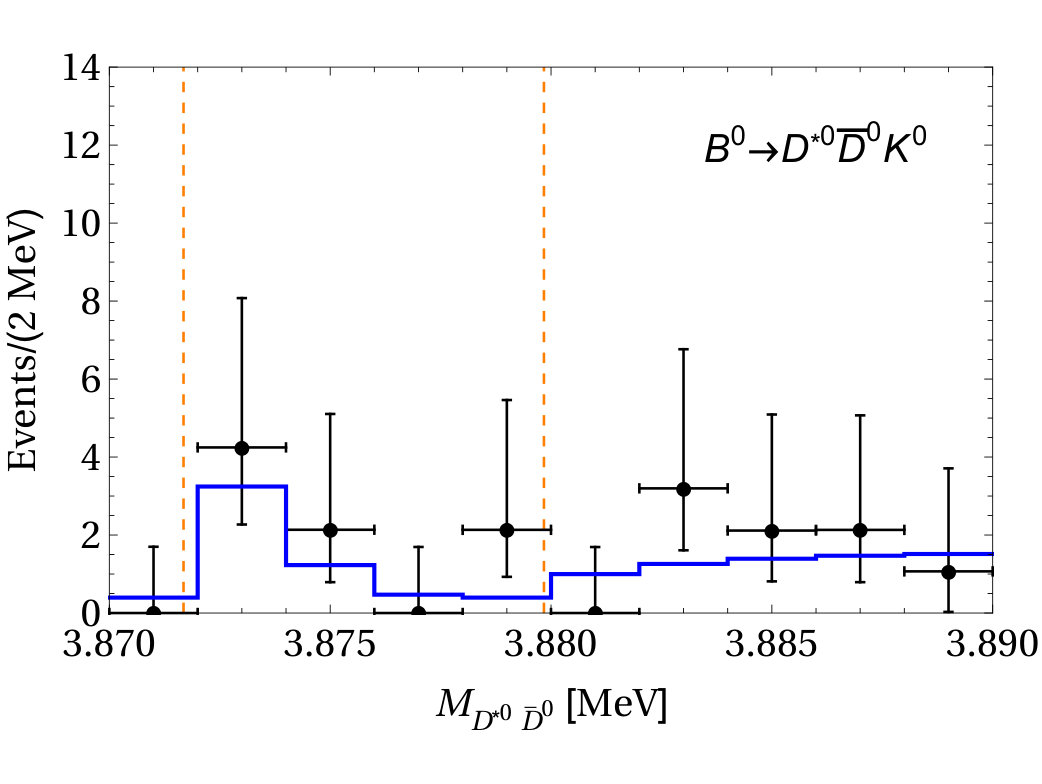 Figure 1
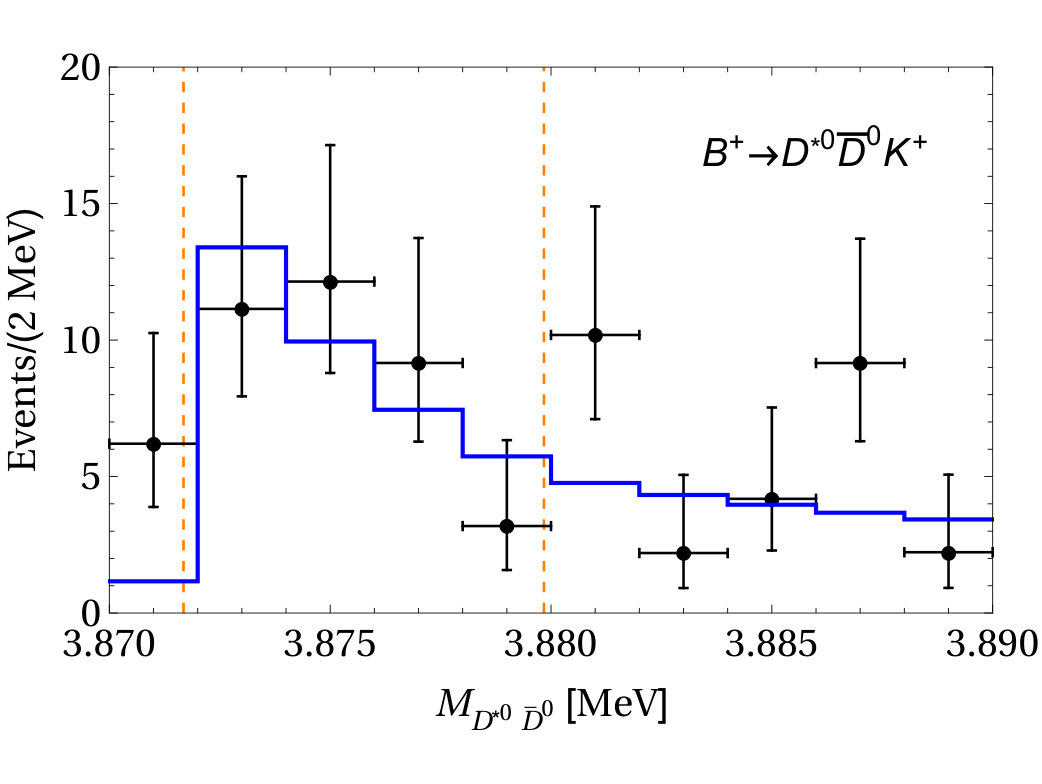 Figure 2
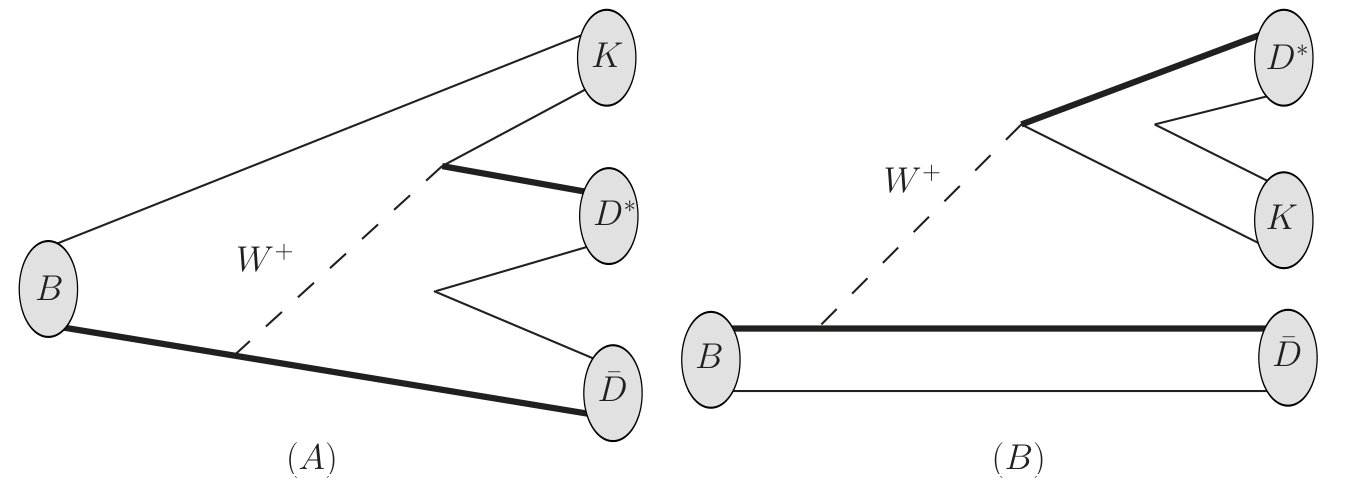 Figure 1
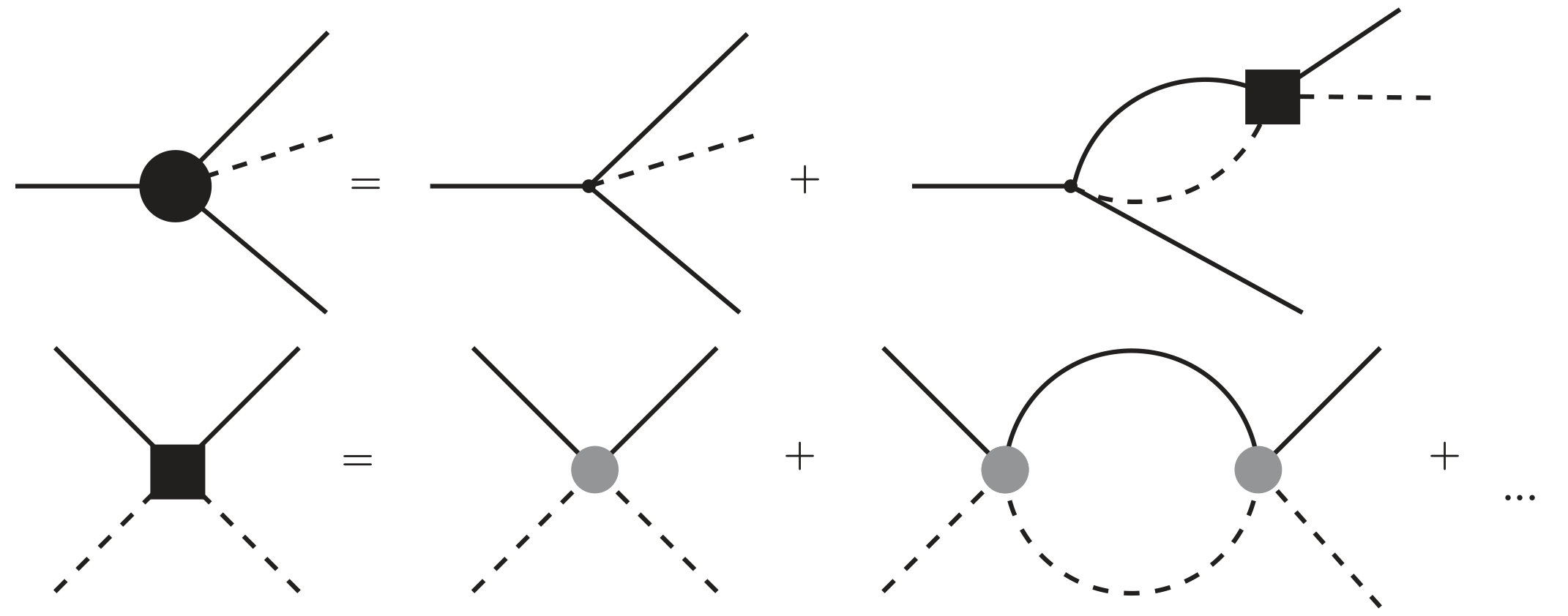 Figure 2
| Parameter | value |
|---|---|
| 7.44/14 |
| 1.0 | -0.47 | 0.81 | 0.03 | 0.00 | -0.09 | 0.06 | |
| 1.0 | -0.80 | -0.05 | 0.00 | 0.07 | -0.06 | ||
| 1.0 | -0.02 | 0.00 | 0.02 | 0.02 | |||
| 1.0 | 0.00 | 0.02 | 0.02 | ||||
| 1.0 | 0.00 | 0.00 | |||||
| 1.0 | 0.74 | ||||||
| 1.0 |
Peer Reviews
No public reviews on file for this paper yet. If you reviewed it on a platform where reviews are public (OpenReview, ICLR, NeurIPS, ICML), you can paste yours below so the community can read it here.
Videos
No videos yet. Explain this paper in a talk, walkthrough, or lecture? Add one.
Isospin analysis of and the absence of the in decays
Zhi Yang
Helmholtz-Institut für Strahlen- und Kernphysik and Bethe Center for Theoretical Physics,
Universität Bonn, D-53115 Bonn, Germany
Institute of Modern Physics, Chinese Academy of Sciences, Lanzhou 730000, China
Qian Wang
Helmholtz-Institut für Strahlen- und Kernphysik and Bethe Center for Theoretical Physics,
Universität Bonn, D-53115 Bonn, Germany
Ulf-G. Meißner
Helmholtz-Institut für Strahlen- und Kernphysik and Bethe Center for Theoretical Physics,
Universität Bonn, D-53115 Bonn, Germany
Institut für Kernphysik, Institute for Advanced Simulation, and Jülich Center for Hadron Physics,
Forschungszentrum Jülich, D-52425 Jülich, Germany
Abstract
We study the isospin amplitudes in the exclusive to decay process and fit the available invariant mass distributions near threshold. The analysis demonstrates that the production of the isospin triplet state is highly suppressed compared to the isospin singlet one. That explains why the has not been found in decays. In addition, the production of the negative charge-parity state might be further suppressed in the heavy quark limit. These two reasons which are based on the molecular assumption offer the first explanation why the is absent in decays. Further studies of the absence from both the experimental and the theoretical side is extremely important for understanding the nature of the and the .
pacs:
14.40.Rt, 14.40.Nd, 13.25.Jx
In 2013, the BESIII and Belle Collaborations reported the charged charmonium-like state in the invariant mass distribution of the process Ablikim:2013mio ; Liu:2013dau . The observed channel, i.e. , reveals its minimal four-quark constituent nature, making it more intriguing than other exotic candidates. The charged state was also confirmed by the reanalysis of the CLEOc data Xiao:2013iha , which also discovered its neutral partner. In addition to the invariant mass distribution in the process, the was also observed in the channel111Here and in what follows, the charge-conjugated channels are considered implicitly. by the BESIII Collaboration Ablikim:2015gda ; Ablikim:2013xfr . The angular analysis of Refs. Ablikim:2013xfr ; Ablikim:2015swa leads to its quantum numbers . The averaged mass is Olive:2016xmw which is slightly above the threshold, thus it is naturally to be regarded as a molecule state Wang:2013cya ; Guo:2013sya ; Wilbring:2013cha ; Dong:2013iqa ; Zhang:2013aoa ; Ke:2013gia . This proximity to the threshold also allows for an interpretations as a cusp effect Swanson:2014tra ; Chen:2013coa . However, it has been demonstrated that the treatment within the cusp scenario is not self-consistent Guo:2014iya and the near threshold pronounced structure in elastic channels necessary requires a nearby pole. Besides these two interpretations, there are also others, such as tetraquark Faccini:2013lda ; Dias:2013xfa ; Qiao:2013raa ; Wang:2013vex ; Deng:2014gqa , hadro-charmonium Voloshin:2013dpa , and hybrid Braaten:2013boa .
In the hadronic molecular picture, the isospin triplet and the isospin singlet Aubert:2004zr ; Choi:2011fc share similar dynamics, such as the analogy of the processes and Guo:2013nza ; Ablikim:2013dyn . As a conclusion, both the and the have been observed in annihilation. The most puzzling aspect of the is its absence in decays which is different to the case of the . The is expected to be seen in the decay due to the analogy of the and the , since the latter one has been observed in both Choi:2003ue and Ablikim:2013dyn processes through its decay .
In the molecular picture, the and the have the same constituents and , but different isospins and C-parities. Therefore, both of them can be formed from the interaction between and . The production of the in the process has already been studied in Ref. Braaten:2004fk , where it occurs through the isospin conserved weak transition () current. On the quark level, the process is given in terms of two diagrams, i.e. the color suppressed internal -emission and the external -emission diagram, cf. Fig. 1. Besides those two, the diagram, i.e. the second diagram of Fig. 2 in Ref. Zito:2004kz , could also contribute. However, it is CKM suppressed diagram and can safely be neglected. Further, the isospin decomposition of the penguin diagram, i.e. the first diagram of Fig. 2 in Ref. Zito:2004kz , is the same as diagram (B) in Fig. 1. Hence the contribution of the penguin diagram in the threshold region can be absorbed into the parameters of diagram (B) in Fig. 1. Based on the above analysis, the process conserves isospin () to the leading order of the expansion parameter of the Wolfenstein parametrisation of the CKM matrix, although it is a weak decay process. It is the prerequisite that one can analyse the isospin amplitudes of the process.
First, we derive the isospin relations for the process through the quark-level Feynman diagrams, c.f. Fig. 1. Since the light quark pair created from the vacuum is a flavor and isospin singlet, the decay amplitudes of the meson from the two diagrams of Fig. 1 are
[TABLE]
where () is the amplitude producing the with isospin [math] () through external -emission, corresponds to the internal -emission with isospin 0, and is the relative phase between diagram (A) and diagram (B) in Fig. 1. The decay amplitudes of the are
[TABLE]
Here, the isospin relations we derived are different from those in Ref. Zito:2004kz , where the fact that the system from the internal -emission can only be isospin due to the light quark pair coming from vacuum was ignored.
Second, except for the short-distance direct production, final-state interactions also contribute as shown in Fig. 2. The amplitudes consist of two parts: one is the short-distance production amplitude and the other one is the long-distance scattering. The rescattering process proceeds in two pathways. Taking production as an example, it includes the scattering following the decay and scattering following the decay. The system we are concerned with is in the near-threshold energy region, as we consider the coalescence of the charm mesons into or . At the threshold, Lorentz invariance requires the short-distance decay amplitude to have the simple form Braaten:2004fk
[TABLE]
where is the polarization four-vector of the vector charmed meson, is the momentum of the bottom meson and are coefficients that need to be determined222One should notice that the constants are the normalized ones as discussed in Refs. Braaten:2004fk ; Braaten:2004ai .. are the combinations of , and , which are the constants corresponding to and .
After integrating over phase space, the differential decay width is written as
[TABLE]
where is the invariant mass of and , is the energy of the system in its rest frame relative to the threshold, , is the triangle function and for , while for . The matrix is the two-body scattering amplitude for the coupled channels and Cohen:2004kf ; Braaten:2005jj
[TABLE]
where and are the binding momenta for the neutral and charged channels, respectively, and is the energy gap between the two channels. Thus, one can fit the invariant mass distributions through Eq. (8).
Next we turn to the production of the hadronic molecule . Its production can be factorized as the short-distance production of the constituents and the long-distance formation of the state parts. The factorization formulas for the prompt production of the at hadron colliders have been studied in Refs. Artoisenet:2009wk ; Guo:2014sca . For the production of through or decay, the factorization formula is written as
[TABLE]
where and are the coupling constants of the and channel to the state, respectively, which are related to the residue of the scattering amplitudes at the pole position. The ratio of the production through and decays Choi:2011fc
[TABLE]
is another constraint in the fit.
The fitted invariant mass distributions are shown as the blue histograms in Fig. 3, which pass through all the experimental data. The dip structure at in the process is due the opening of the charged threshold. The fit parameters with error are shown in Tab. 1. The large uncertainties stem from those of the experimental data. The corresponding parameter correlation matrix is shown in Tab. 2, from which one can see that there are no particularly large correlations between the parameters. That also indicates there are no redundant parameters in our formulae. Further high statistics data will help to reduce the uncertainties. The most interesting parameters are , and with the isospin of the system as subscripts, which reflect the production strengths of diagrams (A) and (B). From the fiited parameters, one can extract several interesting features which help us understand the nature of the and the absence of the in decay.
- •
The behaves as a bound state with the binding energy below the threshold. It should not be the same as that, i.e. Eq. (53) of Ref. Guo:2017jvc , extracted from the mass (or the peak position in another word) of the . That is because that the peak positions are channel dependent, but the pole position is not. Especially, in its component channel, the peak position might be a little higher than the pole position due to the phase space limit.
- •
The contribution of diagram (B) to the isospin triplet channel is about three orders smaller than that to the isospin singlet channel, as .
- •
As shown by Eqs. (1) and (4), the small value of also indicates the small short-distance production amplitudes of the and processes at threshold. Thus the production of isotriplet state through these processes is quite small.
- •
Since diagram (A) also contributes to the isospin singlet channel, there is the coherent interference between diagrams (A) and (B) for the isospin singlet channel. As the result, for each individual channel, the ratios of the and components are
[TABLE]
From the above equations, one concludes that the production of and pairs in decay is highly suppressed. The large uncertainty of the upper limit in the second ratio stems from the destructive interference in the denominator, as the errors of the parameters are almost the same, thus generating this uncertainty.
Besides the isospin suppression, there might be another suppression coming from the C-parity as discussed in Ref. Braaten:2004fk , where the productions of the states with and are constructive and destructive, respectively. In the heavy quark limit, the wave functions of and are the same, leaving the production of a state with in the transition from to equal to zero as shown by Eq.(8) in Ref. Braaten:2004fk . However, the branching ratio of is about 3 times as that of . The deviation of the value from the heavy quark limit value indicates significant heavy quark symmetry breaking effect. Thus the suppression from the charge-parity is not sizeable. In conclusion, the production rate of the in decays is dominantly suppressed by the small value of the isospin triplet production amplitude .
On the contrary, in annihilation, since the and the are produced together with and emissions, respectively, the C-parity will not suppress any of them. At the same time, since virtual photons do not have fixed isospin, the isospin factors for both isospin triplet and isospin singlet are the same. The only suppression happens for the production of the in annihilation stemming from the additional factor of the fine-structure constant.
In summary, we have analyzed the isospin amplitudes of the process and fitted the presently available invariant mass distributions. The results indicate that the production of the isospin triplet state is highly suppressed due to the small value of . In addition, the will be further suppressed because of its negative charge-parity. These two reasons for the first time lead to a concise explanation why the is absent in decays within the hadronic molecular picture. Stated differently, the absence of the in decays clearly points towards its molecular nature. A detailed scan of the invariant mass distributions of the six processes , , , , , with high accuracy (near threshold), especially for the and reactions where only the isospin triplet production amplitude contributes, will help to reduce the uncertainty of the conclusion, such as the uncertainty of the ratios between the isospin triplet amplitudes and the isospin singlet ones.
Q.W. is grateful to Yu-Ming Wang for useful discussions and comments. This work is supported in part by the DFG and the NSFC through funds provided to the Sino-German CRC 110 “Symmetries and the Emergence of Structure in QCD”. The work of U.G.M. was also supported by the Chinese Academy of Sciences (CAS) President’s International Fellowship Initiative (PIFI) (Grant No. 2017VMA0025). The work of Z.Y. was also supported by CAS Pioneer Hundred Talents Program.
The reference list from the paper itself. Each links out to its DOI / PubMed record.
- 1(1) M. Ablikim et al. [BESIII Collaboration], Phys. Rev. Lett. 110 , 252001 (2013).
- 2(2) Z. Q. Liu et al. [Belle Collaboration], Phys. Rev. Lett. 110 , 252002 (2013).
- 3(3) T. Xiao, S. Dobbs, A. Tomaradze and K. K. Seth, Phys. Lett. B 727 , 366 (2013).
- 4(4) M. Ablikim et al. [BESIII Collaboration], Phys. Rev. Lett. 115 , no. 22, 222002 (2015).
- 5(5) M. Ablikim et al. [BESIII Collaboration], Phys. Rev. Lett. 112 , no. 2, 022001 (2014).
- 6(6) M. Ablikim et al. [BESIII Collaboration], Phys. Rev. D 92 , no. 9, 092006 (2015).
- 7(7) C. Patrignani et al. [Particle Data Group], Chin. Phys. C 40 , no. 10, 100001 (2016).
- 8(8) Q. Wang, C. Hanhart and Q. Zhao, Phys. Rev. Lett. 111 , no. 13, 132003 (2013).