Atomic masses of intermediate-mass neutron-deficient nuclei with relative uncertainty down to 35-ppb via multireflection time-of-flight mass spectrograph
S. Kimura, Y. Ito, D. Kaji, P. Schury, M. Wada, H. Haba, T. Hashimoto,, Y. Hirayama, M. MacCormick, H. Miyatake, J. Y. Moon, K. Morimoto, M. Mukai,, I. Murray, A. Ozawa, M. Rosenbusch, H. Schatz, A. Takamine, T. Tanaka, Y. X., Watanabe, H. Wollnik

TL;DR
This paper reports high-precision mass measurements of various neutron-deficient nuclei using a multireflection time-of-flight spectrograph, achieving relative uncertainties down to 35 parts per billion, and discusses implications for nuclear physics and astrophysics.
Contribution
The study demonstrates the capability of a multireflection time-of-flight spectrograph combined with GARIS-II for ultra-precise mass measurements of intermediate-mass neutron-deficient nuclei.
Findings
Achieved a mass uncertainty of 2.1 keV for $^{65}$Ga.
Found discrepancies with literature values for $^{67}$Ge and $^{81}$Br.
Confirmed agreement with 2016 Atomic Mass Evaluation for $^{65}$Ga.
Abstract
High-precision mass measurements of Cu, Zn, Ga, Ge, As, Br, Rb, and Sr were performed utilizing a multireflection time-of-flight mass spectrograph combined with the gas-filled recoil ion separator GARIS-II. In the case of Ga, a mass uncertainty of 2.1 keV, corresponding to a relative precision of , was obtained and the mass value is in excellent agreement with the 2016 Atomic Mass Evaluation. For Ge and Br, where masses were previously deduced through indirect measurements, discrepancies with literature values were found. The feasibility of using this device for mass measurements of nuclides more neutron-deficient side, which have significant impact on the -process pathway, is discussed.
Click any figure to enlarge with its caption.
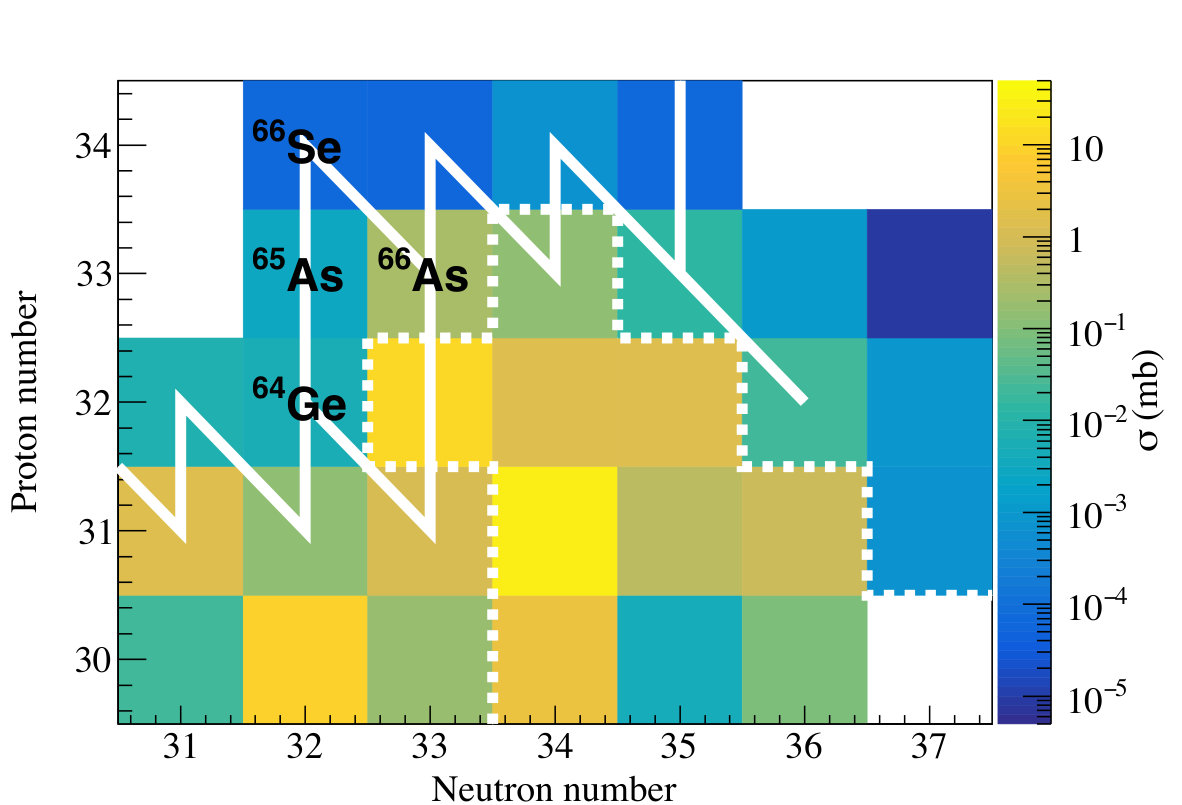 Figure 1
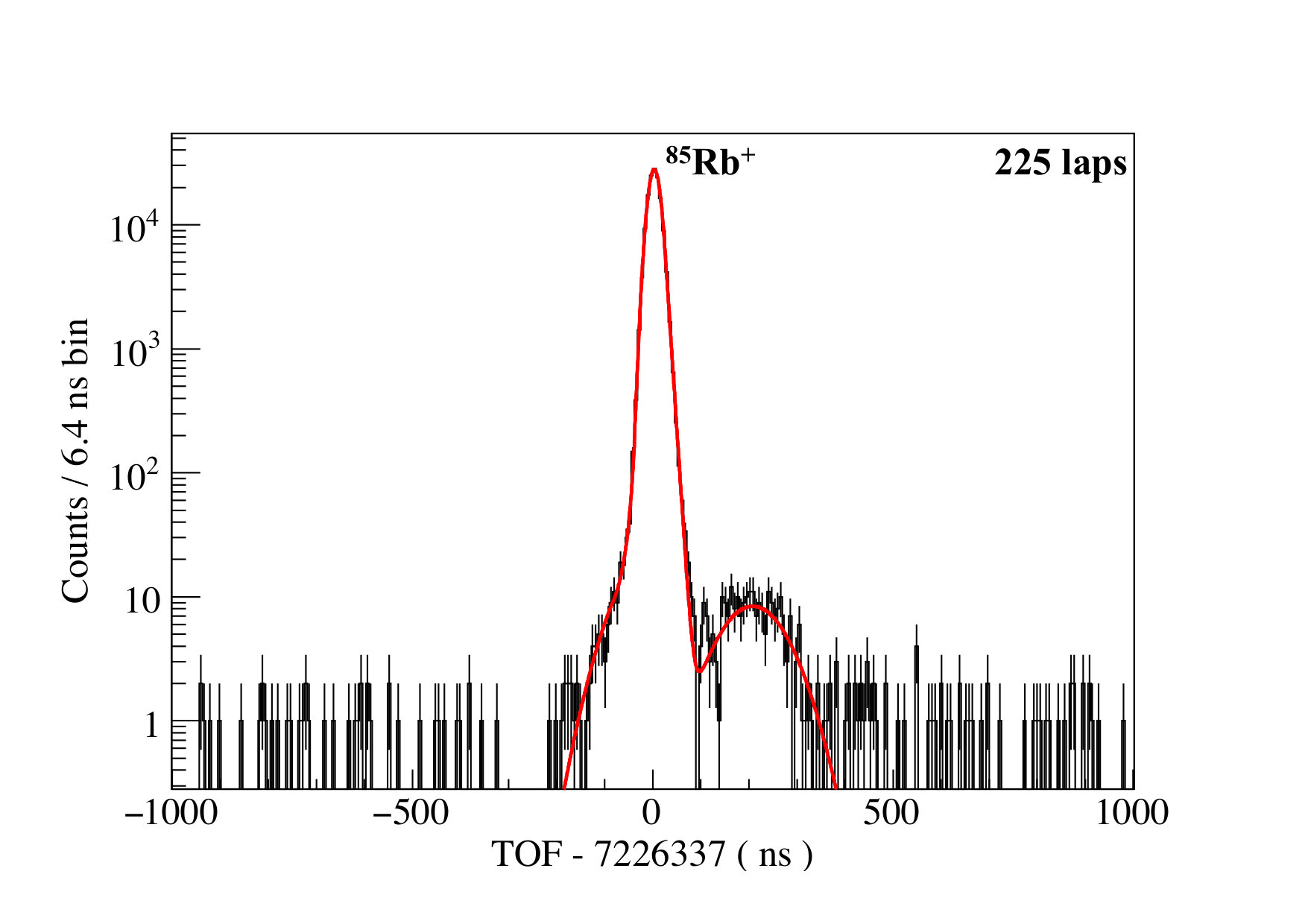 Figure 2
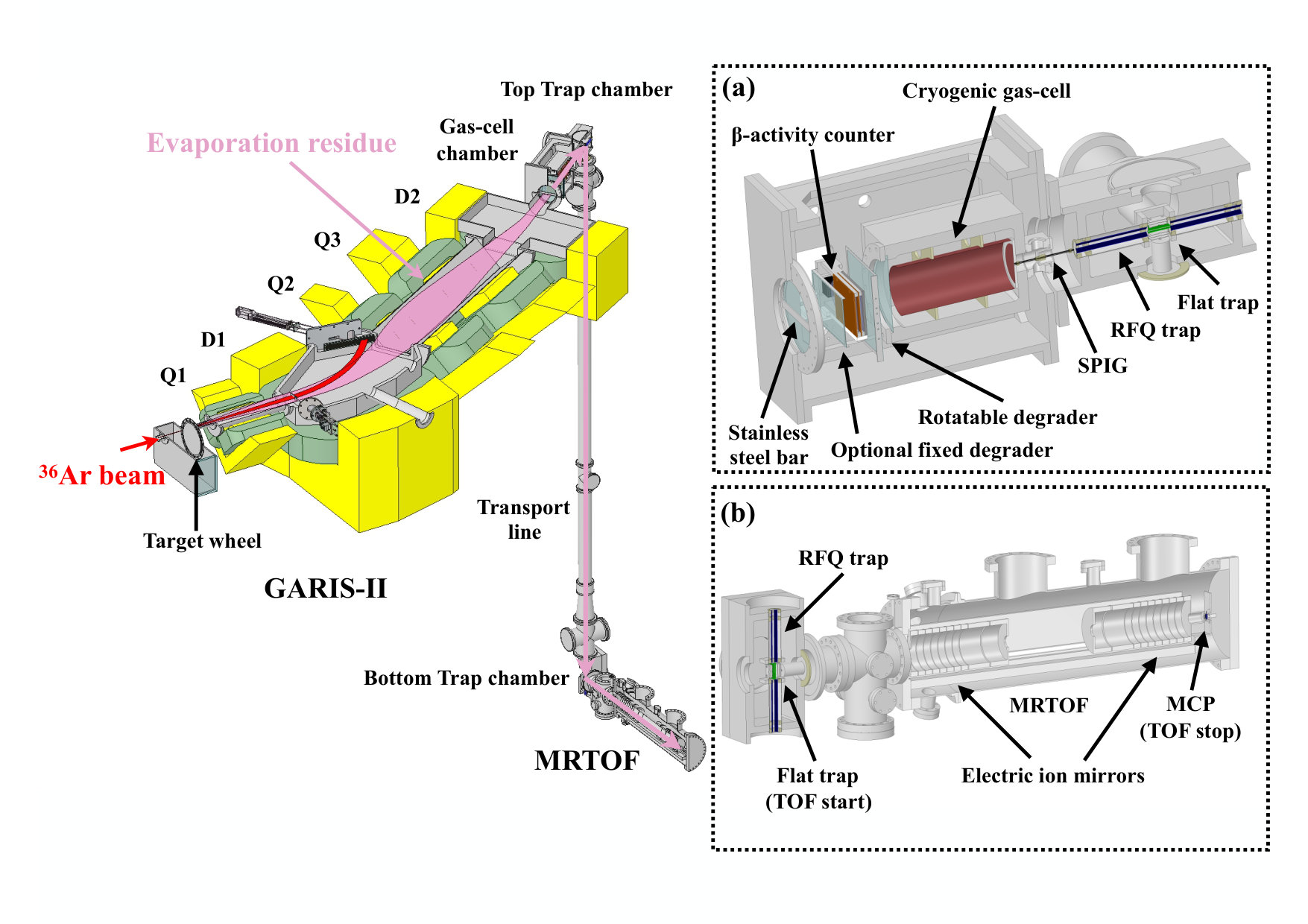 Figure 3
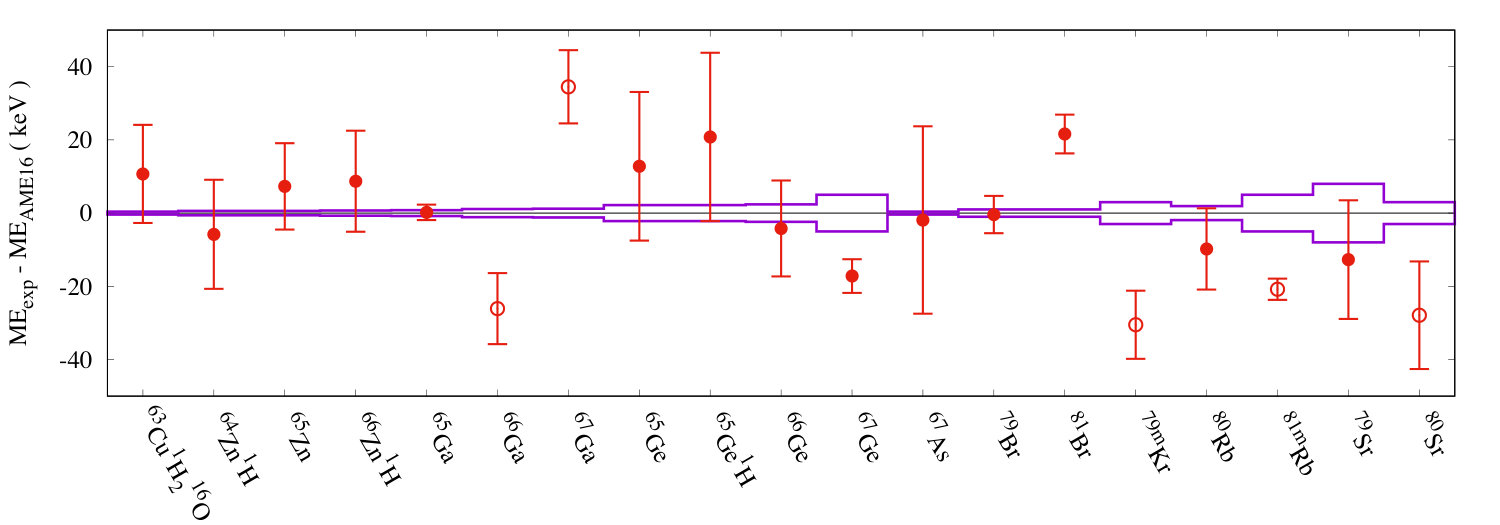 Figure 4
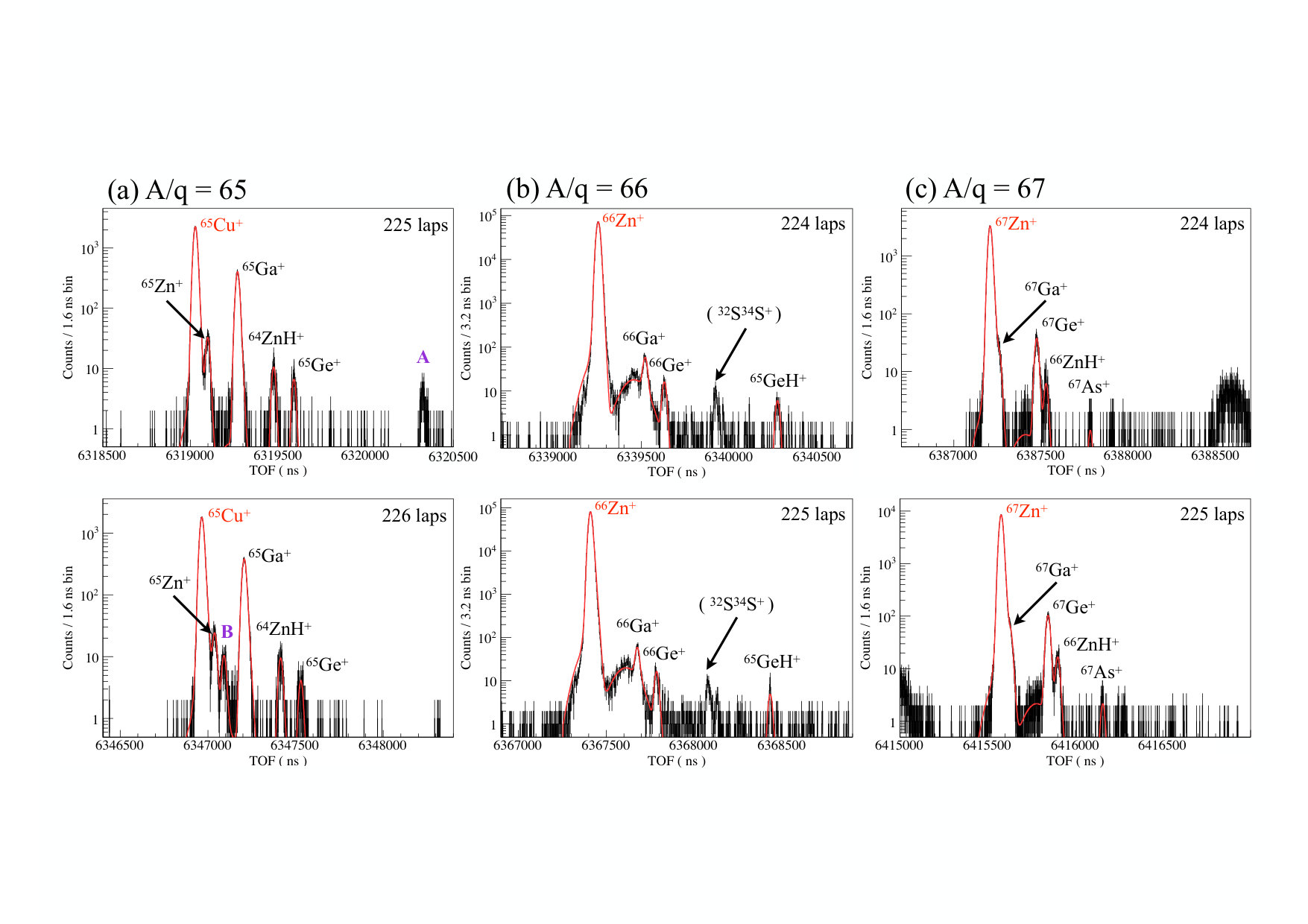 Figure 5
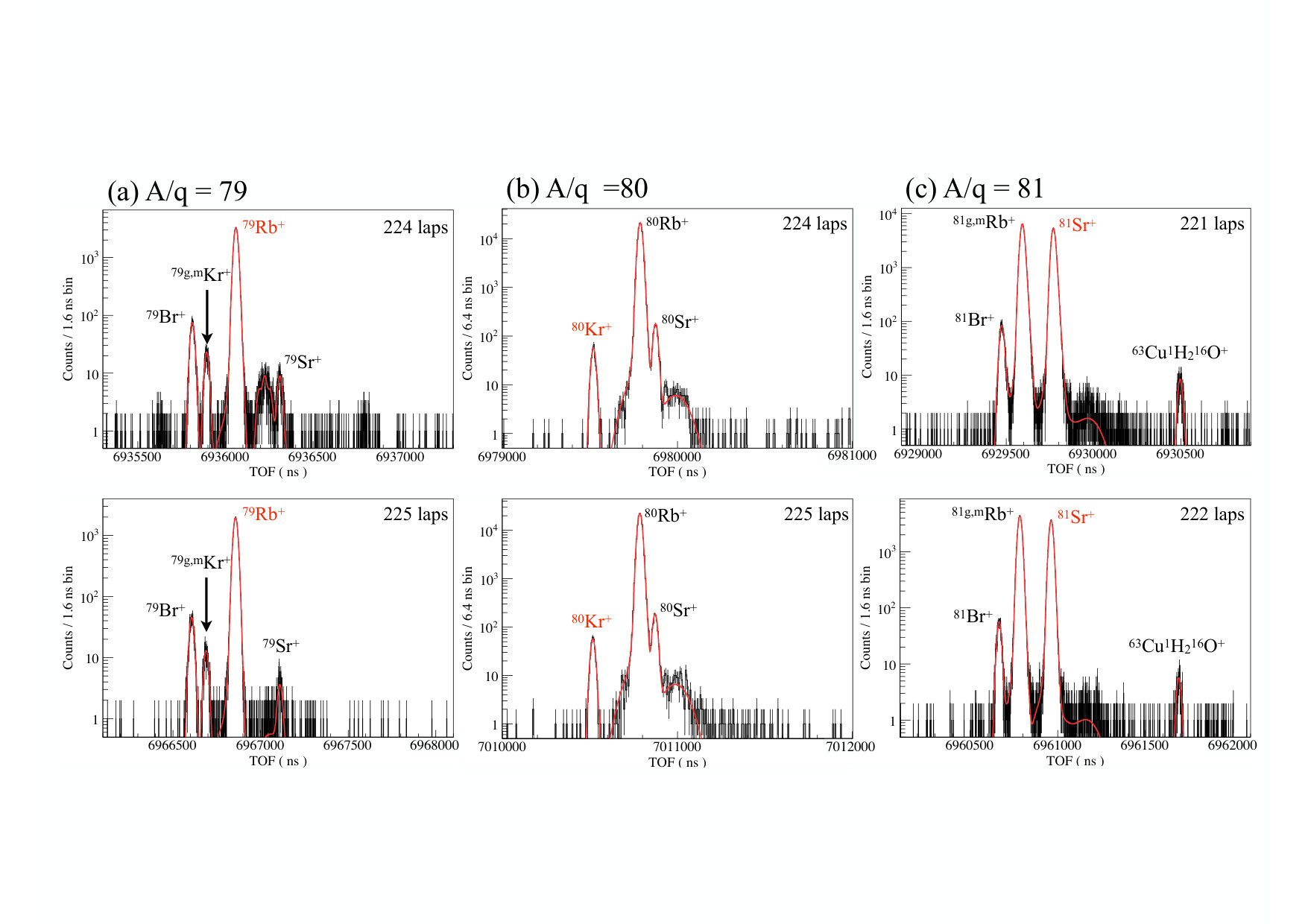 Figure 6
| Species | Ref. | MEexp (keV) | MElit (keV) | ME (keV) | m/m | |
| 63Cu1H216O+ | 81Sr+ | 1.00020961(17)L | 55728(13) | 55738.9(4) | 11(13) | |
| 64Zn1H+ | 65Cu+ | 1.00014125(25) | 58721(15) | 58715.0(6) | 6(15) | |
| 65Zn+ | 65Cu+ | 1.00002247(20) | 65905(12) | 65912.0(6) | 7(12) | |
| 66Zn1H+ | 67Zn+ | 1.00010072(22) | 61602(14) | 61610.2(7) | 9(14) | |
| 65Ga+ | 65Cu+ | 1.000076165(33) | 62657.1(21) | 62657.5(8) | 0.2(22) | |
| 66Ga+ | 66Zn+ | 1.00008385(16)L | [ 63749.8(97) ] | 63723.7(11) | [ 21.6(97) ] | |
| 67Ga+ | 67Zn+ | 1.00001662(16) | [ 66845(10) ] | 66879.0(12) | [ 35(10) ] | |
| 65Ge+ | 65Cu+ | 1.00017854(34) | 56465(20) | 56478.2(22) | 13(20) | |
| 65Ge1H+ | 66Zn+ | 1.00032130(37) | 49168(23) | 49189.2(22) | 21(23) | |
| 66Ge+ | 66Zn+ | 1.00011868(21)L | 61611(13) | 61607.0(24) | 4(13) | |
| 67Ge+ | 67Zn+ | 1.000083493(73) | 62675.2(46) | 62658(5) | 17(7) | |
| 67As+ | 67Zn+ | 1.00018112(41)L | 56589(26) | 56587.2(4) | 2(26) | |
| 79Br+ | 79Rb+ | 0.999928378(63) | 76068.4(51) | 76068.0(10) | 0.4(52) | |
| 81Br+ | 81Sr+ | 0.999914739(60) | 77955.4(53) | 77977.0(10) | 21.6(54) | |
| 79Kr+ | 79Rb+ | 0.99995185(12)a | 74342.7(93) | 74442(3) | 100(10) | |
| 80Rb+ | 80Kr+ | 1.00007668(15) | 72185(11) | 72175.5(19) | 10(11) | |
| 81Rb+ | 81Sr+ | 0.999948753(11)b | 75391.5(29) | 75457(5) | 65(6) | |
| 79Sr+ | 79Rb+ | 1.00007227(22)L | 65490(16) | 65477(8) | 13(18) | |
| 80Sr+ | 80Kr+ | 1.00010148(20) | [ 70339(15) ] | 70311(3) | [ 28(15) ] |
Peer Reviews
No public reviews on file for this paper yet. If you reviewed it on a platform where reviews are public (OpenReview, ICLR, NeurIPS, ICML), you can paste yours below so the community can read it here.
Videos
No videos yet. Explain this paper in a talk, walkthrough, or lecture? Add one.
Atomic masses of intermediate-mass neutron-deficient nuclei with
relative uncertainty down to 35-ppb via multireflection time-of-flight mass spectrograph
S. Kimura
Y. Ito111Present address: Department of Physics, McGill University, Quebec, H3A 2T8, Canada
D. Kaji
P. Schury
M. Wada
H. Haba
T. Hashimoto
Y. Hirayama
M. MacCormick
H. Miyatake
J. Y. Moon
K. Morimoto
M. Mukai
I. Murray
A. Ozawa
M. Rosenbusch
H. Schatz
A. Takamine
T. Tanaka
Y. X. Watanabe
H. Wollnik
Department of Physics, University of Tsukuba, Ibaraki 305-8577, Japan
Nishina Center for Accelerator Based Science, RIKEN, Saitama, 351-0198, Japan
Wako Nuclear Science Center (WNSC), Institute of Particle and Nuclear Studies (IPNS),
High Energy Accelerator Research Organization(KEK), Saitama, 351-0198, Japan
Rare Isotope Science Project (RISP), Institute of Basic Science (IBS), Daejeon 305-811 Korea
Institut de Physique Nuclaire, IN2P3-CNRS, Universit Paris-Sud, Universit Paris-Saclay, 91406 Orsay Cedex, France
Department of Physics and Astronomy and National Superconducting Cyclotron Laboratory, Michigan State University, East Lansing, Michigan 48824 USA
Department of Physics, Kyushu University, Hakozaki, Higashi-ku, Fukuoka 812-8581, Japan
New Mexico State University, Las Cruces, New Mexico 88001, USA
Abstract
High-precision mass measurements of 63Cu, 64-66Zn, 65Ga, 65-67Ge, 67As, 78,81Br, 80Rb, and 79Sr were performed utilizing a multireflection time-of-flight mass spectrograph combined with the gas-filled recoil ion separator GARIS-II. In the case of 65Ga, a mass uncertainty of 2.1 keV, corresponding to a relative precision of , was obtained and the mass value is in excellent agreement with the 2016 Atomic Mass Evaluation. For 67Ge and 81Br, where masses were previously deduced through indirect measurements, discrepancies with literature values were found. The feasibility of using this device for mass measurements of nuclides more neutron-deficient side, which have significant impact on the -process pathway, is discussed.
keywords:
Nuclear masses, MRTOF-MS, GARIS-II, -Process
PACS:
21.10.Dr, 29.30.Aj, 26.30.Ca
1 Introduction
Nuclear masses of nuclei along the line are crucial in determining the rapid proton-capture (-) process pathway which drives explosive astronomical phenomena called type I X-ray bursts [1]. The -process follows a pathway which transits through several key nuclei, notably 64Ge, 68Se and, 72Kr, the exact route being strongly dependent on the effective lifetimes of these waiting-point nuclei. Effective lifetimes of waiting-point nuclei depend exponentially on the -values of the one-(two-)proton capture reaction ( ) at an environmental temperature lower (higher) than GK [2]. The uncertainties in the nuclear masses needed to determine these -values should be less than 10 keV to significantly reduce the uncertainties of -process calculations [3, 4].
The masses of the waiting-point nuclei, 64Ge [5], 68Se [6], and 72Kr [7] have been measured with precisions beyond that required for X-ray burst studies. However, among the six nuclides (65As, 69Br, 73Rb, 66Se, 70Kr, and 74Sr ) which are the counterparts for calculating - and -values, only the masses of 65As and 69Br have been determined experimentally, with uncertainties of 85 keV [8] and 40 keV [9], respectively. For the others, only theoretical predictions are given. A recent -value sensitivity study pointed out that the 65As mass uncertainty has significant impact on the light curves and the ash compositions of X-ray bursts [10].
High-precision experimental mass data of nuclides near the line are also necessary for verification of the Standard Model through the unitarity of the Cabibbo-Kobayashi-Masukawa (CKM) matrix. The “corrected” -values of super allowed -decay between analog states are directly related to the dominant term in the top-row sum of the CKM matrix [11]. To calculate the -values, the necessary nuclear parameters are partial lifetimes of the transition and the corresponding -values. For nuclear masses, a relative precision of is required. The unitarity of the CKM matrix is confirmed to the level of with the uncertainties of present nuclear data [12]. A large fraction of the nuclear uncertainty stems from the mass uncertainty of 66As (30 keV [5]) and the ambiguity in the 70Br mass value [12, 6].
Half-lives of these as-yet insufficiently studied nuclides, excluding highly proton-unbound 69Br and 73Rb, span from tens to hundreds of milliseconds. These short half-lives make them difficult to effectively measure with Penning traps. In contrast, the multireflection time-of-flight mass spectrograph (MRTOF-MS) has advantages, discussed below.
The MRTOF-MS has been developed for both mass measurement and isobar separation techniques in recent years. Typical mass resolving power of MRTOF-MS reaches with short measurement times of less than 10 ms. MRTOF-MS have been applied for mass measurement of heavy nuclei [13, 14, 15] and light neutron-rich nuclei [16, 17, 18] in several facilities. The achieved relative mass uncertainties have so far reached the order of , providing measurements relevant for nuclear-structure physics and some astrophysics. However, the measurement precision reported so far from on-line MRTOF-MS measurements is not sufficient for -process and unitarity of CKM matrix.
The SHE-mass facility at RIKEN has been constructed to enable mass measurements of super-heavy elements (SHE) [13]. However, the applicable mass region is not limited and can be extended to light nuclei as required for studies relevant to the -process. The facility consists of an MRTOF-MS [19] coupled with the gas-filled recoil ion separator GARIS-II [20] via a cryogenic gas-cell and an ion transport system, and has been utilized for the measurement of neutron-deficient nuclei produced by symmetric fusion-evaporation reactions for the first time. Several medium-mass reaction products have been identified and measured with high precision. In the present study, we report the on-line measurements and discuss the data-analysis and achieved precision in the context of utilizing the SHE-mass facility for the most exotic cases in near future.
2 Experiment
A beam, with maximum intensity of , was provided by the RIKEN linear accelerator RILAC. Sixteen targets mounted on a 300 mm diameter rotating wheel [21] were employed to produce neutron-deficient nuclei through fusion-evaporation reactions via (,X). The targets were prepared by a spray coating technique [22] on 3 m Ti backing foils. The average target thickness was . The wheel rotated at 2000 rpm during irradiation. The helium gas pressure of GARIS-II was set to 1 mbar during the measurements.
In the SHE-mass facility, a detector system tracking activities is specialized for (super-)heavy, -decaying nuclei. The modified setup in the GARIS-II focal plane for intermediate-mass -decaying nuclei is shown in Fig. 1–(a). Since there is a lack of data on the mean charge states of high-velocity intermediate-mass nuclei in dilute helium gas, a retractable -activity counter was installed at the GARIS-II focal plane for finding the optimum -value. It consisted of double-layered, 1 mm and 2 mm thick plastic scintillators with two 1.5 mm copper energy degraders to suppress the low-energy -rays ( MeV).
A schematic view of the SHE-mass facility is shown in Fig. 1. Nuclei produced via fusion-evaporation reactions (pink band of Fig. 1) will be separated from unwanted light primary beam-like particles (red band of Fig. 1) and guided to the focal plane of GARIS-II. When symmetric reactions are used, a difficulty arises from the lack of separation between the primary beams and the reaction products in GARIS-II due to their small difference in magnetic rigidity, . Thus, intense primary beams could degrade gas cell performance or even lead to breakage of the thin Mylar windows between GARIS-II and the gas cell. To overcome this, a system of adjustable beam stoppers has been developed to enhance the suppression of such particles (a detailed discussion will be provided in a forthcoming publication). Additionally, a stainless steel bar was set in front of the GARIS-II bulkhead to further protect its Mylar window from beam bombardments.
The SHE-mass facility, located after GARIS-II, comprises a cryogenic gas cell, an ion transport/preparation section consisting of two ion-trap systems separated by a transport line, and the MRTOF-MS. The gas cell was cooled to 90 K and pressurized with helium gas at 100 mbar room temperature equivalent. Two independent Mylar energy degraders, a 2.5 m optional fixed degrader and a 5 m rotatable degrader providing an effective thickness ranging from 5 m to 9 m, allowed optimization of the ion stopping ranges in the gas cell.. After stopping in the gas cell, the reaction products were extracted with an rf-carpet using the traveling-wave technique [23].
After extraction from the gas cell, the ions were captured, cooled, and bunched by the radio-frequency (RF) trap system in the top trap chamber. This system consists of two linear radio-frequency quadrupole (RFQ) Paul traps, one on either side of a central RF trap with a planar electrode geometry (flat trap) [24]. A Bradbury-Neilson gate [25] installed in the transport line between the two traps allows for rejection of unwanted molecular ions that may be extracted from the gas cell with a mass resolving power up to . After recapturing and cooling the ions again, the trapping and cooling process in the bottom flat trap is the final preparation step for the mass measurement.
The time-of-flight measurement begins the moment ions are perpendicularly ejected from the bottom flat trap to travel toward the MRTOF-MS; the ejection trigger signal also serves as the time-to-digital conversion (TDC) start trigger. Due to a combination of differences in cable lengths and inherent properties of the MOSFETs utilized in the trap ejection circuitry, there is a delay () between actual ion ejection and the TDC start trigger. This delay has been directly measured with an oscilloscope as well as by using false TDC stop triggers associated with switching noise and determined to be ns. Its uncertainty was evaluated to be less than 10 ns [13].
The ions are captured in the MRTOF-MS by temporarily lowering the potential of the entrance mirror and are then reflect back and forth between the electrostatic ion mirrors. After the ions have undergone a a specific number of reflections ( 225 laps, corresponding to a flight time of for the masses under study herein) the potential of the exit mirror is temporarily lowered to allow ions to leave and travel to the ion detector, where they make a time focus and thereby a mass resolving power of 120,000 is achieved. After stopping in the gas cell, the average radioactive ion will spend less than 30 ms traversing the system before reaching the detector after the MRTOF-MS.
3 Analysis method
The measured time-of-flight (TOF) value for an ion, having mass and charge , which undergoes laps in the MRTOF-MS device can be represented by
[TABLE]
where is a constant offset dependent on the measurement system, and and are constants related to the non-reflection flight path and the flight path between consecutive reflections, respectively. In order to determine the mass of analyte ions, two different methods – single referencing [26] and double referencing [16, 17] – have been employed. In the case of the double reference method, two references of well-known mass which have experienced the same flight length are required. In contrast, the single reference method needs only one reference mass, however the value of must be determined independently. Uncertainty in can dominate the systematic mass uncertainty in the case of large fractional mass differences between reference and analyte, but becomes negligibly small in this method, when using an isobaric mass reference.
The TOF values varied as a function of time due to thermal expansion of the MRTOF-MS device and minor instabilities in the high-voltage power supply system for mirror electrodes [19]. These TOF drifts could be compensated by use of an isobaric reference species for each measurement. The TOF corrections were performed within each subset, obtained by dividing the raw data set into parts. For ions in each subset the corrected TOF are calculated with the following relation:
[TABLE]
where is the uncorrected TOF of each ion in subset , while and are the fitted TOF center of the full raw spectra and of the spectral subset, respectively, of the isobaric reference species. This correction method was applied to all the data presented here. For a typical case, the width of the 81Sr peak with 221 laps (see Fig. 5 – (c)), was reduced from =29.67(9) ns to =28.63(9) ns (4%) by applying this TOF correction technique. In the present experiment, improvements of peak width by TOF drift compensation is small due to the relatively short measurement duration of 1 hr, however for the high-precision measurements we desire it is still important, while future measurements of more neutron-deficient nuclei will require longer measurement durations and necessitate the compensation technique moreso.
To determine the masses of observed nuclides, the single reference method was adopted. In this method , the ionic mass of nuclide X, is given by Eq. 3:
[TABLE]
where is the TOF ratio, and are the TOF of nuclide X and the reference ion, respectively, is the mass of the reference ion, is the constant time offset within the measurement system mentioned above, and is assumed. The systematic mass error resulting from the uncertainty of the constant time offset can be estimated as follows [27],
[TABLE]
When employing isobaric reference masses, one can calculate the relative systematic mass error induced by to be on the order of , a negligible contribution in the present study.
In the present measurements, only singly-charged ions were measured. Thus, the atomic mass of nuclide X, , is given by
[TABLE]
where and are the atomic mass of the reference nuclide and the electron rest mass, respectively. For mass values of the references, the 2016 Atomic Mass Evaluation (AME16) values [28, 29] were adopted.
Excluding low statistics species which have less than a few hundreds events, the least squares fitting routine of the ROOT package [30] was used to determine . For the low statistics cases the maximum likelihood method was used.
Measurements were performed with two or more different number of laps for each A/q series. The final results of measurements belonging to the same A/q series were obtained as their weighted average,
[TABLE]
where is a weight of each measurement and is defined by .
4 Fitting function
A phenomenological fitting function, based on an exponential-Gaussian hybrid function [26, 19, 31], was developed through the study of high-statistical offline measurements of 85Rb*+* ions. A typical TOF spectrum of 85Rb*+* ions is shown in Fig. 2. In order to reproduce the shape of main peak, we employed the function:
[TABLE]
where indicate the range of each sub-function. The variable is defined as: , where is the peak center. Thus, has seven independent parameters, not including the characteristic times . The number of parameters can be analytically reduced to three by imposing the condition that continuity in the functions and their derivatives at each time ; the remaining independent parameters are then ,, and .
In addition to the primary peaks, we observed bump structures neighboring the intense peaks in sufficiently high-statistics TOF spectra. These bumps maintain a constant intensity and position relative to the primary peak and are deduced to be the result from the following process: secondary electrons are emitted from the surface of the MCP ion detector, they accelerate to nearby surfaces and produce tertiary ions which accelerate back to the MCP. Hence, these bumps are not actual events and depend only on the intensities of parent peaks. The bump shapes are modeled with the following Gaussian function,
[TABLE]
In the fitting algorithm, and were determined by scaling the parameter of mass reference peaks relative to that of 85Rb+: and . The values were determined as independent parameters in fitting the mass reference peaks, then fixed for each isobaric species of interest. The bump height parameter was calculated assuming a constant relative intensity, . The other two bump parameters, and , were fixed based on 85Rb+ fitted results.
For the species of interest, the only free parameters in the fitting function are the peak center and the peak height . The and parameters were determined from the mass reference values. In the fitting algorithm, to enhance the mass precision, the parameter was treated as a function of , , and , where is the TOF ratio from Eq. 3. Then the fitting function for peaks is described by
[TABLE]
If the peak corresponds to the mass reference, is always unity; the total number of fitting parameters is .
5 Experimental accuracy
In the intermediate-mass neutron-deficient region, the production mechanism typically provides a large range of isobaric species which can be simultaneously delivered to the MRTOF-MS. We take advantage of this and utilize isobaric references within each isobaric chain to suppress mass-dependent systematic errors. To minimize the possibility of introducing errors from inaccurately determined reference masses [5], we select the reference species as the highest intensity spectral peak corresponding to a nuclide whose mass value has been flagged as being derived from an “absolute mass-doublet” measurement as defined in AME16 as well as having no known long-lived isomeric states.
Before we can hope to bring the MRTOF-MS to bear on such problems as CKM unitarity, we must have reasonable confidence in the accuracy limit of the device. When using a simultaneously acquired isobaric mass reference, the accuracy is essentially limited by peak fitting. Primarily, there is a fundamental concern of how well the model function represents the real data. In addition to that, we must be sure that we do not introduce any significant biases, e.g., in the process of binning the data.
To test for bias introduced in the process of binning the data, we use a typical 65Ga spectrum. Following the same procedures as outlined above, we first determine the mass of 65Ga using a variety of bin sizes for the TOF data. The variations introduced by differing bin sizes in the range of 0.8 ns to 12.8 ns are smaller than the 1.310*-8* AME16 relative mass uncertainty. A second possibility for the introduction of a bias is the choice of time to start the binning. It is possible that some bias could be introduced based on the choice to begin the binning process e.g., at ns or ns. To investigate this, we used the same 65Ga spectrum, with 6.4 ns binning. The start of the binned spectrum was systematically shifted in increments of 0.8 ns, and the same procedures as previously described were used to determine the mass of 65Ga in each case. The fluctuation of the mass values was smaller than the uncertainty of the AME16 value and no effect on the mass value determined for 65Ga could be discerned. From these two studies, we confirmed that systematic effects in 65Ga measurements from binning are below the level of our precision.
It is worth noting that we have previously published results showing an accurate relative mass precision of 610*-8* [19] in the case of the well-resolved 40Ca+/40K+ isobaric doublet. However in several of the measurements analyzed in this study, the peaks were not completely resolved. In principle, it would be possible to use convoluted peak fitting in cases where peaks significantly overlap. However, it has been the authors’ experience that such fittings can be fraught with inaccurate results, particularly when relative intensities are not known .
In some cases, there were known (or suspected) long-lived isomeric states at the 100 keV-level. With our present mass resolving power, such isomeric states would be separated from the ground state for 20% of FWHM. In such a case, even an analytically-derived model function would achieve low-precision without knowledge of the isomeric population ratio. As we lack knowledge of the isomeric population and utilize a phenomenologically-derived model function, we must designate the results from such cases as unreliable.
Even in better resolved cases, we must set some limit for requisite peak separation. We consider two identical Gaussian peaks with some separation, with a fitting range chosen from - to the center of separation of the peaks. If the peaks have FWHM separation, one can easily find that the fit result will be biased toward the rightmost peak by 11% of FWHM. If the peaks have full-width fifth-maximum separation, the bias falls to 3% of FWHM. With full-width tenth-maximum (FWTM) separation, the bias falls to 0.5% of FWHM. Thus, to ensure that peak overlap cannot bias the result beyond our desired level of precision, we also denote data wherein adjacent peaks were not resolved beyond the FWTM level to designate the mass derived from these data as possibly unreliable.
6 Results
Mass measurements were performed with two different settings of GARIS-II: Tm and Tm, corresponding to reaction products from the sulfur targets () and reactions products from the titanium backings (), respectively. Atomic and molecular ions of 25 species were identified within the TOF spectra of six different isobaric chains.
A summary of the results is shown in Table 1 and Fig 3. The relative precisions of were achieved in the present study. Details of the results for each series will be discussed in the following parts.
6.1
For the series, mass measurements were performed with three different lap values (225-227 laps). Typical TOF spectra are shown in Fig. 4 – (a). 65Cu was employed as the mass reference. All mass excess values in this series were in agreement with the AME16 values. For 65Ga, a mass uncertainty of 2.1 keV, corresponding to a relative precision of , was obtained. This is the most precise measurement yet performed by MRTOF-MS. The accumulated number of 65Ga events was .
6.2
Mass excess values of the series were obtained from measurements with six different lap values (223-227, 299 laps). Here, 66Zn was used as the mass reference. A discrepancy with the AME16 value was found for 66Ga. However, from Fig. 4 –(b) it can be seen that 66Ga peaks are located in the bump structures of 66Zn peaks and they do not satisfy the FWTM reliability requirement. The mass of the peak located between 66Ge*+* and 65GeH*+* is consistent with the sulfur-dimer 32S34S*+*, however, the source of such a molecule is unclear and only a tentative assignment is made.
6.3
In the series, four measurements (223-225, 227 laps) were performed. The mass reference in this series was 67Zn. The mass values of two nuclides, 67Ga and 67Ge, were inconsistent with the AME16 values. It is seen in Fig. 4 – (c) that the 67Ga peaks are fully embedded in the 67Zn peaks, eliminating 67Ga from further discussion. In contrast to the case of 67Ga, the 67Ge peaks are well-resolved. The discrepancy in the 67Ge mass value was seen to be 17 keV, corresponding to 2.4-. The 67Ge mass value of AME16 was evaluated by an indirect method, namely threshold measurements of the reaction [34, 35]. The threshold values of were extrapolated by using the 2/3-law [36], wherein the deexcitation -ray yield is correlated to the induced -particle energy by . However, when the Coulomb barrier height exceeds the reaction Q-value, the yield curve can be expressed as
[TABLE]
which is distorted from the 2/3-law. This distorted yield curve leads the overestimation of the reaction threshold. The discrepancy of 67Ge mass value is resolved by such consideration of the influence of Coulomb barrier. Thus a new mass excess value, keV, for 67Ge is proposed
6.4
For the A/q=79 series as show in Fig 5 – (a), 79Rb was taken as the mass reference since it is the highest intensity nuclide in the set which has previously been evaluated in a Penning trap measurement [37] and has no known long-lived isomeric states. There are five measurements in this series (224,225, 227-229 laps). The mass values obtained for 79Br and 79Sr are in good agreement with those in AME16. The discrepancy of the 79Kr mass value is set aside due to an unresolved, long-lived isomeric state.
6.5
There are two measurements with different lap values (224 and 225 laps) for the series as show in Fig 5 – (b). 80Kr was taken as the mass reference since it is the only nuclide which satisfies the requirements to be a mass reference. The mass value of 80Sr in the present study is inconsistent with the AME16 value. However, as can be seen in Fig. 5 – (b), the FWTM reliability requirement is not met.
6.6
In the A/q = 81 series, mass excess values were determined by four measurements with different lap values (221, 222, 224, and 225 laps). Fig 5 – (c) shows the measured TOF spectra of the A/q = 81 series. 81Sr was selected as a mass reference for the series since its mass value was determined by Penning trap measurements [38, 39] and it also provides high-intensity peaks. In addition, 81Sr has no known long-lived isomeric states. In this series inconsistent mass values were found for two nuclides: 81Rb and 81Br. For 81Rb we dismiss the discrepancy as being due to the admixture of an unresolved, long-lived isomeric state. The 81Br peak, however, satisfies the reliability requirements. As in the case of 67Ge, the mass value of 81Br was evaluated using the results of indirect measurements connecting to the absolute mass-doublet nuclide 82Kr: . We claim that the connection between and is susceptible to error since it depends on a -decay endpoint measurement [40]. The excitation energies of adopted by [40], which were measured by a NaI scintillator, have slightly smaller values (10 keV) as compared with currently adopted ones measured with Ge detectors [41]. If the modern excitation energies are used, the resultant -value agrees with the presently measurement mass of 81Br. Thus a new mass excess value for of keV is proposed.
7 Discussion
Figure 6 shows the theoretical production cross-sections of (,X) reactions in the present measurement setting. The LisFus code [43] was used to calculate these values. In the present study it was possible to access nuclides with cross-sections slightly less than one millibarn. The desired nuclides, however, are predicted to have cross-sections that are one to three orders of magnitude smaller than those measured in the present study (see Fig. 6).
The total efficiency of the SHE-mass facility in the present measurements could be estimated by counting the number of 80Rb events in both the -activity counter and the MRTOF-MS. An intensity of 80Rb ions at the GARIS-II focal plane was estimated to be from -activity counting rate and the detection efficiency calculated by GEANT4 simulations [44]. The counting rate at the MRTOF-MS was . The total efficiency of the SHE-mass facility excluding the transmission efficiency of GARIS-II for the present measurements was estimated to be 0.03%.
In the present series of measurements, only singl-charged ions have been studied in the MRTOF-MS spectra. A recent gas-cell study suggests that most elements could be extracted as doubly-charged ions [45]. This implies that the single-charged state could be a very minor component among all ionization states in the gas-cell and provides room for great improvement in the total efficiency. In the case of super-heavy element mass measurements at the SHE-mass facility, ions were extracted as doubly-charged ions and the total efficiencies reached the few percent level, which is roughly one hundred times higher than the present value. The mass measurements of the Md isotopes, which have production cross-sections on the order of 100 nb, have been achieved by optimizing the SHE-mass facility for doubly-charged ions [14]. This improved total efficiency could allow to access nuclides with microbarn or sub-microbarn, production cross sections. The SHE-mass facility can be used for not only the study of super-heavy elements but also the intermediate-mass nuclides in more neutron-deficient side, which are crucial to the -process.
8 Summary and Conclusions
In conclusion, the masses of 63Cu, 64-66Zn, 65Ga, 65-67Ge, 67As, 78,81Br, 80Rb, and 79Sr were measured using the MRTOF-MS combined with GARIS-II under the minimal B-value difference of the primary beam and reaction products. The masses of these nuclides have been determined by the single reference method using known isobaric references. There are some inconsistencies between AME16 values, and two new mass excess values are proposed: keV and keV. This result reinforces the need for direct mass measurements of all nuclides, even for stable isotopes, if their masses were previously evaluated by indirect techniques. The relative mass precisions in the present study span the range from . In the most precise measurement, that of 65Ga, a mass uncertainty of 2.1 keV was obtained. This result shows that mass measurements satisfying the requirement of the CKM matrix can be achieved with the MRTOF-MS, given sufficient statistics. The SHE-mass facility is seen to be suitable for precision mass measurements of intermediate-mass, more neutron-deficient nuclides, crucial to the -process.
We would like to express our sincere gratitude to the RIKEN Nishina Center for Accelerator-Based Science and the Center for Nuclear Science at the University of Tokyo for their support of the present measurements. H. S. acknowledges support from the US National Science Foundation under PHY-1565546 and PHY-1430152 (JINA Center for the Evolution of the Elements). This study was supported by the Japan Society for the Promotion of Science KAKENHI, Grant Number 24224008, 15H02096, 15K05116, and 17H06090.
The reference list from the paper itself. Each links out to its DOI / PubMed record.
- 1[1] A. Parikh, J. José, G. Sala, C. Iliadis, Nucleosynthesis in type I X-ray bursts , Progress in Particle and Nuclear Physics 69 (2013) 225–253. doi:http://dx.doi.org/10.1016/j.ppnp.2012.11.002 . URL http://www.sciencedirect.com/science/article/pii/S 01466%41012001354 · doi ↗
- 2[2] B. A. Brown, R. R. C. Clement, H. Schatz, A. Volya, W. A. Richter, Proton drip-line calculations and the rp rp \mathrm{rp} process , Phys. Rev. C 65 (2002) 045802. doi:10.1103/Phys Rev C.65.045802 . URL http://link.aps.org/doi/10.1103/Phys Rev C.65.045802 · doi ↗
- 3[3] H. Schatz, The importance of nuclear masses in the astrophysical rp-process , International Journal of Mass Spectrometry 251 (2 - 3) (2006) 293 – 299. doi:http://dx.doi.org/10.1016/j.ijms.2006.02.014 . URL http://www.sciencedirect.com/science/article/pii/S 13873%80606001187 · doi ↗
- 4[4] H. Schatz, Nuclear masses in astrophysics , International Journal of Mass Spectroscopy 349–350 (2013) 181–186. doi:10.1016/j.ijms.2013.03.016 . URL http://www.sciencedirect.com/science/article/pii/S 13873%80613001073 · doi ↗
- 5[5] P. Schury, C. Bachelet, M. Block, G. Bollen, D. A. Davies, M. Facina, C. M. Folden III, C. Guénaut, J. Huikari, E. Kwan, A. Kwiatkowski, D. J. Morrissey, R. Ringle, G. K. Pang, A. Prinke, J. Savory, H. Schatz, S. Schwarz, C. S. Sumithrarachchi, T. Sun, Precision mass measurements of rare isotopes near n = z = 33 𝑛 𝑧 33 n=z=33 produced by fast beam fragmentation , Phys. Rev. C 75 (2007) 055801. doi:10.1103/Phys Rev C.75.055801 . URL http://link.aps.org/doi/10.1103/Phys Rev C.75.05580 · doi ↗
- 6[6] J. Savory, P. Schury, C. Bachelet, M. Block, G. Bollen, M. Facina, C. M. Folden, C. Guénaut, E. Kwan, A. A. Kwiatkowski, D. J. Morrissey, G. K. Pang, A. Prinke, R. Ringle, H. Schatz, S. Schwarz, C. S. Sumithrarachchi, r p 𝑟 𝑝 rp , Phys. Rev. Lett. 102 (2009) 132501. doi:10.1103/Phys Rev Lett.102.132501 . URL http://link.aps.org/doi/10.1103/Phys Rev Lett.102.132501 · doi ↗
- 7[7] D. Rodríguez, V. S. Kolhinen, G. Audi, J. Äystö, D. Beck, K. Blaum, G. Bollen, F. Herfurth, A. Jokinen, A. Kellerbauer, H. J. Kluge, M. Oinonen, H. Schatz, E. Sauvan, S. Schwarz, Mass measurement on the r p 𝑟 𝑝 rp -process waiting point Kr 72 superscript Kr 72 {}^{72}\mathrm{K}\mathrm{r} , Phys. Rev. Lett. 93 (2004) 161104. doi:10.1103/Phys Rev Lett.93.161104 . URL http://link.aps.org/doi/10.1103/Phys Rev Lett.93.161104 · doi ↗
- 8[8] X. L. Tu, H. S. Xu, M. Wang, Y. H. Zhang, Y. A. Litvinov, Y. Sun, H. Schatz, X. H. Zhou, Y. J. Yuan, J. W. Xia, G. Audi, K. Blaum, C. M. Du, P. Geng, Z. G. Hu, W. X. Huang, S. L. Jin, L. X. Liu, Y. Liu, X. Ma, R. S. Mao, B. Mei, P. Shuai, Z. Y. Sun, H. Suzuki, S. W. Tang, J. S. Wang, S. T. Wang, G. Q. Xiao, X. Xu, T. Yamaguchi, Y. Yamaguchi, X. L. Yan, J. C. Yang, R. P. Ye, Y. D. Zang, H. W. Zhao, T. C. Zhao, X. Y. Zhang, W. L. Zhan, Direct Mass Measurements of Short-Lived A = 2 Z − 1 · doi ↗