Interactions and scattering of quantum vortices in a polariton fluid
Lorenzo Dominici, R. Carretero-Gonzalez, Jesus Cuevas-Maraver, Antonio, Gianfrate, Augusto S. Rodrigues, D.J. Frantzeskakis, P.G. Kevrekidis,, Giovanni Lerario, Dario Ballarini, Milena De Giorgi, Giuseppe Gigli, and, Daniele Sanvitto

TL;DR
This paper investigates the dynamics and interactions of quantum vortices in a polariton fluid within a microcavity, revealing how nonlinearity and density gradients influence vortex behavior and scattering events.
Contribution
It provides new insights into vortex interactions at the particle level in open quantum systems, including vortex splitting and tunable scattering phenomena.
Findings
Vortices exhibit rotational dynamics driven by nonlinearity and phase gradients.
Composite spin-vortex molecules can split into half-vortices due to vorticity seeding.
Close-proximity vortices undergo scattering-like events described by an effective potential.
Abstract
Quantum vortices, the quantized version of classical vortices, play a prominent role in superfluid and superconductor phase transitions. However, their exploration at a particle level in open quantum systems has gained considerable attention only recently. Here we study vortex pair interactions in a resonant polariton fluid created in a solid-state microcavity. By tracking the vortices on picosecond time scales, we reveal the role of nonlinearity, as well as of density and phase gradients, in driving their rotational dynamics. Such effects are also responsible for the split of composite spin-vortex molecules into elementary half-vortices, when seeding opposite vorticity between the two spinorial components. Remarkably, we also observe that vortices placed in close proximity experience a pull-push scenario leading to unusual scattering-like events that can be described by a tunable…
Click any figure to enlarge with its caption.
 Figure 1
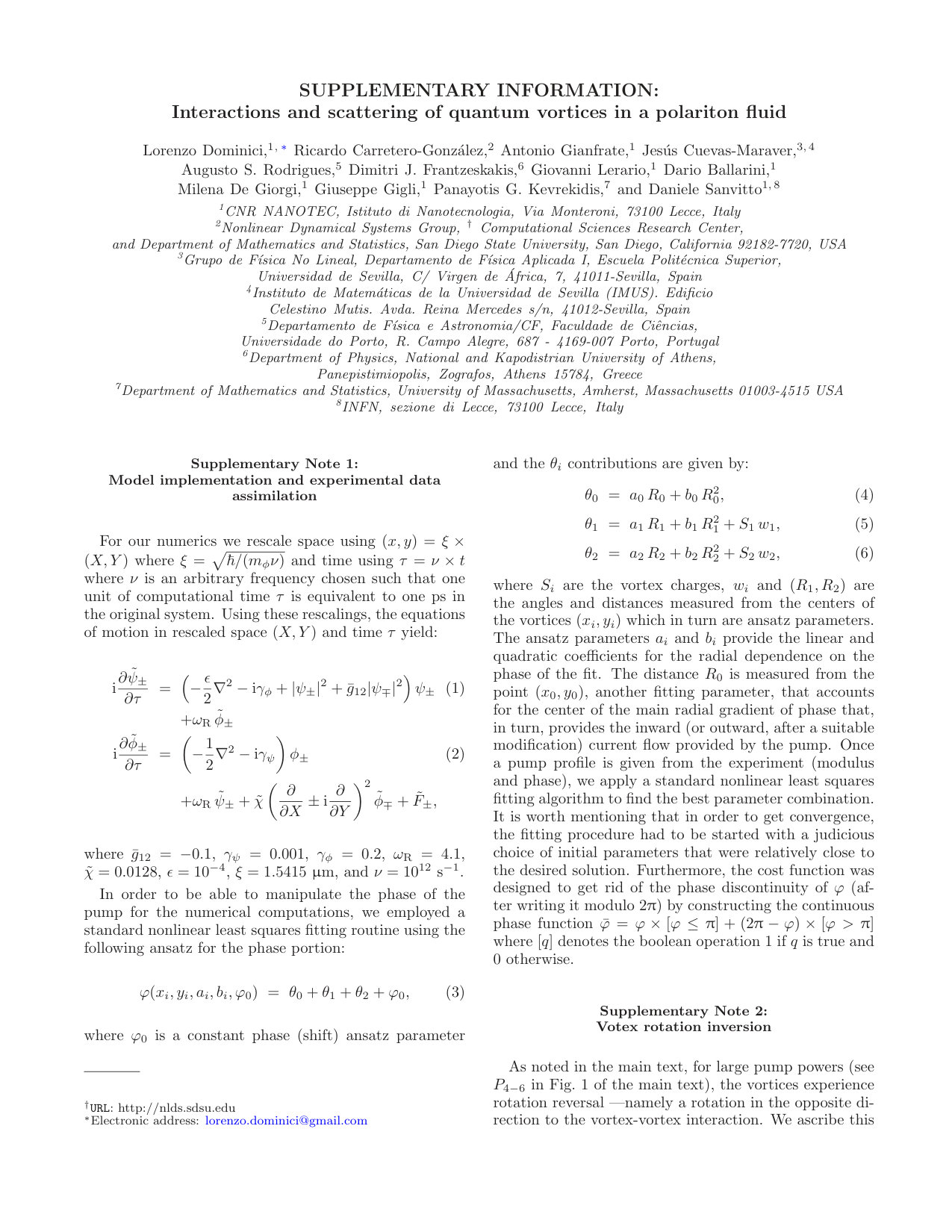 Figure 2
Peer Reviews
No public reviews on file for this paper yet. If you reviewed it on a platform where reviews are public (OpenReview, ICLR, NeurIPS, ICML), you can paste yours below so the community can read it here.
Videos
No videos yet. Explain this paper in a talk, walkthrough, or lecture? Add one.
Interactions and scattering of quantum vortices in a polariton fluid
Lorenzo Dominici
CNR NANOTEC, Istituto di Nanotecnologia, Via Monteroni, 73100 Lecce, Italy
Ricardo Carretero-González
Nonlinear Dynamical Systems Group, Computational Sciences Research Center, and Department of Mathematics and Statistics, San Diego State University, San Diego, California 92182-7720, USA
Antonio Gianfrate
CNR NANOTEC, Istituto di Nanotecnologia, Via Monteroni, 73100 Lecce, Italy
Jesús Cuevas-Maraver
Grupo de Física No Lineal, Departamento de Física Aplicada I, Escuela Politécnica Superior, Universidad de Sevilla, C/ Virgen de África, 7, 41011-Sevilla, Spain
Instituto de Matemáticas de la Universidad de Sevilla (IMUS). Edificio Celestino Mutis. Avda. Reina Mercedes s/n, 41012-Sevilla, Spain
Augusto S. Rodrigues
Departamento de Física e Astronomia/CF, Faculdade de Ciências, Universidade do Porto, R. Campo Alegre, 687 - 4169-007 Porto, Portugal
Dimitri J. Frantzeskakis
Department of Physics, National and Kapodistrian University of Athens, Panepistimiopolis, Zografos, Athens 15784, Greece
Giovanni Lerario
CNR NANOTEC, Istituto di Nanotecnologia, Via Monteroni, 73100 Lecce, Italy
Dario Ballarini
CNR NANOTEC, Istituto di Nanotecnologia, Via Monteroni, 73100 Lecce, Italy
Milena De Giorgi
CNR NANOTEC, Istituto di Nanotecnologia, Via Monteroni, 73100 Lecce, Italy
Giuseppe Gigli
CNR NANOTEC, Istituto di Nanotecnologia, Via Monteroni, 73100 Lecce, Italy
Panayotis G. Kevrekidis
Department of Mathematics and Statistics, University of Massachusetts, Amherst, Massachusetts 01003-4515 USA
Daniele Sanvitto
CNR NANOTEC, Istituto di Nanotecnologia, Via Monteroni, 73100 Lecce, Italy
INFN, sezione di Lecce, 73100 Lecce, Italy
Abstract
**Abstract
** Quantum vortices, the quantized version of classical vortices, play a prominent role in superfluid and superconductor phase transitions. However, their exploration at a particle level in open quantum systems has gained considerable attention only recently. Here we study vortex pair interactions in a resonant polariton fluid created in a solid-state microcavity. By tracking the vortices on picosecond time scales, we reveal the role of nonlinearity, as well as of density and phase gradients, in driving their rotational dynamics. Such effects are also responsible for the split of composite spin-vortex molecules into elementary half-vortices, when seeding opposite vorticity between the two spinorial components. Remarkably, we also observe that vortices placed in close proximity experience a pull-push scenario leading to unusual scattering-like events that can be described by a tunable effective potential. Understanding vortex interactions can be useful in quantum hydrodynamics and in the development of vortex-based lattices, gyroscopes, and logic devices.
quantum vortices vortex interactions condensates polaritons
**Introduction
**Quantum vortices huang_quantum_2015 correspond to wave field rotations in systems described by means of complex wavefunctions. In contrast to the classical case, the continuity of the phase constrains the phase circulation (also called phase winding or topological charge ) to be an integer number. A direct consequence is that the fluid velocity—that in a superfluid is proportional to the phase gradient—decays as away from the vortex core. Quantum vortices are commonly observed in a wide range of contexts including condensates stringari ; fetter ; DarkBook ; Lagoudakis2008 ; Sanvitto2010 , superconductors blatter_vortices_1994 , optics willner_different_2012 ; molina-terriza_twisted_2007 , free electron beams uchida_generation_2010 , and even in the recently detected gravitational waves originating from the merging of two spinning black holes abbott_observation_2016 . In particular, quantum vortex configurations and pairing in condensates are fundamental in relation to their long-range order coherence, phase transitions, and quantum turbulence BPA ; dagvadorj_nonequilibrium_2015 ; serafini_vortex_2017 .
Nonlinear effects enable the motion of vortices in external density and phase field gradients kivshar_dynamics_1998 . These interactions result in quantum vortices experiencing two main driving velocities: one parallel to phase gradients and another perpendicular to density gradients. In atomic Bose Einstein condensates (BECs), both the case of cowinding and that of counterwinding two or few vortices have been studied navarro_dynamics_2013 ; torres_dynamics_2011 ; theo ; li_dynamics_2016 ; middelkamp_guiding-center_2011 . When considering the spinor nature of two-component condensates, recent works pointed to the possible representation in terms of vortex molecules nitta_vortex_2014 ; kasamatsu_vortex_2004 and to the more complex nature of the corresponding interactions pshenichnyuk_pair_2017 ; tylutki_confinement_2016 ; kasamatsu_short-range_2016 ; eto_interaction_2011 . One driving concept in such theoretical works is the perpendicular velocity exerted by the vortices on each other calderaro_vortex_2017 , resulting in the orbiting/parallel motion of two co-/counter-winding vortex cores, respectively. Experimental collisional dynamics seo_collisional_2016 , were recently induced on the time-scale of seconds in the case of an antiferromagnetic spinor BEC, exploiting the counter-rotating orbits of opposite charge vortices.
The rich phenomenology of vortex dynamics observed in BECs reaches far out of their specific physical domains, including their role as cosmological simulators Zurek1985 ; jeff . In that context, among the proposals for fundamental physical theories are schemes describing the quantum vacuum as a special superfluid/BEC medium Huang20161 ; fedi_superfluid_2016 ; sbitnev_hydrodynamics_2016_I , and the elementary particles as quantized vortex excitations on such background sbitnev_hydrodynamics_2016_II .
In this work we use a compact solid-state device to explore the fundamental nonlinear interactions between vortices and their dynamics in an exciton polariton BEC sanvitto_road_2016 ; Byrnes2014 . Semiconductor microcavity polaritons represent a convenient platform to achieve condensates of strongly coupled exciton and photon fields Byrnes2014 ; Kasprzak2006 , for the study of two-dimensional (2D) quantum hydrodynamics and topological excitations Lagoudakis2008 ; Lagoudakis2009 ; roumpos2 ; Amo2009 ; Sanvitto2010 ; Amo2011 ; Manni2012 in dissipative and interacting superfluids. Polariton fluids are hence similar to nonlinear optics media and atomic BECs, yet possessing their own peculiarities, such as Rabi coupling Dominici2014 , nonparabolic dispersions (e.g., negative mass) gianfrate_superluminal_2018 and strong nonlinearities dominici_real-space_2015 . One of their assets is the ability to readily generate a given initial state (setting velocity, directionality, spin and orbital angular momentum, etc.), therefore providing a full control over the quantum state of the polariton fluid sanvitto_all-optical_2011 . Polaritons support rich spinorial patterns, in analogy to optical (multi-frequency or multi-polarization) systems and multi-component BECs Kevrekidis2016140 ; kasamatsu_multi_review_2005 . When considering both the spin and orbital angular momentum degrees of freedom, three basic vortex configurations are most relevant: (i) the full-vortex, that is composed of phase singularities with the same orbital charge in both spin populations, (ii) the spin-vortex, which, in contrast, is composed of opposite windings between the two spin components, and (iii) the half-vortex, that consists of a unit charge coupled to a chargeless configuration. It is straightforwardly observed that in the full-vortex case, the resulting polarization is spatially homogeneous, while for the other two cases a surrounding inhomogeneous texture is present. Full- and half-integer quantum vortices Liew2007 ; Rubo2007 ; Voronova2012 have attracted recent interest since they can be studied both under spontaneous as well as resonant generation, and offer the possibility to shape vortex-antivortex pair-creation events sanvitto_all-optical_2011 , vortex lattices Hivet2014 ; boulier_vortex_2015 and spin-vortex textures Manni2013 ; Liu2015 ; donati_twist_2016 , together with highly nonlinear dynamics dominici_vortex_2015 and, more recently, even Rabi-vortex coupling effects dominici_ultrafast_2018 .
We generate the polariton fluid directly embedding a pair of vortices, using a resonant pulsed excitation beam with a modified Laguerre-Gauss (LG) spatial profile. Indeed, the resonant excitation results in that the photonic pulse profile is coherently converted in a polariton fluid, representing its initial condition. In this manner we are able to seed vortices (initially locked by the resonant photonic pulse) at any desired locations and with a settable intercore distance. The winding direction of the vortex (i.e., , orbital angular momentum) can be set too. Here we always initialize the fluid with a pair of cowinding vortices, inside a given spin component, in order to activate self-propelled rotations of the pair itself. After the pulsed pump completes its injection, we track the ensuing vortex dynamics for different pumping powers which amounts to controllably varying the nonlinearity in the system. When the external pumping is increased—thus the total population and hence the effective nonlinearity—vortices are able to interact more strongly.
Indeed, this increases the self-rotation effect and, in the case of a spinorial configuration with opposite orbital charges between the two spin components, is able to split the spin-vortex states into their composing half-quantum vortices (i.e., baby-skyrmionsdonati_twist_2016 ). Furthermore, contrary to the case of vortices in atomic, one-component, BECs, we observe that, for high enough pumping power, a radial dynamics is triggered too and the vortices start to approach each other. Such effect grants access to unexpected vortex-vortex scattering scenarios. We deploy a theoretical model to understand why vortices get closer to each other and conclude that this effect is due to strong spiral density patterns—mediated by the intrinsic excitonic nonlinearity—that channel the vortices to get closer to each other and eventually scatter.
The understanding and control of vortex-vortex interactions can play a role in quantum hydrodynamics tsubota_quantum_2013 , BECs phase transitions dagvadorj_nonequilibrium_2015 and patterns formation zhao_pattern_2017 or superfluid vacuum theories Huang20161 , as well as suggesting hints in the design of vortex lattices shaping Hivet2014 , ultra-sensitive gyroscopes Franchetti2012 and information processing polariton devices Sigurdsson2014 .
**Results
A multicomponent polariton fluid.** Our physical system consists of four components: the exciton and the photon fields in both the and circular polarizations (denoted as , spin angular momentum). Both spin polarizations of the photon field can be accessed (measured) independently in the experiment, while the exciton fields are not accessible for measurement. However, given that the system is only excited in one of its two normal modes, the lower polariton branch, the photon field corresponds to a one-to-one mapping of the exciton field (apart from a -phase shift) and, in essence, of the polariton field. In our experiments (see the Methods section below for more details), the ultrafast imaging of the quantum fluid over tens of picoseconds, reveals the in-situ (2+1)D hydrodynamics, where the vortices can be individually tracked and their full trajectories retrieved. This is a significant advantage over atomic BECs, where, typically, only the density can be monitored (not the phase) and where only a few snapshots from a given experimental sequence can be obtained Freilich1182 .
Vortex dynamics. The spatial structure of the vortices is reported in Fig. 1a,b, where the left panels show the photonic emission from the initial state of the polariton fluid (which bears the same spatial profile as the resonant photonic pump). The pumping density and phase distribution is the same for all the different pulse powers used here—that in turn correspond to the initial total polariton populations denoted , see Fig. 1—and, more importantly, the phase winding is the same in both spinorial components (i.e., we are initializing a pair of full-vortices). We note that we only display in Fig. 1 the spin polarization photon field as the field is perfectly synchronized and follows, indistinguishably, the dynamics of the field (for more details please see below the section on Spinorial vortex configurations). The phase map allows for the precise determination of vortex locations (small black spots in the amplitude maps and labeled as and here and in the following) . It is evident that the total topological charge (i.e., ), is composed of two separated cores in the central region. The initial vortex separation, which can be controlled upon proper tuning of the optical pulse-shaping device (see Methods section below) , is . In Fig. 1a,b we show three snapshots of the fluid at time intervals of , for the case with the largest density (). Note that the vortices rotate around the center of the configuration and approximately maintain the same mutual distance, while some circular ripples are induced in the density. It is also relevant to mention that the initial size of vortex cores (as seeded by the pump) is about three times larger than the healing length expected from the initial polariton density ( for at ). However, at very long times, when the polariton population decreases significantly (population at is about of the maximum population), should increase by less than a factor of two. Nevertheless, since the healing length represents a minimal value for the vortex core size, we can exclude any substantial effect of on the cores size during the observed dynamics, for any of the six different power regimes (as a matter of fact, the core size stability during the relevant time ranges can be also noted in all the amplitude maps shown here and in the following sections). On the other hand, this also confirms the strong out-of-equilibrium nature of the initial configuration and suggests that an ensuing relaxation is expected to affect the fluid reshaping and, thus, take part in mediating the inter-vortex rotational and radial effects described in the following. For this reason, we describe the observed dynamics in terms of what could be considered as effective vortex-pair interactions. A possible alternative, genuine, quasi-equilibrium regime could also be studied upon reaching thermalization (where core sizes would relax to their natural healing length) in, for example, ultra-high quality samples with lifetimes of hundreds of picoseconds caputo_topological_2017 .
The vortex-vortex dynamics are summarized in the time plots in Fig. 1c,d which show, respectively, the intervortex distance and angle in the time range (please note that here and in the following, the arrival of the photonic pulse has been chosen as the time zero of the dynamics, while the maximum polariton population is reached after ). The cores separation in Fig. 1c slightly decreases during the whole dynamics, with approximately the same constant speed for all the different initial densities (that is an average for each of the two vortices). We ascribe this continuous slow vortex approach to the presence of an inward phase gradient in the pump beam as it can be clearly deduced from the presence of the spiral phase patterns in Fig. 1b
(see Supplementary Note 3 for more details). Such a gradient represents an external linear drive that was set upon fine tuning of the optical focusing of the pump, in order to weakly push the vortices towards each other.
Nonlinear rotational effects. The nonlinear rotation of the vortices is evident from Fig. 1d (such nonlinear effect I, with its associated rotational regime, are manifest since the early times of the dynamics, the precise duration depending on power). It is crucial to note that this rotational effect is generated by the circular superfluid currents (proportional to the azimuthal phase gradients) independently generated by each vortex on the location of its partner. Furthermore, we observe that the rate of rotation of the vortices increases for stronger pump powers. This is equivalent to the case in atomic BECs where the vortex interactions increase with the strength of the nonlinearity in the system. This can be physically interpreted by noting that increasing the density also increases the speed of sound, and thus one would expect faster motion of the vortices as they interact. In our case, as the pump power is increased, the polariton population increases and so does the effective nonlinearity—proportional to the exciton density [see Eq. (Interactions and scattering of quantum vortices in a polariton fluid)]. At a first order approximation, this action is expected to depend on the instantaneous and local density, which rises during the pump pulse arrival and then exponentially decays due to dissipation associated with polariton lifetime (mainly due to photon emission). The overall effect of this rise and fall of the effective nonlinearity is expected to induce a fast rotation followed by a slow deceleration in time, qualitatively resulting in an overall sigmoid shape of the curves. However, such a simplified scheme is able to capture the vortex dynamics only for short times, as shown by the solid lines in Fig. 1d which are fitting curves using the theoretical toy-model introduced in the Supplementary Note 6. In the experiments, we observe the presence of an additional counter-rotating effect at later times for the largest powers ( rotational effect and regime II, manifesting at and for , respectively) which leads to a reversal of the rotation (rather than simply to its saturation). Here, the nonlinear reshaping of the fluid results in the formation of circular density ripples whose radial gradient represents an additional azimuthal drive on vortex motion. As the vortices ride on the inside of these (circular) radial ripples—previously reported Liew2007 ; dominici_real-space_2015 ; dominici_vortex_2015 and studied from a bifurcation perspective as ring dark (gray) solitons Rodrigues2014 —they provide a sharp negative radial density gradient that is responsible for the vortices rotating in a clockwise direction that overcomes the mutual vortex-vortex counter-clockwise motion. Our numerical results, implementing the generalized open-dissipative Gross-Pitaevskii model described in the Methods section (also see Supplementary Note 1), do produce the radial ripples, however they are generated further away from the center and, therefore, they do not affect the vortex rotation (i.e., the model does not precisely reproduce the intensity or the spatial location of the rotational effect II). Nonetheless, we have checked that by changing the strength of the nonlinear interaction terms and/or the size of the pump spot width, and the initial location of the vortices, it is possible to qualitatively reproduce this rotation reversal (see Supplementary Note 2). Furthermore, our numerical simulations also reproduce the main experimental observations, including the slow vortex approach (inward drift induced by the pump radial phase), the increase of the rate of rotation as the nonlinearity increases ( effect and regime I), and also corroborates the sigmoid saturation which is present in the experiment for low enough powers (i.e., the cases).
Scattering-like events. We explore the scattering between vortices after initially placing the two cores closer to each other. For this set of scattering-like experiments, we only seed vortices in the spinorial component while using a plain (vortex-less) Gaussian profile in the component. We use a relative polariton population in the equivalent to of the polariton population in the component. We have checked in our model that changes in the relative populations between the and spinorial components do not qualitatively change the results hereby presented. In the following we only discuss the relevant field. The corresponding experimental dynamics are shown in Fig. 2, where the initial core separation is . The first two rows in the figure show the amplitude and phase maps at the initial time and successive instants, for two powers (Fig. 2a) and (Fig. 2b). In both cases there is a given time frame (respectively and ) at which the two vortex cores appear to merge and then separate again (see right panels). When the vortices reach their closest proximity (comparable with their core radius), they cannot be clearly resolved apart in the amplitude maps. Given the access to the phase maps, where the phase singularities can be pinpointed with pixel resolution, the dynamics of the point-like entities can be tracked even when the vortex cores are nearly overlapping with each other (see also Supplementary Movies 1–4, reporting the amplitude and phase for the first four powers , respectively). The associated trajectories extracted from the phase maps are reported in the panels of Fig. 2c, for the time range . The time-space vortex filaments highlight the approach and bounce-back of the two cores that, after the scattering, emerge rotated compared to their initial locations. The deformation of the vortex strings in the domain is related to the nonlinear energy stored and released by the fluid during the scattering. Nevertheless, these coherent structures robustly emerge (as individual entities) from the scattering events.
The vortex-vortex collisions are mapped in Fig. 2d, as the trajectories for the two vortices. Upon larger initial densities, the phase singularities reach a more intimate proximity, confirming a nonlinear scattering-like process. Trajectories from the numerical simulations are reported in Fig. 2e, and qualitatively reproduce the experiments. They show how the phase singularities, slightly wandering at low power, go through stronger scattering paths upon increasing the population. We point out that in the numerical model the scattering-like events are also observed when starting with an outward phase gradient of the resonant pump, when increasing the density (see Supplementary Note 3). This is a further confirmation that the scattering events are an inherent nonlinear effect, independent from the external action of the initial pump gradient.
The collisional features are recognizable in the time plots for the intervortex angle and distance in Fig. 3a,b, respectively. The angle remains approximately constant before suddenly suffering a sharp change and then settling again (sigmoid feature). The intervortex distance reaches a minimum for a time in close correspondence to the inflection point of the angle curve, hence at the maximum of the angular speed, before the two vortices bounce back. We performed a fitting of the curves, to retrieve an empirical trend for the collisional events upon larger excitation density. The scattering time and time width parameters correspond to: 3.6, 1.7, , ps and 4.7, 3.8, 2.3, 1.4 ps, respectively, for the cases. The results for this set of experiments, and the corresponding modeling, highlight that earlier (and faster) scattering events are associated to larger powers. The rotational component during the scattering events is outlined in Fig. 3c, showing the angular velocity as a function of the separation. All the curves represent a decreasing trend in the dependence, and lie between and power laws. It is important to contrast this observed trend in the context of point-vortices in superfluid BECs. Since the tangential superfluid velocity in a BEC vortex is inversely proportional to the distance from the core, the angular velocity of a vortex pair rotating under the mutual azimuthal interaction Jackson1998 ; DarkBook ; Kevrekidis_MPLB_2004 is proportional to . However, in our system seems to decay faster. This is attributed to the fact that the derivation of assumes an effectively constant density background, while in the polariton case there is an exponentially decreasing density with time (similar results are obtained with the numerical model, see Supplementary Note 5).
Extracting an effective potential. Finally, we show the radial acceleration during the scattering events in Fig. 3d. This plot helps to interpret the collisional dynamics as driven by an effective radial pull-push. For relatively large distances, the effective force is approximately zero leading to circular-like motion; while, at shorter ranges, the effective force acquires a negative component (and stronger for higher densities) and thus induces the vortices to get closer to each other. It is important to mention that the curves depicted in Fig. 3d are drawn under non-equilibrium conditions and cannot be straightforwardly assigned to a genuine pairwise potential between the vortices. Nonetheless, the results suggest that it is possible to induce two cowinding vortices to get closer to each other and modulate (increase) the rate of approach upon increasing the condensate’s density. Numerical simulations of our model of Eqs. (Interactions and scattering of quantum vortices in a polariton fluid)-(Interactions and scattering of quantum vortices in a polariton fluid) suggest that, while the polariton vortices drag each other in a mutual circular dance, as standard cowinding vortices do, they also induce local spiral density patterns self-channeling their approach and scattering. A cleaner depiction of this self-channeling density spiral is presented in Supplementary Note 4 (see also Supplementary Movie 5). Parametric explorations within the numerical model allow us to conclude that the vortex approach is mediated by a combination of the photonic kinetic energy term, the Rabi coupling between the photonic and excitonic components, and the intrinsic excitonic nonlinearity. The induced attraction represents a novel fundamental effect to be used at the basis of more complex quantum hydrodynamics and turbulence scenarios as well as in the nonlinear shaping of multi-component vortex lattices.
Spinorial vortex configurations. The phase singularities in each of the two spin populations represent elementary point-like particles with two associated quantum numbers, the SAM and OAM (e.g., , where represents the specific vortex core and SAM and OAM its unitary spin and orbital angular momentum charge). Depending on the direction of the quantum numbers, different vortex combinations are possible. Here it is relevant to explore the effect of the mutual azimuthal thrust on the core dynamics when seeding composite vortices relying on same, as well as opposite, charges between the different spin components (i.e., when starting with full- or spin-vortex pairs, respectively). In contrast to the results presented in Fig. 1 where both and spin polarizations remained synchronized during evolution, here the different interactions inside each of the two spin polarizations result in the two components evolving independently. We therefore need to individually measure and display the evolution in each spin component. The results are reported in Fig. 4 and validate that the rotation effect and its direction are due to the phase drive of the two vortex currents which are present inside the same spinorial component. Indeed, in the cowinding case, the rotation is in the same direction for both the and vortex doublets, as shown in Fig. 4a,b. The initial configuration is almost identical in both spin populations albeit with a small deviation of the vortex positions between components. Despite this small initial deviation, the vortices across components stay close to each other and the overall dynamics between components stays synchronized, due to the same nonlinear effects (rotational regime I) existing in both spin populations. It is also possible that the weak attractive inter-spin interactions help in stabilizing against small differential disorder between the spin populations dominici_vortex_2015 . In contrast, for the counterwinding case, the observed trajectories (see blue and red orbits in Fig. 4c,d) are (left-to-right) mirrored across the components. The (2+1)D vortex lines for both co- and counter-rotating cases are reported in Fig. 4e,f, respectively. In such panels we emphasize the co- and counter-rotations by using two lines (blue and red, at any time frame) linking the and cores inside any of the two spin populations [and with the lines drawing two sheets in the domain].
In the time plots of Fig. 5a we confirm the opposite rotations (as solid blue and red line) in time , and the faster rotation when increasing power (as dashed lines). The separation of the corresponding and cores between the two spins is reported in Fig. 5b (please note that such distances are labeled as and ). The resulting counter-rotation of the doublets leads to the separation of at least one interspin couple, for which the distance increases approximately linearly (see , solid purple line). Due to slight asymmetries in the initial conditions (not a perfect alignment/tuning of the phase shaping), the second couple separation actually decreases (although, for later times, we see it separating as well, see , solid magenta line). These observations are also exhibited by the numerical simulations, that use the experimental profiles as an initial condition. In fact, the numerical plots of the intervortex angles and distance in Fig. 5c,d qualitatively reproduce those of Fig. 5a,b. In contrast, the cowinding and co-rotating doublets preserve the initial overlapping for the corresponding cores between the spins (the interspin cores distance is during the whole dynamics, see dashed light and dark orange lines in Fig. 5b).
In summary, the above set of experiments show that the vortex-vortex interactions within the same spin component dominate the dynamics, while the interactions across the components are weaker and, thus, are not essential to understand the rotational dynamics. In fact, further numerical tests, including cases varying the strength, and even eliminating, the spin-orbit coupling yielded almost identical results. Nonetheless, the two independent intra-spin rotational drives can affect the overall resulting spinorial state. For instance, topological charges seeded as full-vortices keep rotating jointly. In contrast, when seeded as spin-vortices they dissociate due to the effect of the opposite nonlinear rotation. Therefore, the two couples get split into four half-vortices Rubo2007 ; Manni2013 ; donati_twist_2016 ; dominici_vortex_2015 .
**Discussion
**We have studied the external and internal effects governing the dynamics of two quantum vortices in a nonlinear and out-of-equilibrium 2D polariton fluid and discussed these in terms of effective vortex interactions. The results show that stronger density regimes enhance the effective pair interactions, accelerating or even reversing the mutual rotational effect and giving rise to unexpected radial dynamics. Indeed, nonlinearity fuels the azimuthal phase drive between vortices resulting in an increase of the speed of the circular motion for same-charge vortices. Strikingly, at short range, the intrinsic excitonic nonlinearity induces an effective radial thrust that compels the cores to approach and bounce back from each other. We exploit this feature to demonstrate unusual vortex-vortex scattering-like events. These represent an original scenario that could be further investigated in other multicomponent superfluids, and would be particularly interesting in the nonlinear shaping of vortex or vortex-antivortex lattices. More fundamental, yet intriguing, could be the case of studying the analogue dynamics when seeding opposite-charge vortex pairs (i.e., vortex-antivortex) and look for the presence and nature of a similar effective radial thrust, as well as its possible influence on pair-annihilation and nucleation events.
We further study the effects of seeding opposite-charge couples between the two spinorial components. As a result, the vortex-vortex doublets’ rotational direction inside each of the two spin is opposite, which in turn splits these composite spin-vortices into half-vortices. These structures, consisting of a unitary charge coupled to a chargeless configuration, are relevant in a wide range of fields within optical, nonlinear, atomic or high energy physics, where they are also known as Poincaré beams, vortex-bright solitons, baby-skyrmions or filled-core vortices Cardano2013 ; DarkBook ; Kevrekidis2016140 .
An interesting extension for further exploration would be to study, e.g., the interplay between two possible competing actions: the rotational split of the spin-vortices (due to the intra-spin polariton nonlinearities) and their stabilization upon the locking of the phase singularities (by the weaker inter-spin attractions). The splitting dynamics could also be investigated for the case of opposite charge vortices which tend to move parallel to each other.
**Methods
** Experimental methods.
We used a microcavity sample with an AlGaAs 2 optical thickness and three 8 nm In0.04Ga0.96As quantum wells (QWs), placed in the antinodes of the cavity mode Dominici2014 ; dominici_real-space_2015 ; dominici_vortex_2015 ; gianfrate_superluminal_2018 . The multilayer mirrors embedding the cavity consist of AlAs/GaAs layers, with an overall photonic quality factor of and a resulting effective lifetime for the (lower) polariton fluid of 25 ps, at normal incidence and at a temperature of 10 K. The quality factor of the device is associated to a photon lifetime of , resulting in a polariton lifetime of . However, time-delayed reflections back from the substrate edge help in sustaining the polariton fluid population for a longer time, resulting in the longer effective lifetime stated above. The substrate optical thickness of 1.5 mm corresponds to a 10 ps time distance of the reflected echos dominici_real-space_2015 . We performed the experiments in a defects-clean region of the sample, usually a wide square area contained between four line dislocations. The excitation and reference beams are laser pulses with 80 MHz repetition rate and time width ( bandwidth). The picosecond excitation and its tuning allow the exclusive initialization of the lower polariton mode, centered at , while the upper mode that is 3 nm above (Rabi splitting of ) is not excited.
Vortex generation. Double optical vortices are seeded into the system by phase-shaping the plain-Gaussian LG00 laser pulse, into a modified Laguerre-Gaussian LG0±2 state upon passage on the -plate, which is a patterned liquid crystal phase retarder dominici_vortex_2015 ; Cardano2013 ; Marrucci2006 . Indeed the initial splitting of the two unitary charges composing the LG0±2 state can be set upon proper tuning of the -plate. Power control is set upon the use of a plate and of a linear polarizer before the -plate. The photonic vortex is focused at normal incidence on the sample by means of a aspherical lens, to resonantly excite the polariton fluid. Polarization control is implemented by means of and plates and of linear polarizers, prior to and after the -plate in order to achieve the desired combinations of topological states between the two spin populations.
Ultrafast holographic imaging. The dynamical imaging of the polariton fluid is based on the ultrafast implementation of the so-called off-axis digital holography Dominici2014 ; dominici_real-space_2015 ; dominici_vortex_2015 ; gianfrate_superluminal_2018 ; Anton2012 ; Nardin2010 ; Schnars_book2005a . The sample emission is let interfere with a delayed and coherent reference beam, which is an expanded twin copy of the Gaussian excitation beam, able to provide amplitude and phase homogeneous fronts. The emission and reference beams are sent on the CCD (charge coupled device) camera with a mutual angle of inclination . This allows to obtain interferograms which are associated only to the time portion of the emission synchronous to the time arrival of the reference pulse, which can be set by a sub-micrometric step delay line. Each interferogram is analyzed by using Fast Fourier Transform (FFT), in the reciprocal space, where the off-axis term contains the modulation information associated to the emission at the given time. This can be filtered to retrieve the dynamics of the polariton fluid, in both amplitude and phase. The polariton phase maps are processed with a digital algorithm to retrieve all the phase singularities, whose trajectories are rebuilt. The used spatial and temporal steps here are and , respectively, while the time resolution is set by the reference pulse itself to . Every time-frame results from tens of thousands of repeated shots, which are integrated by the CCD camera set in a range between and . The visibility of the fringes remains stable for values 1.0 ms, which cuts out the mechanical vibrations of the setup. This procedure allows to follow deterministic vortex trajectories, while eventual stochastic (random path) vortices are washed away by the averaging of the integration process.
Theoretical model. In the polariton literature, there have been extensive studies in both the realms of incoherent pumping WC2007 and coherent coupling dominici_real-space_2015 ; dominici_vortex_2015 . The present setting belongs to the latter kind, as we are resonantly pumping our sample. Therefore, to simulate our experimental setup we use a model of four coupled Gross-Pitaevskii (GP) equations for the two spin (circular polarization) components for both excitons and photons:
[TABLE]
where and represent, respectively, the wavefunctions for the excitons and photons ( indicates the two polarizations), and are the respective masses and and are the respective lifetimes, is the Rabi coupling frequency, is the intra-spin exciton-exciton interaction strength while represents the inter-spin interaction strength, is the coefficient of the spin-orbit coupling, and is the applied external laser pulse. The value for the Rabi splitting is taken to be and the exciton-exciton interaction strength dominici_real-space_2015 . The exciton and photon lifetimes relevant for this experiment are and respectively. We consider the strength of the inter-spin exciton interaction to be an order of magnitude weaker than the intra-spin interaction, so that . The photon mass , where is the electron mass, was extracted from the dispersion relationship. On the other hand, the exciton mass is approximately four orders of magnitude larger than the photonic one, so that the exciton kinetic term could be in principle safely neglected. Also, we treat the mass of the transverse electric component of the cavity mode, as being around that of the transverse magnetic component , so that the strength of the TE-TM splitting is taken to be . Finally, the external laser pulse is modelled as a coherent pump term in the photon field of Eq. (Interactions and scattering of quantum vortices in a polariton fluid), by writing
[TABLE]
where for the spatial part we used the normalized experimentally measured 2D spatial profiles—corresponding to a modified Laguerre-Gauss profile with the appropriate number of vortices that are seeded in the condensate—and for the temporal part we used
[TABLE]
The strength of the laser pulse, , is chosen so as to replicate the observed total photon output in the experiments. The duration of the probe was chosen in order to correspond to a , in line with the experimental realization. The pump is instantiated some time into the simulation, reaching its maximum at and removed completely after so as to negate any unintended phase-locking.
Data availability. All the original interferograms produced from the experiments of this study are available upon request from the corresponding author.
**Acknowledgments
**We thank Romuald Houdré and Alberto Bramati for the microcavity sample. We kindly acknowledge Lorenzo Marrucci and Bruno Piccirillo for providing the -plate devices. We acknowledge the European Research Council project POLAFLOW (Grant 308136), the Italian Ministero dell’Istruzione dell’Universitá e della Ricerca project “Beyond Nano” and the project “Molecular nAnotechnologies for heAlth and environmenT” (MAAT, PON02-00563-3316357 and CUP B31C12001230005) for financial support. R.C.G. and P.G.K. acknowledge support from NSF-DMS-1309035, PHY-1603058, NSF-DMS-1312856, and PHY-1602994. J.C.M. thanks financial support from MAT2016-79866-R project (AEI/FEDER, UE).
The reference list from the paper itself. Each links out to its DOI / PubMed record.
- 1(1) B. P. Abbott and LIGO Scientific Collaboration and Virgo Collaboration , Observation of Gravitational Waves from a Binary Black Hole Merger , Phys. Rev. Lett., 116 (2016), p. 061102.
- 2(2) A. Amo, J. Lefrère, S. Pigeon, C. Adrados, C. Ciuti, I. Carusotto, R. Houdré, E. Giacobino, and A. Bramati , Superfluidity of polaritons in semiconductor microcavities , Nat. Phys., 5 (2009), pp. 805–810.
- 3(3) A. Amo, S. Pigeon, D. Sanvitto, V. G. Sala, R. Hivet, I. Carusotto, F. Pisanello, G. Leménager, R. Houdré, E. Giacobino, C. Ciuti, and A. Bramati , Polariton superfluids reveal quantum hydrodynamic solitons. , Science, 332 (2011), pp. 1167–1170.
- 4(4) C. Antón, G. Tosi, M. D. Martín, L. Viña, A. Lemaître, and J. Bloch , Role of supercurrents on vortices formation in polariton condensates , Opt. Express, 20 (2012), pp. 16366–16373.
- 5(5) G. Blatter, M. V. Feigel’man, V. B. Geshkenbein, A. I. Larkin, and V. M. Vinokur , Vortices in high-temperature superconductors , Rev. Mod. Phys., 66 (1994), pp. 1125–1388.
- 6(6) T. Boulier, H. Terças, D. D. Solnyshkov, Q. Glorieux, E. Giacobino, G. Malpuech, and A. Bramati , Vortex Chain in a Resonantly Pumped Polariton Superfluid , Sci. Rep., 5 (2015), p. 9230.
- 7(7) T. Byrnes, N. Y. Kim, and Y. Yamamoto , Exciton-polariton condensates , Nat. Phys., 10 (2014), pp. 803–813.
- 8(8) L. Calderaro, A. L. Fetter, P. Massignan, and P. Wittek , Vortex dynamics in coherently coupled Bose-Einstein condensates , Phys. Rev. A, 95 (2017), p. 023605.