Searching for Dark Matter with Neutron Star Mergers and Quiet Kilonovae
Joseph Bramante, Tim Linden, Yu-Dai Tsai

TL;DR
This paper proposes astrophysical signatures of dark matter that causes neutron star implosions, leading to observable effects such as altered merger rates, quiet kilonovae, and specific spatial distributions, which can test dark matter models.
Contribution
It introduces new observable signatures of dark matter-induced neutron star implosions, including quiet kilonovae and spatial distribution patterns, to test dark matter theories.
Findings
Dark matter causes neutron star implosions forming small black holes.
Implosions reduce neutron star merger rates detectable by LIGO/Virgo.
Spatial distribution of kilonovae can reveal dark matter effects.
Abstract
We identify new astrophysical signatures of dark matter that implodes neutron stars (NSs), which could decisively test whether NS-imploding dark matter is responsible for missing pulsars in the Milky Way galactic center, the source of some -process elements, and the origin of fast-radio bursts. First, NS-imploding dark matter forms solar mass or smaller black holes inside neutron stars, which proceed to convert neutron stars into 1.5 solar mass BHs. This decreases the number of neutron star mergers seen by LIGO/Virgo (LV) and associated merger kilonovae seen by telescopes like DES, BlackGEM, and ZTF, and instead, producing a population of "black mergers" containing 1.5 solar mass black holes. Second, dark matter-induced neutron star implosions may create a new kind of kilonovae that lacks a detectable, accompanying gravitational signal, which we call…
Click any figure to enlarge with its caption.
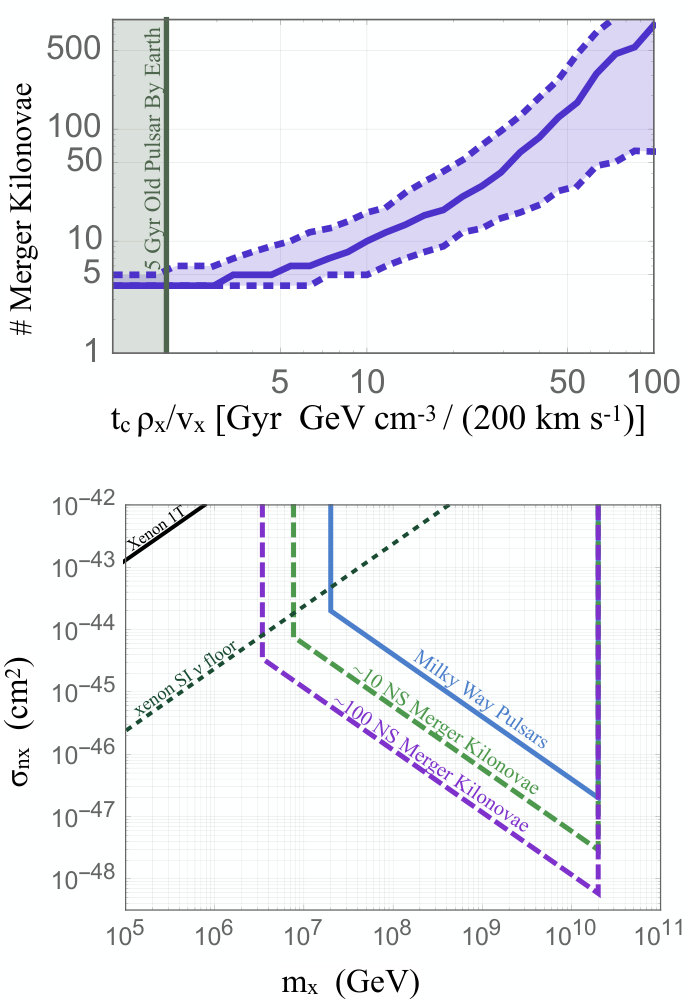 Figure 1
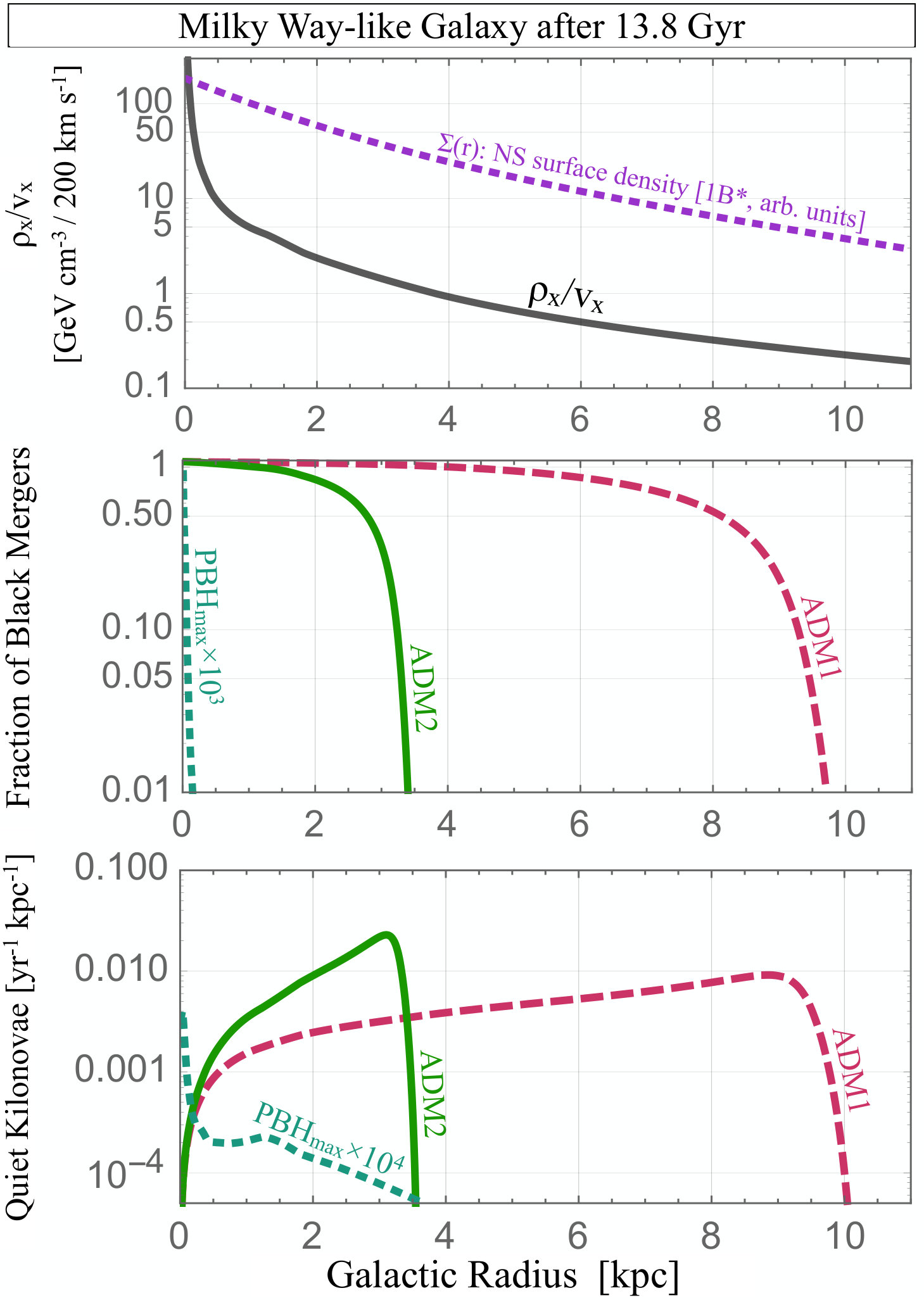 Figure 2
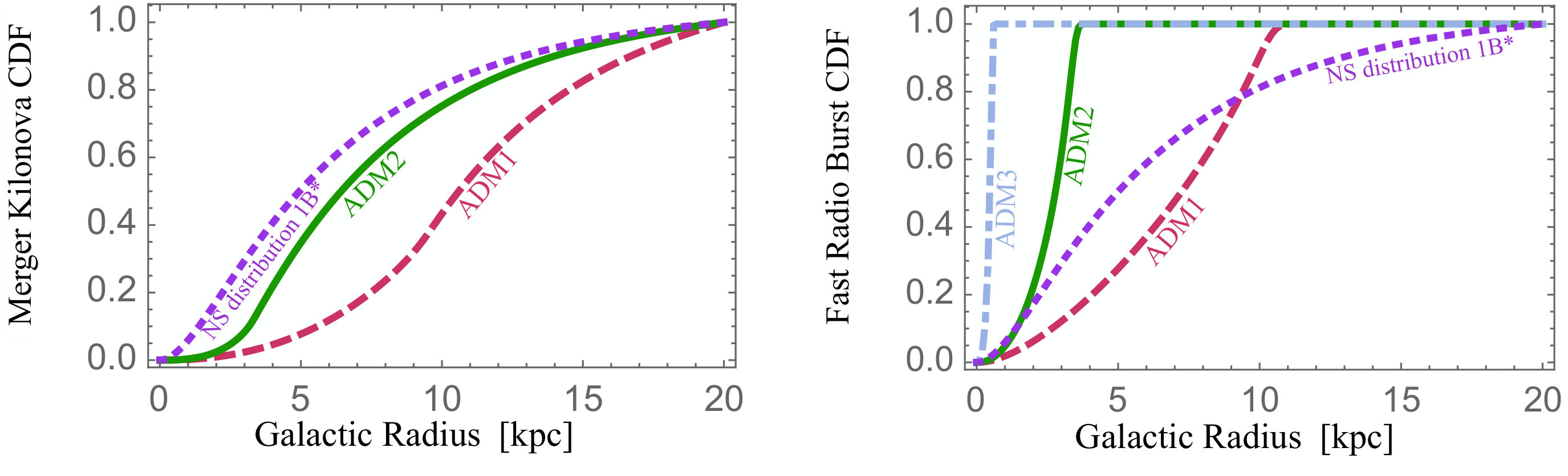 Figure 3
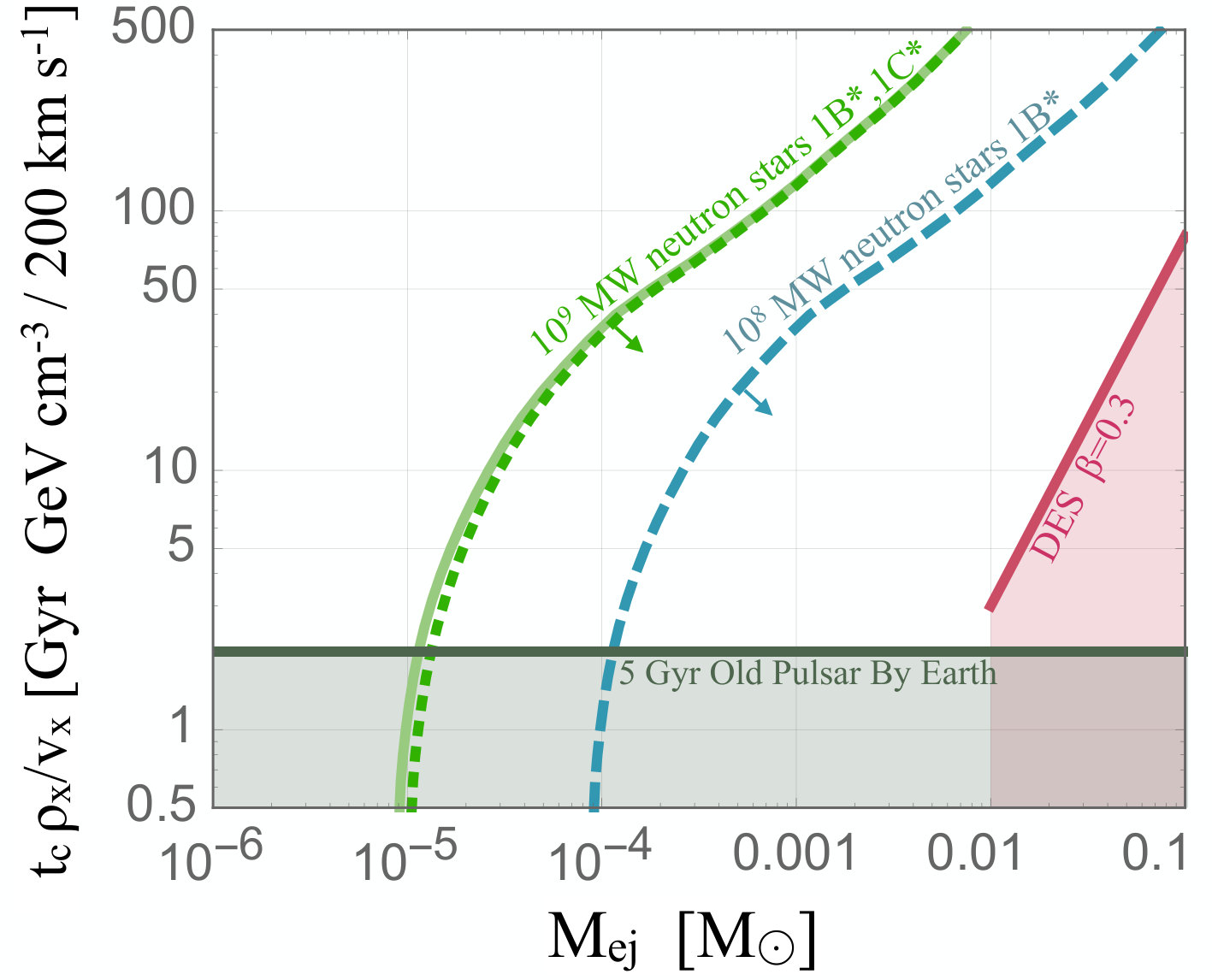 Figure 4
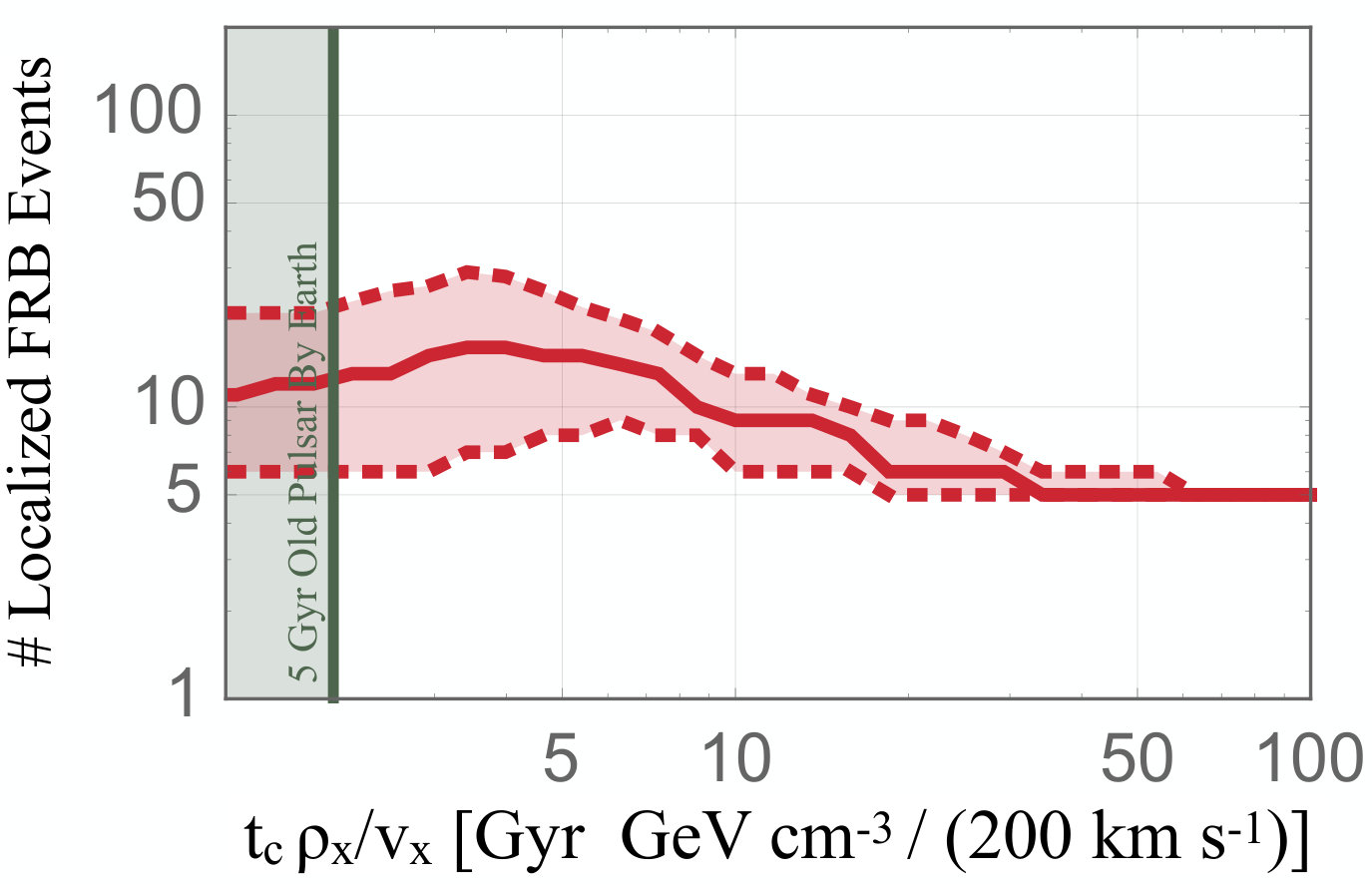 Figure 5
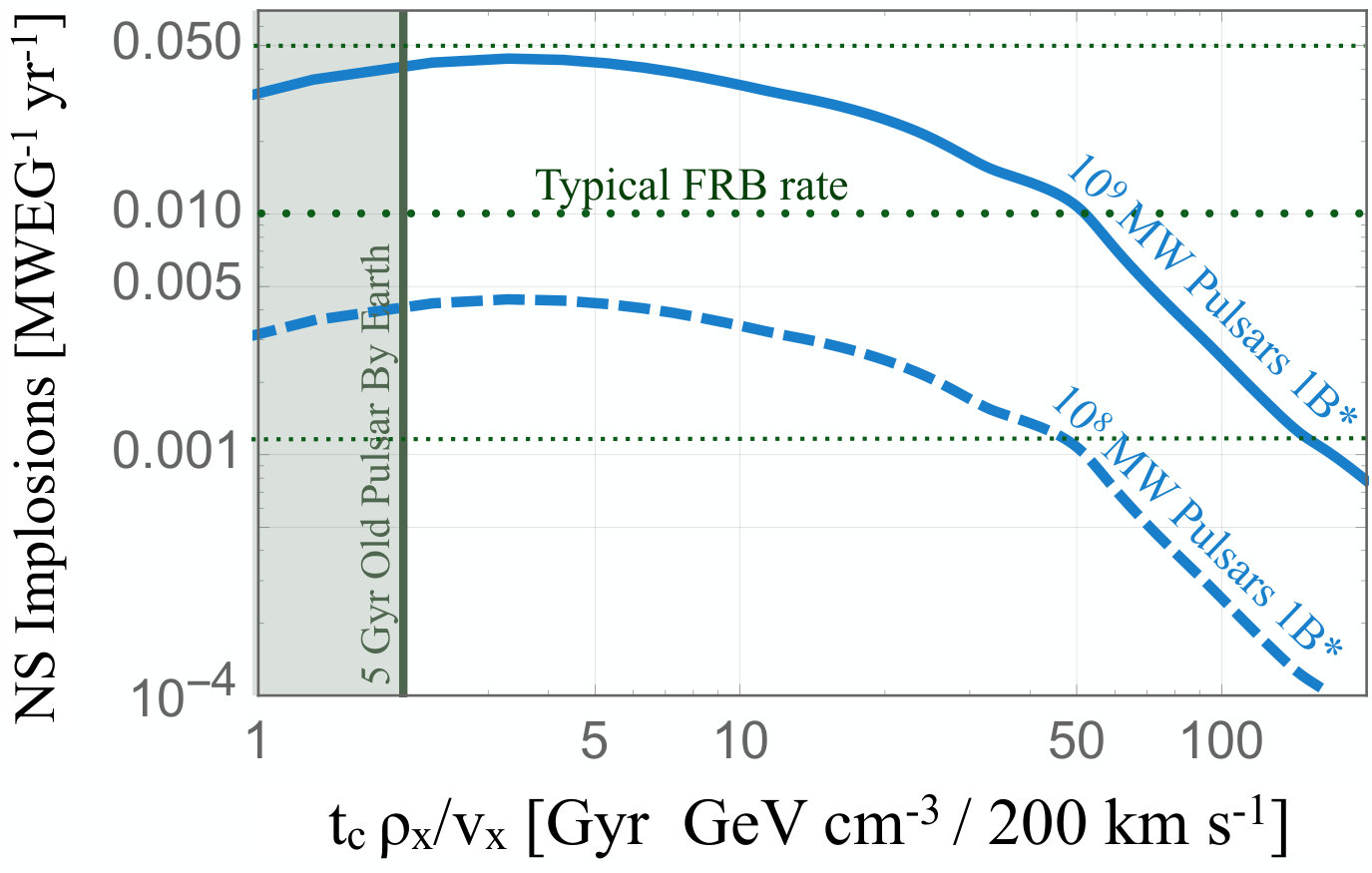 Figure 6
| Model | NS-NS | NS-BH | BH-BH | LM-BH | NS Im. | Im./ |
|---|---|---|---|---|---|---|
| Non-Imp. | 1e-4 | 3e-6 | 4e-7 | 0 | 0 | 0 |
| ADM1 | 3e-5 | 9e-7 | 4e-7 | 7e-5 | 4e-2 | 7e8 |
| ADM2 | 7e-5 | 2e-6 | 4e-7 | 3e-5 | 3e-2 | 3e8 |
| PBHmax | 1e-4 | 3e-6 | 4e-7 | 4e-11 | 1e-7 | 400 |
Peer Reviews
No public reviews on file for this paper yet. If you reviewed it on a platform where reviews are public (OpenReview, ICLR, NeurIPS, ICML), you can paste yours below so the community can read it here.
Videos
No videos yet. Explain this paper in a talk, walkthrough, or lecture? Add one.
Searching for Dark Matter with Neutron Star Mergers and Quiet Kilonovae
Joseph Bramante
CPARC and Department of Physics, Engineering Physics, and Astronomy, Queen’s University, Kingston, Ontario, Canada
Perimeter Institute for Theoretical Physics, Waterloo, Ontario, Canada
Tim Linden
CCAPP and Department of Physics, The Ohio State University, Columbus, OH, USA
Yu-Dai Tsai
Perimeter Institute for Theoretical Physics, Waterloo, Ontario, Canada
Laboratory for Elementary Particle Physics, Cornell University, Ithaca, NY, USA
Abstract
We identify new astrophysical signatures of dark matter that implodes neutron stars (NSs), which could decisively test whether NS-imploding dark matter is responsible for missing pulsars in the Milky Way galactic center, the source of some -process elements, and the origin of fast-radio bursts. First, NS-imploding dark matter forms solar mass or smaller black holes inside neutron stars, which proceed to convert neutron stars into 1.5 solar mass BHs. This decreases the number of neutron star mergers seen by LIGO/Virgo (LV) and associated merger kilonovae seen by telescopes like DES, BlackGEM, and ZTF, and instead, producing a population of “black mergers” containing 1.5 solar mass black holes. Second, dark matter-induced neutron star implosions may create a new kind of kilonovae that lacks a detectable, accompanying gravitational signal, which we call “quiet kilonovae.” Using DES data and the Milky Way’s r-process abundance, we constrain quiet kilonovae. Third, the spatial distribution of neutron star merger kilonovae and quiet kilonovae in galaxies can be used to detect dark matter. NS-imploding dark matter destroys most neutron stars at the centers of disc galaxies, so that neutron star merger kilonovae would appear mostly in a donut at large radii. We find that as few as ten neutron star merger kilonova events, located to 1 kpc precision could validate or exclude dark matter-induced neutron star implosions at confidence, exploring dark matter-nucleon cross-sections 4-10 orders of magnitude below current direct detection experimental limits. Similarly, NS-imploding dark matter as the source of fast radio bursts can be tested at confidence once 20 bursts are located in host galaxies by radio arrays like CHIME and HIRAX.
I Introduction
Uncovering the identity and interactions of dark matter would deepen our understanding of fundamental physics and the origin of our universe. Because dark matter is abundant in galactic halos, it may be revealed through its impact on stars. Indeed, a number of ongoing astrophysical searches may be unveiling dark matter that forms black holes inside and implodes old neutron stars Bramante and Linden (2014); Bramante and Elahi (2015); Goldman and Nussinov (1989); de Lavallaz and Fairbairn (2010); Kouvaris and Tinyakov (2011), thereby creating r-process elements Bramante and Linden (2016), and possibly fast radio bursts Fuller and Ott (2015).
Traditional neutron star-based searches for asymmetric dark matter have relied on old pulsars in the Milky Way, whose old age bounds the capture rate of asymmetric dark matter, which can eventually form black holes inside of neutron stars. Finding old pulsars in the Milky Way’s galactic center, where dark matter is denser, more dark matter is captured, and therefore pulsars potentially implode faster, would advance the frontier of asymmetric dark matter detection. However, extensive radio surveys of the Milky Way galactic center have not found enough pulsars to conclusively strengthen or invalidate the hypothesis that dark matter implodes neutron stars in that region. Fortuitously, the unprecedented sensitivity of laser interferometer gravitational wave detectors at LIGO/Virgo Abbott et al. (2016), the broad optical purview of DES Doctor et al. (2017); Soares-Santos et al. (2016), BlackGEM Ghosh and Nelemans (2015), and other optical telescopes, as well as kilo-channel radio reception at CHIME Berger et al. (2016) and HIRAX Newburgh et al. (2016), are better scrutinizing the dynamics of neutron stars and black holes. Indeed, recently a neutron star merger was found both in gravitational waves Abbott et al. (2017a) and follow-on telescope observations Abbott et al. (2017b).
This article demonstrates how the combined statistics of neutron star mergers observed in galaxies can be used to unmask dark matter with nucleon scattering cross-sections orders of magnitude smaller than the present reach obtained from neutron stars in the Milky Way, and up to ten orders of magnitude beyond any planned underground dark matter detection experiment. This new search method applies to many asymmetric dark matter models Petraki and Volkas (2013); Zurek (2014), including mass bosons Bramante and Linden (2014); Bramante and Elahi (2015); Goldman and Nussinov (1989); de Lavallaz and Fairbairn (2010); Kouvaris and Tinyakov (2011); McDermott et al. (2012); Bramante et al. (2013); Bell et al. (2013); Bertoni et al. (2013); G ver et al. (2014); Kouvaris and Tinyakov (2014); Kurita and Nakano (2016), mass self-interacting fermions Kouvaris (2012); Bramante et al. (2014); Bramante and Elahi (2015), and mass bosons and fermions de Lavallaz and Fairbairn (2010); Bramante (2015); Bramante and Linden (2016); Bramante and Unwin (2017).
Additionally, this article details distinct signatures of dark matter-induced neutron star implosions, which can be discovered by upcoming gravitational, optical, and radio surveys. NS-imploding dark matter may produce detectable quiet kilonovae: a kilonova powered by the ejection of neutron star fluid during the dark matter-induced implosion of a neutron star. These quiet kilonovae would be “quiet” and distinct from the now-observed neutron star merger kilonovae, in that they would not produce gravitational waves detectable by LIGO/Virgo. The remainder of this document is structured as follows: in Section II we review asymmetric dark matter that implodes neutron stars and introduce the normalized implosion time. Section III details how neutron star populations in disc galaxies are altered by NS-imploding dark matter. Section IV details prospects for finding primordial black holes (PBHs) using neutron star mergers and quiet kilonova. Section V provides the first constraint on “quiet kilonovae.” Section VI details a major result of this work: that NS mergers can be used as an incisive new search for dark matter. A location and rate analysis testing whether fast radio bursts originate from dark matter-induced neutron star implosions is presented in Section VII. In section VIII, we conclude. Appendix A presents the cumulative distributions functions employed in Section VII and VI and Appendix B provides details of neutron star implosions induced by heavy asymmetric dark matter.
II Dark matter-induced neutron star implosions
Once enough dark matter has accumulated in a neutron star’s interior, dark matter may collapse into a small () black hole that subsequently consumes the neutron star Bramante and Linden (2014); Goldman and Nussinov (1989); Bramante and Linden (2016). We begin by defining a useful variable combination, the “normalized implosion time,” which relates dark matter-induced NS implosions occurring at different radii from a galactic center, where the local dark matter density and velocity dispersion will be different, see Figure 1. The maximum mass accumulation rate of dark matter into a NS is Baryakhtar et al. (2017)
[TABLE]
where and are the mass and radius of the neutron star and is Newton’s constant. The time until NS implosion scales inversely with the mass accumulation rate, ; therefore is proportional to the dark matter velocity dispersion divided by density, . Furthermore, and are the only quantities in that depend on the galactocentric radius . It follows that for dark matter which implodes NSs in time , the quantity
[TABLE]
which we call the normalized implosion time,111The units given in square brackets in Eq.(2) might be read as “A neutron star will implode in one gigayear for local dark matter density and dark matter velocity dispersion .” is independent of . Throughout we will normalize to a typical dark matter density () and velocity dispersion () for a disc galaxy.
The value of for a specific dark matter model can be determined by calculating the time for dark matter with local density and relative velocity to implode a neutron star. While many asymmetric dark matter models implode neutron stars Bramante and Linden (2014); Bramante and Elahi (2015); Goldman and Nussinov (1989); de Lavallaz and Fairbairn (2010); Kouvaris and Tinyakov (2011); McDermott et al. (2012); Bramante et al. (2013); Bell et al. (2013); Kouvaris (2012); Bramante et al. (2014); Bramante and Elahi (2015); Bramante (2015); Bramante and Linden (2016), we will focus on heavy asymmetric dark matter as a simple example. In the case of heavy asymmetric dark matter, the critical mass of dark matter required to form a small black hole is for dark fermions with mass Bramante (2015), and for dark scalars with self-interaction potential Colpi et al. (1986). In these models, the neutron star will implode shortly after it collects a critical mass of dark matter at time , where this expression assumes all dark matter passing through the neutron star is captured – see Appendix B for details and for the scaling of dark matter-nucleon cross-section with . Then the value of the galactic radial invariant is
[TABLE]
for heavy asymmetric fermions and bosons, respectively.
III Black mergers, quiet kilonovae, and r-process donuts
NS-imploding dark matter creates an unexpected population of low mass black holes (BHs), depleting the expected population of NSs. This in turn would alter the number of merging neutron stars that would be seen by LIGO/Virgo, along with their accompanying merger kilonovae, which are the days-long luminous outbursts from beta decaying neutrons ejected when NSs fall into a BH or another NS Lattimer et al. (1977); Kasen et al. (2013).
We now determine the number and position of neutron stars converted to BHs by dark matter in a Milky Way-like galaxy. With some subtleties that we will address, our findings for a typical 13 Gyr old disc galaxy can be applied to events in different galaxies, using a Milky Way equivalent galaxy (MWEG) volumetric conversion for merger and kilonova rates, one Abadie et al. (2010).
The number of neutron stars converted into BHs by dark matter in an MWEG will depend on the historic neutron star formation rate in the galaxy, the dynamics and final positions of neutron stars after formation, the dark matter halo density profile, and the relative velocity of dark matter with respect to neutron stars. We model the historic star formation rate using a global fit to astronomical data (Hopkins and Beacom (2006), Table 1, Column 2). While we use to determine the relative historic rate of neutron star formation, we normalize the total rate to neutron star births over the MWEG lifetime Paczynski (1990); Blaes and Madau (1993); Sartore et al. (2010). At birth, it has been observed that neutron stars receive natal kicks which result in an initial velocity boost of (Hobbs et al., 2005; Faucher-Giguere and Kaspi, 2006). A recent study of neutron star dynamics in an MWEG has found that most () neutron stars are retained within a kiloparsec of the MWEG disc plane, with a NS surface density . We therefore model the MWEG neutron star distribution as a thin disk with surface density given by models 1B* (and 1C* as indicated for comparison) in Sartore et al. (2010).
To model dark matter in an MWEG, we use an NFW dark matter halo density profile Navarro et al. (1997), , with dark matter density normalization and scale factor . To approximate the dark matter velocity dispersion in an MWEG, we match the phenomenological fit of Sofue to stellar velocities in the Milky Way (Sofue (2013), Figure 11). With the star formation rate, neutron star distribution and dark matter properties specified, the fraction of neutron stars at radius converted to solar mass BHs is given by where is the lifetime of the universe and is the collapse time at radius , obtainable from Eq. (3). Similarly, the rate of neutron star implosions (and also quiet kilonovae) per unit galactocentric radius is given by In Figure 1, we plot the fraction of neutron stars converted to BHs along with the rate of neutron star implosions per year per kpc, both as a function of galactocentric radius, for a 13 Gyr old MWEG. In Table 1, we show how standard rates for compact object mergers would be altered, and display dark matter-induced neutron star implosion rates, for a few values of . Table 1 also gives the maximum rate for PBH implosion of NSs, which we address in the next section.
IV Rare neutron star implosions from primordial black holes
Black holes formed from primordial perturbations during the radiation-dominated expansion of the early universe Hawking (1974); Carr and Hawking (1974), with masses between GeV, can be captured inside and subsequently consume neutron stars Capela et al. (2013a, b). As this work was being completed Fuller et al. (2017) appeared, which addresses PBH-induced NS implosions, and following Bramante and Linden (2016), considers r-process elements and kilonovae produced by NS implosions. The maximum PBH-induced NS implosion rate for an MWEG found here differs markedly from Fuller et al. (2017), because we use the realistic, standard values for the NS population density, PBH density, and PBH velocity dispersion. We will find that NS implosions from primordial BHs (PBHs) in a typical Milky Way-like galaxy are rare.
PBHs with halo density are captured by neutron stars at a rate Capela et al. (2013a)
[TABLE]
where the energy loss of a PBH transiting the NS is , and for a typical neutron star density profile . With Eq. (4) it can be verified that PBH capture in NSs is maximized for PBH masses GeV. Assuming GeV PBHs make up the entire dark matter density, , we find that the PBH NS implosion rate appears too low to be detectable by next generation astronomical surveys, as shown in Figure 11 and Table 1.
V Milky Way r-process enrichment and DES bounds on quiet kilonovae
NSs imploded by dark matter may eject a substantial amount of neutrons into the interstellar medium. Ejected neutron fluid will decompress, beta decay, and form a portion of the r-process elements observed in the Milky Way Lattimer et al. (1977); Eichler et al. (1989); Kasen et al. (2013); Bramante and Linden (2016). R-process elements are heavy elements with atomic masses around , formed from neutron rich fluid at an as-yet undetermined astrophysical site. While core collapse supernovae have been historically favored as candidate sites for r-process production, recent observations of a high r-process abundance in Reticulum II, and low r-process abundance in other ultra faint dwarf galaxies, favors r-process production from rare events like a NS merger Ji et al. (2016) or NS implosion Bramante and Linden (2016). In the case of a NS implosion, the amount of NS fluid ejected will likely depend on tidal forces during the implosion Bramante and Linden (2016), which require a complete hydrodynamical simulation to be properly modelled. However, it is known that in total, of r-process elements must be formed to match the abundance seen in the Milky Way van de Voort et al. (2015); Shen et al. (2015); Wehmeyer et al. (2015). Therefore, the amount of neutron fluid ejected per NS implosion can be bounded, by limiting the total NS mass ejected to in the Milky Way. In Figure 2, we present such bounds, as a function of . This can be compared to the final column of Table 1, which shows the expected number of NS implosions after Gyr.
Quiet kilonovae produced by NS-imploding dark matter can be searched for using state-of-the-art optical surveys. DES has recently published a null wide field optical search for kilonovae Doctor et al. (2017), which are the days-long luminous outbursts of beta-decaying neutron fluid ejected from NSs falling into BHs or other neutron stars. Because this search does not rely on a gravitational signature and instead seeks out beta decay emission from NS fluid flung into outer space, its findings can be used to constrain quiet kilonovae, NS fluid ejected from a NS implosion. Because kilonovae light curves depend mainly on the mass and velocity of NS fluid ejected Kasen et al. (2013), bounds obtained for NS merger kilonovae can be applied to quiet kilonovae from NS implosions. We set this bound in Figure 2, computing the quiet kilonova rate for each model point, assuming an MWEG containing NSs.
VI Searching for dark matter with NS mergers
Here we show how the galactocentric radial positions of merger kilonovae would be sufficient to explore asymmetric dark matter-nucleon cross-sections orders of magnitude smaller than those presently probed using old pulsars in the Milky Way. The current generation of LV instrumentation is sensitive to gravitational strains on the order of 10*-23* at an optimal frequency of 400 Hz, allowing for the observation of double neutron star (NS) binaries out to distances of 70 Mpc Abbott et al. (2016). Anticipated upgrades will significantly expand this reach, as the amplitude of gravitational wave events is inversely proportional to the source distance, while the expected merger rate increases as the distance cubed. In the coming decade, up to hundreds of NS merger events are anticipated. Once a NS merger event is located to within square degrees by LIGO/Virgo, wide field telescopes like BlackGEM Ghosh and Nelemans (2015) and the Zwicky Transient Factory Bellm (2014) are poised to image any subsequent kilonovae. The number of kilonovae found using this method will depend on their peak brightness, predictions for which range from -10 to -16 AB magnitude Doctor et al. (2017), while BlackGEM will perhaps probe a 100 degree field of view down to -14 AB magnitude for 200 Mpc distant mergers. As shown in Figure 1, galaxies with NS-imploding dark matter will have fewer NS merger kilonovae in their centers, where most NSs will have been converted to BHs. Therefore, the spatial distribution of merger kilonovae that can be used to test for dark matter. In the top panel of Figure 3, we show the results of a cumulative distribution test, where the standard (model “1B*”) NS distribution defined Section 2, is tested against the distribution expected if dark matter is imploding neutron stars.
The altered NS merger distribution is calculated by taking the fraction of NSs converted into black holes shown in Figure 1, and applying this conversion fraction to the 1B* expected distribution of NS mergers. The expected and dark matter-modified cumulative distribution functions of NS mergers in an MWEG are plotted in Appendix A. Statistical results were obtained by running 400 random Kolomogorov-Smirnov cumulative distribution trials, for each neutron star normalized implosion time (), to determine how many merger kilonovae located in galaxies would be necessary to detect NS-imploding dark matter at 2 significance. Using the same methodology, in Section VII we find that FRBs localized in galaxies would determine whether FRBs are a byproduct of NS implosions.
In practice, merger kilonovae occur in galaxies that are somewhat different from the Milky Way. To convert a measured galactocentric radius in a NS-merger-containing (non-Milky Way) galaxy, , to a Milky Way equivalent radius , one can solve the formula
[TABLE]
for , where and are the dark matter density and velocity dispersion of the MWEG and non-Milky Way galaxies, as indicated. For example, the recently detected NS merger in NGC 4993 occurred in a galaxy which would have an NFW profile defined by and scale factor . The NS merger in NGC 4993 occurred at kpc from its center Abbott et al. (2017b). Solving Eq. (5), this corresponds to an Milky Way equivalent radius of 5-8 kpc. Note that this analysis also assumes that most identified NS mergers will have an age of Gyr – indeed, the NS merger progenitor found in NGC 4993 is projected to be this old Blanchard et al. (2017).
In Figure 3, the per-nucleon cross-section sensitivity obtainable for heavy, asymmetric, fermionic dark matter is shown, as calculated using the capture rate and collapse conditions presented in Bramante et al. (2017); Bramante (2015) and Appendix B in this document. Lighter asymmetric dark matter can also be found using these methods, as in Refs. Bramante and Linden (2014); Bramante and Elahi (2015); Goldman and Nussinov (1989); de Lavallaz and Fairbairn (2010); Kouvaris and Tinyakov (2011); McDermott et al. (2012); Bramante et al. (2013); Bell et al. (2013); Bertoni et al. (2013); G ver et al. (2014); Kouvaris and Tinyakov (2014); Kurita and Nakano (2016).
VII Fast radio bursts from dark matter
Fast radio bursts (FRBs) are a newly-discovered class of millisecond-length Ghz radio pulses found to distances of 2 Gpc with an all sky rate day, whose source is unknown Lorimer et al. (2007); Thornton et al. (2013). In Fuller and Ott (2015) it was proposed that dark matter-induced NS implosions may be the source of FRBs. The electromagnetic energy released by a NS implosion matches what is required for an FRB Palenzuela (2013); Dionysopoulou et al. (2013); Falcke and Rezzolla (2014). Ref. Fuller and Ott (2015) calculated the per MWEG NS implosion rate assuming a constant star formation history and a NS population that tracked the baryonic density in an MWEG. We improve on these rate calculations by using a realistic star formation history Hopkins and Beacom (2006) and NS distribution Sartore et al. (2010), see Figure 4.
The rate of NS collapse due to dark matter accumulation in the Milky Way can be estimated in several limits. In the limit of arbitrarily rapid dark matter accumulation, all NSs collapse to BHs soon after formation and the NS collapse rate is equal to the supernova rate (approximately 0.02 yr*-1* (Diehl et al., 2006)). This scenario is ruled out by observations of Gyr old neutron stars. Intriguingly, in the case of less rapid dark matter-induced NS implosions, the overall present-day NS implosion rate actually increases due to enhanced star formation rate in the young Milky Way. While the star-formation rate of the Milky Way is currently 0.68 — 1.45 M⊙ yr*-1* Robitaille and Whitney (2010), the rate at redshift z=2 was approximately 14 M⊙ yr*-1* van Dokkum et al. (2013); Snaith et al. (2014); Marasco et al. (2015). If dark matter induces most Gyr old NSs to implode in the present epoch, then the current implosion rate will reflect the high-redshift star formation rate. Because the dark matter density diminishes with increasing distance from the galactic center, the delay-time between NS formation and NS collapse varies considerably as a function of galactocentric radius, as evident in Figure 1 in the main text. In Figure 4 we plot the number of NS implosions expected per MWEG as a function of . Upper, median, and lower FRB rates are also indicated for comparison Rane et al. (2016); Wiel et al. (2016).
VIII Gravitational waves from a neutron star implosion in the Milky Way
We have identified new signatures of neutron star-imploding dark matter, and fashioned qualitatively new methods for uncovering this dark sector using imminent astronomical observations. Specifically, our proposed analysis of NS merger kilonova locations has the potential to explore dark matter-nucleon scattering cross-sections up to ten orders of magnitude beyond present direct detection experiments. Finally, we note that the collapse of a neutron star into a BH could be detected directly at advanced LV, if the NS resides in the Milky Way. As we have calculated in Section 2, NS implosion event rates may be as large as per year. Reference Baiotti et al. (2007) finds the following strain for a NS collapsing to a BH, so that advanced LV Abbott et al. (2013) may find an implosion out to . We leave additional gravitational signatures of NS-imploding dark matter to future work, along with the application of the spatial kilonova analysis introduced here, to electromagnetic transients from exotic compact object mergers Giudice et al. (2016); Bramante et al. (2017).
Acknowledgements.
We thank Asimina Arvanitaki, Masha Baryakhtar, Shaon Ghosh, Robert Lasenby, Shirley Weishi Li, and Luis Lehner for useful discussions and correspondence. Research at Perimeter Institute is supported by the Government of Canada through Industry Canada and by the Province of Ontario through the Ministry of Economic Development & Innovation. J. B. thanks the Aspen Center for Physics, which is supported by National Science Foundation grant PHY-1066293. T. L. is partially supported by NSF Grant PHY-1404311 to John Beacom.
Appendix A Cumulative Distribution Functions
Figure 5 shows the cumulative distribution functions used in the Kolmogorov-Smirnov tests, whose results are displayed in Figures 3 and 4. As indicated, the displayed CDFs here were generated using the neutron star distribution model 1B* in Sartore et al. (2010). However, note that we have found that Kolmogorov-Smirnov tests utilizing other pulsar distribution models in Sartore et al. (2010) require a similar number of NS mergers to achieve sensitivity to asymmetric dark matter comparable to the results shown in Figures 3 and 4.
Appendix B Dark matter-induced Neutron Star Implosion Time
The analysis of NS implosions in Section 1 assumed that the longest timescale in the NS implosion process is the time for a NS to accrete a BH-forming mass of dark matter. Here we justify this assumption by computing timescales for all dynamical processes leading up to dark matter-induced NS implosions. As an example, we consider fermionic dark matter in the PeV mass range with dark matter-nucleon cross-section . For , all PeV mass dark matter passing through the NS will be captured Bramante et al. (2017), as assumed in Section 1. Extending this work to PeV mass bosonic dark matter requires minor modifications discussed around Eq. (3) of the main text, with similar results obtained. Similar results arises for low mass dark matter Kouvaris (2012); de Lavallaz and Fairbairn (2010); Bramante et al. (2013); Bertoni et al. (2013); Bramante (2015), where sensitivity to scales inversely with – so that the reach of this study results in up to a -fold improvement in sensitivity.
A small BH may form when a NS accumulates so much dark matter, that the dark matter cannot support its own weight with degeneracy pressure. This critical mass for fermionic dark matter is , as reported in the main text. In principle ( for lower mass dark matter) dark matter may accumulate to size in a NS, yet not implode. This is because until dark matter in a NS “self-gravitates” or equivalently forms a bulk whose density exceeds the NS density, it will remain stable.222In the case of dark matter with substantial self-interactions, this computation is different Kouvaris (2012); Bramante et al. (2014); Bramante and Elahi (2015). We find the self-gravitating mass Bramante et al. (2013) for PeV mass dark matter, and determine that , which justifies our assumption in the main text, that a BH will form once dark matter accumulates. For the limiting case of a younger NS with temperature ,
[TABLE]
and one can see that is at least times larger than for PeV mass dark matter.
Next we review the dynamical timescales for a NS to become converted to a BH by accumulated dark matter. First the dark matter particles thermally equilibrate with the neutron star, through repeated scattering; we denote this thermalization time scale by . Once an unstable mass of dark matter has thermalized into a small volume, the dark matter will collapse, cool, and form a BH, over a time . Lastly, the small BH formed of dark matter accretes the surrounding neutron star in a time . We will see that each process occurs much faster than the time scale, and conclude that the neutron star implosion time is determined by .
We first consider the thermalization. Dark matter particles captured and accumulated in the neutron star thermalize with the neutrons and cool to temperature , same as the neutron star, before it start lose more kinetic energy and eventually collapse into a BH. The time scale is determined by the neutron-dark matter collisions Bertoni et al. (2013), in particular
[TABLE]
After thermalization, the dark matter particles form a spherical configuration of radius , where the dark matter density at collapse is equal to the NS density . The dark matter particles can further lose more of their energy and collapse into a BH. There are several mechanisms that contribute to this cooling, with associated time scales. Here we focus on cooling via dark matter-neutron scattering, while other cooling mechanisms can be found in e.g. Goldman and Nussinov (1989). The dark matter cooling and collapse time is approximately the time for dark matter to lose of its kinetic energy to surrounding neutrons,
[TABLE]
where is the number density of the neutrons. The first term is the time for a single collision. In addition, Pauli blocking has to be taken into account, as it reduces cross-section by a factor of , hence the second term. Here is the neutron Fermi momentum in a NS and . The factor of here is the velocity of the dark matter sphere as it collapses through radius , which can be written as . The final factor takes into account that in each collision only a fraction of the dark matter kinetic energy is transferred, so one requires collisions for an order-one energy loss.
With the BH formed, assuming it accretes the remainder of the NS, the time for which depends on the BHBH mass ( Bramante and Linden (2016); Kouvaris and Tinyakov (2014)).
[TABLE]
We find that are much shorter than , which therefore determines the time until a NS implodes.
The reference list from the paper itself. Each links out to its DOI / PubMed record.
- 1Bramante and Linden (2014) Joseph Bramante and Tim Linden, “Detecting Dark Matter with Imploding Pulsars in the Galactic Center,” Phys. Rev. Lett. 113 , 191301 (2014) , ar Xiv:1405.1031 [astro-ph.HE] . · doi ↗
- 2Bramante and Elahi (2015) Joseph Bramante and Fatemeh Elahi, “Higgs portals to pulsar collapse,” Phys. Rev. D 91 , 115001 (2015) , ar Xiv:1504.04019 [hep-ph] . · doi ↗
- 3Goldman and Nussinov (1989) I. Goldman and S. Nussinov, “Weakly Interacting Massive Particles and Neutron Stars,” Phys. Rev. D 40 , 3221–3230 (1989) . · doi ↗
- 4de Lavallaz and Fairbairn (2010) Arnaud de Lavallaz and Malcolm Fairbairn, “Neutron Stars as Dark Matter Probes,” Phys. Rev. D 81 , 123521 (2010) , ar Xiv:1004.0629 [astro-ph.GA] . · doi ↗
- 5Kouvaris and Tinyakov (2011) Chris Kouvaris and Peter Tinyakov, “Constraining Asymmetric Dark Matter through observations of compact stars,” Phys. Rev. D 83 , 083512 (2011) , ar Xiv:1012.2039 [astro-ph.HE] . · doi ↗
- 6Bramante and Linden (2016) Joseph Bramante and Tim Linden, “On the r 𝑟 r -Process Enrichment of Dwarf Spheroidal Galaxies,” Astrophys. J. 826 , 57 (2016) , ar Xiv:1601.06784 [astro-ph.HE] . · doi ↗
- 7Fuller and Ott (2015) Jim Fuller and Christian Ott, “Dark Matter-induced Collapse of Neutron Stars: A Possible Link Between Fast Radio Bursts and the Missing Pulsar Problem,” Mon. Not. Roy. Astron. Soc. 450 , L 71–L 75 (2015) , ar Xiv:1412.6119 [astro-ph.HE] . · doi ↗
- 8Abbott et al. (2016) Benjamin P. Abbott et al. (Virgo, LIGO Scientific), “Upper Limits on the Rates of Binary Neutron Star and Neutron Star - Black Hole Mergers From Advanced Ligo’s First Observing Run,” Astrophys. J. 832 , L 21 (2016) , ar Xiv:1607.07456 [astro-ph.HE] . · doi ↗