Search for low mass vector resonances decaying to quark-antiquark pairs in proton-proton collisions at sqrt(s) = 13 TeV
CMS Collaboration

TL;DR
This paper reports a search for low mass vector resonances decaying into quark-antiquark pairs in proton-proton collisions at 13 TeV, using the CMS detector, setting new limits in previously unexplored mass regions.
Contribution
It introduces a novel search method for low mass vector resonances at the LHC, focusing on merged jet signatures at high transverse momentum.
Findings
No evidence of vector resonances in the 100-300 GeV range.
Sets upper limits on production cross sections in new mass-coupling regions.
Explores the previously untested below 140 GeV mass region.
Abstract
A search is reported for a narrow vector resonance decaying to quark-antiquark pairs in proton-proton collisions at sqrt(s) = 13 TeV, collected with the CMS detector at the LHC. The data sample corresponds to an integrated luminosity of 2.7 inverse femtobarns. The vector resonance is produced at large transverse momenta, with its decay products merged into a single jet. The resulting signature is a peak over background in the distribution of the invariant mass of the jet. The results are interpreted in the framework of a leptophobic vector resonance and no evidence is found for such particles in the mass range of 100-300 GeV. Upper limits at 95% confidence level on the production cross section are presented in a region of mass-coupling phase space previously unexplored at the LHC. The region below 140 GeV has not been explored by any previous experiments.
Click any figure to enlarge with its caption.
 Figure 1
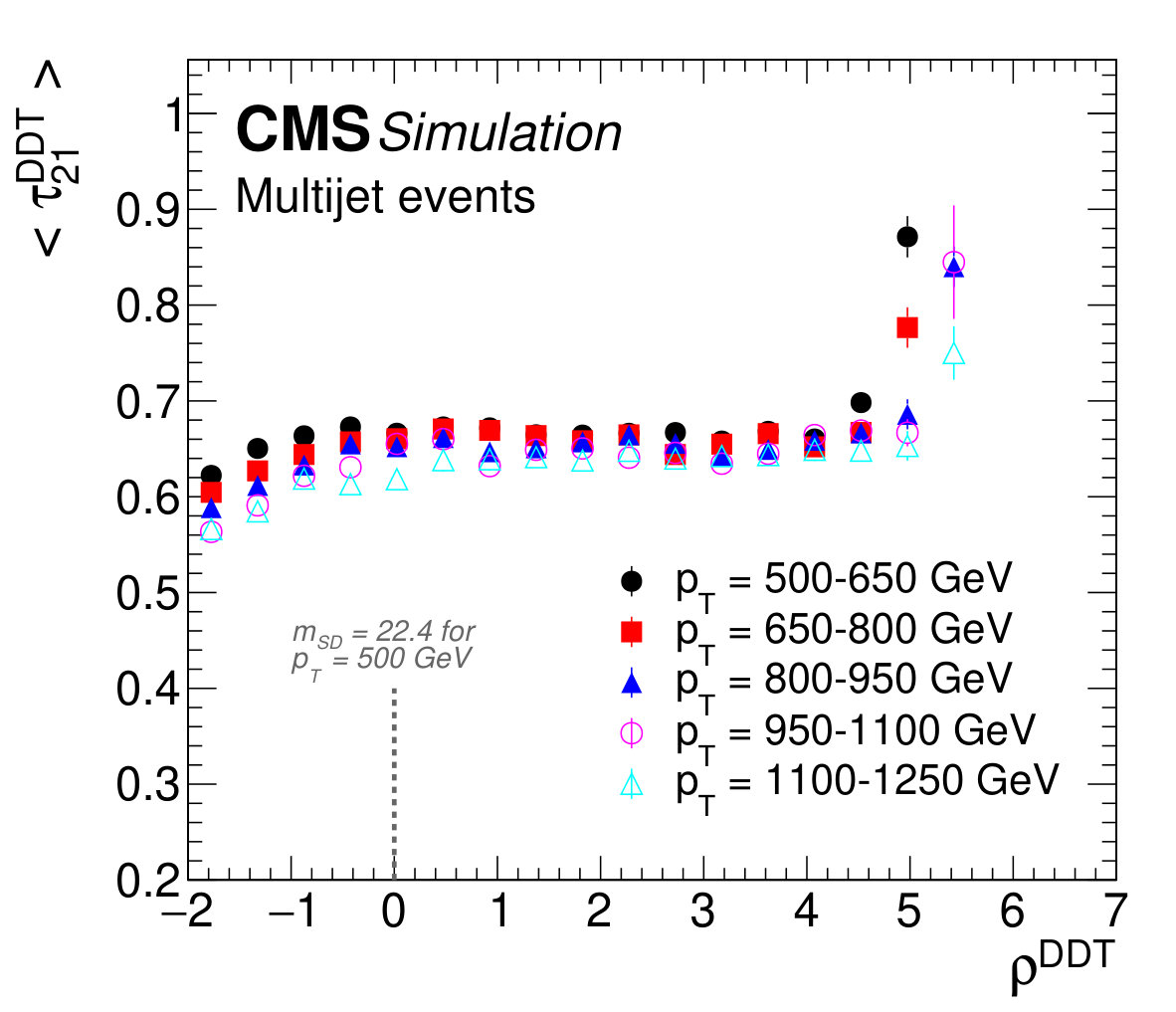 Figure 1
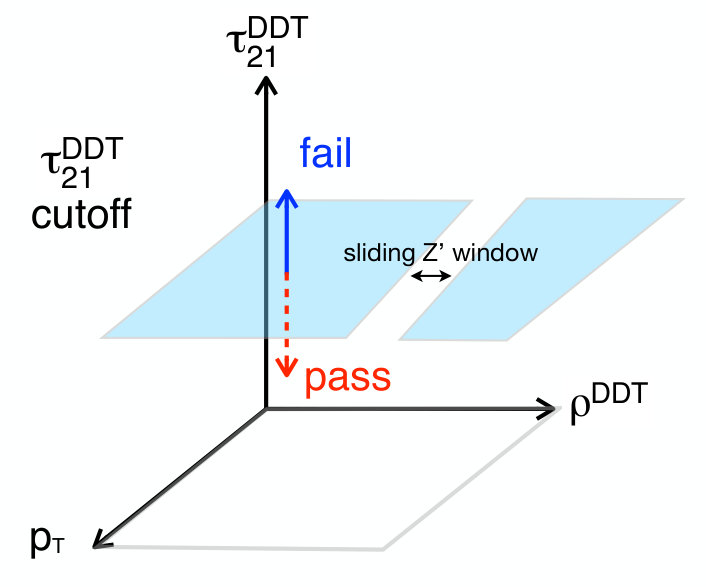 Figure 1
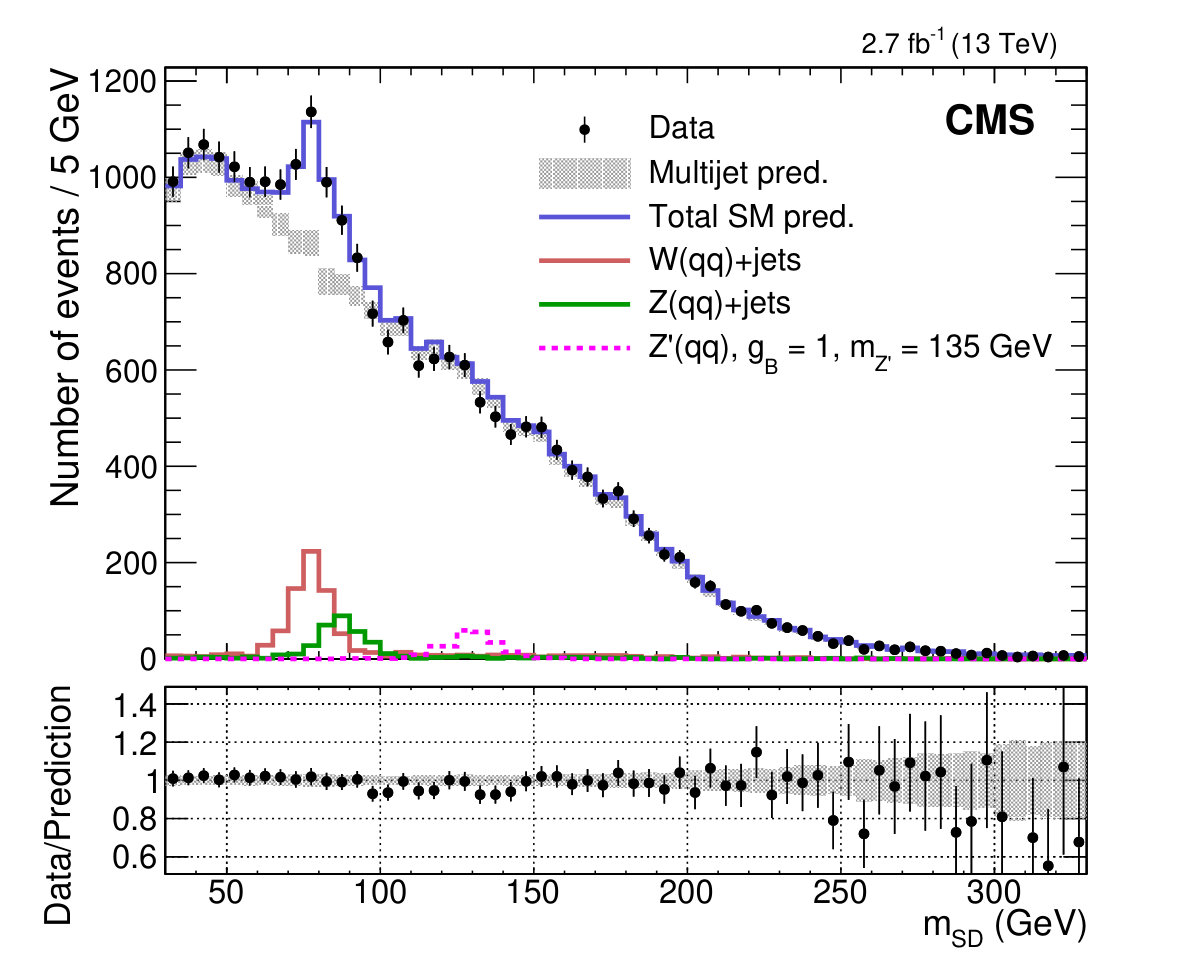 Figure 2
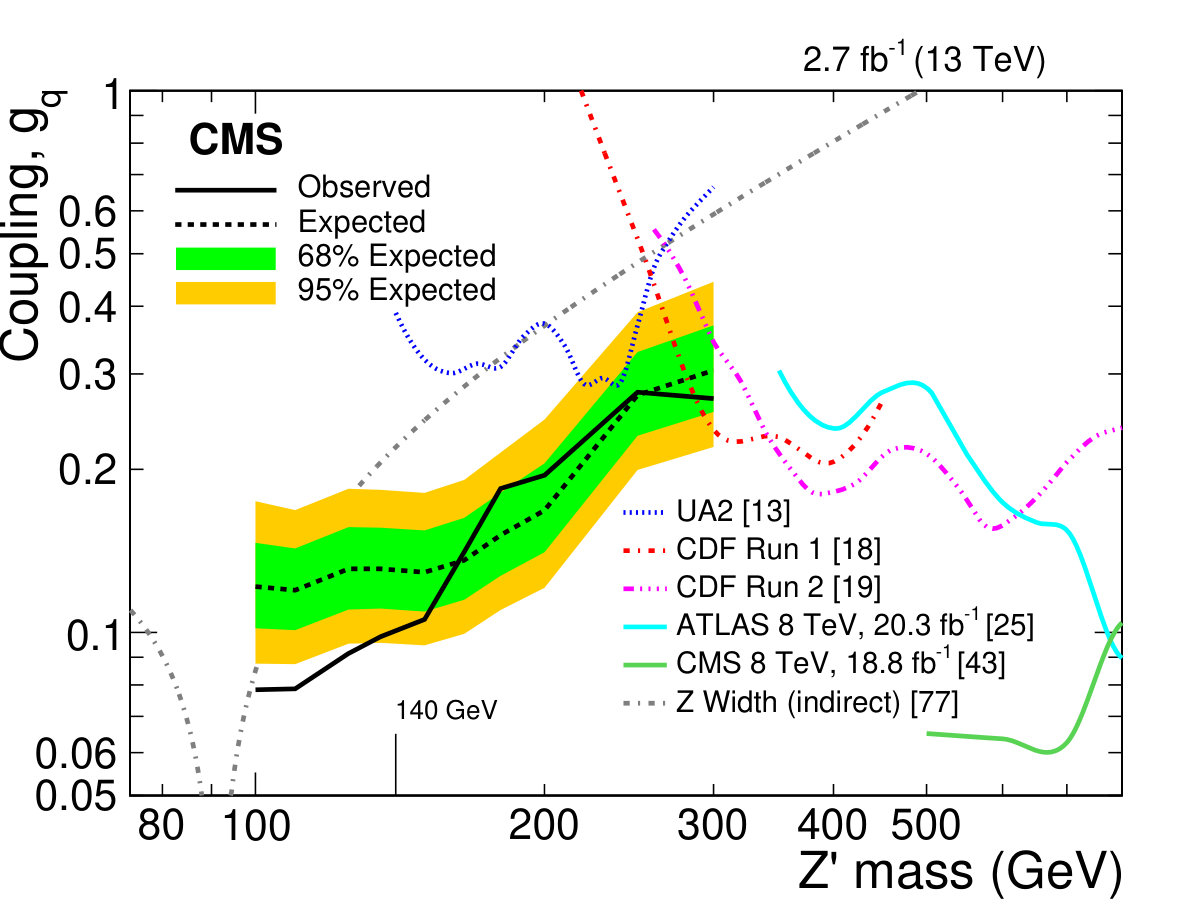 Figure 3
 Figure 6
Peer Reviews
No public reviews on file for this paper yet. If you reviewed it on a platform where reviews are public (OpenReview, ICLR, NeurIPS, ICML), you can paste yours below so the community can read it here.
Videos
No videos yet. Explain this paper in a talk, walkthrough, or lecture? Add one.
\cmsNoteHeader
EXO-16-030
\RCS
\RCS \RCS
\cmsNoteHeader
EXO-16-030
Search for low mass vector resonances decaying to quark-antiquark pairs in proton-proton collisions at
Abstract
A search is reported for a narrow vector resonance decaying to quark-antiquark pairs in proton-proton collisions at , collected with the CMS detector at the LHC. The data sample corresponds to an integrated luminosity of 2.7\fbinv. The vector resonance is produced at large transverse momenta, with its decay products merged into a single jet. The resulting signature is a peak over background in the distribution of the invariant mass of the jet. The results are interpreted in the framework of a leptophobic vector resonance and no evidence is found for such particles in the mass range of 100–300\GeV. Upper limits at 95% confidence level on the production cross section are presented in a region of mass-coupling phase space previously unexplored at the LHC. The region below 140\GeVhas not been explored by any previous experiments.
Over the past half-century, searches for narrow resonances in the dijet invariant mass spectrum have been an important part of the physics program at every collider. Such searches are well motivated within the many classes of theories beyond the current standard model (SM) that predict resonances with significant couplings to quarks [1, 2, 3, 4, 5, 6, 7, 8, 9, 10, 11]. The first searches for such particles at the UA1 [12] and UA2 [13, 14] experiments at the CERN SS have been extended to larger values of resonance masses by the CDF [15, 16, 17, 18, 19] and D0 [20, 21, 22] experiments at the Fermilab Tevatron, and by the ATLAS [23, 24, 25, 26, 27, 28, 29, 30, 31, 32] and CMS [33, 34, 35, 36, 37, 38, 39, 40, 41, 42, 43, 44, 45] experiments at the CERN LHC.
In this Letter, we report on a search for vector (\PZpr) resonances decaying to quark-antiquark pairs () using the data collected in pp collisions at \TeVby the CMS detector, corresponding to an integrated luminosity of 2.7\fbinv. This search concentrates on the mass region of 100–300\GeV, exploring for the first time masses below 140\GeV [13, 14]. To access this mass regime, we present a new analysis technique exploiting novel jet substructure techniques and associated production with a jet. The search is interpreted in the framework of a leptophobic vector resonance and can also be reinterpreted in terms of searches for generic vector-like resonances decaying to quarks. [46].
With the increase in collision energy and beam intensity at hadron colliders, there has been a loss of search sensitivity for lighter resonances with couplings to quarks and gluons. The main experimental difficulties originate from the large increase in the cross section of multijet backgrounds at small resonance masses, and the more restrictive trigger requirements needed to reduce the data recording rate because of limited resources for event processing and storage. To overcome these difficulties, we require events to have a jet with large transverse momentum (\pt) from initial-state radiation (ISR) produced in association with the resonance. This ISR constraint provides enough energy in the event to satisfy the trigger. Combinatorial backgrounds are reduced by requiring the resonance be reconstructed within a single jet. The jet is required to have the two-prong structure expected from signal. The dominant background is from SM events comprised of jets produced through quantum chromodynamics (QCD). This multijet background is estimated by inverting the two-prong substructure requirement, which is specifically designed to be uncorrelated with the jet mass. By searching for new particles produced in association with an ISR jet, we are able to search for new resonances in a coupling and mass regime to which previous searches were insensitive.
A detailed description of the CMS detector, together with a definition of the coordinate system and the relevant kinematic variables, can be found in Ref. [47]. The central feature of the CMS apparatus is a superconducting solenoid of 6\unitm internal diameter, providing a magnetic field of 3.8\unitT. A silicon pixel and strip tracker, a lead tungstate crystal electromagnetic calorimeter (ECAL), and a brass and scintillator hadron calorimeter (HCAL), each composed of a barrel and two endcap sections, reside within the solenoid. Forward calorimeters extend the pseudorapidity () [47] coverage provided by the barrel and endcap detectors. Muons are measured in gas-ionization detectors embedded in the steel flux-return yoke outside the solenoid.
We employ the CMS particle-flow (PF) algorithm [48, 49] to reconstruct and identify each individual particle through an optimized combination of information from the various elements of the CMS detector. The energy of a photon is obtained directly from the ECAL measurement, corrected for losses in detector sensitivity due to zero suppression near signal threshold. The energy of an electron is determined from a combination of its momentum at the primary interaction vertex determined using the tracker, the energy of the corresponding ECAL cluster, and the energy sum of all bremsstrahlung photons spatially compatible with originating from the electron track. The energy of a muon is obtained from the curvature of the corresponding track. The energy of a charged hadron is obtained from a combination of its momentum measured in the tracker and the matching of ECAL and HCAL energy depositions, corrected for the response function of the calorimeters to hadronic showers. The energy of a neutral hadron is obtained from the corresponding corrected ECAL and HCAL energies.
The benchmark \PZprsignal events are simulated at leading order (LO) using the \MGvATNLO 2.2.1 generator [50]; Pythia 8.205 generator [51, 52] and \GEANTfour [53]. The dominant SM backgrounds arise from multijets, , and sources. These backgrounds are simulated at LO using the \MGvATNLO 2.2.1 generator and hadronized with \PYTHIA using the CUETP8M1 tune [54]. To events containing \PW and \PZ bosons, we apply higher-order QCD and Electroweak (EWK) corrections to improve modeling of the high \pt\PW and \PZ events, following [55, 56, 57, 58, 59]. Owing to the similarity between the signal process and the SM \PW and \PZ topologies, the next-to-leading-order (NLO) QCD corrections and associated uncertainties applied to the \PW and \PZ simulations are also applied to the signal simulation. The NLO EWK corrections are not applied since such corrections are different for leptophobic \PZprsignal production.
To isolate the \PZprsignal and overcome trigger restrictions, we select a high-\ptsignal jet, which typically recoils against another high-\ptISR jet. We use a logical “or” of trigger requirements that selects on the total hadronic transverse energy in the event and, in some cases, additionally select on the mass of the jet after removing remnants of soft radiation, with the jet trimming technique [60]. Jets at the trigger level are reconstructed using the anti-\ktalgorithm [61, 62] with a distance parameter of 0.8, and are referred to as AK8 jets.
After the trigger selection, the AK8 jets are reconstructed by clustering particle candidates in the event. To mitigate the effect of additional interactions in the same or adjacent bunch crossings (pileup), the pileup per particle identification (PUPPI) algorithm [63] is used, prior to jet clustering, to weight the PF candidates on the likelihood of coming from the primary interaction vertex. Other corrections are applied to jet energies as a function of jet and \ptto match the detector response and to bring data and simulation into agreement. We require at least one AK8 jet to have and to satisfy to be fully efficient with respect to the trigger requirements. We veto events containing identified and isolated electrons or muons with , and or , respectively, to reduce backgrounds from SM EWK processes.
The Lorentz-boosted system is reconstructed as a single high-\ptjet, where the decay products have merged into one object, assumed to be the jet of highest \ptin the event. From simulation studies, approximately 70% of \PZprsignal events satisfy this assumption. The most important variable is the soft drop jet mass (), which employs soft drop grooming [64, 65], a technique used to remove soft and wide-angle radiation in jets. The variable enhances the peak at the \PZprmass for signal events and the same act of soft drop grooming reduces the masses from background quark- and gluon-initiated events. For computing , we use a soft radiation fraction selection greater than and an angular exponent parameter of .
Since the jet has a two-prong structure, we use substructure tools developed to identify jets from hadronically decaying \PW bosons. We use a variable based on the -subjettiness ratio [66], also referred to as , which is used in other searches to determine a jet’s consistency with having a two-prong structure [67, 68, 69]. However, any chosen cutoff value sculpts the jet mass distributions in a way that depends on the \ptof the jet, and causes a complex mass distribution that peaks at high jet mass. This limits its usefulness when searching for resonant peaks over a large range in \pt. We therefore employ a transformation of to , where DDT stands for designed decorrelated tagger [70]. It is a generic technique to reduce mass correlations of the observable in multijet events. We specifically deploy it here through a linear transformation between and a dimensionless jet mass variable [71], , where the scale . We determine the optimal transformation from simulation to be . Events are selected by requiring .
The dominant background comes from multijet events. For each \PZprmass point, we estimate this background using sidebands of kinematic distributions in the data, in order to minimize reliance on the simulation. We use both and background-dominated sideband regions and take advantage of the lack of correlation between and . The method is illustrated in Fig. 1(left), where the mean in the distribution of is plotted as a function of for different bins in jet \pt. Both and \pthave little dependence on in range from 0 to 4 corresponding to . Figure 1(right) illustrates the strategy for estimating the multijet background. We define the pass-to-fail ratio, , as the ratio of yields in the pass region () to the yields in the fail region (). We rescale multijet events from the fail region using parameterized in \ptand to predict the mulijet signal region background:
[TABLE]
where and are the passing and failing multijet distributions. We determine by fitting the ratio of data events in the pass to fail regions over the (, \pt) space. With this method, we fit for any residual correlations between and , modeling them as polynomial functions. Fitting , in place of the normalization, allows the region where the trigger selection is not fully efficient to be exploited; therefore we begin the fit in this region at a jet \pt 350\GeV. Prior to performing the fit, we subtract the \PW and \PZboson contributions expected from simulation, at NLO, to estimate only nonresonant contributions such as the multijet background. To avoid a bias induced by a given \PZprsignal, we exclude a window from the fit centered about the given \PZpr of width , which corresponds approximately to the jet mass resolution. The missing strip in the shape in Fig. 1 (right) reflects this window. Fits are therefore performed as a function of \PZprmass to estimate the background. The two-dimensional depends slightly on the chosen mass hypothesis, as different windows in jet mass are excluded for each \PZprmass. Finally, the mass distribution in data is tested for the presence of signal using the multijet prediction along with the simulated \PW and \PZpredictions.
The uncertainties in the method described above arise from three sources. The first uncertainty arises from residual systematic effects in the method, as determined from a self-consistency check in simulated events. This systematic effect is correlated across all jet mass bins. The second is due to the uncertainty in the shape from the fit parameter uncertainties, also correlated across all jet mass bins. The third source originates from uncorrelated statistical uncertainties in the size of the fail sample and the statistical uncertainties in the self-consistency test.
Smaller backgrounds from resonant SM processes (\PW/\PZ+jets) are estimated from simulation, but with corrections for the mass shapes and efficiencies evaluated from data as discussed below. The expectations for all SM background processes (multijets, \PW/\PZ+jets) are determined for jet masses from 30 to 330\GeV. Including the region near the \PW and \PZ boson masses provides a constraint on the mass distribution of the \PZprand its normalization by determining the \PW/\PZ +jets contribution in situ.
The systematic effects on shapes and normalizations of the \PW, \PZ, and signal distributions are correlated. We constrain the jet mass scale, jet mass resolution, and selection efficiency using a sample of merged \PW boson jets in semileptonic events in data. Using the same selection as in the analysis provides passing and failing regions for merged \PW boson jets in data and in simulation. A simultaneous fit to the two samples in is performed to extract the tagging efficiency of a merged \PW boson jet, its jet mass scale, and the resolution in simulation and in data. Scale factors relating data and simulation are then computed and applied to the simulation. These scale factors and their uncertainties determine the initial distributions for the \PW, \PZ, and signal that are further constrained in the final fit in situ using the presence of the \PW and \PZpeaks in the jet mass distribution. Finally, additional systematic uncertainties are applied to the \PW, \PZ, and \PZprsignal yields that are associated with higher-order corrections to the boson \ptdistributions, jet energy scale [72], the modeling of pileup and the integrated beam luminosity [73]. A quantitative summary of the systematic effects considered is shown in Table Search for low mass vector resonances decaying to quark-antiquark pairs in proton-proton collisions at .
The reference list from the paper itself. Each links out to its DOI / PubMed record.
- 1[1] E. Eichten, I. Hinchliffe, K. D. Lane, and C. Quigg, “Supercollider physics”, Rev. Mod. Phys. 56 (1984) 579, 10.1103/Rev Mod Phys.56.579 . · doi ↗
- 2[2] P. H. Frampton and S. L. Glashow, “Chiral color: An alternative to the standard model”, Phys. Lett. B 190 (1987) 157, 10.1016/0370-2693(87)90859-8 . · doi ↗
- 3[3] U. Baur, I. Hinchliffe, and D. Zeppenfeld, “Excited quark production at hadron colliders”, Int. J. Mod. Phys. A 2 (1987) 1285, 10.1142/S 0217751 X 87000661 . · doi ↗
- 4[4] J. L. Hewett and T. G. Rizzo, “Low-energy phenomenology of superstring inspired E(6) models”, Phys. Rept. 183 (1989) 193, 10.1016/0370-1573(89)90071-9 . · doi ↗
- 5[5] U. Baur, M. Spira, and P. M. Zerwas, “Excited quark and lepton production at hadron colliders”, Phys. Rev. D 42 (1990) 815, 10.1103/Phys Rev D.42.815 . · doi ↗
- 6[6] E. H. Simmons, “Coloron phenomenology”, Phys. Rev. D 55 (1997) 1678, 10.1103/Phys Rev D.55.1678 , ar Xiv:hep-ph/9608269 . · doi ↗
- 7[7] L. Randall and R. Sundrum, “An alternative to compactification”, Phys. Rev. Lett. 83 (1999) 4690, 10.1103/Phys Rev Lett.83.4690 , ar Xiv:hep-th/9906064 . · doi ↗
- 8[8] S. Cullen, M. Perelstein, and M. E. Peskin, “Te V strings and collider probes of large extra dimensions”, Phys. Rev. D 62 (2000) 055012, 10.1103/Phys Rev D.62.055012 , ar Xiv:hep-ph/0001166 . · doi ↗