LLT polynomials, chromatic quasisymmetric functions and graphs with cycles
Per Alexandersson, Greta Panova

TL;DR
This paper explores the combinatorics of LLT polynomials and chromatic quasisymmetric functions using Dyck path models, extending to circular arc digraphs, and investigates their $e$-positivity properties and coefficients.
Contribution
It introduces a Dyck path model for circular arc digraphs, extending the study of LLT polynomials and chromatic quasisymmetric functions to new graph families and explores their $e$-positivity conjectures.
Findings
Parallel phenomena in $e$-positivity of LLT and chromatic quasisymmetric functions.
Natural combinatorial interpretations for $e$-coefficients of line and cycle graphs.
Extension of Dyck path models to circular arc digraphs.
Abstract
We use a Dyck path model for unit-interval graphs to study the chromatic quasisymmetric functions introduced by Shareshian and Wachs, as well as vertical strip --- in particular, unicellular LLT polynomials. We show that there are parallel phenomena regarding -positivity of these two families of polynomials. In particular, we give several examples where the LLT polynomials behave like a "mirror image" of the chromatic quasisymmetric counterpart. The Dyck path model is also extended to circular arc digraphs to obtain larger families of polynomials. This circular extensions of LLT polynomials has not been studied before. A lot of the combinatorics regarding unit interval graphs carries over to this more general setting, and we prove several statements regarding the -coefficients of chromatic quasisymmetric functions and LLT polynomials. In particular, we believe that certain…
Click any figure to enlarge with its caption.
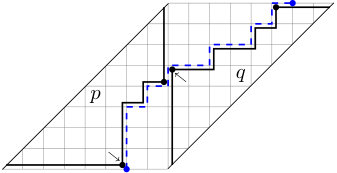 Figure 1
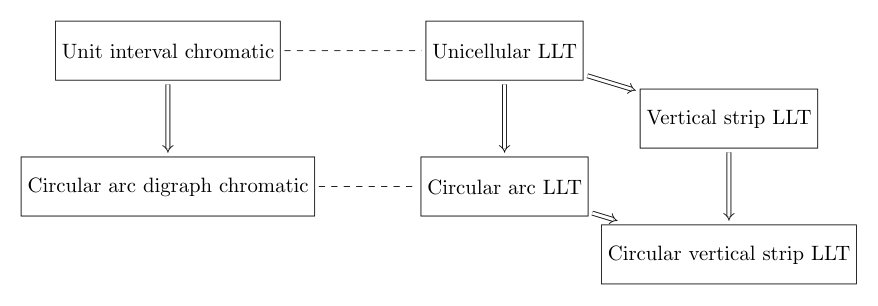 Figure 2
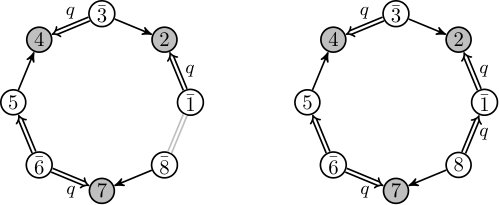 Figure 3
Peer Reviews
No public reviews on file for this paper yet. If you reviewed it on a platform where reviews are public (OpenReview, ICLR, NeurIPS, ICML), you can paste yours below so the community can read it here.
Videos
No videos yet. Explain this paper in a talk, walkthrough, or lecture? Add one.