On the smallest non-trivial quotients of mapping class groups
Dawid Kielak, Emilio Pierro

TL;DR
This paper proves that the smallest non-trivial quotient of the mapping class group for genus at least 3 surfaces is a specific symplectic group, confirming a conjecture and extending previous representation results.
Contribution
It establishes the minimal non-trivial quotient of the mapping class group as a symplectic group and generalizes representation results to any field.
Findings
Confirmed the conjecture that the smallest non-trivial quotient is Sp_{2g}(2)
Extended Korkmaz's results to projective representations over arbitrary fields
Provided new insights into the structure of mapping class groups
Abstract
We prove that the smallest non-trivial quotient of the mapping class group of a connected orientable surface of genus at least 3 without punctures is , thus confirming a conjecture of Zimmermann. In the process, we generalise Korkmaz's results on -linear representations of mapping class groups to projective representations over any field.
Click any figure to enlarge with its caption.
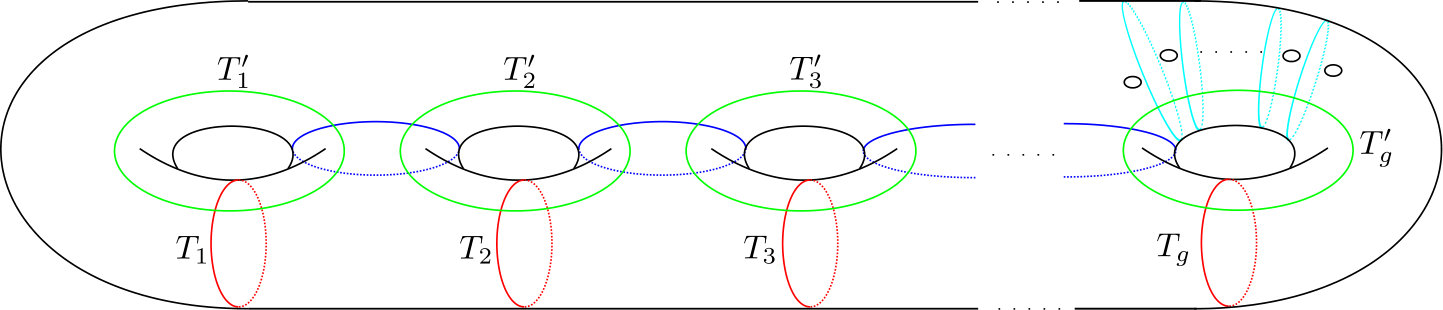 Figure 3
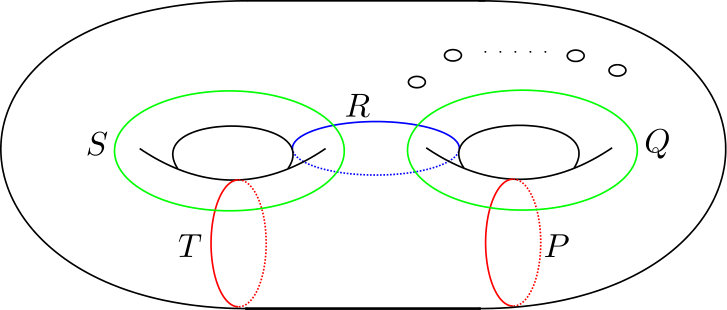 Figure 4
| Classical | |||
|---|---|---|---|
| Type | Conditions | Dimension | isomorphism |
| U | |||
| Order of | |
|---|---|
| 720 | |
| 7920 | |
| 95040 | |
| 175560 | |
| 443520 | |
| 604800 | |
| 1451520 | |
| 10200960 | |
| 44352000 | |
| 50232960 | |
| 244823040 | |
| 898128000 | |
| 4030387200 | |
| 47377612800 | |
| 145926144000 | |
| 448345497600 | |
| 460815505920 | |
| 495766656000 | |
| 42305421312000 | |
| 64561751654400 | |
| 273030912000000 | |
| 24815256521932800 | |
| 51765179004000000 | |
| 90745943887872000 | |
| 4089470473293004800 | |
| 4157776806543360000 | |
| 86775571046077562880 | |
| 208114637736580743168000 | |
| 1255205709190661721292800 | |
| 27930968965434591767112450048000 | |
| 4154781481226426191177580544000000 | |
| 59980383884075203672726385914533642240000 | |
| 2060902435720151186326095525680721766346957783040000 | |
| 808017424794512875886459904961710757005754368000000000 | |
| 1132992015386677099994486205757869431795095310094129168384000000 |
| Simple factors of centralisers of elements of order or | ||||
| Alternating | Lie type | Sporadic | ||
| 4 | , | – | – | |
| 5 | | , , | – | |
| , | , | | ||
| , , | , | – | ||
| – | , , | – | ||
| 6 | – | , , , | | |
| | , , , | , | ||
| – | – | | ||
| 7 | – | , , , , | | |
| 8 | – | , , , | , | |
| 10 | – | – | , , , , | |
Peer Reviews
No public reviews on file for this paper yet. If you reviewed it on a platform where reviews are public (OpenReview, ICLR, NeurIPS, ICML), you can paste yours below so the community can read it here.
Videos
No videos yet. Explain this paper in a talk, walkthrough, or lecture? Add one.
On the smallest non-trivial quotients of mapping class groups
Dawid Kielak and Emilio Pierro
Abstract.
We prove that the smallest non-trivial quotient of the mapping class group of a connected orientable surface of genus without punctures is , thus confirming a conjecture of Zimmermann. In the process, we generalise Korkmaz’s results on -linear representations of mapping class groups to projective representations over any field.
1. Introduction
In [Zim] Zimmermann conjectured that the smallest quotient of the mapping class group of a surface of genus (with ) is , the symplectic group of rank over the field of two elements. Zimmermann proved this statement for . We confirm his conjecture in general, and prove
Theorem 3.18.
Let be a non-trivial finite quotient of , the mapping class group of a connected orientable surface of genus with boundary components. Then either , or and the quotient map is obtained by postcomposing the natural map with an automorphism of .
The natural map is obtained as a sequence of surjections: we start by observing that surjects by [FM, Proposition 3.19 and Theorem 4.6] onto (which we will denote by ) – the surjection is obtained by ‘capping’, that is gluing discs to the boundary components of . The group acts on
[TABLE]
in a way preserving the algebraic intersection number, which is a symplectic form. This leads to a homomorphism
[TABLE]
which is surjective by [FM, Theorem 6.4]. Reducing integers modulo we obtain an epimorphism , and this way we obtain the natural map .
Note that has plenty of finite quotients – Grossman showed in [Gro] that it is residually finite. (In the same paper Grossman showed that is residually finite as well.)
The situation changes when we allow punctures: the mapping class group of a surface with punctures maps onto the symmetric group , and such a quotient can be smaller than . If we however look at a pure mapping class group, our theorem applies, since such a mapping class group can be obtained from by capping the boundary components with punctured discs; the resulting homomorphism is surjective.
When is a closed non-orientable surface of genus , then it contains a subsurface homeomorphic to , and so Theorem 3.18 implies that any finite quotient of is either of cardinality at most , or at least (we are using the fact that Dehn twists along simple non-separating two-sided curves generate an index subgroup of , as shown by Lickorish [Lic]).
Our result coheres nicely with the theorem of Berrick–Gebhardt–Paris [BGP] which states that the smallest non-trivial action of on a set is unique and obtained by mapping onto and taking the smallest permutation representation of the latter group. Let us remark here that the discussion above has a parallel in the setting of automorphisms of free groups: Baumeister together with the authors has shown in [BKP] that the smallest non-abelian quotient of is ; in the same paper it is shown that (for large ) every action of the group of pure automorphisms of on a set of cardinality is trivial, and the smallest known non-trivial action comes from the smallest action of , and is defined on a set of cardinality .
The proof of Theorem 3.18 follows the same general outline as in [BKP]: since is perfect, we know that its smallest non-trivial quotient is simple and non-abelian. We go through the Classification of Finite Simple Groups (CFSG) and exclude all such groups smaller than from the list of potential quotients. The finite simple groups fall into one of the following four families:
- (1)
the cyclic groups of prime order; 2. (2)
the alternating groups , for ; 3. (3)
the finite groups of Lie type; and 4. (4)
the sporadic groups.
For the full statement of the CFSG we refer the reader to [Wil]. For the purpose of this paper, we further divide the finite groups of Lie type into the following two families:
- (C)
the “classical groups”: , , , , and ; and 2. (E)
the “exceptional groups”: , , , , , , , , and .
The cyclic groups are excluded since they are abelian. The alternating groups are easily dealt with using the aforementioned result of Berrick–Gebhardt–Paris (see Theorem 3.7 and the corollary following it).
To deal with the classical groups we investigate the low-dimensional representation theory of . Korkmaz in [Kor2] (see also [FH] by Franks–Handel) showed that every homomorphism has abelian image whenever and (in particular, the image is trivial when ). His method can actually be used to obtain the more general
Theorem 2.7.
Every projective representation of with and in dimension less than is trivial.
Note that the representation theory of mapping class groups is in general poorly understood, even when compared with the representation theory of : it is still an open problem whether mapping class groups are linear; in this context let us mention a result of Button [But], who proved that mapping class groups are not linear over fields of positive characteristic. The groups are not linear over any field, as shown by Formanek–Procesi [FP]. In the setting of mapping class groups there is also no satisfactory counterpart to the result of the first-named author, who in [Kie] classified linear representations of (for and over fields of characteristic not dividing ) in all dimensions below . The best result in this direction is proven by Korkmaz in [Kor3], where he classified all representations of over up to dimension .
Acknowledgements.
The authors are grateful to Barbara Baumeister and Stefan Witzel for helpful conversations.
The first-named author was supported by the DFG Grant KI-1853. The second-named author was supported by the SFB 701 of Bielefeld University.
2. Mapping class groups and their representations
Throughout, we take to be a connected orientable surface of genus with boundary components. We allow boundary components as they accommodate inductive arguments; we do not allow punctures.
We let denote the mapping class group of , that is the group of isotopy classes of orientation preserving homeomorphisms of which preserve each boundary component pointwise. The isotopies are also required to fix the boundary components pointwise.
Figure 2.1 depicts a choice of simple closed curves on (in fact when ); any two of these curves can be permuted by homeomorphisms of . In fact more is true: using the classification of surfaces, we immediately see that any two non-separating simple closed curves in can be mapped to one another using a homeomorphism of .
We let denote the set of Dehn twists along the curves visible in Figure 2.1. The set is a generating set for when ; this and similar facts can easily be found in the book of Farb and Margalit [FM]. We let and denote Dehn twists along the indicated curves. When arguing about representations of , we will repeatedly use the braid relations: for every we have
[TABLE]
Let us record the following classical result – for a discussion on the history of the result, see [FM, Section 5.1]. The formulation we state here is as given by Korkmaz.
Theorem 2.2** ([Kor1, Theorem 5.1] and [Kor2, Theorem 3.4]).**
Let and . The abelianisation of is trivial. When , the abelianisation of is isomorphic to the cyclic group of order , and the derived subgroup of is perfect.
We will now use the method developed by Korkmaz [Kor2] to investigate low-dimensional representations of . Korkmaz originally studied -linear representations, whereas we are interested in projective representations over more general fields.
Proposition 2.3**.**
Let and , and let be a homomorphism. Let and denote two Dehn twists along simple closed non-separating curves intersecting each other in a single point. The following are equivalent:
- (1)
. 2. (2)
* commutes with .* 3. (3)
* factors through the abelianisation of .*
Proof.
(1) (2) This is clear.
(2) (3) Note that is generated by , and we immediately see that commutes with for every : either this is already true in , or we can find a homeomorphism of such that and , and then use the fact that and commute. Therefore, takes any two elements of the generating set to commuting elements in , and so is abelian.
(3) (1) All Dehn twists along simple closed non-separating curves are conjugate in , and hence so are and . If has abelian image then . ∎
Throughout, we use to denote the centraliser of in (where ).
Proposition 2.5**.**
Let . Every projective representation
[TABLE]
with has abelian image.
Proof.
We will proceed identically to [Kor2, Proposition 4.3]. By extending scalars we may assume that is algebraically closed. This allows us to use the Jordan normal form.
Because we are working with projective representations, we need to look at the cases and separately (the case is trivial, since is the trivial group).
Throughout, we will use Dehn twists , and supported on the curves depicted in Figure 2.4. For any of these Dehn twists, say , we denote by some lift of to . Such lifts are unique up to multiplication by a scalar matrix.
In general, our aim is to show that or that commutes with or that commutes with . In either of these cases, we deduce the fact that is abelian from Proposition 2.3.
Assume that . Let us list the three possible Jordan normal forms of (we label the cases using Greek letters):
[TABLE]
where . We fix a basis for so that is precisely as depicted above.
In case we have , and so we are done.
In case consider and . Since commutes with and , we know that and permute the eigenspaces of . But has a unique eigenspace, and so and both preserve this eigenspace, and so are upper-triangular. Since , and are all conjugate, we see that every diagonal entry of and is equal to (we might have to change the lifts and for this). Thus and commute (this follows from the obvious direct calculation).
In case we obtain a homomorphism where the codomain is the group of permutations of the eigenspaces of (note that stands for the cyclic group of order two; this is standard notation in finite groups theory). Using the braid relation we see that the images and coincide.
If is trivial, then and are diagonal (as they preserve the eigenspaces of ), and therefore they commute.
Suppose that is not trivial. Note that this non-trivial permutation is induced by multiplying the eigenvalues of by , where , and . By changing the lift we may assume that
[TABLE]
Now, as , both and must be of the form
[TABLE]
Changing the lifts and so that, in particular, both matrices have determinant (which can be achieved by taking conjugates of ), we may write
[TABLE]
Now and commute. This finishes the case .
Assume that . This case is more involved, since there are six possibilities for the Jordan normal form of . These are as follows:
[TABLE]
where and are pairwise distinct. Again, we pick a basis for so that is as depicted.
Case is very similar to the case above: we have a homomorphism from to the group of permutations of the eigenspaces of . Since these permutations are given by multiplying the eigenvalues of by some , we see that the image of our homomorphisms consists of -cycles only and . Therefore, using the braid relation between and again, we see that and have the same image under this homomorphism.
If then and are diagonal, and hence commute.
If then we may take
[TABLE]
and, without loss of generality,
[TABLE]
where . A direct computation shows that
[TABLE]
Thus, the braid relation between and holds (a priori, it only had to hold up to multiplication by a scalar matrix), and informs us that . Therefore we have
[TABLE]
If then , and so we may apply Proposition 2.3. Otherwise, the eigenspaces of cannot be permuted (as they have different dimensions). Therefore (up to multiplication by a scalar) has to be of the form
[TABLE]
since and commute in . Now, has to permute the eigenspaces of , and so must be diagonal. But then commutes with .
In the cases –, the eigenspaces of , as well as the more general kernels of matrices of the form , cannot be permuted. Thus, every lift of every element commuting in with satisfies in .
Let us now suppose that we are in the case . Here .
Let us consider the case . Since commutes with , and by the remark above, commutes with , and . Thus, (and also ) is of the form
[TABLE]
Since we know the Jordan normal form for (up to scalar multiplication), we see that (up to scalar multiplication again) is of the form
[TABLE]
and the same is true for . It now immediately follows from the obvious calculation that and commute.
In case we argue similarly, and see that and must be upper-triangular. Since these matrices can only have one eigenvalue, we choose the lifts and so that the matrices are unipotent. Thus, the braid relation between and holds, and immediately shows that (via a direct calculation), which finishes this case.
Case is a little more involved, and we have to also use . We choose and in such a way that their only eigenvalue is . If the -eigenspaces of and do not coincide, then and have to be upper triangular (with respect to a suitable basis), since they have to preserve both the -eigenspace of and of . We then argue as in the previous case.
If the -eigenspaces of and coincide, then is of the form
[TABLE]
A direct computation verifies that and commute.
We are left with the case . We start precisely as in case : choose lifts and in such a way that their eigenvalue with -dimensional eigenspace is . If these eigenspaces do not coincide, then and are (after a change of basis of the -eigenspace of ) of the form
[TABLE]
Since preserves the eigenspaces of and , the matrix is also of the form depicted above.
Up to possibly taking different lifts , , and , we know that the diagonal entries are and , in some order. Using the braid relations between the pairs and , we first see that the braid relations hold also for and , and then we see that these diagonal entries appear in the same order in all three matrices , , and .
If the first two entries are both equal to , then it is immediate (as before) that and commute. Otherwise, the fact that and satisfy the braid relation implies that or that satisfies the equation (this follows from directly computing the two sides of the braid relation ). In the latter case, the equation guarantees that the braid relation holds also for the pair . But and commute, and so . Thus commutes with , and we are done by Proposition 2.3.
We are left with the situation in which the -dimensional eigenspaces of and coincide. Then we have of the form
[TABLE]
Now, arguing as above, we see that (in which case we are done), or satisfies the equation . Since the pair can be conjugated in to the pair , the -dimensional eigenspaces of and coincide. Thus, is of same form as (depicted above), and the equation tells us that the braid relation between and holds. But and commute, which forces . This finishes the proof. ∎
Proposition 2.6**.**
Let be a vector space of finite dimension over an algebraically closed field. Let be any matrix. Suppose that does not admit an eigenspace of dimension at least . Then there exist subspaces and of such that all of the following hold:
- (1)
; 2. (2)
the dimensions , and are at most ; 3. (3)
both and are preserved by .
Proof.
Let denote the characteristic polynomial of . For a root of we denote the corresponding eigenspace by .
Suppose that has only one root . If then the kernel of has dimension , and we are done by taking and . Otherwise, we take – recall that that by assumption.
Suppose now that has exactly two distinct roots, and . For concreteness, let us assume that . If then , since by assumption. Therefore we may take .
If then take ; we have , and so the dimensions are as required.
We are left with the possibility that has at least distinct roots, say and . We may take and . ∎
Again, we follow the ideas of Korkmaz and deduce the following.
Theorem 2.7**.**
Every projective representation of with and in dimension less than is trivial.
Proof.
Since we can extend scalars, we may assume that we are working over an algebraically closed field . Let denote the vector space with , and let be a projective representation.
Our proof is an induction on , and a secondary induction on . Note that when then is the trivial group, and the result follows.
To ease notation, set and (see Figure 2.1). Let denote a subsurface of homeomorphic to which intersects the supporting curves of and trivially, but contains the support of the Dehn twists and for . For every we choose a lift of in .
Observe that for every we have with , and being clearly independent of the choice of and . Define by . The commutator relation
[TABLE]
immediately shows that is a homomorphism.
Note that when then is trivial, since in this case is a homomorphism from a perfect group (see Theorem 2.2) to an abelian group. We are however also interested in the case , and so we will need to worry about being non-trivial in the course of the proof.
We start by investigating the eigenspaces of in . Suppose first that does not admit an eigenspace of codimension at least . This immediately implies that , and so we may apply Proposition 2.6 to . In this case, Proposition 2.6 gives us non-trivial subspaces and of of codimension at least . The subspace is preserved by for every , since , as and are conjugate, and so .
When , we apply Proposition 2.5 to the induced projective representations and of . We conclude that these representations have abelian images, and so are trivial when restricted to the derived subgroup of . Hence restricted to this derived subgroup has nilpotent image. But the derived subgroup is perfect by Theorem 2.2, and so is trivial on the derived subgroup of . This implies that (as and are conjugate), and so is trivial by Propositions 2.3 and 2.2.
Now suppose that . The inductive hypothesis tells us that the restricted projective representations , and of are trivial. Hence, restricted to has nilpotent image. But is perfect by Theorem 2.2, and so is trivial on , and hence . But , and the Dehn twists in are pairwise conjugate and generate , and so .
Now suppose that admits an eigenspace of codimension at most . If the codimension is [math], then and we are done by Proposition 2.3. Hence let us suppose that the codimension is equal to . Let denote the eigenspace of codimension for , which exists since and are conjugate.
If , then we put and in the previous argument.
If then we see that is also preserved by , as and are related by the conjugation by . Hence preserves .
Since is of codimension , we can choose a basis for with exactly one vector, say , lying outside of . Since with , we conclude that is trivial. Therefore the eigenspaces of are preserved by \phi\big{(}\operatorname{MCG}(\Gamma)\big{)}.
Suppose that is not central in . Then has some non-trivial proper eigenspace in . Now we can take and in the previous argument.
We are left with the case of being central on . If is central on then we are done by Proposition 2.3. Otherwise, is precisely an eigenspace of . Using an analogous argument we show that it is also an eigenspace of . As an eigenspace of , the subspace is preserved by the image under of all elements in which commute with . But is generated by such elements and , and hence is a projective representation of of smaller dimension than . By induction, is the trivial projective representation. So is , as it is one dimensional. We now finish the argument as before, using that every nilpotent quotient of is trivial as is perfect. ∎
3. Minimal finite quotients of
3.1. Finite groups of Lie type
Here we give an extremely rudimentary introduction to the finite groups of Lie type, restricted almost exclusively to the few facts and statements that we will require. For further details the reader is encouraged to consult the book of Gorenstein–Lyons–Solomon [GLS].
Note that we will denote the cyclic group of prime order by . This is standard notation in finite group theory.
Let be a prime, and a power thereof. The finite groups of Lie type over the field of elements are divided into finite collections (types), each corresponding to a Dynkin diagram or a twisted Dynkin diagram; the types and are called classical, and the types , , , , , , , , and are called exceptional.
As mentioned above, to each type we associate a finite family of finite groups; the members of such a family are called versions. There are two special versions: the universal one, which has the property that it maps homomorphically onto every other version with a central kernel, and the adjoint version, which is the homomorphic image of every other version where the corresponding kernel is again central. The adjoint versions are simple with the following exceptions [CCN*+*, Chapter 3.5]:
[TABLE]
where denotes the quaternion group of order , and denotes the cyclic group of that order. The group contains an index subgroup , known as the Tits group, which is simple. For the purpose of this paper, we treat as a finite group of Lie type.
Each finite group of Lie type has a rank, which is simply the number of vertices of the corresponding Dynkin diagram (or, equivalently, the index appearing as a subscript of the type).
Groups of types and are defined only over fields of order while groups of type are defined only over fields of order . All groups of all other types are defined over all finite fields.
For reference, we also recall the following additional exceptional isomorphisms
[TABLE]
In addition, for all and .
The adjoint version of a classical group over comes with a natural projective module over an algebraically closed field in characteristic ; the dimensions of these modules are taken from [KL, Table 5.4.C] and listed in Table 3.1. Note that these projective modules are irreducible. Table 3.1 lists also the necessary conditions on the ranks for a given type.
The Dynkin diagrams and coincide, and so we do not talk about groups of type . However, when it comes to finding the smallest projective modules, one should consider the adjoint version of as the projective symplectic group , rather then the projective orthogonal group . This technical point will be however of no bearing for us.
A parabolic subgroup of is any subgroup containing a Borel subgroup of , that is the normaliser of a Sylow -subgroup of .
Proposition 3.2** (Jordan decomposition).**
Let be a finite group of Lie type defined over a field of characteristic . For every element we have unique elements , such that
[TABLE]
and the order of is a power of ( is unipotent), and the order of is coprime to ( is semisimple).
In fact, the above works for any element of a finite group, and any prime . We stated it in such a form to emphasise the relation to algebraic groups.
We now look at the first of the two structural results about finite groups of Lie type that we will need.
Theorem 3.3** (Borel–Tits [GLS, Theorem 3.1.3(a)]).**
Let be a finite group of Lie type in characteristic , and let be a non-trivial -subgroup of . Then there exists a proper parabolic subgroup such that lies in the normal -core of , and .
Recall that the normal -core is the maximal normal -subgroup.
Theorem 3.4** (Levi decomposition [GLS, Theorem 2.6.5(e,f,g), Proposition 2.6.2(a,b)]).**
Let be a proper parabolic in a finite group of Lie type in characteristic .
- (1)
Let denote the normal -core of (note that is nilpotent). There exists a subgroup , such that and . 2. (2)
* (the Levi factor) contains a normal subgroup such that is abelian of order coprime to .* 3. (3)
* is isomorphic to a central product of finite groups of Lie type (the simple factors of ) in characteristic such that the sum of the ranks of these groups is lower than the rank of .*
The following is the second structural result that we will need.
Theorem 3.5** ([GLS, Theorem 4.2.2]).**
Let be an adjoint version of a finite group of Lie type defined in characteristic . Let be an element of prime order with , and let denote its centraliser in . Then
- (1)
The group contains a normal subgroup (the connected centraliser), such that is an elementary abelian -group. 2. (2)
The group contains an abelian subgroup (the torus) and a normal subgroup such that . 3. (3)
The group is a central product of subgroups (the Lie factors); each Lie factor is a finite group of Lie type in characteristic . 4. (4)
The sum of the ranks of the Lie factors is bounded above by the rank of .
Remark 3.6*.*
From the aforementioned results in [GLS], and from [DM] and [Shi] we can additionally deduce that
- (1)
the groups of type and are never simple factors of a Levi factor of a proper parabolic subgroup of any group of Lie type; 2. (2)
when is of type , then the simple factors of the Levi factor and the Lie factors are isomorphic to , , or ; and 3. (3)
when is of type , then the simple factors of the Levi factor and the Lie factors are isomorphic to , , and .
3.2. Alternating and classical groups
In this subsection we prove that is the smallest quotient of among the alternating and classical groups; Theorem 3.18 will then follow for sufficiently large . The proof is supported on two pillars: Theorem 2.7 and the following result of Berrick–Gebhardt–Paris:
Theorem 3.7** ([BGP, Theorem 4]).**
Let and . Up to conjugation, the group contains a unique subgroup of index . Also, it does not contain any proper subgroups of smaller index.
Note that we have rephrased the theorem in a way suitable to our needs – in fact Berrick–Gebhardt–Paris prove more, since they also establish the index of the second smallest subgroup, and give lower bounds for the index of the third one.
Corollary 3.8**.**
Let and . Any epimorphism is obtained by postcomposing the natural map with an automorphism of .
Let us remark here that for , the group has trivial outer automorphism group [Wil, Section 3.5.5].
Proof.
Let us start with the natural epimorphism obtained by first gluing discs to the boundary components (‘capping’), then abelianising , and then reducing the entries of matrices modulo . Since has a (maximal) subgroup of index (see [KL, Table 5.2.A]), we conclude that is the unique (up to conjugation) subgroup of of index . Crucially, contains the kernel .
Now let be any epimorphism. By uniqueness, we see that is conjugate to , and so, in particular, contains the normal subgroup of . Therefore is a proper normal subgroup of . But the latter group is simple, and therefore . We conclude that factors through . Since the images of and have equal cardinality, we immediately conclude that is equal to followed by an automorphism of . ∎
Proposition 3.9**.**
For , the smallest non-trivial quotient of among alternating groups and classical groups of Lie type is .
Proof.
Let denote the smallest non-trivial quotient of among the alternating groups and the classical groups of Lie type. Theorem 3.7 tells us that cannot act on fewer than points, and thus if is an alternating group then its rank is bounded below by . But using Stirling’s approximation we see that
[TABLE]
for .
Now let us assume that is an adjoint version of a classical group of Lie type. Combining the assumption that with Theorem 2.7, we conclude that is isomorphic to , , or . But has a subgroup of index (see [KL, Table 5.2.A]), and hence cannot be a quotient of by Theorem 3.7; similarly, has a subgroup of index and thus it is ruled out by the uniqueness part of Theorem 3.7, since is simple and not isomorphic to , and we may argue exactly as in Corollary 3.8. ∎
Remark 3.10*.*
At this point we can already say that for sufficiently large , the smallest non-trivial quotient of is , and the quotient map is obtained by postcomposing the natural map with an automorphism of . For large enough the sporadics are excluded by any one of Theorems 2.7 and 3.7, and the exceptional groups of Lie type are excluded by Theorem 2.7, since the smallest dimension of a non-trivial projective representation of such a group is bounded above by . We also use Corollary 3.8.
3.3. Exceptional groups
To deal with exceptional groups we will develop a technique that applies to all finite groups of Lie type, excluding and . For classical groups it does not however surpass Theorem 2.7 in applicability.
Definition 3.11**.**
Let be a finite group. Given an integer , The -rank of is defined to be the largest integer such that , the -fold direct product of the cyclic group of order , embeds into .
Lemma 3.12**.**
Let be the adjoint version of a group of Lie type over the field of size . Let be an odd prime coprime to . Then the -rank of is bounded above by the rank of .
Proof.
Using [GLS, Theorem 4.10.3b] we see that the -rank of is bounded above by the number , defined to be the multiplicity of the cyclotomic polynomial associated to in the order of thought of as a polynomial in . Here stands for the group of inner diagonal automorphisms of , and is the multiplicative order of modulo .
Note that has the same order as the universal version of , and these orders are given in [GLS, Table 2.2]. They are always of the form
[TABLE]
where is a natural number, is the rank of , and is a root of unity (of order at most ). (Note that, following the convention of [GLS], for Suzuki–Ree groups i.e. types , and , we take the square root of in place of in the above formula.) Given a cyclotomic polynomial , none of the polynomials of the form is divisible by . Thus the multiplicity is bounded above by . ∎
Proposition 3.13**.**
Let and . Let be a homomorphism to a finite group with .
- (1)
Let divide the order of . If the -rank of is less than then some with is central in . 2. (2)
If and the -rank of is less than , then is central in .
Proof.
(1) Let the order of be . Consider
[TABLE]
This is the image in of a group isomorphic to , and so, since the -rank of is less than , for some we have
[TABLE]
with and .
Now consider . Since commutes with every with , we immediately see that commutes with . But then commutes with the image under of every generator of from , and so lies in the centraliser of . Using conjugation, we obtain the same result for , as required.
(2) Suppose that has order . Then using the braid relation
[TABLE]
and noting that also has order as and are conjugate, we conclude that is either trivial, or has order , where .
If then commutes with . Since commutes with all the other generators in , it is immediate that is central.
If has order , then consider
[TABLE]
where has order for each . Using the assumption on the -rank of , and the fact that is prime, without loss of generality we have
[TABLE]
with . Similarly as before, we conclude that commutes with . But , and commutes with itself, and so commutes with and we are done as before. ∎
Corollary 3.14**.**
Let and . Let be a finite non-trivial group with trivial centre and with -rank less than for every . Then is not a quotient of .
Proof.
Suppose that is a quotient map. Since is non-trivial and has trivial centre, we have by Proposition 2.3, and we also see that cannot be central in . Therefore, by Proposition 3.13(1), the order of is . But this contradicts Proposition 3.13(2). ∎
Theorem 3.15**.**
Let . Let and be a version of a group of Lie type of rank less than , or let and be a version of a group of Lie type of rank less than with the exception of and . Then every homomorphism is trivial.
Proof.
Let denote such a homomorphism. The proof is an induction on . Since is perfect we may assume that is the adjoint version.
For the base case we use Theorem 2.7: it immediately deals with the cases , and . It actually also rules out the case , since the adjoint version of this type has a faithful projective representation in dimension .
Suppose that . Let . Let us look at the Jordan decomposition , where is the unipotent part and the semi-simple part. Let us first assume that . Since the Jordan decomposition is unique, \phi\big{(}C_{\operatorname{MCG}(\Sigma_{{g},{b}})}(T_{1})\big{)} commutes with , and therefore, by Theorem 3.3, there exists a proper parabolic subgroup containing . Using Theorem 3.4 (and its notation) we see that the parabolic subgroup contains a nilpotent normal subgroup such that . Note that we have an epimorphism obtained by identifying two boundary components of and declaring the newly obtained simple closed curve to be the curve underlying (it is easy to see that this is an epimorphism; alternatively, see [AS, Section 2.3]). Let
[TABLE]
denote the homomorphism obtained by composing the above map with the restriction of . The Levi factor contains a normal subgroup such that is abelian. The group is perfect, and therefore . The group is a central product of finite groups of Lie type whose rank is strictly smaller than the rank of . The inductive hypothesis tells us that is trivial. Therefore \phi\big{(}C_{\operatorname{MCG}(\Sigma_{{g},{b}})}(T_{1})\big{)} is trivial as is nilpotent and is perfect. Thus is the trivial homomorphism, as contains , and all generators in are conjugate.
Note that the exclusion of and for is not a problem for the induction, since these groups do not appear as proper parabolic subgroups.
Now suppose that . We may assume that , as otherwise we have which trivialises . Pick so that is of prime order in . Note that does not divide the characteristic of the ground field of , and so by Lemmata 3.12 and 3.13 we see that centralises .
Let denote the centraliser of in . We apply Theorem 3.5, and use the notation thereof. The centraliser contains a normal subgroup such is abelian. But is perfect (as ), and so . Now is abelian, and so again we see that . Now we need to consider two cases: either each of the Lie factors has rank strictly smaller than , or there is only one such factor of rank equal to . In the former case we apply the inductive hypothesis to followed by a projection for each , and conclude that is trivial. In the latter case we are satisfied with the conclusion that , since , and so is of smaller cardinality than , as has no centre. We now run a secondary induction on the order of . Again, the exclusion of and is not a problem, since it occurs only for . ∎
Remark 3.16*.*
In fact the above proof also shows that if is of type or then every homomorphism is trivial for every and . The reason for this is that the simple factors of the Levi factor of any proper parabolic subgroup of or the Lie factors of centralisers of semi-simple elements are of type , , or , and so all of rank at most .
Corollary 3.17**.**
None of the groups of exceptional type is the smallest quotient of some with , .
Proof.
Let be a finite exceptional group of Lie type. Since is perfect, we need only consider the adjoint versions. Theorem 3.15 tells us that cannot be a quotient of unless is bounded above by the rank of , or unless and is the adjoint version of or . The types and are excluded by 3.16.
A direct computation of orders (see [GLS, Table 2.2]) tells us that
- (1)
2. (2)
3. (3)
4. (4)
5. (5)
and this concludes the proof, since the smallest member of each of the families except and is the group defined over the field of elements. For , the smallest simple member of the family is ; for , the smallest simple member of the family is . ∎
3.4. Sporadic groups
In this section we prove the main result.
Theorem 3.18**.**
Let be a non-trivial finite quotient of , the mapping class group of a connected orientable surface of genus with boundary components. Then either , or and the quotient map is obtained by postcomposing the natural map with an automorphism of .
Proof.
Without loss of generality, we may take to be a smallest quotient of . Corollary 3.17 tells us that is not an exceptional group of Lie type, and by Proposition 3.9 we see that we need only rule out the sporadic groups.
We will go through the list of sporadic groups in order of increasing cardinality (see Table 3.19). Considering a group , we define to be the smallest such that . Our aim is to show that is not the quotient of any with .
Suppose that we have achieved our goal for all groups smaller than . If we show that is not a quotient of for any , then we can also conclude that it is not a quotient of any with : suppose that is a quotient of such a . We have a homomorphism , and its image in is a subgroup of , and hence either itself, which is impossible, or a proper subgroup of . But this is also impossible, since we have shown that groups smaller than cannot be quotients of .
Let us now start going through the list, and suppose that we consider a group ; at this point we already know that all non-trivial groups smaller that are never quotients of . Thus, when looking at , we may use the assumption that all homomorphisms from to groups smaller than are trivial.
We start by invoking Corollary 3.14, and identify those groups whose -rank, where is equal to or an odd prime, is less than (this is equivalent to having all -ranks less than for all ). The prime ranks of sporadic groups are known and listed in [GLS, Table 5.6.1]; it turns out that for the ranks are always bounded above by . If the -rank or the -rank of is at least , then is listed in Table 3.20. (The -rank was computed using GAP [GAP] – because of the complexity of the problem of determining the -rank, we have only computed it for some sporadic groups. Thus the list may contain groups whose - and -ranks are in fact smaller than . It may also contain traces of nuts.) At this point we already know that the remaining sporadic groups are not the smallest quotients of .
Suppose that is one of the groups in Table 3.20, and let
[TABLE]
denote the putative quotient map. We may assume that is not trivial and of order divisible only by and (the latter assumption is justified by Proposition 3.13). Thus some power of will have order exactly or , and the centraliser of in is an epimorphic image of . Thus, if we know that every homomorphism from to any simple non-abelian factor of a centraliser of an element of order or in is trivial, then we may conclude that is trivial.
For the remaining sporadic groups, Table 3.20 lists the non-abelian simple factors of centralisers of elements of order or (the information is taken from [GLS, Table 5.3]). (To simplify the notation, in the sequel we use type to denote the corresponding adjoint version.)
Every homomorphism from with to any of the alternating groups visible in the table is trivial, since by Theorem 3.7 the smallest alternating group to which can map non-trivially has rank .
All the groups of Lie type occurring as simple factors are eliminated by Theorem 3.15, with the the exception of inside ; this group is eliminated by Theorem 2.7.
The last column of Table 3.20 lists the remaining sporadic simple factors. Each of these is too small to allow for a non-trivial homomorphism from the relevant . ∎
The reference list from the paper itself. Each links out to its DOI / PubMed record.
- 1[AS] Javier Aramayona and Juan Souto. Homomorphisms between mapping class groups. Geom. Topol. 16 (2012), 2285–2341.
- 2[BKP] Barbara Baumeister, Dawid Kielak, and Emilio Pierro. On the smallest non-abelian quotient of Aut ( F n ) Aut subscript 𝐹 𝑛 \mathrm{Aut}(F_{n}) . ar Xiv:1705.02885 .
- 3[BGP] A. J. Berrick, V. Gebhardt, and L. Paris. Finite index subgroups of mapping class groups. Proc. Lond. Math. Soc. (3) 108 (2014), 575–599.
- 4[But] J.O. Button. Mapping class groups are not linear in positive characteristic. ar Xiv:1610.08464 .
- 5[CCN + ] J. H. Conway, R. T. Curtis, S. P. Norton, R. A. Parker, and R. A. Wilson. An Atlas of finite groups . Oxford University Press, Eynsham, 1985.
- 6[DM] D. I. Deriziotis and G. O. Michler. Character table and blocks of finite simple triality groups D 4 3 ( q ) superscript subscript 𝐷 4 3 𝑞 {}^{3}D_{4}(q) . Trans. Amer. Math. Soc. 303 (1987), 39–70.
- 7[FM] Benson Farb and Dan Margalit. A primer on mapping class groups , volume 49 of Princeton Mathematical Series . Princeton University Press, Princeton, NJ, 2012.
- 8[FP] Edward Formanek and Claudio Procesi. The automorphism group of a free group is not linear. J. Algebra 149 (1992), 494–499.