Convergence from Divergence
Ovidiu Costin, Gerald V. Dunne

TL;DR
This paper introduces a method to transform divergent series common in physics into rapidly convergent inverse factorial series, enabling rigorous extrapolation across different parameter regimes and connecting to existing summation techniques.
Contribution
The authors develop a novel resummation technique converting divergent series into convergent inverse factorial series, enhancing the analysis of asymptotic expansions in physics.
Findings
Convergent inverse factorial series can replace divergent perturbative series.
The method allows rigorous extrapolation from large to small parameters.
Connections to Borel summation and the Stokes phenomenon are established.
Abstract
We show how to convert divergent series, which typically occur in many applications in physics, into rapidly convergent inverse factorial series. This can be interpreted physically as a novel resummation of perturbative series. Being convergent, these new series allow rigorous extrapolation from an asymptotic region with a large parameter, to the opposite region where the parameter is small. We illustrate the method with various physical examples, and discuss how these convergent series relate to standard methods such as Borel summation, and also how they incorporate the physical Stokes phenomenon. We comment on the relation of these results to Dyson's physical argument for the divergence of perturbation theory. This approach also leads naturally to a wide class of relations between bosonic and fermionic partition functions, and Klein-Gordon and Dirac determinants.
Click any figure to enlarge with its caption.
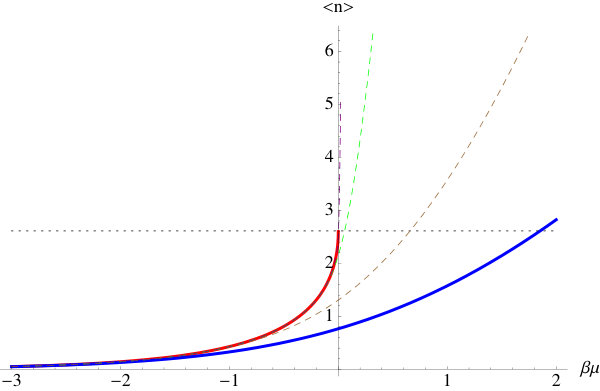 Figure 3
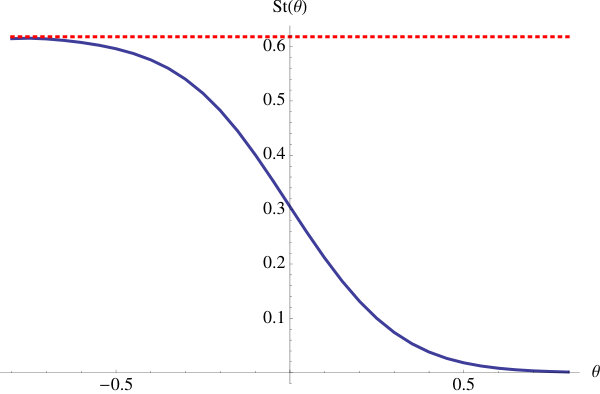 Figure 4
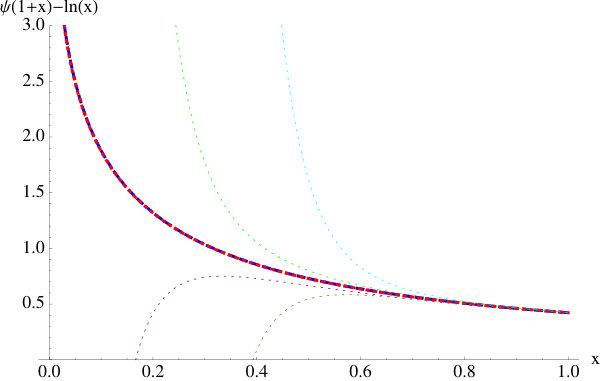 Figure 1
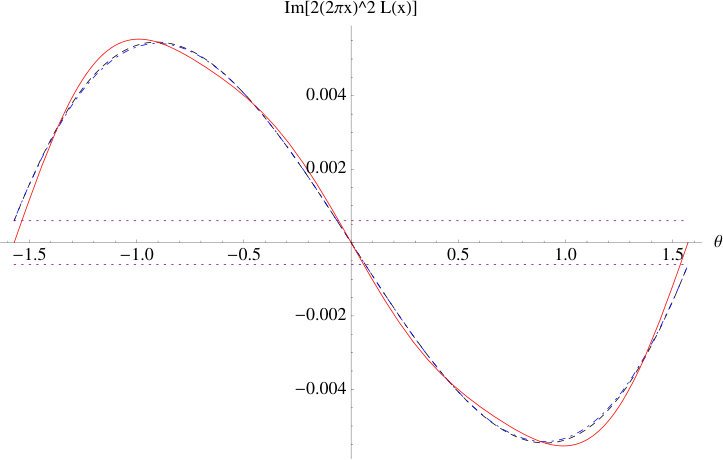 Figure 2
Peer Reviews
No public reviews on file for this paper yet. If you reviewed it on a platform where reviews are public (OpenReview, ICLR, NeurIPS, ICML), you can paste yours below so the community can read it here.
Videos
No videos yet. Explain this paper in a talk, walkthrough, or lecture? Add one.
Convergence from Divergence
Ovidiu Costin1 and Gerald V. Dunne2
1 Department of Mathematics, The Ohio State University, Columbus, OH 43210
2Department of Physics, University of Connecticut, Storrs, CT 06269
Abstract
We show how to convert divergent series, which typically occur in many applications in physics, into rapidly convergent inverse factorial series. This can be interpreted physically as a novel resummation of perturbative series. Being convergent, these new series allow rigorous extrapolation from an asymptotic region with a large parameter, to the opposite region where the parameter is small. We illustrate the method with various physical examples, and discuss how these convergent series relate to standard methods such as Borel summation, and also how they incorporate the physical Stokes phenomenon. We comment on the relation of these results to Dyson’s physical argument for the divergence of perturbation theory. This approach also leads naturally to a wide class of relations between bosonic and fermionic partition functions, and Klein-Gordon and Dirac determinants.
Physics often requires approximation in the form of an expansion in which a physical parameter becomes large or small compared to other scales. This is a generic feature of perturbation theory, and much physical information is encoded in the relation between the characteristic divergence of perturbation theory and non-perturbative physics LeGuillou:1990nq ; carlbook . It is less well-known that divergent series can readily be converted to convergent expressions, such as continued fractions or inverse factorial series watson ; norlund ; wall . For example, a series in inverse powers of a large parameter may be re-written as a series in inverse Pochhammer symbols, :
[TABLE]
where are Stirling numbers of the first kind nist . This can be viewed as a resummation of the series expansion, and often this resummed series converges, even if the original series diverges watson . Unfortunately, convergence is typically slow, and such series are not accurate near a Stokes line, so they have found somewhat limited use in applications weniger . Here we describe physical applications of a new form of inverse factorial series costins which is both rapidly convergent and valid near a Stokes line.
To illustrate the basic idea, consider the digamma function, , which occurs frequently in physics. This has a well-known asymptotic expansion for large argument nist , which can be converted to a slowly convergent inverse factorial series using (1). Instead, consider the integral representation
[TABLE]
The remarkable ”dyadic identity” (for all )
[TABLE]
and successive integrations by parts 111An efficient method is the Horn expansion norlund : given a Borel integral , change variables to , so that , where . Then integrating by parts successively one finds the inverse factorial series expansion: , with coefficients expressed in terms of derivatives of evaluated at . Even when these coefficients cannot be found in closed form it is a simple matter to construct a table of coefficients. leads to a “dyadic” inverse factorial series expansion
[TABLE]
in which the large parameter is rescaled by factors of . This expansion has the dual advantage of being rapidly convergent, and also having the correct Stokes jump as the phase of is rotated. In fact, it gives a global representation valid everywhere in the cut plane. Fig. 1 shows the convergence even at extremely small values of , contrasted with the truncated asymptotic expansions.
This example generalizes to the physical example of the one-loop Euler-Heisenberg (EH) effective Lagrangian eh ; schwinger , which encodes vacuum polarization effects in quantum electrodynamics (QED). (In fact the EH effective Lagrangian can be expressed in terms of the log of the Barnes gamma function, which involves an integral of the log gamma function dunne , so these examples are closely related.) In the weak field limit the exact (Borel) integral representation of the EH effective Lagrangian is expanded as a divergent series:
[TABLE]
Here , with and the electron mass and charge, and the external magnetic field strength. But , so
[TABLE]
This generates a new inverse factorial expansion, with the asymptotic parameter effectively rescaled by for each term in the sum. A convergent dyadic expansion of (7) is obtained by systematically removing the “instanton pole” terms from the integrand, and matching near 222This yields an approximation of the form: .. The resulting dyadic weak-field expansion behaves very much like the digamma example plotted in Fig. 1. The imaginary part is more interesting, and is shown in Fig. 2. Fig. 2 shows that when the phase of the magnetic field is rotated, to become an electric field () 333For a constant background field which is either magnetic or electric, the only Lorentz invariant quantity is , so converts from a background magnetic field to a background electric field., the dyadic factorial series encodes the correct imaginary non-perturbative contribution which is associated with the genuine physical process of particle production from the QED vacuum:
[TABLE]
At first sight, this result appears to be in conflict with Dyson’s physical argument Dyson:1952tj that QED perturbation theory (as an expansion in the fine structure constant ) should be divergent, because if it were convergent it would not be able to describe the expected physical instability as the phase of is changed from [math] to . In mathematical terms, Dyson’s argument is that a convergent series in cannot describe a non-perturbative Stokes jump. The resolution of this apparent contradiction is that Dyson’s argument refers to a series expansion in powers of , whereas the above examples show clearly that a dyadic factorial series correctly describes this non-perturbative effect, even though the dyadic factorial series is convergent. The key fact is that the inverse Pochhammer symbols of the dyadic factorial expansion encode the proper analytic continuation properties, while the powers of the divergent expansion do not, even when truncated at optimal order.
In these two examples, the integral representations (2) and (5) are in Borel form, with Borel transforms having an infinite sequence of equally spaced poles on the imaginary axis. Physically, the sum over poles in (5) becomes an instanton sum when the phase of rotates by . But note that the poles in (5) are at integer multiples of , while those of (7) are at half-odd-integer multiples of . This is because before rescaling by we have used the fact that every integer can be expressed as a half-odd-integer times a power , exactly once 444This interpretation also leads to generalizations from “dyadic” to “n-adic” inverse factorial series expansions, with even faster convergence, if desired.. Thus the dyadic expansion, which is a resummation of standard perturbation theory, also produces a nontrivial rearrangement of the non-perturbative instanton sum.
More general physical problems (e.g., for special functions such as Bessel functions or Painlevé functions [see below], or in quantum mechanics, quantum field theory and matrix models LeGuillou:1990nq ; carlbook ; costinbook ; marino ) involve Borel transforms with cuts in the Borel plane. For these we use a generalized dyadic identity in terms of polylog functions (written here for and 555The analytic continuation properties are given by properties of the polylog functions. An alternative representation is .):
[TABLE]
Note that (3) is obtained for . Mathematically, the dyadic identities (3, 9) have a natural interpretation in terms of Umbral Calculus rota , as geometric Riemann sum approximations to the “proper-time” integral:
[TABLE]
The identity (3) can also be interpreted as expressing the Bose-Einstein distribution as a classical term minus a series of Fermi-Dirac distributions with rescaled temperature. This has numerous thermodynamic consequences. For e.g., thermodynamic quantities for non-relativistic Bose (+) or Fermi (-) ideal gases are expressed in terms of polylog functions pathria ; dingle (here is the inverse temperature, the chemical potential, and is related to the spatial dimension and the particular physical quantity):
[TABLE]
The number densities in 3 dimensions are: , and . Iterating the polylog duplication relation, , we learn that the bosonic and fermionic densities are related as (see Fig. 3):
[TABLE]
Similarly, for relativistic ideal gases, thermodynamic quantities are expressed in terms of the functions
[TABLE]
The dyadic identity (3) implies, for example for :
[TABLE]
(Higher values of the index can be reached by taking derivatives with respect to and .) These expressions naturally isolate the non-analytic term for bosons, whose physical importance for Bose-Einstein condensation has been emphasized in haber . These Bose-Fermi relations can also be understood at the level of the partition function using the novel logarithmic identity (obtained from (9) by differentiating wrt at ):
[TABLE]
The dyadic identities (3, 9, 15) have interesting implications for trans-series expansions costinbook ; Aniceto:2013fka , wherein a function is expanded in terms of powers (and possibly iterations) of three basic “trans-monomial” objects: , , and . These are asymptotically independent functions. However, (3, 9, 15) show that powers of and logarithms of can indeed be expressed in terms of exponentials, but it requires an infinite number of different exponentials. The logarithmic expression (15) has potential applications for the computation of entropy, partition functions and effective actions, as an alternative representation of the logarithm compared to conventional proper-time or replica methods.
For example, the effective actions for bosonic or fermionic fields on the hyperbolic manifold are basic building blocks for studying strong-coupling expansions of one-loop corrections for Wilson loop minimal surfaces in (see, e.g., forini ). They can be expressed as:
[TABLE]
where is the volume of forini . The dyadic identities, combined with an integral representation of , imply another identity
[TABLE]
Therefore, the effective actions are related as:
[TABLE]
implying relations for the strong-coupling expansions.
So far, we have described examples where an explicit Borel representation is known analytically. However, the convergent dyadic series are also numerically useful when no such explicit Borel transform is known. To illustrate this approach, consider the asymptotic expansion of the solution of the first Painlevé equation (). The Painlevé equations have numerous applications in physics, including random matrix theory, fluid mechanics, statistical physics, matrix models, and 2d quantum gravity LeGuillou:1990nq ; carlbook ; clarkson ; ising ; tracy-widom ; forrester ; marino ; DiFrancesco:1993cyw . The standard form of , , can be converted to Boutroux-like form,
[TABLE]
more suitable for asymptotic analysis, by defining , where is the natural variable in terms of which the trans-series representation is costinbook ; Garoufalidis:2010ya ; costin-huang-tanveer :
[TABLE]
The sum over is an “instanton sum” with exponentially small “instanton” factors , where is a trans-series parameter, and represents the fluctuations about the -instanton term. It is straightforward to generate many terms in these fluctuation expansions, each of which is a divergent series. We can convert the trans-series expression (19) into a unique global convergent dyadic inverse factorial expansion by the following procedure toappear : (i) From the large-order behavior of the expansion coefficients we learn that the associated Borel transform has two square root branch cuts along the real axis, from and ; (ii) For each instanton sector, use the conformal map to map the Borel transform of to the unit disc, then re-expand about , and re-express in terms of using the inverse map . This procedure yields an optimal and global representation of the Borel transform in the doubly-cut plane; (iii) Use the Cauchy kernel, and the resurgent properties of the trans-series to express the necessary Laplace transforms as integrals wrapped around the cuts. This step is efficiently done numerically by rotating the cuts to vertical lines emanating from the branch points at integer values of ; (iv) Convert the resulting asymptotic expansions to dyadic expansions using the dyadic identity (3). Note that (3) can clearly be generalized by shifting and rescaling, , and there is in fact a unique optimal choice of for each instanton series. The output of these algorithmic steps is a unique, global and convergent representation of the function in the appropriate sector of the physical plane. As an illustration see Fig. 4, which shows the smoothed Stokes jump berry ; costin-kruskal in the (convergent) dyadic expansion, as the phase of is varied across the Stokes line: the jump is equal to the magnitude of the Stokes constant . We can also extend the analysis, which began in the asymptotic large regime, to very small values of , and the convergence of the dyadic expansions provides a new simple proof of the Dubrovin conjecture dubrovin ; costin-huang-tanveer concerning the analyticity of tritronquée solutions to Painlevé-I.
We have illustrated this numerical procedure with Painlevé-I, but it is very general, and can be applied systematically to a wide variety of physical problems for which it is possible to generate asymptotic expansions toappear . A novelty of this approach is that it is constructive, producing a provably convergent and unique expression which still correctly encodes the important non-perturbative physics of the Stokes phenomenon. Furthermore, since these new series are convergent, we may rigorously extrapolate from an asymptotic region with a large parameter to the opposite region of small parameter. This method is therefore ideally adapted to the study of dualities, and general relations between weak-coupling and strong-coupling. The numerical procedure also provides a new way to evaluate Stokes constants with extremely high precision.
This material is based upon work supported by the U.S. Department of Energy, Office of Science, Office of High Energy Physics under Award Number DE-SC0010339 (GD), and by the National Science Foundation under Award Number DMS 1515755 (OC).
The reference list from the paper itself. Each links out to its DOI / PubMed record.
- 1(1) J. C. Le Guillou and J. Zinn-Justin, Large order behavior of perturbation theory , (North-Holland, 1990).
- 2(2) C. M. Bender and S. A. Orszag, Advanced Mathematical Methods for Scientists and Engineers: Asymptotic Methods and Perturbation Theory , (Springer, 1999).
- 3(3) H. S. Wall, Analytic Theory of Continued Fractions , (American Mathematical Society, 1948).
- 4(4) G. N. Watson, “The transformation of an asymptotic series into a convergent series of inverse factorials”, Rend. Circolo Mat. Palermo 34 , 41-88 (1912).
- 5(5) N. E. Nörlund, Lecons sur les séries d’interpolation , (Gauthier-Villars, 1926).
- 6(6) NIST Digital Library of Mathematical Functions, http://dlmf.nist.gov/ .
- 7(7) E. J. Weniger, “Summation of divergent series by means of factorial series”, Appl. Numer. Math. 60 , 1429-1441 (2010).
- 8(8) O. Costin and R. D. Costin, “A new type of factorial series expansion and applications”, ar Xiv:1608.01010 .