SU(4) flavor symmetry breaking in D-meson couplings to light hadrons
C.E. Fontoura, J. Haidenbauer, G. Krein

TL;DR
This paper investigates the extent of SU(4) flavor symmetry breaking in D-meson couplings to light hadrons using quark models, revealing significant symmetry breaking that impacts D-meson interactions and bound state predictions.
Contribution
The study quantifies SU(4) flavor symmetry breaking in D-meson couplings using quark models, providing new insights into the magnitude of symmetry violation.
Findings
SU(4) symmetry broken by about 30% in D-meson couplings
20% symmetry breaking in baryon-baryon-meson couplings
Implications for D-meson interactions and bound states in nuclei
Abstract
The validity of SU(4)-flavor symmetry relations of couplings of charmed mesons to light mesons and baryons is examined with the use of quark-pair creation model and nonrelativistic quark model wave functions. We focus on the three-meson couplings , and and baryon-baryon-meson couplings , and . It is found that SU(4)-flavor symmetry is broken at the level of 30% in the tree-meson couplings and 20% in the baryon-baryon-meson couplings. Consequences of these findings for DN cross sections and existence of bound states D-mesons in nuclei are discussed.
Click any figure to enlarge with its caption.
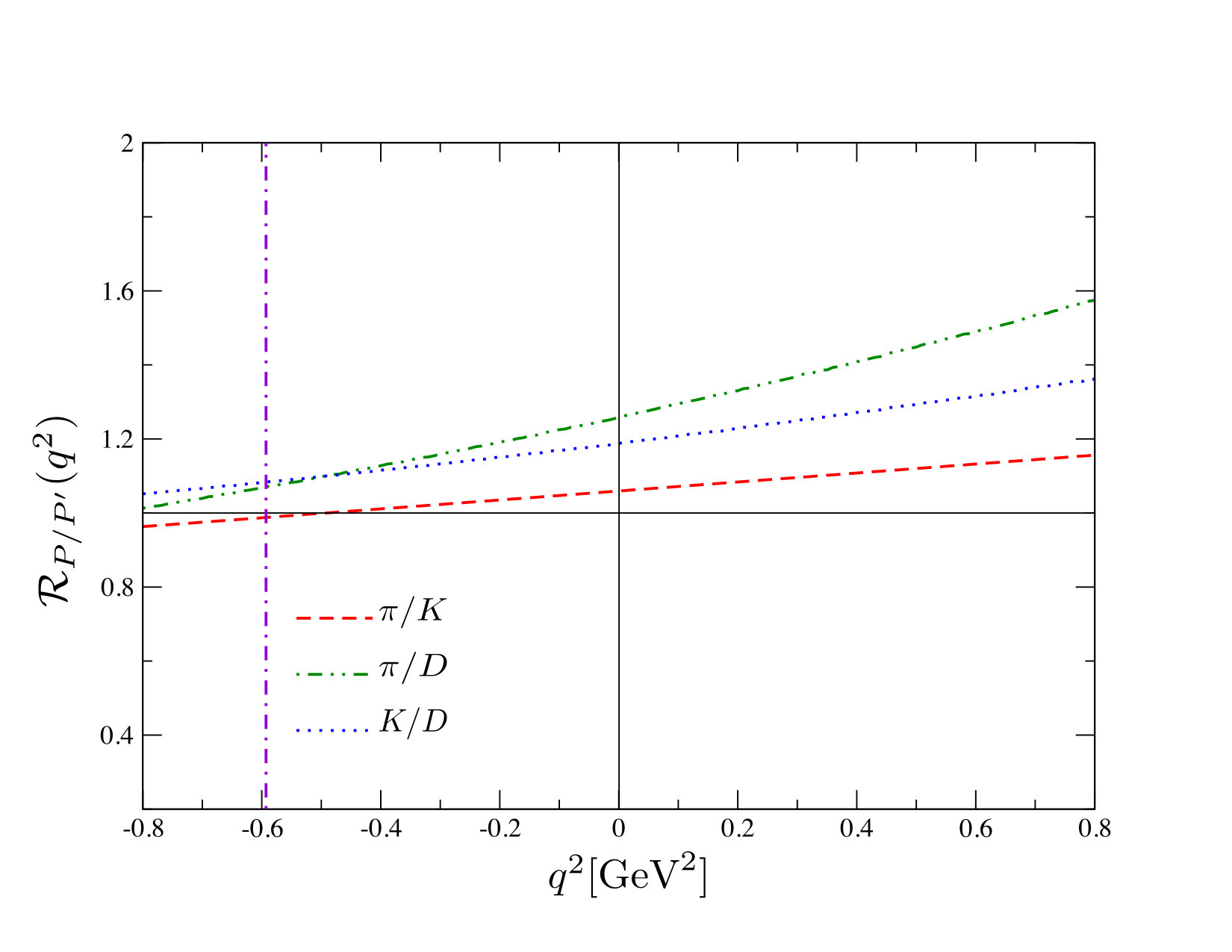 Figure 1
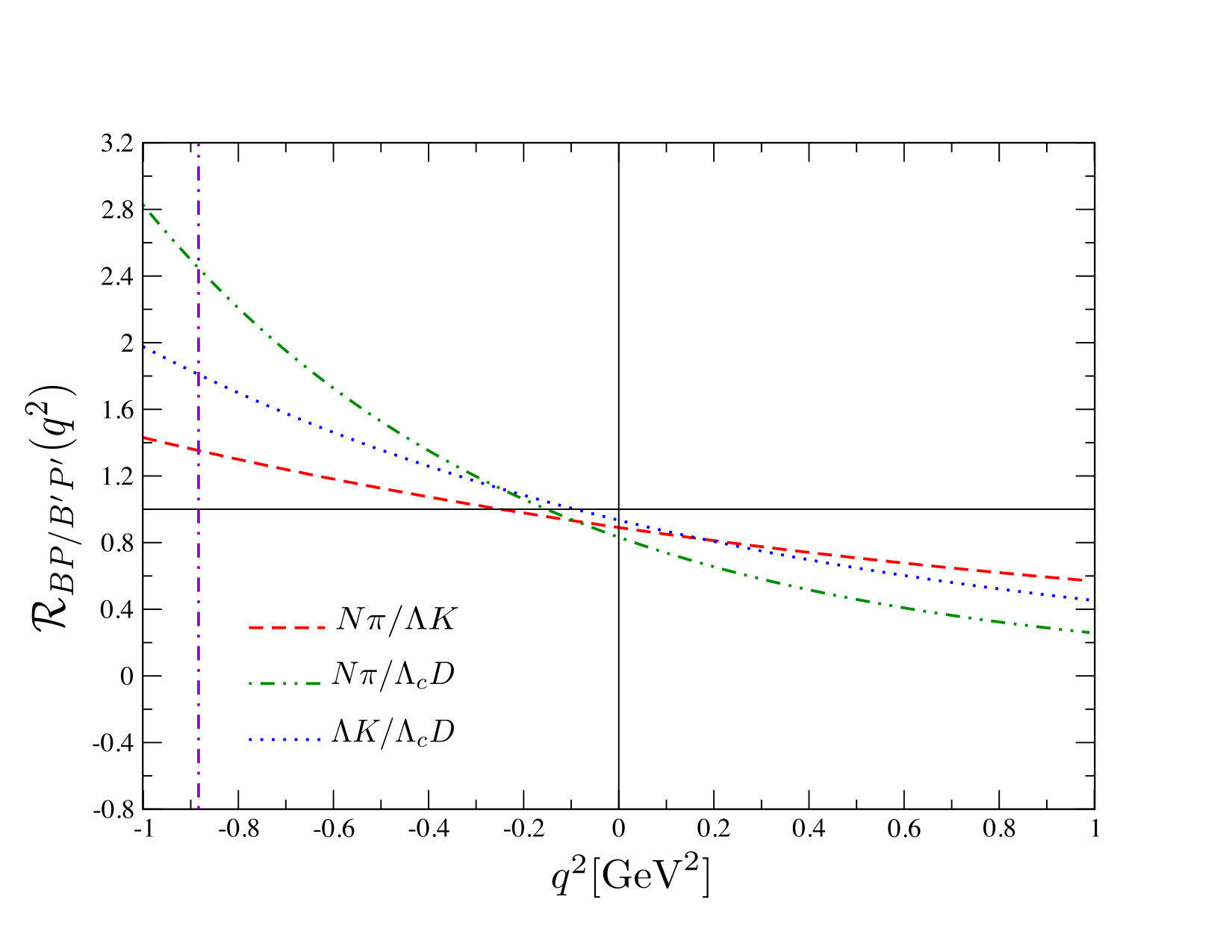 Figure 2
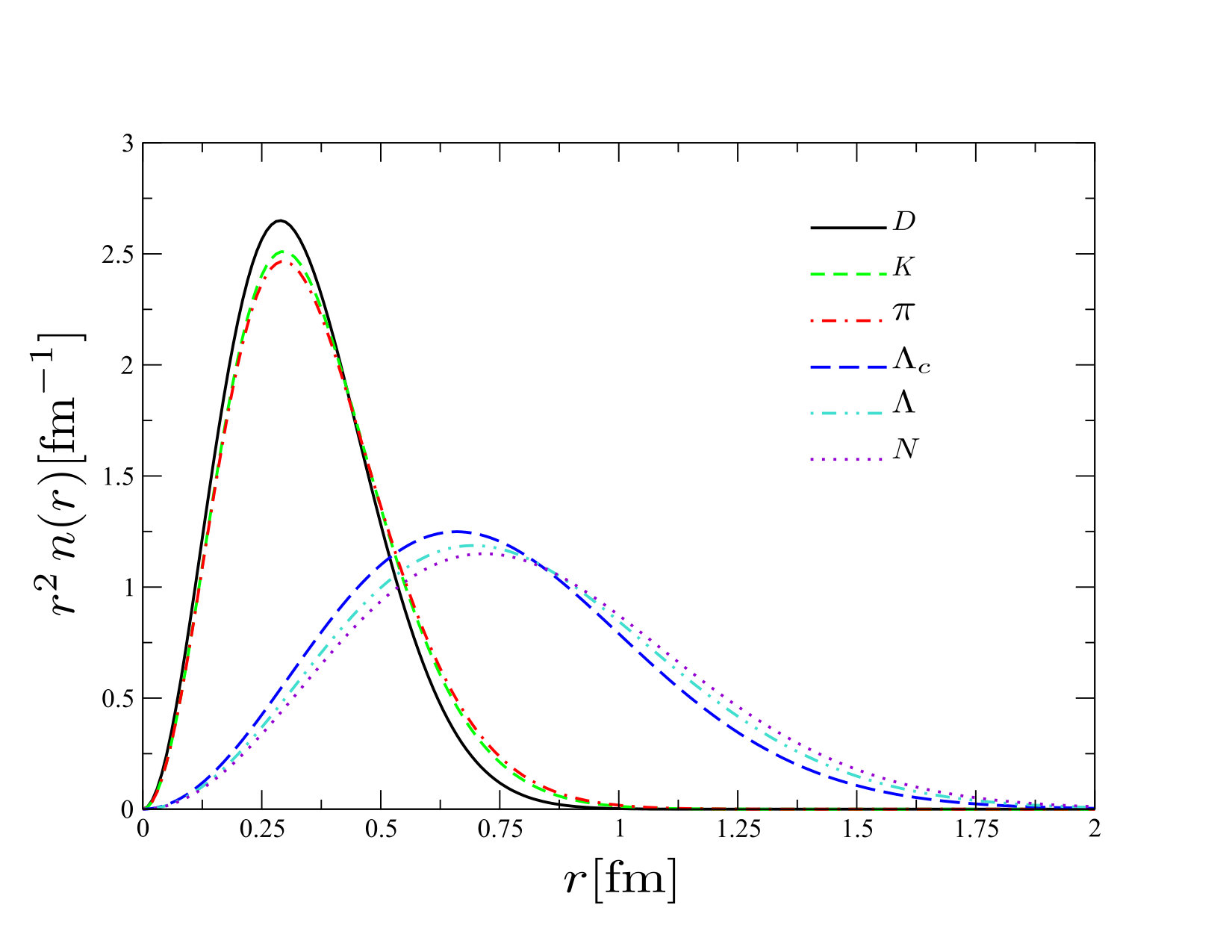 Figure 3
| 138 | 495 | 1866 | 770 | 958 | 1115 | 2195 | |
| 138 | 495 | 1866 | 770 | 940 | 1115 | 2286 | |
| 359 | 377 | 499 | 275 | 234 | 241 | 253 |
| 1.05 | 1.26 | 1.19 | |
| 0.99 | 1.07 | 1.08 | |
| Ref. ElBennich:2011py | 1.09 | 0.21 | 0.19 |
| Ref. Ballon-Bayona:2017bwk | 1.11 | 2.23 | 2.00 |
| 0.89 | 0.83 | 0.92 | |
| Ref. lc-sr | — | — | 0.68 |
Peer Reviews
No public reviews on file for this paper yet. If you reviewed it on a platform where reviews are public (OpenReview, ICLR, NeurIPS, ICML), you can paste yours below so the community can read it here.
Videos
No videos yet. Explain this paper in a talk, walkthrough, or lecture? Add one.
11institutetext: Instituto Tecnológico da Aeronáutica, DCTA, 12228-900 São José dos Campos, SP, Brazil 22institutetext: Instituto de Física Teórica, Universidade Estadual Paulista, 01140-070 São Paulo, SP, Brazil 33institutetext: Institute for Advanced Simulation, Institut für Kernphysik, and Jülich Center for Hadron Physics
Forschungszentrum Jülich, D-52425 Jülich, Germany
SU(4) flavor symmetry breaking in D-meson couplings to light hadrons
C.E. Fontoura 1122
J. Haidenbauer 33
G. Krein 22
(Received: date / Revised version: date)
Abstract
The validity of SU(4)-flavor symmetry relations of couplings of charmed mesons to light mesons and baryons is examined with the use of quark-pair creation model and nonrelativistic quark model wave functions. We focus on the three-meson couplings , and and baryon-baryon-meson couplings , and . It is found that SU(4)-flavor symmetry is broken at the level of 30% in the tree-meson couplings and 20% in the baryon-baryon-meson couplings. Consequences of these findings for DN cross sections and existence of bound states D-mesons in nuclei are discussed.
pacs:
14.40.LbCharmed mesons and 14.20.LqCharmed baryons and 12.39.FeChiral Lagrangians and 12.39.JhNonrelativistic quark model and 12.40.-y Other models for strong interactions
Introduction. Currently there is considerable interest in exploring the interactions of charmed hadrons with light hadrons and atomic nuclei Briceno:2015rlt . Particular attention is paid to mesons, much discussed over the last few years in connection with -mesic nuclei Tsushima:1998ru ; GarciaRecio:2010vt ; GarciaRecio:2011xt and binding to nuclei Ko:2000jx ; Krein:2010vp . Presently, there is no experimental information about the interaction, a situation that the ANDA@FAIR experiment Wiedner:2011mf could remedy in the future. Most of the knowledge on the interaction comes from calculations using hadronic Lagrangians motivated by SU(4) extensions of light-flavor chiral Lagrangians Mizutani:2006vq ; Lin:1999ve ; Hofmann:2005sw ; Haidenbauer:2007jq ; Haidenbauer:2008ff ; Haidenbauer:2010ch ; Fontoura:2012mz and heavy quark symmetry Yasui:2009bz ; GarciaRecio:2008dp . These require as input coupling constants and, in some cases, form factors. For the particular case of reactions (where ), Ref. Haidenbauer:2007jq found that among all the couplings in the effective Lagrangian, and provide the largest contributions to cross sections and phase shifts for kinetic center of mass (c.m.) energies up to MeV — they also play an important role for the interaction Haidenbauer:2010ch . Flavor SU(4) symmetry relates those couplings to couplings in the light-flavor sector:
[TABLE]
The studies in Refs Haidenbauer:2007jq ; Haidenbauer:2008ff ; Haidenbauer:2010ch utilized the SU(4) relations above, based on and , which are the values used in a large body of work conducted within the Jülich model Haidenbauer:1991kt ; Hoffmann:1995ie for light-flavor hadrons.
Given the prominent role played by meson-baryon Lagrangians in the study of the interaction and associated phenomena, it is of utmost importance to assess the validity of (1) and (2). SU(4) breaking effects on three-hadron couplings were examined recently using a variety of approaches, that include vector meson dominance (VMS) Mat98 ; Lin00a , Dyson-Schwinger and Bethe-Salpeter equations (DS-BS) of QCD ElBennich:2011py , QCD sum rules (QCDSR) Bracco:2011pg ; lc-sr ; qcdsr , lattice QCD Can:2012tx , and holographic QCD Ballon-Bayona:2017bwk . In this work we use the quark model with a quark-pair creation operator 3P0 . In this setting, the three-hadron couplings are given by matrix elements of the operator evaluated with quark-model wave functions. The literature on the model is too vast to be properly reviewed here, we simply mention that it is being used extensively since the early 1970s to study strong decays and that our calculation of vertices shares similarities with those of nucleon-meson couplings and form factors in 3P0 ; Downum:2006re .
Three-Hadron Couplings. To evaluate the matrix element of the quark-pair creation operator, , it is convenient to employ the “decay frame” of an initial hadron at rest 3P0 ; Downum:2006re , i.e. the transition of a hadron state into a final two-hadron state is written as
[TABLE]
with , and
[TABLE]
where gives the strength of the quark-pair creation, and are creation operators with color , flavor , spin projection , and momentum , , with being the Pauli matrices, Pauli spinors, and .
We employ the standard quark-model Hamiltonian Swanson:1992ec :
[TABLE]
where are the quark masses and , with the color SU(3) Gell-Mann matrices and the spin-1/2 vector. Notwithstanding the inability of the model to describe all features associated with the Goldstone-boson nature of the pion, nonetheless it mimics some of the effects of dynamical chiral symmetry breaking, notably the mass splitting Szczepaniak:2000bi . As in QCD itself, the only source of SU(4) breaking in (5) is the quark-mass matrix and hence the breaking in the couplings comes solely from the hadron wave functions. The Schrödinger equation is solved as a generalized matrix problem using a finite basis of Gaussian functions with the eigenvalues determined by the Rayleigh-Ritz variational principle. Reasonable values for the masses of the ground states of the hadrons of interest can be obtained by expanding the meson and baryon intrinsic wave functions as Swanson:1992ec ; SilvestreBrac:1995gz :
[TABLE]
where the are dimensionless expansion parameters and
[TABLE]
Here, is the variational, , , and . The matrix element can be evaluated analytically; it is given by
[TABLE]
where are spherical harmonics with for three-meson (nucleon-baryon-meson) couplings, comes from summing over color, spin, and flavor and is given by
[TABLE]
The amplitude in (8) is given by
[TABLE]
where are given by ( in stands for and in NBP for )
[TABLE]
and the “cut-off” parameters are given by
[TABLE]
where
[TABLE]
with , .
In the limit of SU(4) symmetry, , and , and the ratios
[TABLE]
are all equal to 1, expressing the same symmetry as in (1) and (2). In this limit, must be the same for all couplings, which seems a reasonable assumption, as they involve the same light-quark pair creation. Symmetry-breaking effects are contained in the factors , and .
Let us now connect to meson-exchange models. A typical three-meson vertex function, as it appears in that approach in the potentials (with ) Haidenbauer:2007jq ; Haidenbauer:2008ff ; Haidenbauer:2010ch , is given by (in the decay frame)
[TABLE]
Here is a kinematical factor involving the energies of the hadrons, is the Lagrangian coupling constant, and there is also form factor with a cutoff mass , where or Haidenbauer:1991kt ; Hoffmann:1995ie . Here, the value of refers to the case when the vector meson is on its mass shell. Then and the form factor is . For low-energy elastic scattering, the exchanged (and ) meson is far from its mass shell; the momentum transfer is small and negative, i.e. with . Therefore, it is common practice to use the static approximation in the form factors. We note that for the () processes studied in Refs. Haidenbauer:2007jq ; Haidenbauer:2008ff ; Haidenbauer:2010ch ; Fontoura:2012mz up to kinetic c.m. energy of MeV, the highest c.m. momentum is . The cutoff mass in the form factors is another source of symmetry breaking in the meson-exchange potentials. However, in the () interactions in Haidenbauer:2007jq ; Haidenbauer:2008ff ; Haidenbauer:2010ch those masses were simply taken over from the corresponding () interactions, for - as well as for exchange. Thus, they drop out in the ratio (17).
The situation with baryon exchange is much more complicated, as different baryons are exchanged in the and reactions. The separation of kinematical effects and the coupling strength, as in (18), cannot be easily done. Indeed in () elastic scattering only () exchange contributes while for () there is only exchange, and only in the transitions (). Furthermore, for heavy baryons like an extrapolation to the pole is rather questionable as the quark-model is not expected to work at such high momenta. Despite these drawbacks, we include here our baryon results for illustration purposes.
Results. We use the quark-model parameters of Swanson:1992ec : , , , , , . We take to fit the meson mass. Tab. 1 shows the results; convergence is achieved with Gaussian functions. Clearly, the model fits well the experimental values of the masses, the largest discrepancy is % in the mass of . In particular, the and mass splittings are well described. In addition, MeV and MeV, also in fair agreement with data PDG . Since the corresponding effects on the and wave functions have a very small effect on the coupling constants, we consider only those couplings involving and . We take and so .
The ratios are shown in Fig. 1; we recall, couplings enter graphs with exchange and couplings in graphs with baryon exchanges. Fig. 1 reveals that SU(4) breaking, at and , is relatively modest. At , the largest SU(4) breaking, not unexpectedly, is in , of the order of % compared to coupling, and % compared to . Moreover, in agreement with phenomenology, there is almost no SU(3) breaking in . At the pole () the breaking is also small, at most % in coupling. The ratios of couplings are presented in the bottom panel of the figure. As can be seen, the SU(4) breaking at is at most % in the vertex compared to the coupling and % compared to the . The SU(3) symmetry breaking, i.e. in the coupling, is of the order of %, also compatible with phenomenology. Interestingly, for GeV/c, i.e close to the nucleon pole (for orientation, shown by the vertical line in the bottom panel of Fig. 1), the coupling is 3 times smaller than the coupling, while the ratio of the to couplings is around 1.8. This is to be compared with the value 0.68 in lc-sr . However, such possible SU(4) breaking far into the time-like region might not be relevant for low-energy scattering because, according to Haidenbauer:2007jq , the contribution of exchange to the cross section is very small anyway.
Physically, the SU(4) breaking originates from the different extensions of the hadron wave functions. In Fig. 2, we plotted the normalized light-quark radial distribution functions in the hadrons of interest—the Fourier transform of . The distributions get more compact (shorter-ranged) for heavier hadrons as the binding increases due to smaller kinetic energies of the heavy quarks. This implies into smaller overlap and thereby a smaller coupling. For the , Fig. 2 shows that the overlap increases because the large- part of the light quark distribution in is cut off by the one from , which explains the increased values of the couplings for heavier baryons. Fig. 2 makes the physics transparent and explains the modest effects on the couplings.
We have also computed the coupling constants and of the Lagrangians in Haidenbauer:2007jq by matching the transition amplitude in (3) to the one calculated with those Lagrangians. The matching is done at tree level at 3P0 ; Downum:2006re . Taking the typical values for of the literature, Downum:2006re , the matching leads to and , that are in very good agreement with phenomenology, and , , , . In Tab. 2 we collected the ratios of these couplings and quoted results from the literature. The ratios include isospin factors, as in (1) and (2)—for exact SU(4) symmetry, the ratios are 1. The value for agrees well with VMD Mat98 ; Lin00a , QCDSR Bracco:2011pg , and lattice QCD Can:2012tx , and agrees within a factor of 2 with DS-BS ElBennich:2011py and holographic QCD Ballon-Bayona:2017bwk .
Summary. We used a quark-pair creation model with nonrelativistic quark-model wave functions to investigate the effects of SU(4) symmetry breaking in the and couplings, the most relevant for the and interactions Haidenbauer:2007jq ; Haidenbauer:2010ch . The quark masses in the Hamiltonian (5) are the only source of SU(4) breaking. The predictions of the model are reliable for low-momentum transfers in the vertices. The pattern found for SU(4) breaking for momenta in the amplitudes is , while in the it is . Since the (and ) coupling is more important for the cross section than the (and ) coupling, at least in the calculations in Haidenbauer:2007jq ; Haidenbauer:2008ff ; Haidenbauer:2010ch ; Fontoura:2012mz , our results indicate that the use of SU(4) symmetry for the coupling constants could be a reasonable first approximation, in line with other studies in the literature Mat98 ; Lin00a ; Can:2012tx ; lc-sr ; Ballon-Bayona:2017bwk . Clearly, for estimating the impact of our findings for the SU(4) breaking on cross sections, and also binding energies of -mesic nuclei, further detailed studies are required. Finally, we note that the symmetry breaking pattern we found for couplings is opposite to that in Ref. ElBennich:2011py , but it agrees with the one in the holographic QCD calculation in Ballon-Bayona:2017bwk . We found also an opposite ratio for to the one in lc-sr . Further studies are needed for full clarification.
Work partially supported by the Brazilian agencies CNPq, Grants No. 305894/2009-9 (GK) and 150659/2015-6 (CEF) and FAPESP Grant No. 2013/01907-0 (G.K.).
The reference list from the paper itself. Each links out to its DOI / PubMed record.
- 1(1) R. A. Briceño et al. , Chin. Phys. C 40 , 042001 (2016).
- 2(2) K. Tsushima et al. , Phys. Rev. C 59 , 2824 (1999).
- 3(3) C. Garcia-Recio et al. , Phys. Lett. B 690 , 369 (2010).
- 4(4) C. Garcia-Recio et al. , Phys. Rev. C 85 , 025203 (2012).
- 5(5) S. H. Lee, C. M. Ko, Phys. Rev. C 67 , 038202 (2003).
- 6(6) G. Krein et al. , Phys. Lett. B 697 , 136 (2011).
- 7(7) U. Wiedner, Prog. Part. Nucl. Phys. 66 , 477 (2011).
- 8(8) T. Mizutani, A. Ramos, Phys. Rev. C 74 , 065201(2006).