Combination of searches for heavy resonances decaying to WW, WZ, ZZ, WH, and ZH boson pairs in proton-proton collisions at sqrt(s) = 8 and 13 TeV
CMS Collaboration

TL;DR
This paper presents a combined search for heavy resonances decaying into various boson pairs using CMS data at 8 and 13 TeV, setting new limits on W', Z', and graviton masses and cross sections.
Contribution
It is the first combined search for WW, WZ, WH, and ZH resonances, providing the most stringent limits to date on certain heavy boson and graviton models.
Findings
Lower mass limits for W' and Z' at 2.3 and 2.4 TeV.
Most stringent limits on bulk graviton cross section for 0.6-4.0 TeV.
First combined analysis of multiple boson resonance channels.
Abstract
A statistical combination of searches is presented for massive resonances decaying to WW, WZ, ZZ, WH, and ZH boson pairs in proton-proton collision data collected by the CMS experiment at the LHC. The data are taken at centre-of-mass energies of 8 and 13 TeV, corresponding to respective integrated luminosities of 19.7 and up to 2.7 inverse femtobarns. The results are interpreted in the context of heavy vector triplet and singlet models that mimic properties of composite-Higgs models predicting W' and Z' bosons decaying to WZ, WW, WH, and ZH bosons. A model with a bulk graviton that decays into WW and ZZ is also considered. This is the first combined search for WW, WZ, WH, and ZH resonances and yields lower limits on masses at 95% confidence level for W' and Z' singlets at 2.3 TeV, and for a triplet at 2.4 TeV. The limits on the production cross section of a narrow bulk graviton…
Click any figure to enlarge with its caption.
 Figure 1
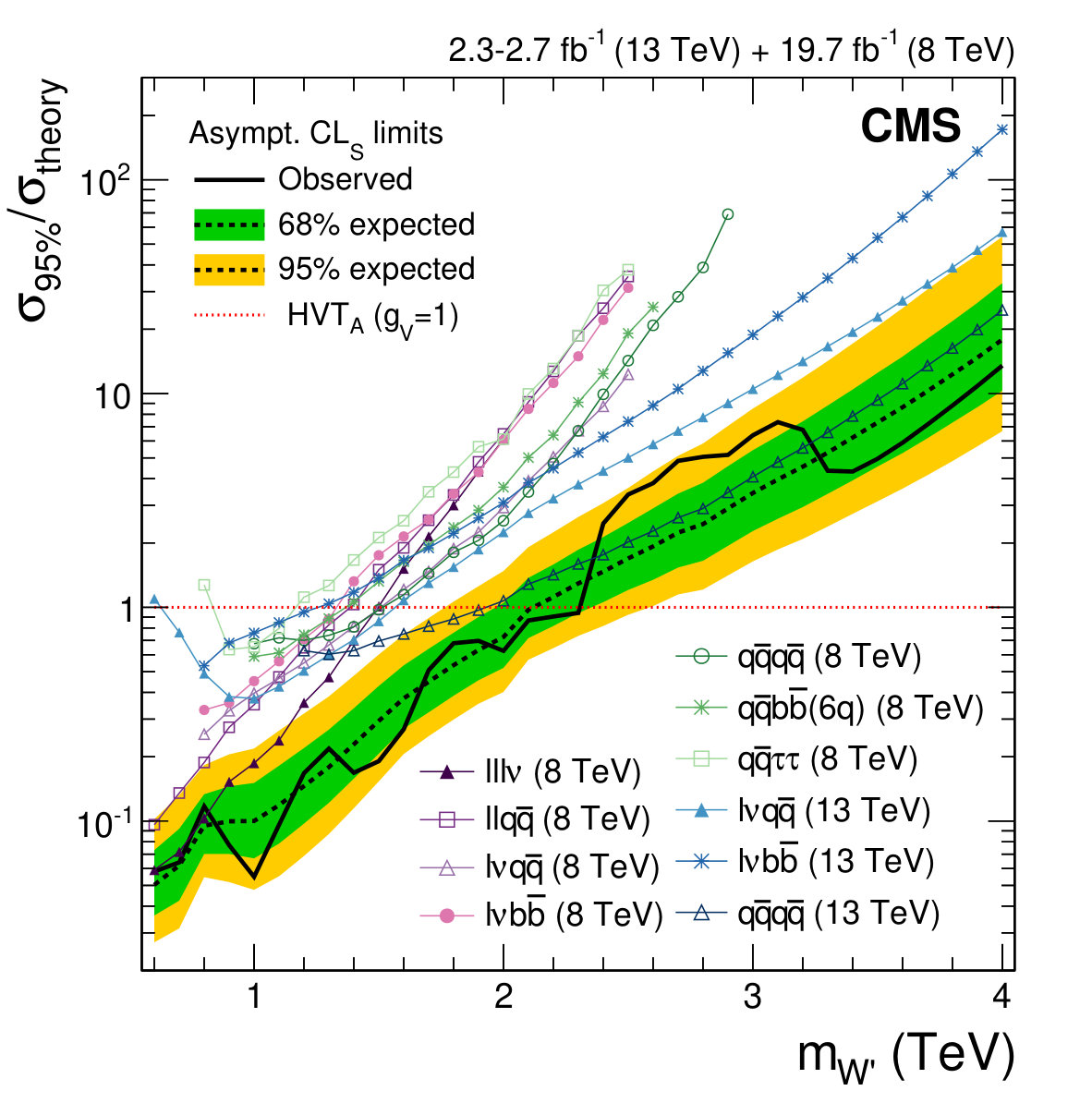 Figure 1
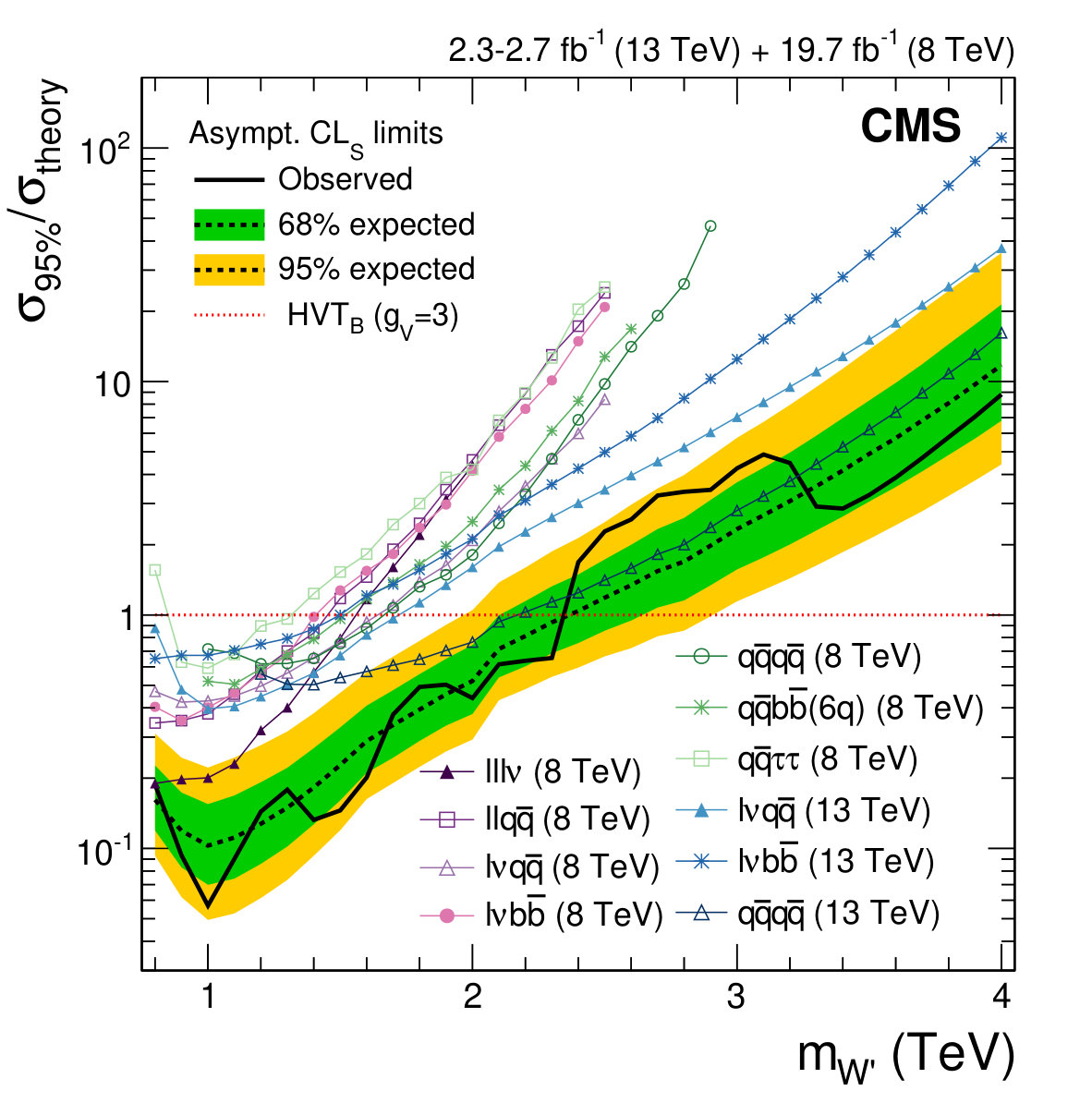 Figure 1
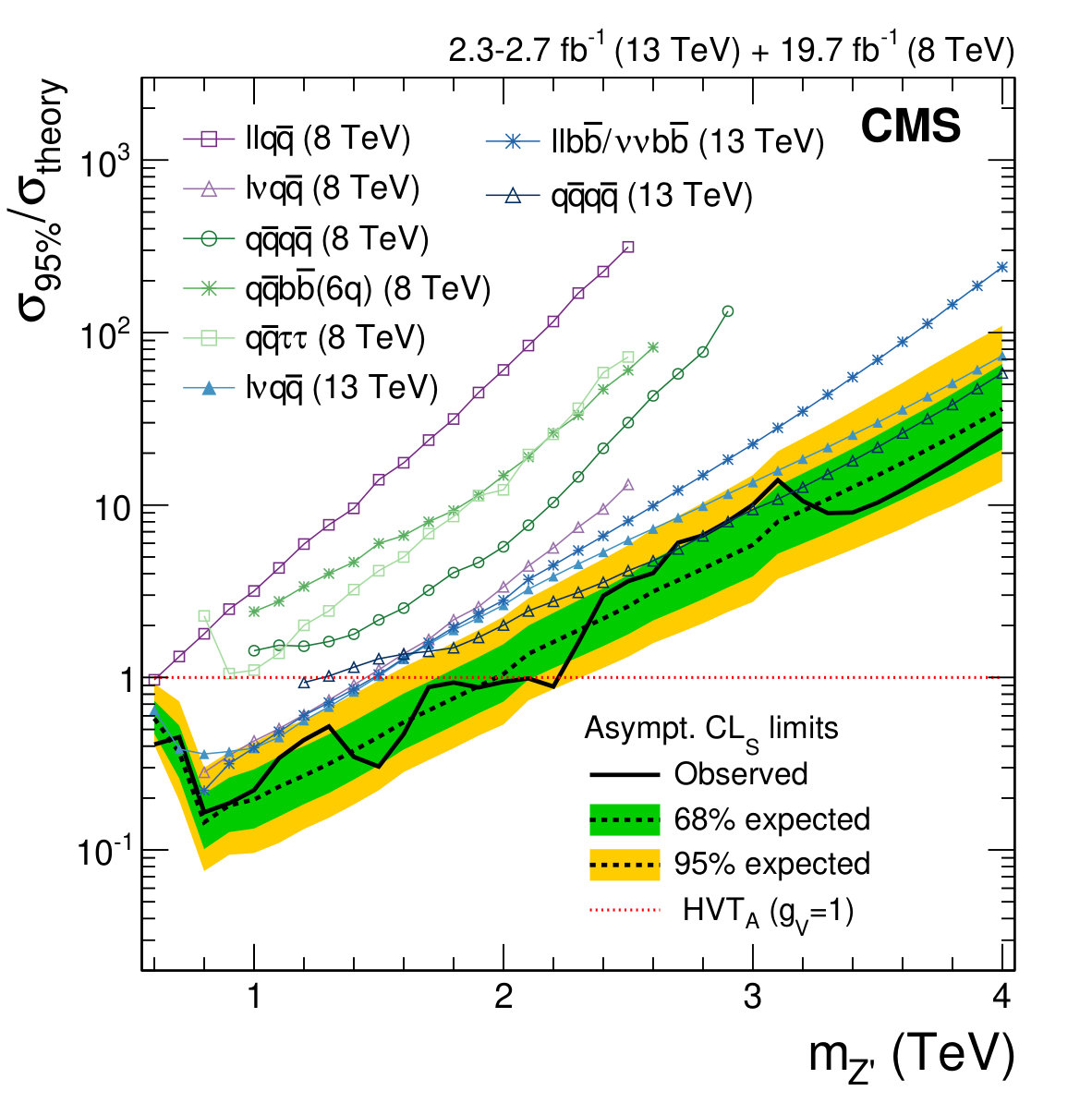 Figure 1
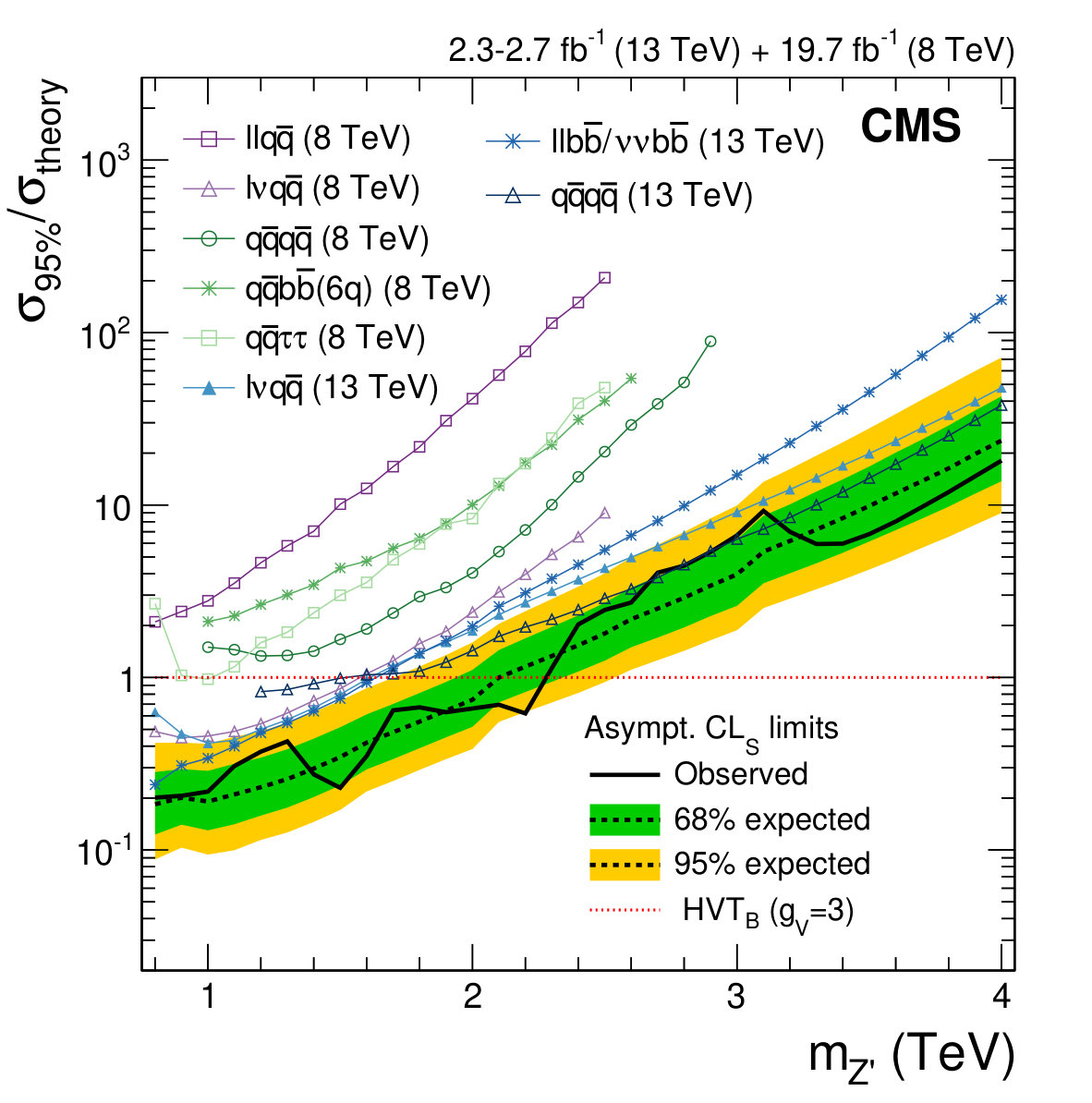 Figure 1
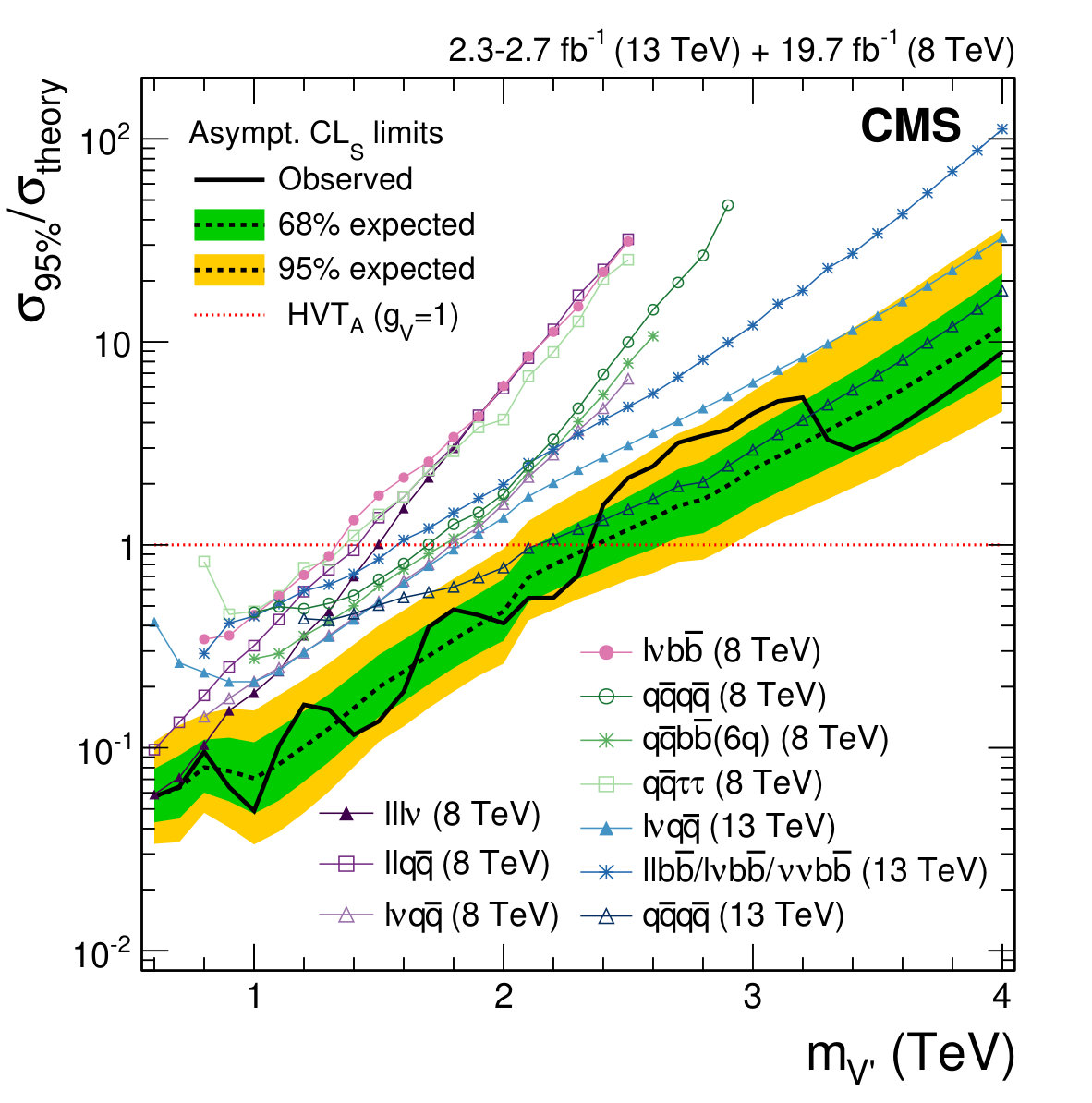 Figure 2
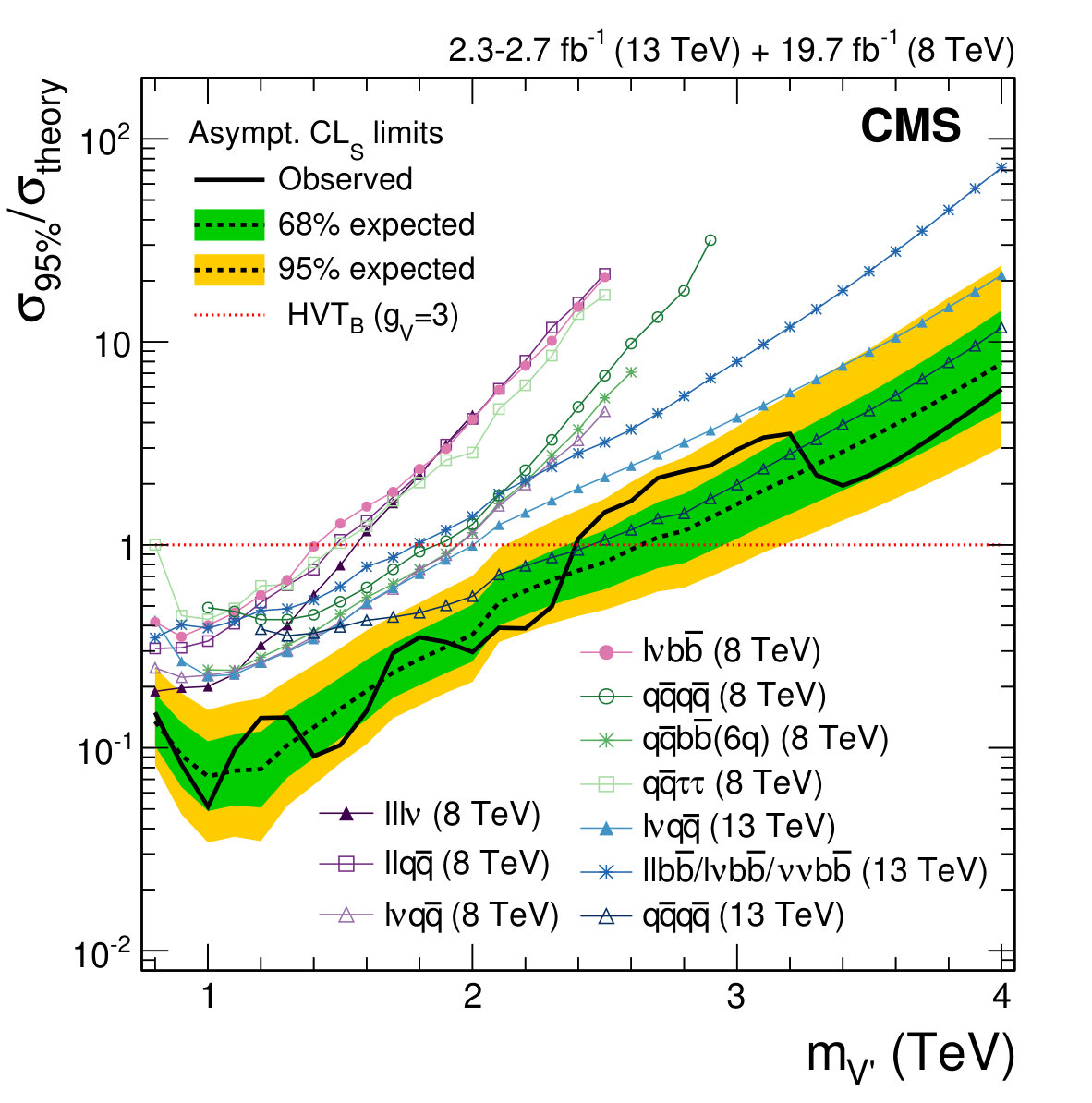 Figure 2
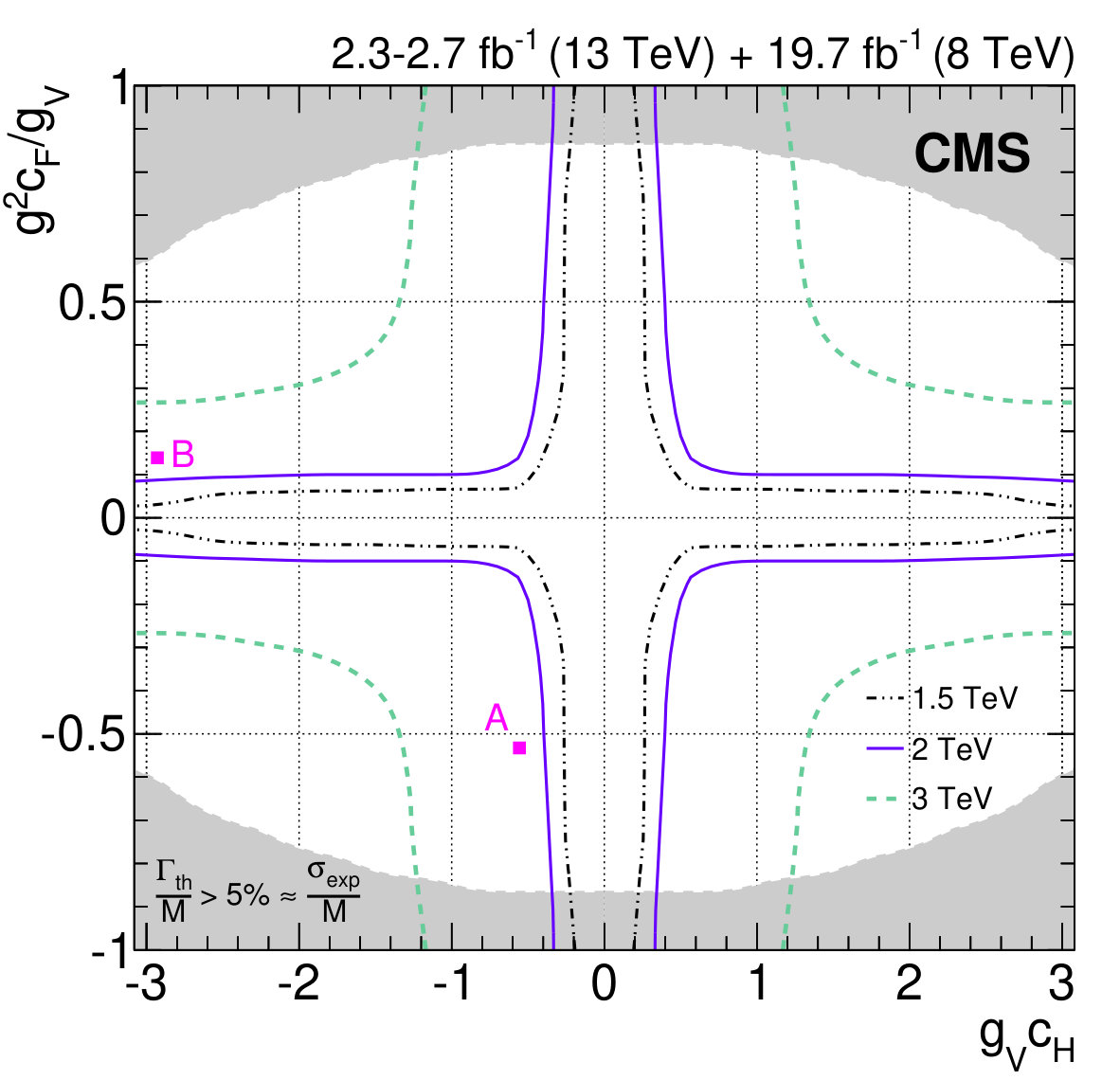 Figure 2
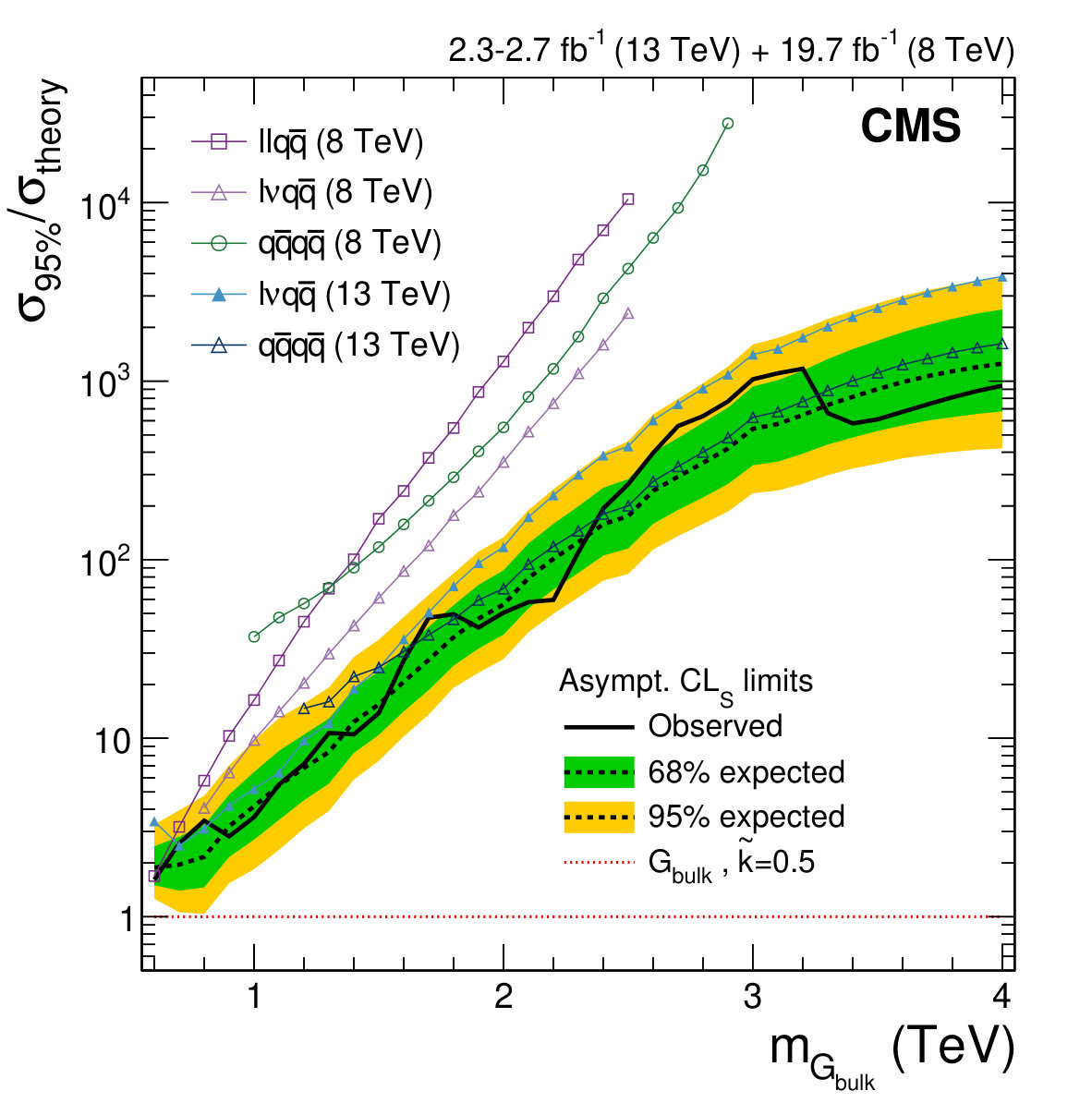 Figure 3
 Figure 10
Peer Reviews
No public reviews on file for this paper yet. If you reviewed it on a platform where reviews are public (OpenReview, ICLR, NeurIPS, ICML), you can paste yours below so the community can read it here.
Videos
No videos yet. Explain this paper in a talk, walkthrough, or lecture? Add one.
\cmsNoteHeader
B2G-16-007
\RCS
\RCS \RCS
\cmsNoteHeader
B2G-16-007
Combination of searches for heavy resonances decaying to WW, WZ, ZZ, WH, and ZH boson pairs in proton-proton collisions at and 13\TeV
Sudha Ahuja
Nural Akchurin
Thea Klaeboe Aarrestad
Luca Brianza
Yu-Hsiang Chang
Ching-Wei Chen
Jordan Damgov
Phil Dudero
Laurent Favart
Raffaele Gerosa
Alessio Ghezzi
Maxime Gouzevitch
Pietro Govoni
Lindsey Gray
Andreas Hinzmann
Huang Huang
Ji-Kong Huang
Raman Khurana
Ben Kilminster
Clemens Lange
Sung-Won Lee
Qiang Li
Yun-Ju Lu
Petar Maksimovic
Jennifer Ngadiuba
Sergio Novaes
Alexandra Oliveira
Alberto Zucchetta
Jacopo Pazzini
Maurizio Pierini
Salvatore Rappoccio
José Ruiz
Thiago Tomei
Henry Yee-Shian Tong
Nhan Tran
Qun Wang
Mengmeng Wang
Jun-Yi Wu
Zijun Xu
Shin-Shan Eiko Yu
Xiaoqing Yuan
Abstract
A statistical combination of searches is presented for massive resonances decaying to WW, WZ, ZZ, WH, and ZH boson pairs in proton-proton collision data collected by the CMS experiment at the LHC. The data were taken at centre-of-mass energies of 8 and 13\TeV, corresponding to respective integrated luminosities of 19.7 and up to 2.7\fbinv. The results are interpreted in the context of heavy vector triplet and singlet models that mimic properties of composite-Higgs models predicting \PWprand \PZprbosons decaying to WZ, WW, WH, and ZH bosons. A model with a bulk graviton that decays into WW and ZZ is also considered. This is the first combined search for WW, WZ, WH, and ZH resonances and yields lower limits on masses at 95% confidence level for \PWprand \PZprsinglets at 2.3\TeV, and for a triplet at 2.4\TeV. The limits on the production cross section of a narrow bulk graviton resonance with the curvature scale of the warped extra dimension , in the mass range of 0.6 to 4.0\TeV, are the most stringent published to date.
0.1 Introduction
Hypotheses for physics beyond the standard model (SM) predict the existence of heavy resonances that decay to any combination of two among the massive vector bosons (W or Z, collectively referred to as V) or to a V and the scalar SM Higgs boson (H). Among the considered models are those dealing with warped extra dimensions (WED) [1, 2] and composite-Higgs bosons [3, 4, 5, 6]. Searches for such VV and VH resonances in different final states have previously been performed by the ATLAS [7, 8, 9, 10, 11, 12] and CMS [13, 14, 15, 16, 17, 18, 19, 20] experiments at the CERN LHC. As all of these searches have similar sensitivities, a statistical combination of the CMS results is provided to improve the overall result. The current status of heavy diboson searches at CMS is also of interest in this respect, with recent work in the all-jet VV [21] and lepton+jet WH [16] decay channels showing possible enhancements.
The benchmark models considered in combining the results are a heavy vector triplet (HVT) model [22] and the bulk scenario [23, 24, 25] ( graviton) in the Randall–Sundrum (RS) WED model [1, 2]. The HVT model generalizes a large number of models that predict spin-1 resonances, such as those in composite-Higgs theories, which can arise as a singlet, either \PWpror \PZpr [26, 27, 28], or as a triplet (where represents and bosons) [22]. The HVT and models are considered as benchmarks for diboson resonances with spin 1 ( or WH, or ZH), and spin 2 ( or ZZ), respectively, produced via quark-antiquark annihilation (, ) and gluon-gluon fusion ().
The analyses included in this statistical combination are based on proton-proton (pp) collision data collected by the CMS experiment [29] at and 13\TeV, corresponding to respective integrated luminosities of 19.7 and 2.3–2.7\fbinv. Of the 2.7\fbinvrecorded at 13\TeV, the detector was fully operational for 2.3\fbinv, while 0.4\fbinvwere collected with only the central part of the detector () in optimal condition. The signal corresponds to a narrow charge 0 or 1 resonance with a mass 0.6\TeVthat decays to any of the two high energy W, Z, or Higgs bosons, where narrow refers to the assumption that the natural relative width is smaller than the typical experimental resolution of 5%, which is true for a large fraction of the parameter space of the reference models. For the mass range under study, the particles emerging from the boson decays are highly collimated, requiring special reconstruction and identification techniques that are in common in these kinds of analyses.
Analyses were performed using all-lepton, lepton+jet, and all-jet final states that include decays of W and Z bosons into charged leptons ( or ) and neutrinos (), as well as the reconstructed jets evolved from the products of the boson decays. The latter include and . The analyses use and decays of the Higgs boson, which are labeled as \bbbaror , together with a vector boson decaying to hadrons. Final states with the Higgs boson decaying into a lepton pair are also considered. In all, we combine results from the following final states: 3 (8\TeV) [13]; (8\TeV) [14]; (8\TeV) [14]; (8\TeV) [15]; (8\TeV) [16]; (8\TeV) [17]; and (8\TeV) [18]; (13\TeV) [19]; (13\TeV) [19]; and , , and (13\TeV) [20]. Since some more forward parts of the detector, which provide information for the calculation of the missing transverse momentum, were not in optimal condition for a fraction of the 2015 data-taking period, the analyses of 13\TeVdata in the , , , and decay channels are based on the dataset corresponding to the integrated luminosity of 2.3\fbinvrather than 2.7\fbinv.
Given the limited experimental jet mass resolution, the and candidates cannot be fully differentiated, and individual analyses can be sensitive to several different interpretations in the same model. For example, the final state is sensitive to HVT \PWprdecays to a WZ boson pair as well as to \PZprdecays to WW boson pairs. The sum of contributions from multiple signals with their respective efficiencies is sought in the combination. For this reason, separate interpretations are given below for a vector triplet and for vector singlets (\PWpror \PZpr).
This letter is structured as follows. After a brief introduction to the benchmark models in Section 0.2, a summary of the analyses entering the combination is given in Section 0.3. The combining procedure is described in Section 0.4, and finally the results and summary are provided in Sections 0.5 and 0.6.
0.2 Theoretical models
As indicated above, heavy diboson resonances are expected in a large class of models that attempt to accommodate the difference between the electroweak and Planck scales. We perform the combination in the context of seven benchmark theories formulated to cover different spin, production, and decay options for resonances decaying to VV and VH. The properties of models for spin-1 and spin-2 resonances are briefly discussed in the following two subsections, with benchmark resonances summarized in Table 0.2.2. For both spin-1 and spin-2 resonances, the signal cross sections used in this paper are given in Tables .7 and .7 of the Appendix.
0.2.1 Spin-1 resonances
Several extensions of the SM such as composite-Higgs [3, 4, 5, 6] and little Higgs [30, 31] models can be generalized through a phenomenological Lagrangian that describes the production and decay of spin-1 heavy resonances, such as a charged \PWpr and a neutral \cPZpr, using the HVT model.
The HVT couplings are described in terms of four parameters:
- (i)
describes interactions of the new resonance with the Higgs boson or longitudinally polarized SM vector bosons; 2. (ii)
describes the interactions of the new resonance with fermions; 3. (iii)
gives the typical strength of the new interaction and 4. (iv)
is the mass of the new resonance.
The \PWpr and \cPZpr bosons couple to the fermions through the combination of parameters and to the H and vector bosons through , where is the SU(2)L gauge coupling. The Higgs boson is assumed to be part of a Higgs doublet field. Therefore, its dynamics are related to the Goldstone bosons in the same doublet by SM symmetry. Those Goldstone bosons are equivalent to the corresponding longitudinally polarised W and Z bosons in the high energy limit according to the “Equivalence Theorem” [32]. The coupling of the Higgs boson to the \PWprand \PZprresonances can thus be described by the same coupling as used for the longitudinal W and Z bosons.
The production of \PWpr and \cPZpr bosons at hadron colliders is expected to be dominated by the process or . Two benchmark models are studied, denoted A and B, that were suggested in Ref. [22]. In model A, weakly coupled vector resonances arise from an extension of the SM gauge group. In model B, the heavy vector triplet is produced by a strong coupling mechanism, as embodied in theories such as in the composite-Higgs model. Consequently, in model A the branching fractions to fermions and SM massive bosons are comparable, whereas in model B, fermionic couplings are suppressed. Therefore, in the context of WW, WZ, ZH, and WH resonance searches, model B is of more interest, since model A is strongly constrained by searches in final states with fermions. In both options, the heavy resonances couple as SM custodial triplets, so that \PWpr and \PZpr are expected to be approximately degenerate in mass, and the branching fractions and to be comparable to and . We consider model A (, ) with parameter , and model B (, ) with parameter . A value of is chosen for model B to represent strongly coupled electroweak symmetry breaking, e.g. composite-Higgs models, while assuring small natural widths relative to the experimental resolution. We also consider heavy resonances that couple to \PWpr and \cPZpr as singlets, i.e. expecting only one charged or neutral resonance at a given mass, as summarized in Table 0.2.2.
Previous searches for a \PWprboson decaying into a pair of SM massive bosons (WZ, WH) provide a lower mass limit of 1.8\TeVin model A () and 2.3\TeVin model B (), where the results from 8\TeVdata [7, 15, 13, 16, 8, 9] are most stringent at low resonance masses, while \unit13\TeV analyses [19, 20, 10, 11] dominate at higher resonance masses. Searches for a \PZprboson decaying into a pair of SM massive bosons (WW, ZH) yield lower mass limits of 1.4 and 2.0\TeVin models A and B, respectively, based on 8\TeV [12, 18, 17] and \unit13\TeV [19, 20, 10, 11] data. For a heavy vector triplet resonance, the most stringent lower mass limits of 2.35\TeV(model A) and 2.60\TeV(model B) are obtained from a combination of VV searches at 13\TeV [10].
0.2.2 Spin-2 resonances
Massive spin-2 resonances can be motivated in WED models through Kaluza–Klein (KK) gravitons [1, 2], which correspond to a tower of KK excitations of a spin-2 graviton. The original RS model (here denoted as RS1) can be extended to the bulk scenario (), which addresses the flavor structure of the SM through the localization of fermions in the warped extra dimension [23, 24, 25].
These WED models have two free parameters: the mass of the first mode of the KK graviton, , and the ratio , where is the curvature scale of the WED and is the reduced Planck mass. The constant acts as the coupling constant of the model, on which the production cross sections and widths of the graviton depend quadratically. For models with , the natural width of the resonance is sufficiently small to be neglected relative to detector resolution.
In the bulk scenario, coupling of the graviton to light fermions is highly suppressed, and the decay into photons is negligible, while in the RS1 scenario, the graviton decays to photon and fermion pairs dominate. In the context of WW and ZZ resonance searches, the bulk scenario is of great interest, since RS1 is already strongly constrained through searches in final states with fermions and photons [33, 34, 35]. The production of gravitons at hadron colliders in the bulk scenario is dominated by gluon-gluon fusion, and the branching fraction . The decay mode into a pair of Higgs bosons, which is not studied in this paper, has a branching fraction comparable to .
For , where the bulk graviton has comparable or larger width than the detector resolution, the most stringent lower limit of 1.1\TeVon its mass is set by a combination of searches in the diboson final state [10]. The most stringent limits on the cross section for narrow bulk graviton resonances for are also determined through searches in the diboson final state [19, 14, 14, 15]; however, the integrated luminosity of the dataset is not large enough to allow us to obtain mass limits for this resonance.
0.3 Data analyses
0.3.1 The CMS detector
The central feature of the CMS apparatus is a superconducting solenoid of 6\unitm internal diameter, providing a magnetic field of 3.8\unitT. Within the solenoid volume are a silicon pixel and strip tracker, a lead tungstate crystal electromagnetic calorimeter, and a brass and scintillator hadron calorimeter, each composed of a barrel and two endcap sections. Forward calorimeters extend the pseudorapidity coverage provided by the barrel and endcap detectors. Muons are measured in gas-ionization detectors embedded in the steel flux-return yoke outside the solenoid. A more detailed description of the CMS detector, together with a definition of the coordinate system used and the relevant kinematic variables, can be found in Ref. [29].
0.3.2 Analysis techniques
This paper combines searches for heavy resonances over a background spectrum described by steeply falling distributions of the invariant mass of two reconstructed W, Z, or Higgs bosons in several decay modes. The candidates are reconstructed from electron [36] or muon [37] candidates, while candidates are formed from the combination of electron or muon candidates with missing transverse momentum [38], where the longitudinal momentum of the neutrino is constrained such that the invariant mass is equal to the W mass [39]. The selection criteria for leptons are such that they ensure disjoint datasets for the searches in lepton+jet final states with 0, 1, and 2 leptons. The contributions from candidates are constructed from e and decays of , and from candidates, in combination with missing transverse momentum. The , , , and candidates are reconstructed from QCD-evolved jets [40], as described in detail in the following.
Since the W, Z, and Higgs bosons originating from decays of heavy resonances tend to have large Lorentz boosts, their decay products have a small angular separation, requiring special reconstruction techniques. For highly boosted W, Z, and Higgs bosons decaying to electron, muon, and tau candidates, identification and isolation requirements are formulated such that any other nearby reconstructed lepton is excluded from the computation of quantities used for identification and isolation. This method retains high identification efficiency, while maintaining the same misidentification probability when two leptons are very collimated.
When W, Z, or Higgs bosons decay to quark-antiquark pairs, the showers of hadrons originating from these pairs merge into single large-radius jets that are reconstructed using two jet algorithms [41]. The Cambridge–Aachen [42] and the anti-\kt [43] algorithms with a distance parameter of 0.8 are used for the 8 and 13\TeVdata, respectively, providing comparable jet reconstruction performance. Jet momenta are corrected for additional pp collisions (pileup) that overlap the event of interest, as specified in Ref. [44]. To discriminate against quark and gluon jet background, selections on the pruned jet mass [45, 46] and the N-subjettiness ratio [47] are applied. The jet pruning algorithm reclusters the jet constituents, while applying additional requirements to eliminate soft, large-angle QCD radiation that increases the jet mass relative to the initial V or H, quark, or gluon jet mass. The variable indicates the probability of a jet to be composed of two hard subjets rather than just one hard jet. A jet is a candidate V jet if its pruned mass, , is compatible within resolution with the W or Z mass. The specific selection depends on the analysis channel. For example, the 13\TeVanalyses define the window in the range . In the 13\TeVdata, to further enhance analysis sensitivity to different signal hypotheses, two distinct categories enriched in W or Z bosons are defined through two disjoint ranges in . Sensitivity is then further improved in both 8 and \unit13\TeV data by categorizing events according to the variable into a low purity (LP) and a high purity (HP) category. Although the HP category dominates the total sensitivity of the analyses, the LP category is retained, since it provides improved sensitivity for high-mass resonances. The optimal selection criteria for and depend on signal and background yields and therefore differ across analyses. As a consequence, the efficiencies for identifying W and Z bosons can be different. The total efficiency of the and HP selection criteria for a jet with \ptof 1\TeVoriginating from the decay of a heavy resonance ranges from 45% to 75%, with a mistagging rate of 2% to 7% [40, 48].
A category enriched in Higgs bosons is identified through a pruned-jet mass window around the Higgs boson mass, ensuring a separate selection relative to V jet identification. For example, the searches in the , , and final states at 13\TeV [20] define the window in the range . In addition, for the final state, further discrimination against background is gained by applying a b tagging algorithm [49, 50, 51] to the two individual subjets into which the H-jet candidate is split. The b tagging algorithm discriminates jets originating from b quarks against those originating from lighter quarks or gluons. To distinguish jets from background, a technique similar to V jet identification is applied using the N-subjettiness ratio [18]. The selection efficiencies for each signal and channel are summarized in Table 0.3.2.
In all-jet final states [15, 18, 19], the background expectation is dominated by multijet production, which is estimated through a fit of a signal+background hypothesis to the data, where the background is described by a smoothly falling parametric function. In lepton+jet (, , , , , and ) final states [14, 16, 17, 19, 20], the dominant backgrounds from V+jets production are estimated using data in the sidebands of . The contamination from WH and ZH resonances decaying into lepton+jet final states in the high sideband defined in the and analyses has been evaluated considering the cross sections excluded by the and searches. The impact of this contamination on the resulting background estimate is found to be negligible. In all-lepton final states [13], the dominant background from SM diboson production is estimated using simulated events.
0.3.3 Reinterpretations
In this subsection, we discuss analyses that have been reinterpreted for this paper since not all signal models presented in this combination were considered in the originally published analyses.
In the searches for new heavy resonances decaying into pairs of vector bosons in lepton+jet ( and ) final states [14] at , 95% confidence level (CL) exclusion limits are obtained for the production cross section of a bulk graviton. Using a parametrization for the reconstruction efficiency as a function of W and Z boson kinematics, a reinterpretation is performed in the context of the HVT model described in Section 0.2.1, which predicts the production of charged and neutral spin-1 resonances decaying preferably to WW and WZ pairs. This reinterpretation is obtained by rescaling the bulk-graviton signal efficiencies by factors taking into account the different kinematics of W and Z bosons from \PWpr and \cPZpr production relative to graviton production. The scale factors are obtained for each value of the sought resonance by means of the tables published in Ref. [14]. Signal shapes are unchanged by the combination process, and the effect of the scaling factor on the signal efficiency takes into account the differences in acceptance for the various signals and masses. Since the parametrization is restricted to the HP category of the analyses, the LP category is not used for the HVT \PWpr and \cPZpr interpretations of these channels. The window that defines the signal regions of the analysis channels is chosen such that the channel is sensitive to both the charged and the neutral resonances predicted in the HVT model. This additional signal efficiency is taken into account in the combination presented in Section 0.5.2.
The searches for heavy resonances decaying into pairs of vector bosons in the lepton+jet ( and ) [14, 14, 19] and all-jet () [15, 19] final states at 8 and 13\TeVare also sensitive to the WH and ZH signatures, since a small fraction of jets initiated by Higgs bosons have a pruned jet mass in the W or Z range. These searches are therefore reinterpreted for WH and ZH signals, to profit from this additional sensitivity. The efficiencies of these additional signals for the analyses selections are calculated and indicated in Table 0.3.2 with an asterisk. This contribution is found to be negligible for the search in the final state at 8\TeV, as in this analysis events are rejected if the boson jet satisfies b tagging requirements. The fraction of jets initiated by Z bosons that have a pruned jet mass in the Higgs boson mass range is found to be negligible and therefore this contribution is not taken into account in the combination.
The search for resonances in the final state [18] is optimized for a \PZprresonance decaying to a ZH pair. However, given the large window () used to tag the decays, this analysis channel is also sensitive to the production of the charged spin-1 \PWprresonance decaying to a WH pair predicted in HVT models. Similarly, the search in the all-jet final state with 8\TeVdata is optimized for the signal hypothesis, while being sensitive as well to a \PZprresonance decaying to WW. This overlap is taken into account in the statistical combination described in Section 0.5.2. For all the other analyses, limits have been previously obtained in the same models as those considered in this letter and a reinterpretation is not needed.
0.4 Combination procedure
We search for a peak on top of a falling background spectrum by means of a fit to the data. The likelihood function is constructed using the diboson invariant mass distribution in data, the background prediction, and the resonant line-shape, to assess the presence of a potential diboson resonance. We define the likelihood function as
[TABLE]
where “data” stands for the observed data; represents the full ensemble of nuisance parameters; and are the expected signal and background yields; is a scale factor for the signal strength; is the product of Poisson probabilities over all bins of diboson invariant mass distributions in all channels (or over all events for channels with unbinned distributions); and is the probability density function for all nuisance parameters to measure a value given its true value [52]. After maximizing the likelihood function, the best-fit value of corresponds therefore to the ratio of the best-fit signal cross section to the predicted cross section , assuming that all branching fractions are as predicted by the relevant signal models.
The treatment of the background in the maximum likelihood fit depends on the analysis channel. In the , , and analyses, the parameters in the background function are left floating in the fit, such that the background prediction is obtained simultaneously with , in each hypothesis [15]. In the remaining analyses (, , , , ), the background is estimated using sidebands in data, and the uncertainties related to its parametrized distribution are treated as nuisance parameters constrained through Gaussian probability density functions in the fit [14]. The likelihoods from all analysis channels are combined.
The asymptotic approximation [53] of the criterion [54, 55] is used to obtain limits on the signal scale factor that take into account the ratio of the theoretical predictions for the production cross sections at 8 and 13\TeV.
Systematic uncertainties in the signal and background yields are treated as nuisance parameters constrained through log-normal probability density functions. All such parameters are profiled (refitted as a function of the parameter of interest ) in the maximization of the likelihood function. When the likelihoods from different analysis channels are combined, the correlation of systematic effects across those channels is taken into account by treating the uncertainties as fully correlated (associated with the same nuisance parameter) or fully uncorrelated (associated with different nuisance parameters). Table 0.4 summarizes which uncertainties are treated as correlated among 8 and 13\TeVanalyses, e and channels, HP and LP categories, and mass categories enriched in W, Z, and Higgs bosons in the combination. Additional categorization within individual analyses is described in their corresponding papers. The nuisance parameters treated as correlated between 8 and 13\TeVanalyses are those related to the parton distribution functions (PDFs) and the choice of the factorization () and renormalization () scales used to estimate the signal cross sections. The signal cross sections and their associated uncertainties are reevaluated for this combination at both 8 and 13\TeV, estimating thereby their full impact on the expected signal yield rather than just the impact on the signal acceptance. The PDF uncertainties are evaluated using the NNPDF 3.0 [56] PDFs. The uncertainty related to the choice of and scales is evaluated following [57, 58] by changing the default choice of scales in six combinations of , by factors of , , , , , and . The experimental uncertainties are all treated as uncorrelated between 8 and 13\TeVanalyses. The case where the most important uncertainties are treated as fully correlated among 8 and 13\TeVanalyses has been studied and found to have negligible impact on the results. After the combined fit, no nuisance parameter was found to differ significantly from its expectation and from the fit result in individual analyses.
0.5 Results
We evaluate the combined significance of the 8 and 13\TeVCMS searches for all signal hypotheses. The ATLAS Collaboration reported an excess in the all-jet VV search, corresponding to a local significance of 3.4 standard deviations (s.d.) for a \PWprresonance with a mass of 2\TeV [21]. Similarly, the CMS experiment reported a local deviation of 2.2 s.d. in the lepton+jet search for a \PWprresonance with a mass of 1.8\TeV [16]. The present combination does not confirm these small excesses (within the context of the models considered), as the highest combined significance in the mass range of the reported excesses is found to be for a \PWprresonance at 1.8\TeVwith a local significance of 0.8 standard deviations.
In the following, we present for each channel 95% CL exclusion limits on the signal strength in Eq. 1, expressed as the exclusion limit on the ratio of the signal cross section to the predicted cross section, assuming that all branching fractions are as predicted by the relevant signal models.
0.5.1 Limits on \PWprand \PZprsinglets
Figure 1 (upper) shows a comparison and combination of results obtained in the 8 and 13\TeVsearches for a \PWprsinglet resonance in HVT models A and B. The 95% CL exclusion limits on the signal strengths are given for the mass ranges for model A and for model B. Table 0.5.1 summarizes the lower limits on the resonance masses. Below mass values of , the most sensitive channel is the 3 final state at 8\TeV. At higher masses, the search at 13\TeVdominates the sensitivity. The overall sensitivity benefits from the combination for resonance masses up to 2\TeV, lowering the exclusion limit on the cross section by up to a factor of relative to the most sensitive single channel, as several channels of similar sensitivity are combined in this mass range. Above resonance masses of 2\TeV, the 8\TeVanalyses do not have significant sensitivity compared to the search at 13\TeV.
Figure 1 (lower) shows the analogous results for a \PZprsinglet resonance for final states of WW and ZH in the HVT models A and B. The channel at 8\TeVand the , , , and channels at 13\TeVdominate the sensitivity over the whole range, with 8 and 13\TeVanalyses giving almost equal contributions for masses below 2\TeV. Above this value, the sensitivity arises mainly from the 13\TeVdata. As in the \PWpranalyses, the mass limit is not affected by the combination compared to what is obtained from the 13\TeVsearches.
0.5.2 Limits on the heavy vector triplet
Figure 2 (upper) shows the comparison and combination of the results obtained in the 8 and 13\TeVsearches for resonances in a heavy vector triplet. The lower limits on the resonance masses for HVT models A and B are quoted in Table 0.5.1. As for the \PWprand \PZprcases, the observed mass limit of 2.4\TeVfor both models obtained combining the 8 and 13\TeVsearches is dominated essentially by the 13\TeVanalyses alone.
Figure 2 (lower) displays a scan of the coupling parameters and the corresponding observed 95% CL exclusion contours in the HVT models from the combination of the 8 and 13\TeVanalyses. The parameters are defined as and in terms of the coupling strengths of the new resonance to the H and V, and to fermions, respectively, given in Section 0.2.1. The range is limited by the assumption that the resonance sought is narrow. The shaded area represents the region where the theoretical width is larger than the experimental resolution of the searches, and therefore where the narrow-resonance assumption is not satisfied. This contour is defined by a predicted resonance width, relative to its mass, of 5%, corresponding to the best detector resolution of the searches.
0.5.3 Limits on the bulk graviton
Figure 3 shows a comparison and combination of results obtained in the 8 and 13\TeVVV searches in the bulk graviton model with . The sensitivity arises mainly from the 13\TeV and channels. The 13\TeVsearches supersede the 8\TeVcombination down to masses of 0.7\TeV, since in this model, the signal is produced via gluon-gluon fusion, in contrast to the qq annihilation process responsible for the production of HVT resonances. The combination yields the most stringent limits to date on signal strengths for narrow bulk graviton resonances () in the mass range from 0.6 to 4.0\TeV.
0.6 Summary
A statistical combination of searches for massive narrow resonances decaying to WW, ZZ, WZ, WH, and ZH boson pairs in the mass range 0.6–4.0\TeVhas been presented. The searches are based on proton-proton collision data collected by the CMS experiment at centre-of-mass energies of 8 and 13\TeV, corresponding to integrated luminosities of 19.7 and up to \unit2.7\fbinv, respectively. The results of the searches and of the combination are interpreted in the context of heavy vector singlet and triplet models predicting \PWprand \PZprbosons decaying to WZ, WH, WW, and ZH, and a model with a bulk graviton that decays into WW and ZZ. The small excesses observed with 8\TeVdata by the ATLAS and CMS experiments [21, 16] at 1.8–2.0\TeVare not confirmed by the analyses performed with 13\TeVdata. This is the first combined search for WW, WZ, WH, and ZH resonances and yields 95% confidence level lower limits in the heavy vector triplet model B on the masses of \PWprand \PZprsinglets at 2.3\TeV, and on a heavy vector triplet at 2.4\TeV. The limits on the production cross section of a narrow bulk graviton resonance with the curvature scale of the warped extra dimension , in the mass range of 0.6 to 4.0\TeV, are the most stringent published to date. The statistical combination of VV and VH resonance searches in several distinct final states was found to yield a significant gain in sensitivity and therefore represents a powerful tool for future resonance searches with the large expected diboson event data sample at the LHC.
Acknowledgements.
We congratulate our colleagues in the CERN accelerator departments for the excellent performance of the LHC and thank the technical and administrative staffs at CERN and at other CMS institutes for their contributions to the success of the CMS effort. In addition, we gratefully acknowledge the computing centers and personnel of the Worldwide LHC Computing Grid for delivering so effectively the computing infrastructure essential to our analyses. Finally, we acknowledge the enduring support for the construction and operation of the LHC and the CMS detector provided by the following funding agencies: BMWFW and FWF (Austria); FNRS and FWO (Belgium); CNPq, CAPES, FAPERJ, and FAPESP (Brazil); MES (Bulgaria); CERN; CAS, MoST, and NSFC (China); COLCIENCIAS (Colombia); MSES and CSF (Croatia); RPF (Cyprus); SENESCYT (Ecuador); MoER, ERC IUT, and ERDF (Estonia); Academy of Finland, MEC, and HIP (Finland); CEA and CNRS/IN2P3 (France); BMBF, DFG, and HGF (Germany); GSRT (Greece); OTKA and NIH (Hungary); DAE and DST (India); IPM (Iran); SFI (Ireland); INFN (Italy); MSIP and NRF (Republic of Korea); LAS (Lithuania); MOE and UM (Malaysia); BUAP, CINVESTAV, CONACYT, LNS, SEP, and UASLP-FAI (Mexico); MBIE (New Zealand); PAEC (Pakistan); MSHE and NSC (Poland); FCT (Portugal); JINR (Dubna); MON, RosAtom, RAS, RFBR and RAEP (Russia); MESTD (Serbia); SEIDI, CPAN, PCTI and FEDER (Spain); Swiss Funding Agencies (Switzerland); MST (Taipei); ThEPCenter, IPST, STAR, and NSTDA (Thailand); TUBITAK and TAEK (Turkey); NASU and SFFR (Ukraine); STFC (United Kingdom); DOE and NSF (USA). Individuals have received support from the Marie-Curie program and the European Research Council and Horizon 2020 Grant, contract No. 675440 (European Union); the Leventis Foundation; the A. P. Sloan Foundation; the Alexander von Humboldt Foundation; the Belgian Federal Science Policy Office; the Fonds pour la Formation à la Recherche dans l’Industrie et dans l’Agriculture (FRIA-Belgium); the Agentschap voor Innovatie door Wetenschap en Technologie (IWT-Belgium); the Ministry of Education, Youth and Sports (MEYS) of the Czech Republic; the Council of Science and Industrial Research, India; the HOMING PLUS program of the Foundation for Polish Science, cofinanced from European Union, Regional Development Fund, the Mobility Plus program of the Ministry of Science and Higher Education, the National Science Center (Poland), contracts Harmonia 2014/14/M/ST2/00428, Opus 2014/13/B/ST2/02543, 2014/15/B/ST2/03998, and 2015/19/B/ST2/02861, Sonata-bis 2012/07/E/ST2/01406; the National Priorities Research Program by Qatar National Research Fund; the Programa Clarín-COFUND del Principado de Asturias; the Thalis and Aristeia programs cofinanced by EU-ESF and the Greek NSRF; the Rachadapisek Sompot Fund for Postdoctoral Fellowship, Chulalongkorn University and the Chulalongkorn Academic into Its 2nd Century Project Advancement Project (Thailand); and the Welch Foundation, contract C-1845.
.7 Signal cross section tables
.8 The CMS Collaboration
**Yerevan Physics Institute, Yerevan, Armenia
** A.M. Sirunyan, A. Tumasyan \cmsinstskip**Institut für Hochenergiephysik, Wien, Austria
** W. Adam, E. Asilar, T. Bergauer, J. Brandstetter, E. Brondolin, M. Dragicevic, J. Erö, M. Flechl, M. Friedl, R. Frühwirth\cmsAuthorMark1, V.M. Ghete, C. Hartl, N. Hörmann, J. Hrubec, M. Jeitler\cmsAuthorMark1, A. König, I. Krätschmer, D. Liko, T. Matsushita, I. Mikulec, D. Rabady, N. Rad, H. Rohringer, J. Schieck\cmsAuthorMark1, J. Strauss, W. Waltenberger, C.-E. Wulz\cmsAuthorMark1 \cmsinstskip**Institute for Nuclear Problems, Minsk, Belarus
** V. Chekhovsky, V. Mossolov, J. Suarez Gonzalez \cmsinstskip**National Centre for Particle and High Energy Physics, Minsk, Belarus
** N. Shumeiko \cmsinstskip**Universiteit Antwerpen, Antwerpen, Belgium
** S. Alderweireldt, E.A. De Wolf, X. Janssen, J. Lauwers, M. Van De Klundert, H. Van Haevermaet, P. Van Mechelen, N. Van Remortel, A. Van Spilbeeck \cmsinstskip**Vrije Universiteit Brussel, Brussel, Belgium
** S. Abu Zeid, F. Blekman, J. D’Hondt, I. De Bruyn, J. De Clercq, K. Deroover, S. Lowette, S. Moortgat, L. Moreels, A. Olbrechts, Q. Python, K. Skovpen, S. Tavernier, W. Van Doninck, P. Van Mulders, I. Van Parijs \cmsinstskip**Université Libre de Bruxelles, Bruxelles, Belgium
** H. Brun, B. Clerbaux, G. De Lentdecker, H. Delannoy, G. Fasanella, L. Favart, R. Goldouzian, A. Grebenyuk, G. Karapostoli, T. Lenzi, J. Luetic, T. Maerschalk, A. Marinov, A. Randle-conde, T. Seva, C. Vander Velde, P. Vanlaer, D. Vannerom, R. Yonamine, F. Zenoni, F. Zhang\cmsAuthorMark2 \cmsinstskip**Ghent University, Ghent, Belgium
** A. Cimmino, T. Cornelis, D. Dobur, A. Fagot, M. Gul, I. Khvastunov, D. Poyraz, S. Salva, R. Schöfbeck, M. Tytgat, W. Van Driessche, W. Verbeke, N. Zaganidis \cmsinstskip**Université Catholique de Louvain, Louvain-la-Neuve, Belgium
** H. Bakhshiansohi, O. Bondu, S. Brochet, G. Bruno, A. Caudron, S. De Visscher, C. Delaere, M. Delcourt, B. Francois, A. Giammanco, A. Jafari, M. Komm, G. Krintiras, V. Lemaitre, A. Magitteri, A. Mertens, M. Musich, K. Piotrzkowski, L. Quertenmont, M. Vidal Marono, S. Wertz \cmsinstskip**Université de Mons, Mons, Belgium
** N. Beliy \cmsinstskip**Centro Brasileiro de Pesquisas Fisicas, Rio de Janeiro, Brazil
** W.L. Aldá Júnior, F.L. Alves, G.A. Alves, L. Brito, C. Hensel, A. Moraes, M.E. Pol, P. Rebello Teles \cmsinstskip**Universidade do Estado do Rio de Janeiro, Rio de Janeiro, Brazil
** E. Belchior Batista Das Chagas, W. Carvalho, J. Chinellato\cmsAuthorMark3, A. Custódio, E.M. Da Costa, G.G. Da Silveira\cmsAuthorMark4, D. De Jesus Damiao, S. Fonseca De Souza, L.M. Huertas Guativa, H. Malbouisson, C. Mora Herrera, L. Mundim, H. Nogima, A. Santoro, A. Sznajder, E.J. Tonelli Manganote\cmsAuthorMark3, F. Torres Da Silva De Araujo, A. Vilela Pereira \cmsinstskip**Universidade Estadual Paulista a, Universidade Federal do ABC b, São Paulo, Brazil
** S. Ahujaa, C.A. Bernardesa, T.R. Fernandez Perez Tomeia, E.M. Gregoresb, P.G. Mercadanteb, C.S. Moona, S.F. Novaesa, Sandra S. Padulaa, D. Romero Abadb, J.C. Ruiz Vargasa \cmsinstskip**Institute for Nuclear Research and Nuclear Energy, Sofia, Bulgaria
** A. Aleksandrov, R. Hadjiiska, P. Iaydjiev, M. Rodozov, S. Stoykova, G. Sultanov, M. Vutova \cmsinstskip**University of Sofia, Sofia, Bulgaria
** A. Dimitrov, I. Glushkov, L. Litov, B. Pavlov, P. Petkov \cmsinstskip**Beihang University, Beijing, China
** W. Fang\cmsAuthorMark5, X. Gao\cmsAuthorMark5 \cmsinstskip**Institute of High Energy Physics, Beijing, China
** M. Ahmad, J.G. Bian, G.M. Chen, H.S. Chen, M. Chen, Y. Chen, C.H. Jiang, D. Leggat, Z. Liu, F. Romeo, S.M. Shaheen, A. Spiezia, J. Tao, C. Wang, Z. Wang, E. Yazgan, H. Zhang, J. Zhao \cmsinstskip**State Key Laboratory of Nuclear Physics and Technology, Peking University, Beijing, China
** Y. Ban, G. Chen, Q. Li, S. Liu, Y. Mao, S.J. Qian, D. Wang, Z. Xu \cmsinstskip**Universidad de Los Andes, Bogota, Colombia
** C. Avila, A. Cabrera, L.F. Chaparro Sierra, C. Florez, J.P. Gomez, C.F. González Hernández, J.D. Ruiz Alvarez \cmsinstskip**University of Split, Faculty of Electrical Engineering, Mechanical Engineering and Naval Architecture, Split, Croatia
** N. Godinovic, D. Lelas, I. Puljak, P.M. Ribeiro Cipriano, T. Sculac \cmsinstskip**University of Split, Faculty of Science, Split, Croatia
** Z. Antunovic, M. Kovac \cmsinstskip**Institute Rudjer Boskovic, Zagreb, Croatia
** V. Brigljevic, D. Ferencek, K. Kadija, B. Mesic, T. Susa \cmsinstskip**University of Cyprus, Nicosia, Cyprus
** M.W. Ather, A. Attikis, G. Mavromanolakis, J. Mousa, C. Nicolaou, F. Ptochos, P.A. Razis, H. Rykaczewski \cmsinstskip**Charles University, Prague, Czech Republic
** M. Finger\cmsAuthorMark6, M. Finger Jr.\cmsAuthorMark6 \cmsinstskip**Universidad San Francisco de Quito, Quito, Ecuador
** E. Carrera Jarrin \cmsinstskip**Academy of Scientific Research and Technology of the Arab Republic of Egypt, Egyptian Network of High Energy Physics, Cairo, Egypt
** Y. Assran\cmsAuthorMark7*,\cmsAuthorMark8, M.A. Mahmoud\cmsAuthorMark9,*\cmsAuthorMark8, A. Mahrous\cmsAuthorMark10 \cmsinstskip**National Institute of Chemical Physics and Biophysics, Tallinn, Estonia
** R.K. Dewanjee, M. Kadastik, L. Perrini, M. Raidal, A. Tiko, C. Veelken \cmsinstskip**Department of Physics, University of Helsinki, Helsinki, Finland
** P. Eerola, J. Pekkanen, M. Voutilainen \cmsinstskip**Helsinki Institute of Physics, Helsinki, Finland
** J. Härkönen, T. Järvinen, V. Karimäki, R. Kinnunen, T. Lampén, K. Lassila-Perini, S. Lehti, T. Lindén, P. Luukka, E. Tuominen, J. Tuominiemi, E. Tuovinen \cmsinstskip**Lappeenranta University of Technology, Lappeenranta, Finland
** J. Talvitie, T. Tuuva \cmsinstskip**IRFU, CEA, Université Paris-Saclay, Gif-sur-Yvette, France
** M. Besancon, F. Couderc, M. Dejardin, D. Denegri, J.L. Faure, F. Ferri, S. Ganjour, S. Ghosh, A. Givernaud, P. Gras, G. Hamel de Monchenault, P. Jarry, I. Kucher, E. Locci, M. Machet, J. Malcles, J. Rander, A. Rosowsky, M.Ö. Sahin, M. Titov \cmsinstskip**Laboratoire Leprince-Ringuet, Ecole polytechnique, CNRS/IN2P3, Université Paris-Saclay, Palaiseau, France
** A. Abdulsalam, I. Antropov, S. Baffioni, F. Beaudette, P. Busson, L. Cadamuro, E. Chapon, C. Charlot, O. Davignon, R. Granier de Cassagnac, M. Jo, S. Lisniak, A. Lobanov, P. Miné, M. Nguyen, C. Ochando, G. Ortona, P. Paganini, P. Pigard, S. Regnard, R. Salerno, Y. Sirois, A.G. Stahl Leiton, T. Strebler, Y. Yilmaz, A. Zabi, A. Zghiche \cmsinstskip**Université de Strasbourg, CNRS, IPHC UMR 7178, F-67000 Strasbourg, France
** J.-L. Agram\cmsAuthorMark11, J. Andrea, D. Bloch, J.-M. Brom, M. Buttignol, E.C. Chabert, N. Chanon, C. Collard, E. Conte\cmsAuthorMark11, X. Coubez, J.-C. Fontaine\cmsAuthorMark11, D. Gelé, U. Goerlach, A.-C. Le Bihan, P. Van Hove \cmsinstskip**Centre de Calcul de l’Institut National de Physique Nucleaire et de Physique des Particules, CNRS/IN2P3, Villeurbanne, France
** S. Gadrat \cmsinstskip**Université de Lyon, Université Claude Bernard Lyon 1, CNRS-IN2P3, Institut de Physique Nucléaire de Lyon, Villeurbanne, France
** S. Beauceron, C. Bernet, G. Boudoul, R. Chierici, D. Contardo, B. Courbon, P. Depasse, H. El Mamouni, J. Fay, L. Finco, S. Gascon, M. Gouzevitch, G. Grenier, B. Ille, F. Lagarde, I.B. Laktineh, M. Lethuillier, L. Mirabito, A.L. Pequegnot, S. Perries, A. Popov\cmsAuthorMark12, V. Sordini, M. Vander Donckt, S. Viret \cmsinstskip**Georgian Technical University, Tbilisi, Georgia
** A. Khvedelidze\cmsAuthorMark6 \cmsinstskip**Tbilisi State University, Tbilisi, Georgia
** I. Bagaturia\cmsAuthorMark13 \cmsinstskip**RWTH Aachen University, I. Physikalisches Institut, Aachen, Germany
** C. Autermann, S. Beranek, L. Feld, M.K. Kiesel, K. Klein, M. Lipinski, M. Preuten, C. Schomakers, J. Schulz, T. Verlage \cmsinstskip**RWTH Aachen University, III. Physikalisches Institut A, Aachen, Germany
** A. Albert, M. Brodski, E. Dietz-Laursonn, D. Duchardt, M. Endres, M. Erdmann, S. Erdweg, T. Esch, R. Fischer, A. Güth, M. Hamer, T. Hebbeker, C. Heidemann, K. Hoepfner, S. Knutzen, M. Merschmeyer, A. Meyer, P. Millet, S. Mukherjee, M. Olschewski, K. Padeken, T. Pook, M. Radziej, H. Reithler, M. Rieger, F. Scheuch, L. Sonnenschein, D. Teyssier, S. Thüer \cmsinstskip**RWTH Aachen University, III. Physikalisches Institut B, Aachen, Germany
** G. Flügge, B. Kargoll, T. Kress, A. Künsken, J. Lingemann, T. Müller, A. Nehrkorn, A. Nowack, C. Pistone, O. Pooth, A. Stahl\cmsAuthorMark14 \cmsinstskip**Deutsches Elektronen-Synchrotron, Hamburg, Germany
** M. Aldaya Martin, T. Arndt, C. Asawatangtrakuldee, K. Beernaert, O. Behnke, U. Behrens, A.A. Bin Anuar, K. Borras\cmsAuthorMark15, V. Botta, A. Campbell, P. Connor, C. Contreras-Campana, F. Costanza, C. Diez Pardos, G. Eckerlin, D. Eckstein, T. Eichhorn, E. Eren, E. Gallo\cmsAuthorMark16, J. Garay Garcia, A. Geiser, A. Gizhko, J.M. Grados Luyando, A. Grohsjean, P. Gunnellini, A. Harb, J. Hauk, M. Hempel\cmsAuthorMark17, H. Jung, A. Kalogeropoulos, O. Karacheban\cmsAuthorMark17, M. Kasemann, J. Keaveney, C. Kleinwort, I. Korol, D. Krücker, W. Lange, A. Lelek, T. Lenz, J. Leonard, K. Lipka, W. Lohmann\cmsAuthorMark17, R. Mankel, I.-A. Melzer-Pellmann, A.B. Meyer, G. Mittag, J. Mnich, A. Mussgiller, E. Ntomari, D. Pitzl, R. Placakyte, A. Raspereza, B. Roland, M. Savitskyi, P. Saxena, R. Shevchenko, S. Spannagel, N. Stefaniuk, G.P. Van Onsem, R. Walsh, Y. Wen, K. Wichmann, C. Wissing \cmsinstskip**University of Hamburg, Hamburg, Germany
** S. Bein, V. Blobel, M. Centis Vignali, A.R. Draeger, T. Dreyer, E. Garutti, D. Gonzalez, J. Haller, M. Hoffmann, A. Junkes, R. Klanner, R. Kogler, N. Kovalchuk, S. Kurz, T. Lapsien, I. Marchesini, D. Marconi, M. Meyer, M. Niedziela, D. Nowatschin, F. Pantaleo\cmsAuthorMark14, T. Peiffer, A. Perieanu, C. Scharf, P. Schleper, A. Schmidt, S. Schumann, J. Schwandt, J. Sonneveld, H. Stadie, G. Steinbrück, F.M. Stober, M. Stöver, H. Tholen, D. Troendle, E. Usai, L. Vanelderen, A. Vanhoefer, B. Vormwald \cmsinstskip**Institut für Experimentelle Kernphysik, Karlsruhe, Germany
** M. Akbiyik, C. Barth, S. Baur, C. Baus, J. Berger, E. Butz, R. Caspart, T. Chwalek, F. Colombo, W. De Boer, A. Dierlamm, B. Freund, R. Friese, M. Giffels, A. Gilbert, D. Haitz, F. Hartmann\cmsAuthorMark14, S.M. Heindl, U. Husemann, F. Kassel\cmsAuthorMark14, S. Kudella, H. Mildner, M.U. Mozer, Th. Müller, M. Plagge, G. Quast, K. Rabbertz, M. Schröder, I. Shvetsov, G. Sieber, H.J. Simonis, R. Ulrich, S. Wayand, M. Weber, T. Weiler, S. Williamson, C. Wöhrmann, R. Wolf \cmsinstskip**Institute of Nuclear and Particle Physics (INPP), NCSR Demokritos, Aghia Paraskevi, Greece
** G. Anagnostou, G. Daskalakis, T. Geralis, V.A. Giakoumopoulou, A. Kyriakis, D. Loukas, I. Topsis-Giotis \cmsinstskip**National and Kapodistrian University of Athens, Athens, Greece
** S. Kesisoglou, A. Panagiotou, N. Saoulidou \cmsinstskip**University of Ioánnina, Ioánnina, Greece
** I. Evangelou, G. Flouris, C. Foudas, P. Kokkas, N. Manthos, I. Papadopoulos, E. Paradas, J. Strologas, F.A. Triantis \cmsinstskip**MTA-ELTE Lendület CMS Particle and Nuclear Physics Group, Eötvös Loránd University, Budapest, Hungary
** M. Csanad, N. Filipovic, G. Pasztor \cmsinstskip**Wigner Research Centre for Physics, Budapest, Hungary
** G. Bencze, C. Hajdu, D. Horvath\cmsAuthorMark18, F. Sikler, V. Veszpremi, G. Vesztergombi\cmsAuthorMark19, A.J. Zsigmond \cmsinstskip**Institute of Nuclear Research ATOMKI, Debrecen, Hungary
** N. Beni, S. Czellar, J. Karancsi\cmsAuthorMark20, A. Makovec, J. Molnar, Z. Szillasi \cmsinstskip**Institute of Physics, University of Debrecen, Debrecen, Hungary
** M. Bartók\cmsAuthorMark19, P. Raics, Z.L. Trocsanyi, B. Ujvari \cmsinstskip**Indian Institute of Science (IISc), Bangalore, India
** S. Choudhury, J.R. Komaragiri \cmsinstskip**National Institute of Science Education and Research, Bhubaneswar, India
** S. Bahinipati\cmsAuthorMark21, S. Bhowmik, P. Mal, K. Mandal, A. Nayak\cmsAuthorMark22, D.K. Sahoo\cmsAuthorMark21, N. Sahoo, S.K. Swain \cmsinstskip**Panjab University, Chandigarh, India
** S. Bansal, S.B. Beri, V. Bhatnagar, U. Bhawandeep, R. Chawla, N. Dhingra, A.K. Kalsi, A. Kaur, M. Kaur, R. Kumar, P. Kumari, A. Mehta, M. Mittal, J.B. Singh, G. Walia \cmsinstskip**University of Delhi, Delhi, India
** Ashok Kumar, Aashaq Shah, A. Bhardwaj, S. Chauhan, B.C. Choudhary, R.B. Garg, S. Keshri, S. Malhotra, M. Naimuddin, K. Ranjan, R. Sharma, V. Sharma \cmsinstskip**Saha Institute of Nuclear Physics, HBNI, Kolkata, India
** R. Bhattacharya, S. Bhattacharya, S. Dey, S. Dutt, S. Dutta, S. Ghosh, N. Majumdar, A. Modak, K. Mondal, S. Mukhopadhyay, S. Nandan, A. Purohit, A. Roy, D. Roy, S. Roy Chowdhury, S. Sarkar, M. Sharan, S. Thakur \cmsinstskip**Indian Institute of Technology Madras, Madras, India
** P.K. Behera \cmsinstskip**Bhabha Atomic Research Centre, Mumbai, India
** R. Chudasama, D. Dutta, V. Jha, V. Kumar, A.K. Mohanty\cmsAuthorMark14, P.K. Netrakanti, L.M. Pant, P. Shukla, A. Topkar \cmsinstskip**Tata Institute of Fundamental Research-A, Mumbai, India
** T. Aziz, S. Dugad, B. Mahakud, S. Mitra, G.B. Mohanty, B. Parida, N. Sur, B. Sutar \cmsinstskip**Tata Institute of Fundamental Research-B, Mumbai, India
** S. Banerjee, S. Bhattacharya, S. Chatterjee, P. Das, M. Guchait, Sa. Jain, S. Kumar, M. Maity\cmsAuthorMark23, G. Majumder, K. Mazumdar, T. Sarkar\cmsAuthorMark23, N. Wickramage\cmsAuthorMark24 \cmsinstskip**Indian Institute of Science Education and Research (IISER), Pune, India
** S. Chauhan, S. Dube, V. Hegde, A. Kapoor, K. Kothekar, S. Pandey, A. Rane, S. Sharma \cmsinstskip**Institute for Research in Fundamental Sciences (IPM), Tehran, Iran
** S. Chenarani\cmsAuthorMark25, E. Eskandari Tadavani, S.M. Etesami\cmsAuthorMark25, M. Khakzad, M. Mohammadi Najafabadi, M. Naseri, S. Paktinat Mehdiabadi\cmsAuthorMark26, F. Rezaei Hosseinabadi, B. Safarzadeh\cmsAuthorMark27, M. Zeinali \cmsinstskip**University College Dublin, Dublin, Ireland
** M. Felcini, M. Grunewald \cmsinstskip**INFN Sezione di Bari a, Università di Bari b, Politecnico di Bari c, Bari, Italy
** M. Abbresciaa**,b, C. Calabriaa**,b, C. Caputoa**,b, A. Colaleoa, D. Creanzaa**,c, L. Cristellaa**,b, N. De Filippisa**,c, M. De Palmaa**,b, L. Fiorea, G. Iasellia**,c, G. Maggia**,c, M. Maggia, G. Minielloa**,b, S. Mya**,b, S. Nuzzoa**,b, A. Pompilia**,b, G. Pugliesea**,c, R. Radognaa**,b, A. Ranieria, G. Selvaggia**,b, A. Sharmaa, L. Silvestrisa**,\cmsAuthorMark14, R. Vendittia, P. Verwilligena \cmsinstskip**INFN Sezione di Bologna a, Università di Bologna b, Bologna, Italy
** G. Abbiendia, C. Battilana, D. Bonacorsia**,b, S. Braibant-Giacomellia**,b, L. Brigliadoria**,b, R. Campaninia**,b, P. Capiluppia**,b, A. Castroa**,b, F.R. Cavalloa, S.S. Chhibraa**,b, M. Cuffiania**,b, G.M. Dallavallea, F. Fabbria, A. Fanfania**,b, D. Fasanellaa**,b, P. Giacomellia, L. Guiduccia**,b, S. Marcellinia, G. Masettia, F.L. Navarriaa**,b, A. Perrottaa, A.M. Rossia**,b, T. Rovellia**,b, G.P. Sirolia**,b, N. Tosia**,b,\cmsAuthorMark14 \cmsinstskip**INFN Sezione di Catania a, Università di Catania b, Catania, Italy
** S. Albergoa**,b, S. Costaa**,b, A. Di Mattiaa, F. Giordano*a**,b, R. Potenzaa**,b, A. Tricomia**,b, C. Tuvea**,*b \cmsinstskip**INFN Sezione di Firenze a, Università di Firenze b, Firenze, Italy
** G. Barbaglia, K. Chatterjeea**,b, V. Ciullia**,b, C. Civininia, R. D’Alessandroa**,b, E. Focardia**,b, P. Lenzia**,b, M. Meschinia, S. Paolettia, L. Russoa**,\cmsAuthorMark28, G. Sguazzonia, D. Stroma, L. Viliania**,b,\cmsAuthorMark14 \cmsinstskip**INFN Laboratori Nazionali di Frascati, Frascati, Italy
** L. Benussi, S. Bianco, F. Fabbri, D. Piccolo, F. Primavera\cmsAuthorMark14 \cmsinstskip**INFN Sezione di Genova a, Università di Genova b, Genova, Italy
** V. Calvellia**,b, F. Ferroa, E. Robuttia, S. Tosi*a**,*b \cmsinstskip**INFN Sezione di Milano-Bicocca a, Università di Milano-Bicocca b, Milano, Italy
** L. Brianzaa**,b,\cmsAuthorMark14, F. Brivioa**,b, V. Ciriolo, M.E. Dinardoa**,b, S. Fiorendia**,b,\cmsAuthorMark14, S. Gennaia, A. Ghezzia**,b, P. Govonia**,b, M. Malbertia**,b, S. Malvezzia, R.A. Manzonia**,b, D. Menascea, L. Moronia, M. Paganonia**,b, K. Pauwels, D. Pedrinia, S. Pigazzini*a**,b, S. Ragazzia**,b, T. Tabarelli de Fatisa**,*b \cmsinstskip**INFN Sezione di Napoli a, Università di Napoli ’Federico II’ b, Napoli, Italy, Università della Basilicata c, Potenza, Italy, Università G. Marconi d, Roma, Italy
** S. Buontempoa, N. Cavalloa**,c, S. Di Guidaa**,d,\cmsAuthorMark14, F. Fabozzia**,c, F. Fiengaa**,b, A.O.M. Iorioa**,b, W.A. Khana, L. Listaa, S. Meolaa**,d,\cmsAuthorMark14, P. Paoluccia**,\cmsAuthorMark14, C. Sciaccaa**,b, F. Thyssena \cmsinstskip**INFN Sezione di Padova a, Università di Padova b, Padova, Italy, Università di Trento c, Trento, Italy
** P. Azzia**,\cmsAuthorMark14, N. Bacchettaa, L. Benatoa**,b, D. Biselloa**,b, A. Bolettia**,b, R. Carlina**,b, A. Carvalho Antunes De Oliveiraa**,b, M. Dall’Ossoa**,b, P. De Castro Manzanoa, T. Dorigoa, F. Gasparinia**,b, U. Gasparinia**,b, A. Gozzelinoa, M. Gulminia**,\cmsAuthorMark29, S. Lacapraraa, M. Margonia**,b, G. Marona**,\cmsAuthorMark29, A.T. Meneguzzoa**,b, N. Pozzobona**,b, P. Ronchesea**,b, R. Rossina**,b, F. Simonettoa**,b, E. Torassaa, S. Venturaa, M. Zanetti*a**,b, P. Zottoa**,*b \cmsinstskip**INFN Sezione di Pavia a, Università di Pavia b, Pavia, Italy
** A. Braghieria, F. Fallavollitaa**,b, A. Magnania**,b, P. Montagnaa**,b, S.P. Rattia**,b, V. Rea, M. Ressegotti, C. Riccardia**,b, P. Salvinia, I. Vai*a**,b, P. Vituloa**,*b \cmsinstskip**INFN Sezione di Perugia a, Università di Perugia b, Perugia, Italy
** L. Alunni Solestizia**,b, G.M. Bileia, D. Ciangottinia**,b, L. Fanòa**,b, P. Laricciaa**,b, R. Leonardia**,b, G. Mantovania**,b, V. Mariania**,b, M. Menichellia, A. Sahaa, A. Santocchia*a**,*b, D. Spiga \cmsinstskip**INFN Sezione di Pisa a, Università di Pisa b, Scuola Normale Superiore di Pisa c, Pisa, Italy
** K. Androsova, P. Azzurria**,\cmsAuthorMark14, G. Bagliesia, J. Bernardinia, T. Boccalia, L. Borrello, R. Castaldia, M.A. Cioccia**,b, R. Dell’Orsoa, G. Fedia, A. Giassia, M.T. Grippoa**,\cmsAuthorMark28, F. Ligabuea**,c, T. Lomtadzea, L. Martinia**,b, A. Messineoa**,b, F. Pallaa, A. Rizzia**,b, A. Savoy-Navarroa**,\cmsAuthorMark30, P. Spagnoloa, R. Tenchinia, G. Tonellia**,b, A. Venturia, P.G. Verdinia \cmsinstskip**INFN Sezione di Roma a, Sapienza Università di Roma b, Rome, Italy
** L. Baronea**,b, F. Cavallaria, M. Cipriania**,b, D. Del Rea**,b,\cmsAuthorMark14, M. Diemoza, S. Gellia**,b, E. Longoa**,b, F. Margarolia**,b, B. Marzocchia**,b, P. Meridiania, G. Organtinia**,b, R. Paramattia**,b, F. Preiatoa**,b, S. Rahatloua**,b, C. Rovellia, F. Santanastasio*a**,*b \cmsinstskip**INFN Sezione di Torino a, Università di Torino b, Torino, Italy, Università del Piemonte Orientale c, Novara, Italy
** N. Amapanea**,b, R. Arcidiaconoa**,c,\cmsAuthorMark14, S. Argiroa**,b, M. Arneodoa**,c, N. Bartosika, R. Bellana**,b, C. Biinoa, N. Cartigliaa, F. Cennaa**,b, M. Costaa**,b, R. Covarellia**,b, A. Deganoa**,b, N. Demariaa, B. Kiania**,b, C. Mariottia, S. Masellia, E. Migliorea**,b, V. Monacoa**,b, E. Monteila**,b, M. Montenoa, M.M. Obertinoa**,b, L. Pachera**,b, N. Pastronea, M. Pelliccionia, G.L. Pinna Angionia**,b, F. Raveraa**,b, A. Romeroa**,b, M. Ruspaa**,c, R. Sacchia**,b, K. Shchelinaa**,b, V. Solaa, A. Solanoa**,b, A. Staianoa, P. Traczyk*a**,*b \cmsinstskip**INFN Sezione di Trieste a, Università di Trieste b, Trieste, Italy
** S. Belfortea, M. Casarsaa, F. Cossuttia, G. Della Riccaa**,b, A. Zanettia \cmsinstskip**Kyungpook National University, Daegu, Korea
** D.H. Kim, G.N. Kim, M.S. Kim, J. Lee, S. Lee, S.W. Lee, Y.D. Oh, S. Sekmen, D.C. Son, Y.C. Yang \cmsinstskip**Chonbuk National University, Jeonju, Korea
** A. Lee \cmsinstskip**Chonnam National University, Institute for Universe and Elementary Particles, Kwangju, Korea
** H. Kim, D.H. Moon \cmsinstskip**Hanyang University, Seoul, Korea
** J.A. Brochero Cifuentes, J. Goh, T.J. Kim \cmsinstskip**Korea University, Seoul, Korea
** S. Cho, S. Choi, Y. Go, D. Gyun, S. Ha, B. Hong, Y. Jo, Y. Kim, K. Lee, K.S. Lee, S. Lee, J. Lim, S.K. Park, Y. Roh \cmsinstskip**Seoul National University, Seoul, Korea
** J. Almond, J. Kim, H. Lee, S.B. Oh, B.C. Radburn-Smith, S.h. Seo, U.K. Yang, H.D. Yoo, G.B. Yu \cmsinstskip**University of Seoul, Seoul, Korea
** M. Choi, H. Kim, J.H. Kim, J.S.H. Lee, I.C. Park, G. Ryu \cmsinstskip**Sungkyunkwan University, Suwon, Korea
** Y. Choi, C. Hwang, J. Lee, I. Yu \cmsinstskip**Vilnius University, Vilnius, Lithuania
** V. Dudenas, A. Juodagalvis, J. Vaitkus \cmsinstskip**National Centre for Particle Physics, Universiti Malaya, Kuala Lumpur, Malaysia
** I. Ahmed, Z.A. Ibrahim, M.A.B. Md Ali\cmsAuthorMark31, F. Mohamad Idris\cmsAuthorMark32, W.A.T. Wan Abdullah, M.N. Yusli, Z. Zolkapli \cmsinstskip**Centro de Investigacion y de Estudios Avanzados del IPN, Mexico City, Mexico
** H. Castilla-Valdez, E. De La Cruz-Burelo, I. Heredia-De La Cruz\cmsAuthorMark33, R. Lopez-Fernandez, J. Mejia Guisao, A. Sanchez-Hernandez \cmsinstskip**Universidad Iberoamericana, Mexico City, Mexico
** S. Carrillo Moreno, C. Oropeza Barrera, F. Vazquez Valencia \cmsinstskip**Benemerita Universidad Autonoma de Puebla, Puebla, Mexico
** I. Pedraza, H.A. Salazar Ibarguen, C. Uribe Estrada \cmsinstskip**Universidad Autónoma de San Luis Potosí, San Luis Potosí, Mexico
** A. Morelos Pineda \cmsinstskip**University of Auckland, Auckland, New Zealand
** D. Krofcheck \cmsinstskip**University of Canterbury, Christchurch, New Zealand
** P.H. Butler \cmsinstskip**National Centre for Physics, Quaid-I-Azam University, Islamabad, Pakistan
** A. Ahmad, M. Ahmad, Q. Hassan, H.R. Hoorani, A. Saddique, M.A. Shah, M. Shoaib, M. Waqas \cmsinstskip**National Centre for Nuclear Research, Swierk, Poland
** H. Bialkowska, M. Bluj, B. Boimska, T. Frueboes, M. Górski, M. Kazana, K. Nawrocki, K. Romanowska-Rybinska, M. Szleper, P. Zalewski \cmsinstskip**Institute of Experimental Physics, Faculty of Physics, University of Warsaw, Warsaw, Poland
** K. Bunkowski, A. Byszuk\cmsAuthorMark34, K. Doroba, A. Kalinowski, M. Konecki, J. Krolikowski, M. Misiura, M. Olszewski, A. Pyskir, M. Walczak \cmsinstskip**Laboratório de Instrumentação e Física Experimental de Partículas, Lisboa, Portugal
** P. Bargassa, C. Beirão Da Cruz E Silva, B. Calpas, A. Di Francesco, P. Faccioli, M. Gallinaro, J. Hollar, N. Leonardo, L. Lloret Iglesias, M.V. Nemallapudi, J. Seixas, O. Toldaiev, D. Vadruccio, J. Varela \cmsinstskip**Joint Institute for Nuclear Research, Dubna, Russia
** S. Afanasiev, P. Bunin, M. Gavrilenko, I. Golutvin, I. Gorbunov, A. Kamenev, V. Karjavin, A. Lanev, A. Malakhov, V. Matveev\cmsAuthorMark35*,*\cmsAuthorMark36, V. Palichik, V. Perelygin, S. Shmatov, S. Shulha, N. Skatchkov, V. Smirnov, N. Voytishin, A. Zarubin \cmsinstskip**Petersburg Nuclear Physics Institute, Gatchina (St. Petersburg), Russia
** Y. Ivanov, V. Kim\cmsAuthorMark37, E. Kuznetsova\cmsAuthorMark38, P. Levchenko, V. Murzin, V. Oreshkin, I. Smirnov, V. Sulimov, L. Uvarov, S. Vavilov, A. Vorobyev \cmsinstskip**Institute for Nuclear Research, Moscow, Russia
** Yu. Andreev, A. Dermenev, S. Gninenko, N. Golubev, A. Karneyeu, M. Kirsanov, N. Krasnikov, A. Pashenkov, D. Tlisov, A. Toropin \cmsinstskip**Institute for Theoretical and Experimental Physics, Moscow, Russia
** V. Epshteyn, V. Gavrilov, N. Lychkovskaya, V. Popov, I. Pozdnyakov, G. Safronov, A. Spiridonov, M. Toms, E. Vlasov, A. Zhokin \cmsinstskip**Moscow Institute of Physics and Technology, Moscow, Russia
** T. Aushev, A. Bylinkin\cmsAuthorMark36 \cmsinstskip**National Research Nuclear University ’Moscow Engineering Physics Institute’ (MEPhI), Moscow, Russia
** M. Chadeeva\cmsAuthorMark39, E. Popova, E. Tarkovskii \cmsinstskip**P.N. Lebedev Physical Institute, Moscow, Russia
** V. Andreev, M. Azarkin\cmsAuthorMark36, I. Dremin\cmsAuthorMark36, M. Kirakosyan, A. Terkulov \cmsinstskip**Skobeltsyn Institute of Nuclear Physics, Lomonosov Moscow State University, Moscow, Russia
** A. Baskakov, A. Belyaev, E. Boos, M. Dubinin\cmsAuthorMark40, L. Dudko, A. Ershov, A. Gribushin, V. Klyukhin, O. Kodolova, I. Lokhtin, I. Miagkov, S. Obraztsov, S. Petrushanko, V. Savrin, A. Snigirev \cmsinstskip**Novosibirsk State University (NSU), Novosibirsk, Russia
** V. Blinov\cmsAuthorMark41, Y.Skovpen\cmsAuthorMark41, D. Shtol\cmsAuthorMark41 \cmsinstskip**State Research Center of Russian Federation, Institute for High Energy Physics, Protvino, Russia
** I. Azhgirey, I. Bayshev, S. Bitioukov, D. Elumakhov, V. Kachanov, A. Kalinin, D. Konstantinov, V. Krychkine, V. Petrov, R. Ryutin, A. Sobol, S. Troshin, N. Tyurin, A. Uzunian, A. Volkov \cmsinstskip**University of Belgrade, Faculty of Physics and Vinca Institute of Nuclear Sciences, Belgrade, Serbia
** P. Adzic\cmsAuthorMark42, P. Cirkovic, D. Devetak, M. Dordevic, J. Milosevic, V. Rekovic \cmsinstskip**Centro de Investigaciones Energéticas Medioambientales y Tecnológicas (CIEMAT), Madrid, Spain
** J. Alcaraz Maestre, M. Barrio Luna, M. Cerrada, N. Colino, B. De La Cruz, A. Delgado Peris, A. Escalante Del Valle, C. Fernandez Bedoya, J.P. Fernández Ramos, J. Flix, M.C. Fouz, P. Garcia-Abia, O. Gonzalez Lopez, S. Goy Lopez, J.M. Hernandez, M.I. Josa, A. Pérez-Calero Yzquierdo, J. Puerta Pelayo, A. Quintario Olmeda, I. Redondo, L. Romero, M.S. Soares \cmsinstskip**Universidad Autónoma de Madrid, Madrid, Spain
** J.F. de Trocóniz, M. Missiroli, D. Moran \cmsinstskip**Universidad de Oviedo, Oviedo, Spain
** J. Cuevas, C. Erice, J. Fernandez Menendez, I. Gonzalez Caballero, J.R. González Fernández, E. Palencia Cortezon, S. Sanchez Cruz, I. Suárez Andrés, P. Vischia, J.M. Vizan Garcia \cmsinstskip**Instituto de Física de Cantabria (IFCA), CSIC-Universidad de Cantabria, Santander, Spain
** I.J. Cabrillo, A. Calderon, B. Chazin Quero, E. Curras, M. Fernandez, J. Garcia-Ferrero, G. Gomez, A. Lopez Virto, J. Marco, C. Martinez Rivero, F. Matorras, J. Piedra Gomez, T. Rodrigo, A. Ruiz-Jimeno, L. Scodellaro, N. Trevisani, I. Vila, R. Vilar Cortabitarte \cmsinstskip**CERN, European Organization for Nuclear Research, Geneva, Switzerland
** D. Abbaneo, E. Auffray, P. Baillon, A.H. Ball, D. Barney, M. Bianco, P. Bloch, A. Bocci, C. Botta, T. Camporesi, R. Castello, M. Cepeda, G. Cerminara, Y. Chen, D. d’Enterria, A. Dabrowski, V. Daponte, A. David, M. De Gruttola, A. De Roeck, E. Di Marco\cmsAuthorMark43, M. Dobson, B. Dorney, T. du Pree, M. Dünser, N. Dupont, A. Elliott-Peisert, P. Everaerts, G. Franzoni, J. Fulcher, W. Funk, D. Gigi, K. Gill, F. Glege, D. Gulhan, S. Gundacker, M. Guthoff, P. Harris, J. Hegeman, V. Innocente, P. Janot, J. Kieseler, H. Kirschenmann, V. Knünz, A. Kornmayer\cmsAuthorMark14, M.J. Kortelainen, C. Lange, P. Lecoq, C. Lourenço, M.T. Lucchini, L. Malgeri, M. Mannelli, A. Martelli, F. Meijers, J.A. Merlin, S. Mersi, E. Meschi, P. Milenovic\cmsAuthorMark44, F. Moortgat, M. Mulders, H. Neugebauer, S. Orfanelli, L. Orsini, L. Pape, E. Perez, M. Peruzzi, A. Petrilli, G. Petrucciani, A. Pfeiffer, M. Pierini, A. Racz, T. Reis, G. Rolandi\cmsAuthorMark45, M. Rovere, H. Sakulin, J.B. Sauvan, C. Schäfer, C. Schwick, M. Seidel, A. Sharma, P. Silva, P. Sphicas\cmsAuthorMark46, J. Steggemann, M. Stoye, M. Tosi, D. Treille, A. Triossi, A. Tsirou, V. Veckalns\cmsAuthorMark47, G.I. Veres\cmsAuthorMark19, M. Verweij, N. Wardle, A. Zagozdzinska\cmsAuthorMark34, W.D. Zeuner \cmsinstskip**Paul Scherrer Institut, Villigen, Switzerland
** W. Bertl, K. Deiters, W. Erdmann, R. Horisberger, Q. Ingram, H.C. Kaestli, D. Kotlinski, U. Langenegger, T. Rohe, S.A. Wiederkehr \cmsinstskip**Institute for Particle Physics, ETH Zurich, Zurich, Switzerland
** F. Bachmair, L. Bäni, L. Bianchini, B. Casal, G. Dissertori, M. Dittmar, M. Donegà, C. Grab, C. Heidegger, D. Hits, J. Hoss, G. Kasieczka, W. Lustermann, B. Mangano, M. Marionneau, P. Martinez Ruiz del Arbol, M. Masciovecchio, M.T. Meinhard, D. Meister, F. Micheli, P. Musella, F. Nessi-Tedaldi, F. Pandolfi, J. Pata, F. Pauss, G. Perrin, L. Perrozzi, M. Quittnat, M. Rossini, M. Schönenberger, A. Starodumov\cmsAuthorMark48, V.R. Tavolaro, K. Theofilatos, R. Wallny \cmsinstskip**Universität Zürich, Zurich, Switzerland
** T.K. Aarrestad, C. Amsler\cmsAuthorMark49, L. Caminada, M.F. Canelli, A. De Cosa, S. Donato, C. Galloni, A. Hinzmann, T. Hreus, B. Kilminster, J. Ngadiuba, D. Pinna, G. Rauco, P. Robmann, D. Salerno, C. Seitz, Y. Yang, A. Zucchetta \cmsinstskip**National Central University, Chung-Li, Taiwan
** V. Candelise, T.H. Doan, Sh. Jain, R. Khurana, M. Konyushikhin, C.M. Kuo, W. Lin, A. Pozdnyakov, S.S. Yu \cmsinstskip**National Taiwan University (NTU), Taipei, Taiwan
** Arun Kumar, P. Chang, Y.H. Chang, Y. Chao, K.F. Chen, P.H. Chen, F. Fiori, W.-S. Hou, Y. Hsiung, Y.F. Liu, R.-S. Lu, M. Miñano Moya, E. Paganis, A. Psallidas, J.f. Tsai \cmsinstskip**Chulalongkorn University, Faculty of Science, Department of Physics, Bangkok, Thailand
** B. Asavapibhop, K. Kovitanggoon, G. Singh, N. Srimanobhas \cmsinstskip**Cukurova University, Physics Department, Science and Art Faculty, Adana, Turkey
** A. Adiguzel, F. Boran, S. Cerci\cmsAuthorMark50, S. Damarseckin, Z.S. Demiroglu, C. Dozen, I. Dumanoglu, S. Girgis, G. Gokbulut, Y. Guler, I. Hos\cmsAuthorMark51, E.E. Kangal\cmsAuthorMark52, O. Kara, A. Kayis Topaksu, U. Kiminsu, M. Oglakci, G. Onengut\cmsAuthorMark53, K. Ozdemir\cmsAuthorMark54, D. Sunar Cerci\cmsAuthorMark50, H. Topakli\cmsAuthorMark55, S. Turkcapar, I.S. Zorbakir, C. Zorbilmez \cmsinstskip**Middle East Technical University, Physics Department, Ankara, Turkey
** B. Bilin, G. Karapinar\cmsAuthorMark56, K. Ocalan\cmsAuthorMark57, M. Yalvac, M. Zeyrek \cmsinstskip**Bogazici University, Istanbul, Turkey
** E. Gülmez, M. Kaya\cmsAuthorMark58, O. Kaya\cmsAuthorMark59, E.A. Yetkin\cmsAuthorMark60 \cmsinstskip**Istanbul Technical University, Istanbul, Turkey
** A. Cakir, K. Cankocak \cmsinstskip**Institute for Scintillation Materials of National Academy of Science of Ukraine, Kharkov, Ukraine
** B. Grynyov \cmsinstskip**National Scientific Center, Kharkov Institute of Physics and Technology, Kharkov, Ukraine
** L. Levchuk, P. Sorokin \cmsinstskip**University of Bristol, Bristol, United Kingdom
** R. Aggleton, F. Ball, L. Beck, J.J. Brooke, D. Burns, E. Clement, D. Cussans, H. Flacher, J. Goldstein, M. Grimes, G.P. Heath, H.F. Heath, J. Jacob, L. Kreczko, C. Lucas, D.M. Newbold\cmsAuthorMark61, S. Paramesvaran, A. Poll, T. Sakuma, S. Seif El Nasr-storey, D. Smith, V.J. Smith \cmsinstskip**Rutherford Appleton Laboratory, Didcot, United Kingdom
** K.W. Bell, A. Belyaev\cmsAuthorMark62, C. Brew, R.M. Brown, L. Calligaris, D. Cieri, D.J.A. Cockerill, J.A. Coughlan, K. Harder, S. Harper, E. Olaiya, D. Petyt, C.H. Shepherd-Themistocleous, A. Thea, I.R. Tomalin, T. Williams \cmsinstskip**Imperial College, London, United Kingdom
** M. Baber, R. Bainbridge, O. Buchmuller, A. Bundock, S. Casasso, M. Citron, D. Colling, L. Corpe, P. Dauncey, G. Davies, A. De Wit, M. Della Negra, R. Di Maria, P. Dunne, A. Elwood, D. Futyan, Y. Haddad, G. Hall, G. Iles, T. James, R. Lane, C. Laner, L. Lyons, A.-M. Magnan, S. Malik, L. Mastrolorenzo, J. Nash, A. Nikitenko\cmsAuthorMark48, J. Pela, M. Pesaresi, D.M. Raymond, A. Richards, A. Rose, E. Scott, C. Seez, S. Summers, A. Tapper, K. Uchida, M. Vazquez Acosta\cmsAuthorMark63, T. Virdee\cmsAuthorMark14, J. Wright, S.C. Zenz \cmsinstskip**Brunel University, Uxbridge, United Kingdom
** J.E. Cole, P.R. Hobson, A. Khan, P. Kyberd, I.D. Reid, P. Symonds, L. Teodorescu, M. Turner \cmsinstskip**Baylor University, Waco, USA
** A. Borzou, K. Call, J. Dittmann, K. Hatakeyama, H. Liu, N. Pastika \cmsinstskip**Catholic University of America, Washington, USA
** R. Bartek, A. Dominguez \cmsinstskip**The University of Alabama, Tuscaloosa, USA
** A. Buccilli, S.I. Cooper, C. Henderson, P. Rumerio, C. West \cmsinstskip**Boston University, Boston, USA
** D. Arcaro, A. Avetisyan, T. Bose, D. Gastler, D. Rankin, C. Richardson, J. Rohlf, L. Sulak, D. Zou \cmsinstskip**Brown University, Providence, USA
** G. Benelli, D. Cutts, A. Garabedian, J. Hakala, U. Heintz, J.M. Hogan, K.H.M. Kwok, E. Laird, G. Landsberg, Z. Mao, M. Narain, S. Piperov, S. Sagir, E. Spencer, R. Syarif \cmsinstskip**University of California, Davis, Davis, USA
** D. Burns, M. Calderon De La Barca Sanchez, M. Chertok, J. Conway, R. Conway, P.T. Cox, R. Erbacher, C. Flores, G. Funk, M. Gardner, W. Ko, R. Lander, C. Mclean, M. Mulhearn, D. Pellett, J. Pilot, S. Shalhout, M. Shi, J. Smith, M. Squires, D. Stolp, K. Tos, M. Tripathi \cmsinstskip**University of California, Los Angeles, USA
** M. Bachtis, C. Bravo, R. Cousins, A. Dasgupta, A. Florent, J. Hauser, M. Ignatenko, N. Mccoll, D. Saltzberg, C. Schnaible, V. Valuev \cmsinstskip**University of California, Riverside, Riverside, USA
** E. Bouvier, K. Burt, R. Clare, J. Ellison, J.W. Gary, S.M.A. Ghiasi Shirazi, G. Hanson, J. Heilman, P. Jandir, E. Kennedy, F. Lacroix, O.R. Long, M. Olmedo Negrete, M.I. Paneva, A. Shrinivas, W. Si, H. Wei, S. Wimpenny, B. R. Yates \cmsinstskip**University of California, San Diego, La Jolla, USA
** J.G. Branson, G.B. Cerati, S. Cittolin, M. Derdzinski, A. Holzner, D. Klein, G. Kole, V. Krutelyov, J. Letts, I. Macneill, D. Olivito, S. Padhi, M. Pieri, M. Sani, V. Sharma, S. Simon, M. Tadel, A. Vartak, S. Wasserbaech\cmsAuthorMark64, F. Würthwein, A. Yagil, G. Zevi Della Porta \cmsinstskip**University of California, Santa Barbara - Department of Physics, Santa Barbara, USA
** N. Amin, R. Bhandari, J. Bradmiller-Feld, C. Campagnari, A. Dishaw, V. Dutta, M. Franco Sevilla, C. George, F. Golf, L. Gouskos, J. Gran, R. Heller, J. Incandela, S.D. Mullin, A. Ovcharova, H. Qu, J. Richman, D. Stuart, I. Suarez, J. Yoo \cmsinstskip**California Institute of Technology, Pasadena, USA
** D. Anderson, J. Bendavid, A. Bornheim, J.M. Lawhorn, H.B. Newman, C. Pena, M. Spiropulu, J.R. Vlimant, S. Xie, R.Y. Zhu \cmsinstskip**Carnegie Mellon University, Pittsburgh, USA
** M.B. Andrews, T. Ferguson, M. Paulini, J. Russ, M. Sun, H. Vogel, I. Vorobiev, M. Weinberg \cmsinstskip**University of Colorado Boulder, Boulder, USA
** J.P. Cumalat, W.T. Ford, F. Jensen, A. Johnson, M. Krohn, S. Leontsinis, T. Mulholland, K. Stenson, S.R. Wagner \cmsinstskip**Cornell University, Ithaca, USA
** J. Alexander, J. Chaves, J. Chu, S. Dittmer, K. Mcdermott, N. Mirman, J.R. Patterson, A. Rinkevicius, A. Ryd, L. Skinnari, L. Soffi, S.M. Tan, Z. Tao, J. Thom, J. Tucker, P. Wittich, M. Zientek \cmsinstskip**Fairfield University, Fairfield, USA
** D. Winn \cmsinstskip**Fermi National Accelerator Laboratory, Batavia, USA
** S. Abdullin, M. Albrow, G. Apollinari, A. Apresyan, A. Apyan, S. Banerjee, L.A.T. Bauerdick, A. Beretvas, J. Berryhill, P.C. Bhat, G. Bolla, K. Burkett, J.N. Butler, A. Canepa, H.W.K. Cheung, F. Chlebana, M. Cremonesi, J. Duarte, V.D. Elvira, I. Fisk, J. Freeman, Z. Gecse, E. Gottschalk, L. Gray, D. Green, S. Grünendahl, O. Gutsche, R.M. Harris, S. Hasegawa, J. Hirschauer, Z. Hu, B. Jayatilaka, S. Jindariani, M. Johnson, U. Joshi, B. Klima, B. Kreis, S. Lammel, D. Lincoln, R. Lipton, M. Liu, T. Liu, R. Lopes De Sá, J. Lykken, K. Maeshima, N. Magini, J.M. Marraffino, S. Maruyama, D. Mason, P. McBride, P. Merkel, S. Mrenna, S. Nahn, V. O’Dell, K. Pedro, O. Prokofyev, G. Rakness, L. Ristori, B. Schneider, E. Sexton-Kennedy, A. Soha, W.J. Spalding, L. Spiegel, S. Stoynev, J. Strait, N. Strobbe, L. Taylor, S. Tkaczyk, N.V. Tran, L. Uplegger, E.W. Vaandering, C. Vernieri, M. Verzocchi, R. Vidal, M. Wang, H.A. Weber, A. Whitbeck \cmsinstskip**University of Florida, Gainesville, USA
** D. Acosta, P. Avery, P. Bortignon, A. Brinkerhoff, A. Carnes, M. Carver, D. Curry, S. Das, R.D. Field, I.K. Furic, J. Konigsberg, A. Korytov, K. Kotov, P. Ma, K. Matchev, H. Mei, G. Mitselmakher, D. Rank, L. Shchutska, D. Sperka, N. Terentyev, L. Thomas, J. Wang, S. Wang, J. Yelton \cmsinstskip**Florida International University, Miami, USA
** S. Linn, P. Markowitz, G. Martinez, J.L. Rodriguez \cmsinstskip**Florida State University, Tallahassee, USA
** A. Ackert, T. Adams, A. Askew, S. Hagopian, V. Hagopian, K.F. Johnson, T. Kolberg, T. Perry, H. Prosper, A. Santra, R. Yohay \cmsinstskip**Florida Institute of Technology, Melbourne, USA
** M.M. Baarmand, V. Bhopatkar, S. Colafranceschi, M. Hohlmann, D. Noonan, T. Roy, F. Yumiceva \cmsinstskip**University of Illinois at Chicago (UIC), Chicago, USA
** M.R. Adams, L. Apanasevich, D. Berry, R.R. Betts, R. Cavanaugh, X. Chen, O. Evdokimov, C.E. Gerber, D.A. Hangal, D.J. Hofman, K. Jung, J. Kamin, I.D. Sandoval Gonzalez, M.B. Tonjes, H. Trauger, N. Varelas, H. Wang, Z. Wu, J. Zhang \cmsinstskip**The University of Iowa, Iowa City, USA
** B. Bilki\cmsAuthorMark65, W. Clarida, K. Dilsiz\cmsAuthorMark66, S. Durgut, R.P. Gandrajula, M. Haytmyradov, V. Khristenko, J.-P. Merlo, H. Mermerkaya\cmsAuthorMark67, A. Mestvirishvili, A. Moeller, J. Nachtman, H. Ogul\cmsAuthorMark68, Y. Onel, F. Ozok\cmsAuthorMark69, A. Penzo, C. Snyder, E. Tiras, J. Wetzel, K. Yi \cmsinstskip**Johns Hopkins University, Baltimore, USA
** B. Blumenfeld, A. Cocoros, N. Eminizer, D. Fehling, L. Feng, A.V. Gritsan, P. Maksimovic, J. Roskes, U. Sarica, M. Swartz, M. Xiao, C. You \cmsinstskip**The University of Kansas, Lawrence, USA
** A. Al-bataineh, P. Baringer, A. Bean, S. Boren, J. Bowen, J. Castle, S. Khalil, A. Kropivnitskaya, D. Majumder, W. Mcbrayer, M. Murray, C. Royon, S. Sanders, R. Stringer, J.D. Tapia Takaki, Q. Wang \cmsinstskip**Kansas State University, Manhattan, USA
** A. Ivanov, K. Kaadze, Y. Maravin, A. Mohammadi, L.K. Saini, N. Skhirtladze, S. Toda \cmsinstskip**Lawrence Livermore National Laboratory, Livermore, USA
** F. Rebassoo, D. Wright \cmsinstskip**University of Maryland, College Park, USA
** C. Anelli, A. Baden, O. Baron, A. Belloni, B. Calvert, S.C. Eno, C. Ferraioli, N.J. Hadley, S. Jabeen, G.Y. Jeng, R.G. Kellogg, J. Kunkle, A.C. Mignerey, F. Ricci-Tam, Y.H. Shin, A. Skuja, S.C. Tonwar \cmsinstskip**Massachusetts Institute of Technology, Cambridge, USA
** D. Abercrombie, B. Allen, V. Azzolini, R. Barbieri, A. Baty, R. Bi, K. Bierwagen, S. Brandt, W. Busza, I.A. Cali, M. D’Alfonso, Z. Demiragli, G. Gomez Ceballos, M. Goncharov, D. Hsu, Y. Iiyama, G.M. Innocenti, M. Klute, D. Kovalskyi, Y.S. Lai, Y.-J. Lee, A. Levin, P.D. Luckey, B. Maier, A.C. Marini, C. Mcginn, C. Mironov, S. Narayanan, X. Niu, C. Paus, C. Roland, G. Roland, J. Salfeld-Nebgen, G.S.F. Stephans, K. Tatar, D. Velicanu, J. Wang, T.W. Wang, B. Wyslouch \cmsinstskip**University of Minnesota, Minneapolis, USA
** A.C. Benvenuti, R.M. Chatterjee, A. Evans, P. Hansen, S. Kalafut, S.C. Kao, Y. Kubota, Z. Lesko, J. Mans, S. Nourbakhsh, N. Ruckstuhl, R. Rusack, N. Tambe, J. Turkewitz \cmsinstskip**University of Mississippi, Oxford, USA
** J.G. Acosta, S. Oliveros \cmsinstskip**University of Nebraska-Lincoln, Lincoln, USA
** E. Avdeeva, K. Bloom, D.R. Claes, C. Fangmeier, R. Gonzalez Suarez, R. Kamalieddin, I. Kravchenko, J. Monroy, J.E. Siado, G.R. Snow, B. Stieger \cmsinstskip**State University of New York at Buffalo, Buffalo, USA
** M. Alyari, J. Dolen, A. Godshalk, C. Harrington, I. Iashvili, A. Kharchilava, A. Parker, S. Rappoccio, B. Roozbahani \cmsinstskip**Northeastern University, Boston, USA
** G. Alverson, E. Barberis, A. Hortiangtham, A. Massironi, D.M. Morse, D. Nash, T. Orimoto, R. Teixeira De Lima, D. Trocino, R.-J. Wang, D. Wood \cmsinstskip**Northwestern University, Evanston, USA
** S. Bhattacharya, O. Charaf, K.A. Hahn, N. Mucia, N. Odell, B. Pollack, M.H. Schmitt, K. Sung, M. Trovato, M. Velasco \cmsinstskip**University of Notre Dame, Notre Dame, USA
** N. Dev, M. Hildreth, K. Hurtado Anampa, C. Jessop, D.J. Karmgard, N. Kellams, K. Lannon, N. Loukas, N. Marinelli, F. Meng, C. Mueller, Y. Musienko\cmsAuthorMark35, M. Planer, A. Reinsvold, R. Ruchti, N. Rupprecht, G. Smith, S. Taroni, M. Wayne, M. Wolf, A. Woodard \cmsinstskip**The Ohio State University, Columbus, USA
** J. Alimena, L. Antonelli, B. Bylsma, L.S. Durkin, S. Flowers, B. Francis, A. Hart, C. Hill, W. Ji, B. Liu, W. Luo, D. Puigh, B.L. Winer, H.W. Wulsin \cmsinstskip**Princeton University, Princeton, USA
** A. Benaglia, S. Cooperstein, O. Driga, P. Elmer, J. Hardenbrook, P. Hebda, D. Lange, J. Luo, D. Marlow, K. Mei, I. Ojalvo, J. Olsen, C. Palmer, P. Piroué, D. Stickland, A. Svyatkovskiy, C. Tully \cmsinstskip**University of Puerto Rico, Mayaguez, USA
** S. Malik, S. Norberg \cmsinstskip**Purdue University, West Lafayette, USA
** A. Barker, V.E. Barnes, S. Folgueras, L. Gutay, M.K. Jha, M. Jones, A.W. Jung, A. Khatiwada, D.H. Miller, N. Neumeister, J.F. Schulte, J. Sun, F. Wang, W. Xie \cmsinstskip**Purdue University Northwest, Hammond, USA
** T. Cheng, N. Parashar, J. Stupak \cmsinstskip**Rice University, Houston, USA
** A. Adair, B. Akgun, Z. Chen, K.M. Ecklund, F.J.M. Geurts, M. Guilbaud, W. Li, B. Michlin, M. Northup, B.P. Padley, J. Roberts, J. Rorie, Z. Tu, J. Zabel \cmsinstskip**University of Rochester, Rochester, USA
** B. Betchart, A. Bodek, P. de Barbaro, R. Demina, Y.t. Duh, T. Ferbel, M. Galanti, A. Garcia-Bellido, J. Han, O. Hindrichs, A. Khukhunaishvili, K.H. Lo, P. Tan, M. Verzetti \cmsinstskip**The Rockefeller University, New York, USA
** R. Ciesielski, K. Goulianos, C. Mesropian \cmsinstskip**Rutgers, The State University of New Jersey, Piscataway, USA
** A. Agapitos, J.P. Chou, Y. Gershtein, T.A. Gómez Espinosa, E. Halkiadakis, M. Heindl, E. Hughes, S. Kaplan, R. Kunnawalkam Elayavalli, S. Kyriacou, A. Lath, R. Montalvo, K. Nash, M. Osherson, H. Saka, S. Salur, S. Schnetzer, D. Sheffield, S. Somalwar, R. Stone, S. Thomas, P. Thomassen, M. Walker \cmsinstskip**University of Tennessee, Knoxville, USA
** M. Foerster, J. Heideman, G. Riley, K. Rose, S. Spanier, K. Thapa \cmsinstskip**Texas A&M University, College Station, USA
** O. Bouhali\cmsAuthorMark70, A. Castaneda Hernandez\cmsAuthorMark70, A. Celik, M. Dalchenko, M. De Mattia, A. Delgado, S. Dildick, R. Eusebi, J. Gilmore, T. Huang, T. Kamon\cmsAuthorMark71, R. Mueller, Y. Pakhotin, R. Patel, A. Perloff, L. Perniè, D. Rathjens, A. Safonov, A. Tatarinov, K.A. Ulmer \cmsinstskip**Texas Tech University, Lubbock, USA
** N. Akchurin, J. Damgov, F. De Guio, C. Dragoiu, P.R. Dudero, J. Faulkner, E. Gurpinar, S. Kunori, K. Lamichhane, S.W. Lee, T. Libeiro, T. Peltola, S. Undleeb, I. Volobouev, Z. Wang \cmsinstskip**Vanderbilt University, Nashville, USA
** S. Greene, A. Gurrola, R. Janjam, W. Johns, C. Maguire, A. Melo, H. Ni, P. Sheldon, S. Tuo, J. Velkovska, Q. Xu \cmsinstskip**University of Virginia, Charlottesville, USA
** M.W. Arenton, P. Barria, B. Cox, R. Hirosky, A. Ledovskoy, H. Li, C. Neu, T. Sinthuprasith, X. Sun, Y. Wang, E. Wolfe, F. Xia \cmsinstskip**Wayne State University, Detroit, USA
** C. Clarke, R. Harr, P.E. Karchin, J. Sturdy, S. Zaleski \cmsinstskip**University of Wisconsin - Madison, Madison, WI, USA
** D.A. Belknap, J. Buchanan, C. Caillol, S. Dasu, L. Dodd, S. Duric, B. Gomber, M. Grothe, M. Herndon, A. Hervé, U. Hussain, P. Klabbers, A. Lanaro, A. Levine, K. Long, R. Loveless, G.A. Pierro, G. Polese, T. Ruggles, A. Savin, N. Smith, W.H. Smith, D. Taylor, N. Woods \cmsinstskip1: Also at Vienna University of Technology, Vienna, Austria
2: Also at State Key Laboratory of Nuclear Physics and Technology, Peking University, Beijing, China
3: Also at Universidade Estadual de Campinas, Campinas, Brazil
4: Also at Universidade Federal de Pelotas, Pelotas, Brazil
5: Also at Université Libre de Bruxelles, Bruxelles, Belgium
6: Also at Joint Institute for Nuclear Research, Dubna, Russia
7: Also at Suez University, Suez, Egypt
8: Now at British University in Egypt, Cairo, Egypt
9: Also at Fayoum University, El-Fayoum, Egypt
10: Now at Helwan University, Cairo, Egypt
11: Also at Université de Haute Alsace, Mulhouse, France
12: Also at Skobeltsyn Institute of Nuclear Physics, Lomonosov Moscow State University, Moscow, Russia
13: Also at Ilia State University, Tbilisi, Georgia
14: Also at CERN, European Organization for Nuclear Research, Geneva, Switzerland
15: Also at RWTH Aachen University, III. Physikalisches Institut A, Aachen, Germany
16: Also at University of Hamburg, Hamburg, Germany
17: Also at Brandenburg University of Technology, Cottbus, Germany
18: Also at Institute of Nuclear Research ATOMKI, Debrecen, Hungary
19: Also at MTA-ELTE Lendület CMS Particle and Nuclear Physics Group, Eötvös Loránd University, Budapest, Hungary
20: Also at Institute of Physics, University of Debrecen, Debrecen, Hungary
21: Also at Indian Institute of Technology Bhubaneswar, Bhubaneswar, India
22: Also at Institute of Physics, Bhubaneswar, India
23: Also at University of Visva-Bharati, Santiniketan, India
24: Also at University of Ruhuna, Matara, Sri Lanka
25: Also at Isfahan University of Technology, Isfahan, Iran
26: Also at Yazd University, Yazd, Iran
27: Also at Plasma Physics Research Center, Science and Research Branch, Islamic Azad University, Tehran, Iran
28: Also at Università degli Studi di Siena, Siena, Italy
29: Also at Laboratori Nazionali di Legnaro dell’INFN, Legnaro, Italy
30: Also at Purdue University, West Lafayette, USA
31: Also at International Islamic University of Malaysia, Kuala Lumpur, Malaysia
32: Also at Malaysian Nuclear Agency, MOSTI, Kajang, Malaysia
33: Also at Consejo Nacional de Ciencia y Tecnología, Mexico city, Mexico
34: Also at Warsaw University of Technology, Institute of Electronic Systems, Warsaw, Poland
35: Also at Institute for Nuclear Research, Moscow, Russia
36: Now at National Research Nuclear University ’Moscow Engineering Physics Institute’ (MEPhI), Moscow, Russia
37: Also at St. Petersburg State Polytechnical University, St. Petersburg, Russia
38: Also at University of Florida, Gainesville, USA
39: Also at P.N. Lebedev Physical Institute, Moscow, Russia
40: Also at California Institute of Technology, Pasadena, USA
41: Also at Budker Institute of Nuclear Physics, Novosibirsk, Russia
42: Also at Faculty of Physics, University of Belgrade, Belgrade, Serbia
43: Also at INFN Sezione di Roma; Sapienza Università di Roma, Rome, Italy
44: Also at University of Belgrade, Faculty of Physics and Vinca Institute of Nuclear Sciences, Belgrade, Serbia
45: Also at Scuola Normale e Sezione dell’INFN, Pisa, Italy
46: Also at National and Kapodistrian University of Athens, Athens, Greece
47: Also at Riga Technical University, Riga, Latvia
48: Also at Institute for Theoretical and Experimental Physics, Moscow, Russia
49: Also at Albert Einstein Center for Fundamental Physics, Bern, Switzerland
50: Also at Adiyaman University, Adiyaman, Turkey
51: Also at Istanbul Aydin University, Istanbul, Turkey
52: Also at Mersin University, Mersin, Turkey
53: Also at Cag University, Mersin, Turkey
54: Also at Piri Reis University, Istanbul, Turkey
55: Also at Gaziosmanpasa University, Tokat, Turkey
56: Also at Izmir Institute of Technology, Izmir, Turkey
57: Also at Necmettin Erbakan University, Konya, Turkey
58: Also at Marmara University, Istanbul, Turkey
59: Also at Kafkas University, Kars, Turkey
60: Also at Istanbul Bilgi University, Istanbul, Turkey
61: Also at Rutherford Appleton Laboratory, Didcot, United Kingdom
62: Also at School of Physics and Astronomy, University of Southampton, Southampton, United Kingdom
63: Also at Instituto de Astrofísica de Canarias, La Laguna, Spain
64: Also at Utah Valley University, Orem, USA
65: Also at BEYKENT UNIVERSITY, Istanbul, Turkey
66: Also at Bingol University, Bingol, Turkey
67: Also at Erzincan University, Erzincan, Turkey
68: Also at Sinop University, Sinop, Turkey
69: Also at Mimar Sinan University, Istanbul, Istanbul, Turkey
70: Also at Texas A&M University at Qatar, Doha, Qatar
71: Also at Kyungpook National University, Daegu, Korea
The reference list from the paper itself. Each links out to its DOI / PubMed record.
- 1[1] L. Randall and R. Sundrum, “A large mass hierarchy from a small extra dimension”, Phys. Rev. Lett. 83 (1999) 3370, 10.1103/Phys Rev Lett.83.3370 , ar Xiv:hep-ph/9905221 . · doi ↗
- 2[2] L. Randall and R. Sundrum, “An alternative to compactification”, Phys. Rev. Lett. 83 (1999) 4690, 10.1103/Phys Rev Lett.83.4690 , ar Xiv:hep-th/9906064 . · doi ↗
- 3[3] B. Bellazzini, C. Csáki, and J. Serra, “Composite Higgses”, Eur. Phys. J. C 74 (2014) 2766, 10.1140/epjc/s 10052-014-2766-x , ar Xiv:1401.2457 . · doi ↗
- 4[4] R. Contino, D. Marzocca, D. Pappadopulo, and R. Rattazzi, “On the effect of resonances in composite Higgs phenomenology”, JHEP 10 (2011) 081, 10.1007/JHEP 10(2011)081 , ar Xiv:1109.1570 . · doi ↗
- 5[5] D. Marzocca, M. Serone, and J. Shu, “General composite Higgs models”, JHEP 08 (2012) 013, 10.1007/JHEP 08(2012)013 , ar Xiv:1205.0770 . · doi ↗
- 6[6] D. Greco and D. Liu, “Hunting composite vector resonances at the LHC: naturalness facing data”, JHEP 12 (2014) 126, 10.1007/JHEP 12(2014)126 , ar Xiv:1410.2883 . · doi ↗
- 7[7] ATLAS Collaboration, “Combination of searches for WW, WZ, and ZZ resonances in p p 𝑝 𝑝 pp collisions at s = 8 𝑠 8 \sqrt{s}=8 Te V with the ATLAS detector”, Phys. Lett. B 755 (2016) 285, 10.1016/j.physletb.2016.02.015 , ar Xiv:1512.05099 . · doi ↗
- 8[8] ATLAS Collaboration, “Search for production of W W / W Z 𝑊 𝑊 𝑊 𝑍 WW/WZ resonances decaying to a lepton, neutrino and jets in p p 𝑝 𝑝 pp collisions at s = 8 𝑠 8 \sqrt{s}=8 Te V with the ATLAS detector”, Eur. Phys. J. C 75 (2015) 209, 10.1140/epjc/s 10052-015-3425-6 , ar Xiv:1503.04677 . [Erratum: \DOI 10.1140/epjc/s 10052-015-3593-4]. · doi ↗