TL;DR
This paper improves bounds on the Eden model's infection spread in high dimensions, providing evidence that the Eden conjecture about the limit shape being a Euclidean ball does not hold above dimension 22.
Contribution
The authors extend Dhar's computations with modern tools to significantly lower the known dimension where the Eden conjecture fails.
Findings
Eden conjecture does not hold in dimensions greater than 22
Improved computational bounds on infection speed in high-dimensional Eden models
Lowered the known dimension threshold from 35 to 22 for the conjecture's failure
Abstract
We consider the Eden model on the d-dimensional hypercubical unoriented lattice , for large d. Initially, every lattice point is healthy, except the origin which is infected. Then, each infected lattice point contaminates any of its neighbours with rate 1. The Eden model is equivalent to first passage percolation, with exponential passage times on edges. The Eden conjecture states that the limit shape of the Eden model is a Euclidean ball. By putting the computations of Dhar [Dha88] a little further with modern computers and efficient implementation we obtain improved bounds for the speed of infection. This shows that the Eden conjecture does not hold in dimension superior to 22 (the lower known dimension was 35).
Click any figure to enlarge with its caption.
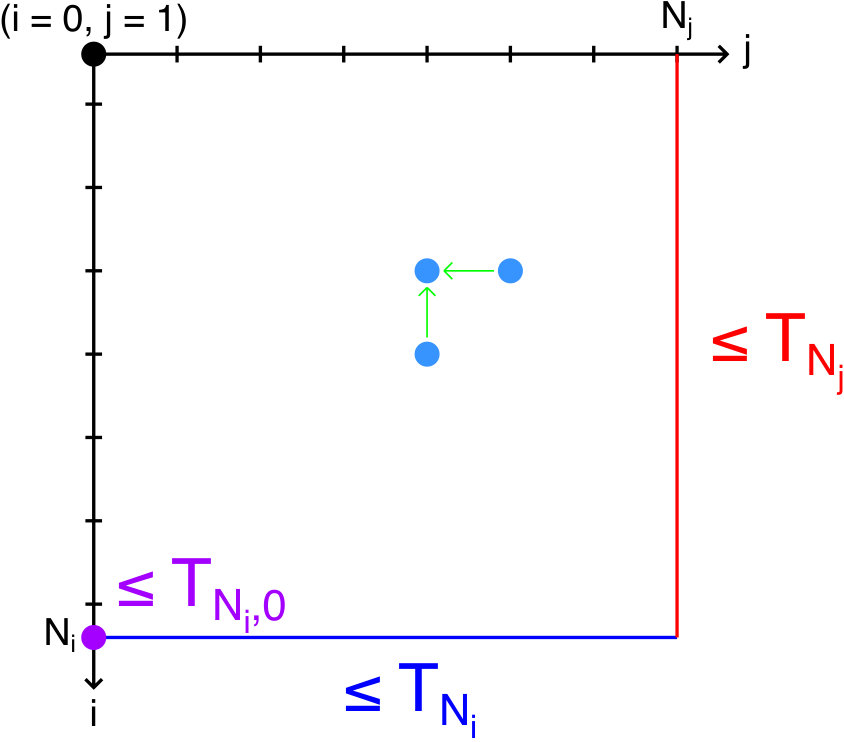 Figure 1
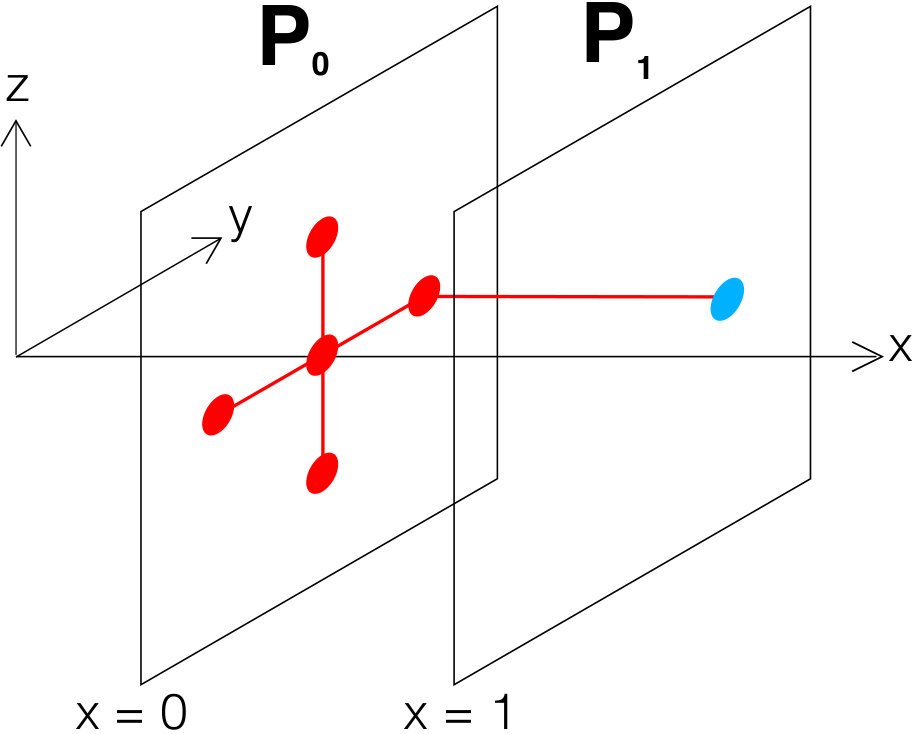 Figure 2
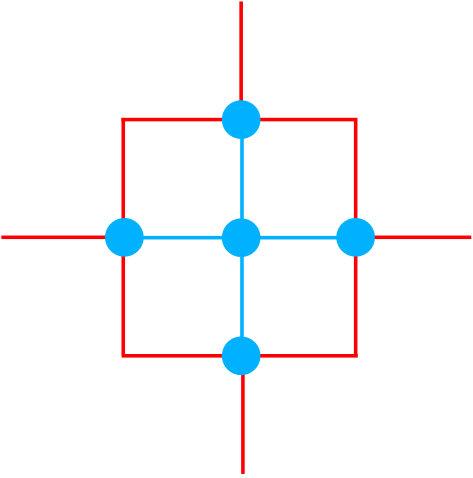 Figure 3
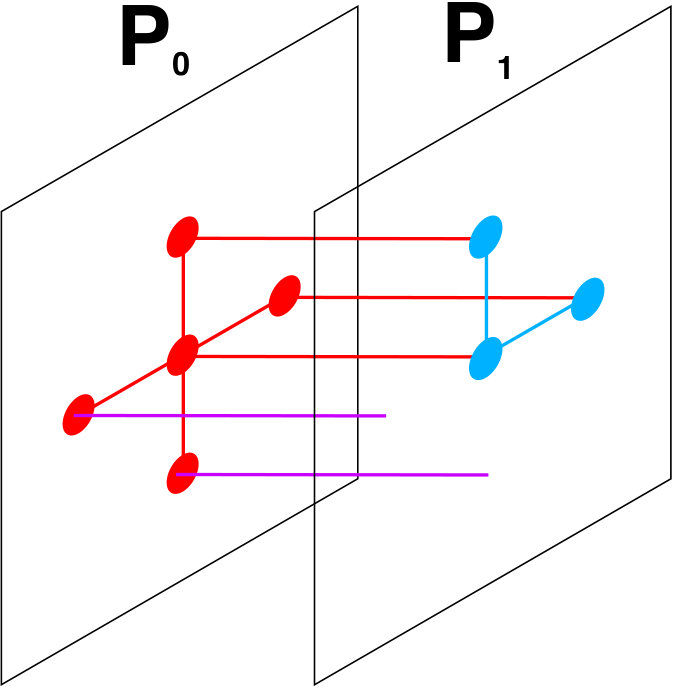 Figure 4
Peer Reviews
No public reviews on file for this paper yet. If you reviewed it on a platform where reviews are public (OpenReview, ICLR, NeurIPS, ICML), you can paste yours below so the community can read it here.
Code & Models
Videos
No videos yet. Explain this paper in a talk, walkthrough, or lecture? Add one.
Dimension improvement in Dhar’s refutation of the Eden conjecture
Quentin Bertrand & Jules Pertinand
(May 2017)
Abstract
We consider the Eden model on the -dimensional hypercubical unoriented lattice, for large . Initially, every lattice point is healthy, except the origin which is infected. Then, each infected lattice point contaminates any of its neighbours with rate . The Eden model is equivalent to first passage percolation, with exponential passage times on edges. The Eden conjecture states that the limit shape of the Eden model is a Euclidean ball.
By pushing the computations of Dhar [5] a little further with modern computers and efficient implementation we obtain improved bounds for the speed of infection. This shows that the Eden conjecture does not hold in dimension superior to (the lowest known dimension was ).
1 The Eden model: definitions and previous results
We consider the first passage percolation on a -dimensional hypercubical unoriented lattice ([2]) as stated in [3]. Let be a family of i.i.d random variables, with exponential law of parameter . Let n . For a path : of neighbouring vertices, we define the passage time along : . The family defines a random distance,
[TABLE]
For all we set . Richardson (1973) and Cox-Durett (1981) have shown that there exists a compact convex such that for all
[TABLE]
Eden conjectured that this limit form was a Euclidean ball in every dimension.
For all we note the hyperplane of equation in dimension . We note the origin of the hypercube. Observe that is the distance between the origin and the hyperplan . Cox-Durrett, Hammersley and Welsh ([6]) have shown that with probability 1 , for a certain , and moreover that
[TABLE]
Dhar ([Dha88]) obtained numerical upper bounds on for small and valid for any . This yields good upper bounds for . Due to computer limitations, Dhar was not able to use his method in 1988 for . The aim of this letter is to detail how to extend his computations, and how to compute efficiently new upper bounds for .
For all we note the hyperplane . Observe that is chosen so that it is at the same Euclidean distance from as . Therefore, if the Eden conjecture were true, one would have . For the same reasons as before exists and thus we can define as . Couronné, Enriquez and Gerin ([3]) found an numerical lower bound on (in fact, the same result also appears in a different form in [4]):
[TABLE]
This means that a lower bound on the time of infection along the diagonal has been found. By combining his results with Dhar, [3] showed that , and thus that the limit shape of the infection is not an euclidean ball in dimension . In this letter we extend Dhar’s method and use [3] lower bound to prove that .
Theorem 1**.**
. In particular the limiting shape is not an Euclidean ball, and the Eden conjecture is false in dimension 22.
2 Dhar’s strategy for
Idea Since we will push Dhar’s strategy a little further, we first detail the idea introduced in [5]. To compute an upper bound for , Dhar slightly modifies the model and considers a unidirectional infection. This means that a site in can only contaminate its neighbours in and . We note the time of infection from to the plan by the unidirectional infection. It is clear that this infection spreads more slowly than the original model, and therefore we obtain for every
[TABLE]
From now on, we only consider the model of unidirectional infection in our computations.
2.1 Notations
We consider a -dimensional infection. Let be the expected waiting time before the infection reaches starting from an infected cluster in (and the other sites are healthy). For a cluster of sites, we define its set of perimeter edges (see Figure 1). As stated in [5] we have
[TABLE]
For an edge such that and , we set (i.e. is the endpoint of which is not in ). We define .
2.2 Recursive inequality
Let be the time at which the first contamination occurs. At time , a site in cluster contaminates either one of its neighbours in or one of its neighbours in (see figure 2). The total number of such "susceptible" sites is given by , it follows that where ’s are i.i.d. passage times, i.e. is distributed as an exponential r.v. with mean . Using the same argument we have:
[TABLE]
At time , the new infected site is uniformly distributed among the possibilities. If then . If , then the infection goes on, starting from configuration . Because of the memoryless property of the exponential distribution, we have the Markov property
[TABLE]
Therefore we obtain
[TABLE]
We have
[TABLE]
The right-hand side is decreasing in and thus
[TABLE]
which is inequality (8) in [5] (note a small misprint in Dhar’s inequality (8)). This recursive inequality and a rough bound on leads to a tight bound on :
[TABLE]
The numerical results for the bound on can be found in subsection 4.2, page 4.2.
3 An upper bound for
Idea We consider the same unidirectional infection. We still use but now we found bounds for considering a starting cluster not just in but in .
3.1 Upper bound on
We consider an modified infection starting with starting clusters with sites and with sites. For we note the set of perimeter edges connecting the cluster to the rest of the plan see Figure 1. Similarly to the previous section, we define and
[TABLE]
Le be the set of edges from to healthy sites in (see figure 3). Clearly, . On the other hand, is minimal when is exactly in front of : therefore .
Using the same method that in the previous section we have
[TABLE]
This leads to
[TABLE]
Like in the previous section the right hand-side of the inequality is decreasing in the variables and (the proof is in annex). Morover and . This leads to
[TABLE]
And by taking the maximum of in the set it leads to
[TABLE]
With the recursion inequality 9. It is now possible to recursively compute an upper bound on .
3.2 Boundary conditions
The computation is also done backwards. For initialization, we use the upper bounds for that we obtained in the previous section.
As shown in Fig. 4 we roughly bound borders and then appply the backward inequation 9:
[TABLE]
The last inequality is obtained by considering the disjoint paths for in . The length of each such path is the sum of two independent exponential r.v., i.e. a Gamma(2,1). The numerical results can be found in subsection 4.2, page 4.2.
3.3 Expansion to
Using the same technique, we can compute the upper bound for all .We have to dynamically fill a n-dimensionnal array which remains reasonnably time consuming for . We still get initialising bounds with the previous calculation and the straight forward paths to .
For we obtain a dynamic equation of level 3 with the following bounding conditions:
[TABLE]
For the numerical computations of and , the method is the same. We did not go any further in the calculus because filling the hypercube began to be very time consuming. The numerical results can be found in subsection 4.2, page 4.2.
4 Implementation and numerical results
4.1 Numerical Tricks
Sensitivity to boundary data. To get the upper bound of , one can see from the dynamic equations that we use the previously computed for to initialize the boundary of the hypercube. We saw numerically that the resulting upper bound is very sensitive to this initialisation. With a better precision of this boundary data, we get far better upper bounds.
Choice of parameters , . We used this property to efficiently chose the size of the box. It’s more efficient to put the computational effort on boundary data than on the recursion. For instance, imagine we want to compute the upper bound on . We have recursion with order 3, and limit conditions involving the calculus of . To compute the bound on we may want to build a box to fill it. But we can obtain faster results by filling a box, and using a box to compute the limits-condition .
4.2 Numerical results
We did the implementation for the computation of the bounds on in C++ 111https://github.com/QB3/Dimension-improvement-in-Dhar-s-refutation-of-the-Eden-conjecture . Using this code we obtained the following results:
[TABLE]
4.3 Future work
We focused on and did not work at all on . But in order to prove the conjecture wrong in dimension 2 bounds on and need to be improved. Indeed Monte-Carlo simulations ([1]) give and . To improve Dhar suggested us a trick: if then it can easily be shown that . This lead to a slightly different recursion inequality on a bound for which allowed us to catch the dimension . Unfortunately neither Dhar or us finaly managed to find a correct proof of .
Acknowledgements
We would like to thank Lucas Gerin for introducing us to the subject. He kindly guided us through this project, and took time to answer all our questions. We warmly thank Deepak Dhar for his precious help and the huge amount of time he spent for us.
Appendix A Annex
**Goal: ** prove that
[TABLE]
is decreasing in and
We proved that: Thus
The maximization is over a finite set, this means that there exists , and such that
We can rewrite the inequality as:
It follows And then
However we know that this means that
Let now study the function
is monotone, tends to [math] when goes to infinity moreover we proved that there exists such that . This proves that f is decreasing. We can replace by a lower bound on it: . This leads to
We can use exactly the same trick to prove that can be replaced by a lower bound:
The reference list from the paper itself. Each links out to its DOI / PubMed record.
- 1AD [15] Sven Erick Alm and Maria Deijfen. First passage percolation on ℤ 2 superscript ℤ 2 \mathbb{Z}^{2} : A simulation study. Journal of statistical physics , 161(3):657–678, 2015.
- 2ADH [15] Antonio Auffinger, Michael Damron, and Jack Hanson. 50 years of first passage percolation. ar Xiv preprint ar Xiv:1511.03262 , 2015.
- 3CEG [11] Olivier Couronné, Nathanaël Enriquez, and Lucas Gerin. Construction of a short path in high-dimensional first passage percolation. Electronic Communications in Probability , 16:22–28, 2011.
- 4Dha [86] Deepak Dhar. Asymptotic shape of eden clusters. In On growth and form , pages 288–292. Springer, 1986.
- 5Dha [88] Deepak Dhar. First passage percolation in many dimensions. Physics Letters A , 130(4-5):308–310, 1988.
- 6HW [65] John M Hammersley and DJA Welsh. First-passage percolation, subadditive processes, stochastic networks, and generalized renewal theory. In Proc. Internat. Res. Semin., Statist. Lab., Univ. California, Berkeley , pages 61–110. Springer, 1965.
