Zero mass limit of Kerr spacetime is a wormhole
Gary W. Gibbons, Mikhail S. Volkov

TL;DR
This paper demonstrates that the zero mass limit of Kerr spacetime results in a non-trivial, locally flat wormhole with a singularity, challenging the common assumption that it reduces to flat Minkowski space.
Contribution
It reveals that the zero mass Kerr spacetime is a wormhole with a negative tension ring, not flat space, and extends this interpretation to Kerr-(anti)-de Sitter spacetimes.
Findings
Zero mass Kerr spacetime is a wormhole, not flat space.
The limiting spacetime has two asymptotic regions and a curvature singularity.
The interpretation extends to Kerr-(anti)-de Sitter spacetimes.
Abstract
We show that, contrary to what is usually claimed in the literature, the zero mass limit of Kerr spacetime is not flat Minkowski space but a spacetime whose geometry is only locally flat. This limiting spacetime, as the Kerr spacetime itself, contains two asymptotic regions and hence cannot be topologically trivial. It also contains a curvature singularity, because the power-law singularity of the Weyl tensor vanishes in the limit but there remains a distributional contribution of the Ricci tensor. This spacetime can be interpreted as a wormhole sourced by a negative tension ring. We also extend the discussion to similarly interpret the zero mass limit of the Kerr-(anti)-de Sitter spacetime.
Click any figure to enlarge with its caption.
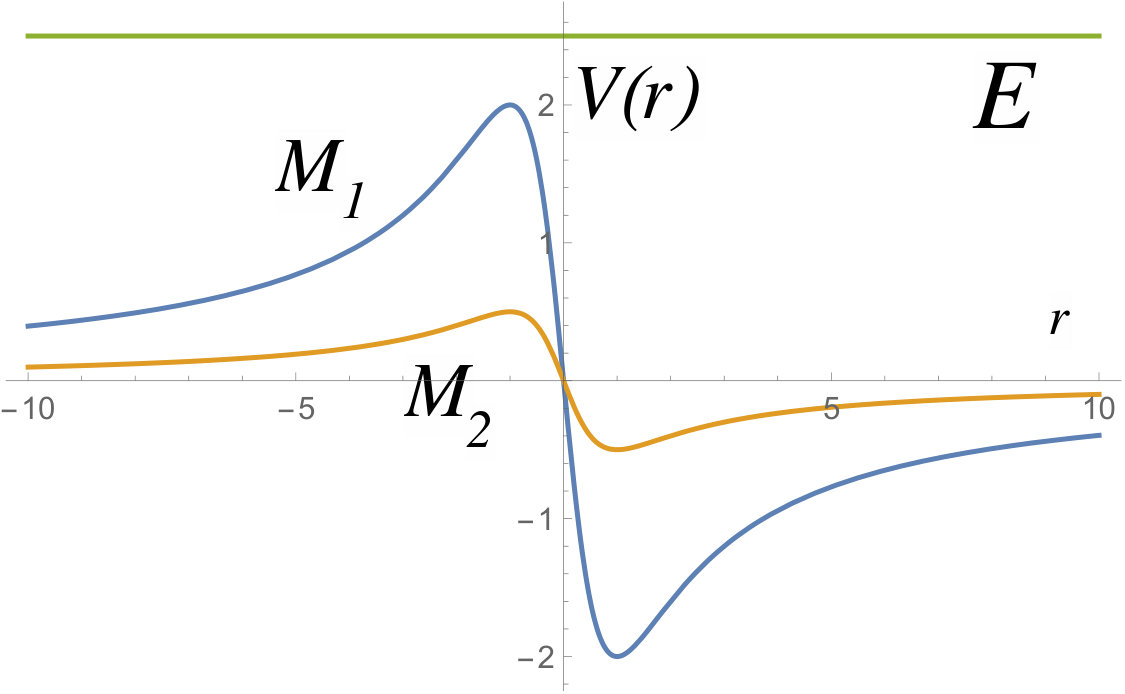 Figure 1
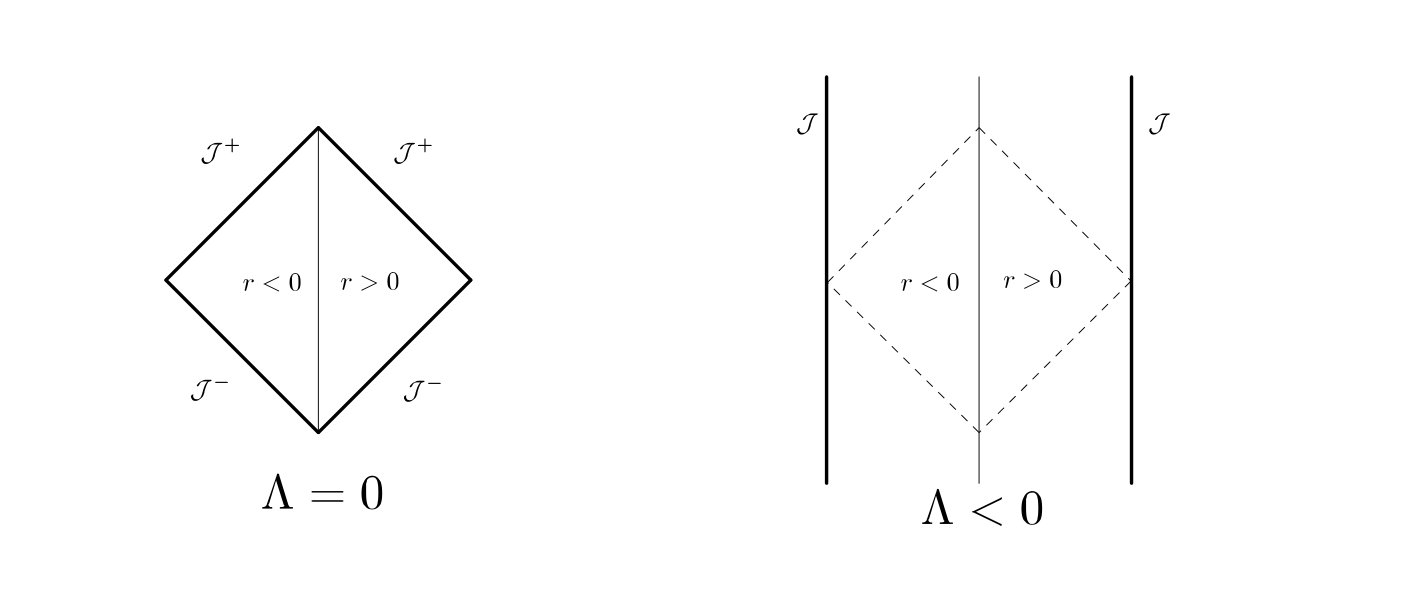 Figure 2
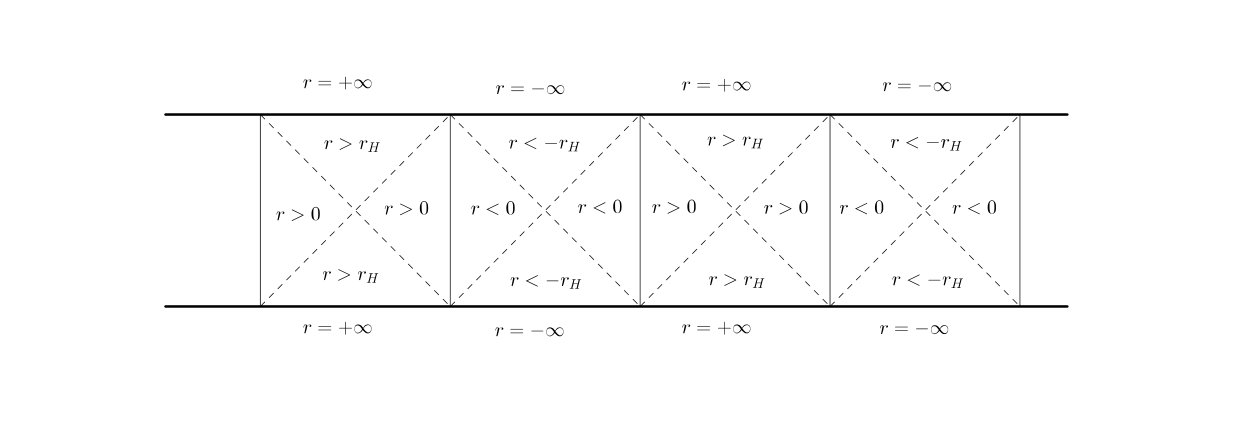 Figure 3
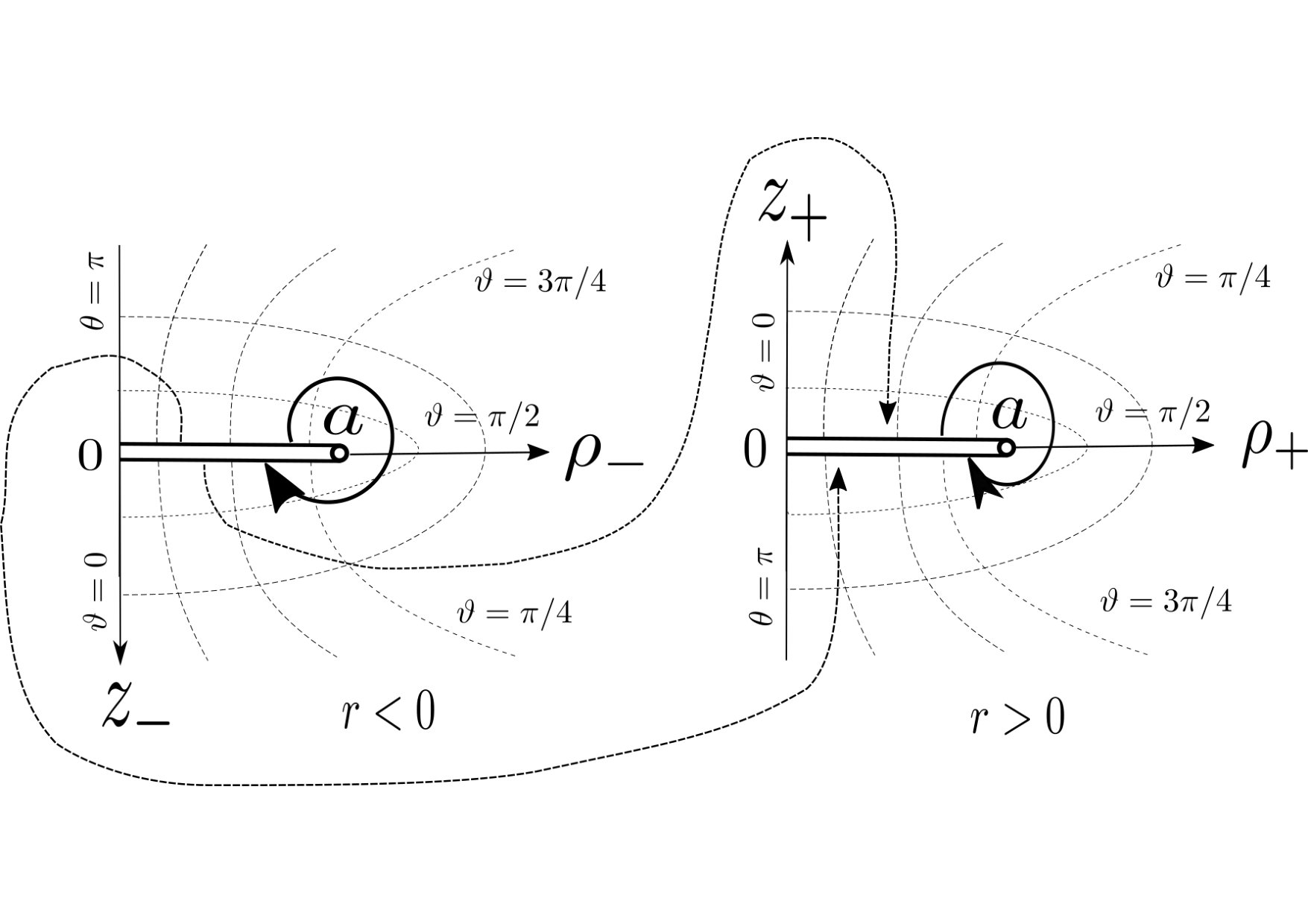 Figure 4
Peer Reviews
No public reviews on file for this paper yet. If you reviewed it on a platform where reviews are public (OpenReview, ICLR, NeurIPS, ICML), you can paste yours below so the community can read it here.
Videos
No videos yet. Explain this paper in a talk, walkthrough, or lecture? Add one.
Zero mass limit of Kerr spacetime is a wormhole
Gary W. Gibbons
DAMTP, University of Cambridge, Wilberforce Road, Cambridge CB3 0WA, UK
Laboratoire de Mathématiques et Physique Théorique CNRS-UMR 7350,
Université de Tours, Parc de Grandmont, 37200 Tours, France
Mikhail S. Volkov
Laboratoire de Mathématiques et Physique Théorique CNRS-UMR 7350,
Université de Tours, Parc de Grandmont, 37200 Tours, France
Department of General Relativity and Gravitation, Institute of Physics,
Kazan Federal University, Kremlevskaya street 18, 420008 Kazan, Russia
Abstract
We show that, contrary to what is usually claimed in the literature, the zero mass limit of Kerr spacetime is not flat Minkowski space but a spacetime whose geometry is only locally flat. This limiting spacetime, as the Kerr spacetime itself, contains two asymptotic regions and hence cannot be topologically trivial. It also contains a curvature singularity, because the power-law singularity of the Weyl tensor vanishes in the limit but there remains a distributional contribution of the Ricci tensor. This spacetime can be interpreted as a wormhole sourced by a negative tension ring. We also extend the discussion to similarly interpret the zero mass limit of the Kerr-(anti)-de Sitter spacetime.
I Introduction
In the recent work Gibbons and Volkov (2016, 2017) we studied wormholes obtainable from vacuum Weyl metrics via duality rotations. One of our findings were wormholes with locally flat geometry described by the line element (2.4) below (where ) and sourced by singular rings of negative tension. Such solutions can be viewed as a particular case of the “loop based wormholes” obtained by surgeries and identifications performed on Minkowski space Visser (1996). In this note we show that the same solutions can also be obtained by taking the zero mass limit of the Kerr spacetime.
It is usually argued in the literature (see for example Landau and Lifshitz (1975); Visser (2007)) that taking the Kerr black hole mass to zero reduces the curvature to zero hence yielding flat Minkowski space. Indeed, the Kerr geometry becomes locally flat in this limit. However, it cannot be globally flat and topologically trivial because it inherits from the original Kerr geometry the non-trivial topology with two asymptotic regions. At the technical level, this means that the radial coordinate in the metric spans a line and not a half-line. It follows that, although the Weyl part of the curvature vanishes when , the curvature also contains a distributional Ricci part supported by the ring which does not vanish in the limit. This can be interpreted as an effect of the matter source – a ring made of a cosmic string with a negative tension. The geometry outside the ring is locally flat and has two asymptotic regions connected by a throat – the disk encircled by the ring.
In what follows we first describe how the locally flat wormholes can be obtained via analytic continuation and then discuss the relation to the Kerr metric.
II Flat space in oblate spheroidal coordinates
Let us consider Minkowski metric,
[TABLE]
and pass first to the cylindrical coordinates with , , so that
[TABLE]
and then further transform to the oblate spheroidal coordinates by setting
[TABLE]
where , . This gives
[TABLE]
The Jacobean of the coordinate transformation
[TABLE]
vanishes at , hence for
[TABLE]
This corresponds to a ring of radius in the equatorial plane. As a result, the coordinates cover the whole of Minkowski space, excluding the -axis and the ring. The coordinate singularity on the axis may be treated in the standard way and we shall discuss it no further. Let us consider the coordinate singularity at the ring. One has
[TABLE]
hence lines of constant are oblate (half)-ellipses in the plane, orthogonal to them are hyperbolas of constant (see Fig.1). In the limit the ellipses shrink to the segment of the -axis,
[TABLE]
whereas the coordinate is discontinuous across the segment since
[TABLE]
This can be understood as follows. The inverse coordinate transformation ,
[TABLE]
has a branch point at and the segment (2.8) corresponds to the branch cut position. Choosing only one branch of the square root, its real part is non-negative but the imaginary part is then necessarily discontinuous across the cut.
As a result, the coordinates are discontinuous at the disk of radius in the equatorial plane. A timelike geodesic along the -axis, which is simply a straight line in the coordinates, is described in the coordinates by
[TABLE]
where are the particle energy, mass, and proper time, respectively. Since should be non-negative, one is bound to choose opposite signs in front of and also different values of (either [math] or for this geodesic) at the opposite sides of the disk. As a result, is not smooth while is discontinuous across the disk.
III Wormhole via analytic extension
The metric (2.4) can be geodesically extended to negative values of . Indeed, if is allowed to become negative, then there is no need to change sign in front of in (2.11) across the disc, hence is smooth. As we shall see in a moment, there is no need either to require that jumps. Therefore, the geodesics analytically continue from to the region. This applies not only to geodesics along the -axis but to all geodesics which do not hit the ring . As a result, the metric in (2.4) naturally extends to .
When expressed in the coordinates, the metric is still manifestly flat and is given by (2.2), but the speciality now is that the coordinate transformation (2.3) is no longer bijective. Since and map to the the same , it follows that when and span all their values, and will span all their values twice. Therefore, one needs two charts to cover the spacetime, let us call them and . In each chart the metric has the form (2.2), but one has
[TABLE]
hence one chart spans the Riemann sheet where , the other chart spans the sheet where , while together they span the whole of the Riemann surface. Each Riemann sheet has a branch cut along the segment (2.8) and the two sheets are glued to each other along the cuts by identifying the upper side of one cut with the lower side of the other and vice versa (see Fig.1). The -coordinate then changes continuously when passing from one chart to the other while the -coordinate simply passes through zero and changes sign.
As a result, the spacetime actually consistes of two copies of glued together through the disk, hence this is a wormhole with two asymptotic regions. The geometry is locally flat and the curvature is locally zero, but not globally since the ring at now supports a physical singularity of the curvature. To see this one notices that a contour around the branch point in the chart does not close after a revolution of but continues to the chart and only after a second revolution of returns to the original chart to close. As a result, the total angle increment is , therefore there is a negative angle deficit of and hence the conical singularity of the curvature at the ring.
One arrives at the same conclusion using the coordinates. Introducing and , the metric (2.4) reduces for small to
[TABLE]
where . Since , the metric contains a conical singularity at stretching along the azimuthal -direction (see Sokolov and Starobinsky (1977) for an account of “bent” conical singularities). This curvature singularity can be interpreted as that corresponding to a matter source – a ring made of infinitely thin cosmic string with negative tension Gibbons and Volkov (2016, 2017)
[TABLE]
The ring “cuts a hole” in spacetime and acts as a “gate” connecting the universe and the universe. To create a ring wormhole of one metre radius one needs a negative energy equivalent to the mass of Jupiter (see Gibbons and Volkov (2016, 2017) for further details).
IV Zero mass limit of Kerr spacetime
Summarising the above discussion, depending on the choice of range of the radial coordinate, the same metric (2.4) describes either flat Minkowski space or the wormhole with locally flat geometry. Let us now see that the latter can also be obtained from the Kerr spacetime by taking the black hole mass to zero.
Consider the Kerr metric Kerr (1963) expressed in Boyer-Lindquist coordinates Boyer and Lindquist (1967),
[TABLE]
As is well known Carter (1968a), the radial coordinate here can be both positive or negative, , and there are two asymptotic regions corresponding to (see Adamo and Newman (2014); Heinicke and Hehl (2014); Teukolsky (2015) for recent reviews of the Kerr metric). The black hole mass has opposite signs when viewed from these two regions. The curvature invariant
[TABLE]
diverges at , that is at , which corresponds to a ring in the equatorial plane. The singularity is shielded by the horizon if and is naked if .
The geodesics which do not belong to the equatorial plane miss the ring singularity and pass from the region to the region. For example, a timelike geodesic along the symmetry axis is described by
[TABLE]
where . The potential is attractive for and repulsive for and is perfectly regular at (see Fig.2). If is larger than the maximal value of the potential, , then interpolates over the whole range, .
Let us fix and take the limit . The potential then uniformly tends to zero letting the particle move freely in the interval . The Kerr metric (IV) reduces in this limit precisely to (2.4) and describes, since , the locally flat wormhole and not flat Minkowski space as is usually assumed in the literature.
A remark is in order here. As was discussed above, the geometry (2.4) is locally flat, but this fact alone is not sufficient to determine its global structure and one needs in addition to specify the range of the radial coordinate . If one is interested in a local geometry in an open set, for example for , then it is correct to say that the limit of the Kerr metric is flat. However, one is not free to choose the spacetime topology when one takes the limit. The original Kerr spacetime contains two asymptotic regions and the geodesics interpolating between them sweep the total interval, . These properties should hold also for , hence the topology is non-trivial in this limit and corresponds to the wormhole described above. This spacetime still contains a curvature singularity.
In fact, the existence of curvature singularity for was emphasised already by Carter in Carter (1968a) (between Eqs.(4,5) of that paper) by saying that in the special case where vanishes “there must still be a curvature singularity at , although the metric is then flat everywhere else”. Specifically, the curvature consists of the Weyl part and Ricci part. The Weyl part vanishes as as seen from (4.16), while the Ricci tensor is zero outside the singularity since the metric is vacuum. However, the Ricci tensor is still allowed to have a non-zero value at the singularity, even in the limit. Indeed, as we have seen above, the metric (2.4) has the conical singularity at the ring, hence the Ricci tensor has a delta-function structure with the support at the ring. This is the descendant of the black hole ring singularity for .
Another way to illustrate the same thing is to return to a finite value of and express the Kerr metric in Kerr-Schild coordinates Kerr and Schild (1965) related to Boyer-Lindquist coordinates in (IV) via
[TABLE]
where
[TABLE]
which yields
[TABLE]
One notices that in these formulas are related to precisely as in (2.3), therefore the discussion of Section III applies literally. It follows that, since , one needs two Kerr-Schild charts and to cover the manifold. Each chart has a branch cut at , , and to analytically continue from one chart to the other one identifies the upper side of one cut with the lower side of the other and vice versa. These facts are identical to those described in Section III, but they are described also in the Hawking-Ellis book Hawking and Ellis (2011) discussing in Section 5.6 the structure of the supercritical Kerr spacetime. Figure 27 in that book shows how the two charts are glued through the cuts, and it is precisely the same as our Fig.1.
This shows that the conical singularity is present already for . Indeed, a contour around the core of the ring singularity passes from one Kerr-Schild charts to the other and then back to close, hence the total angle increment is (the terms in the second line in (4.20) do not influence this result if the contour is vanishingly small). Therefore, the ring source of the Kerr metric supports, apart from the power-law singularity of the Weyl part of the curvature, also the distributional singularity of the Ricci part of the curvature. The former disappears in the limit but the latter remains. The part of the Kerr source that vanishes for was computed in Israel (1977), while the non-vanishing part corresponds to the negative tension ring.
Finally we recall that the Kerr spacetime with contains closed timelike curves (CTC) Carter (1968a). This is a consequence of the fact that the component of the metric (IV),
[TABLE]
becomes negative in the region close to the ring, hence closed orbits of the vector become timelike. These CTC’s can be deformed to pass through any point of the spacetime Carter (1968a). However, if then is positive and the problem does not arise.
V Locally (anti)-de Sitter wormholes
As an application, we consider the generalisation of the above analysis for a non-vanishing cosmological constant. For one cannot use the Weyl formulation originally applied in Gibbons and Volkov (2016, 2017) to construct wormholes. However, one can consider the limit of the Kerr-(anti)-de Sitter ((A)dS) metric Carter (1973) expressed in oblate spheroidal coordinates similar to those used in (2.4) Akcay and Matzner (2011),
[TABLE]
assuming that . For this metric reduces to (2.4). For it is singular at the ring , similarly to (2.4). The metric is regular everywhere else (away from the symmetry axis) if , while for it is regular (and static) only for . The coordinate transformation with
[TABLE]
brings the metric to the standard (A)dS form,
[TABLE]
If the radial coordinate in (V) changed in the interval then the coordinate transformation (5.23) would be bijective and the geometry (V) would be globally (A)dS. The ring at would then correspond to a coordinate singularity. However, the geometry (V) inherits the global structure of the original Kerr-(A)dS geometry, hence . As a result, the geometry is only locally (A)dS and interpolates between two (A)dS regions connected through the throat – the disk encircled by the ring at . The ring itself supports a curvature singularity whose existence is revealed by considering a closed contour in the plane spanned by and . The arguments similar to those used around (3.13) show that the winding angle increases up to , hence there is a conical singularity of the Ricci tensor. This can be interpreted as a cosmic string loop with the negative tension .
Summarising, the zero mass limit of the Kerr-(A)dS metric (V) describes a wormhole supported by a negative tension ring whose geometry is locally (A)dS. For it reduces to the locally flat wormhole (2.4). Below we describe some properties of the geometry (V).
V.1 Structure of wormholes with and
The global structure of wormholes is simple for or . They connect through the disk either two copies of Minkowski space or two copies of AdS space, respectively. Considering for simplicity geodesics following the symmetry axes with , the conformal diagrams of subspaces spanned by these geodesics are shown in Fig.3.
The diagram of the solution is made of two copies of the Minkowski space conformal diagram, one for and the other for . The copies are joined across the history of the disk at (the disk is represented by one point, ). Similarly, the diagram for the AdS wormhole consists of two copies of the AdS diagram with the timelike boundary .
V.2 Structure of wormhole with
The global structure of the wormhole is more complex. The wormhole then connects through the disk at de Sitter regions with and with cosmological horizon at to those with and with cosmological horizons at . As shown in Fig.4, this gives rise to an infinite sequence of alternating and regions. This diagram can be obtained by considering the Kruskal extension, however, one can apply a much simpler method just to see that the diagram is periodic.
Restricting to the region(s) where and setting
[TABLE]
the metric (V) becomes
[TABLE]
The wormhole throat is placed where while the cosmological horizon is at . The advantage of this parameterization is that the range of the radial coordinate can be analytically extended to the whole line , the metric coefficients then becoming periodic functions of . This explains the periodicity of the spacetime diagram in Fig.4 containing an infinite sequence of wormhole throats at and “Einstein-Rosen bridges” at . However, the coordinates used in (V.2) are not global and cover only the interior of the diamonds in Fig.4.
V.3 Separation of variables in the wave equation
As a last remark, returning to (V), we notice that coordinates used in this metric allow one to separate the variables in the Klein-Gordon equation
[TABLE]
For this is not surprising since the variables in the wave equation (and in the the Hamilton-Jacobi equation Pretorius and Israel (1998)) separate in flat space expressed in the spheroidal coordinates. The variables separate also for if the metric is expressed in Boyer-Lindquist coordinates Carter (1968b); Chong et al. (2005), but it is not immediately obvious that they separate in spheroidal coordinates. However, setting we find that (5.27) reduces to
[TABLE]
where is the separation constant determined by the condition of regularity of .
VI Conclusions
To summarize, we have shown that the zero mass limit of the Kerr spacetime is not flat Minkowski space as is usually assumed but a locally flat static wormhole spacetime containing a conical singularity of the Ricci tensor along a ring. This singularity can be interpreted as an effect of a singular matter source – a negative tension cosmic string loop. Similarly, the zero mass limit of the Kerr-AdS or Kerr-de-Sitter spacetime is a locally (A)dS wormhole supported by a negative tension ring. This yields probably the simplest way to construct wormholes – by taking limits of the known metrics.
As a final remark, we notice that the Kerr spacetime can be “mutilated” and restricted to the region by introducing an additional matter source distributed over the disk encircled by the ring singularity Israel (1970). The limit of such “mutilated” spacetime would be flat Minkowski space. The limit of the full Kerr spacetime is the wormhole.
Acknowledgements
We are indebted to Gérard Clément for his remark about similarity of our wormhole metric (2.4) with the zero mass Kerr metric, which initiated our study. G.W.G. thanks the LMPT for hospitality and acknowledges the support of “Le Studium” – Institute for Advanced Studies of the Loire Valley. M.S.V. was partly supported by the Russian Government Program of Competitive Growth of the Kazan Federal University.
The reference list from the paper itself. Each links out to its DOI / PubMed record.
- 1Gibbons and Volkov (2016) G. W. Gibbons and M. S. Volkov, Phys.Lett. B 760 , 324 (2016) , ar Xiv:1606.04879 [hep-th] . · doi ↗
- 2Gibbons and Volkov (2017) G. W. Gibbons and M. S. Volkov, JCAP 1705 , 039 (2017) , ar Xiv:1701.05533 [hep-th] . · doi ↗
- 3Visser (1996) M. Visser, Lorentzian wormholes: From Einstein to Hawking (AIP, 1996) p. 412.
- 4Landau and Lifshitz (1975) L. Landau and E. Lifshitz, The Classical Theory of Fields , Course of theoretical physics (Butterworth-Heinemann, 1975).
- 5Visser (2007) M. Visser, in Kerr Fest: Black Holes in Astrophysics, General Relativity and Quantum Gravity Christchurch, New Zealand, August 26-28, 2004 (2007) ar Xiv:0706.0622 [gr-qc] .
- 6Sokolov and Starobinsky (1977) D. D. Sokolov and A. A. Starobinsky, Sov.Phys. Doklady 22 , 312 (1977).
- 7Kerr (1963) R. P. Kerr, Phys. Rev. Lett. 11 , 237 (1963) . · doi ↗
- 8Boyer and Lindquist (1967) R. H. Boyer and R. W. Lindquist, J. Math. Phys. 8 , 265 (1967) . · doi ↗